


9,14 €
Mehr erfahren.
- Herausgeber: Amber Books Ltd
- Kategorie: Geisteswissenschaft
- Serie: Landscape History
- Sprache: Englisch
“When everyone had had plenty to eat and drink they called for the gladiators. The moment anyone’s throat was cut, they clapped their hands in pleasure. And it sometimes even turned out that someone had specified in their will that the most beautiful women he had purchased were to fight each other….”
– Athenaeus, The Learned Banqueters
With their origins as blood rites staged at the funerals of rich aristocrats, gladiatorial combat is one of the defining images of ancient Rome. For more than 600 years, people flocked to arenas to watch these highly trained warriors participate in a blood-soaked spectacle that was part sport, part theatre and part cold-blooded murder. Gladiatorial contests were a spectacular dramatization of the Roman emperor’s formidable power.
Gladiator looks at life and service in the Roman arenas from the origins of the games in the third century BCE through to the demise of the games in the fifth century CE. It explores the lives of the prisoners of war, criminals, slaves and volunteers who became gladiators, their training, and the more than 20 types of gladiator they could become, fighting with different types of weapons.
From Spartacus’s slave revolt to the real Emperor Commodius who liked to play at being a gladiator, from female gladiators to the great combats involving hundreds of exotic animals, Gladiator is a colourful, accessible study of the ancient world’s famous warrior entertainers.
Das E-Book können Sie in Legimi-Apps oder einer beliebigen App lesen, die das folgende Format unterstützen:
Seitenzahl: 292
Veröffentlichungsjahr: 2015
Ähnliche


















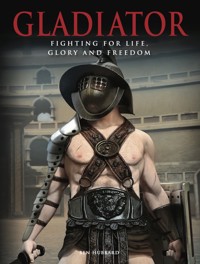
GLADIATOR
FIGHTING FOR LIFE, GLORY AND FREEDOM
BEN HUBBARD
This digital edition first published in 2015
Published by Amber Books Ltd United House North Road London N7 9DP United Kingdom
Website: www.amberbooks.co.uk Instagram: amberbooksltd Facebook: amberbooks Twitter: @amberbooks
Copyright © 2015 Amber Books Ltd
ISBN: 978-1-78274-278-4
All rights reserved. With the exception of quoting brief passages for the purpose of review no part of this publication may be reproduced without prior written permission from the publisher. The information in this book is true and complete to the best of our knowledge. All recommendations are made without any guarantee on the part of the author or publisher, who also disclaim any liability incurred in connection with the use of this data or specific details.
www.amberbooks.co.uk
CONTENTS
INTRODUCTION
ORIGINS
THE EMPERORS’ GAMES
THE GLADIATORS
TYPES OF GLADIATORS
A DAY AT THE GAMES
THE DECLINE OF THE GAMES
GLOSSARY
BIBLIOGRAPHY
SELECTED ROMAN EMPERORS: DATES OF RULE
INDEX
PICTURE CREDITS
Introduction
The gladiatorial games lay at the centre of Roman life. Citizens flocked to their local amphitheatre to be entertained by animal hunts, public executions and gladiators fighting to the death. Thousands died during large and lavish games that sometimes lasted for weeks on end. However, these festivals of killing were not unusual for those attending – it was simply a part of being Roman. The history of the gladiators is inextricably linked with the story of Rome and its Emperors. At the peak of Rome’s Imperial age, Emperors provided games on an increasingly extravagant scale. They spared no expense in entertaining the public and showing off Rome’s power and dominion over man and beast.
The Spectacle of Death
Exotic animals such as elephants, crocodiles and rhinoceroses were imported from foreign shores to be slaughtered in front of the crowd. In the amphitheatre, harmless herbivores were let loose among large forest sets before being hunted down and killed en masse.
Other more dangerous animals such as bulls and bears were chained together and forced to fight. Men with spears dispatched panthers, lions and tigers and were, in turn, often torn apart by these dangerous predators. Wild animals were also set onto enemies of state, who were sometimes nailed upside down to a cross. Others were also crucified after first being dressed in tunics covered with pitch; after being nailed to the cross they were set alight. Thousands of Christians executed in this way were used as human torches to illuminate the games held by Emperor Nero. Nero was a great supporter of the gladiatorial spectacles and fond of inventing storylines for the public executions. On one occasion he dressed a man like the mythological figure Daedalus and flew him across the arena on wires to be devoured by bears. Nero even entered the arena himself, sometimes dressing in the skin of a wild animal and attacking the genitals of men and women tied to stakes.
Other emperors also had an appetite for the blood of the amphitheatre: Claudius liked watching the expressions of gladiators as they died; Caligula enjoyed forcing the sick, elderly and disabled to fight to the death. Commodus actually fought in the Colosseum as a gladiator. The Emperor dressed in the skin of a lion, carried a club and likened himself to the mythical demigod Hercules. He also called himself one of the greatest gladiators who had ever lived.
A third century BCE funerary relief created by ‘Ammias of Araxios’, in memory of her husband, a gladiator.
The animal hunts or venationes, shown in this relief, made up the morning event of a gladiatorial spectacle.
An emperor’s participation at a gladiatorial spectacle was an important part of his relationship with his people. Many got it wrong.
However, his bouts in the arena were a farce, as both the Emperor and his opponent were only ever armed with wooden swords. It was only behind his closed palace doors that Commodus used a steel blade, where he often cut the noses and ears off his sparring partners while practising his swordplay.
Commodus’ antics in the arena made him a laughing-stock with the public and the Roman Senate. The games were an Emperor’s gift to his people, but they were also a time when he had to judge his participation carefully. A clever Emperor would enjoy the games as an enthusiastic spectator but also maintain his royal dignity. Tiberius got it wrong by not showing up to the games at all; Commodus, on the other hand, took it too far. He sealed his ignominious end by announcing he would inaugurate the year 193 CE dressed as a gladiator.
Plebeians and Patricians
The games were attended by both rich and poor and the amphitheatre was a microcosm of Roman society: wealthy citizens known as Patricians sat nearest the arena floor, dressed in white togas; other, lesser citizens called Plebeians sat above them in their colourful tunics. The amphitheatre was a great amplifier of public opinion and ordinary Romans, feeling protected within the crowd, often voiced their displeasure at the Emperor. This had to be done carefully, as some Emperors were known to bristle at criticism and then become vindictive. Caligula once remarked he wished the Colosseum crowd had a single neck so he could kill it at one blow; Domitian threw a spectator to the dogs after he badmouthed a murmillo, his favourite type of gladiator.
Astute Emperors gave the people what they wanted. Titus had wooden balls thrown into the crowd at the day’s end, each one representing a gift to be collected. More commonly, Emperors curried favour with the spectators by obeying their wishes to let a defeated gladiator live or be killed. This occurred at the end of a bout where one gladiator had been beaten, lost his weaponry or was too injured to go on. At this time he would hold his index finger up in submission. His opponent would then look to the crowd questioningly: “Should I kill him, or not?” This was the spectators’ cue to make their feelings clear. By sticking out their hands and turning their thumbs they would indicate whether the defeated man should be finished off or granted a missio, a reprieve. Emperors wanting to please the crowd followed their lead. Others, who included both Caligula and Domitian, showed their antipathy for their people by going against them.
Defeated gladiators who had fought bravely and won the respect of the crowd were often allowed to live. Every gladiator was expected to fight according to the virtues that had made Rome great, including training (disciplina), contempt for death (contemptus mortis), love of glory (amor laudis) and the desire to win (cupido victoriae). However, those defeated gladiators who had not been granted a missio were still expected to die honourably. They would do so by wrapping their arms around their opponent’s legs and waiting for the fatal sword thrust between their shoulder blades.
Much of what we know about the gladiators comes from mosaics in Roman villas such as this one from Negrar, in modern Verona.
Gladiators included prisoners of war, condemned criminals and disobedient slaves, who were clapped in chains and transported to a gladiator school.
Power and Glory
The virtues that Rome demanded of its gladiators were those displayed by its legionaries, who, under the command of ambitious generals, conquered two-thirds of the ancient world. Rome’s invasions of Sicily, Carthage and the countries of the western Mediterranean set it on its path to becoming the greatest power the world had ever known. Riches plundered from these new territories were sent back to Rome by the wagonload.
Alongside the tonnes of gold, silver and bronze entering Rome were vast numbers of slaves and prisoners of war. The armaments of these conquered tribal warriors such as the Gauls and Thracians were styled into the first types of gladiators. This gave the public the chance to see in the arena the enemies of Rome who had been overcome on the battlefield. Many foreign warriors who had fought against Rome ended up being sentenced to a gladiator school. They were now the infamis – the disgraced, lower on the social ladder than actors and prostitutes. Their only chance of survival was to train hard and beat every opponent in the arena. Only the greatest and best-loved gladiators were awarded the wooden rudis, the symbol of their freedom, and allowed to leave the arena forever.
A romantic rendering shows the Forum Romanum, the centre of Rome and the setting for early munera.
As Rome grew into a large Empire, its elite families became wealthier from the spoils of war than they could ever have imagined. Many grabbed huge tracts of land, pushing Roman farmers out and making their new slaves work the soil. As corrupt senators feathered their nests and ordinary Romans became destitute, a new brand of military “hard man” seized control. These were the men still well known to us in the modern age: Sulla, Pompey, Caesar. Each of these ruthless generals cared little for the democratic machinations of the Senate or the ideological pretentions of the Roman Republic. Instead they wanted power and the creation of a legacy that would make their names live forever.
Bread and Circuses
Julius Caesar knew the best way to achieve control was to win over the Roman public. He did so by providing the most grandiose gladiatorial games the ancient world had ever seen. He gave gifts of money and grain to the people of Rome, bankrupting himself in the process and borrowing heavily against his future successes. It was a political masterstroke, one that earned Caesar the love and adulation of the public and sparked the poet’s phrase that still lives on 2000 years later – panem et circenses, bread and circuses.
The success of Roman civilization was based on the brilliance of its engineering works. Many of the aqueducts, which brought clean water to all Roman citizens, still stand today.
With his policy of bread and circuses, Caesar created the blueprint of rule for every Roman leader who followed him. Caesar, of course, did not survive long enough to witness the full success of his policy: the Senate, fearing the general had become a tyrant, stabbed him to death during a senatorial meeting. But Caesar’s heir and successor, Augustus, adopted bread and circuses to the letter, becoming Rome’s first and greatest Emperor in the process.
Under Augustus, Rome grew into an Empire that would control five million square kilometres of land and rule 60 million subjects. Rome’s success was due to its determined and pragmatic approach to expansion. It turned every new conquered territory into a smaller version of Rome. A Roman infrastructure was then added to every new town and city: aqueducts to supply fresh water, public baths to keep its inhabitants clean and an amphitheatre for the gladiatorial entertainment. Provincial elites were employed to collect taxes and keep the local population in line by copying the bread and circuses programme developed in the capital. This system of Roman rule was known as the pax romana, the Roman peace, which brought its citizens prosperity, protection and all the trappings of the world’s most advanced civilization. Most importantly it gave the people from its conquered territories the chance to become Roman. But, in the end, the people of the Empire needed something Rome could not supply: spiritual fulfillment.
Every Roman city had public baths, temples, an aqueduct and an amphitheatre for gladiatorial games, such as this one in the ancient city of Segobriga, Cuenca, Spain.
A 2013 gladiatorial re-enactment marks the anniversary of the legendary founding of Rome in 753 BCE.
Rise and Fall of the Empire
In the capital, the debauched and sometimes deranged Emperors who succeeded Augustus turned Rome into a metropolis of vice and corruption financed by Imperial loot. Emperors played out their most depraved fantasies in public and bribed and infantilized the people: the mob was born. Their Imperial games became opulent extravaganzas that lasted for weeks on end and introduced new and novel ways of slaying man and beast. But in the provinces, far from the toxic centre of Rome, an unforeseen threat began to take shape. A religious movement, later called Christianity, provided people with spiritual and moral guidance not available under the pax romana.
A re-enactment of a pompa, the procession before a gladiatoral contest in the arena.
It was this small religious sect from the East that ended up subverting the Roman Empire and aiding its decline and fall. While Christianity rose, the aqueducts, baths and temples of Rome crumbled as a dark age fell over Europe. Medieval pilgrims travelled to the sites of executed martyrs; decaying amphitheatres were plundered for their marble and overgrown with weeds.
In modern times millions of tourists flock to the Colosseum in Rome. Here, they can try and imagine the lives of thousands of Roman citizens who went to the gladiatorial games for a daylong bill of violence and visceral pleasure. They can gaze into the arena and wonder about those who fought and died there, and the kind of civilization that turned death and torture into a form of entertainment.
Tomb paintings such as this one found in Paestum, Campania, are among the earliest known representations of gladiators.
Origins
Gladiatorial contests as we know them today – a hand-to-hand duel to the death between armed combatants – became a feature of Roman life from the third century BCE. The exact origins of these contests, however, remain something of a mystery. The only consensus between historians past and present is that the gladiator fights did not originate in Rome.
In its broadest terms, the gladiatorial tradition is linked to the shedding of blood at the funerals of important people. Human sacrifice as part of a funeral ceremony was not an uncommon occurrence in the early civilizations of the ancient world. When archaeologist Leonard Woolley discovered the Mesopotamian city of Ur in 1922, he unearthed the royal tombs known today as the ‘death pits’. Dating from around 2600 BCE, these were sites of mass-sacrifice where the royal family was buried with its servants. As the bodies of these servants were discovered in neat lines, Woolley surmised that they had ingested poison before taking up their final prearranged positions.
Human sacrifice at funerals was also a feature of Mediterranean cultures, such as the Mycenaeans of Bronze Age Greece. They believed that blood spilt on the graves of fallen warriors would aid them on their journey to the afterlife. In the Iliad, Homer describes Achilles honouring the fallen Patroclus in this way:
A gladiatorial relief depicting a victorious secutor adorns the Diocletian baths in Rome.
“Then he completed the grim task he had in mind, killing twelve noble sons of the brave Trojans with his bronze blade, and setting the pyre alight so the pitiless flames would spread. Then he gave a groan, and called his dear friend by name: ‘All hail to you, Patroclus, though in the House of Hades. See how I keep the promises I made. Twelve noble sons of brave Trojans, the fire will devour with you. But the dogs, not the flames, shall feed on Hector, son of Priam.’”
– Homer, the Iliad, translated by Samuel Butler
The Royal Tombs of the ancient Sumerian city of Ur, in modern-day Iraq. Ur was the site of human sacrifice as part of funerary ceremonies for nobles.
Festus, a second century CE scholar, suggests that the first gladiator fights were actually developed as a less cruel substitute for the sacrifices carried out on warriors’ tombs. This development was often attributed to the Etruscans, the civilization that borrowed heavily from the Greeks and in turn passed many of its customs on to the Romans. The Etruscans were known to sacrifice prisoners of war on their warriors’ tombs, and a line from first century BCE Greek writer Nikolaos of Damascus also confirmed their gladiatorial involvement:
“The Romans organized performances by gladiators, a habit they had acquired from the Etruscans, not only at festivals and in the theatres, but also at feasts. That is to say, certain people would frequently invite their friends for a meal and other pleasant pastimes, but in addition there might be two or three pairs of gladiators. When everyone had had plenty to eat and drink they called for the gladiators. The moment anyone’s throat was cut, they clapped their hands in pleasure. And it sometimes even turned out that someone had specified in their will that the most beautiful women he had purchased were to fight each other, or someone else might have set down that two boys, his favourites, were to do so.”
– Quoted in Athenaeus, The Learned Banqueters, translated by S. Douglas Olson
A nineteenth-century artist’s impression of the funeral pyre of Patroclus, the fallen hero of the Iliad.
Funeral Fresco
The theory that Roman gladiators originated with the Etruscans was widely accepted for centuries, despite the lack of any hard evidence to back it up. Notably, there were no convincing depictions of gladiator contests found in Etruscan tomb paintings, traditionally a primary source for archeologists. The closest example was found in a sixth century BCE Etruscan tomb in Tarquinia in central Italy. Here, a man is shown being attacked by a wild cat, which is held on a leash by another man. Advocates of the Etruscan theory argued that the painting depicted the animal hunts, which later appeared on the daylong gladiatorial programme. But there was still no sign of armed warriors fighting each other, and critics suggested that the link was tenuous at best.
This sixth century BCE Etruscan mural discovered in the Tomb of the Auguries, Tarquinia, led to the theory that the gladiatorial contests were of Etruscan origin.
Spectacle or Sport?
As time went on the religious significance of the munus as a funeral ceremony was all but forgotten as the event became purely about sport. This, among other issues, was seized upon by the Christian writer Tertullian (160–220 CE) in his condemnation of the gladiatorial games:
“It remains to examine the most famous, the most popular spectacle of all. It is called munus (a service) from being a service due… The ancients thought that by this sort of spectacle they rendered a service to the dead, after they had tempered it with a more cultured form of cruelty. For of old, in the belief that the souls of the dead are propitiated with human blood, they used at funerals to sacrifice captives or slaves of poor quality whom they bought. Afterwards it seemed good to obscure their impiety by making it a pleasure. So after the persons procured had been trained in such arms as they then had and as best they might – their training was to learn to be killed! – they then did them to death on the appointed funeral day at the tombs. So they found comfort for death in murder. This is the origin of the munus. But by and by they progressed to the same height in refinement as in cruelty; for the pleasure of the holiday lacked something, unless savage beasts too had their share in tearing men’s bodies to pieces. What was offered to appease the dead was counted as a funeral rite. This type of thing is idolatry, for idolatry too is a type of funeral rite; the one and the other are alike service to the dead. For in the images of the dead demons have their abode.”
– Tertullian, De Spectaculis, translated by S. Thelwall
Tertullian’s De Spectaculis was a moral treatise on Rome’s gladiatorial games.
Then, in the mid-twentieth century, the discovery of tomb paintings in Campania, Italy, offered up fresh evidence for the gladiatorial origins debate. A fourth century BCE fresco found in the city of Paestum depicted scenes from funeral games that include a chariot race and single combat between two men armed with shields and spears. An official standing beside the fighters indicates it is an organized bout rather than a brawl.
As Campania was first colonized by the Greeks, it may be that the region became responsible for replacing human sacrifice at funerals with mortal combat between two warriors. One point is undisputed – Campania turned into the great hub of gladiatorial activity under Rome; the leading gladiator schools were situated there, as were the first stone amphitheatres. Julius Caesar himself later owned a gladiator school in Capua, Campania.
A medieval interpretation of combatants at Roman munera from the Republican era.
MUNERA
The first Roman gladiator contests took place at the funerals of rich aristocrats. This type of funeral was called a munus, which referred to a duty to the dead fulfilled by their family. This posthumous obligation served two purposes – it honoured the dead while raising the profile of the family hosting the event. The family name was all-important in ancient Rome, especially among the Patricians, the ruling class, and the handful of aristocratic families that controlled the Senate. The achievements of the dead served not only as a reminder for the living, but also as a glittering signpost against which family members were encouraged to measure themselves. A munus, then, provided a perfect excuse to show off the position and status of the living under the guise of the accomplishments of the dead. For this reason, the privately funded munus became an increasingly lavish and expensive occasion designed specifically for the entertainment of a crowd.
The first recorded Roman munus took place in 264 BCE to honour an aristocrat called Junius Brutus Pera. At this munus, three pairs of gladiators – called bustuarii, after bustum, or funeral pyre – fought each in the city’s Forum Boarium. Nearly 50 years later in 216 BCE, a three-day munus was held for Consul Marcus Aemilius Lepidus. Performing at this munus were 22 pairs of gladiators who fought in the larger Forum Romanum. Then, in 183 BCE, a much grander munus took place in honour of Publius Licinius. It lasted for three days, featured 60 pairs of gladiators and saw free handouts of meat for the spectators.
Consul Marcus Aemilius Lepidus was a popular war hero, aristocrat and consul whose munera were held over a three-day period.
In the years to come the munus grew in size and popularity. As Rome expanded its borders, its aristocrats grew wealthier and their munera became more extravagant.
The public attitude also changed, and it was expected that every munus would be a spectacular event followed by a banquet. The food supplied was impressively exotic fare, which included boar, wild fowl and sow’s udder. At this time, no cost was too great for high-profile aristocrats eager to curry favour with the people of Rome.
Portents and Omens
Roman historian Livy’s account of the Ludi Apollinares is notable not only as an historical document but also as a record of the superstitious way the Romans viewed the world. Although portents and omens of doom were to be taken seriously, they could also be prevented if the right offering or sacrifice was made to the gods:
“The Games of Apollo had been exhibited the previous year, and when the question of their repetition the next year was moved by the praetor Calpurnius, the Senate passed a decree that they should be observed for all time. Some portents were observed this year and duly reported. The statue of victory which stood on the roof of the temple of Concord was struck by lightning and thrown down on to the statues of Victory which stood above the facade in front of the pediment, and here it was caught and prevented from falling lower. At Anagnia and Fregellae the walls and gates were reported to have been struck. In the forum of Subertum streams of blood had flowed for a whole day. At Eretium there was a shower of stones and at Reate a mule had produced offspring. These portents were expiated by sacrifices of full-grown victims; a day was appointed for special intercessions and the people were ordered to join in solemn rites for nine days.”
– Livy, The History of Early Rome, translated by B.O. Foster
Livy’s monumental History of Rome in 142 books became a popular classic during his own lifetime.
The ruins of the Forum Romanum remain a popular destination for modern tourists.
LUDI
During the early Roman Republic, munera were privately funded and not regulated by the state. Instead the state provided its own public games called ludi, usually held to give thanks to the gods or commemorate a military victory. The oldest ludi were the Equirria and Consualia, horseracing spectacles that were dedicated to the gods Mars and Consus. As the Republic wore on, more ludi were added to the Roman calendar. The Ludi Florales were held during the spring to encourage a good harvest. Attendees wore multi-coloured clothes and enjoyed various circus games that culminated in a sacrifice to the goddess Flora.
“When everyone had had plenty to eat and drink they called for the gladiators. The moment anyone’s throat was cut, they clapped their hands in pleasure.”
— Nikolaos of Damascus
Chariot racing in the Circus Maximus is shown in this first century CE relief.
The Ludi Apollinares were instituted in 212 BCE during Rome’s second Punic War against their bitter enemies, the Carthaginians. The aim of the ludi was to request the god Apollo’s help in expelling the Carthaginians from the city of Capua, which had been seized by General Hannibal in 216 BCE. Famously, the first Ludi Apollinares was actually interrupted when a cry went up that the enemy was at the gates. Assuming Hannibal had finally arrived to sack Rome, the spectators duly ran for their weapons before finding it had been a false alarm. The cry “Hannibal ante portas’” – “Hannibal before the gates!” – quickly became a popular proverbial phrase. In the end Hannibal was ousted from the Italian peninsula, and in 211 BCE Capua was recaptured by the Roman legions. The Ludi Apollinares continued to be celebrated annually from that point on.
The Ludi Apollinares provided spectators with the two most common forms of Roman entertainment outside of the munera: theatre (ludi scaenici) and chariot racing (ludi circenses). Roman theatre consisted of mime, comedy and pantomime, which was mostly bawdy slapstick played for laughs. Many Roman Patricians felt the theatre was an affront to Roman values and made a point of vetoing the shows. This attitude was also upheld by the Senate, which decreed that no stone buildings could be constructed for theatrical performances. Instead, wooden buildings had to be erected and then demolished again for every show. The Roman elite’s abhorrence of everything theatrical continued throughout its history. Actors were considered infamis, the disgraced, and only slightly higher than gladiators in the social order. Emperor Nero’s dalliances with the stage became the final insult that led his own Praetorian Guard to turn against him. Roman senator and writer Tacitus also mentions the theatre with the same incredulity as he does gladiatorial games:
A bas-relief depicts early venatores battling with a lion, panther and bear.
“There are the peculiar and characteristic vices of this metropolis of ours, taken on, it seems to me, almost in the mother’s womb – the passion for play actors and the mania for gladiatorial shows and horse-racing.”
– Tacitus, The Annals, Translated by Alfred Church and William Brodribb
Chariot racing, by comparison to the theatre, was a universally loved and passionately defended spectator sport in Rome. Its popularity was such that Etruscan King Tarquinius Priscus founded the Circus Maximus to house the races and christened it with spectacular Ludi Romani that ran for several days in a row. Originally built of wood, the Circus was a large U-shaped arena, with stepped-seating for around 150,000 spectators.
The racing itself involved four teams – the reds, blues, greens and whites – each of which inspired fanatical loyalty from Roman fans of all classes. Nero was an ardent supporter of the event and even raced a chariot himself on occasion. Charioteers usually drove teams of two to four horses around the central spina barrier for seven laps to complete a race. Each race was a furious, high-octane event where charioteers tied themselves into the chariots by their reins and did their best to encourage accidents among their fellow racers. Fatalities – equine and human alike – were common.
The slaughter of elephants first began in the Circus Maximus at the end of a parade.
Enter the Animals
The ludi at the Circus Maximus took a new twist with the introduction of wild animals in the second century BCE. Exhibitions of exotic animals from newly conquered lands were of great interest to the Roman public. The more unusual and terrifying creatures had particular allure, with popular favourites including elephants, lions, tigers, bears, wild goats and camels. Circus organizers paid handsomely to have animals from northern Africa and the Near East lured into cages and transported to the capital. After weeks spent caged aboard wagons and ships the animals would arrive at their destination half crazed with fear, starvation and exhaustion. It is little wonder that when exposed to the glare and hullaballoo of the Circus, some animals were known to snap and attack the audience.
The poet Claudian describes the appeal of foreign animals to Roman citizens:
“...beasts that are the joy of the rich amphitheatre and the glory of the woods. Whatsoever inspires fear with its teeth, wonder with its mane, awe with its horns and bristling coat – all the beauty, all the terror of the forest is taken.”
– Claudian, On Stilicho’s Consulship
Before long it was decided to present these ‘terrors of the forest’ in the environs of their natural habitats, albeit artificially created. Parading exotic animals around an arena was one thing, but seeing them in action was another. Whole forest ‘sets’ made of trees, bushes and logs were built in the Circus to provide a stage for the venationes, or animal hunts. During these events, the animals would be released from their cages into the manmade forests and then hunted down by the venatores with spears, bows and arrows.
“The pleasure of the holiday lacked something, unless savage beasts, too, had their share in tearing men’s bodies to pieces.”
— Tertullian
Ludi at the Circus became the perfect occasion for Rome to display its power and dominion over animals from its recently acquired territories. This had begun early on, as the Roman legions made their first forays into nearby lands. In 252 BCE, Consul Caecilius Metellus returned to Rome from Sicily with over 100 war elephants he had captured during his victory over the Carthaginians. Pliny the Elder, a writer and military commander, reported that once the elephants had been paraded at the Circus Maximus they were slaughtered because nobody knew what to do with them.
Metellus’ victory led to the First Punic War with Carthage that ended in Rome’s conquest of Sicily. In 146 BCE, during the Third Punic War, Rome crushed the Carthaginians and razed their capital city to the ground. Such was the ferocity of the Roman flames that scorch marks can still be seen on the stone remains of this once mighty city-state. But Rome did not stop at Carthage. In the same year, Roman legionaries brutally suppressed an uprising in Corinth and then sacked the Greek city.
The effect of the military operations against Carthage and Corinth sent a clear message that dissent towards Rome would not be tolerated. It also brought a huge infusion of wealth into Rome’s coffers. Most importantly, 146 BCE marked the year that Rome gained complete control of the western Mediterranean. It had simply proved itself to be an irresistible force that not even the greatest ancient civilizations could defeat.
But Rome’s ascent to world superpower also heralded the arrival of a new, unforeseen force that changed the course of its history. These were the military ‘hard men’: insatiably ambitious generals who tore up the constitutional rulebook and dominated the final years of the Republic. To win popular support and draw a veil over their misdeeds, these men would supply increasingly lavish and extravagant games. The only thing that lay between them and complete power was the Senate, which, by its very design, was meant to prevent the rise of a king of Rome.
A scene from the Roman sacking of Carthage in 146 BCE. Carved into the wood of the catapult are the words used by the orator Cato at the end of every speech: “Delenda est Carthago!” – “Carthage must be destroyed!”
Here, Tiberius Gracchus removes Tribune Octavius from power through a vote in the popular assembly.
THE DECLINE OF THE REPUBLIC
As the Roman legions steamrolled their way over foreign civilizations, the Senate at home behaved as if nothing had changed. But Rome’s great acquisitions of conquered lands and the booty that came with it changed everything.
For centuries the Senate had been controlled by the Equestrians, a handful of elite aristocratic families who monopolized all of the major offices of government. These families were becoming obscenely rich from the wagonloads of plundered wealth rolling in from abroad. Many spent large fortunes buying the smallholdings owned by peasant farmers in their creation of large, consolidated estates.
As the men from these smallholdings had been called up to serve in the army no-one had been left to tend the fields, and often the farms were crippled by debt. Powerful senators armed with bulging bags of war profits then made short work of buying them off. The farmers had little choice but to join the increasingly large numbers of dispossessed Plebeians looking for work in Rome. It is no wonder that this group, which included unemployed army veterans, became a disaffected mass that bubbled and seethed under the senatorial plutocrats.
The senators themselves chose to ignore the plight of the Plebeians, as one proverbial golden harvest after another filled their overstuffed granaries. It seemed there was little anyone could do to tip the balance until two idealistic senatorial brothers, Tiberius and Gaius Gracchus, stepped into view. The Gracchi had one popular mandate: to pass land reforms that would restore some semblance of a fair and just republican system.
In 122 BCE, Gaius Gracchus met the same fate as his brother Tiberius. He was stabbed to death and his body thrown into the Tiber. Some 3,000 of his supporters were also killed.
The Gracchi’s reforms aimed to redistribute the new lands inherited by Rome, return farmland seized during the senatorial land grab and create a grain ration for the Plebeians. As these measures were obviously unthinkable to the Senate, the Gracchi got themselves elected as Popular Tribunes to push them through. This was an office of government set up to protect the interests of the Plebeians, and had the power to pass legislation through the Popular Assembly. As the Gracchi delivered this fatally effective political manoeuvre, all the Senate could do was sit and rage.
The resulting retaliation took the familiar route of sudden personal violence. In 133 BCE, several senators clubbed Tiberius to death on Capitol Hill, and nine years later his brother Gaius was similarly dispatched. Interestingly, Gaius’ murder took place in the same year that he removed the seating in a Roman arena to provide free standing room for the public.




