


17,99 €
Mehr erfahren.
- Herausgeber: John Wiley & Sons
- Kategorie: Geisteswissenschaft
- Sprache: Englisch
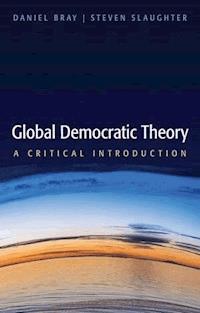
Global Democratic Theory is the first comprehensive introduction to the changing contours of democracy in today’s hyperconnected world. Accessibly written for readers new to the topic, it considers the impact of globalization and global forms of governance and activism on democratic politics and examines how democratic theory has responded to address these challenges, including calls for new forms of democracy to be developed beyond the nation-state and for greater public participation and accountability in existing global institutions.
Divided into two parts, the book shows how globalization provides both new obstacles and new opportunities for democracy. Part I explores the shifts underway at the national and international levels that are challenging democracy within nation-states around the world. In response, new proposals for global and transnational democracy have emerged. Part II critically analyses five main approaches of ‘global democratic theory’ Ð liberal internationalism, cosmopolitan democracy, deliberative democracy, social democracy and radical democracy, focusing on their specific interpretation of the problems facing democracy, their normative claims, and the feasibility of their proposed pathways of democratization. The book’s extensive account of the problems and possibilities facing democracy today will be essential reading for students and scholars of politics, political theory and political philosophy.
Sie lesen das E-Book in den Legimi-Apps auf:
Seitenzahl: 354
Veröffentlichungsjahr: 2015
Ähnliche




















Contents
Cover
TitlePage
Copyright
Acknowledgments
Introduction: Democratic Theory in a Global Era
Globalization and Democratic Theory
Global Democratic Theory
Chapter Structure
Key Readings
1 Globalization and the Democratic State
The Modern State
Perspectives on Globalization
Neo-Liberal Globalization and the Competition State
Public Responses to Globalization
Responses to Globalization in Democratic Theory
Conclusion
Key Readings
2 Global Governance and Transnational Civil Society
A Brief History of Global Governance
The Purposes and Problems of Contemporary Global Governance
Transnational Civil Society
Conclusion: Global Democratic Theory
Key Readings
3 Liberal Internationalism
The Globalization Paradox
Government Networks and Democracy-Enhancing Multilateralism
Global Technocracy or Democratic Internationalism?
Conclusion
Key Readings
4 Cosmopolitan Democracy
Globalization and the Erosion of Democratic Autonomy
A New Global Architecture of Cosmopolitan Democracy
The Pathways to Cosmopolitan Democracy
Conclusion
Key Readings
5 Deliberative Democracy
Deliberative Democracy and Global Politics
Transnational Deliberative Democracy
Criticisms of Transnational Deliberative Democracy
Conclusion
Key Readings
6 Social Democracy
The Social Democratic Imperative
The International Dimension of Social Democracy
The Problems of Social Democracy
Conclusion
Key Readings
7 Radical Democracy
The Shackles of Imperial Sovereignty
The Democracy of the Multitude
Revolution without a Manifesto
Conclusion
Key Readings
Conclusion: Global Democratic Theory and the Citizen
Global Democratic Theory
Global Democratic Futures
Conclusion
Key Readings
References
Index
End User License Agreement
Guide
Cover
Table of Contents
Begin Reading
Pages
iii
iv
vi
vii
1
2
3
4
5
6
7
8
9
10
11
12
13
14
15
16
17
18
19
20
21
22
23
24
25
26
27
28
29
30
31
32
33
34
35
36
37
38
39
40
41
42
43
44
45
46
47
48
49
50
51
52
53
54
55
56
57
58
59
60
61
62
63
64
65
66
67
68
69
70
71
72
73
74
75
76
77
78
79
80
81
82
83
84
85
86
87
88
89
90
91
92
93
94
95
96
97
98
99
100
101
102
103
104
105
106
107
108
109
110
111
112
113
114
115
116
117
118
119
120
121
122
123
124
125
126
127
128
129
130
131
132
133
134
135
136
137
138
139
140
141
142
143
144
145
146
147
148
149
150
151
152
153
154
155
156
157
158
159
160
161
162
163
164
165
166
167
168
169
170
171
172
173
174
175
176
177
178
179
180
181
182
183
184
185
186
187
188
Global Democratic Theory
A Critical Introduction
Daniel Bray & Steven Slaughter
polity
Copyright © Daniel Bray and Steven Slaughter 2015
The right of Daniel Bray and Steven Slaughter to be identified as Authors of this Work has been asserted in accordance with the UK Copyright, Designs and Patents Act 1988.
First published in 2015 by Polity Press
Polity Press65 Bridge StreetCambridge CB2 1UR, UK
Polity Press350 Main StreetMalden, MA 02148, USA
All rights reserved. Except for the quotation of short passages for the purpose of criticism and review, no part of this publication may be reproduced, stored in a retrieval system, or transmitted, in any form or by any means, electronic, mechanical, photocopying, recording or otherwise, without the prior permission of the publisher.
ISBN-13: 978-0-7456-9148-0
A catalogue record for this book is available from the British Library.
Library of Congress Cataloging-in-Publication Data
Bray, Daniel, 1976–
Global democratic theory: a critical introduction/Daniel Bray, Steven Slaughter.pages cm
Includes bibliographical references and index.ISBN 978-0-7456-8087-3 (hardback: alk. paper) -- ISBN 978-0-7456-8088-0 (pbk.: alk. paper) 1. Democracy--Philosophy. 2. Globalization--Political aspects. I. Slaughter, Steven, 1970– II. Title.JC423.B767 2015321.8–-dc23
2014036703
The publisher has used its best endeavours to ensure that the URLs for external websites referred to in this book are correct and active at the time of going to press. However, the publisher has no responsibility for the websites and can make no guarantee that a site will remain live or that the content is or will remain appropriate.
Every effort has been made to trace all copyright holders, but if any have been inadvertently overlooked the publisher will be pleased to include any necessary credits in any subsequent reprint or edition.
For further information on Polity, visit our website: politybooks.com
Acknowledgments
This book emerged from a joint belief that our various reflections on the problems and future possibilities of democracy were occurring within a distinct subset of broader accounts of democratic and political theory. These reflections are expressed in a literature that examines the changing nature of democratic theory and practice in a context of globalization, global governance, and transnational civil society. We refer to this literature as “global democratic theory” and believe that it can play an important role in guiding contemporary movements for democratization. As such, the primary aim of the book is to provide academics, students, and politically engaged citizens with an accessible account of the impact of globalization on democracy, the main theories of global and transnational democracy that have been developed in response, and a critical analysis of their key claims and prospects in practice. We hope the book will be a significant contribution to the literature because there is currently no single volume that brings together the scholarship of global democratic theory in this time of increased attention to globalization and democratic change. Given that so many scholars working in this area have published in Polity Press over the last two decades, it seemed appropriate to publish this book with them, so our first thanks go to the many staff at Polity who have supported this area of scholarship over the years. A special thank you also goes to the people who specifically contributed to the production of this book, particularly Louise Knight for her initial interest in the project.
This project was made possible with the help of a number of people who contributed invaluable academic and personal support. Steven would like to thank Andrew Scott and the School of Humanities and Social Sciences at Deakin University for their assistance and support. We would also like to thank several research assistants who helped in various stages of this project, including Uschi Steedman and Mark Ryan. On a personal note, Steven would like to thank Yvette, Zara, and Lucinda for their love and support during the writing of this book. Its final stages coincided with the birth of Lucas Nakata Bray who has brought boundless joy and many sleepless nights to Daniel’s life over the past year. A very special thank you goes to Sana for her love, patience, and strength during this time.
Introduction:Democratic Theory in a Global Era
The contemporary global era is characterized by new modes of power and authority as well as shifting patterns of social interaction in which democratic ideas have an uncertain place. This uncertainty stems from the fact that democracy has become the main principle of legitimate political rule at the same time as global forces outside democratic control have increased in importance and threaten established forms of public representation, participation, and accountability located within the state. To varying degrees, democratic relationships of representation and accountability between citizens and their state are increasingly blurred as political decision-making becomes more densely embedded within complex and overlapping forms of globalization and global governance. Indeed, the contemporary era is characterized by the increased significance of global and transnational forms of authority comprised of regional and International Governmental Organizations (IGOs) like the European Union (EU) and the United Nations (UN), and networks of civil society actors ranging from networks of activists such as the World Social Forum (WSF), to networks of experts such as international science academies and the World Economic Forum (WEF). Furthermore, the power of the state to organize economic life is now significantly conditioned by the operation of global market forces and transnational corporations (TNCs). Generally speaking, there has been a displacement of decision-making from the state to global forms of governance and global markets. In this context, David Held (1998: 21) claims that “the idea of a political community of fate – of a self-determining collectivity which forms its own agenda and life conditions – can no longer meaningfully be located within the boundaries of a single nation-state alone.”
These global and transnational dynamics have created a number of significant challenges to contemporary understandings of democracy. First, the core democratic capacities of states are undermined by the growing ability of global governance and global markets to limit the meaningful choices available to governments and their people. Second, the shift of power to global and regional institutions creates “democratic deficits” where increasingly numerous and complicated tasks of policy-making are conducted beyond the accountability and oversight of the domestic publics of democratic states. Third, new political opportunities for promoting democratic practices have arisen in global and transnational networks involving a host of NGOs, social movements, and experts (Scholte 2002, 2011b; Dryzek 2011). On many issues, for example, human rights activists, business elites, refugees, climate change scientists, and religious leaders claim to speak for global or transnational constituencies that go beyond state interests. Many of these actors claim to serve democratic functions of representation or public scrutiny, or make demands for more inclusion and accountability in global governance in the name of democracy. Overall, the impact of globalization on democracy appears considerable and the
Lesen Sie weiter in der vollständigen Ausgabe!
Lesen Sie weiter in der vollständigen Ausgabe!
Lesen Sie weiter in der vollständigen Ausgabe!
Lesen Sie weiter in der vollständigen Ausgabe!
Lesen Sie weiter in der vollständigen Ausgabe!
Lesen Sie weiter in der vollständigen Ausgabe!
Lesen Sie weiter in der vollständigen Ausgabe!
Lesen Sie weiter in der vollständigen Ausgabe!
Lesen Sie weiter in der vollständigen Ausgabe!
Lesen Sie weiter in der vollständigen Ausgabe!
Lesen Sie weiter in der vollständigen Ausgabe!




