


14,99 €
Mehr erfahren.
- Herausgeber: Parkstone International
- Kategorie: Geisteswissenschaft
- Sprache: Englisch
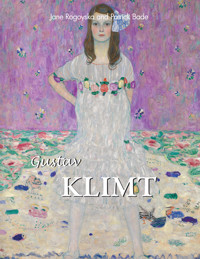
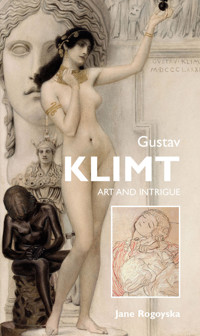
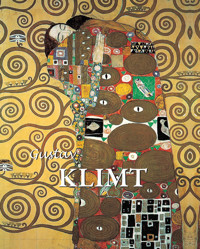
“I am not interested in myself as a subject for painting, but in others, particularly women…”Beautiful, sensuous and above all erotic, Gustav Klimt’s paintings speak of a world of opulence and leisure, which seems aeons away from the harsh, post-modern environment we live in now. The subjects he treats – allegories, portraits, landscapes and erotic figures – contain virtually no reference to external events, but strive rather to create a world where beauty, above everything else, is dominant. His use of colour and pattern was profoundly influenced by the art of Japan, ancient Egypt, and Byzantium. Ravenne, the flat, two-dimensional perspective of his paintings, and the frequently stylised quality of his images form an oeuvre imbued with a profound sensuality and one where the figure of woman, above all, reigns supreme. Klimt’s very first works brought him success at an unusually young age. Gustav, born in 1862, obtained a state grant to study at Kunstgewerbeschule (the Vienna School of Arts and Crafts) at the age of fourteen. His talents as a draughtsman and painter were quickly noticed, and in 1879 he formed the Künstlercompagnie (Artists’ Company) with his brother Ernst and another student, Franz Matsch. The latter part of the nineteenth century was a period of great architectural activity in Vienna. In 1857, the Emperor Franz Joseph had ordered the destruction of the fortifications that had surrounded the medieval city centre. The Ringstrasse was the result, a budding new district with magnificent buildings and beautiful parks, all paid for by public expenses. Therefore the young Klimt and his partners had ample opportunities to show off their talents, and they received early commissions to contribute to the decorations for the pageant organised to celebrate the silver wedding anniversary of the Emperor Franz Joseph and the Empress Elisabeth. In 1894, Matsch moved out of their communal studio, and in 1897 Klimt, together with his closest friends, resigned from the Künstlerhausgenossenschaft (the Cooperative Society of Austrian Artists) to form a new movement known as the Secession, of which he was immediately elected president. The Secession was a great success, holding both a first and second exhibition in 1898. The movement made enough money to commission its very own building, designed for it by the architect Joseph Maria Olbrich. Above the entrance was its motto: “To each age its art, to art its freedom.” From around 1897 onward, Klimt spent almost every summer on the Attersee with the Flöge family. These were periods of peace and tranquillity in which he produced the landscape paintings constituting almost a quarter of his entire oeuvre. Klimt made sketches for virtually everything he did. Sometimes there were over a hundred drawings for one painting, each showing a different detail – a piece of clothing or jewellery, or a simple gesture. Just how exceptional Gustav Klimt was is perhaps reflected in the fact that he had no predecessors and no real followers. He admired Rodin and Whistler without slavishly copying them, and was admired in turn by the younger Viennese painters Egon Schiele and Oskar Kokoschka, both of whom were greatly influenced by Klimt.
Das E-Book können Sie in Legimi-Apps oder einer beliebigen App lesen, die das folgende Format unterstützen:
Seitenzahl: 122
Veröffentlichungsjahr: 2023
Ähnliche

















Author: Jane Rogoyska and Patrick Bade
Library of Congress Cataloging-in-Publication Data
Rogoyska, Jane.
Gustav Klimt / Jane Rogoyska and Patrick Bade. -- 2nd ed.
p. cm.
Includes index.
1. Klimt, Gustav, 1862-1918. 2. Artists--Austria--Biography. I. Klimt, Gustav, 1862-1918. II. Bade, Patrick. III. Title.
N6811.5.K55R64 2011b
709.2--dc23
[B]
2011024520
© 2023 Confidential Concepts, worldwide, USA
© 2023 Parkstone Press International, New York, USA
All rights reserved.
No part of this publication may be reproduced or adapted without the permission of the copyright holder, throughout the world. Unless otherwise specified copyrights on the works reproduced lie with the respective photographers, artists, heirs or estates. Despite intensive research, it has not always been possible to establish copyright ownership. Where this is the case, we would appreciate notification.
Jane Rogoyska and Patrick Bade
Contents
The Viennese Secession
His Life
Beginnings
Secession
Scandal
Fin de Siècle Vienna
Lovers and Friends
Drawings and Sketches
Society Portraits
Pattern and Nudity
Klimt’s Legacy
His Work
FABLE
THE IDYLL
THE THEATRE OF TAORMINA
FEMALE NUDE LYING DOWN
AUDITORIUM OF THE OLD BURGTHEATER
PORTRAIT OF JOSEPH PEMBAUR
ANCIENT GREEK ART I
THE LOVE
MUSIC I
FINAL DRAWING FOR THE ALLEGORY OF TRAGEDY
FISH BLOOD
COMPOSITIONAL PROJECT FOR MEDICINE
PALLAS ATHENA
POTRAIT OF SONJA KNIPS
EXHIBITION WALLPAPER FOR SECESSION I
NUDA VERITAS
NUDA VERITAS (DETAIL)
SCHUBERT AT PIANO
TWO LOVERS
ISLAND ON THE ATTERSEE
GOLDFISH
JUDITH I
PORTRAIT OF GERTHA FELSOVANYI
THE BEETHOVEN FRIEZE: AMBITION, COMPASSION AND THE KNIGHT IN SHINING ARMOR (DETAIL)
POTRAIT OF EMILIE FLÖGE
FOREST OF BEECH TREES I
HOPE I
WATER SNAKE I
WATER SNAKE II
THE THREE AGES OF WOMEN
POTRAIT OF MARGARET STONBOROUGH-WITTGENSTEIN
THE STOCLET FRIEZE (DETAIL)
SUNFLOWER GARDEN
POTRAIT OF FRETZA RIEDLER
MEDICINE
HYGIEIA (DETAIL OF MEDICINE)
POTRAIT OF ADELE BLOCH-BAUER I
HOPE II
THE KISS
THE KISS (DETAIL)
DANAË
KAMMER CASTLE ON THE ATTERSEE I
WOMAN IN HAT WITH FEATHER BOA
JUDITH II
THE BLACK FEATHER HAT
LIFE AND DEATH
GARDEN WITH CRUCIFIX
FARMHOUSE IN UPPER AUSTRIA
POTRAIT OF ADELE BLOCH-BAUER II
RIA MUNK ON HER DEATH BED
PORTRAIT OF MÄDA PRIMAVESI
POTRAIT OF EUGENIA PRIMAVESI
VIRGIN
MALCESINE ON LAKE GARDA
POTRAIT OF ELISABETH BACHFEN-ECHT
HOUSE AT UNTERACH ON THE ATTERSEE
POTRAIT OF FRIEDERIKE MARIA BEER
PATH OF GARDEN AND HENS
THE CHURCH AT UNTERACH ON THE ATTERSEE
GIRLFRIENDS (DETAIL)
BABY
ADAM AND EVE (UNFINISHED)
DANCER
BRIDE (UNFINISHED)
Biography
Index
Notes
Gnawing Sorrow (detail from second panel ofThe Beethoven Frieze), 1902.
Casin on plaster, height: 220cm. Secession, Vienna.
The Viennese Secession
Eight Years of Secession (March 1897 – June 1905)[1]
Criticism – Polemic Pamphlet – Chronicle
by Ludwig Hevesi, Vienna 1906
The city council has, in recent days, in a moment of epiphany, made the decision to grant the Vereinigung bildender Künstler Österreichs (Association of Visual Artists in Austria) a piece of property for the construction of an art exhibition center on the corner of the Wollzeile in Vienna[2]. The conditions, however, for this grant still need mitigation. This is what the Viennese would call a “Wiener Lokalnachricht” (a local headline) but compared to all the other headlines that have been published in the papers over the last years, this announcement is of tremendous importance. A magic word has been spoken which shall break the chains and raise the dead from their graves: an urban expansion is on the horizon that shall rejuvenate Vienna’s art scene. As a city of the arts, Vienna, this formidable little town shall finally become Great Vienna, truly a New Vienna. The citizens of Vienna themselves are going to be surprised by the news since all the conspirators behind this project have been untiringly working in deepest silence in their metaphorical mountain retreat. The time of planning is finally over; today action speaks louder than words, for this courageous venture is already secured, both artistically and financially, at least for the next decade.
It was a group of young artists with strong and fresh blood running through their veins whose determination set this movement in motion; it is the most consistent movement in Vienna ever since the fiery temperament and genius of Hans Makart set the world of art on fire. This movement holds great promise; it might follow in the footsteps of all the other great art movements: The “Vereinigung der XI” in Berlin who exhibit their art in Schulte’s art gallery or it might even be a Secession just as in Munich, Paris and other art capitals all over the world. It could be an exodus to the Holy Mountain; one part movement of opposition, one part new creation, an “Anti-Salon” which will – by nature – always be a salon for the rejected.
At the same time, however, these bold, young Austrians are considerate patriots. They want to be neither frondeurs[3] nor Watergeuzen[4] and even less do they want to wage a guerilla war against the Academy and the Künstlerhaus. It is not the urge to rebel against their elders that is driving them forward. They are not out to offend anyone or to celebrate themselves. No, their goal is to elevate the traditional, classical Austrian art to a modern, international level. The artists themselves put their intention into the following words:
The Death of Juliet, 1886.
Black pencil with white highlights,
27.6 x 42.4 cm.
Graphische Sammlung Albertina, Vienna.
Man’s Head Lying Down (painting from the ceiling of the Imperial Venetian Theatre), 1886-1888.
Black chalk, white highlights, 28 x 43 cm.
Graphische Sammlung Albertina, Vienna.
“A band of young artists has, driven by an ideal and an unshakeable faith in Vienna’s artistic future, undeterred by any obstacle - founded an association of visual artists for Austria. With the help of several true friends of the arts and supporters who are willing to make sacrifices and disregard material hardship, they want to follow their calling and be artistically active.”
Despite their non-confrontational intentions, the V.b.K.Ö is still a “warlike” association because they wanted to fight the lack of ideas and the artistic phlegm in today’s art scene. This goal is not to be reached by arguing polemically but by aiming for purely artistic ideals and educating the “eye”, the art perception of the masses so that they can better understand the living, ever-evolving nature of art. This better alternative will thus become an enemy of everything that was only “good” so far and, naturally, even more hostile towards the “bad”.
This task requires immense endurance, for the public has to be broken of it’s tolerance for bad art. The “bad” has simply to be made impossible by silencing the demand for it. The necessity for a new renaissance in the arts is evidenced by the presence of quite a few famous names - which are beyond any suspicion of being youthful upstarts - that are joining the ranks of the movement. Grandmaster Rudolf Alt was asked to act as honorary president. Which accusation could there be that is not disproved by his presence? Quite a few academic professors are joining the ranks of the artists: Myslbek, Hellmer, Julian Falat, Hynais. Among our young members are Engelhart and Moll, whose determination is the stuff of legends; Bernatzik, Bacher, Klimt, Krämer, Knüpfer, Mayreder, Ottenfeld, Stöhr, Jettel and Dei have also joined the group.[5]
Artists from all of Europe are sending their regards and cheering their colleagues on; New-Munich and New-Berlin are standing shoulder to shoulder with New-Vienna. Stuck, Marr, Herterich, Dettmann, KuehI, Dill and many more, even some Parisian masters, have joined the group as “non-residential members”. A youth association is international by concept and cannot be anything other than international; youth organizations all over the world share the same goal: to celebrate life to the fullest.
This general, international approval is an important safeguard for the Viennese group. It provides them with contacts beyond Austria, which is highly crucial, since it is getting more and more difficult to organize a Viennese exhibition with a European character. Even during the last international exhibition in the Künstlerhaus, the 30,000 guilders that had been granted by the government were not sufficient to purchase foreign artworks. Munich, Berlin and Dresden allow their art galleries to keep up with the development in the world of art and thus give their youth access to a modern artistic education. By contrast, in Vienna the circumstances are getting more difficult; without the Emperor and the Prince of Liechtenstein things would have gotten worse already.
Especially this year’s spring exhibition made Vienna’s isolated position painfully apparent. Such a lack of inspiration has not been seen in an annual exhibition in a long time. The artists are acting as if they were members of a private club; they know each other so well that no one has to say anything new or to contribute anything innovative. We actually know the reason why Vienna’s art scene is getting bogged down. We have pointed it out on several occasions: the lure of prestige.
The floor in the Academy and the Künstlerhaus is littered with the cudgels that have been taken up on the behalf of various causes: this academic chair or that coveted award or a jury decision or yet another important commission. The downside of practicing art competitively and in community with other artists has revealed itself dramatically in the confined space that is the art scene of Vienna. So, it is also an act of self-help when these young artists, with their unbreakable spirit, make themselves ready to strike out at the old clutter so that the art scene can finally breathe fresh air again. This new association will make it possible to have healthy competition again.
Allegory of Sculpture, 1889.
Pencil and watercolour, 44 x 30 cm.
Historisches Museum, Vienna.
Left: Greek Art, 1890-1891.
Oil on plaster, 230 x 80 cm.
Kunsthistorisches Museum, Vienna.
Right: Egyptian Art II, 1890-1891.
Oil on plaster, 230 x 80 cm.
Kunsthistorisches Museum, Vienna.
Egyptian Art I (Young Girl with Horus), 1890-1891.
Oil on plaster, 230 x 230.
Kunsthistorisches Museum, Vienna.
Portrait of a Woman (possibly Mrs. Heymann), c. 1894.
Oil on wood, 39 x 23 cm.
Kunsthistorisches Museum, Vienna.
Some things will be made impossible, such as the atrocity that did not allow someone like Emil Jakob Schindler, two years before his death, at the height of his brilliance, to exhibit the 28 paintings he wished to show to the world but instead allowed him to show only 14 paintings, which were, moreover, displayed apart from each other, completely out of context. If Schindler was still alive today he would surely go to the Wollzeile to display his art.
The fire that has been ignited by this movement needs to be maintained, just like fuelling a fireplace; for this very reason the exhibition center is being planned and built. From this new and free house of artists maybe even the Academy can be won over and a modern gallery can be established, a Viennese Luxembourg[6]. The whole profit of future exhibitions is going to be invested into such a modern gallery; the gallery will only blossom out of a well-nurtured stem. The new house is going be a focal point and a staging area for the still scattered Austrian forces and even the province will be fed artistically out of this rich larder. There will be “elite-exhibitions” in every city so that even those that have been disinherited of their art appreciation can feel part of a beautiful body; the body of art. There is much blessing to impart. There even shall be art for the people. If, for example, a young law student asks the administration of the gallery for free entry, the request should be considered and a way found to realize the plea, so that the need for art is satisfied. Ultimately we want these young people to, God willing, buy the works from our painting and sculpting progeny.[7]
It is a pleasant phenomenon that this particular movement combines passion with reason. Without dreaming about a utopian future for their art collective and without trumpets or fireworks these young people of the Vereinigung have approached the challenge pragmatically. Rich patrons of the art have been admitted into confidence so that the authorities of Vienna and the urban expansion office could see the importance of this project early on. Everything that was needed could be purchased cheaply by those bold men. Not often has the determination of a few prepared the ground for artistic creation. Everyone who supported this project in even the littlest measure deserves the praise of the public. The project has progressed even so far that the construction plan for the new exhibition center should be finished soon. On the plot of land spanning 1200 square metres, that has been granted by the council, a true art palace of 640 square metres with a will rise, surrounded by an aesthetically pleasing recreation area. The building is planned as a public building with a raised ground floor with a skylight and now windows; the outer walls will be artfully decorated with frescos so that Vienna not even gets a center of art but also a structural ornament. The financial means for the execution and maintenance of the project have been secured and now the artists are hoping to be able to open the doors of their new home soon.
“May visionary friends of the arts,” the V.b.K.Ö says in their message, “may first and foremost those citizens of Vienna who are enthusiastic about art, honour our endeavours and support them as best they can. May patrons and artists strive together to make Vienna into what it is destined to be: Vienna, City of Art. (27 March 1897).”
After the Rain, 1899.
Oil on canvas, 80 x 40 cm.
Österreichische Galerie Belvedere, Vienna.
Water Sprites (Silver Fish), 1899.
Oil on canvas, 82x52cm.
Tree of Life (detail), c.1905-1909.
Museum für Angewandte Kunst, Vienna.
His Life
“I am not interested in myself as a subject for painting,but in others, particularly women…”
Beautiful, sensuous, and, above all, erotic, Gustav Klimt’s paintings speak of a world of opulence and leisure, which seems eons away from the harsh, post-modern environment we live in now. The subjects he treats – allegories, portraits, landscapes and erotic figures – contain virtually no reference to external events, but strive rather to create a world where beauty, above everything else, is dominant.




