


19,99 €
Mehr erfahren.
- Herausgeber: John Wiley & Sons
- Kategorie: Geisteswissenschaft
- Serie: DMS - Digital Media and Society
- Sprache: Englisch
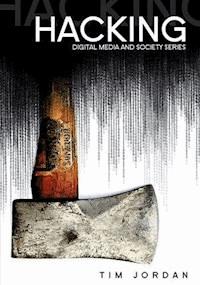
Hacking provides an introduction to the community of hackers and an analysis of the meaning of hacking in twenty-first century societies.
On the one hand, hackers infect the computers of the world, entering where they are not invited, taking over not just individual workstations but whole networks. On the other, hackers write the software that fuels the Internet, from the most popular web programmes to software fundamental to the Internet's existence. Beginning from an analysis of these two main types of hackers, categorised as crackers and Free Software/Open Source respectively, Tim Jordan gives the reader insight into the varied identities of hackers, including:
• Hacktivism; hackers and populist politics
• Cyberwar; hackers and the nation-state
• Digital Proletariat; hacking for the man
• Viruses; virtual life on the Internet
• Digital Commons; hacking without software
• Cypherpunks; encryption and digital security
• Nerds and Geeks; hacking cultures or hacking without the hack
• Cybercrime; blackest of black hat hacking
Hackers end debates over the meaning of technological determinism while recognising that at any one moment we are all always determined by technology. Hackers work constantly within determinations of their actions created by technologies as they also alter software to enable entirely new possibilities for and limits to action in the virtual world. Through this fascinating introduction to the people who create and recreate the digital media of the Internet, students, scholars and general readers will gain new insight into the meaning of technology and society when digital media are hacked.
Sie lesen das E-Book in den Legimi-Apps auf:
Seitenzahl: 261
Veröffentlichungsjahr: 2013
Ähnliche




















Hacking
Digital Media and Society Series
Mark Deuze, Media Work
Alexander Halavais, Search Engine Society
Robert Hassan, The Information Society
Tim Jordan, Hacking
Jill Walker Rettberg, Blogging
Hacking
Digital Media and Technological Determinism
TIM JORDAN
polity
Copyright © Tim Jordan 2008
The right of Tim Jordan to be identified as Author of this Work has been asserted in accordance with the UK Copyright, Designs and Patents Act 1988.
First published in 2008 by Polity Press
Polity Press
65 Bridge Street
Cambridge cb2 1ur, UK
Polity Press
350 Main Street
Malden, ma 02148, USA
All rights reserved. Except for the quotation of short passages for the purpose of criticism and review, no part of this publication may be reproduced, stored in a retrieval system, or transmitted, in any form or by any means, electronic, mechanical, photocopying, recording or otherwise, without the prior permission of the publisher.
ISBN-13: 978-0-7456-5815-5
A catalogue record for this book is available from the British Library.
Typeset in 10.25 on 13 pt FF Scala
by Servis Filmsetting Ltd, Stockport, Cheshire
Printed and bound in Great Britain by MPG Books Ltd, Bodmin, Cornwall
The publisher has used its best endeavours to ensure that the URLs for external websites referred to in this book are correct and active at the time of going to press. However, the publisher has no responsibility for the websites and can make no guarantee that a site will remain live or that the content is or will remain appropriate.
Every effort has been made to trace all copyright holders, but if any have been inadvertently overlooked the publishers will be pleased to include any necessary credits in any subsequent reprint or edition.
For further information on Polity, visit our website: www.polity.co.uk
Contents
Acknowledgements
1 The Hack
2 Cracking: Black Hats on the Internet
3 Free Software and Open Source: Collaboration, Objects and Property
4 Hacking the Social: Hacktivism, Cyberwar, Cyberterror, Cybercrime
5 Hacking the Non-Hack: Creative Commons, Hackers who don’t Programme, Programming Proletariat, Hacking Sub-Cultures and Nerds and Geeks
6 The Meaning of Hacking
Further reading
References
Index
Acknowledgements
Thanks to Andrea Drugan and her team who suggested looking at hacking in a series about digital media. Andrea and Jonathan Skerrett were very helpful during writing and production. Several anonymous reviewers offered suggestions which made significant improvements. I drew on years of discussion with far too many people to mention, thanks to all of them. Of course, all mistakes are my own.
To hacking, god knows what I owe in general, but specifically this was written using OpenOffice, operating system Ubuntu. For less specific but nonetheless more important support, thanks to Masters Lite at Clissold Swimming Club and the Ancient Shadows. For the most important things in life, thanks to Matilda and Joanna, though the adventure has been more mountainous while writing this book than I could have expected.
CHAPTER ONE
The Hack
Introducing hacking
The hack is a way of understanding what is possible, sensible and ethical in the twenty-first century. This overview of hacking will explain those who hack and their communities, because only by grasping hacking in the full sense of the people who hack and the social and cultural relations within which they live can we open up some important facets of twenty-first-century life. Further, only by exploring the norms and cultures found in this community will we open up a side to our existence that has arrived – whether we like it or simply put up with it or hate it – with the growing ubiquity of computers and the ever-expanding connections produced by computer networks.
Kevin Mitnick is a hacker, though some would demand he be called a cracker. He became famous for a number of activities: being held responsible for breaking the security on a US government computer security advisor’s system, using a technique (IP-spoofing) that had not been documented before; for breaking into the corporations Fujitsu, Motorola, Nokia and possibly others, seeking software for mobile phones to try and secure his own systems; and, for being the hacker who was held in solitary confinement because someone claimed he could launch nuclear weapons by whistling phone tones down a phone line (Shimomura 1995; Littman 1996). Mitnick subsequently became a computer security consultant.
Linus Torvalds is a hacker. He became famous for leading the development of an operating system called Linux. This complex software package began as a technical exercise for Torvalds, who wrote and released the core component (the kernel) of an operating system. Subsequently, Torvalds oversaw an expanding collective effort to write more and more components of it, until Linux emerged as a free, sophisticated operating system which is considered by many to be a technically significant rival to Microsoft’s Windows operating system.
Torvalds and Mitnick exemplify the two core components of hacking: cracking, and free software and open source programming. Between these components are generated dynamics which create the particular characteristics of hacking, but these two are not the only components of hacking. We will explore how hacking is used to affect society though such things as cyberwar, cyberterrorism, hacktivism and cybercrime. We will also explore the way hacking is not solely about programming or using computers when we examine connections between Creative Commons, hackers who do not programme, the programming proletariat and hacking sub-cultures. Finally, all these various components will be drawn together to consider the meaning of hacking.
Lesen Sie weiter in der vollständigen Ausgabe!
Lesen Sie weiter in der vollständigen Ausgabe!
Lesen Sie weiter in der vollständigen Ausgabe!
Lesen Sie weiter in der vollständigen Ausgabe!
Lesen Sie weiter in der vollständigen Ausgabe!
Lesen Sie weiter in der vollständigen Ausgabe!
Lesen Sie weiter in der vollständigen Ausgabe!
Lesen Sie weiter in der vollständigen Ausgabe!




