


Erhalten Sie Zugang zu diesem und mehr als 300000 Büchern ab EUR 5,99 monatlich.
- Herausgeber: Luath Press
- Kategorie: Geisteswissenschaft
- Sprache: Englisch
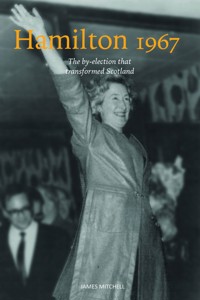
Stop the world, Scotland wants to get on.' - Hamilton, Scotland, 3 November 1967A young couple, married only one day, join a group of eager SNP supporters in the early morning of the by-election to gather last minute votes around Hamilton.Journalists scrap pre-recorded interview answers in the middle of the night as they do not adequately convey the political event that would transform Scottish politics thereafter. Instead, a 17-year-old is sent out to collect responses that better capture the tremendous political upset that has just occurred.'Winnie Wins by a Mile!' was splashed across the Hamilton Advertiser's front page.This book details the political history and moments leading up to the election of the SNP's Winnie Ewing and the profound effect her success has had on the political landscape of Scotland and the UK since. Professor James Mitchell of the University of Edinburgh provides an insightful examination of the different factors that contributed to Ewing and the SNP's 1967 success. Through interviews with and surveys of SNP members, archival research and trawling through contemporary sources, Mitchell presents a multi-layered understanding of this crucial turning point in Scottish politics.This watershed by-election was transformative for the SNP and for Scotland. In the increasingly turbulent waters of contemporary politics, Hamilton 1967 provides a necessary historical context to assist in one's navigation of the political landscape today.
Sie lesen das E-Book in den Legimi-Apps auf:
Seitenzahl: 238
Veröffentlichungsjahr: 2017
Das E-Book (TTS) können Sie hören im Abo „Legimi Premium” in Legimi-Apps auf:
Ähnliche



















PROFESSOR JAMES MITCHELL holds the chair in Public Policy and is Director of the Academy of Government at the University of Edinburgh. He previously held chairs at the University of Strathclyde and Sheffield. His research has included studies of political parties and public opinion in Scotland. His most recent work has included studies of the SNP, Scottish elections and the independence referendum. All of his work is informed by an appreciation of the importance of the past in its impact on current concerns.
First published 2017
ISBN: 978-1-912387-13-7
Typeset in 11.5 point Sabon
by 3btype.com
The authors’ right to be identified as author of this work under the Copyright, Designs and Patents Act 1988 has been asserted.
© James Mitchell 2017
Contents
Timeline
Preface
Introduction
CHAPTER ONE Turbulent politics, economic security and insecurity
CHAPTER TWO The Campaign
CHAPTER THREE The Fallout
Conclusion: Hamilton in a Historical Context
Endnotes
Timeline
1966
31 March
General Election. Labour wins an overall majority of 97 with 46 seats of Scotland’s 71 seats and 49.8% of the vote. SNP win 5% of the vote standing in 23 seats, saving 13 deposits.1
25 May
Government announces membership of Royal Commission on Local Government in Scotland under chair of Lord Wheatley.
16 May
National Union of Seamen go on strike
23 May
Government declares a State of Emergency as seamen’s strike affects international trade.
15 June
David Steel MP’S Abortion Bill gets second reading in Commons.
29 June
Premier Harold Wilson distances himself from US bombings in Vietnam.
1 July
Bank rate raised to 7% and special deposits doubled.
3 July
Frank Cousins resigns as Minister for Technology in opposition to Government’s prices and incomes policy.
4 July
Prices and Incomes Board legislation published.
5 July
Leo Abse introduces Sexual Offences Bill legalising homosexuality but Bill does not extend to Scotland.
14 July
Gwynfor Evans wins Carmarthen by-election and becomes the first ever Plaid Cymru MP.
20 July
Wage freeze and package of £500m cuts to avoid speculation against sterling.
29 July
White Paper proposes compulsory wages freeze.
30 July
England wins World Cup.
4 August
25 Labour MPS abstain in vote on Prices and Incomes Bill.
19 October
Russell Johnston, Liberal MP, introduces Scottish Self-Government Bill.
10 November
Wilson Government formally announces it will seek membership of EEC.
16–17 November
Commons debates membership of EEC – both main parties divided on issue.
1967
18 January
Jeremy Thorpe becomes leader of the Liberal Party.
7 February
National Front founded.
2 March
Harold Wilson warns Labour backbenchers against rebelling, ‘every dog is allowed one bite, but a different view is taken of a dog that goes on biting’.
22 March
Iron and Steel Act passed – nationalising an important Lanarkshire industry.
9 March
Glasgow Pollok by-election – Conservatives take seat from Labour and SNP wins 28.2%. Plaid Cymru win 39.9% but defeated by Labour with 49.0% in Rhondda West by-election.
21 April
Queen’s Speech. Government announces intention to join EEC if safeguards for Commonwealth agreed
2 May
Formal announcement that UK would apply for EEC membership
Local elections. SNP win 60,000 votes (23 per cent) in Glasgow but no seats on the council.
3 May
Budget imposes Selective Employment Tax in effort to shift employment from service sector to declining manufacturing sector, on which Lanarkshire is heavily dependent.
10 May
Vote on EEC membership in carried 34 Labour MPS vote against and 51 abstain; 26 Conservatives and one Liberal voted against.
16 May
De Gaulle states at press conference that UK was not ready for EEC membership.
18–20 May
Scottish Liberal Party conference rejects call from Ludovic Kennedy for a pact with the SNP.
2–4 June
SNP annual conference
20 July
Justice Latey Committee recommends reducing age of majority from 21 to 18.
24 July
Chancellor of Exchequer Jim Callaghan dismisses devaluation as a policy for Government.
25 July
Government enacts an increase in family allowance to come into effect from October but provokes resignation of Peggy Herbison, veteran Labour Minister and Lanarkshire MP who viewed it as too little.
28 August
Cabinet re-shuffle with Harold Wilson taking overall responsibility for the economy.
18 September
Start of dock strikes in London and Liverpool.
21 September
Conservatives gain Cambridge and Walthamstow West from Labour in by-elections.
8 October
Clement Attlee dies.
27 October
Abortion Act passed.
31 October
Queen’s Speech includes commitment to abolish hereditary peers.
2 November
HAMILTON BY-ELECTION. WINNIE EWING WINS SEAT FOR SNP FROM LABOUR.
18 November
Devaluation of £ sterling.
23 November
West Derbyside by-election – Labour falls to third place behind Liberals.
24 November
Launch of ‘Thistle Group’ inside the Conservative Party arguing for home rule.
November
Devaluation of £ sterling.
1968
16 January
Cuts in public spending announced.
19 March
Budget introduces deflationary package of measures.
11 April
STUC conference comes out in favour of devolution.
9 May
SNP wins 30% of vote and 108 seats in local government elections, with 37.2% of vote in Glasgow and 13 councillors elected including George Leslie.
18 May
Ted Heath makes his ‘Declaration of Perth’ at Scottish Conservative Party conference and announces the establishment of committee under Sir Alec Douglas-Home.
18–21 September
Liberal Party Assembly opposes a call for Scottish independence in favour of a federal scheme.
Passenger road transport and sea transport transferred to Scottish Office.
1969
15 April
Harold Wilson appoints a Royal Commission under Labour Crowther to consider the Constitution.
6 May
Local elections. SNP makes only modest gains which are interpreted as a setback.
25 September
Publication of Report of the Royal Commission on the Scottish Local Government under Lord Wheatley.
30 October
Glasgow Gorbals by-election. Labour wins seat with 53.4% with SNP in second place with 25.0% – interpreted as setback for SNP.
1970
19 March
Report of Scottish Constitutional Committee – under Sir Alec Douglas-Home and appointed by Ted Heath – issued, recommending an elected Scottish Convention.
19 March
South Ayrshire by-election. Jim Sillars holds the seat comfortably for Labour with 54.1% and SNP win 20.4% of vote.
18 June
General Election. SNP contests 65 constituencies and wins 11.4% of vote. Hamilton is lost but Western Isles is gained from Labour. Conservatives returned to power.
October
The giant Forties oil field discovered by BP in the central North Sea.
1979
1 March
1st Scottish Devolution Referendum. 51.6% vote for creation of Scottish Assembly but insufficient turnout to reach the required 40% of electorate voting Yes.
1997
11 September
2nd Scottish Devolution Referendum. Scotland votes overwhelmingly Yes Yes to create Scottish Parliament and devolve some tax raising powers.
1999
12 May
Scottish Parliament opens with Winnie Ewing MSP stating ‘I want to start with the words that I have always wanted either to say or to hear someone else say – the Scottish Parliament, which adjourned on 25 March 1707, is hereby reconvened.’
2007
16 May
Alex Salmond becomes Scotland’s first SNP First Minister, leading a minority government following the Holyrood election on 3 May.
2011
5 May
SNP win unexpected overall majority in Holyrood election.
2014
18 September
1st Scottish Independence Referendum. Scotland votes 55% No, 45% Yes.
20 November
Nicola Sturgeon becomes 2nd SNP First Minister of Scotland.
2015
7 May
SNP win 56 out of 59 Westminster seats in UK general election.
2016
5 May
SNP lose overall majority in Holyrood election and form administation with support of Scottish Green Party.
2017
8 June
SNP reduced from 56 to 35 Westminster seats in Theresa May’s snap general election.
Preface
THE IMMEDIATE IDEA for this book was the forthcoming 50th anniversary of the Hamilton by-election held on 2 November 1967. Having worked on the subject over many years, conducted numerous interviews, surveyed SNP members, delved in the archives and trawled through newspapers and other contemporary sources, the anniversary offered an opportunity to reflect on the crucial turning point in Scottish politics in the 1960s. In writing The Scottish Question (Oxford University Press 2014), I became aware that, despite the wealth of material on the subject, we still had not come close to understanding Scotland’s transition from a stable two-party system to the multiparty system that now exists and that the role and nature of Scottish nationalism, particularly how it has evolved as an ideology, required more attention focused on this period.
Much has been written in an attempt to explain the rise of the SNP and the wider political and social developments at that time. It proved fruitful to read these accounts again. Many have not aged well but a remarkable number remain fresh and valuable. It was particularly pleasing to read work by my late colleague Jack Brand. In the 1960s, Jack was Director of the Survey Research Centre at Strathclyde University and contributed hugely to our understanding of Scottish politics. It was a privilege to co-direct the 1992 Scottish Election Study with him, drawing on his long experience and deep understanding of political behaviour. His impish demeanour challenged and charmed in equal measure but his depth of knowledge of Scottish politics and history, national movements in Europe and political science were enviable.
Much of Jack’s work used here was in the form of journalism submitted to various newspapers. These newspapers were invaluable in understanding developments in Hamilton. The local Hamilton Advertiser was a key source for this book. Not only did it bring the by-election to life, but reading through more than two years of the paper helped me understand the everyday life in the constituency. The Scottish Boundary Commission helped supply information on Hamilton’s 1967 boundaries and I gratefully acknowledge Crown Copyright, Ordnance Survey for allowing me to use the map of the constituency at the start of Chapter Two.
I was keen to speak to some of those involved in the 1967 campaign and it was both enlightening and fun to meet and discuss matters with a number of locals who had been involved. Tom Muir, Helen Moir, James Price, Ian and Margaret Gourlay, Les Cordingley, Jack Foley, Barbara Samson and Alan Forsyth had great tales to tell and recollections of the campaign. John McAteer, Winnie Ewing’s election agent, was by all accounts an important figure who sadly died in 1977, but his widow, Kate, offered fascinating insights into the campaign and the very human nature of political activism. Kate’s home was the headquarters of the campaign until a shop at Peacock Cross was acquired and she supplied tea and digestives after an evening’s canvassing. This side of political campaigning is all too often overlooked by cynics who view political activists as a species apart from normal people. As much as anything this book is a celebration of political activism (of all political persuasions).
Fergus and Annabelle Ewing answered many questions and recounted stories from their childhood or pointed me in the direction of those who might. They also kindly arranged for me to visit and interview their mother. Fergus provided me with two photographs from the campaign. I am very grateful to the Scottish Political Archive at Stirling University for kind permission to use other photographs in the book. I had interviewed Winnie Ewing at various times over many years but this book was an opportunity to focus on the by-election. Whenever she was pressed on some aspect of her role, she would shift the conversation to emphasise the role played by others, particularly Robert McIntyre, John McAteer, Hugh MacDonald and, of course, the enormous support she was given by her late husband Stewart. It is difficult to measure the importance of those who contribute in the background to lively political debate. For every successful – and indeed unsuccessful – candidate, there are usually scores of other politicians who do not seek the limelight. The notion that they are all out for themselves is a view that could only be held by those utterly ignorant of the workings of democratic politics.
Academic colleagues were also helpful with advice and comments. Paula Somerville was very helpful. Paula’s Through the Maelstrom (Stirling 2013) is an excellent detailed account covering the period discussed. David Rollo, son of the SNP’S Hamilton candidate in 1959, was generous in supplying information and ideas. My PhD student Thomas Stewart offered a fine critical reading through draft chapters. Particular thanks must go to Ewen Cameron of Strathclyde University who read through chapters offering remarkably helpful detailed comments. Ewen brought sources to my attention that I would have missed. I want to thank Cliff Williamson, historian of Bath Spa University, for his encylopaedic knowledge of politics and society in the period covered, but mostly for lending support and helping me get this finished. My son Euan helped with research for the book. He spent considerable time diligently researching Hansard online – and found himself in a world that was well before he was born. He became fascinated in Biafra and the Nigerian Civil War, which Winnie Ewing engaged with at length during her time as Hamilton’s MP. Euan was born two months after the Scottish Parliament came into being and now has a better understanding than most of his generation of the period that marked the transition between two very different periods in Scottish politics.
Much of the research was conducted in the National Library of Scotland, including the archives. Other sources used in the book are drawn from the National Archives at Kew, west London and the Bodleain Library in Oxford. The University of Edinburgh Library, including its Centre for Research Collections, provided many sources. Gavin MacDougall at Luath was typically supportive of this project. Luath provides a great service to authors and the public that we ought to celebrate. Gavin MacDougall and Luath continue to be a major asset to public life in Scotland. Books on Scottish politics were few and far between before 1967. Luath has ensured that many works that might otherwise never have found a publisher are available and contribute to debate and understanding as will, no doubt, be important sources for future historians.
In my research, I came across reference to a young couple who had been married the day before the by-election and then spent the day in rainy Hamilton campaigning for Winnie Ewing. I tried to track them down and had all but given up when I received an email from Grant Thoms, editor of the Scots Independent. Unknown to me, my initial enquiry had been passed on through a number of people – Ian McCann, Ian Hudghton, Ian Hamilton and Irene McGugan. Irene sent me contact details for Tom and Ruth Walker with whom I corresponded. The book’s Introduction provides an account of the night of the count drawn from what they wrote for their SNP branch newsletter.
Finally, I recall Jack Brand taking issue with someone who offered a cheap, cynical shot at political activists at an academic conference many years ago. In his erudite, polite way Jack reminded us all that political activists were not, as the cynic had suggested, ‘swivel eyed’ extremists but the backbone to any democracy. This book is dedicated to Jack’s memory and to the unsung heroes of democracy in all democratic political parties.
Introduction
From the start of Harold Wilson’s second term of office the government started to lose by-election seats in rapid succession. The years of this administration proved a watershed in British by-election history: out of 37 contests the government was defeated in almost half.1
[Hamilton] had a tremendous impact on Scottish public opinion... This election really marked the arrival of the SNP for the majority of the Scottish electorate as a party with a serious political future.2
Victory in the rain
TWO CAR LOADS of SNP supporters left Arbroath in the early hours of the morning of the Hamilton by-election in November 1967. One car included a couple who had married the day before, on the bride’s birthday. Tam and Ruth Walker, along with Jim McGugan who would be SNP candidate in many elections over subsequent years, were founder members of the Arbroath branch of the SNP. The honeymoon couple spent polling day handing out last minute leaflets in the rain in High Blantyre. The unexpected weather meant that a Mary Quant-style plastic raincoat had to be bought for Ruth. A photograph of the couple appeared in the next day’s Daily Record.3 They represented an important part of the explanation for the election of Winnie Ewing as SNP MP for what had been one of Labour’s safest seats in Parliament. There was an enthusiasm and energy in the SNP ranks that was absent amongst the main parties.
The couple offered their ‘eye-witness’ account of events outside the count at St John’s School in Hamilton in their branch newsletter. It captures the excitement and idealism of these young SNP supporters. They thought that every car in the car park appeared to be covered with ‘Vote Ewing’ posters and reported that SNP leader Arthur Donaldson thought the SNP had a ‘strong chance’. Pipes and guitars were being played despite heavy rain and SNP activists were singing the 1960s protest song, ‘We shall overcome’. The crowd kept calling on Winnie Ewing to come out as they awaited the declaration. The count was over about 15 minutes after midnight and journalists rushed to phones to call news desks but the crowd outside could still only speculate. Even when the returning officer appeared with a smiling Ewing, the Arbroath members reported, ‘We know we have won yet we do not know’. The Tory candidate followed and spoke to Ewing while Labour’s Alex Wilson stood back, understandably deflated.
When the result was declared, though the precise figure was muffled by the crowd, the emotional energy of a small fringe party that had not seen victory since a by-election in the very unusual circumstances of the closing stages of the Second World War, was released, ‘Dancing, singing, shouting, drunker than any alcohol could ever make us. Drunk with joy and victory. One young woman is helped away in tears streaming down her cheeks. Another Nationalist wanders about dreamily, carrying half a banner staff.’ But these foot soldiers, who remain the SNP’S main strength, were aware that this victory was only the start. As quoted from an article by Magnus Magnusson that had appeared in The Scotsman earlier in the week supporting Ewing, ‘Now let the real battle commence’.4
Few are aware that the campaign started well over a year before polling day. The issues raised are largely forgotten and the extent to which victory was cause or effect in the growing support for the SNP has never been disentangled. There have been competing interpretations of the SNP success with some emphasising macro-level developments including the decline of Empire and Britain’s place in the world, signifying a weakening of British nationalism; major socio-economic changes disrupting traditional patterns of political behaviour; the context of the swinging Sixties when new political and social movements arose; the unpopularity of a Labour Government that had over-promised at the previous year’s general election and struggled to cope with major challenges; the greatly improved organisational capacity of the SNP. Other explanations focus on the party, its activists and, of course, the candidate herself. We do not have opinion poll data from Hamilton, or even for Scotland, that can assist the study of the event. Local election results gave little hint of the SNP victory. The evidence in assessing the causes of the SNP breakthrough is necessarily speculative and it therefore must be treated with care. Assertions have been made and become accepted wisdom that need to be questioned. Some claims prove to be inaccurate or at least exaggerated on inspection.
Hamilton 1967 raises many ‘What ifs...?’ What if John Smith, later leader of the Labour Party, had won the Labour nomination having it made to the short list? What if there had been a snap by-election, rather than more than a year-long campaign? What if Harold Wilson’s cabinet of impressive intellects but massive egos had managed to cohere better and given a better appearance of competence in difficult circumstances? What if the Liberals had stood a candidate? None of these questions can be answered with full confidence but each is another way of asking why the SNP won.
This book is based on the evidence that could be provided, including interviews with some of the key figures involved and relies on archives of the SNP papers and of leading figures such as Arthur Donaldson and Dr Robert McIntyre. There is also heavy reliance on newspaper reports, including the local Hamilton Advertiser, and the main daily and Sunday newspapers. Media coverage of the by-election was understandably limited until late in the campaign though there is much of value to be found in the local paper in the two years prior to the by-election that helps us understand the context, issues and nature of Hamilton politics and society. It is tempting to focus simply on the decline of the coal industry and view the area as a place on the verge of post-industrialisation but Hamilton was buzzing with activity in the mid to late 1960s. There is as much, indeed probably more, evidence of reasons to be optimistic than pessimistic than might be imagined. Viewed from when events unfolded leading up to the by-election, many people in Hamilton were excited and hopeful about the future. The SNP message was as mixed as was the mood of the times – critical of government failure but offering a positive alternative.
Many of the issues then being discussed remain with us today. Harold Wilson’s Government had applied for membership of the European Economic Community and the UK’S relations with Europe was a recurring theme at the time. Scotland’s constitutional status and whether Scotland should have its own voice in negotiations has resonated down the years. The role of women in Scottish politics was discussed. The issue of young voters and the age of majority would arise in the by-election and afterwards. As today, the mid-late 1960s were a period of political and economic turbulence. Old certainties were being questioned and old loyalties strained. These phenomena were not restricted to Scotland. Hamilton was, in this sense, emblematic of the age.
By-elections
By-elections come and go, attracting immediate attention, much speculation and exaggerated interpretations of their impact. New dawns beckon and minor parties assume, or at least hope, that a by-election success signals a breakthrough. In 1962, the Liberals’ much awaited revival was thought to have been signalled by victory at Orpington. That came to little; though the Liberals did go on to win more seats, including David Steel’s victory at the Roxburgh, Selkirk and Peebles by-election in 1965. In the 1980s, the Social Democrats scored a number of by-election victories suggesting that a major realignment was underway in British politics. In the event, it fizzled out. By-elections are not good guides as to what is likely to happen at any subsequent general election. Spectacular by-election gains more often than not return to the party that had lost the seat and by-election victories rarely tell us much about underlying political developments.
But equally, by-elections are more than just local concerns. They can be important media events not only because they may be the only electoral show in town and may highlight, in exaggerated form, some underlying trends. Carefully considered, along with longer term trends and other evidence, by-elections are tests – tests that need to be repeated to be sure that they are not occasional political spasms. Before devolution, by-elections had a significance in Scottish politics. They were uniquely Scottish political events. General elections were British political contests with the Scottish dimension overwhelmed by the debate on who should be Prime Minister. Scottish local elections rarely attracted the same attention but a by-election was Scottish theatre, rarely performed but often with an interesting cast. The establishment of the Scottish Parliament removed this distinction and by-elections are now less significant than they were pre-devolution.
The evolution of interpretations of the Hamilton by-election has been cyclical. In its immediate aftermath, it was widely thought to signify major change in Scottish politics but within three years Hamilton was dismissed as a protest vote. Within another four years, Hamilton 1967 again assumed significance as the harbinger of major change but by 1979 was once more being dismissed. Today, it is seen as significant but whether as cause or consequence of longer term change is not always clear. There have been ebbs and flows but the SNP has had a continuous presence in the House of Commons since Hamilton.
Even if a by-election tells us less about underlying trends than might be immediately imagined, such interpretations can themselves create change. Hamilton 1967 was thought to be significant by the Labour Government and Conservative Opposition at Westminster and thereby caused change. There had been periodic spasms of support for home rule with Government reactions developing Scotland’s position in the union, but the reaction to Hamilton set Scotland on a long, though far from certain, route to the establishment of the Scottish Parliament. Labour and Conservative Parties set up enquiries, dabbled with constitutional change and emphasised their Scottish credentials. Whitehall woke up to the Scottish Question in 1967 as never before. The idea that there was a Scottish political system5 caused an increase in the amount of media attention paid to Scottish politics.
CHAPTER ONE
Turbulent politics, economic security and insecurity
In all our plans for the future, we are re-defining and we are re-stating our Socialism in terms of the scientific revolution. But that revolution cannot become a reality unless we are prepared to make far-reaching changes in economic and social attitudes which permeate our whole system of society. The Britain that is going to be forged in the white heat of this revolution will be no place for restrictive practices or for outdated methods on either side of industry.1
Modernisation is a homogenizing process... Modernisation produces tendencies toward convergence among societies. Modernisation involves movement ‘toward an interdependence among politically organised societies and toward an ultimate integration of societies.’ The ‘universal imperatives of modern ideas and institutions’ may lead to a stage ‘at which the various societies are so homogeneous as to be capable of forming a world state’.2
Introduction
IN THE EARLY 1960s, the United Kingdom was thought to be a stable democracy, growing in prosperity and optimism. Labour’s leader Harold Wilson caught the mood with his 1963 party conference speech tapping into this sense of modernisation, progress and increased opportunities. The occasional by-election upset did little to dent the sense that Britain’s two party system remained intact. Britain looked politically united. This was the period when British politics was assumed to be dominated by class. Peter Pulzer’s famous claim, published in the year of the Hamilton by-election, that class was the ‘basis of British politics; all else is embellishment and detail’3 was the dominant view at this time.
Perennial Scottish Question
The ‘Scottish Question’ has never been answered definitively. Nor can it be. The notion that there ever was a ‘settled will’ speaks more of hope than reality. The relationship between Scotland and London/rest of the UK (rUK) has occasionally risen up the political agenda. There have been periods of relative calm but these have invariably been disrupted by periods of grievance and demands for reform of one kind and another. But these were disruptions rather than ruptures. Every generation needs to address these matters. What is striking is the extent to which successive UK




