


46,99 €
Mehr erfahren.
- Herausgeber: John Wiley & Sons
- Kategorie: Fachliteratur
- Sprache: Englisch
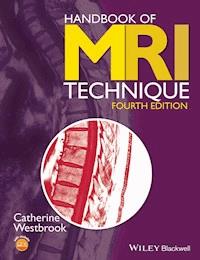
Now entering its fourth edition, the market-leading Handbook of MRI Technique has been fully revised and updated to incorporate new technologies and developments essential to good practice. Written specifically for technologists and highly illustrated, it guides the uninitiated through scanning techniques and helps more experienced technologists to improve image quality.
The first part of the book considers the main aspects of theory that relate to scanning and also includes practical tips on gating, equipment use, patient care and safety, and information on contrast media. The second half provides step-by-step instruction for examining each anatomical area, beginning with a basic anatomy section followed by sections on indications, patient positioning, equipment, artefacts and tips on optimizing image quality.
- Written by an international team of technologists from the United States, United Kingdom and Europe
- Suitable for users for all types of MRI systems
- Now includes key points throughout for quick reference
- Companion website at www.wiley.com/go/westbrook/mritechnique with self-assessment and image flashcards
Handbook of MRI Technique continues to be the ideal support both for radiographers new to MRI and for regular users looking for information on alternative techniques and suggestions on protocol modifications.
Sie lesen das E-Book in den Legimi-Apps auf:
Seitenzahl: 450
Veröffentlichungsjahr: 2014
Ähnliche


















CONTENTS
Cover
Title page
Copyright page
Preface
Acknowledgements
Contributors
1 How to use this book
Introduction
Basic anatomy
Common indications
Equipment
Patient positioning
Suggested protocol
Image optimization
Patient considerations
Contrast usage
Terms and abbreviations used in Part 2
Conclusion
Abbreviations
Part 1: Theoretical and practical concepts
2 Parameters and trade-offs
Introduction
Signal to noise ratio
Contrast to noise ratio
A note on tissue suppression techniques
Spatial resolution
Scan time
Decision strategies
Conclusion
3 Pulse sequences
Introduction
Spin echo
Fast spin echo or turbo spin echo
Inversion recovery (IR/IR-FSE)
Coherent gradient echo (T2*)
Balanced gradient echo (T2*)
Incoherent (spoiled) gradient echo (T1/PD)
Steady-state free precession (T2)
Echo planar imaging
Magnetic resonance angiography
Conclusion
4 Flow phenomena and artefacts
Flow phenomena
Introduction
Time of flight
Entry slice phenomenon
Intra-voxel dephasing
Flow artefact remedies
Artefacts
Introduction
Phase mismapping
Aliasing
Chemical shift
Chemical misregistration
Truncation
Magnetic susceptibility
Conclusion
5 Gating and respiratory compensation techniques
Introduction
Cardiac gating (ECG gating)
Lead placement
How to improve the trace
Cable safety
Peripheral gating (Pe gating)
Gating parameters
Cine imaging
Respiratory compensation (RC)
Conclusion
6 Patient care and safety
Introduction
Patient safety
Patient counselling
Patient immobilization
Patient after care
Conclusion
7 Contrast agents
Introduction
Positive contrast agents
Negative contrast agents
Conclusion
Part 2: Examination areas
8 Head and neck
Brain
Basic anatomy
(Figures 8.1 and 8.2)
Temporal lobes
Basic anatomy
(Figure 8.21)
Posterior fossa and internal auditory meatus
Pituitary fossa
Basic anatomy
(Figure 8.32)
Basic anatomy
(Figures 8.36 and 8.37)
Paranasal sinuses
Pharynx
Basic anatomy
(Figure 8.45)
Larynx
Basic anatomy
(Figure 8.45)
Thyroid and parathyroid glands
Basic anatomy
(Figures 8.52 and 8.53)
Salivary glands
Temporomandibular joints
Basic anatomy
(Figure 8.55)
Vascular imaging
9 Spine
Cervical spine
Basic anatomy
(Figures 9.1 and 9.2)
Thoracic spine
Lumbar spine
Whole spine imaging
10 Chest
Lungs and mediastinum
Basic anatomy
(Figure 10.1)
Heart and great vessels
Basic anatomy
(Figures 10.9 and 10.10)
Thymus
Breast
Basic anatomy
(Figure 10.23)
Axilla
Brachial plexus
11 Abdomen
Liver and biliary system
Basic anatomy
(Figure 11.1)
Kidneys and adrenal glands
Basic anatomy
(Figure 11.8)
Pancreas
Basic anatomy
(Figure 11.15)
Vascular imaging
12 Pelvis
Male pelvis
Basic anatomy
(Figure 12.1)
Female pelvis
Basic anatomy
(Figure 12.10)
Obstetrics
13 Upper limb
Shoulder
Basic anatomy
(Figure 13.1)
Humerus
Basic anatomy
(Figure 13.12)
Elbow
Basic anatomy
(Figures 13.13 and 13.14)
Forearm
Wrist and hand
Key points
14 Lower limb
Hips
Basic anatomy
(Figure 14.1)
Femur
Basic anatomy
(Figure 14.7)
Knee
Basic anatomy
(Figure 14.8)
Tibia and fibula
Basic anatomy
(Figure 14.19)
Ankle
Basic anatomy
(Figure 14.21)
Foot
Vascular imaging
Basic anatomy
(Figures 14.33 and 14.34)
Index
Access to companion website
End User License Agreement
List of Tables
Chapter 02
Table 2.1 Summary of parameters
Table 2.2 Parameters and their trade-offs
Chapter 03
Table 3.1 Comparison of manufacturer acronyms (see
How to use this book
for abbreviations)
Table 3.2 Summary of the contrast characteristics of pathology and normal anatomy
Chapter 04
Table 4.1 Artefacts and their remedies
Chapter 08
Table 8.1
Summary of parameters
Chapter 09
Table 9.1
Summary of parameters
Chapter 10
Table 10.1
Summary of parameters
Chapter 11
Table 11.1
Summary of parameters
Chapter 12
Table 12.1
Summary of parameters
Chapter 13
Table 13.1
Summary of parameters
Chapter 14
Table 14.1
Summary of parameters
List of Illustrations
Chapter 01
Figure 1.1 Correct placement of a flat surface coil in the bore of the magnet. The surface of the coil (shaded) area must be parallel to the Z axis to receive signal. The coil is therefore positioned so that transverse magnetization created in the X and Y axes is perpendicular to the coil.
Figure 1.2 Positioning of the alignment lights.
Chapter 05
Figure 5.1 The correct placement of gating leads.
Figure 5.2 A normal ECG Trace and the correct placement of the triggering threshold relative to the R wave.
Figure 5.3 Correct positioning of the respiratory bellows to ‘catch' both thoracic and abdominal respiration.
Chapter 08
Figure 8.1 Transverse aspect of the brain showing inferior structures.
Figure 8.2 Oblique aspect of the brain showing inferior structures.
Figure 8.3 Axial/oblique FSE T2-weighted image of the brain showing normal appearances.
Figure 8.4 Sagittal SE T1-weighted midline slice of the brain showing the axis of the anterior and posterior commissures.
Figure 8.5 Sagittal SE T1-weighted midline slice of the brain showing slice prescription boundaries and orientation for axial/oblique imaging.
Figure 8.6 Sagittal SE T1-weighted image showing slice prescription boundaries and orientation for coronal imaging.
Figure 8.7 Axial IR T1-weighted image using a TI of 700 ms.
Figure 8.8 Axial/oblique FLAIR image of the brain. Periventricular abnormalities will have a high signal intensity in contrast to the low signal of CSF which has been nulled using a long TI.
Figure 8.9 Axial/oblique incoherent (spoiled) GRE image of the brain.
Figure 8.10 SS-FSE T2-weighted image of the brain. The entire brain was scanned in 40 s.
Figure 8.11 SS-EPI image of the brain. The entire brain was scanned in 14 s.
Figure 8.12 DWI showing large area of high signal on right. High signal on a DWI can be the result of restricted diffusion or ‘T2 shine-through'.
Figure 8.13 Calculated ADC image showing restricted diffusion (acute stroke) as low signal. Small area of high signal in right posterior represents ‘T2 shine-through'.
Figure 8.14 T2-weighed FLAIR showing lesion.
Figure 8.15 Fractional anisotropy (FA) map showing anisotropic (ordered) diffusion in the white matter tracts.
Lesen Sie weiter in der vollständigen Ausgabe!
Lesen Sie weiter in der vollständigen Ausgabe!
Lesen Sie weiter in der vollständigen Ausgabe!
Lesen Sie weiter in der vollständigen Ausgabe!
Lesen Sie weiter in der vollständigen Ausgabe!
Lesen Sie weiter in der vollständigen Ausgabe!
Lesen Sie weiter in der vollständigen Ausgabe!
Lesen Sie weiter in der vollständigen Ausgabe!
Lesen Sie weiter in der vollständigen Ausgabe!
Lesen Sie weiter in der vollständigen Ausgabe!
Lesen Sie weiter in der vollständigen Ausgabe!
Lesen Sie weiter in der vollständigen Ausgabe!
Lesen Sie weiter in der vollständigen Ausgabe!
Lesen Sie weiter in der vollständigen Ausgabe!
Lesen Sie weiter in der vollständigen Ausgabe!
Lesen Sie weiter in der vollständigen Ausgabe!
Lesen Sie weiter in der vollständigen Ausgabe!
Lesen Sie weiter in der vollständigen Ausgabe!
Lesen Sie weiter in der vollständigen Ausgabe!
Lesen Sie weiter in der vollständigen Ausgabe!
Lesen Sie weiter in der vollständigen Ausgabe!
Lesen Sie weiter in der vollständigen Ausgabe!
Lesen Sie weiter in der vollständigen Ausgabe!




