


Erhalten Sie Zugang zu diesem und mehr als 300000 Büchern ab EUR 5,99 monatlich.
- Herausgeber: Mercier Press
- Kategorie: Geisteswissenschaft
- Serie: Hidden City Series
- Sprache: Englisch
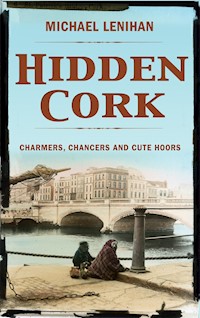
NOW AVAILABLE IN PAPERBACK.In this collection, Michael Lenihan delves into the rich tapestry of Cork's history to reveal some of its most bizarre events and strangest characters. From quack doctor Baron Spolasco, to the outlaw Airt Ó Laoghaire, Cork has seen some eccentric, wonderful and even some downright nasty people.With revelations of mass graves in Bishop Lucey Park,how Jonathan Swift was awarded the freedom of the city, stories of the Gas Works' strike and the trams of the city, Hidden Cork opens the door on history, dumps the boring bits and brings to life the flow of time through the streets of Cork.
Sie lesen das E-Book in den Legimi-Apps auf:
Seitenzahl: 307
Veröffentlichungsjahr: 2010
Das E-Book (TTS) können Sie hören im Abo „Legimi Premium” in Legimi-Apps auf:
Ähnliche




















MERCIER PRESS
3B Oak House, Bessboro Rd
Blackrock, Cork, Ireland.
www.mercierpress.ie
http://twitter.com/IrishPublisher
http://www.facebook.com/mercier.press
© Michael Lenihan, 2009
ISBN: 978 1 85635 708 1
This eBook is copyright material and must not be copied, reproduced, transferred, distributed, leased, licensed or publicly performed or used in any way except as specifically permitted in writing by the publishers, as allowed under the terms and conditions under which it was purchased or as strictly permitted by applicable copyright law. Any unauthorised distribution or use of this text may be a direct infringement of the author’s and publisher’s rights and those responsible may be liable in law accordingly.
Contents
Title Page
Copyright Page
Foreword by Dr Dónal Ó Drisceoil
Quack Doctor in Cork
The Sinking of SS Killarney
Harry Badger
Eccentric Mayor Pick
Scab Labour
Two Cork Criminals
Priest Hunting in Cork
Mass Grave of 1690
Early River Transport
Paying for a Title
An Insult to Swift
Muskerry Tram Crash
Cork’s Silent Transport
James Barry, Female Surgeon
A Letter Writer
The Bibliophile Bishop
A Mayor Hanged
The Waterloo Glass Factory
Tales of a Rake
Cork Arctic Explorer
The Paper Man
The Outlaw Art Ó Laoighre
Abducting an Heiress
Bull-baiting in Cork
The Rebels
Early Aeronautics in Cork
Healthcare for the Poor
Buried Alive
Abandoned Babies
Steeple Ready to Fall
The Bard of the Lee
Cork’s Greatest Collector
Founder of Roches Stores
Arson and Murder
The City Flooded
Controversial Election
Cork’s Finest Hour
Legend and Land Squabbles
Travelling in Cork
Catholic Bishop, Protestant Landlord
Eccentric Historian
Queen’s Arson
Black Eagle of the North
Henry Ford
Folklore of Cork
Battle of the Starlings 1621
Lamentable Burning
A Cork Poisoner
St Anne’s Shandon
Failing Banks
Lotto Fever Hits Cork
Scandals, News and Gossip
Debtors Incarcerated
Rebuilding the Cathedral
Riots and Faction-Fighting
Bells and Cannons
The Illumination of Cork
Records of Cork
Criminals Whipped
Beggars
Commercial Buildings
Cork Workers in Conflict
Perfectly Preserved
First Cork Exhibition
Murder of the Lord Mayor
Hunger Strike
Slaves Jump Ship in Cork
Revolutionary Doctor
Smith’s History of Cork
Beamish v. Murphy’s
Promoting Fine Arts
The Sirius
Tom Green
Bibliography
To my wife Josephine,
my son Andrew,
my daughter Catherine
and grandson Culann
Foreword
Cork, like everywhere else, has a rich and varied history (though Cork’s, of course, as any native will tell you, is richer and more varied than most!). Historians set out to describe, explain and analyse the city’s past in context, forging long narratives, drawing out links, identifying patterns and probing the dynamics of Cork’s political, social, economic and cultural life over the centuries. This is not Michael Lenihan’s purpose. He is an avid collector of documents and artefacts relating to Cork’s history and with a keen eye and Corkonian’s feel for his native place he has delved into his wonderful collection and served us up a cornucopia of Leeside characters, events and places which brings the city’s past to life.
This Cork miscellany, in the fine tradition of the late Seán Beecher, shines light into both familiar and unfamiliar corners of the city’s history, illuminating – through sketches of weird and wonderful characters, travellers’ descriptions, beautiful illustrations, potted histories of buildings and landmarks and succinct accounts of bizarre and fascinating events and episodes – multiple aspects of ‘hidden’, historical Cork. We descend joyfully in a hot air balloon onto the city’s trams, visiting – in no particular order and amongst much more – factories, graveyards, asylums, prisons, hospitals, churches and dispensaries, before observing some bull baiting, starling battles, faction fights and slave escapes in the company of quack doctors, bibliophile bishops, striking workers, bards, beggars and arctic explorers, all lit up by gas lamps and burning buildings.
Michael has a peerless collection of rare illustrations and photographs of historical Cork, a number of which are published here for the first time and are alone worth the cover price.
Informative and entertaining in equal measure, Hidden Cork gives the lie to the notion that history can ever be boring. Like all good popular histories, itshould encourage some readers, their interest aroused or curiosity tickled by the portrayal of a particular character or event, to delve deeper into aspects of our rich past.
DR DÓNAL Ó DRISCEOIL Department of History University College Cork
Quack Doctor in Cork
Baron Spolasco was a notorious quack doctor during the early 1800s. He made spurious claims of successful cures for practically every known disease and affliction at that time. The baron printed leaflets selling his own medical potions such as ‘balm of Spolasco’ and his famous ‘Antiphroditic’ cure-all, which apparently never failed. His other infallible cures, ‘the life preservers’, he claimed, were used in boarding schools, factories, coal and lead mines, and always had the effect of keeping everyone that took them hail and hearty.
During 1837, the bold baron was peddling his wares in Limerick. After his farewell address to the people of Limerick, he proudly announced that he would travel to Cork to afford to sufferers there the benefit of his cures in the most unyielding cases, although other practitioners had pronounced them ‘incurable’. This was followed by a series of advertisements in the Cork Standard, outlining a list of local cures followed by the sale of 2,000 boxes of his ‘vegetable patent pills’. An advertisement in the Cork Standard on 4 December 1837 stated:
I, George Daly, Plasterer North Mall, do certify that Baron Spolasco cured me effectually of a diseased arm (the limb was swelled to an enormous extent), and that I was altogether unable to use a knife and fork and was thus afflicted for three years.
Further miraculous cures were pronounced, such as the case Spolasco recorded in his book, The Narrative of the Wreck of the Killarney:
Mrs Horrigan, wife of a farmer at the Mile-House, Blarney Lane near this city, perfectly cured of cancerous sores upon her nose and face, which for seven years had disfigured her. This person was cured without an operation, and no mark left!
Cornelius Smith of Hammond’s Marsh was cured of paralysis of the arm from which he suffered for several years. He was so fully cured that he could return to gainful employment thanks to the baron’s medical expertise. The baron successfully treated numerous people, including two patients who were blind for twenty years and could now see thanks to his wonderful treatments. He found it necessary to charge the princely sum of five shillings to a poor person for his advice, but the wealthy would have to pay the usual fee of one guinea – no doubt, a nice little earner at the time. His consulting rooms were at No. 4 King Street (currently MacCurtain Street).
Possibly because he was afraid he would be exposed as a fraud, he eventually decided to leave Cork. The baron said, ‘he had received an urgent call from the agent of a person of high personage with regard to a difficult surgical case’. He left Cork with his son Robert and they departed on the paddle steamer the SS Killarney. Following the sinking of the Killarney and the loss of his son, his next port of call was Glamorgan in Wales. There he had a special medallion struck in his honour. This unofficial advertising token proclaimed that the baron had 5,000 recent astounding cures to his credit.
It is recorded that he treated Susannah Thomas at Bridgend Glamorgan for severe stomach pain. Upon examination, he informed her that he knew by her eyes that she was extremely ill but that he could cure her. He prescribed two pills which he handed to the patient and charged 22s 6d for his services. Susannah’s condition grew worse and the baron prescribed a wine-glass full of brandy mixed with a glass of wine stating, ‘That will rouse her.’ But this concoction did her constitution no good, so the baron revisited the patient. He then administered two spoons of castor oil followed by an ounce of turpentine. Within fifteen minutes, Susannah was dead. The autopsy revealed that she had a duodenal ulcer.
A coroner’s court brought in a verdict of manslaughter as the medicine found in the deceased was ‘highly injurious’. It also emerged that the baron had treated twelve other patients in Bridgend with the same pills. A warrant was issued for the baron’s arrest and he subsequently appeared before the magistrates, and was committed to Cardiff jail to await trial at the next quarter sessions. He wrote to the newspapers saying that it was all ‘a foul conspiracy got up against him’.
Following his release from prison, after a successful appeal, he decided to head for America where he was unknown, as it would provide him with rich pickings. He departed for the United States where he frequently appeared in a carriage drawn by four fine horses, hired to cause a sensation. Because of his showmanship and great impudence, he continued to fool many people and made a great deal of money while in America.
Little is recorded about the baron’s subsequent life, but he eventually died penniless in New York in December 1858. The Gentleman’s Magazine of the time records, ‘the death recently of the quack, Doctor Baron Spolasco well known in South Wales and Gloucestershire’.
The Sinking of SS Killarney
The steamer Killarney, heading for Bristol, set sail on the morning of Friday 19 January, 1838, from Penrose Quay at about 9.30 a.m. Captain Bailey was in charge and it had a large cargo of pigs on board. Having left the harbour the weather deteriorated, with heavy falls of snow, and the captain decided to head back to Cobh. The vessel remained at anchor for a time before the captain decided to head to sea once again. It was now dark and the weather soon grew even worse.
At about two o’clock in the morning, the vessel heaved terribly with one passenger shouting ‘the vessel is filling, we shall all be lost’. Everything was thrown about and broken on the ship. Carpet-bags, glasses, candlesticks, etc., were strewn everywhere and one hundred and fifty pigs were washed overboard. Because of the heavy mist, no one knew where they were. The engine stopped and the steamer listed. Water poured through a hole in the stern, filling the engine room, and several passengers were washed overboard.
The captain did everything he could to return to Cork Harbour, but the sails were shattered to pieces by the storm and the engine boilers were out of action because of the water. The pumps were the only things keeping the Killarney afloat and, when she struck a rock in Rennie Bay, she broke up. The mast, funnel and rigging gave way with a thunderous roar as they bent and cracked, and within an hour no trace of the wreck was visible. A number of passengers made it to a nearby rock with the night approaching, and spent the night clinging onto the rock. Sadly not all survived the cold and dark to see the morning.
Early on Sunday morning hundreds of people appeared on the beach near the wreck collecting various items including the bodies of the drowned pigs. They were more interested in plunder than in the survivors who were clinging to the rock. For some time no amount of shouting or pleading could convince the mob to help the stranded survivors. However, finally one gentleman on the beach ascended the high cliff, about four hundred feet above the rock, while several others descended to the bottom edge of the cliff with ropes and slings. Mr John Galwey and Mr Edward Hull attempted, with the aid of a musket, to get a line onto the rock, but were unsuccessful. It was then decided to run two ropes from the cliff on the east of the rock to the cliff on the west of the rock, leaving the centre to overhang the rock. A young boy attempted to ascend the ropes to the cliff, but fell into the water and was drowned.
The survivors had to endure another night on the rock as darkness fell. Exhaustion, extreme cold, thirst and hunger made everyone silent and motionless. Morning came and Lady Roberts, with thirty men, arrived on the scene and a basket containing a bottle of wine, whiskey and some bread was lowered down. Instructions were issued to attach a further line around the rock and a cot was lowered. Mary Leary was the first passenger saved by this ingenious contraption and she was drawn through the air amid cheers. The cot was lowered continuously until everyone was removed safely. The passengers and crew had totalled fifty persons, thirty-six of whom were lost and fourteen rescued. One of the fourteen brought ashore died soon afterwards from the effects of hypothermia.
After nearly a week’s recuperation, on Monday 29 January, the survivors headed for Cork in four carriages. Crowds of spectators assembled on the road to Carrigaline full of excitement and curiosity. On Monday evening at 7 o’clock, nine men and one woman arrived the South Infirmary for further treatment, while the remaining three passengers were well enough to return home.
One month later, a similar disaster almost occurred aboard the Victory, a steamer which departed from Cobh on 17 February 1838. On that occasion, the captain ordered that the five hundred pigs on board be thrown overboard to lighten the ship and as a result of this action, the vessel subsequently reached Kinsale Harbour safely.
Harry Badger
Over the years Cork has had numerous characters – quaint, strange and amusing. Unfortunately, when a character dies they cannot be replaced, but stories about them are retold until finally they fade, and they are ultimately forgotten. We are lucky that records of some of our most colourful Cork characters still exist. One such gentleman, Harry Badger, flourished during the 1820s. Harry spent most of his time on South Main Street near the old City Courthouse. He was very popular with the locals who constantly played tricks on him.
It seems that Harry had no taste buds and was likely to eat or drink almost anything that came his way. A few lads arranged to meet him at the local watering hole. A pint of the finest porter was paid for and given to the bold Harry. Amidst the cheers and laughter, a lively mouse was dropped into the pint unknown to the recipient. Harry downed the pint in one whip, without even drawing breath. To the astonishment of the crowd the glass was placed on the bar counter empty, with no sign of the mouse. Everyone looked at Harry waiting for a reaction, but all Harry did was give a loud burp, wipe his face on his sleeve and head for the door, smiling. He was asked by one of the lads if he had tasted anything in the porter and he duly replied ‘there was possibly a fly in the drink, but that was no cause for alarm’.
The artist James McDaniel was commissioned to paint a picture of Harry and lithographs were produced by Guy & Co. printers. He wore a brass helmet on his head which was frequently knocked off by the local rascals. To try to prevent this Harry placed a number of iron spikes on the helmet. He wore a red coat with a pair of bright yellow breeches, and was a remarkable sight. He was so popular that many artists sketched him and a number of copies of his image were reproduced on tin. These were mounted as chimney ornaments and were supplied by George Gwynne, who had a shop in the Marsh area of the city (now part of the Middle Parish).
Harry’s favourite food was tripe and the larger the feed, the better. The practical jokers decided to prepare a delicious concoction in his honour. The ingredients were selected, but this was to be no ordinary culinary delight. They cut a pair of huntsman’s leather breeches into tiny pieces, which were then boiled with milk, plenty of onions and a nice seasoning of salt and pepper to add flavour to the dish. They sent for Harry and escorted him to a local hayloft where the steaming pot was placed before him. The meal was so large it was reckoned that it would take several days to consume.
Harry decided to stay in the hayloft until he finished every morsel. It took two days to consume, much to the delight of the practical jokers. Unfortunately, even Harry’s cast-iron constitution was unable to digest such a mixture, and it is believed that he died due to his consumption of pieces of the leather huntsman’s breeches. The boys of Cork mourned him deeply, as they had lost one of Cork’s most amusing and colourful characters.
Eccentric Mayor Pick
The eccentric Vesian Pick, a Huguenot immigrant from France, was elected mayor of Cork in July 1779, having previously served as city sheriff. It appears that during the French landing at Bantry Bay in 1796 he was involved in organising the city’s defences. He was out of pocket as a result and received compensation of £29 14s 1d. The Lord Lieutenant arrived in the city in 1797 and was entertained lavishly by Vesian. The citizens contributed £97 7s 10d to-wards the expenses incurred by the Lord Lieutenant’s stay and Vesian received a knighthood for his trouble. The mayor’s annual allowance at the time was the princely sum of £1,200.
He never had a great grasp of the English language. When he wrote to the Lord Lieutenant during the French invasion of 1796 to inform him of the panic within the city, the opening line went as follows, ‘I am writing this letter with a sword in one hand and a pistol in the other.’ His introduction of the city’s sheriffs to the Lord Lieutenant was just as impressive, ‘Ise de Mayor your Excellency and dese are de cherubs.’
During his time in office, one of his functions was to administer judgement at the old court of conscience, an early court system where the law could be applied with clemency. He relied totally upon his clerk Walter Thornhill to advise him. Vesian, not a man to let decorum get in his way, called him ‘Watty’. When any difficult cases came his way, Watty was consulted: ‘What do you tink of dat Watty?’
‘I think so and so, sir.’
‘Well I tinks de very same’, and the matter was dealt with.
If a case came to court which could not be dealt with by Vesian or if Watty was away he would say, ‘Go away; de law could take no hold of dat.’ An order was once given against a person for not paying a debt, and a judgement was given against the debtor’s herd of cows. Having discovered that a bull was among the herd, the warrant was returned to the judge to be changed. With the Wisdom of Solomon, Vesian modified the warrant by writing on it ‘one of these cows is a bull’. So with one stroke of a pen his own peculiar version of justice was dispensed.
Vesian occupied the mayoralty house (now the Mercy Hospital) and one of his duties was to entertain visiting dignitaries. Once, when a sumptuous banquet was to be provided, Watty was consulted with regard to the menu. He suggested turtle soup for a starter as he had heard that a ship was in Cobh selling turtles for about £2. Watty was immediately sent to Cobh to get a fine turtle.
During Watty’s absence, a boat arrived in Cork with some turtles. A sailor arrived at the mayoralty house and Vesian met him in the hallway.
‘What do you want good man, and what’s dat ting?’
‘Why ’tis a turtle your honour and I will let you have it cheap.’
‘How much?’
‘Ten shillings,’ replied the sailor.
Vesian was suspicious of the low price. He had heard of mock turtle soup and, not understanding what this actually was, he flew into a rage shouting, ‘Go out o’ dat, you bad man, you impostor and take that nasty bird out o’ dat; ’tis no turtle at all; ’tis only a mock.’
His final appearance at the municipal council was on 16 January 1821, nearly forty-two years after his election. He died shortly afterwards and was buried within the Huguenot church at French Church Street where his remains were rediscovered in the 1880s during construction work on a new heating system.
Scab Labour
A strike took place at the Cork gas works in February 1901 precipitated by three men taking an unofficial leave of absence. The men were on shift work and requested a leave of absence from the manager, who informed them that they were not allowed to leave the premises due to the heavy work schedule at the time. The men were unhappy with his decision and they promptly left work without permission.
The following morning the manager asked to see them before they resumed work, but they took no notice. At 9.00 a.m. all hands downed tools, claiming that they all had grievances and had decided to write to the directors. They eventually went back to work, but their list of grievances was sent to the directors in March 1901.
One of these complaints concerned a foreman, William Buckley, who allegedly was disrespectful to the men and was accused of petty tyranny. An example was given: on Sunday 3 March an employee, Cornelius Cronin, had his fire cleaned and almost refilled when William Buckley ordered him to empty it and start again. As a result, Cornelius had to wait until 12 o’clock for his breakfast.
The men had ten issues in total and the directors responded to each one a few days later. For example, in regard to the allegation against William Buckley, they claimed that he was always respectful to the men, although they often sorely tried his temper. In respect of the Cronin incident, Buckley said that the fire was full of clinkers, proving that it had not been properly cleaned out. Another grievance that had been raised concerned the wheeling of coal from the parish of St Nicholas to the parish of St Michael, which seemed a considerable distance. The directors, however, pointed out that the parish boundary line ran right through the works so that the men were constantly moving between the two parishes within the gas works wall. The men replied on 15 March and eventually a compromise was reached.
But on 16 May, the manager requested that an extra shovel of coal should be put on the fires in the retort house. This was seen as increasing the work load and the workers took exception to this. As a result four men were fired. Within an hour, the entire workforce was on strike again and when Mr Harrington, the manager, requested that the men return to work, they refused unless their colleagues were reinstated.
The supply of gas to the city was cut off with severe consequences. The manager, clerical staff and others took over the work and a small supply was resumed. The carters then went out in support of the striking workers and the police had to escort all deliveries to the gas works. The strikers picketed the gas works and assaulted strike-breakers who were employed by the company. They were considered the lowest form of life, and were called ‘scabs’ and ‘blacklegs’. The strike-breakers were often imported from other areas, paid a higher rate, and were housed and fed inside the works for their own safety.
The supply of gas had nearly returned to normal when the second largest tank was mysteriously destroyed, causing havoc in the gas works. Appeals were made to the public for a fund to support the strikers, their wives and children. Cork labour leader Cornelius Lehane called a public meeting to be held on Grand Parade and leaflets were circulated urging, ‘Working men of Cork assemble in your thousands and by your presence show to the enemies of labour that you are determined to maintain the strikers in their effort to resist the encroachment of the home-made capitalists. Working men unite! You have nothing to lose but your chains and the whole world to gain.’
Both sides became firmly entrenched until eventually a compromise was reached. The strike lasted until September but the strikers eventually had to accept the gas company’s dictates. It took some time before life at the gasworks returned to some normality.
Two Cork Criminals
Mr and Mrs S.C. Hall were travel writers and made several tours of Ireland in the 1820s. Their aim was to give a general view of the conditions and character of the country from their own experiences. Their book, Ireland: Its Scenery, Character etc. was republished several times because of its popularity. Their descriptions, legends, traditions and personal sketches thoroughly charmed their Victorian readers. A critic in the London Illustrated News said, ‘It is neither a guide book, a tale, a history or a travel book but contains instruction for the tourist, amusement for the reader, information for the student and novelties for the curious.’
The following story is taken from the Cork section of their work: Casey and Hartnett were well two well-known criminals living in Cork in 1825. They accosted a gentleman in Glanmire and robbed him of his money. A policeman gave chase and in the struggle he was killed. They were eventually captured and brought to justice. Because of their previous criminal convictions, they were sentenced to death. The gallows were erected and their graves were dug, but a legal wrangle ensued. The defendants’ lawyer placed a legal challenge on the sentencing. It was pointed out that the judge in passing sentence had forgotten to add the very important words, ‘And be buried within the precincts of the jail’, thus technically failing to complete the due process of law. Consequently, the sentence was declared null and void.
Such was Casey’s fear of death that the jailers believed he would have had to be dragged in irons and forcibly brought to the place of execution. While the judges were deliberating, Casey was hatching a plot to escape. His wife visited him in jail and brought a large oaten cake, which was inspected by the jailer. Nothing was suspected and the cake was given to the prisoner. When his wife left Casey tore open the cake and found the small file she had been instructed to hide inside.
He worked feverishly for many hours filing the iron fasteners of the bars in his cell. His plan was to free himself first and then to release his partner in crime, Hartnett, who was in the cell next door. He eventually succeeded in making an opening and after several hours of super-human effort, he was out. He freed Hartnett in the same way, but Hartnett found it difficult to follow him, as he was exhausted from the effort of forcing himself through the small escape hole and did not have Casey’s stamina. He lagged further and further behind, and finally all he could do was hide in the prison yard and hope to avoid detection.
Casey climbed over two high prison walls, and escape was finally within his grasp. He reached the third wall and accidentally fell into the grave that had been dug for him. He had one last wall to scale but the brickwork crumbled beneath his feet and he fell helplessly to the ground. At that moment the prison clock struck five and he knew that his escape would be discovered, as the cells would be checked. He covered himself in a heap of dirt and waited nervously. He heard the commotion and the warders searching for him; after half an hour he was discovered. The jailers who found him said that if he had a weapon he would have killed anyone who approached him. By sheer weight of numbers, he was restrained and dragged back to his cell, a broken man. The governor, upon interviewing Casey, remarked that he was a small man to have so much strength. Casey replied, ‘All great men were small men’ and laughed.
After the escape had been discovered, the judges were still in session. The death sentence was thrown out and both prisoners were acquitted much to their relief. But as soon as they left the prison and entered the outside world, they were re-arrested. Casey and Hartnett were retried on the robbery charge. The sentencing judge was to have his revenge. They were both convicted and sentenced to transportation to the penal colonies for life. Justice had been done.
Priest Hunting in Cork
The earliest record of the Franciscan friary in Cork ranges from the years 1214 to 1240. It is believed that its founder was Dermot MacCarthy Mór, king of Desmond. He married Petronilla Bloet, and had a good relationship with her Norman brethren. Luke Wadding, in his Annales Minorum, records that accommodation was reserved in the friary for MacCarthy’s private use. MacCarthy is believed to have been buried there when he died at a young age. His son, Finghen, succeeded him and he in turn continued to expand the friary. However, the family’s bad luck continued when the De Cogan’s and Dónal Cairbreach MacCarthy murdered Finghen in 1249. Later it is recorded that Philip de Prendergast donated a sizeable parcel of land to the friars, covering an area from the east of the city to Tobaire Brenoke on the west. He also bequeathed a fishery, which existed near what we now know as the North Mall, and the old distillery.
The location of the tobair or well was marked by a stone on one of the old walls of the Wise’s North Mall distillery. The well was a place of pilgrimage for the citizens of old Cork and was reputed to have medical properties which could cure various illnesses, in particular sore eyes. Another well existed at the Franciscan Well Brewery, and flocks of people used to gather there hoping for a miracle cure for their eye ailments. However, when the friary was suppressed and the confiscated property resold, the new owner blocked up the well to stop any further pilgrimages.
Archaeological evidence unearthed at the rear of the old houses at the North Mall includes carved and inscribed stones. The historian John Windele records that in 1804 stone coffins, containing the remains of eminent nobles, knights and abbots, were excavated from the site. One of these stone coffins had a lid with the inscription in Norman French and a sceptre engraved on the lid.
The Franciscan friary is indicated on the earliest maps of old Cork, including the London Tower map of 1545. Other maps which show the site are the 1585 Trinity map and the Pacata Hibernia map of c.1600. We are fortunate that the antiquarian and folklorist Crofton Croker drew a sketch of the old friary in 1831, because five years later it was demolished.
The friary was suppressed during the reign of Henry VIII and under subsequent British monarchs. During the years 1637 until 1640, Father Francis O’Mahony, a Franciscan, records that Catholics were in control of the city, and a bishop resided in Cork. When the lord president of Munster, Sir William St Leger, took control of the city for the Protestant side in 1644 and expelled the Catholics from Cork, Donagh MacCarthy with the aid of Father O’Mahony plotted a revolt. Lord Inchiquin, Governor of Munster, heard of the conspiracy through paid informers and O’Mahony was arrested. He was tortured by his captors to extract names and details of the plot, but he remained silent. When he was hanged some of his friends immediately cut down his body from the gibbet and brought him to his sister’s house in Castle Street. He was resuscitated and recovered from his ordeal, but when soldiers heard that the priest had survived, they went to his sister’s house, dragged him from it and hanged him again. He did not survive the second time and his lifeless body was removed for burial.
There followed a dark period in Cork’s history of informers, priest hunting and executions, until the relaxation of the Penal Laws in the late eighteenth century.
Mass Grave of 1690
During Cork’s 800th anniversary celebration of its first charter of 1185, Cork Corporation took the bold initiative of creating a public park for the citizens of Cork; it was named Bishop Lucey Park and opened on 6 December 1985. Nowadays this piece of medieval Cork is often thronged with people enjoying a lunchtime break. They are happily sipping coffee and eating their lunch, unaware that underneath the park’s lush growth, hides a dark secret – a huge mass grave filled with the dead of 1690.
Rev. Rowland Davies, an army chaplain with the Duke of Marlborough’s forces, compiled a journal which gives us an insight into the events which occurred during the troubled times of the 1690 siege of Cork. He vividly describes the placing of several cannons far above the city at the Fair Hill end and the utter destruction of two forts near Shandon Castle. The surviving garrison retreated behind the protection of the city walls, but these old walls were no match for this new type of artillery.
Elizabeth Fort was quickly abandoned and the Duke of Marlborough’s artillery exploded throughout the city. On 28 September 1690, heavy cannons were loaded near Red Abbey and concentrated cannon fire pounded the city walls mercilessly until they began to crumble. The Protestant bishop and about 1,300 Protestant inhabitants were taken as hostages by the city’s Catholic defenders and used in an attempt to negotiate a treaty. However, a truce could not be agreed so hostilities broke out again, and the artillery recommenced the bombardment.
The citizens pulled up the street paving in an attempt to deaden the noise of cannon balls shattering the pavements. The cannons outside thundered and roared until they breached the wall on the east side towards Southgate. The Duke of Grafton approached over the river intending to attack the city at the breach, but a musketeer sniping from the city wall mortally wounded him, and he died a week later. The place where he fell was called Grafton’s Alley (now Grafton’s Lane) and is situated off the South Mall.
Naval support was sought by the attackers and the Salamander and another warship sailed to the marsh end. The ships’ guns were aimed at the breach in the wall and cannon balls fired into the city. The defenders were also raked by small ordinance fire from Cat Fort, which was located near modern Tower Street and had a commanding view of the city. Nothing could possibly withstand this attack and the inhabitants surrendered the following morning, 28 September 1690. After the surrender, 4,000 people were confined as prisoners in places of worship.
One can only imagine the carnage, which included the rotting corpses of both humans and animals lying in the streets. As the weather was very wet, both English soldiers and Irish prisoners became ravaged by disease and died in huge numbers. The situation became so bad that some prisoners were released. The illnesses spread to the citizens and the city was soon in a dismal condition. The remains of the dead were buried in a large pit, human corpses and animals thrown in together. Because of pestilence, many traders and citizens fled to other parts of the country or went abroad.
Subsequently, when a school and alms house were being built in the late nineteenth century within the precincts of what is now Bishop Lucey park, a deep pit was discovered in which large quantities of human remains, mixed with the bones of horses, were found.
Over a period of time the stone from the old walls was removed, houses were built and gardens extended. Cork was no longer confined within the walls of its man-made boundary and its expansion brought trade and prosperity to the enlarged city.
Early River Transport
A ferry existed from Lavitt’s Quay across the river to Ferry Lane, adjacent to St Mary’s Dominican church on Pope’s Quay, as early as 1620. On 20 March 1620, the corporation of Cork granted Dominick Roche, his executors and assigns, the sole right of a ferry boat to carry passengers into the city while the new stone bridges were being erected or for one year after the pulling down of the old timber bridges.




