


Erhalten Sie Zugang zu diesem und mehr als 300000 Büchern ab EUR 5,99 monatlich.
- Herausgeber: Mercier Press
- Kategorie: Geisteswissenschaft
- Sprache: Englisch
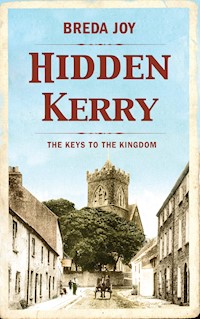
The magnetism of Kerry lies as much in its people as its landscape. 'Hidden Kerry' takes you on the less-travelled paths of the kingdom and is peopled with a varied cast of characters with colourful stories. Open the covers and lose yourself in the story of Lord Kenmare's forgotten mansion, which hosted royal visits until it was consumed by fire in 1913. An amazing edifice of towers, marble and art, it was reduced to a pile of ashes in hours. You will also meet vibrant characters, such as Lily of the Valley: Lily van Ooost, the Flemish artist who made her home in the Black Valley where she embarked on wildly creative textile projects, including knitting a jumper for Dublin's Halfpenny Bridge. As well as this 'Hidden Kerry' will tell you where to find the county's unknown natural beauty spots concealed just minutes off the beaten track.
Sie lesen das E-Book in den Legimi-Apps auf:
Seitenzahl: 338
Veröffentlichungsjahr: 2014
Das E-Book (TTS) können Sie hören im Abo „Legimi Premium” in Legimi-Apps auf:
Ähnliche



















For my father, Brendan, who tells a good story.
MERCIER PRESS
3B Oak House, Bessboro Rd
Blackrock, Cork, Ireland.
www.mercierpress.ie
http://twitter.com/IrishPublisher
http://www.facebook.com/mercier.press
© Breda Joy, 2014
Epub ISBN: 978 1 78117 346 6
This eBook is copyright material and must not be copied, reproduced, transferred, distributed, leased, licensed or publicly performed or used in any way except as specifically permitted in writing by the publishers, as allowed under the terms and conditions under which it was purchased or as strictly permitted by applicable copyright law. Any unauthorised distribution or use of this text may be a direct infringement of the author’s and publisher’s rights and those responsible may be liable in law accordingly.
Content
Acknowledgements
Introduction
Arresting Experience
Kitchener’s Kerry
Fealeside
The Street
Thomas Xavier Doodle
The Smearlagh Way
Bromore Cliffs
Searching for Jesse James’ Grandfather
Lady Lixnaw and Joyce
The Forgotten Village
Cornie Tangney
The Headless Earl
Kerry’s Sherwood Forest
The Town of the Rose
Dynamite in the Night
Brosnan and Sheehy, Peacebrokers
A Manner of Speaking
Hidden Dingle
Ventry’s U-boat
On the Edge
Rescuing Marie-Antoinette
Finding Nimmo
Ancient Cahersiveen
Valentia: A World Apart
The Misses Delap
Derrynane Journeys
The Gun Runner
Albinia’s Jewels
The Eight-Foot Bed
Big Bertha
The Little Nest
Rinuccini’s Road
Lily of the Valley
Mrs Herbert’s Lovers
Doomed Mansion
Killarney’s Old Order
A Strange Twist of Fate
McCormack’s Crubeens
Billy Vincent
Fighting Franco
War Heroine
Famine Fire
Goddess Country
The Moving Bog
Bibliography
Acknowledgements
The opportunity to write this book came my way thanks to photographer Valerie O’Sullivan, who told Mary Feehan of Mercier Press that I had a project on hand about Kerry. Mary put me on the road with a job of work which has afforded me immense satisfaction. Most importantly, she set a deadline which gave me, alternately, a sharp focus and bouts of blind panic.
I received an amount of help from James O’Connor, Allman’s Terrace, Killarney, who has a burning interest in local history and the outdoors. Another pillar of my research was Dingle parish priest Canon Tomás B. Ó Luanaigh, former president of the Kerry Archaeological and Historical Society, which was also an invaluable resource. Other society members who helped me to source information were Noel Grimes, Killarney, and Isabel Bennett, archaeologist and curator of Músaem Chorca Dhuibhne (Dingle Peninsula Museum). I am particularly grateful to Gordon Revington, my colleague in Kerry’s Eye, for drawing my attention to the Second World War heroine, Janie McCarthy. Gordon directed me to Paris-based Isadore Ryan, another man with a fund of knowledge. My thanks to both writers for filling me in on her heroic work in Paris. The erudite Monsignor Pádraig Ó Fiannachta was only ever an email away to enlighten me, especially on the roots of obscure expressions as Gaeilge. I could not have reimagined the Austen-like existence of the Delap sisters without the primary source material provided by their descendant, Joanna Lee of Dublin. Kenmare historian Gerard Lyne was of immense help.
The material in this book is largely drawn from my forays into the Kerry countryside and from the written word. There was no ‘big plan’ and serendipity worked its usual magic. My work as a journalist in Kerry for the past twenty-eight years stood me in good stead. This book would have been much the poorer without the ‘guides’ who shared their knowledge and memories of their own places: Patrick Lynch, Tarbert; Michael Leane, Killarney; Junior Murphy, Cahersiveen; Michael Egan, Valentia Island; Bobby Hanley, Kenmare; Mike O’Donnell and Tomás Slattery, Tralee; Michael Guerin, Listowel; and Bernard Goggin, Dingle. Sadly, Bobby Hanley passed away on Monday 11 August 2014.
Fr Pat Moore introduced me to the Smearlagh Way and Jesse James territory. Thanks also to Peter Malone for providing a list of West Kerry ‘leads’. Seán Quinlan of the Rattoo Heritage Society in North Kerry filled out my understanding of his area.
Pádraig and Kerry Kennelly of Kerry’s Eye eliminated a major headache by formatting the photographs for me. Colleague Bridget McAuliffe gave me sound advice. Jimmy Darcy, sports journalist and colleague, took on ‘Brosnan and Sheehy, Peacebrokers’, the one essay I judged it wiser to ‘sub-contract’.
My research led me to some marvellous books, including Kathleen O’Rourke’s Old Killarney, kindly loaned to me by Maura O’Sullivan. I re-read Joseph O’Connor’s Hostage to Fortune, a pure gem. It was reassuring also to have my copy of T. J. Barrington’s Discovering Kerry at my back when I needed extra facts. Thank you to Kerry County Librarian Tommy O’Connor and his Tralee staff, including Michael Lynch, Noirín O’Keeffe and Tina Cronin; thanks also to Killarney Librarian Éamonn Browne and his staff, to Cahersiveen Library, and to Patricia O’Hare and her staff at the Muckross House Research Library.
I owe a debt of gratitude to Eileen Sheehan, Liz O’Brien and Valerie O’Sullivan for their wise counsel when I was getting frazzled. Special mention to my aunt, Lily O’Shaughnessy, for all those ‘Muckross dinners’. Last, but not least, a word of appreciation of my calm son, Brendan, for cooking at weekends when the only culinary offering in the house was fried brain (mine).
Finally I would like to thank everyone at my publishers, Mercier Press, as well as Liz Hudson and Rachel Hutchings for their invaluable work on the book.
Countless people helped me to gather the stories between these covers. It is impossible to thank everyone individually, but if I have left anyone significant out, please put it down to one of my ‘senior moments’; believe me, there are many. I deeply appreciate everyone’s help and hope to return it in kind where possible. Ar scáth a chéile a mhairmíd: We all live in the shelter of one another.
Introduction
'Do I not meet scores of people who tell me they would love to go to Kerry, but they have never been nearer than Killarney.’ These words of Samuel Murray Hussey (1824–1913), an infamous landlord’s agent, distil better than anything the intent of this book – to move away from the well-beaten tourist paths and reveal the wider and deeper dimensions of Kerry.
I have to confess my handicap in this respect from the outset; I am one of the Killarney breed who drive our neighbours in Tralee, Dingle and Kenmare to distraction with notions that our lakeland valley is Heaven itself. But the remarkable thing is that it practically is. See how the malaise can take hold and take care, because neither visitor nor native is immune to the spell of our mountains and lakes.
On a more serious note, I have made it my business in my research to travel down narrow roads and into hinterlands where guesthouse signs and rental cars are as scarce as the proverbial hens’ teeth. In the case of the main towns and well-known routes, I have gone beyond surface appearances to narrate personal histories and to introduce remarkable local characters that you will not find in brochures or guidebooks. The chronology is roughly from the 1500s through to the twentieth century, the eclectic pendulum of subject matter swinging with the verve of a Russian gymnast from the beheading of the Earl of Desmond in 1583 to a special birthday celebration for Big Bertha, the cow, in 1992.
Kerry is known as ‘the Kingdom’, but the county is far from a singular experience; there are kingdoms within kingdoms. The easiest distinction to make is based on the southern and northern divide: South Kerry, where generations survived on mountainy farms, pulled themselves up on the camera straps of dollared ‘yanks’, composed poems or took the boat or plane, and North Kerry of moneyed Tralee, the great fertile plain, the milch cow, the writers, the balladeers and the Norman castles and estates. Other little kingdoms include the legendary Sliabh Luachra floating to the east and famed for traditional music married to floor-pounding set dancing, the ‘highlands’ of Glencar and Bealach Oisín (Ballaghisheen) in the centre of the Ring of Kerry, and ‘Over the Water’ with its stone forts and deserted beaches, near Cahersiveen. In Dingle town you may think you have arrived in West Kerry until you overhear locals talking about heading ‘back west’, signifying Ballyferriter or Dunquin out on the peninsula. Incidentally, I probed a Dingle friend about possible hidden places to write about, only to get the following response (minus the expletives): ‘I have a theory that tourists shouldn’t be told about hidden places; we need a few that will still be our own to get away from them.’
This book’s journey begins at Tarbert on the River Shannon, where many of the county’s early settlers made their entrance, and finishes close to the Cork border under the ancient twin peaks of the Paps Mountains. Writing it has been as good, if not better, than a semester at university for me. I have refreshed my mind on half-forgotten dramas and discovered many new places and characters. It has given me an appreciation of an era in Kerry history when Europe was possibly a far more palpable reality for our forebears, through defensive alliances with the Catholic monarchies of France, Spain, Portugal and Italy, than it is for us today. The North Kerry boyhood of Lord Kitchener of the iconic war recruitment posters, Jesse James’ ancestry in Asdee of the ‘Moving Statues’, the link between James Joyce’s family and Lixnaw, and the electioneering antics of ‘Tom Doodle’ in Listowel all fascinated me, as I hope they will you.
Walking along Bromore Cliffs outside Ballybunion on a still and frosty November afternoon is one of the experiences that will remain with me. Another is listening to Ursula Leslie’s stories as the evening drew in around Tarbert House, where scarcely a chair or a floor tile has been changed since the days when Benjamin Franklin, Charlotte Brontë and Daniel O’Connell crossed the threshold (obviously not all together). To sit in the porch of Tony Walsh’s house on Valentia Island and to hear him relate stories such as a boat outing to the Great Blasket to dance sets in Peig Sayers’ kitchen was pure gold.
When I meet visitors who have taken a guided tour of the Dingle Peninsula, I ask them, ‘Did they tell you the one about the German commander whose U-boat surfaced in Ventry Harbour during the Second World War to put a party of Greek sailors ashore?’ I knew about this humanitarian episode of old, but the escape plan hatched for Marie Antoinette in Dingle was a find for me, even though it is so often recounted ‘back west’ as to be unremarkable; you see a few mountain passes can make our little kingdoms insular.
Many Kerry people, myself included, had all but forgotten that Margaret Thatcher was descended from a Kenmare washerwoman until the story resurfaced when she died. Among the characters who stand out for me are Albinia Brodrick, who turned her back on society life in London to build a hospital near Castlecove on the Ring of Kerry; Cornie Tangney of Scartaglin, who epitomised the spirit of individuality that once marked village life in Kerry; Mrs Elizabeth Herbert, who threw up her life in Muckross House to run away with her lover; and Fr Francis O’Sullivan, a gun-running friar who was beheaded on Scariff Island by Cromwellian soldiers. Some of the most moving stories I came across concern the terrible suffering of Kerry people during the famine years of the 1840s: lonely roads leading to the workhouses, the sundering of families, deaths from disease and hunger and mass graves.
Apart from Kerry’s people and its landscapes, one of the county’s great hidden treasures is its language: the Irish language as it is still spoken, mostly but not exclusively in the Gaeltacht areas, and the particular Kerry brand of Hiberno-English which draws heavily from the Irish. I have written principally about the latter. Bhain mé ard shult as seo (I got great enjoyment out of this) and I hope it will help to keep some of the words and expressions in currency.
I have always made it a priority to be a tourist in my own county but, being a creature of habit, I have tended to go back to my old haunts. This book is as much for the locals as it is for the visitors, to nudge ourselves beyond the familiar and to venture a little further into the paradise we are blessed to live in. What I am conscious of at the end of the day is that a wealth of other places, characters and happenings are still out there waiting to be chronicled. If your corner is not covered this time out, be patient with me, I could be back.
Slán go fóill
Arresting Experience
Tarbert (Tairbeart: ‘peninsula’) is a ‘drive thru’ town for most people: roll off or on the car ferry and continue down the road to Kerry or up the coast through Clare and Galway. But this was not always the case. The list of illustrious visitors to the Shannonside village reads like a ‘Who’s Who’ of the literary and political world of earlier centuries: Benjamin Franklin, Charlotte Brontë, Daniel O’Connell, Horatio Herbert Kitchener, Winston Churchill and Dean Jonathan Swift. Their chief port of call was Tarbert House, dating from 1690 and still home to the Leslie family, who played a key role in the prosperity of the town in the heyday epoch of the 1800s. One of the many treasures from the house’s past is a signed parchment application for Catholic Emancipation, which Daniel O’Connell made to the British House of Commons in 1813.
From 1 May to the end of August, Tarbert House, located at the end of a tree-lined drive opening off the road to the ferry, is open to the public. The custodian of the house and of the family history is Ursula Leslie. A native of Limerick, Ursula was a young barrister enjoying London life to the hilt in the mid-1960s when she met her future husband, John Leslie from Tarbert, on an Aer Lingus flight. To step across the threshold of Ursula’s home and stand in the entrance hall is to enter a world little changed since all those famous visitors alighted on the banks of the Shannon to sample the Leslie hospitality.
Winston Churchill was related to the Leslies through an aunt who married into the family, and he spent some of his boyhood holidays there. Charlotte Brontë visited in 1854; she had just married her father’s curate, Arthur Bell Nicholls, and they were on their way to Killarney on honeymoon. She suffered from tuberculosis and, in March 1855, died at the age of thirty-eight, along with her unborn child. Benjamin Franklin came to visit Sir Edward Leslie, then a Westminster MP, as part of a mission in 1776 to strengthen trade between Ireland and the American republic, then in its cradle days. Lord Kitchener was a young boy when his family lived for a time on an estate between Tarbert and Glin in County Limerick, and he revisited Tarbert House in 1910 as part of a holiday tour. Dean Swift wrote, ‘The Leslies have lots of books upon their shelves. All written by Leslies about themselves.’
One of countless colourful anecdotes related by Ursula Leslie, a no-holds-barred conversationalist, is that of the visit of John Paul Jones, a commander in the US Continental Navy, on a ‘terrible night’ in 1778. Jones weighed anchor in Tarbert after two British gunboats pursued him; he had just sunk two British boats in Carlingford as part of the conflict that had ensued after the Declaration of Independence. At the time, the British marines leased Tarbert House, and Jones sent men ashore to create the illusion of sails with lanterns threaded through tree branches. With the aid of this ruse, he escaped down the Shannon, onto Valentia Island and back to America.
The hall at Tarbert House was tiled for a reason: cockfighting was a gentleman’s sport in the 1800s. Ursula demonstrated how the backs of the hall chairs were designed to fit together as a circle. After dinner, the gentlemen sat astride the circle of chairs to watch the unfortunate birds fight to the death with spurs and claws.
The Leslie coat of arms features a thistle, three buckles and the motto ‘Grip Fast’. Its origins are attributed to a Hungarian nobleman, Bartholomew, the first Leslie to arrive in Scotland in 1067. He is said to have been protecting Queen Margaret, the wife of King Malcolm III of Scotland, when she was swept from her horse into a river after a buckle broke. As he rescued her from the torrent, Bartholomew said, ‘Grip fast, my lady.’
Decorative carvings featuring the Shannon’s bottle-nosed dolphins embellish the hall couch. Other motifs include wheat sheaves, a rope and boats. Other interesting features of the hallway are the musket and bayonet racks and the trestles dating back to the time of the first Kerry Volunteers, formed to guard against a feared offensive by Napoleon’s forces on the Shannon in the late 1700s.
The dining room has all the original furniture, including two gilded Chippendale mirrors carved from one piece of wood. The Leslies were connected through marriage to the Chutes of Tralee, and a silver trophy in the dining room belonged to Trevor Chute.
An entirely different window on Kerry life opens a little further down the road from Tarbert House, at the Tarbert Bridewell Courthouse & Jail Museum, where the exhibition reveals the harsh life of the poverty-stricken classes who were imprisoned or transported to penal colonies during the 1830s. The Tarbert Bridewell was one of eight new bridewells constructed in Kerry between 1828 and 1829. Among the bizarre sentences listed in the exhibition is seven years’ transportation for stealing a book entitled A Summary Account on the Flourishing State of the Island of Tobago. Jonathan Binns, writing in 1837, suggested that there were cases in North Kerry where men ‘had committed petty thefts for the sole purpose of being transported’. Another detail recorded is that the Knight of Glin, who spent his time helping the poor during the Great Famine, died in 1854 from cholera he contracted while visiting a workhouse.
In 1887 John Redmond, who was subsequently to become leader of the Irish Parliamentary Party, defended nine local men who were tried at Tarbert Bridewell for holding an illegal Land League meeting. One of the few Land League flags still extant in Ireland is on display here. It was recovered from the thatch of the Lavery homestead in Church Street in the 1950s and emblazoned with the words ‘Tarbert National League’. It was embroidered by Mrs Lavery, whose husband was treasurer of the group.
The bridewell is the starting point for my walking tour with Patrick J. Lynch, the author of Tarbert: An Unfinished Biography and chairman of the Tarbert Historical and Heritage Society. Patrick explains that Tarbert primarily developed as a harbour town and that, in the early years, it was a busy port for ships delivering goods for the south-west of Ireland. It was well known as a natural harbour and was often used by boats to shelter from storms. During the night of the Big Wind in 1839, a total of thirty-seven schooners took shelter in Tarbert.
Patrick presents an eyewitness account of Famine-time Tarbert thanks to a batch of letters written by Dr Thomas Graham, who was stationed on the HMS Madagascar. The British relief ship was based in Tarbert from 1846 to 1848 as a grain carrier for the south-west of Ireland. Patrick describes the importance of the letters the doctor wrote to his sister at home in Scotland, the lucid style and humanitarian nature of which shed great light on the area at the time. The doctor gives a graphic account of helping people during the Famine years. While he was only supposed to look after the people on the Madagascar, it seems he was unable to refuse locals who urged him to help their sick. He writes of going into cabins and having to wipe away the tears from the smoke as he tried to alleviate the suffering. The letters are simply an invaluable insight into Tarbert of the time.
Patrick explains that travel in the 1800s was often by water, making Tarbert a place of strategic importance in the south-west of Ireland. People travelling south from Dublin went by road or canal to Limerick and transferred to Tarbert, where they continued their journey by sea or by Bianconi coach. (The strategic location of the town came into its own once again in 1969 when the Shannon ferry service between Tarbert and Killimer was inaugurated, linking Kerry and Clare. It is a daily, year-round service.)
The insatiable demand for food and agricultural produce created by the Napoleonic Wars in the 1800s rippled all the way up the Shannon to Tarbert and boosted the harbour town’s trade hugely. As a result of this wave of trade and prosperity, Tarbert acquired a lighthouse, built on a tidal rock to the north of Tarbert Island in 1831; its population had grown to 1,046 by 1846. But, as Patrick points out, the boom was to be followed by a bust, in the normal cycle of economies. ‘The advent of the rail link to Foynes in Limerick in 1858 sounded the death knell for Tarbert,’ he says.
Staying with the boom for now, the ferry road running past the bridewell leads to Tarbert’s piers, built in 1837 and 1859 to service the thriving export trade in corn, butter and pigs. On their return journeys, the ships were loaded with coal, iron and steel. In that era, Tarbert boasted two towering general providers’ stores: Pattersons (1839), which stood where Tarbert’s e-Town is located, across the road from the bridewell, and the six-storey Russells’ Store (1847) on its town side.
Patrick points out the surviving stone perimeter wall of Russells’ Store. Set into the wall is a series of twelve beautifully wrought bronze plaques telling the story of Tarbert and its hinterland from St Senan in the early Christian period right up to the development of the electricity generating station on Tarbert Island in the 1960s. This work of art is reason alone to stop the car in Tarbert. The bronzes, entitled A Storied Shannonside, are the work of artists Liam Lavery and Eithne Ring. Across the street the orange façade of the Swanky Bar provides a striking contrast.
The Green river runs beside Russells’ wall. The walking tour Patrick gives me follows the riverside path beside it and across the footbridge which leads around to Memorial Plaza where two plaques commemorate the district’s war dead and the Tarbert boating tragedy of 1893. This Shannon tragedy claimed the lives of seventeen people, including seven women, who had been returning from an excursion to County Clare on 15 August, a holy day and a festival day throughout Kerry. It is believed that the boat, one of two that travelled that day, was overcrowded and unseaworthy. The loss of life left a deep mark on the psyche of the community.
Of the eleven Tarbert men who died in the First World War, six of them were under the age of twenty-five. Among them was Michael Lynch, who died in northern France on the Belgian border in 1916, at the age of twenty. He was Patrick Lynch’s uncle. From the Memorial Plaza, we walk back up into the town, passing Coolahan’s Bar, in business since 1887, the site of the Munster Bank (1872) and the former AIB Bank, whose closure in 2012 symbolises the demise in Tarbert’s fortunes.
Patrick points out the corner building, the Ferry Hostel, and says it stands on the site of the former Leslie Arms Hotel, which was one arm of the planned estate town developed by Sir Edward Leslie. We continue down Church Street, which becomes the Limerick Road; Glin in County Limerick, seat of the Knights of Glin, is only four miles away. Patrick points out the most significant building on this street: the two-storey house to the left which was the home of Tarbert’s most illustrious son of contemporary times, Thomas MacGreevy (1893–1967). Twice wounded at the Somme, MacGreevy was a poet, a literary and art critic, and director of the National Gallery in Dublin from 1950 to 1963. He moved to Paris in 1927 and became a personal friend of James Joyce and Samuel Beckett. Academic Susan Schreibman, in an article in The Kerry Magazine, wrote that his poetry captured an Ireland ‘unsure of the way forward and uneasy about its past’. She said that his genius was that he was not simply attuned to what was happening in Ireland, but to Europe as a whole. His most anthologised poem is ‘Aodh Rua Ó Domhnaill’.
The day I visited Tarbert, the only sign of vibrancy was Tarbert Comprehensive School, where lines of cars and buses were waiting for the outpouring of students at 4 p.m. Yet something welling from the realms of hope tells me that the Shannon estuary will come into its own again through harnessing natural gas reserves, and the rising tide will lift Tarbert once more. In the meantime, do resist the temptation to drive through: switch off the ignition and savour the history of this storied Shannonside town.
Kitchener’s Kerry
One of the most iconic images of the twentieth century, that of a mustachioed military figure staring out from the First World War recruitment posters, is that of a Kerryman.
Or is it?
Field Marshal Horatio Herbert Kitchener was born at Gunsborough Villa, three miles from Listowel, on 24 June 1850. This undoubtedly makes him a Kerryman by birth, but whether the distinguished British Army officer regarded himself as such is a matter of debate. According to Listowel author Fr Anthony Gaughan, Kitchener was not particularly proud of his Irish origins or nationality. Reminded of his birth in Ireland, the field marshal is reported to have quoted the Duke of Wellington: ‘A man can be born in a stable and not be a horse.’
However, the fact that the famous military figure took the trouble to revisit the North Kerry of his boyhood as an adult suggests that he placed some importance on the fact that he was a Kerryman and an Irishman by birth. In June 1910 Kitchener visited his Kerry childhood haunts: Gunsborough, Crotta, Listowel, Tarbert, Ballygoghlan, Ballybunion and Tralee. A news report in The Kerryman of Saturday 25 June 1910 gave the following account of his visit to Killarney, where he stayed in the Victoria Hotel:
Lord Kitchener enjoyed his trip through the Lower, Middle and Upper Lakes yesterday immensely. He stated that it had been forty years since he had been in Killarney last, and he sincerely hoped he would be able to visit it oftener in the future. He was charmed with the scenery and the weather was ideal.
The report went on to relate how he had signed the hotel’s ‘distinguished roll’ and posed for photographs with the proprietor before leaving for Derreen, the residence of the marquess of Lansdowne, en route to Cork via Glengariff. ‘His lordship charmed everybody with whom he came in contact in the Lake and district by his extreme graciousness and affability and carried away with him the God-speed of everybody,’ it concluded. In July 1910 Kitchener wrote from Roche’s Hotel (now the Parknasilla Hotel) near Sneem to the Leslies of Tarbert House suggesting that he and his brother would call for lunch.
Retired garda superintendent and local historian Donal J. O’Sullivan, a Corkman, posited in an article for the Kerry Archaeological & Historical Society that Kitchener was the best-known Kerryman internationally. He has subsequently admitted that this claim did not meet with a great reception in some corners of Kerry. In fact, I would hazard that Kitchener’s Kerry connection is one of the county’s best-kept secrets.
Kitchener’s birthplace is a story in itself. Gunsborough Villa, which still stands near the village of Ballylongford, was located twelve miles from Ballygoghlan, between Tarbert and Glin, where the future field marshal’s father, Colonel Henry Horatio Kitchener, had bought a bankrupt estate around 1850. Kitchener Senior had served with the British Army in India, and his introduction to North Kerry may have come through his brother, Philip, who was a land agent for the Earl of Dunraven in Adare, County Limerick. Possibly because the estate house was still being refurbished, the heavily pregnant Fanny Kitchener was staying at Gunsborough, which, according to Donal O’Sullivan, belonged to a family friend and retired clergyman, Robert Sandes. The fact that Kitchener was baptised by Revd Robert Wren Sandes in Aghavallen Church of Ireland near Ballylongford the following September suggests that the stay was a prolonged one.
The health of Fanny Kitchener, a vicar’s daughter, was precarious; she suffered from acute deafness and had contracted tuberculosis. Gaughan relates that Henry Kitchener was forced to leave his regiment in India and return to England in 1847 because of his wife’s ill-health. She gave birth to two more sons while the family was still living in Kerry: Arthur Buck in 1852 and Walter in 1858.
Her husband’s reinvention as a landlord on the estate close to the Shannon estuary appeared to bring him a measure of prosperity. According to Gaughan, Kitchener Senior was a harsh landlord who was resented because he had a notorious habit of whipping his tenants. The tables were allegedly turned on him on one occasion when the Knight of Glin, John Fraunceis Eyre Fitzgerald, whipped Colonel Kitchener at the Tralee Races. It is not certain that the Knight’s action was motivated by the treatment of the tenants.
The family lived mostly at a second property, Crotta Great House, near the village of Kilflynn. The Kitcheners purchased Crotta, which has a fascinating history of its own, around 1852. It was here that Horatio spent most of his North Kerry boyhood; he was about fourteen years of age when the family severed their ties with the county of his birth. The family worshipped in the Church of Ireland church in the village of Kilflynn. The ‘Kitchener Memorial Bible’, first presented to the church after Kitchener’s death, has since been entrusted to Saint John’s Church of Ireland in Ashe Street, Tralee.
And what of the boy Kitchener? Gaughan recounts an incident, recorded by Mrs C. E. Gourley in her book They Walked beside the River Shannow, in which he struck one of his father’s staff, Jamsey Sullivan, with his riding crop as Sullivan was felling trees in a wood. Sullivan retaliated by hitting out at Kitchener, who fell from his horse and was knocked unconscious. The incident is described in this way:
Fear gripped the other workmen. It was during the agrarian troubles and had the boy Kitchener died they would have been accused of murdering the landlord’s son. The lad recovered and won the respect of the men for his sense of justice – he did not tell his father, nor have Jamsey punished.
The young Kitcheners were educated at home by tutors, a regime that was said to have left them lagging behind their peers academically. In 1864 the family moved from Kerry to Switzerland in the vain hope that the climate there would improve Fanny’s health, but she died during the summer of that year, at the age of thirty-nine. Kitchener was deeply saddened at the loss of his mother. At boarding school in Switzerland, Kitchener keenly felt the disadvantage of his home schooling. It has been suggested that this experience of feeling inferior spurred him to be a tireless achiever. In 1867 his father remarried and moved to Dunedin on New Zealand’s South Island. Kitchener and his brother Walter spent the school holidays with relatives in Britain because their father had left them behind when he emigrated. This, coupled with his beloved mother’s early death, must have had a huge psychological impact on Kitchener.
His military career saw him serve on numerous overseas postings and won him the admiration of the British parliament, which rewarded him with the title ‘Baron of Khartoum’. His subsequent campaign in the Boer War was marked by unprecedented savagery. He went on to become Secretary of State for War in 1914. The famous recruitment posters, which enjoy an enduring currency no one could have predicted, have made his face instantly recognisable right into the twenty-first century.
Kitchener was killed near the Orkney Islands off Scotland on 5 June 1916 when the warship on which he was travelling to Russia was sunk by a German mine; his body was never recovered. Horatio Herbert Kitchener went a long way for a boy who might have lost his life in a fall from a horse in a Kerry wood.
Fealeside
Where the River Feale loops like a sickle between the Listowel racecourse and the town, the sound of the racing water rises up into Tea Lane and the Gleann. If you are a local, tea is pronounced tae, and the Gleann’s full title is Gleannaphouca or the Glen of the Fairies. The Gleann stretches for about a quarter of a mile along the river line, taking in, above it, a street of little houses where coopers and other craftsmen plied their trade.
The Feale was a natural playground for youngsters like Michael Guerin growing up in the houses of the Gleann in the 1950s. From Lent, when the boys began to fish for brown trout, into June and July, when the white sea trout came up the river in shoals, the river was the centre of their lives. Upstream on the Island Bridge, visible from the terrace of the Listowel Arms Hotel, they dived into a deep pool. The Mill Dam, downstream at Greenville, was another natural meeting place. Sawdust pitched from the bars high up in Market Street down the Market Cliff to the riverbank at the end of fair days was often a source of treasure when the river washed coins out of it. Schoolmaster and writer Bryan MacMahon captured the emotional currency of the river in a song, ‘My Silver River Feale’.
Such were the lyrical topics that occupied Michael Guerin and myself when we surveyed the river from the terrace of the Listowel Arms, a venue that has hosted some of the top names in literature since the Listowel Writers’ Week was founded in 1970. Michael shared with me a poem written by the late Seán Ashe about the houses of the Gleann, which once formed the most populated street in Listowel. Seán was a reporter for local and national papers as well as running a shop with his sister, Nora. His talent as a wordsmith is evident in the following verse from his poem:
Now homeward come the brawny men,
At close of hard-worked day.
The caged birds sing their vesper song,
Back all along the way.
The Convent Bell its age-old spell,
I hear it ringing down.
Its hopeful message to retell,
’Tis evening in the Gleann.
Listowel translates as Lios Tuathail, or Tuathail’s Fort, and in the fine town square I prompted my guide for stories of the occupants of the houses there – I had some memory of Bryan MacMahon talking about piano music cascading through an open window in the evenings. Michael responded with an anecdote about a notorious landlord’s agent, George Sandes, who was said to have ‘died the gander’s death’ in one of the houses. This was a new expression to my innocent Killarney ears. How do I explain it … in delicate terms? The gander’s death besets a person in the throes of passion or in flagrante delicto. Stories of the rapacious Mr Sandes were still very alive in the minds of Michael’s uncles when he was growing up. The agent was said to prey without shame on the daughters of tenants, declaring, ‘If you haven’t the rent book, send me your daughters.’
Leaving all thoughts of priapic ganders behind us, we walked towards Listowel Castle, built by the Fitzmaurices in the fifteenth century, and noted the image of a face about halfway up the right side of the façade. To the rear of the castle once stood a sweet factory, North Kerry Manufacturing. Here, the river walk would bring us all the way out to the Big Bridge on the Tralee Road but we opted to continue through the Square, passing The Seanchaí (Kerry Writers’ Museum) and Saint Mary’s church. The corner house on our right as we left the square was eye-catching for the standard of the decorative plasterwork. On our left as we walked down Bridge Road was Gurtenard House, dating back to the 1830s. Now privately owned, it has been home to a number of families, including the Collis’, Fitzgeralds and Armstrongs. The Earl and Countess of Listowel entertained the local gentry there between 1870 and 1890.
Turning left into the town park, Childers Park, our conversation switched to the writer and balladeer, Seán McCarthy (1923–90), a Listowel man who spent his final days in the North Kerry village of Finuge and whose best-known ballad is ‘Shanagolden’. Michael related how Seán used to joke that the family had a swimming pool front and back when they were growing up on the Forge Road – bog holes. But we recalled too a darker story, which inspired Seán’s song, ‘In Shame Love, In Shame’, which had its roots in a far less tolerant Ireland. One of Seán’s sisters was single when she became pregnant and because of this she was refused admittance to the hospitals in Listowel and Tralee while in labour. Her cruel journey ended in the County Home in Killarney where she died giving birth to a baby girl. When her funeral cortège arrived back in Listowel, the gates of St Mary’s church were locked and chained. It took the intervention of some locals to have the coffin admitted. Seán McCarthy was extremely hurt at the callous treatment of his sister and wrote the song in her memory.
While we remembered Seán and his sister, we sat near the Dandy Lodge at the entrance to the park. The gate lodge, originally located outside Lord Listowel’s house on Bridge Road, was transferred across the road brick by brick in 1997. From here we continued through the park to the banks of the Feale beside the Big Bridge and followed the river to the Garden of Europe, a fresh discovery for me though I visit Listowel often. The sculpture garden is a must-see and was developed on a site which was, in earlier existences, the town dump and a quarry that supplied the stone for the construction of much of Listowel. Our walk continued through the graveyard on Church Road and back into the town centre from where we did another loop, taking in the Lartigue Monorail museum and the Famine graveyard, Teampaillín Bán. North Kerry’s railways, including the Lartigue, are one of the passions of Michael, who wrote and published The Lartigue Monorailways in 1988 and assisted in the publication of The North Kerry Line by Dr Alan O’Rourke in 2013. Proceeds of this book will go towards the Great Southern Trail from Limerick to Tralee. The original steam-powered monorail, designed by Frenchman Charles Lartigue, ran for nine miles between Listowel and the seaside resort of Ballybunion between 1888 and 1924. The museum, located in a former goods shed, is a short distance from Listowel, just off the Ballybunion Road.
The Street
Church Street in Listowel, a street of scholars and craftsmen, has been immortalised in verse by John B. Keane, who spent his boyhood there before decamping a roofline away to William Street, where the family bar is located. His poem ‘The Street’ features in an illustrated wall display opposite Listowel Garda Station.




