


12,96 €
Mehr erfahren.
- Herausgeber: Paraclete Press
- Kategorie: Religion und Spiritualität
- Sprache: Englisch
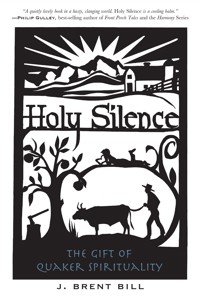
People of all faiths and backgrounds are drawn to silence. We yearn for it in these busy and difficult times, but often, when silence becomes available, we don't know what to do with it. For centuries, Quakers have taught that when we are silent, God grants us insights, guidance, and spiritual understanding that is different from what we might realize in our noisy, everyday lives. This wise book invites us to discover this and other unique gifts of the Quaker way. It is a satisfying experience and taste of a spiritual tradition unflinching in its dedication to listening for the sounds and voice of God. "A quietly lovely book in a hasty, clanging world. Holy Silence is a cooling balm." -Philip Gulley, author of the best-selling Home to Harmony series Visit Brent Bill at his blog: http://holyordinary.blogspot.com/
Das E-Book können Sie in Legimi-Apps oder einer beliebigen App lesen, die das folgende Format unterstützen:
Seitenzahl: 171
Veröffentlichungsjahr: 2005
Ähnliche

















Holy Silence
The Gift of Quaker Spirituality
Holy Silence
The Gift of Quaker Spirituality
J. BRENT BILL
2007 Fourth Printing
2006 Third Printing
2005 First and Second Printing
Copyright © 2005 by J. Brent BillISBN 978-1-55725-420-7
All Scripture quotations, unless otherwise indicated, are taken from the HOLY BIBLE, NEW INTERNATIONAL VERSION. NIV. © 1973, 1978, 1984 by International Bible Society. Used by Permission of Zondervan Publishing House. All Rights Reserved.
Scripture quotations marked (RSV) are taken from the Revised Standard Version of the Bible, © 1952 [2nd edition, 1971] by the Division of Christian Education of the National Council of the Churches of Christ in the United States of America. Used by permission. All rights reserved.
Scripture quotations marked (NRSV) are taken from the New Revised Standard Version of the Bible, © 1989, Division of Christian Education of the National Council of the Churches of Christ in the United States of America. Used by permission. All rights reserved.
Scripture quotations marked (NJB) are taken from The New Jerusalem Bible, © 1985 by Darton, Longman and Todd, Ltd. and Doubleday, a division of Bantam Doubleday Dell Publishing Group, Inc. Reprinted. Used by permission.
Library of Congress Cataloging-in-Publication Data
Bill, J. Brent, 1951- Holy silence: the gift of Quaker spirituality / J. Brent Bill. p. cm. Includes bibliographical references. ISBN 1–55725–420–6 1. Silence—Religious aspects—Society of Friends. 2. Society of Friends—Doctrines. I. Title. BX7748.S5B55 2005 248'.088 '2896—dc22 2004028952
All rights reserved. No portion of this book may be reproduced, stored in an electronic retrieval system, or transmitted in any form or by any means—electronic, mechanical, photocopy, recording, or any other—except for brief quotations in printed reviews, without the prior permission of the publisher.
10 9 8 7 6 5 4
Published by Paraclete Press
Brewster, Massachusetts
www.paracletepress.com
“Never marry but for love; but see that thou lovest what is lovely.”
—William Penn
For Lovely Nancy
CONTENTS
AUTHOR’S NOTE
CHAPTER ONE
Silence: The Quaker Sacrament
CHAPTER TWO
Turned Outside In: Spiritual Silence for Saints and the Rest of Us
CHAPTER THREE
A Thousand Clamoring Voices: Finding Silence in the Noise of Living
CHAPTER FOUR
SoulCare: Practical Steps Toward Silence
CHAPTER FIVE
Gathering: Practicing Communal Silence
CHAPTER SIX
A Holy Hush
ACKNOWLEDGMENTS
Queries
Further Exercises in Quietude
ANNOTATED NOTES
FriendsTalk
A Glossary of Quaker Words and Phrases
Words of Silence
Suggestions for Reading
ABOUT PARACLETE PRESS
Author’s Note
ABOUT THE QUIETUDE QUERIES
Throughout chapters two through five you will find “Quietude Queries.” These queries are intended to provide a “time-out” for reflection. Queries is the Friends practice of examining our souls and seeking clarity. These questions and exercises help to give time to seek truth about ourselves and our spiritual condition, and to tap into Divine insight. Queries guide us in listening for God’s voice in our lives. They are not intended to provide mystical experiences of God, though that may occur.
Quietude means a state of peace and quiet.
These exercises are provided to guide you in peacefully listening to God’s voice and to your own soul in silence. As you read the Quietude Queries, let your mind and soul fill with words, ideas, or images. In silence God gently invites us into the Holy.
CHAPTER ONE
Silence
The Quaker Sacrament
My short, red-headed wife, Nancy, and I marveled as fall colors moved down the mountain across from the Vermont country inn where we were staying. For seven days we watched the golds, russets, and oranges merge into the greens of the valleys. We stood on top of mountains with views of several states and of Canada while the wind whipped what little hair I have left. We wound our rental car along closed-in, curvy, country roads bordered by rushing streams and waterfalls, never able to see more than a few hundred yards ahead of us or a few hundred feet up. For two f latlanders from Indiana, the scenery put us close to sensory overload. I was almost ready to fly back to the safety of Indiana’s landscape with its gentler risings and fallings and bigger sky.
But it was Sunday morning. First Day morning, as older Quakers say. So, before heading to the airport, we drove to South Starksboro Friends Meeting. It was a setting dreamed up by the Vermont tourism council—an 1826 era plain, white, clapboard meetinghouse, its rectangular, steeple-lessness tucked into a clearing halfway up a mountainside. Tombstones dotted the meetinghouse grounds. Sunlight threw the carvings into stark relief.
We took our obligatory leaf peeper pictures while Vermonters indulgently smiled on. Then we made our way across the grass, through the front door, over the wood floor, and settled onto the benches. No modern, padded, or comfortable church pews for us simple Friends. No central heating, either. A black wood stove clanked, stoked for Sunday Meeting. Afghans and comforters sat stacked on one of the benches for those wanting to ward off the chill. Sunlight softened by old, clear, wavy glassed windows filled the room. As did God’s glory.
It was a traditional Friends service conducted in silence. This small group numbered less than a tenth of the Quaker congregation we normally worship with in Indiana. There was no bulletin, no paid preacher, no choir. There was an old pump organ, but it sat tucked in a corner and needed dusting. Any music or message would arise out of the silence—but only if God’s Spirit led someone to sing or share. The preacher in me looked for a clock—it always hangs where the parson, if not the congregation, can see it. There wasn’t one. In spite of that, we all fell silent at about the same time. Some of us bowed our heads. Others wiggled in the benches for a moment, searching perhaps for a comfortable hollow worn by someone’s backside. Exterior sound fell away, save for the ticking of the warming wood stove, the popping of burning wood, and the occasional stifled cough.
I looked and saw Nancy, backlit by sunlight through the window. She sat with head bowed, blue eyes open, and hands folded in her lap. My gaze returned to the wood-planked floor between my feet. I took off my glasses and closed my eyes. Soon interior noise fell away. Thoughts of the late-afternoon flight to Indianapolis, worries about work waiting for me at the office, and the flood of minutiae that swamps my mind when outside noise stops, slowly vanished—dropping into a well of holy silence. I let myself be guided into the deep waters of the soul.
That is when it happened. The only thing I can compare it to is the Catholic belief that in the “celebration of Mass … Christ is really present through Holy Communion to the assembly gathered in His name.” It is the same way with silence for Quakers. Friends believe that Christ is actually present—except we have no host to elevate or priest to preside. Rather, we believe that when our hearts, minds, and souls are still, and we wait expectantly in holy silence, that the presence of Christ comes among us. That October day, on the side of the Green Mountains, Jesus was good to His word that, “where two or three come together in my name, there am I with them.” In the silence, where outer and inner noise ceased, we became what Quakers call a gathered meeting—gathered together and with Jesus. We sensed Him in the electrified air. I felt charged with an awareness of the miraculous—the marrow of my bones hummed in holy recognition of the One who had stood at the dawn of creation and called the world into being. And it did not just happen to me.
The presence of Christ among us changed the hour. Instead of enduring sixty minutes of dragging, stagnant silence, we felt that the first chapter of John’s Gospel had come to life in Vermont—“The Word became flesh and made his dwelling among us. We have seen his glory, the glory of the One and Only, who came from the Father, full of grace and truth.” As if something had been lit deep inside and now shone from their faces, we saw “grace and truth” reflected in the people around us. It was a true Sabbath—free from noise and busyness as we worshiped and were spiritually fed. Though no outward words were spoken, no formal prayers recited, no music played softly in the background to set a mood, God had worked His way into the deepest parts of our hearts and out to our fingers and toes and noses.
Then, too soon, Meeting ended. Don, the person next to me, shifted and shook my hand—a sign among Friends that Meeting for Worship is over. No loud amen’s or formal benedictions for us. Instead we smiled. For a long while no one said anything. No one wanted to break the holy moment. But then our humanness broke in. Small talk broke out. Friends asked for news of mutual acquaintances back in Indiana. Huddled by the wood box, three men discussed who should close off the woodstove. Still, even in this after Meeting chitchat, we sensed that we were now part of each other and of God in a way we had not felt just an hour earlier.
Nancy and I had come to Vermont hoping for some respite from eldercare and work. We were leaving with spirits rejuvenated from an experience that had nothing to do with fall foliage. The Creator had breathed a blessing upon us.
Even as I tell you that story, I am struck by the absurdity of trying to write about silence. Who needs words about silence? Why not just keep silent? Besides, how do you put into words something that is unlike words?
The only justification for trying is that the Friends’ approach to silence is a pathway to God that sates my spirit unlike anything else I have ever experienced. Yes, I appreciate liturgy, hymn singing, sermons, and other religious rituals. But Quaker silence speaks to the spiritual condition in a way nothing else does. This Quaker silence is not just for me or old men on oat boxes or in classic movies, either. It offers a profound spiritual encounter for any woman or man hungry for a fresh way of connecting with God.
Friendly silence speaks—yes, speaks, oddly enough—to the hunger for silence that we see in people all around us. Look at the rising interest in silent retreats and contemplative reading. Something in our souls tells us that getting quiet is a good way to meet God, no matter whether our souls are anxious or settled, swamped by insecurity or swathed in peace.
The prophet Elijah found that out shortly after his showdown with the prophets of Baal on Mount Carmel. Elijah triumphed, and the idolaters lost—their lives. Then Queen Jezebel sent an un-thank you note to Elijah saying, “You killed my prophets. I’ll kill you.” Elijah’s spiritual zeal evaporated, and he got out of town, praying as he went, “God, I’ve had enough. Take my life.” God did not oblige. Instead God told him:
“Go out and stand on the mountain before the LORD, for the LORD is about to pass by.” Now there was a great wind, so strong that it was splitting mountains and breaking rocks in pieces before the LORD, but the LORD was not in the wind; and after the wind an earthquake, but the LORD was not in the earthquake; and after the earthquake a fire, but the LORD was not in the fire; and after the fire a sound of sheer silence. When Elijah heard it, he wrapped his face in his mantle and went out and stood at the entrance of the cave.
Maybe that makes Elijah the first Friend. He learned that God was in “sheer silence.” Other versions say “a still small voice” or a gentle “whisper.” And what he heard in that sheer silence gave him hope and strength to go on living. What Elijah’s story teaches us lies at the heart of Friends silence. This holy hush is about meeting Jesus in an intimate way. Quaker silence encourages us to relax into the love of God until we hear the Spirit’s voice whispering softly in our soul’s ear.
When we really want to hear, and be heard by, someone we love, we do not go rushing into noisy crowds. Silence is a form of intimacy. That’s how we experience it with our friends and lovers. As relationships grow deeper and more intimate, we spend more and more quiet time alone with our lover. We talk in low tones about the things that matter. We do not shout them to each other. We may shout about them to others, but quietness is the hallmark of love.
That is why Christ comes to us when our hearts and minds are silent and still. Quaker silence is pregnant with holy expectation. It is filled with anticipation that Jesus will be there. And not in some abstract, vaguely spiritual feel-good way, either. We believe that Christ comes in a physically present way in the same way that Catholics believe that when the host is elevated it becomes the literal body and blood of Jesus. It is not just some symbol. As Flannery O’Connor, the great Catholic writer, once said of Eucharist, “Well, if it’s a symbol, to hell with it.… It is the center of existence for me; all the rest of life is expendable.”
Friends feel that way about silence. The deep silence of the soul is our Eucharist. Rufus Jones, a Quaker mystic and writer of the twentieth century, said of sacramental silence, “it may be an intensified pause, a vitalized hush, a creative quiet, an actual moment of mutual and reciprocal correspondence with God. The actual meeting of man with God and God with man is the very crown and culmination of what we can do with our human life here on earth.”
This actual meeting of us with God and God with us, as Jones defined it, makes Quaker silence different from other silences. Even other spiritual silences. But this meeting may not seem so different to an outsider who sees us practicing it. She would not see any angels descending. He would not notice halos appearing over our heads. There is no physical evidence of the life-changing activity going on inside us as we experience the love of God filling our souls. “Outwardly,” says Friend Thomas Kelly, “all silences seem alike, as all minutes are alike by the clock. But inwardly the Divine Leader of worship directs us … and may in the silence bring an inward climax which is as definite as the climax of the Mass when the host is elevated in adoration.”
This sacramental language may seem strong from a group that discarded rituals. But Quakers only abandoned rituals in favor of what they considered inner sacraments full of spiritual power. They found that they came to God and God came to them in holy silence. They feasted on Jesus in their hearts. Then they found power to live lives of faithful practice. Friends used silence to throw off the outward and move to the inward, mystical union with the Divine.
The psalmist urges us to “Be still, and know that I am God.” Friends believe that this inward, mystical union is more likely to happen if we approach silence expectantly.
Even though the old Quaker joke calls us to, “Don’t just do something, sit there,” holy silence is more than just sitting there. If it isn’t something more, then we’ll become like the Quakers described by some English fishermen—“They Quakers just came here and sat and sat and nobody never said nothing, until at last they all died and so they gave it up.”
Silence is something we do, not something done to us. It is a participatory act. It engages our heart, mind, soul, and body in listening for the voice of the Beloved. Quaker silence is not passive. After all, how could Holy Communion, which deepens our faith and fills us with passionate love for God, ever be inactive?
Silence allows us to actively pursue a new experience of God. It is open to all, not just Quakers. No one has a corner on living in silence with God. Active holy silence can be for you, as it is for Friends, a “Eucharist and Communion.”
CHAPTER TWO
Turned Outside In
Spiritual Silence for Saints and the Rest of Us
Root beer, the first American flag, fine milk chocolates—all are Quaker inventions of which we humble Friends are humbly proud. If you don’t believe me, check the backgrounds of Charles Hires, Betsy Ross, and the Cadbury clan. Quaker through and through. Sometimes Friends act as if we invented holy silence, too. That’s because it is such an integral part of Quaker life. While we did bring a certain refinement and slant to spiritual silence, we have to admit that using silence as a spiritual practice has a history almost as long as humankind’s spiritual seeking.
If we open some of humanity’s oldest writing we find that worshipers of Mithra, the Iranian god of light and friendship, practiced silence. That’s because they saw silence as a symbol for God. At the same time, in pre-Christian North America, Native Americans used silence as a spiritual discipline. Ohiyesa (which means Winner) was an eastern, woodland Sioux also known as Charles A. Eastman. He wrote, “Each soul must meet the morning sun, the new sweet earth, and the Great Silence alone! What is Silence? It is the Great Mystery! The Holy Silence is His voice!”
The faiths born in the East—Hinduism, Buddhism, and Taoism—have long cultivated an appreciation for silence. They believe silence is essential to spiritual life. They see silence as a mark of spiritual maturity. The Chinese scripture called the Tao Te Ching says, “Those who know do not talk. Those who talk do not know.” Those revered as the holiest people in the East—gurus, bhikkhus, and Zen Masters—are people of few words. They speak little because they believe, as Gandhi said, that “In the attitude of silence the soul finds the path in a clearer light, and what is elusive and deceptive resolves itself into crystal clearness.” That’s why Zen and other Eastern meditations are best practiced in total silence.
In Eastern religions silence is a prerequisite to spiritual purification and growth. Eastern religions teach that silence leads to inner awareness, wisdom, compassion, and loving kindness. Hindus and Buddhists believe silence is a way of achieving Moksha (freedom or salvation), nirvana (right-mindedness), or Buddhahood. In Theravada, silence helps a person to finally realize the ultimate goal—clarity of wisdom.
In the Judeo-Christian tradition, the Old Testament abounds with examples of silence as a means of meeting God. The most famous is the earlier-mentioned exhortation to “Be still and know that I am God.”
The Hebrew Scriptures also show that silence is a way to wisdom—“A wise man will keep quiet until just the right moment,” for example. While the writer of Ecclesiasticus seems more concerned with silence as a way of gaining respect in the community, there is, nonetheless, recognition that silence—the absence of talking—leads us to wisdom. The Bible writers held that wisdom was one of God’s attributes. Silence leads us to wisdom—and an imitation, limited by our human nature as it is, of God.
We also have the Old Testament example of Habakkuk standing at his guard post, keeping watch to see what God had to say. Habakkuk had some hard questions and complaints for God: Why are people suffering? Why is there violence in the land? Why won’t You help? So Habakkuk stands at his post, silent, waiting to hear what God says. God answers Habakkuk. One thing that God says is that God “is in his holy temple; let all the earth keep silence before him.” In so saying, God introduces the idea of silence as a way of worshiping.




