


15,59 €
Mehr erfahren.
- Herausgeber: Oldcastle Books
- Kategorie: Geisteswissenschaft
- Sprache: Englisch
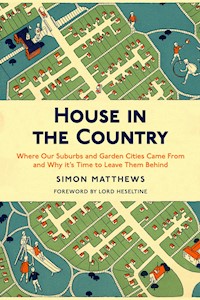
\'Anyone interested in the challenges of housing policy will want to read this methodical analysis of what went well and what did not over much of the last century\' - LORD HESELTINE For nearly 150 years, living in a house in the country has been what many of us aspire to. This book explores how this idea was imported from the US by Ebenezer Howard, founder of the garden city movement, the impact it has had in the UK and why, on cost and environmental grounds, it\'s time to move on from this approach. House in the Country examines the developments in urban planning and residential architecture from 1815 to the present day and considers the legacy of Howard's garden city movement in twenty-first century Britain. An accessible and informative introduction, House in the Country presents a richly detailed narrative containing much historical, social and cultural commentary as well as interviews with key figures in this field.
Das E-Book können Sie in Legimi-Apps oder einer beliebigen App lesen, die das folgende Format unterstützen:
Seitenzahl: 436
Veröffentlichungsjahr: 2022
Ähnliche



















Praise for Simon Matthews
‘Psychedelic Celluloidcovers the swinging sixties in minute detail, noting the influence of pop on hundreds of productions’ –Independent
‘Addresses everything with a thoroughness and eye for detail that’s hugely impressive’ –Irish News
‘The ultimate catalogue of musical references in film and TV from the swinging sixties’ –Glass Magazine
‘Impressively comprehensive… positively jam-packed full of trivia and amusing anecdotes’ –We Are Cult
‘A must-purchase for fans of British films and pop music’ –Goldmine
‘For anyone with a love of the music, fashions, and the scene, or for anyone who simply adores movies,Psychedelic Celluloidis a handy book to own’ –Severed Cinema
FOREWORD
Anyone interested in the challenges of housing policy will want to read this methodical analysis of what went well and what did not over much of the last century. The most depressing conclusion arises from the inconsistency of policy. It is as though new ministers felt they had to make changes as a sort of virility symbol of their competence.
The last words of the book conclude the story with the question as to whether subsequent generations will hold us to account for the inadequacy of their inheritance. We are shown a projection of housing demand to meet the increasing population, the consequences of global warming on coastal communities and the imbalance between public and private housing to name just some of tomorrow’s certainties.
The private sector cannot meet the cost of social housing. Land supply and the cost of acquisition together with all the planning constraints and nimby pressures militate against any radical and comprehensive answers. There are people living in conditions that will be increasingly unacceptable as the years pass. I am all too familiar with the reality of this background having wrestled with its pressures for six years as Secretary of State for the Environment.
A first step, which I would recommend if we are to offer a positive answer to that question, would be the establishment of an independent enquiry to recommend what policies are needed now to provide the all too predictable scale of both public and private housing in the future. Members of the enquiry would be well advised to commence their homework by reading this book.
Lord Heseltine, April 2022
PREFACE
Unless you’re very lucky indeed – and most of us today are not – you will have had at least one, and usually many more, conversations about how expensive it is to buy a house, or how little truly affordable housing now seems to exist. This book arose out of one such conversation.
What it attempts to do is explain why housing is an issue in the UK today, and to highlight the various choices the country has made in the recent past that have produced the present predicament. It also suggests solutions to our difficulties. Too many books present the reader with a narrative that comes across as an opinionated fault-finding exercise. Given the fraught politics of the last couple of decades in the UK, and given too the challenges the country faces in the future, this seemed to me to be an inadequate approach. It’s easy to say what is wrong: it isn’t so easy to fix it.
What the book isn’t is a list of every piece of parliamentary legislation affecting housing, every architect of significance, every major estate or building, every significant public figure linked to housing or every song, novel, play or film with some sort of housing connection. Instead, it offers a narrative threading through the key events, locations and personalities that have affected UK housing policy since the mid-nineteenth century. In doing so it concentrates on the enormous influence that the garden city/garden suburb movement, via its originator Ebenezer Howard, has had (and continues to have) on what kind of housing is built, for whom and where. It suggests that, by default, the UK follows two different models: high-density urban living vs low-density suburban living, with the latter generally preferred. And it argues that whatever the reader’s personal views, the onset of significant climate change demands that we change this.
Thanks are due to publisher Ion Mills and his team at Oldcastle Books, particularly Nick Rennison, without whose largesse none of this would have been possible. I am also grateful for the time given by Lord Heseltine, Joint Leader of the Green Party Councillor Carla Denyer, Councillor Guy Nicholson, Aman Dalvi, Sunand Prasad, Richard Morton, Jonathan Schifferes, Gareth Crawford, David D’Arcy, Andrew Bosi, Tom Bolton, Mazhar Ali and Robin Ramsay all of whom offered advice and opinions about various elements of the text.
Finally – full disclosure here – I served as a local councillor in London between 1987 and 1998. During this time, I chaired a planning committee, a housing committee and sat on a City Challenge board. As well as this my day job for many years involved working as a housing assessment officer for another London local authority. Later, from 2001, I ran my own housing consultancy, buying land and property, advising on land use and carrying out resident surveys across the UK for a client group drawn from local authorities, housing associations and private sector developers. Inevitably, my personal experiences in this field colour the narrative and affect the arguments made, but the positions taken, and the conclusions reached are not partisan, and the aim of the book is to both entertain and inform.
Simon Matthews, February 2022
1
EARLY STIRRINGS
Not everyone in England was pleased by the outcome of the Battle of Waterloo. After 23 years of war, funded by a deeply unpopular income tax, and with the UK dependent on obviously illiberal allies to do most of the fighting on the European mainland, there were many who wanted to withdraw from further conflict, abolish income tax, forswear continental entanglements with Russia, Prussia and Austria, and concentrate on an expansion of trade to deliver the prosperity that the country needed. Among those making this case were Lord Grey, an opposition politician, formerly Foreign Secretary between September 1806 and March 1807, and Robert Wilson, an army officer and radical who had served alongside Wellington in Spain. Both were speaking on the morning of 22 June 1815, at Brooks Club in St James, about the inevitability of Napoleon’s victory when news arrived of his defeat at Waterloo. Thus, instead of gloomy prognostications in Parliament about British-German-Prussian-Dutch reversals, the Secretary of State for War, Earl Bathurst, moved a vote of thanks to Wellington, Field Marshal Blücher and the soldiers of the allied armies.(1)Like many, Grey and Wilson had been prepared to fight France when it was a case of resisting revolution and social upheaval. But neither wanted a Bourbon restoration. When it became clear that this was the alternative preferred by the various kings and emperors of Europe, both had changed their minds about Napoleon. Similar views were shared by the critic and essayist William Hazlitt, Samuel Whitbread, Whig MP for Bedford (who committed suicide in despair), many nonconformist Protestants and even Lord Byron, whose poemThe Age of Bronze(1823) portrayed everything that had happened since Waterloo as a triumph for the selfish, profiteering aristocracy at the expense of the poor.
Nor were such opinions wrong. In the expectation that Napoleon’s 1814 abdication and exile to Elba had brought an end to the cycle of wars that had raged for more than two decades, Parliament had already passed, in April 1815, an Act which forbade any importing of foreign grain until prices reached 80 shillings a quarter, roughly £1,000 a ton. This was a tremendously high level, and one picked to guarantee the profits of landowners even when harvests were poor. Then, with the war against France finally ended at the Treaty of Paris (November 1815), the clamour for the abolition of income tax became impossible to resist, and duly took place in March 1816, after a series of government defeats. Nicholas Vansittart, Chancellor of the Exchequer and MP for Harwich, actually wanted to maintain it, recognising that it was an effective and simple revenue-raising tool. But the tax was so unpopular that Parliament, flexing its muscles and opting for a decisive illustration of its power, ordered the destruction of all documents connected with it.(2)A desire to revert to thestatus quo ante bellumwas also behind the government decision, made in 1819, to return to the gold standard by 1823, a task it completed two years earlier than envisaged. In theory, these arrangements reflected the liberal economics of the time: low taxes, sound money, low expenditure and a balanced budget, all underpinned by free trade. It was considered axiomatic that government spending should be as low as possible, with little made available for education and virtually nothing for health.(3)In practice, despite dramatic cuts in government spending, particularly with the demobilisation of much of the armed forces after 1815, the national debt continued to grow, and the government continued to borrow. Nor was the government against spending large amounts of money on projects that it considered worthy, provided extra taxes were not required.(4)In 1818, it voted to allocate £1m (about £560m in 2020 money) to the Church Building Society as thanksgiving for victory at Waterloo. This was invested in building new Anglican churches, church halls and vicarages, and was specifically targeted at competing with the growing nonconformist and evangelical congregations.
The speed of this enforced transition led to mass protests by the unemployed, exacerbated by a series of poor harvests. The early stages of a national famine occurred in 1816, “the year without a summer”, with extensive rioting taking place in Ely and Spa Fields (London). This was followed in 1817 by an attempted march from Manchester to London by unemployed blanket-carrying textile workers in Manchester and a failed uprising in Derbyshire. The infamous Peterloo massacre, when a gathering in favour of political reform was attacked by heavily armed cavalry, followed in 1819. Many of the participants in these events believed they could favourably petition the Prince Regent and obtain redress for their grievances, or some kind of favourable national settlement. The unrest culminated in the Cato Street Conspiracy, an unsuccessful plan to assassinate the entire cabinet in February 1820, shortly after the death of George III and the accession of the Prince Regent as George IV.
Thus, after 1815, the UK returned to a world where the wealthy lived in some opulence, with scant provision for the rest of the population. Due to the operation of the franchise, most adults (more than 90%, including most of the middle classes) could not vote, and, because boundary changes had not reflected where people lived for hundreds of years, entire towns, particularly recently established manufacturing centres in the midlands and north, had no representation of their own in Parliament.
* * * * * *
In 1820 poet Percy Shelley, then living in semi-exile in Italy, would write inPeter Bell the Third:
Hell is a city much like London—A populous and a smoky city;There are all sorts of people undone,And there is little or no fun done;Small justice shown, and still less pity.
The poem, a savage satire on the London-based ruling class, followed his political versesThe Masque of AnarchyandEngland in 1819 (both 1819) and extended prose essayA Philosophical View of Reform, which would not be published until 100 years later. It portrays a crowded and expanding metropolis at a time when the population of the UK was already drifting from its villages and small market towns to the larger towns and cities. Between 1811 and 1821 the population rose from 18 million to 21 million, and that of London, which grew steadily, comfortably exceeded 1 million. The capital was large, but proportionally smaller than it is now in relation to the rest of the country, and the UK still remained a land of long-established boroughs and small, compact and ancient cities. London and its many crowded streets were considered to be crime-ridden, particularly by gangs of delinquent children (though the extent of this is debated) and there were very few rules governing what could, or couldn’t, be built. Anyone proposing a scheme merely had to ensure that the vestry – the bureaucratic section of the local Anglican parish that dealt with such matters – didn’t object to their plan. For many it was just a question of buying land and starting work.
The growth of towns and cities largely followed an organic process – tendrils of ribbon development slowly advancing along the roads emanating from an old inner core (usually the mediaeval town centre) with, as the development crossed them, rivers and streams culverted into sewers to facilitate drainage. A typical example might be the gradual creeping northward along Ermine Street (now the A10) between Bishopsgate, in the City of London, and Kingsland, in Dalston, then part of Middlesex, of houses, terraces and small streets, the building of which took approximately 250 years. Within cities and towns themselves something quicker was often attempted, and the laying out of a traditional square surrounded with townhouses was particularly popular. This feature first appeared in London in the 1630s, with Inigo Jones a notable exponent, and had been copied from France where Henri IV built the Place des Vosges in 1605. Building around a square or courtyard had, of course, existed in England for centuries prior to this, with many examples of traditional northern European market places to be found across the country, usually where dense networks of buildings faced onto an open space, used for commercial purposes, at an intersection of numerous alleyways and roads. The difference with the Place des Vosges, Covent Garden and its successors, though, was that the properties built as part of these schemes were intended for the very well off, whereas in the older mediaeval “market square” layouts, various social classes tended to live jumbled up together.
Houses were thought of as having an organic life too: they were built, stayed in use for their purpose, went into decline and were often sub-divided into multiple occupancy, with individual rooms separately rented out, before they collapsed into disrepair and were demolished. Most large-scale (by the standards of the time) building was sponsored by wealthy landowners as a means of maximising their return on their estates. From 1800 the Duke of Bedford developed Bloomsbury, where Thomas Cubitt completed Woburn Walk, the first street specifically designed for shopping in 1822. Cubitt also undertook the development of Belgravia, from 1826, for the Duke of Westminster. Promoted as“a stuccoed rival to Mayfair”, its streets featured classical facades and decoration both internally and externally and the scheme as a whole took over 30 years to complete. The greatest exponent of this type of development was John Nash who came to prominence in the 1790s and whose style wobbled between anachronistic Gothic and faux-classical. By 1806 he was personal architect to the Prince Regent, and engaged on the design and building of Regent Street and the massive terraces encircling Regent’s Park, the latter creating an extremely exclusive new residential area of London. Nash’s career was a confirmation that architects were an elite profession, only engaged by the very wealthy. Their training was part of the fine arts, including as it did drawing, an awareness of light, perspective and proportion, and they were heavily steeped in classicism, being deployed on the construction of country houses with landscaped grounds. Appointed to oversee the rebuilding of Buckingham Palace, for which he designed the Marble Arch in 1827, Nash was also a director of the Regent’s Canal Company, which aimed to open up areas adjoining London to commercial development, but would lose his influence after the death of George IV.
Outside London, and with less elevated social connections, James Gillespie Graham designed 150 houses for upper middle-class occupants on the Moray Estate in Edinburgh. Construction of these began in 1822, and the scheme was only finally built out in 1858. Long, drawn-out completions of this type were common then (as now) and reflected the fact that developers building for sale, especially if building an expensive product, would only build at the rate that they could sell. Grainger Town, in Newcastle, was developed for mixed use – shops, public houses, a theatre and houses – by Richard Grainger, John Dobson and Thomas Oliver from 1834 (though adjoining areas were being worked on from 1824). It finally completed in 1841. Similarly, the gated suburb of Victoria Park, Manchester, built by Richard Lane from 1836, took decades to come to fruition. Somewhat less exclusive and dating from the 1830s were Hoxton New Town and De Beauvoir Town. Both were part of the gradual filling in of land along the Ermine Street-A10 corridor and were designed and built by the architects Lewis Roumieu and Alexander Gough. But, again, neither was quick. Although pleasant, clean and well proportioned (compared to many of the surrounding properties) both took until 1850 to complete.(5)
The majority of the “streetscape” created by these schemes, particularly in London, and especially in Belgravia, consisted of houses, built to a density that was typical in European cities, although never quite as high as that found in Paris. In Belgravia, and later in the development of Ladbroke Grove, Kensington during the 1840s, density in selected areas would reach 1067 habitable rooms per hectare, implying a population of 345,000 per square mile if applied consistently: similar to locations like Kowloon today. This reflected how essential it was at the time to compress developments within a small area, reflecting the fact that most people walked everywhere, particularly to and from work.
In terms of what was actually built, the ideal was individual family houses. Apartments (flats) would have been regarded as almost shockingly alien, notwithstanding the historic tendency for many families to live above a shop.(6)The only buildings that resembled flatted blocks were workhouses, and eventually a number of eminent architects did model workhouse designs, including William Adams Nicholson. There was almost nothing, though, that might be called “social housing”, with the arguable exception of almshouses. This was a concept that dated back to mediaeval times, and most towns and cities had a tiny terrace or courtyard of them which were provided almost exclusively by either churches or livery companies, and intended to “relieve” poverty affecting pious, and usually well-connected, elderly residents. Efforts were made to bring the design of such properties up-to-date throughout the nineteenth century, notably by Henry Seward (in Camden for St Martin-in-the-Fields, 1817) and George Porter (in Penge for the Watermen and Lightermen of the City of London, 1840). But their numbers remained tiny, and none was intended for families.
* * * * * *
When victory at Waterloo was being celebrated the idea of building a “new town” barely existed, and density itself in the networks of streets and terraces that spread out from cities was not particularly an issue. But, in the hard, unremitting and largely uncaring years that followed, with cities and towns expanding and exhibiting appalling levels of overcrowding, pollution and generally insanitary conditions, some efforts to address these issues were started.
Anthony Ashley-Cooper, 7thEarl of Shaftesbury established the Labourer’s Friend Society in 1830, to improve the conditions of the labouring classes in rural areas, principally by allotting them land for “cottage husbandry” ie, providing them with space to grow a useful proportion of their own food.(7)This action came after widespread rioting caused by poor wages and impoverishment, much of which occurred a month prior to the July 1830 revolution in France. The English aristocracy required little reminding of how revolutions in France tended to end. Shaftesbury’s action was thus timely, though we might note today, rather curiously, that his grandfather (the 4thEarl) had been one of the founders of the Colony of Georgia in 1733. Here, throughout the 1740s, the Oglethorpe Plan was promoted for building a model capital city at Savannah: an interlocking series of geometric street blocks and squares, where white settler families were given 5-acre kitchen gardens. One wonders to what extent he was aware of this prior involvement of one of his ancestors in creating an ideal living environment. In promoting “cottage husbandry”, he was certainly not following the precedent set by David Dale and Richard Arkwright when they started the settlement of New Lanark in 1785. Here homes had been built to house the workforce of nearby cotton mills. The settlement eventually accommodated 2,500 people in blocks of property spread, mainly due to topography, across 360 acres. However, New Lanark was not widely emulated, possibly because of its location in Scotland or because it provided housing to facilitate industrial production in a country that was still coming to terms with the practicalities of the industrial revolution.(8)
The Labourer’s Friend Society was definitely harking back to a safer, nicer living environment that was supposed to have existed in the recent past, and this theme would become constant through the nineteenth and twentieth centuries as visionaries – and many of the public – sought to avoid the stress of city living. By itself, such sentimentality, or nostalgia, no matter how well intentioned or apposite, might not have amounted to much in terms of social change. But, two things helped. Firstly, a significant cholera pandemic occurred in the UK in 1832, killing 55,000 people nationally, and claiming 6,536 victims in London alone. With so many living in filth and poverty, and nothing approaching a safe water supply available, this was hardly surprising. Secondly, and largely due to the efforts of Prime Minister Lord Grey, whose dismay at Bonaparte’s defeat in 1815 had been at variance with the emotions of so many of his parliamentary contemporaries, 1832 also saw the passing of a Reform Act. This increased the electoral franchise, which rose, in England and Wales, from 400,000 to 650,000, an increase of 37.5%. All remained male and under these arrangements it was still the case that only about 10% of the adult population could vote in parliamentary elections.(9)A very limited form of participatory democracy, Grey’s legislation ushered in an era where the country was ruled by middle-class men whose education, background and interests were somewhat different from the previous aristocracy-dominated electorate with its numerous anomalies. It became easier to pass legislation with a social purpose.
Thus, in the aftermath of 1832, Parliament agreed a year later to spend £20,000 (approximately £7m in 2020 money) on providing facilities to educate the poor. The money was distributed – as was the default position then – to the Anglican Church, for onward transmission to the National Society for Promoting Religious Education. This was followed by the Poor Law Amendment Act, 1834, which established local Poor Law Guardians, funded from a rate paid by local land and property owners. The combination of the education grant, the rate paid to the Poor Law Guardians (who were elected in each parish) and the 1818 donation to the Church Building Society produced three areas of building work – schools, workhouses and churches – where funds, no matter how inadequate, could be accessed to complete projects, and helps to explain why so many nineteenth-century architects specialised in work of this type.
The Municipal Corporations Act of 1835 went further, introducing a uniform system of local government, funded once more by ratepayers, the majority of whom were also electors in the same district. This quickly produced a spate of significant buildings – town halls, libraries, baths, concert halls – but, in terms of expenditure, barely ventured beyond such “public works”. On a grand scale the early 1830s saw the planning of Trafalgar Square and the start of a grandiose Gothic rebuilding of the Houses of Parliament, both involving Sir Charles Barry, assisted on the latter by Augustus Pugin. London also got two new bridges across the River Thames, a Metropolitan police force and the introduction of horse-drawn buses and taxis.
But there was nothing for housing.
Notes
1.The battle took place on 18 June 1815, and was conclusively decided late that day (after 6.30pm) by the arrival of Marshal Blücher’s Prussian army. Wellington’s account of the battle was written on 19 June, reached London on 21 June and was officially published in theLondon Gazetteon 22 June. In holding their views about a likely French victory, Grey and Wilson may have been relying on news of Napoleon’s initial defeat of Blucher at Ligny on 16 June, or possibly of accounts that had reached London of the earlier stages of the fighting at Waterloo.
2.An empty gesture, as the King’s Remembrancer, an official in the Exchequer with a legal duty to keep records of “such things as were to be called upon and dealt with for the benefit of the Crown”, had copies made.
3.Average life expectancy at the time was 41 years, and few, even amongst the middle classes, could afford medical fees.
4.The Public Works Loans Board was established in 1817, originally to fund mines and turnpike trusts. An independent body it loaned money to properly accountable bodies at a rate of interest slightly below market level.
5.Development of De Beauvoir Town actually began in 1821 when William Rhodes, a wealthy local farmer, acquired a lease on 150 acres immediately adjoining the Regents Canal. A court case later concluded that Rhodes had acquired his lease unfairly, and control of the scheme passed back in 1834 to the landowner, Peter Benyon de Beauvoir. (Rhodes’s grandson, Cecil, was responsible for the extension, in the 1890s, of British rule into current day Zimbabwe and Zambia, an area five times the size of the UK, during which tribal-owned land was passed on to white settlers in ways that were widely regarded, then and now, as illegal).
6.In this respect, note that most of the residential dwellings built in Grainger Town, Newcastle were maisonettes above shops.
7.Because of the continued growth, from the eighteenth century onwards, of “enclosures” – the asserting of private ownership over what had once been open land – people progressively lost their historic rights to take reasonable amounts of firewood, and game from such areas. It is instructive to remember that much of the diet of the rural population had been “foraged” as we would now say: hence Shaftesbury’s attempts to address this by the granting of plots of land where they might grow their own food and graze a few livestock.
8.New Lanark passed into the ownership of philanthropist Robert Owen in 1799 and was managed by him according to early cooperative and socialist principles. The homes at New Lanark, though, were not self-contained: as they were built, families occupied a room or rooms and shared various facilities. Owen later visited the US, where in the 1820s he established a number of “Owenite” settlements, none of which survived longer than a few years. Their failure was attributed to most of the residents failing to embrace Owen’s notions of community living and property sharing.
9.The Act directly linked voting rights to property ownership and also specifically stated that voters in parliamentary elections could only be male, disenfranchising the small number of women voters who existed up to 1832. The qualification required in a borough (ie a town) was to be the male head of a household that lived in a property worth £10 a year (£3s 8d per week) in rent: a reasonably high sum, for the time. In rural areas (“counties”) the arrangements were more complex and covered male freeholders of homes worth £2 per annum (an ancient mediaeval qualification – but there were few such cases), those who owned land or had long leases on land worth £10 per annum and those with short leases or tenancies worth £50 per annum. In Scotland, these arrangements increased the electorate by a factor of thirteen. (From 5,000 to 65,000). In Ireland, though, relatively few people met the criteria and the size of the rural electorate barely changed.
2
PIECEMEAL IMPROVEMENTS
The bits of legislation passed between 1832 and 1835 were soon overwhelmed by events in the real world. They proved wholly inadequate to deal with the challenges that arose in the ensuing decade. A truly miserable period, the 1840s were marked by hunger, famine, pestilence and political upheaval. Further reforms were enacted, as a result of which the British state moved very slightly closer to having a government policy on housing – its provision, where it should be built, by whom, and for whom.
The driving force for this came from hunger, poverty and the threat of political turmoil. There were bad grain harvests every year, from 1839 onwards. The impact of these was felt most by those crowded into the UK’s growing towns and cities. The poor were denied the possibility of using grain imported from abroad, and the months of July andAugust 1842 brought extensive hunger riots with 2,000 troops (and 6 field guns) sent to Manchester to face down political opposition led by the Chartists and the Anti-Corn Law League. Manchester had been the birthplace of Edwin Chadwick, who, following an outbreak of cholera in 1838, began preparing, at his own expense, hisReport on the Sanitary Condition of the Labouring Population of Great Britain. This appeared in July 1842 and became one of the best-selling publications of its day. The Prime Minister, Sir Robert Peel, set up a Royal Commission on the Health of Towns, chaired by Chadwick, the following year. The work of this body, and the impact of Chadwick’s original report eventually produced thePublic Health Act 1848 thefirst instance of a British government taking responsibility for the health of the population.(1)
The turmoil of the time, and the problems that ordinary people experienced as they tried to survive in such circumstances, were fruitful material too for novelists, as well as politicians and the authors of official reports. Those who enjoyed Charles Dickens would have noted his switch from the Henry Fielding-type picaresque adventures ofThe Pickwick Papers(1836) toOliver Twist(1837) with its setting in a squalid London of criminal infested “rookeries”. Later works such asA Christmas Carol(1843),David Copperfield(1849) andHard Times(1854), featured a gallery of heartless businessmen, oppressed families, cripples and orphans forced to live and work in a London where they endure a lack of proper living accommodation, crime, illness and poverty.Hard Timeswas also partly set in an industrial (and continually industrialising) metropolis in the north of England. The early to mid-Victorian state-of-the-nation novels includedSybil(1845) written by Benjamin Disraeli, whilst MP for Shrewsbury. Set in a northern town, with horrific living conditions, it reflected his belief that “two nations” existed within the UK, and showed some sympathy for some of the aims of the Chartists.(2)Disraeli’s book prefigured Elizabeth Gaskell’sMary Barton(1848) and Charles Kingsley’sAlton Locke(1849) and may have been an influence on Dickens’sHard Times. All explored similar political and social themes. Mrs Gaskell setMary Bartonin Manchester and showed her main characters emigrating to Canada. Her later work,North and South(1854), likeSybil, argued that society was split, in this case by a difference in the social problems affecting the north of England as opposed to the south.
But, for all the awareness that the novelists of the time demonstrated, Disraeli only sold 3,000 copies ofSybiland Friedrich Engels’sTheCondition of the Working Class in England, which appeared the same year in Germany, was not even published in the UK at the time. A minutely researched account of working people’s lives and circumstances in Manchester, it showed that industrialisation, and the way it forced people to live, had shortened life expectancy in comparison with how the same people had lived and worked a decade or so earlier.(3)Outselling everyone, including Dickens, was George W M Reynolds whoseThe Mysteries of London(1844) used urban squalor to provide lurid, almost gothic, entertainment set in a dirty city inhabited by a starving, ragged working-class and a small, corrupt aristocracy. A Chartist, and an ardent republican, Reynolds emphasised poverty, crime and violence, and, from 1850, ranReynolds’s Weekly Newspaper, which, owned by the Co-operative Party lasted, asReynolds’s News, until the 1960s.
As to what ought to be done, and how it should be paid for, the means to implement even the modest provisions of Chadwick’s Act only existed because Peel, Prime Minister after 1841, and much frustrated by the lack of a significant and reliable source of raising revenue, reintroduced income tax. Effective from May 1842, this was initially set at a rate of 7d in the £ for incomes above £150, and only applied to the relatively wealthy and above.(4)In an era when almost all politicians were independently wealthy, this appears as an interesting example of politicians voting against their own interests and agreeing to do what was best for the country. But, setting the tax at such a low rate only raised a limited amount, and initiatives aimed at improving conditions still tended for many years afterwards to come mainly from private or voluntary sources.(5)Typical of these were the Rochdale Pioneers, a group of artisans who decided to band together in 1843 to open their own store, which they accomplished a year later, selling food items, as a “co-operative”, that they could not otherwise afford as individuals. Similarly, the terrible living conditions faced by many who were forced to migrate to London in search of employment led to the founding of the Young Men’s Christian Association in 1844 by George Williams, who had arrived in the city from Dulverton inSomersetthree years earlier. In Lord Shaftesbury they found a willing patron of the organisation.
The notion that something ought to be done was picked up too at the highest level. In 1845, Victoria Park was opened for the recreational use of those crammed into the teeming slums of the East End. Its origin lay in a masspetitionto the Queen, asking that support be given to recommendations from epidemiologistWilliam Farr, who argued that ill-health was determined by poor environment. The Queen acted: via the Crown Estate, 218 acres of derelict land, mainly spoil left over after gravel and clay had been extracted to make bricks used in the construction of the thousands of houses creeping out from London, was purchased and a large new park – Victoria Park – laid out.(6)
Finally, efforts were made, if only on a tiny scale, to build homes for those who couldn’t afford to buy the properties erected by private builders. In 1844, Shaftesbury’s Labourer’s Friend Society became the Society for Improving the Condition of the Working Classes, with Prince Albert, no less, as President. They engaged Henry Roberts as their architect and, within a few months, had built in Lower Road, Pentonville two narrow terraces designed to house“23 families and 30 aged women”in shared accommodation, different households occupying separate floors within each property.(7)Although an improvement on whatever the residents would have had as an alternative, this quickly turned out to be a far from ideal arrangement. A better plan was devised by Roberts, for the similarly named Metropolitan Association for Improving the Dwellings of the Industrious Classes. Run by Thomas Southwood Smith, a doctor, sanitary inspector and ally of Edwin Chadwick, the Metropolitan Association’s management board was extremely well connected politically, with a membership that included George Hamilton-Gordon (son of Lord Aberdeen, the Foreign Secretary), Viscount Ebrington (a former Lord Lieutenant of Ireland) and George Howard (a former Chief Secretary for Ireland) as well as Thomas Gibson, a merchant and member of the Anti-Corn Law League. Founded in 1841, the Association took some while to prepare and build its first scheme, Metropolitan Buildings, Old Pancras Road. Opened in 1848, this was superior in every respect to Lower Road and contained 21 one- and 90 two-bedroom self-contained flats (each complete with their own flushing lavatories – a huge improvement in itself) in a five-floor block that by virtue of its shape quickly became known as Pancras Square. Solidly built, with pitched roofs, stairwells and long common balconies on each floor that gave access to the front doors of individual flats, it became, with few exceptions, the template for all subsequent blocks of British social housing. Rents were set at 3s 6d (17.5p) per week for a one-bedroom flat and 6s 6d (32.5p) per week for a two-bedroom flat. At a time when a labourer might earn £20 per year (7s-8s per week) this indicates that living in the Metropolitan Buildings either meant spending a very high proportion of one’s income on housing costs, or required one to be a highly paid artisan. But, in the complete absence of government subsidy of any type, it is hard to see what else Southwood Smith and his colleagues could have done. In every other respect they, and Henry Roberts, got the basics right and their development deserves to be better known and appreciated – had it not been destroyed by bombing in 1941, it probably would be.(8)
Slowly, prodded by the emergence of these self-help societies and the influence exerted by a small number of wealthy aristocratic figures, a cadre of architects was appearing who specialised in solving the dilemmas of rapid urban growth.(9)As to what new buildings and blocks should look like, it was clear that visual innovation was frowned on by some of the intelligentsia, and in terms of design, the preferences of many remained backward looking. The same year that Metropolitan Buildings opened, John Ruskin pronounced“…We want no new style of architecture…the forms of architecture already known to us are good enough for us…”Only 29 years old at the time, Ruskin expanded on this view a year later, after a tour of the continent, inThe Seven Lamps of Architecture, in which he argued that the designs executed in the thirteenth century (the “Gothic” style) were truer and more certain than anything subsequently produced. In doing so he was reinforcing the pre-eminence of Augustus Pugin, the leading exponent of what became known as “Victorian Gothic”, and a prolific designer of churches, colleges, presbyteries and country houses through the 1840s. Not content with these commissions, Pugin decried the functional appearance of many of the new workhouses of the time, advocating that such buildings should resemble instead mediaeval monasteries.(10)The views held by Ruskin and Pugin had influence by virtue of their connection to a wider artistic and cultural movement. Ruskin was heavily involved with the Pre-Raphaelite Brotherhood (a group of painters and critics inspired by the clarity and beauty of the art produced before 1500, ie, before Raphael) whilst Pugin, a convert to Catholicism, something which resulted in a plethora of work for him in Ireland, advocated“a return to the faith and the social structures of the Middle Ages”.(11)
Ruskin’s essentially conservative opinions were not necessarily at variance with those held by significant figures within progressive politics, some of whom saw little to be gained by improving urban conditions, and much better prospects to be had by avoiding towns and cities altogether. Feargus O’Connor, formerly MP for Cork (1832-1835) and latterly as the Leeds representative of the London Working Men’s Association, promoted the idea that people should leave heavily overcrowded and insanitary industrial areas and live instead in a properly planned, low-density, rural setting growing their own food.(12)Essentially, people should revert to how they might have lived 50 or so years earlier. To facilitate this, he established the Chartist Co-Operative Land Society in 1845, which bought various pieces of land. One of these, near Rickmansworth, Hertfordshire, covered 100 acres, on which 35 detached houses, with adjoining plots of land were provided. It was called O’Connorville, later renamed Heronsgate, and members of the cooperative “won” their homes through a prizedraw, carried out whenever there were properties available. O’Connor was re-elected to Parliament in 1847, for Nottingham, only to have his plan declared illegal by Parliament a year later on the grounds that it was a lottery and he could never, because of this, reward all those who joined the Chartist Co-Operative Land Society.
It is difficult to understate the unfairness of this attack on the scheme. Parliament involved itself in investigating the National Land Company (as the Chartist Co-Operative Land Society became known) on the basis that complaints were made about how it operated, whilst at the same time a petition containing nearly two million signatures requesting that it be registered as a friendly society was rejected out of hand. Of course, it was true that at any one time there would be a queue of people waiting to win one of O’Connor’s lotteries, and that the only way that queue would “lessen” would be whenever another site was developed. But, on that basis, the Epsom Derby should have been declared illegal too, as it was only held once a year and not everyone who placed a bet could win it. The same predicament affected the early building societies too: the Leeds Permanent Building Society, formed in 1846, was originally intended to wind itself up once it had housed all its subscribers. It continued only because it became clear that people were opening accounts faster than the organisation could build houses.
Perhaps O’Connor should have been more adroit and allocated most of the properties according to housing need, only holding back a few for the prize draw. It is hard not to conclude that the reason his fellow MPs moved rapidly against his scheme was that none of them wanted politically aware (and radical) households rehoused in miniature towns, some of which might well have been in their constituencies. The notion that the Chartists might run their own house-building company, moving educated working men and their families into purpose-built developments was clearly something that alarmed them. O’Connor oversaw the development of six small schemes, one of which, at Dodford in Worcestershire, became relatively successful and proved to be an inspiration 40 years later to another generation of political radicals searching for a solution to urban overcrowding.(13)
* * * * * *
By the time the House of Commons rounded on O’Connor, Peel had departed as Prime Minister. As conditions worsened during his tenure, particularly in Ireland where, from 1845, the potato famine resulted in people being driven off the land, Peel decided, in response, that he had no alternative other than to repeal the Corn Laws. His party refused to back him and split, but the measure was carried out anyway in May 1846, after which his government collapsed. What replaced it was an administration led by Lord John Russell, and the new Chancellor of the Exchequer, Sir Charles Wood, refused any further assistance to Ireland. Russell and his colleagues promoted a kind of aristocratic, bombastic nationalism. There was a noisy attempt to outlaw the establishment of a Roman Catholic religious hierarchy in England, the dispersing, by force, of the last major Chartist demonstration and an attempted uprising in Ireland, together with various overseas adventures, including the annexation of the Punjab and a blockade of Greece.(14)Very little money was available for domestic improvement. Successive cholera epidemics killed 14,000 and 10,000 people respectively in London in 1849 and 1854, during a period in which the population of the city rose to 2.3 million. It continued to rise in the country too, albeit at a slower rate due to the famine in Ireland (which killed a million people) and increasing migration. The drift off the land and into towns and cities continued.
With the government far from engaged in dealing with the problems posed by rapid urbanisation, Prince Albert, the Prince Consort, now emerged as a key sponsor of better housing. Unlike many of his ministers, he was aware that urban overcrowding, poverty, together with hunger and land shortages in rural areas, had provoked uprisings across Europe. Starting in Sicily in January, revolutionary upheavals moved across the continent via Paris, where Louis Philippe I abdicated in February, to Austria and much of Germany by March. Fearing that similar events could happen in the UK (and being related to some of the heads of state facing this turbulence on the other side of the Channel), Albert gave a speech on 18 May 1848 as President of the Society for the Improvement of the Condition of the Labouring Classes, stating his“sympathy and interest for that class of our community who have most of the toil and fewest of the enjoyments of this world”and declaring that it was the“duty of those who, under the blessings of Divine Providence, enjoy station, wealth, and education”to help those who would otherwise struggle.
His chosen method of doing so was via a“Great Exhibition of the Works of Industry of All Nations”, organised by the Royal Society for the Encouragement of Arts, Manufactures and Commerce, of which he was also President.(15)Bitterly opposed by many in Russell’s government, it opened in Hyde Park in May 1851, accommodated inside a gigantic iron and glass structure weighing nearly 10,000 tons, designed by Joseph Paxton, an eminent landscape architect and director of the Midland Railway.(16)Among the programme of works visitors could inspect was an example of a tiny block of model dwellings, known as Prince Albert’s Model Cottages, erected immediately outside Paxton’s huge glasshouse. Containing four, three-bedroom self-contained flats, it was designed by Henry Roberts,“by command of his Royal Highness, the Prince Consort”. At the conclusion of the Great Exhibition the small block was dismantled and re-erected (where it remains today) on the edge of Kennington Park – an ironic choice, as this had been the rallying point in April 1848 of the Chartist demonstration demanding electoral and constitutional reform. Anyone in Hyde Park curious about seeing another example of this type of housing could have visited Streatham Street Buildings (known now as Parnell House), also by Roberts and built in 1849-1850 on land leased from the Duke of Bedford, as part of a small-scale slum clearance project in an area of Bloomsbury then known as the St Giles “rookery”. Solidly built of brick with a pitched roof, it had five floors, with stairwells and access balconies to each, and provided 48 self-contained flats with self-contained kitchens and water closets. As with Metropolitan Buildings and Prince Albert’s Model Cottages it was built for the Society for the Improvement of the Condition of the Labouring Classes.
All this was welcome, but was only a tiny level of provision in comparison to actual housing need. Another modest attempt at speeding development and producing homes with better light and ventilation came in 1851 with the abolition of the Window Tax.(17)It remained the case throughout this period, however, that the preferred method of providing housing remained via private builder-developers, notably the Cubitt brothers whose streets, echoing their earlier Belgravia scheme, marched across Finsbury, Canonbury, Highbury and Barnsbury, culminating in their completion, in 1852, of King’s Cross Station, then the largest in the world.
Few would look back on the 1840s with any sentiment, but, during that justly maligned decade, viable designs emerged for both high-density city and suburban homes.
Notes
1.In this context it is useful to remember that the Prime Minister, Sir Robert Peel was from an industrial and manufacturing background in Lancashire, and familiar with the conditions described by Chadwick.
2.Disraeli’s own preference was for an alliance between enlightened members of the aristocracy and the working classesagainstthe merchants and industrialists. In 1852, when Chancellor of the Exchequer and Leader of the House of Commons in the minority Lord Derby administration, he had unsuccessful discussions with John Bright, the radical Liberal MP for Manchester toward this end.
3.Engels’s family were wealthy textile manufacturers and owned a large mill in Salford (where disturbances among the workforce were recorded in 1842) to which they sent their son as manager. An English translation ofTheCondition of the Working Class in Englandonly appeared in 1887.
4.7d in the £ was equal to a tax rate of 2.9%, or only a seventh, approximately, of what it is now.
5.Income tax was reintroduced by Henry Goulburn, Chancellor of the Exchequer. One of only 5 members out of a cabinet of 14 who sat in the House of Commons, Goulburn was a former slave owner with extensive sugar plantations in Jamaica.
6.The land had been previously owned by the Church Commissioners, as part of the grounds of Bishop’s Hall, the residence of the Bishop of Stepney. The purchase by the Crown, was, therefore, a moving of an asset between government departments rather than any expenditure on privately owned land.
7.The site is now occupied by the Action for Children play centre, in Cubitt Street WC1. It appears that the land for the project became available when the River Fleet, which passes directly beneath, was culverted.
8.It was located at what is now the north side of Chenies Place NW1. Again, in development terms, this was marginal land, with both the culverted River Fleet and the St Pancras Gasworks (opened 1823) only a short distance away. Metropolitan Buildings later had the extensive Midland Railway Somers Town Goods Yard built against its southern boundary in 1877.
9.Typical of these was Edmund Sharpe, later a significant figure in municipal affairs in Lancaster. A church architect, railway architect and sanitary engineer, Sharpe had been a childhood friend of Mrs Gaskell.
10.Pugin, whose work can be seen as a revolt against English utilitarianism, also carried out extensive alterations and extensions to Alton Towers, the country house of the Earl of Shrewsbury. (Now in use as a theme park).
11.Pugin often expressed libellous views of his contemporaries, and, after his death, was disowned by Ruskin.
12.One of O’Connor’s successors as MP for Cork was Daniel O’Connell. Both were part of the Repeal Association: they advocated repealing the 1800 Act of Union between Great Britain and Ireland with the restoration of an independent Irish Parliament. O’Connell, who held a rally at Clontarf in 1843 that attracted a million supporters, died whilst on a pilgrimage to Rome in 1847.
13.The National Land Company owned each of the settlements. Those allocated plots paid rent for them and could, in time, purchase them. However, in a poor year (or if the plot owner was less than competent at managing their holding) they fell into arrears and some were uninterested from the start in paying any rent at all: they wanted to own their own freeholds. There were, therefore, problems with both plot management and rent arrears on all the sites. Essentially a large and early version of a housing cooperative, the fact that such difficulties arose would come as little surprise to anyone familiar with the workings of some such bodies in later years.
14.The Young Ireland movement, under William Smith O’Brien, took forward their objectives via an armed rising, which was easily suppressed in July 1848, a few months after O’Connor’s campaign for political reform via Chartism was abandoned following a gigantic demonstration on Kennington Common.
15.The inspiration for such an event appears to have been the Great Exhibition of Products of French Industry, held regularly in Paris from 1798 to 1849.
16.Paxton’s building was dismantled and re-erected in Sydenham in 1854 where it remained until destroyed by fire in 1936.
17.Introduced in 1696, and related to the beginning of a national debt and establishment of the Bank of England, the Window Tax was an ineffectual revenue-raising device that the government fell back upon when the notion of an income tax was held to be an intrusion into the privacy of the public. It mainly applied to houses with 10 or more windows: to avoid payment builders simply completed houses with less than that number, or with bricked up spaces where windows could be reinstated at a later date, whenever the tax was repealed.




