


18,99 €
Mehr erfahren.
- Herausgeber: John Wiley & Sons
- Kategorie: Geisteswissenschaft
- Sprache: Englisch
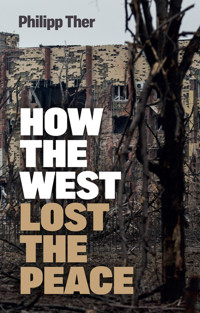
When the Berlin Wall was stormed and the Soviet Union fell apart, the West and above all the United States looked like the sole victors of history. Three decades later, the spirit of triumph rings hollow. What went wrong? In this sequel to his award-winning history of neoliberal Europe, the renowned historian Philipp Ther searches for an answer to this question. He argues that global capitalism created many losers, preparing the ground for the rise of right-wing populists and nationalists. He shows how the promise of prosperity and freedom did not catch on sufficiently in Eastern Europe despite material progress, and how the West lost Russia and alienated Turkey. Neoliberal capitalism also left the world poorly prepared to cope with Covid-19, and the pandemic further weakened the Western hegemony of the post-1989 period, which is now brutally contested by Russia's war against Ukraine. The double punch of the pandemic and the biggest war in Europe since 1945 has brought to a close the age of transformation that was inaugurated by the end of the Cold War. This penetrating analysis of the disarray of the post-1989 world will be of great interest to anyone who wishes to understand how we got to where we are today and the tremendous challenges we now face.
Sie lesen das E-Book in den Legimi-Apps auf:
Seitenzahl: 503
Veröffentlichungsjahr: 2023
Ähnliche




















CONTENTS
Cover
Title Page
Copyright
Preface: The Great Transformation after 1989
Polanyi v. Fukuyama
Essentials and social consequences of neoliberalism
The format of this book
Notes
1 From Neoliberalism to Antiliberalism: The Enduring Relevance of Karl Polanyi
The global hegemony of neoliberalism
Social consequences of the neoliberal hegemony
Essentials of neoliberalism: Mobilization through the threat of poverty
Populist revolts
From neoliberalism to antiliberalism
Notes
2 Lost Social and Political Equilibrium: The USA after the Cold War
Bill Clinton’s centrist shift
Neocons and the rise of right-wing populists
Deindustrialization, social reforms and the low-tax ideology
Fiscal policy role reversal
Rip-off America
Notes
3 The Price of Unity: Germany’s Shock Therapy in International Comparison
Germany’s special path
Reform backlogs and co-transformation
Notes
4 La Crisi: Italy’s Decline as a Portent for Europe
Berlusconism
Detour into Italy’s economic history
The social consequences of Berlusconism
The pendulum swings to the right
Notes
5 The West, Turkey and Russia: A History of Estrangement
How far does European history reach?
The Ottoman Empire and Turkey in European history
Russia in contemporary European history
Notes
6 Eastern Europe as a Pioneer: Polanyi’s Pendulum Swings to the Right
The spectre of fascism
Moving away from right-wing populism
Notes
7 Systemic Competition during the Covid-19 Pandemic
The ‘Chinese virus’ and an ‘American failure’
Pride comes before a fall
Vaccines as a supply-side offer
The pandemic as an EU problem
Vulnerable youth
Omicron as a game changer
Notes
Afterword: A Bad End: The War against Ukraine
Note
Postscript and Acknowledgements
Index
End User License Agreement
Guide
Cover
Table of Contents
Title Page
Copyright
Preface: The Great Transformation after 1989
Begin Reading
Afterword: A Bad End: The War against Ukraine
Postscript and Acknowledgements
Index
End User License Agreement
Pages
iii
iv
vi
vii
viii
ix
x
xi
xii
xiii
xiv
xv
xvi
xvii
xviii
xix
xx
xxi
xxii
xxiii
xxiv
xxv
xxvi
xxvii
xxviii
1
2
3
4
5
6
7
8
9
10
11
12
13
14
15
16
17
18
19
20
21
22
23
24
25
26
27
28
29
30
31
32
33
34
35
36
37
38
39
40
41
42
43
44
45
46
47
48
49
50
51
52
53
54
55
56
57
58
59
60
61
62
63
64
65
66
67
68
69
70
71
72
73
74
75
76
77
78
79
80
81
82
83
84
85
86
87
88
89
90
91
92
93
94
95
96
97
98
99
100
101
102
103
104
105
106
107
108
109
110
111
112
113
114
115
116
117
118
119
120
121
122
123
124
125
126
127
128
129
130
131
132
133
134
135
136
137
138
139
140
141
142
143
144
145
146
147
148
149
150
151
152
153
154
155
156
157
158
159
160
161
162
163
164
165
166
167
168
169
170
171
172
173
174
175
176
177
178
179
180
181
182
183
184
185
186
187
188
189
190
191
192
193
194
195
196
197
198
199
200
201
202
203
204
205
206
207
208
209
210
211
212
213
214
215
216
217
218
219
220
221
222
223
224
225
226
227
228
229
230
231
232
233
234
235
236
268
269
270
271
272
273
274
275
276
277
How the West Lost the Peace
The Great Transformation Since the Cold War
PHILIPP THER
Translated by Jessica Spengler
polity
Substantial parts of this book were published in German as Das andere Ende der Geschichte. Über die große Transformation © Suhrkamp Verlag Berlin 2019. All rights reserved by and controlled through Suhrkamp Verlag Berlin.
This English edition © Polity Press, 2023
Publisher’s note: Chapter 7 and the Afterword are new for the English edition.The material in Chapter 6 and the Preface has also been revised and updated.
The translation of this book was supported by a grant from the Goethe-Institut.
Polity Press65 Bridge StreetCambridge CB2 1UR, UK
Polity Press111 River StreetHoboken, NJ 07030, USA
All rights reserved. Except for the quotation of short passages for the purpose of criticism and review, no part of this publication may be reproduced, stored in a retrieval system or transmitted, in any form or by any means, electronic, mechanical, photocopying, recording or otherwise, without the prior permission of the publisher.
ISBN-13: 978-1-5095-5061-6
A catalogue record for this book is available from the British Library.
Library of Congress Control Number: 2022946158
The publisher has used its best endeavours to ensure that the URLs for external websites referred to in this book are correct and active at the time of going to press. However, the publisher has no responsibility for the websites and can make no guarantee that a site will remain live or that the content is or will remain appropriate.
Every effort has been made to trace all copyright holders, but if any have been overlooked the publisher will be pleased to include any necessary credits in any subsequent reprint or edition.
For further information on Polity, visit our website:politybooks.com
Preface: The Great Transformation after 1989
The West appeared to be history’s sole victor in 1989. The feeling of triumph was especially pronounced in the USA, the main power during the Cold War. Nowhere was this better expressed than in Francis Fukuyama’s famous essay on ‘the end of history’. In the summer of 1989 – before the fall of the Berlin Wall, and long before the collapse of the Soviet Union – Fukuyama predicted the lasting hegemony of liberal democracy and an absolutely free market economy.1
The title of my book refers to a different end to history. With Russia’s invasion of Ukraine, the age of transformation as it was envisioned after 1989 is well and truly over. The new order after the end of state socialism was based on the premise that states and societies – including those that emerged from the former Soviet Union in 1991, and from the former Yugoslavia after four years of war – could develop freely within their recognized borders. Following the liberal and neoliberal thinking of the time, it was believed that fortune would favour the industrious. Russian dictator Vladimir Putin, however, adheres to a different doctrine: might makes right. Ukraine therefore deserves the full support of the West and the entire world – otherwise Russia’s pursuit of a multipolar world order with a Russian sphere of influence in Eastern Europe will instead lead to maximum global disorder.
That said, it would be wrong for the ostensibly united West to point fingers only at Russia. The Covid-19 pandemic was a major rupture which weakened the political dogmas of the post-1989 world even before the war in Ukraine. Interventionism suddenly made a comeback, replacing the concept of a ‘lean state’ which largely withdraws from the economy and many other public duties. Western governments locked down their economies and societies for months on end to contain the virus and prevent mass deaths. They also pumped billions into pharmaceutical companies to support vaccine development, and they subsequently organized nationwide vaccination campaigns. Despite these efforts, humanity will have to live with the novel coronavirus and its variants in the long run – there is no going back to the time before 2020. The one–two punch of the pandemic and the biggest war in Europe since 1945 have brought an end to the era for which historians have not yet found a name. It makes no sense to put a second ‘post-’ in front of post-war, the term used by Tony Judt to describe the long period from 1945 to 1989.2 ‘Post-Cold War’ would also be a strange construction considering the current talk in Europe and Asia of a new Cold War now under way. I therefore propose the age of transformation.
Transformation can be understood and defined in two ways. After the end of state socialism, Western ‘transitologists’ essentially followed Fukuyama’s ideas, though his political opinions were naturally not shared by all social scientists. Economists like Jeffrey Sachs and David Lipton spoke in 1990 of a ‘double transition’ with respect to Poland, which was considered a reform pioneer. They held the view that democratization and the creation of a market economy were closely linked. It was clear from the outset that there was a tension between these two processes, and this inspired a number of interesting research projects and publications. But the most important paradigm in the study of systemic political change was the ‘consolidation’ of democracies, not the weakening and dissolution of them as witnessed in the lost decade after the global financial crisis. Social scientists tended to take a fairly critical view of the economic reforms and privatization of the 1990s. These critics included David Stark, who introduced the broader concept of ‘transformation’ here.3 But for all their critique of the details, scholars primarily considered the changes to be a top-down process after 1989, which is why the concept of reform played such a major role.4
It is also possible to view the transformation as a social process, however, which raises the question of what it does to people and vice versa. This perspective is exemplified by the book The Great Transformation, the magnum opus of the historical sociologist Karl Polanyi, which is the subject of my first essay. Three aspects of this work make it valuable to critically examining the transformation as it was envisioned after 1989: Polanyi looks at social upheavals which can (but do not necessarily) trigger economic changes, he explores political counter-reactions (which he describes as a ‘double movement’) and though he mostly focuses on England, his perspective is ultimately global. This can help us escape the territorial confines of Eastern Europe where the transitologists got bogged down (aside from their occasional forays to Latin America, which I talk about in the first chapter of this book). The post-1989 transformation produced winners and losers not only in post-communist Europe – where ‘transformation losers’ became a stereotype – but also in the West: in the Rust Belt of the USA, the former industrial regions of central and northern England and many other places. In the West, however, such people were referred to not as ‘transformation losers’ but as ‘globalization losers’. The post-communist transformation and globalization were closely connected and shared an ideology, namely, neoliberalism – which Polanyi would probably have continued to refer to as global ‘laissez-faire capitalism’.
I want to stress here that I use the term ‘neoliberalism’ analytically, not polemically. Quinn Slobodian recently published an excellent analysis of neoliberal thinking,5 but intellectual historians to date have paid scant attention to the social consequences of this top-down economic and societal transformation. I foreground this perspective in my essays and address another relevant issue as well: the unintended repercussions of the reforms and the fundamental question of whether the economic policy goals at the heart of neoliberalism were actually achieved.
Polanyi’s long time frame is important as well. The global hegemony of neoliberalism (see chapter 1) obviously did not arise overnight or only after the Berlin Wall fell. It goes back to the 1980s and the governments of Ronald Reagan and Margaret Thatcher. Countries on the periphery of the global economy, like Chile and later Poland, also played a significant role. And globalization, which would come to be constitutive of post-communist economic development and the contours and social consequences of the reforms, was older still and had accelerated since the 1970s.
There are commonalities, however, between Polanyi’s arguments and the post-1989 concept of transformation. Both interpretations deal with a profound and accelerated rupture which simultaneously and synchronously affected political systems, economies and societies.6 This short working definition of transformation can, in principle, also be applied to other periods following deep historical caesuras, such as the time after the French Revolution or the collapse of Europe’s continental empires in 1918. The end of an ancien regime has always created space for a more far-reaching transformation.
However, as Polanyi takes pains to point out, transformations can also generate counter-tendencies. For example, ever since Vladimir Putin’s second term in office, the former KGB officer has sought to bring about an ‘anti-1989’ counter-revolution through repression at home, military interventions in the ‘near abroad’ and now the war in Ukraine.
Some of the revolutionaries of 1989, Václav Havel first and foremost, felt that time sped up in the years that followed – not physically, obviously, but in people’s perception and as a political tool. Covid-19, a kind of bookend to the age of transformation, brought about a massive deceleration. Many overworked fellow academics were initially relieved when their travels came to a halt in March 2020. At the time, they had no inkling of how long the lockdowns and other restrictions would last. Of course, developments stretching over more than three decades are never linear, so this book will also look at the many internal ruptures in the period between 1989 and 2020. Three major turning points are worth mentioning straight away: the transition to radical neoliberalism around the turn of the millennium, which provoked the first populist counter-reactions, the global financial crisis of 2008–9 and the political annus horribilis of 2016.
This book probes the question of how the West could emerge victorious from the Cold War but then lose its global hegemony and, above all, its internal peace in an accelerating cascade of crises. The term ‘crisis’ is generally used to stress the urgency or drama of a particular problem – see the various financial crises since the mid-1980s (as mentioned, sometimes we will have to go back to the period before 1989, and in general it is important not to place too much weight on individual dates), the ‘refugee crisis’ of 2015–16 and the much-discussed crisis of liberal democracy. I use ‘crisis’ differently here. Crisis discourse always emerges when a political system reaches the limits of its creative possibilities, when it can only react to changes instead of shaping them. But this interpretation of crisis is an expression of helplessness which is rarely productive.
From a historian’s perspective, crises are heuristically valuable because they bring to light structural problems and deficits that have developed over a long period of time. The global financial crisis revealed the contradictions inherent in globalized financial capitalism and provided an opportunity to critically interrogate the neoliberal order that had been dominant to that point.7 The surprising majority support for Brexit and the election of Donald Trump laid bare the deficits of (neo) liberal democracy. The Covid-19 pandemic can be interpreted as a crisis of globalization and its associated dependencies, one which aggravated existing tensions between world powers, social classes and generations. The social and economic blow of the pandemic was cushioned by the formerly maligned interventionist state, but trust in liberal democracy has eroded further. This is the continuation of an unsettling trend that began with the ‘great’ transformation starting in the 1980s. The emergence and global spread of new viral diseases also throws our ruthless exploitation of nature into sharp relief. We know that all these problems exist, but they crystallize and become more obvious in times of crisis than in supposedly ‘good times’.
At this point, a notoriously sceptical Central European might ask: when have times ever been good? The 1990s generally have a good reputation because economic growth picked up again, particularly in the USA, while inflation and unemployment sank, as did government debt, eventually. After their planned economies collapsed, the first post-communist countries made it over the hump in 1992 (with Poland leading the way), while China began its unprecedented economic ascent, and progress was made in the fight against poverty in Asia and Latin America.
The main thrust of this book is at odds with the optimism of that time, however. Even during the supposedly ‘golden 1990s’ (which were not especially glittering in Germany or Italy), economic policy took a wrong turn. This is certainly true if we look at the economy in a wider context and ask which social groups benefited from this growth, how sustainable it was and what environmental price was paid for it.
Polanyi v. Fukuyama
When I read the essay by the then-unknown Francis Fukuyama as a young student in 1989, I was struck not so much by his predictions as by his polemic against ‘the Left’. Fukuyama celebrated the West’s imminent Cold War victory as a triumph of both foreign and domestic policy, placing left-wingers in ‘Cambridge, Massachusetts’ on a par with the last remaining communists in Managua and Pyongyang.8 The neoconservative Fukuyama apparently felt that Western social democracy had landed alongside communism on the trash heap of history. Fukuyama’s essay is an important historical source inasmuch as the term ‘liberal’ became an insult in the USA soon after it was published.
Polanyi was a later discovery for me. I had read his work as a student at some point in the early 1990s, but I was not particularly interested in the history of England’s industrialization in the nineteenth century, which makes up the bulk of his book. I was reacquainted with him during a book tour in the USA in 2016, when I revisited the legendary Strand Book Store in New York. There was a copy of The Great Transformation on the shelf, one of the many paperback editions published in the 1960s and 1970s. When you find too many untouched copies of a book on the second-hand shelves of the Strand, you know that the work has not been well received. But when you find a worn book with underlined passages to boot, you can be sure that it has been studied carefully.
Polanyi was not an especially original discovery on my part, as he has always had a lively following amongst political scientists, particularly those researching ‘varieties of capitalism’. I knew of him from social scientific works, but most other historians are unfamiliar with the Austro-Hungarian historical sociologist, even though his magnum opus can be read as a social history of England. The Great Transformation was also an attempt to write a global history avant la lettre of the long nineteenth century. The concept of global laissez-faire capitalism is relevant even now. Friedrich Hayek and other pioneers of neoliberal thinking never directly referenced Polanyi, but the democratic socialism he espoused was, in their view, the greatest enemy on the home front in the Cold War.
As I read Polanyi on my journey to Princeton and Philadelphia, his writing fit with the industrial ruins flanking the train tracks through the Northeast Corridor. His book depicts British agriculture and the rural population as victims of the global division of labour in the nineteenth century. Is there a parallel here to the fate of industry in the USA and northern England since the 1980s? Historical analogies are tricky, as I realized a few days later at the annual congress for Eastern European studies, where the newly elected Donald Trump was compared to all manner of authoritarian rulers and dictators from the 1920s and 1930s. As a contemporary historian, I thought first and foremost of Silvio Berlusconi (more on this in the fourth essay). Under Berlusconi – the longest-serving Italian prime minister after 1945 – Italy involuntarily became a testing ground for right-wing populism and what was, in many respects, a neoliberal economic and social policy. Polanyi avoided historical analogies for good reason; as a sociologist, he was more interested in abstract models and timeless statements.
Reading his book helped me understand why, even in times of growing prosperity, social tensions can fester and erupt in the form of political counter-reactions. Regardless of whether or not you embrace the term neoliberalism, there is no question that capitalism was ‘disembedded’ after 1989 (to pick up on Polanyi’s concept of ‘embedded capitalism’). Another Polanyian term that plays a key role in my book is ‘double movement’, meaning the political counter-reactions that can be triggered by the social effects of unfettered global capitalism.
The majority support for Brexit in the UK and Donald Trump’s election in the USA in 2016 are interpreted here as a counter-movement to neoliberalism and liberal democracy. Italy’s failed constitutional referendum at the end of the same year also came down to growing distrust of reforms crafted by party officials in the capital and imposed from above. Was 2016 therefore an annus horribilis for Western democracies, a counterpoint to the supposed annus mirabilis of 1989? The victories of Donald Trump and Boris Johnson put a great strain on both major Western alliances, the North Atlantic Treaty Organization (NATO) and the European Union (EU). Only very recently, as a result of the Russian war against Ukraine, did ‘the West’ re-emerge as a political unit, though it remains to be seen how long that unity will last.
The drawback to the notion of the annus horribilis is that those of us living through the era cannot really know when or whether neoliberalism has come to an end. Cornerstones of the ideology – such as trust in functioning markets, rational market participants, deregulation, liberalization and foreign direct investments – had already been fractured and delegitimized by the global financial crisis. The political fallout only became apparent eight years later, after most Western countries had seemingly overcome the crisis. The classic analytical problem facing historians is that economic, political, social and cultural changes are seldom synchronous and congruent. A rare modern exception to this was the transformation of the post-communist states and societies, where almost everything changed in one fell swoop after the end of state socialism. The year 2016 was not the same kind of concentrated historical moment, though it did bring about a deep political rupture. But political history alone does not explain either Brexit or the election of Donald Trump. I am therefore not convinced by the popular theory that Trumpism is a product of the increasingly polarized and dysfunctional American political system.9 To get to the deeper roots of the decline of liberal democracy, we have to look beyond Washington and examine the social and economic changes since the 1980s which plunged some parts of the USA into conditions comparable to those of the early post-communist world.
I want to add a personal observation here, one which is more than just an anecdote (I will return later to the question of how historians can employ ‘personal sociology’). On the tenth anniversary of 1989, an older colleague of mine from Germany took me to the big annual convention of the Association for Slavic, East European, and Eurasian Studies for the first time.10 It was held in St Louis, Missouri, and as we ambled through the city with a few Eastern European and Russian colleagues to get lunch, we came across huge shopping centres with ancient linoleum flooring and display cases holding just one or two kinds of deli meats and cheese, nothing more. The empty, dying shops made it feel as though we had been transported back to the era of late-stage state socialism, and we joked about the post-Soviet city in America’s heartland.
What was the political fallout of this social and economic decline? I deal with this question in my first essay, provocatively titled ‘From Neoliberalism to Antiliberalism’. In the past, like many political scientists, I used the term ‘illiberal’, but I have since discarded it because it is one of the chimeras brought into existence by Viktor Orbán. An illiberal democracy is an oxymoron – something Hungary’s prime minister apparently figured out for himself, since he later abandoned the term and claimed to follow a policy of ‘Christian democracy’.
When it comes to the annus horribilis and every other historical rupture, we have to look at the chronology of events from a somewhat broader perspective. Poland’s Law and Justice party (Prawo i Sprawiedliwość, or PiS) first won the presidential and parliamentary elections in 2015. Poland’s recent history bears similarities to Hungary’s, where the global financial crisis and collapse of the ‘Eastern European bubble’ paved the way for Orbán to ascend to power in 2010 and then win a supermajority of parliamentary seats in 2014, giving him the authority to change the constitution. Eastern Europe is not the focus of this book (as it was in its predecessor, Europe since 1989), but it is important to look closely at the region, as I do in the sixth essay here, if we want to understand what can happen when right-wing populists and nationalists win a second election.
Orbán’s victory was overdetermined after the global financial crisis, since the post-communist social democrats who preceded him had been engulfed by corruption scandals and offered no remedy for the looming collapse of Hungary’s national currency and economy. Another decisive turning point came with Orbán’s re-election in 2014, when he achieved a two-thirds parliamentary majority despite losing votes, thus cementing his power indefinitely. Hungary is ultimately just a small country with barely 10 million inhabitants which accounts for a good 1 per cent of the entire gross domestic product (GDP) of the EU, but it is on the brink of changing from a democracy once considered ‘consolidated’ into an authoritarian regime. It is a regime inasmuch as the separation of powers now exists only on paper in Hungary, and the country’s freedom of the press has been massively restricted (luckily the USA never reached this stage under Trump, and there are still critical media outlets in Poland). The fundamental question now facing the EU is whether it can endure as a mixed system in which liberal democracies exist alongside antiliberal regimes.
The political pendulum in Eastern Europe and democracy’s Anglo-Saxon motherlands swung far to the right in 2015–16, not to the left as Polanyi would have hoped and expected. But reading Polanyi can help us better understand the reasons for this rebellion against the neoliberal economic order and liberal democracy. We know that an aversion to large-scale labour migration from the EU played a major role in Brexit, though Polanyi’s book is less helpful in this regard, as he generally does not address the role of migration in global laissez-faire capitalism, even though he himself had to emigrate twice in the course of his life.
There are also limits to Polanyi’s insight when it comes to analysing nationalism and racism. I say this at the outset mainly to emphasize that my aim is not to construct yet another cathedral to a great political thinker. This can sometimes happen when the authors of books on political theory or intellectual history identify too closely with their subjects (just think of the cathedrals built over the years to Hannah Arendt, Michel Foucault and Walter Benjamin). There is no need for an iconography of Polanyi, and such a thing would have been strange to a man of his modest nature anyway.
Historical research into neoliberalism (to which this book aims to contribute) has generally revolved more around its intellectual history and ideology than concrete practices and economic policies. The research is even patchier when it comes to social issues, though it is important not to turn neoliberalism into a bogeyman. Not every negative social development of the past thirty years can be traced back to governance effects or ‘high politics’, since every ideology has limited social reach. Multicausal explanations for historical events are always more convincing than monocausal ones, and sometimes coincidences and a confluence of different developments play a decisive role.
The fourth essay in this book, which deals with Italy, shows that a fundamental distinction can be made between neoliberalism by conviction and situational neoliberalism in which certain principles and measures are implemented primarily because they seem to be the most reasonable option in a certain context. One good example of this is the privatization of state industries, which can take place either out of ideological conviction (as a way of curtailing the state’s role in the economy) or simply to make money in the short term and plug holes in the state budget.
These differences become most apparent when we compare the economic policies of various countries. Unfortunately, it is beyond the scope of this book to provide a systematic international comparison based on precise data which analyses the approaches of different historical actors. In light of this, I can only make spot comparisons and accept that there will be gaps in my coverage. For example, there is no essay specifically about the UK here, even though from the 1980s the country led the way in liberalization, deregulation, privatization, the reduction of state influence on the economy, and global financial capitalism. These five areas of activity formed the core of neoliberal policy, and they serve here as a definition of neoliberalism. We will, however, encounter the UK under Thatcher and Chile under Pinochet several times in the other essays. Chile makes an appearance because it was a pioneering neoliberal reformer in the 1980s, just as Poland was in the following decade. The USA, Germany and Italy are dealt with in more detail in the book, as are Russia and Turkey. I chose these countries based on the premise that social historians should only write academic books about nations whose culture they are familiar with and whose language they can speak, or at least read.11 Google Translate and ‘English only’ will not get you very far if you want to understand the world, much less write a history of it.
As a polyglot, Polanyi was particularly well placed to think globally. He owed this to his roots in the assimilated Jewish bourgeoisie of Habsburg Hungary and his life as an emigrant who had been forced to start fresh in several different countries. Compared to Polanyi, Fukuyama had a comfortable existence. He grew up during the golden years of American capitalism, which may explain why he felt that the free market economy was the superlative model and believed that it was tied to liberal democracy. Three decades later, we know that capitalism can function well without democracy, or with no more than a democratic façade. This is obviously not a new insight, so the more interesting question is why Fukuyama’s so eloquently expressed expectation came about in the first place after 1989.
The West’s unabashed feeling of superiority after the victory in the Cold War affected relations with states and societies that had long looked to the West for orientation. This is the subject of the fifth essay, which reflects on why Russia and Turkey have so brusquely turned their backs on the EU and USA since the start of the twenty-first century. Domestic policy is the main driving force here, but not everything can be blamed on the ‘bad guys’ Putin and Erdoğan. The behavioural parallels between the two countries and the deepening crisis in their relations with the EU, and Germany in particular, should be reason enough for us to turn the lens on ourselves and ask what has gone wrong in the West. This self-critique and brief discussion of NATO’s eastern enlargement are absolutely not meant to relativize Russia’s attack on Ukraine, however. There is no justification for the way Putin wants to re-write the end of history – with the creation of a new Russian empire.
Essentials and social consequences of neoliberalism
From a socio-historical perspective, the neoliberal order had two main negative consequences. The first was only partially intentional and can be summed up in a single sentence: wealthy individuals, social classes, big cities and countries prospered, while poorer regions, communities and vulnerable social groups fell even farther behind, especially in developed industrial nations. This is often portrayed as a case of growing social inequality, something Branko Milanović has studied internationally for many years.12 But the regional divergence is just as pronounced and significant, especially in terms of politics. Opportunities for individual development increasingly come down to where you are born and raised – in an economically dynamic area, or in a small, stagnating town which might be in a rural or deindustrialized region to boot. But even in booming metropolises, your opportunities will differ depending on whether you reside in a ‘good’ or ‘bad’ part of the city. Social diversity is obviously an important issue, but it is rarely debated as such.
The second key problem with the neoliberal order was the way in which it mobilized the population for the labour market – namely, through the threat (and, all too often, the experience) of poverty and social decline, particularly for members of the lower middle class and anyone dismissed as a welfare freeloader. The dimensions and consequences of this social decline varied depending on the country and local context, meaning that it could lead to either relative or absolute poverty. The social reforms in the Global South and post-communist Europe demonstrated neoliberalism’s reliance on state control and simultaneously resulted in existential hardship. The same applies to the USA, where the emphasis on food stamps in the 1990s had disastrous effects on the future prospects and health of poor Black Americans as well as whites. Poverty in the deindustrialized Rust Belt and many big cities took on positively Eastern European dimensions, as reflected in life expectancy rates. The welfare state remained somewhat more intact in the UK because even the Iron Lady dared not break up the National Health Service (NHS). But the former industrial centres of central and northern England face the same lack of prospects as the small and medium-sized cities of the Rust Belt.
More than fifty years ago, the British social historian E.P. Thompson noted that a social group’s material living conditions do not automatically translate into a shared consciousness or political agenda. The neoliberal rhetoric of ‘unavoidable’ economic and social reforms initially led to political demobilization, which stood in contrast to the utilitarian mobilization of the population for the labour market. The effects of this demobilization can be seen in the declining voter turnout rates found in every democracy where the social gap between rich and poor yawned especially wide – a problem which has been further exacerbated by Covid-19.
The political vacuum has been filled largely by right-wing populists and nationalists in the past decade. This theory is not entirely new; Adam Tooze, for example, has written a groundbreaking book stressing the role of the global financial crisis in Brexit and the election of Donald Trump.13 Growing social and regional inequality had toxic political effects in continental Europe as well, particularly in the post-communist East. The stock markets bounced back from the financial crisis remarkably quickly, at least compared with the Great Depression of the 1930s. But many homeowners with mortgage debt, including approximately nine million Americans, lost their property and their wealth, and the EU subsequently had to face the 2011 euro crisis, which was disastrous for Southern Europe.
The socio-political delegitimization of liberal democracy began long before this, however. From the mid-1990s, and even earlier in the USA and UK, the transformation of the labour market and accompanying social reforms changed the everyday life and future prospects of the lower and middle classes alike. This is yet another argument for viewing the post-1989 transformation as an experience which shaped both East and West as well as the newly industrialized countries duly referred to as ‘emerging markets’ from the 1990s onwards.
The Law and Justice party (PiS) in Poland, the Republicans under Trump and the now-irrelevant United Kingdom Independence Party (UKIP) in England received most support in the isolated and impoverished regions we might call ‘the rest of the West’, in a reversal of the triumphalist title of Niall Ferguson’s book.14 It is therefore neither a coincidence nor a mere consequence of the global financial crisis that Poland, the UK and the USA all lurched to the right in 2015–16.
There were other causes and contributing factors, of course, which are beyond the scope of this book to discuss – not least the electoral system. Majority voting systems fostered political polarization and the rise of right-wing populists. Contingency also played a role, as it so often does in history. Trump might not have won in 2016 had he faced a more persuasive opponent, and Brexit happened in part because the influence of the Eurosceptics was woefully underestimated and voter turnout was low. In Poland, PiS achieved an absolute majority in the Sejm in 2015 only because several other parties (especially on the fractured left) failed to meet the percentage threshold for winning parliamentary seats.
But pondering counterfactual scenarios rarely accomplishes much because there is no getting around the actual course of history. The fact remains that social divisions preceded the political polarization. This is particularly true in the USA, where the usual indicators for income and wealth inequality have increasingly come to resemble those of Latin America ever since Reagan was president. This trend intensified under Bill Clinton due in part to his social reforms and the aversion to ‘big government’.
I should say in advance that I cite data and statistics sparingly in this book, partially because they do not fit easily into the format of an essay, and partially because it is important not to rely solely on a quantitative perspective in social history. That said, these essays are very much based on statistics and hard data which I have collected for more than a decade. This particularly applies to the chapter on Germany’s transformation, for which I collated the regional GDP of the ‘five new German states’ in order to compare the former East Germany with the neighbouring Czech Republic. It is also impossible to analyse recent Italian history without a detailed knowledge of sovereign debt, which involves dealing with very large numbers. Indicators such as youth unemployment and income upon entering the labour market are also crucial to understanding Italy’s decline since the mid-1990s.
The USA and UK tended to pity the newly unified Germany back in the 1990s. Germany was considered the ‘sick man of the euro’,15 ranking amongst the bottom three EU states in terms of economic growth from 1995 to the turn of the millennium, and again from 2002 to 2005. In the essay on Germany, I probe the reasons for this ‘unity crisis’, which I experienced first hand while visiting numerous provincial towns in the former East Germany for my dissertation. At the end of the 1990s, the entire Federal Republic of Germany seemed to be caught in a vicious cycle of rising unemployment, sovereign debt and taxes and weak economic growth.
There is also a deeper meaning to the term ‘unity crisis’. It refers here not to the former East Germany, which was reflexively blamed for all manner of problems in the 1990s, but rather to the mistakes and unintentional side effects of the unification of the two German states. Most literature about the post-communist transformation mentions that Poland underwent ‘shock therapy’, claiming in the same breath that this was the basis for the country’s subsequent prosperity.16 As my comparative analysis shows, the former East Germany also experienced shock therapy in many respects, though it was hardly a success story. In the case of Poland, too, this is a one-sided and monocausal theory. The most important prerequisite for the economic upswing starting in 1992 was the availability of highly qualified, low-paid workers.
This high level of education did not just suddenly materialize in 1989, of course. In the era of state socialism, access to education and skilled jobs had been an opportunity for individual advancement for many people. The growth in human capital (which is not strictly a neoliberal concept, as it requires a strong state that invests in resources for its citizens in the long term) cannot be attributed to reform policies of any flavour. Even during the post-communist transformation, what mattered was whether and how a new government invested in education. All in all, we can say that universities benefited, but schools and vocational training institutions did not.
When I speak and write about past historical mistakes, I am often asked whether there were any alternatives at the time. The course of history implicitly speaks against this, which is why historians of all stripes (not just Marxists) tend to take the view that things happened the way they had to. It is hard to counter the power of the factual. This is especially true for the period after 1989, when reforms were all too often presented as having ‘no alternative’. But at many recent historical turning points there were, in fact, opportunities to take a different economic course, and these alternatives were debated. It is important to remember this to avoid any ex-post confirmation of the paradigm of inevitability.
Margaret Thatcher’s famous claim that ‘there is no alternative’, which became a mantra in post-communist Europe just as it did in the West, proved to be politically toxic over the years. It was also responsible in part for the much-discussed ‘crisis of democracy’. To get to the root of this crisis, however, we have to start earlier than the annus horribilis of 2016 or the global financial crisis (Colin Crouch did this back in 2004 in his book on post-democracy, and Cas Mudde also published important theories at about the same time).17 In the mid-1990s, a growing number of moderate leftists and social democratic politicians began to adopt Thatcher’s slogan, and they faced repercussions at the ballot box and a general loss of legitimacy for doing so. The evolution of the moderate Left is a thread running through all the essays here, but to answer the question of how right-wing populists come to power, we really have to look at the stance taken by centre-right conservatives.
This book is obviously not the first to deal with the crisis of the Left and liberal democracy and the rise of right-wing populism. American and European bookshops have been flooded with the subject since 2016, as have professional journals, popular magazines and social media. Maybe this wealth of publications is actually a kind of academic populism. The very term contains a demarcation, as demonstrated by the fact that I have never met anyone in academia who has openly claimed to be an adherent of Trump or Orbán. However, pointing fingers at right-wing populists does not get us very far, especially not in a political sense.
Political scientists often use the term right-wing populism to describe a form of politics; I address this in more detail in my essays on the USA and Italy. But as a historian who has intensively researched modern nationalism, I am acutely aware of the ideological content of this populism – namely, an ethnic, exclusive and xenophobic right-wing nationalism. And if a historian is allowed to prognosticate, I would say that this will remain a major and dangerous challenge in the years and decades to come.
This book closes with an essay on the Covid-19 pandemic. In the first wave of the pandemic, countries with relatively intact social safety nets and well-developed health care systems fared better than the USA. The number of victims was relatively high overall in the UK, too, especially amongst the lower classes. This highlights the long-term consequences of neoliberal politics and short-term effects of populist right-wing governance. Donald Trump and Boris Johnson (to say nothing of Jair Bolsonaro in Brazil) were clearly out of their depth during the pandemic. During the first wave, Germany in particular was considered an international role model – though, like the EU member states in Eastern Europe, it had the benefit of having seen how hard the pandemic hit Italy and Spain, so it could react accordingly.
The tables turned during the second and third waves, especially when it came to vaccination campaigns. The UK and USA moved faster and more effectively, mainly because they were more willing to take risks and they mobilized every available resource to develop vaccines, which they then approved more quickly. Germany and the EU took a more cautious approach to vaccine approval, negotiating with the pharmaceutical industry about liability in the event of damages and ensuring data protection before finally organizing their vaccination campaigns.18 This resulted in a delay of two to three months which cost many lives and necessitated further long lockdowns in the spring of 2021.
I interpret the differing approaches to Covid-19 as an example of the systemic competition waged between the USA and China right from the start of the pandemic in the spring of 2020. Political competition could be found in Europe, too, with Boris Johnson, Viktor Orbán and Serbian president Aleksandar Vučić all claiming that sovereign nation-states resolved the health crisis more effectively than the sluggish, supranational EU. The rates of infection and excess mortality in their three respective countries speak against this theory (as does the slow pace of vaccinations in Switzerland). But from the start of 2021, it was the vaccination campaigns that received the most attention – and in this regard, the three countries were, in fact, faster than their neighbouring states and the EU.
Much is at stake here for the European Union, which must prevail in this competition to avoid losing even more support and legitimacy. It is still too early to write a history of the pandemic – no one knows how the disease and the measures employed to fight it will be viewed in a few years’ time, or how effective the Chinese and Russian vaccines that have been used in Serbia and Hungary will prove to be. What is certain is that Donald Trump will not be the only right-wing populist to lose office on account of the pandemic; Czech prime minister Andrej Babiš was also punished at the polls for his poor management of the health crisis. But frustration and anger about the pandemic’s economic and social consequences could just as easily turn voters against liberal politicians (in France, for instance). We know it is not possible to ‘learn’ from history in the literal sense. At most, we can try to avoid making the same mistakes over again. This is yet another argument for learning more about the accumulating crises of the three decades after 1989 and their economic and political fallout.
The format of this book
At first glance, essays might not seem like the best format for examining the problems of our time, seeing as they are more discursive and subjective, and less oriented on facts and figures, than traditional articles in scholarly journals. But the benefit of focusing on propositions and personal opinions is that it forces the author to be transparent about their own standpoint, something which is taken for granted in cultural and social anthropology. The personal remarks and experiences included in these essays are therefore certainly not anecdotal or random.
One of my sources of inspiration was the ‘personal sociology’ of Didier Eribon, Steffen Mau and other social scientists who have returned to the sites of their childhood as a starting point for analysing the social, economic and political transformation of the past thirty years. Contemporary historians are always revisiting the recent past anyway, some of which we probably lived through ourselves. As a result, personal experiences often influence our research and interpretations, though this influence is rarely made explicit and thus put to good use.
Reading essays can be exciting, too. As a student, I was fascinated by Isaiah Berlin, Albert Hirschman and Leszek Kołakowski, and by Kultura, the Polish exile magazine. When he was a young newspaper editor, Karl Polanyi wrote countless essayistic articles which are still worth reading a century later. Tony Judt was a famously gifted essayist who wrote ‘Reappraisals’ and ‘Memory Chalet’ shortly before his premature death. Mary Beard also reaches a wide audience with her essays, and like Ingrid Rowland and Hannah Arendt before her, she helps balance out the preponderance of male authors in this genre. Tony Judt, with whom I share many political views, took a very personal approach to his work. I myself do not think too much emphasis should be placed on personal experiences (which have often just been a product of biographical coincidence in my case), so I only mention them in this book when they prompt new questions or open up new perspectives.
Most famous essayists have been leftists or liberals, and I feel comfortable in their company. Many went on the defensive after 1989, and while this was understandable, it probably also contributed to the hard-right swing of Polanyi’s pendulum in recent years. We can slow the pendulum by carefully analysing the reasons for this recurrent ‘double movement’. Perhaps doing so will give us a chance to swing it in the other direction, opening up new opportunities for a progressive politics and society.
Notes
1.
Francis Fukuyama, ‘The End of History?’ in:
The National Interest
16 (1989), pp. 3–18. In his 1992 book of the same name, Fukuyama was already somewhat more sceptical, so it is unfair to reduce his thinking to this essay alone. The shift from an optimistic to sceptical world view was even more apparent in the case of Samuel Huntington and his two books from the 1990s,
The Third Wave of Democracy
and
The Clash of Civilizations
.
2.
Tony Judt,
Postwar: A History of Europe Since 1945
, New York: Penguin, 2005.
3.
David Stark has published a large number of works; see, e.g., ‘From System Identity to Organizational Diversity: Analyzing Social Change in Eastern Europe’ in:
Contemporary Sociology
21/3 (1992), pp. 299–304.
4.
Social and cultural anthropologists were the exception here; see, e.g., Michał Buchowski,
Rethinking Transformation: An Anthropological Perspective on Postsocialism
, Poznań: Humaniora, 2001; Christopher Hann (ed.),
Postsocialism: Ideals, Ideologies and Practices in Eurasia
, London: Routledge, 2002; Elizabeth Dunn,
Privatizing Poland: Baby Food, Big Business, and the Remaking of Labor,
Ithaca, NY: Cornell University Press, 2004; David Kideckel,
Getting by in Postsocialist Romania: Labor, the Body, and Working-Class Culture
, Bloomington: University of Indiana Press, 2008; and the exciting new book in Polish by Aleksandra Leyk and Joanna Wawrzyniak,
Cięcia: Mówiona historia transformacji
, Warsaw: Krytyka Polityczna, 2021.
5.
See Quinn Slobodian,
Globalists: The End of Empire and the Birth of Neoliberalism
, Cambridge, MA: Harvard University Press, 2018.
6.
This definition is based on Claus Offe, ‘Das Dilemma der Gleichzeitigkeit: Demokratisierung und Marktwirtschaft in Osteuropa’ in:
Merkur
4/505 (1991), pp. 279–92.
7.
This was one of the main theories in my chronicle of contemporary Europe, which dealt with neoliberal reforms and was published in German in 2014. The German title was
Die neue Ordnung auf dem alten Kontinent: Eine Geschichte des neoliberalen Europe
(The New Order on the Old Continent: A History of Neoliberal Europe). The English version,
Europe Since 1989: A History
, was translated by Charlotte Hughes-Kreutzmüller and published by Princeton University Press in 2016.
8.
The original quote is on p. 17 of his article ‘The End of History?’ in:
The National Interest
16 (1989), pp. 3–18.
9.
This theory is proposed by, e.g., Steven Levitsky and Daniel Ziblatt,
How Democracies Die
, New York: Crown, 2018.
10.
Thank you again, Stefan Troebst.
11.
I have never visited Chile, however, so I have had to make do with secondary literature and sources from the World Bank archives.
12.
See Branko Milanović,
Global Inequality: A New Approach for the Age of Globalization
, Cambridge, MA: Harvard University Press, 2016.
13.
See Adam Tooze,
Crashed: How a Decade of Financial Crises Changed the World
, New York: Viking, 2018, pp. 419–61.
14.
The exact title of the book is
Civilization: The Six Ways the West Beat the Rest
, London: Allen Lane, 2011. In the wake of the global financial crisis, Niall Ferguson himself apparently began to have doubts about the supremacy of the West, which he expressed in the last chapter of the book (see pp. 295–325).
15.
References and citations can be found in the third essay.
16.
See Andrei Shleifer and Daniel Treisman, ‘Normal Countries: The East 25 Years After Communism’ in:
Foreign Affairs
93 (2014), available online at
http://www.foreignaffairs.com/articles/142200/andrei-shleifer-and-daniel-treisman/normal-countries
.
17.
See Colin Crouch,
Post-Democracy: A Sociological Introduction
, Cambridge: Polity, 2004; Cas Mudde,
The Ideology of the Extreme Right
, Manchester: Manchester University Press, 2002.
18.
The difference between taking risks and banking on safety is a main theme in the first contemporary historical account of the pandemic; see Peter Baldwin,
Fighting the First Wave: Why the Coronavirus Was Tackled So Differently Across the Globe
, Cambridge: Cambridge University Press, 2021.
1From Neoliberalism to AntiliberalismThe Enduring Relevance of Karl Polanyi
‘Presentism’ has become something of a trend in professional historiography. Switzerland has an online magazine called Geschichte der Gegenwart (History of the Present); a German contemporary historian brought out ‘A Brief History of the Present’ with a well-known publisher in 2017; and textbook publishers try to make past eras more appealing to their young audience by drawing connections to the present day.1 In the USA, too, the best way to promote a book is to say that it covers a timely topic.
Referencing current academic debates is also more important than ever. Mentioning prominent colleagues is a good way to score points on social media because it increases the likelihood that they will recommend your own work on Twitter or Facebook in return. Presentism and discursivity attract a lot of public attention, but there are limits to what they can achieve. After all, even the most diligent students and political activists only have so much time for reading. Academics today live in an economy of overwhelming supply, where the growing abundance of information and texts bumps up against naturally limited capacity and demand. In other words, more and more information is being sent out into the world, but more and more cannot be received and read. This daily competition for our attention makes it easy to lose sight of more distant periods and older publications and sources. This is a great loss, especially for history as an academic discipline.
I always encourage my students to read older works – and not just history books. You can learn a tremendous amount, particularly about the late nineteenth and twentieth centuries, from the social scientists who were writing at the time. Their studies are historical sources, but many also contain theories and models that help explain the problems of their time as well as our own. The epistemological value lies not in looking to history for answers to new questions and interpreting these findings in a presentistic way based on current needs, but rather in taking past approaches, theories and explanatory models and laying them like a matrix over the present.
The works of the historical sociologist Karl Polanyi are social scientific classics that are always worth revisiting.2 Polanyi’s magnum opus, The Great Transformation, was published towards the end of the Second World War and reached a wide audience in the following thirty years. During Polanyi’s lifetime (he died in 1964 in the USA), even the bastions of the liberal market economy – the USA and UK – thought that ‘laissez-faire capitalism’ was outmoded. This attitude stemmed from their all-too-fresh memories of the stock market crash of 1929, the Great Depression in the 1930s and the rise of fascism.
As a result, even economists who embraced the concept of neoliberalism in the 1950s called for heavier regulation of the markets and legislation against cartels and monopolies.3 Most of society was in favour of taming the free market and creating an ‘embedded’ capitalism, as Polanyi vividly put it. Polanyi fell out of fashion in the 1980s. No new editions of his book were published, and even the translations dried up.4 You were most likely to find his work in a library or second-hand bookshop, a sure sign that it had been relegated to history.
But then the crises of capitalism began to pile up at the end of the 1990s. The Asian financial crisis, which ultimately dragged down Russia and the rouble in 1998, was followed by the dot-com crisis. Polanyi was suddenly relevant again, and he experienced a renaissance. Beacon Press in Boston, which first published The Great Transformation in paperback, brought out a new edition in 2001 with a foreword by Joseph Stiglitz, an unwavering critic of neoliberalism and the Chicago Boys under Milton Friedman. Stiglitz received the Nobel Prize in Economics not long after, further boosting the popularity of The Great Transformation.
There were other, longer-term reasons for the renewed interest in Polanyi. It was clear by the turn of the millennium that only certain social classes, industries, countries and regions had profited from the ‘great transformation’ after 1989. Post-communist Europe oscillated between optimistic awakening (Poland, the Czech Republic, Hungary) and depression (Russia and other post-Soviet states). Political reformers in the East could fall back on an obvious excuse, however: the misery was the fault of the communists, state socialism, mismanagement prior to 1989, Homo sovieticus.
This Manichean view of history also fed into the post-transformation promise of modernization as it was envisioned after 1989. Once countries had made it through the long drought, or the vale of tears, or some other essentially Biblical trial, they were expected to achieve a state of developed capitalism and become as wealthy as the West.
But in the age of neoliberalism, this promise was on shaky ground from the start. Unlike their counterparts in the East, political elites in the USA and Germany did not have the option of badmouthing earlier economic and social developments or the social democratic welfare state. Moreover, it was not clear where the development of these countries was supposed to lead. The West, and especially the USA, had already reached the modern capitalist stage. Aside from increasing consumption or improving the efficiency of the system, there was no place to go from there.




