


127,99 €
Mehr erfahren.
- Herausgeber: John Wiley & Sons
- Kategorie: Fachliteratur
- Sprache: Englisch
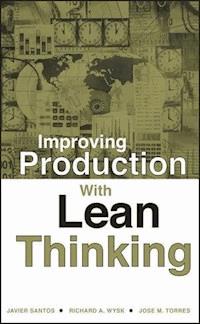
Unique coverage of manufacturing management techniques--complete with cases and real-world examples. Improving Production with Lean Thinking picks up where other references on production processes leave off. It is increasingly important to integrate and systematize lean thinking throughout production/manufacturing and the supply chain because the market is becoming more competitive, products are becoming more complex, and product life is getting shorter and shorter. With a practical focus, this book encompasses the science and analytical background for improving manufacturing, control, and design. It covers specific methodologies and tools for: * Material flow and facilities layout, including a six step layout design process * The design of cellular layouts * Analyzing and improving equipment efficiency, including Poka-Yoke, motion study, maintenance, SMED, and more * Environmental improvements, including 5S implementation With real-life case studies of successful European and American approaches to lean manufacturing, this reference is ideal for engineers, managers, and researchers in manufacturing and production facilities as well as students. It bridges the gap between production/manufacturing and supply chain techniques and provides a detailed roadmap to improved factory performance.
Sie lesen das E-Book in den Legimi-Apps auf:
Seitenzahl: 301
Veröffentlichungsjahr: 2015
Ähnliche

















Contents
Cover
Contents
Title Page
Copyright
Preface
1: Continuous Improvement Tools
CONTINUOUS IMPROVEMENT
IMPROVEMENT PHILOSOPHIES AND METHODOLOGIES
JUST-IN-TIME (JIT)
MEASURING AND PRIORITIZING THE IMPROVEMENTS
BOOK STRUCTURE
RECOMMENDED READINGS
2: Material Flow and Facilities Layout
LAYOUT IMPROVEMENTS
THEORETICAL BASIS
LAYOUT DESIGN METHODOLOGY
TOOLS FOR LAYOUT STUDY
SUMMARY
RECOMMENDED READINGS
3: Material Flow and the Design of Cellular Layouts
THE ASSEMBLY LINE
THEORETICAL BASIS
CELL DESIGN METHODOLOGY
CELL DESIGN TOOLS
SUMMARY
RECOMMENDED READINGS
4: Equipment Efficiency: Quality and Poka-Yoke
POKA-YOKES
THEORETICAL BASIS
POKA-YOKE DESIGN METHODOLOGY
SUMMARY
RECOMMENDED READINGS
5: Equipment Efficiency: Performance and Motion Study
MOTION STUDY
THEORETICAL BASIS
MOTION STUDY TOOLS
SUMMARY
RECOMMENDED READINGS
6: Equipment Efficiency: Availability, Performance, and Maintenance
EQUIPMENT MAINTENANCE
THEORETICAL BASIS
MAINTENANCE PROGRAM IMPLEMENTATION
MAINTENANCE TOOLS
SUMMARY
RECOMMENDED READINGS
7: Equipment Efficiency: Availability, Quality, and SMED
SETUP PROCESS
THEORETICAL BASIS
SMED METHODOLOGY
SMED TOOLS
SMED EFFECTS AND BENEFITS
SUMMARY
RECOMMENDED READINGS
8: Environmental Improvements and the 5S Methodology
A CLEAN AND ORGANIZED WORKSPACE
5S IMPLEMENTATION METHODOLOGY
IMPLEMENTATION OF THE 5S METHODOLOGY IN OFFICES
5S TOOLS
5S BENEFITS AND EFFECTS
SUMMARY
RECOMMENDED READINGS
9: Other Improvement Keys
HUMAN RESOURCES–RELATED KEYS
EFFICIENT MATERIALS USE-RELATED KEYS
VISUAL CONTROL-RELATED KEYS
TECHNOLOGY-RELATED KEYS
SUMMARY
RECOMMENDED READINGS
Appendix A: Problems
INTRODUCTION
CONTINUOUS IMPROVEMENT TOOLS
FACILITIES LAYOUT
CELLULAR LAYOUT
MAINTENANCE
MOTION STUDY
MACHINE-MACHINE DIAGRAMS
NUMERIC PROBLEM SOLUTIONS
Index
Wiley End User License Agreement
List of Tables
2: Material Flow and Facilities Layout
TABLE 2.1. Main Characteristics of the Three Traditional Layouts
3: Material Flow and the Design of Cellular Layouts
TABLE 3.1. Previous and Current Economic Environments
TABLE 3.2. Most Common Activity Scales
7: Equipment Efficiency: Availability, Quality, and SMED
TABLE 7.1. Effect of Setup Time on Production Time
TABLE 7.2. Effect of Large Setup Time in Production Time
TABLE 7.3. Effect of Short Setup Time in Product Cost
TABLE 7.4. Initial Situation
TABLE 7.5. Task Sharing and Simultaneous Operations
TABLE 7.6. Improvement in Task Sharing
List of Illustrations
1: Continuous Improvement Tools
Figure 1.1. The concept of continuous improvement versus reengineering.
Figure 1.2. Continuous change can offset the expense and time required for radical changes.
Figure 1.3. Resources that must be managed effectively.
Figure 1.4. Just-in-time thinking principles. Reprinted with permission from
20 Keys to Workplace Improvement
. English translation copyright © 1995 by Productivity Press, a division of Kraus Productivity Ltd., Translated by Bruce Talbot. Appendix A translated by Miho Matsubara. Appendix C translated by Warren Smith. www.productivitypress.com.
Figure 1.5. Inventory can hide production inefficiencies and slow improvements.
Figure 1.6. Saving time means eliminating waste.
Figure 1.7. The 20 keys to workplace improvement. Reprinted with permission from
JIT Factory Revolution:
A pictorial guide to factory design of the future. English translation copyright © 1988 by Productivity Press a division of Kraus Productivity. Ltd. www.productivitypress.com.
Figure 1.8. Assessing the current position (level) and the target position is critical to success.
Figure 1.9. Radar graphic for each factor.
Figure 1.10. Typical planning times used for production.
Figure 1.11. Grouping losses (waste) to obtain the useful time.
Figure 1.12. Measuring losses in a system.
Figure 1.13. Different consequences of an improvement in maintenance.
Lesen Sie weiter in der vollständigen Ausgabe!
Lesen Sie weiter in der vollständigen Ausgabe!
Lesen Sie weiter in der vollständigen Ausgabe!
Lesen Sie weiter in der vollständigen Ausgabe!
Lesen Sie weiter in der vollständigen Ausgabe!
Lesen Sie weiter in der vollständigen Ausgabe!
Lesen Sie weiter in der vollständigen Ausgabe!
Lesen Sie weiter in der vollständigen Ausgabe!
Lesen Sie weiter in der vollständigen Ausgabe!
Lesen Sie weiter in der vollständigen Ausgabe!
Lesen Sie weiter in der vollständigen Ausgabe!
Lesen Sie weiter in der vollständigen Ausgabe!
Lesen Sie weiter in der vollständigen Ausgabe!
Lesen Sie weiter in der vollständigen Ausgabe!
Lesen Sie weiter in der vollständigen Ausgabe!




