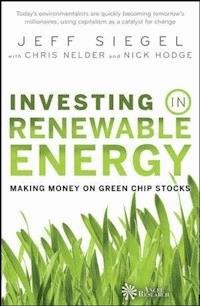
Table of Contents
Title Page
Copyright Page
PREFACE
ONE CHOICE, ONE OPPORTUNITY
PART I - TRANSITIONING TO THE NEW ENERGY ECONOMY
CHAPTER 1 - THE GLOBAL ENERGY MELTDOWN
PEAK ENERGY
CRISIS OR OPPORTUNITY?
THE SOLUTIONS
CHAPTER 2 - THE SOLAR SOLUTION
A SHORT HISTORY OF SOLAR TECHNOLOGIES
THE SKY’S THE LIMIT
GROWING CAPACITY
INVESTING IN SOLAR
COMBINING FORCES, ADDING PROFITS
CHAPTER 3 - GLOBAL WINDS
BENEFITS OF WIND POWER
VAST RESOURCES
FORECAST: WINDY AND PROFITABLE
FALLING COSTS
THE COMPETITIVE ADVANTAGE
INVESTING IN WIND
CHAPTER 4 - THE HEAT BELOW
WHAT IS GEOTHERMAL POWER?
BENEFITS OF GEOTHERMAL POWER
CURRENT PRODUCTION
INVESTING IN GEOTHERMAL
CHAPTER 5 - WHAT MAY WASH UP IN THE TIDE
THE LARGEST UNTAPPED SOURCE OF ENERGY
MASSIVE POTENTIAL
COSTS FALLING
INVESTING IN MARINE ENERGY
CHAPTER 6 - WHAT’S THAT SMELL?
LANDFILL GAS: WASTE OR WATTS?
AGRICULTURE/LIVESTOCK MANURE: FROM COW CHIPS TO GREEN CHIPS
INVESTING IN BIOGAS
CHAPTER 7 - THE EFFICIENCY ADVANTAGE
NEGA-WHAT?
WHAT IS LEED CERTIFICATION?
INVESTING IN ENERGY CONSERVATION AND EFFICIENCY
PART II - THE END OF OIL
CHAPTER 8 - FOREIGN OIL
WHAT IS PEAK OIL?
COUNTING ON OPEC
THE BOTTOM LINE ON OIL
THE PARTY’S OVER
THE FUTURE IS ELECTRIC
THE GAME IS COMING TO US
CHAPTER 9 - BIOFUELS
THE COMPLEXITIES OF BIOFUELS
IMPORTANT QUESTIONS
THE MARKET: GROWING LIKE A WEED
INCENTIVES
THE FUTURE OF TRANSPORTATION
CHAPTER 10 - PLUGGED-IN PROFITS
A DISCLAIMER
OPEC’S BIGGEST FEAR
INVESTMENT OPPORTUNITIES: PHEVs
LITHIUM NIRVANA
GET YOUR MOTOR RUNNING
PART III - THE SCIENCE AND PROFITABILITY OF CLIMATE CHANGE
CHAPTER 11 - GLOBAL WARMING
THE CANARIES OF CLIMATE DOOM
THE EMPIRE STRIKES BACK
A CATASTROPHIC THREAT
BUSINESS RISING TO THE CHALLENGE
POLITICAL RESPONSE
NATURAL CAPITAL
CHAPTER 12 - PROFITING FROM POLLUTION
BUILDING MOMENTUM
COMMODITIZATION OF CARBON: HOW IT WORKS
MORE BANG FOR YOUR CARBON BUCK
WHERE DO WE GO FROM HERE?
BUYER BEWARE
CONCLUSION
NOTES
ABOUT THE AUTHORS
INDEX
Copyright © 2008 by Angel Publishing. All rights reserved.
Published by John Wiley & Sons, Inc., Hoboken, New Jersey. Published simultaneously in Canada.
No part of this publication may be reproduced, stored in a retrieval system, or transmitted in any form or by any means, electronic, mechanical, photocopying, recording, scanning, or otherwise, except as permitted under Section 107 or 108 of the 1976 United States Copyright Act, without either the prior written permission of the Publisher, or authorization through payment of the appropriate per-copy fee to the Copyright Clearance Center, Inc., 222 Rosewood Drive, Danvers, MA 01923, (978) 750-8400, fax (978) 646-8600, or on the web at www.copyright.com. Requests to the Publisher for permission should be addressed to the Permissions Department, John Wiley & Sons, Inc., 111 River Street, Hoboken, NJ 07030, (201) 748-6011, fax (201) 748-6008, or online at http://www.wiley.com/go/permissions.
Limit of Liability/Disclaimer of Warranty: While the publisher and author have used their best efforts in preparing this book, they make no representations or warranties with respect to the accuracy or completeness of the contents of this book and specifically disclaim any implied warranties of merchantability or fitness for a particular purpose. No warranty may be created or extended by sales representatives or written sales materials. The advice and strategies contained herein may not be suitable for your situation. You should consult with a professional where appropriate. Neither the publisher nor author shall be liable for any loss of profit or any other commercial damages, including but not limited to special, incidental, consequential, or other damages.
For general information on our other products and services or for technical support, please contact our Customer Care Department within the United States at (800) 762-2974, outside the United States at (317) 572-3993 or fax (317) 572-4002.
Designations used by companies to distinguish their products are often claimed by trademarks. In all instances where the author or publisher is aware of a claim, the product names appear in Initial Capital letters. Readers, however, should contact the appropriate companies for more complete information regarding trademarks and registration.
Wiley also publishes its books in a variety of electronic formats. Some content that appears in print may not be available in electronic books. For more information about Wiley products, visit our web site at www.wiley.com.
Library of Congress Cataloging-in-Publication Data:
Siegel, Jeffrey, 1970-
Investing in renewable energy : making money on green chip stocks/Jeff Siegel; with Chris Nelder & Nick Hodge. p. cm. Includes bibliographical references and index.
eISBN : 978-0-470-44732-1
1. Energy industries. 2. Renewable energy sources. 3. Clean energy industries. 4. Commodity futures. 5. Investments. I. Hodge, Nick, 1983- II. Nelder, Chris, 1964- III. Title. HD9502.A2S486 2008 333.79’4—dc22 2008018566
.
PREFACE
In 2005, I received the following e-mail:
Dear Jeff,
Why the hell would you invest in renewable energy? You have no idea what you’re talking about. No one’s ever made money from solar and no one ever will!
Certainly we can look to the solar bull market of 2007 to counter the last sentence of that e-mail. Whether it was the 900 percent gain that First Solar (NASDAQ:FSLR) delivered or the 1,700 percent gain that World Water & Solar Technologies (OTCBB:WWAT) delivered, green chip investors who were properly positioned last year made an absolute fortune.
Still, even with all the money we’ve made in the past by investing in renewable energy, the question “Why would you invest in renewable energy?” is still quite valid, especially when you consider the fact that there really is a lack of easily accessible and credible information regarding the current state of the overall energy marketplace.
For instance, while the local news has made a habit of reporting on high gas prices every time the summer driving season kicks into high gear, rarely do we hear how these so-called high gas prices are actually quite cheap. The true cost of gasoline is probably closer to about $11.00 a gallon. You may not be paying that price at the pump, but you are paying it. You’ll see how in Chapter 1.
We also hear a lot about how the United States is the “Saudi Arabia of coal,” boasting a 250-year supply. However, rarely do we hear how these coal-supply numbers are highly inflated, or how the United States most likely passed its peak of coal production nearly 10 years ago. You’ll read more about this in Chapter 1, as well.
And what about nuclear energy? President Bush is behind it, and it doesn’t have the same CO2 emission issues that are associated with coal. Some have even mistakenly (or intentionally) referred to it as “renewable.” But whatever you call it, nuclear capacity is actually set to decrease over the next 25 years. In this book, we’ll explain why.
Overall, our once-vast supplies of cheap, conventional, nonrenewable energy resources are shrinking at an alarming rate, while our demand for electricity and transportation fuels is dramatically increasing. As a result, we have created fertile ground for a very real crisis situation, but also a massive opportunity for renewable energy investors.
Just in 2007 alone, venture capital and private equity pumped $8.5 billion into clean energy. Even as the market began to feel the effects of a full-blown mortgage and credit crisis, the clean energy sector totaled more than $117 billion in new investments last year. That’s about $20 billion ahead of predictions and 41 percent more than 2006 numbers.1
With this kind of big money in play, we have to ask ourselves, “Why are all these people investing in renewable energy?” The answer is quite simple.
The basic fundamentals of supply and demand dictate its profitability!
ONE CHOICE, ONE OPPORTUNITY
Within the next few decades, our increasingly limited access to cheap, nonrenewable energy resources will present a serious economic crisis. Even today, while the oil is still flowing with few interruptions, gas prices rise with every major or minor refinery disruption, causing the cost of nearly everything else to rise as well. Virtually everything we use and consume today relies on oil. It’s the diesel in the trucks that ship our food, clothing, and medicine. It’s the gas in our cars that get us to work, school, and the grocery store. It’s used in fertilizers, cosmetics, and plastics. It’s the stuff that keeps the world’s biggest and richest corporations running, providing employment for millions of people around the world. It is the slippery glue that keeps the world moving.
There’s also the issue of coal and natural gas. Nearly our entire energy infrastructure, which is aging at an alarming rate, was built around the utilization of these finite resources that are being consumed faster than we can supply them.
Whether we like it or not, the age of conventional fossil fuels is quickly coming to an end. So we have two choices: We can continue to chase an energy economy that’s simply unsustainable, and ultimately a long-term failure, or we can use this coming energy crisis as an opportunity to profit from the only other choice we have for power generation: renewable energy.
Renewable energy—which is essentially energy produced from sustainable resources that are naturally replenished—is the only form of energy that will exist beyond oil, coal, natural gas, and nuclear, because the resources used for renewable energy generation are infinite. Moreover, despite the avalanche of misinformation that’s constantly spewed from naysayers and mainstream media, we can actually generate enough renewable energy to satisfy all of our energy needs. Take a look:
• Solar: Enough electric power for the entire country could be generated by covering about 9 percent of Nevada with solar power systems. This is a plot of land roughly 92 miles by 92 miles.
• Wind: According to the U.S. Department of Energy (DoE), wind could provide 5,800 quads of energy each year. That’s about 15 times the current global energy demand.
• Geothermal: According to MIT, there are over 100 million quads of accessible geothermal energy worldwide. The world consumes only 400 quads.
• Marine energy: The Electric Power Research Institute has estimated the wave energy along the U.S. coastline at 2,100 TWh per year. That’s half the total U.S. consumption of electricity.
• Biogas: Your local landfill could be powering your home right now with biogas.
• Conservation and energy efficiency: Aggressive energy conservation can save enough electricity every year to avoid building 24 new power plants.
• Hybrids: If all cars on the road were hybrids and half were plug-in hybrids by 2025, U.S. oil imports could be reduced by about 80 percent.
Of course, most of this information won’t be found on any of the dozen or so cable news networks. You’d also be hard-pressed to read about this stuff in most newspapers or magazines. But this is the information that green chip investors (investors who consistently profit from the integration of renewable energy) have been using for years to make smart investment decisions—decisions that have ultimately produced fortunes.
In this book, you, too, will have an opportunity to review the same objective and peer-reviewed data that the most successful green chip investors have been using and still use today. More important, you will also learn about the latest renewable energy projects and technologies that will usher in the next generation of green chip profits, such as:
• Super-efficient, large-scale solar farms that will replace coal-fired power plants. (Chapter 2)
• Offshore wind turbines that could soon power the entire East Coast of the United States, though they’re so far removed from shore you’ll never even see them. (Chapter 3)
• Geothermal power plants that haven’t even been built yet, but already have long-term power-purchase agreements with the utilities. (Chapter 4)
• Dam-less hydropower systems generating electricity in New York City’s East River. (Chapter 5)
• Commercial-scale renewable energy systems that produce biogas from agricultural livestock. (Chapter 6)
• Energy management systems that conserve enough energy to close down dozens of coal-fired power plants. (Chapter 7)
• Future biofuel feedstocks that can grow in the desert for years, with little or no water. (Chapter 9)
• Hybrid vehicles that will never require a single drop of gasoline or diesel! (Chapter 10)
• A new commodities market that delivers profits by trading CO2. (Chapter 12)
Green chip investors are investing in all of this right now—and making a lot of money in the process. Reading this book will enable you to do the same. But you must read it in its entirety, as this book also clearly outlines the proof any smart investor needs to validate the claim that our fossil-fuel-based energy economy is coming to an end. It may not be the most popular claim to make, but when you’re on the receiving end of massive profits from renewable energy stocks, does it matter?
Here’s to a new way of life, my friend—and a new generation of wealth!
PART I
TRANSITIONING TO THE NEW ENERGY ECONOMY
“I’d put my money on the sun and solar energy. What a source of power! I hope we don’t have to wait until oil and coal run out before we tackle that.”
—THOMAS EDISON
CHAPTER 1
THE GLOBAL ENERGY MELTDOWN
The world is now facing its most serious challenge ever. The name of that challenge is peak energy.
If decisive and immediate action is not taken, peak energy could prove to be a crisis more devastating than world wars, more intractable than plagues, and more disruptive than crop failure. We’re talking about a crisis of epic proportions that will change everything. And rest assured it will not discriminate. Conservative or liberal, black or white, rich or poor, this will be a crisis of equal-opportunity devastation. That may sound hyperbolic to you now, but by the end of this chapter, you will understand why we say it.
Everything we do depends on some form of energy. Our entire way of life, and all of our economic projections, are built on the assumption that there will always be more energy when we want it. But global energy depletion has already begun, although few have realized it.
You’re one of the lucky ones, because after reading this book, you will understand both the challenge of peak energy and some of the solutions early in the game—allowing you the opportunity to be well-positioned to not only profit from the renewable energy revolution that is already under way, but to thrive.
By the time you’ve completed this chapter, you will have a full understanding of what peak energy is, how it affects the future of the entire global economy, and why it is imperative that this challenge of peak energy is met head-on with renewable energy solutions. This will ultimately lead you to profits via the companies that are providing the solutions both in the near-term and well into the future.
PEAK ENERGY
Before we begin discussing the particulars of peak oil, gas, coal, and uranium, we must first discuss what we mean when we use the term peak energy.
The production of any finite resource generally follows a bell curve shape. You start by producing a little, and then increase it over time; then you reach a peak production rate, after which it declines to make the back side of the curve. Between now and 2025, we could see the peak of every single one of our finite fuel resources. But why is the peak important? Because after the peak, we witness the rapid decline of these fuels, leaving us vulnerable to what could amount to the biggest disruption the global economy has ever witnessed. This would be a disruption that could spark an international crisis of epic proportions.
Peak Oil
The first resource that will peak is oil, which is also our most important and valuable fuel resource. We have an entire chapter devoted to oil—Chapter 8—so we will merely summarize here. Here are some simple facts about peak oil:
• The world’s largest oil reservoirs are mature.
• Approximately three-quarters of the world’s current oil production is from fields that were discovered prior to 1970, which are past their peaks and beginning their declines.
Lesen Sie weiter in der vollständigen Ausgabe!
Lesen Sie weiter in der vollständigen Ausgabe!
Lesen Sie weiter in der vollständigen Ausgabe!
Lesen Sie weiter in der vollständigen Ausgabe!
Lesen Sie weiter in der vollständigen Ausgabe!
Lesen Sie weiter in der vollständigen Ausgabe!
Lesen Sie weiter in der vollständigen Ausgabe!
Lesen Sie weiter in der vollständigen Ausgabe!
Lesen Sie weiter in der vollständigen Ausgabe!
Lesen Sie weiter in der vollständigen Ausgabe!
Lesen Sie weiter in der vollständigen Ausgabe!
Lesen Sie weiter in der vollständigen Ausgabe!
Lesen Sie weiter in der vollständigen Ausgabe!
Lesen Sie weiter in der vollständigen Ausgabe!
Lesen Sie weiter in der vollständigen Ausgabe!
Lesen Sie weiter in der vollständigen Ausgabe!
Lesen Sie weiter in der vollständigen Ausgabe!