


7,00 €
Mehr erfahren.
- Herausgeber: The Lilliput Press
- Kategorie: Geisteswissenschaft
- Sprache: Englisch
Ireland's history has long been illuminated, and enlivened, by bizarre, colourful, extravagant, unfettered individuals: ripe country-house eccentrics, saints, scholars, bucks and hell-rakes, duellists, abductors, rhymers and miracle-makers. These factual and fascinating biographical sketches make for 'delightful reading' (Frank Muir).
Das E-Book können Sie in Legimi-Apps oder einer beliebigen App lesen, die das folgende Format unterstützen:
Veröffentlichungsjahr: 1990
Ähnliche




















Somereviewsofthe1975edition
‘Mr Somerville-Large writes with élan and erudition’ — Tim Heald in TheTimes
‘If, as sociologists suggest, eccentricity is a luxury, Ireland is portrayed in this book as one of the most luxurious countries anywhere’ — Malcolm Macpherson in Newsweek
‘Mr Somerville-Large has probed the annals of dim Anglo-Irish families to produce a rare gallery of human curiosities. … All human life is here with a vengeance, and in these affectionately presented pages its vagaries know no bounds’ — William Trevor in the Guardian
‘Peter Somerville-Large has parcelled up as colourful a batch of nature’s sports as could be found a whisker this side of lunacy, and has written about them in a witty, detached prose style which admirably sets off their extraordinary behaviour … delightful reading’ — Frank Muir in TheSpectator
‘Mr Somerville’s book might be taken as a Modern Irish Aubrey, though he is rather more factually accurate than the Master’ — John Jordan in Hibernia
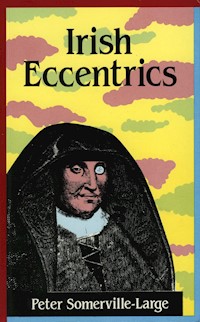
PETER SOMERVILLE–LARGE
Irish Eccentrics
A SELECTION
THE LILLIPUT PRESSDUBLIN
Contents
Title Page
List of Illustrations
Preface to the Lilliput Edition
Introduction
Familiars
Hermits and Ascetics
Miracle Makers, Rhymers, Witches, Giants and Oddities
John Perrot
John Asgill and Dean Swift
Frederick Hervey, Bishop of Derry
Philip Skelton and Other Men of God
Spenders and Spongers
Men of Violence
George Robert Fitzgerald
Scholars
Richard Pokrich
The Stratfords and the Kings
Buck Whaley and Tiger Roche
Court Circles
Lord Massereene
Amanda Ros
Folly and Death and Adolphus Cooke
Selected Books
Index
Plates
About the Author
Copyright
List of Illustrations
1a Crazy Crow. Portraits of Remarkable Persons, Vol. III by Caulfield
1b Zozimus. From a sketch by H. O’Neill, November 25, 1836
2a Richard Crosbie
2b Harry Badger. From a painting by James McDaniel. Cork Historical and Archaeological Journal, 1892
3 St. Brendan celebrating Easter.
4 Valentine Greatrakes
5 Eleanor Butler and Sarah Ponsonby, the Ladies of Llangollen
6a Charles Byrne on Exhibit with Two other Giants
6b The bones of Charles Byrne. Transactions of the Royal Irish Academy, Vol. XXIX
7a The Countess of Desmond
7b Jonathan Swift. From a portrait by Isaac Whood
8 Frederick Hervey, Earl of Bristol and Bishop of Derry. Artist unknown
9a Ruins of Downhill
9b The Mussenden Temple
10 Thomas Dermody. From a portrait by Charles Allingham
11a George Robert Fitzgerald as a Dandy
11b George Robert Fitzgerald before his Execution
12 The Reverend Charles Maturin. From a drawing by W. Brocas
13a Richard Kirwan
13b Jackie Barrett
14a Tiger Roche
14b Colonel Hanger’s Self Portrait. From Life and Adventures and Opinions of Colonel George Hanger
15 Amanda McKittrick Ros. From O Rare Amanda by Jack Loudan
16a The Cabinteely Dolmen
16b Johnny Roche. Cork Historical and Archaeological Journal, 1896
16c Adolphus Cooke’s Tomb
The illustrations have been reproduced by kind permission of the National Library of Ireland, 1a, 1b, 2a, 2b, 3, 4, 5, 6a, 6b, 7a, 11a, 11b, 12, 13a, 13b, 14a, 14b, 16b; of the National Gallery of Ireland, 7b, 8, 10; of the Library of the Northern Ireland Tourist Board, 9a, 9b; and of Jack Loudan, 15.
Acknowledgements
I would like to thank Francis Bonham and John Somerville-Large for directing my attention to Adolphus Cooke; also Mrs. Bayly-Vandeleur of Killucan, Co. Westmeath who kindly lent me a copy of Dr. William’s sworn opinion that he was sane in spite of believing that he was turning into a screech owl. The Royal Academy of Ireland has allowed me to use its marvellous library to search for other eccentrics. I am also grateful for the assistance I received at the National Library of Ireland, the library at Trinity College and the library of the Religious Society of Friends in Dublin. Finally I must thank Giles Gordon who gave me the idea for the book.
Preface to the Lilliput Edition
ECCENTRICITY is a slippery word to define. The dictionary puts it down to ‘being off centre’ and cites several synonyms: peculiarity, freakishness, queerness, aberration. Roget’sThesaurus is more unkind, filing eccentrics under misfits and cranks: crackpot, nut, screwball, oddity, fogey, laughing-stock, freak; and only on reflection including in its stockpot of comparisons rhapsodist, enthusiast, knight-errant, Don Quixote.
In Ireland eccentricity still has a conditional charm, and much of it lies in not being a public nuisance. Rereading my book I find that, apart from men of violence like George Robert Fitzgerald, most of my eccentrics were, if not adornments to society, people who commanded affection. Even Fitzgerald is still remembered with nostalgia around Castlebar because ‘he hunted by moonlight and won all his duels’ and, no doubt, because he was hanged.
In Ireland the word ‘touched’, which Thesaurus does not include but which can be applied to so many eccentrics, was always less of a matter for opprobrium and more a mark of respect. A tolerance of diversity and strangeness in people’s character was one of the more attractive features of Irish life. It spread through many aspects of day-to-day routine. Some of us will remember that before driving-tests became mandatory, there were only two qualifications for potential drivers: one was not to be blind, the other was to declare simply that no one in the family suffered from mental disease. Unfortunately, with Euroconformity it may well be that Irish eccentricity will become unacceptable.
Times change rapidly. For a number of reasons, social, pecuniary, environmental, the Anglo-Irish have produced numerous eccentrics, particularly in the environs of the big house. When I wrote my book in the early seventies there was still a whiff of sulphur about the big house. Today, however, its inmates have become high fashion, and the decaying world of the Anglo-Irish is revived in numerous novels and coffee-table books. An endangered species, the Anglo-Irish are no longer a threat. The landlord has ceased to be an ogre and has become picturesque, while the eccentric landlord is now presented as an ornament, a contrast to the grey conformity of modern life.
When Lilliput Press told me that they wished to bring out a new edition of IrishEccentrics, my gratification was tinged with regret for all those gifted and golden people whom I had not written about. Some of them I came across since in my travels around Ireland; others were encountered through reading. Some I knew personally, like Pope O’Mahony, universally beloved as much for his generosity as his dottiness. Another acquaintance, a well-mannered lady, took up residence at the bottom of my garden and hung her clothes on a tree. She would go round at night opening farmers’ gates to release the animals.
‘It is most cruel shutting them in like that.’ She had plans for storming the zoo and returning suitable animals to Africa.
I encountered for the first time a number of unusual personalities through reading for a book called TheGrandIrishTour. Among the travellers whose route I traced was the saintly Asenath Nicholson, American by birth and only Irish by association or by Conor Cruise O’Brien’s convenient methods of defining Irishness. In 1840, wearing a coat covered in polka dots, a capacious bonnet and a huge bearskin muff, and carrying a carpet-bag full of Bibles, she set off around Ireland to distribute the Bibles to anyone she met. Mrs Nicholson embodied courage, toughness and an engaging personality that could only be described as eccentric.
Another discovery was a native of Moate, Co. Westmeath, who called himself A. Atkinson, Gent. In 1812 Atkinson published a philosophical treatise entitled TheRollofaTennis-ballthroughtheMoralWorld, and then, abandoning his wife and six children, toured Ireland in search of subscribers who would enable his second travel book, TheIrishTourist, to be published. He listed his subscribers in four categories denoting their generosity or meanness; Lord Meath and Daniel O’Connell were entered under class one, while numerous impoverished or avaricious clergymen, tradesmen and gentlemen were listed under class four. Anyone familiar with Tourist’s reflective, garrulous, sermonizing and gossipy style (‘[At] Ballyconnell … I obtained a few subscribers and some marks of civility from Mr Whitelaw the curate, who is married to a daughter of the late valuable Mrs Angel Anna Slack of the county of Leitrim whose character and the remarkable termination of whose life have often been the subject of conversation in select parties …’) would not hesitate to include A. Atkinson, Gent., in any compilation of Irish eccentrics.
I would like to end this introduction — and I hope Fernie will forgive me — with a memory of one of the most charming of living eccentrics whom I encountered on the Antrim coast.
When I met Fernie in Glenarm he was wearing a waterproof suit and polythene wrappings taken from bread loaves over his hands to keep them dry as he prepared to take his 400-c.c. Honda south to Drogheda in the Republic. His motor-bike was burdened down with over two hundred pounds of equipment, not to mention Fernie himself on top. The equipment included a set of Swiss bells, a ventriloquist’s doll, a Punch and Judy show and a fez. There was scarcely a town in Ireland which he had not visited in thirty years. He ignored political and religious divisions, and had not yet found a Republican or Loyalist stronghold where he was not welcomed. He had encountered only one spot of trouble, a stray shot through the Honda’s front wheel. He specialized in giving shows for children and charity performances, presented with a blend of enthusiasm and innocence.
I still have a poster advertising his performance: MADCONJUROR, MAGIC AND SCAPO VENTRILOQUISM, YOU BELL BAND AND DUET CONCERTINA, CHAPEAUGRAPHY TROUBLE WIT, BA-LOONATIC AND THE ROLLO, LAOUGHS, SCREAMS AND YELLS.
Fernie told me he was English — another only to be included among Irish eccentrics by association. Long settled here, married to an Irish girl, a quiet, well-spoken family man, he did not consider himself or his work in any way unusual. No doubt this unselfconsciousness is an essential ingredient in an eccentric’s make-up.
I will leave the last word on the subject with Mary Manning, who wrote in her review of this book when it first appeared:
It would seem to me that the true eccentric is not only a nonconformist; he is usually a gifted person who transforms the dance of life from a pavane into a merry polka; one who wilfully embroiders harsh reality so that it becomes a tapestry of golden nonsense, but at the same time he maintains the balance between eccentricity and insanity; he is never an enemy of mankind, but is often a delight.
Peter Somerville-Large Glenageary,Co.Dublin, Spring1990
Introduction
ALTHOUGH Irish people as a whole are considered unconventional, it is the Anglo-Irish who generally make the records for eccentricity. Comparatively few Celtic Irish are remembered solely as eccentrics. For hundreds of years the majority of the nation was poor, and the behaviour of the poor is seldom recorded or tolerated. ‘I wonder if you’ve noticed’, wrote Margaret Powell recently, ‘but when rich men are peculiar it’s called eccentricity. But when poor men act a bit strange they’re promptly classed as loony.’ But is it only for reasons of wealth that the Anglo-Irish have produced so many eccentrics during the past two hundred and fifty years? There is scarcely a family that cannot number two or three, past and present. Why should so many flourish in the eighteenth century? It may have been a matter of timing. Transferred to Ireland, moulded by their new environment and contact with those whom they had subjected, the English settlers suddenly found they had lost touch with their immediate origins. This was the moment when the country house was transferred into a forcing house for eccentricity. The eighteenth century, which until its close was a period of peace and comparative prosperity, was the first time that the newcomers could take advantage of the circumstances which had given them an undisciplined licence to behave just as they chose. The choice was conditioned not only by wealth, but by isolation, prejudice, deficiencies in education and boredom. Bishop Berkeley may have noticed what was happening when, in June 1736, he wrote to a Mr. Urban that ‘we also in this island are growing an odd and mad people. We were odd before, but I was not sure of our having the genius necessary to become mad.’ But we should not search too closely for a reason. Maurice Craig has confessed that when he was asked whether he thought living in country houses made people eccentric, or was it merely that eccentric people tended to live in country houses, he did not attempt an answer.
It may also be that among Celts the trait is transformed into fanaticism. Pure eccentricity is a luxury that native Irishmen have been unable to afford. Wherever it exists in Ireland it tends to be sombre. There is far less of the gaiety that characterizes the English eccentric, who according to Edith Sitwell has ‘that peculiar and satisfactory knowledge of infallibility that is the hallmark and birthright of the British nation’. A proud definition of an English village is that it is a collection of eccentrics. This hallmark can be seen in the behaviour of Lord Bristol or Archbishop Whately, who tripped across the sea to join the odd and whimsical among the Irish. How lighthearted they were in comparison with their Irish counterparts! Irish eccentrics are a desolate crowd; one is reminded that the profligacy, violence, and even the extremes of austerity that form a basis for much of their behaviour have been linked by Dante in the seventh circle of Hell. Few make good family men; most have a preoccupation with death. The country houses are homes for tyrants. No buck oppressed with debt, drinking himself senseless, shooting his friends or throwing away his money under the chandeliers at Daly’s appeared to be experiencing any enjoyment. Ascetics earnestly flogged themselves. Garish figures have roamed Ireland’s cities, imposing a harsh familiarity, typified by Zozimus’ grating voice chanting recitations.
The line between eccentricity and madness is blurred as Swift knew when he left his money to found a madhouse because ‘no nation needed it so much’. Wars, poverty and loneliness have contributed to the erection of the asylums that rise like cathedrals outside Irish towns. The weather exerts its pressures as grey moody skies shot with cloud help to govern Irish behaviour. ‘You feel … an exhaustion rising into the air to meet you,’ V. S. Pritchett found, visiting Ireland. ‘You reach for the whiskey glass. Those wan sick clouds only a few hundred feet above the earth, might be damp souls of little value leaving gods that cannot cure. Yet a day or two, even an hour or two later, you could be flying into theatrical anarchy, swaying from one bizarre piece of break-up vapour to another … you have arrived at the beginning and end of creation.’
The true insane flicker through history. Here is just one, described by James Hamilton, Lord Abercorn’s agent, in the terrible year of 1798:
I lament to tell you that poor Harry Hood, your Lordship’s surveyor is mad, and not likely to recover … (He) fancies that he will be murdered by United Irishmen and that his own family are trying to poison him … His first essay was in the middle of a most stormy and inclement night to leap out of a 2nd storey window with his breeches, a loose coat and nightcap on; the pockets of his coat he filled with stones, got a long pitchfork in his hand, and in this trim marched in the dead of night as far as Raphoe 8 miles: day appearing, he concealed himself in a waste house and took the first opportunity of the Bishop of Raphoe’s gate opening to run in and call for protection …
Harry Hood had to be restrained, but although I have written about a number of people who were acknowledged as lunatics, others as mad as he were tolerated and flourished at liberty.
The eighteenth century in Ireland was so rich with distortions of human behaviour that we turn with reluctance to the more distant past where a scale of standards is difficult to determine. We can only use our own estimate in describing the edifying routines of anchorites and ascetics. Along with these formidable holy men are assembled other people with preoccupations that were pursued with unnatural singlemindedness. To quacks, healers, almanack makers, witches and wizards, have been added giants and centenarians who could not help stepping outside the normal pattern of our existence. The list is not nearly comprehensive. I have left out most modern people altogether and all that goes on in pubs and behind lace curtains in country towns. There is too much material. ‘To a certain extent all of us are a bit odd, all of us are eccentric,’ Chekov has said.
I have followed the example of recent anthologists in accepting Conor Cruise O’Brien’s useful comments on being Irish:
Irishness is not primarily a condition of birth or blood or language; it is the condition of being involved in the Irish situation and usually of being mauled by it.
This is a definition that allows the compiler to take enormous liberties. I have included people who travelled abroad, one or two who never set foot in Ireland, and Englishmen like Lord Bristol and Translated Asgill who spent time there and suffered for it.
Familiars
THE people who have shuffled out of line emphasize by their appearance that their world is apart from ours. Generally they have singular clothes which are either parrot-bright or cobweb-dirty; usually they are solitary, sometimes they are deformed. They have haunted us over the centuries. For a few years a figure is as much an adornment of a city as any landmark of brick or stone; then he vanishes and is replaced by someone equally strange and equally well known. Sometimes one or two brief appearances may make a character remembered for a generation. Captain Debrisay, Crazy Crow, Zozimus, Stoney Pockets—they are some of the figures who have wandered up and down or lingered on corners, or, like Paginini, the Window Pest, glared out for a couple of decades from the window seat of the Kildare Street Club to reveal his head twisted in a hunting accident so that it was on the same level as his neck.
An early Dublin familiar was Joseph Damer, the usurer and miser, who came over from England with Cromwell to make a fortune out of moneylending. From the Swan and London Tavern, ‘a timber house slated’ where he lived,
He walked the streets and wore a threadbare cloak;
He dined and supped at charge of other folk.
Around 1740 the dramatist, John O’Keefe, took notes on some of the city’s best-known characters. He lovingly described the elderly veteran, Captain Debrisay, who insisted on wearing clothes that had been fashionable in the reign of Charles II. They consisted of ‘a large cocked hat, all on one side of his face, nearly covering his left eye; a great powdered wig hanging at the side in curls, and in the centre of the back a large cockade with a small drop curl from it; his embroidered waistcoat down to his knees; the top of the coat not within three inches of his neck; the large buttons about a foot from it; buttons all the way down the coat, but only one at the waist buttoned; the hilt of the sword through the opening of the skirt; a long cravat, fringed, the eye pulled down through the third buttonhole, small buckles …’
Another Dubliner observed by O’Keefe was a conjuror. ‘He was unalterable in regard to dress, and would have died rather than change his old fashion, although it were to prevent either a plague or famine. On his head was a broad slouchy hat and white cap. About his neck was tied a broad band with tassels hanging down.
‘He wore a long dangling coat of good broad cloth, close-breasted and buttoned from top to bottom. No skirts, no sleeves, no waistcoat. A pair of trouser breeches down to the ankles, broad-toed, low-heel shoes which were a novelty in his time and the latchets tied with two pack threads, a long black stick, no gloves; and thus bending near double, he trudged slowly along the streets with downcast eyes, minding nobody, but still muttering something to himself.’
In the eighteenth century Dublin beggars were notorious; they were perpetually threatened with the lash, the stocks and imprisonment. They crowded the coaches wherever they stopped, and were the first sight for new arrivals coming in to Dublin by jaunting car from the Pigeon House after crossing the Irish Sea. Their general appearance was such that one traveller wondered what English beggars did with their cast-off rags ‘til he went over to Ireland and then he perceived that they were sent on to the Irish beggars’.
The most notable was a cripple named Corrigan, known as His Lowship, Prince Hackball, or The King of the Beggars. Every morning a little cart drawn by a mule or two dogs brought him down to his spot on the Old Bridge which spanned the Liffey opposite Church Street. Here he begged for fifty years, in spite of the disapproval of city functionaries who sought to tidy him away. In 1744 the parish beadle of St. Werburgh’s Church had him seized; ‘but on his way to the House of Industry he was rescued by a riotous mob’. This was the beginning of a tug or war between the parish and Hackball’s own people who sought to protect him. A public advertisement warned ‘the friends of Hackball … the noted beggar … that if they do not prevent him from begging in the streets, [the authorities] will apprehend him tho’ it should be with a military force, which they are determined to use against the multitudes who assemble to rescue those who are in the custody of parish offices’. When he was an old man the parish was able to arrest him and confine him for good.
Billy the Bowl was another beggar hard to shut away. He had been born without legs and moved about by the use of his arms with the stump of his body encased in a wooden bowl shod with iron. He was handsome with ‘fine dark eyes, aquiline nose, well-formed mouth, dark curling locks, with a body and arms of Herculean power’. But his temper was unsteady, and when he was put in an institution the Board resolved ‘that the man in the bowl-dish is not a proper person to be discharged from the House’. He managed to escape and somehow wandered around Dublin undetected for two years in spite of his unmistakable appearance, until he attacked two women in a lane near the Royal Barracks. He was taken in a wheelbarrow to Green Gaol and sentenced to hard labour for life, a legal action that made him for a time a hero of the Dublin mob.
Crazy Crow flourished some decades later towards the end of the eighteenth century. He was not a beggar, but made a living as porter to musical bands and as a body snatcher. Bully Acre near the Royal Hospital and the Poor Man’s Burial Ground were said to provide work for at least fifty resurrection men like Collins and Daly, who thought nothing of strewing the public highway with bodies they were forced to abandon. William Rae, a Scots naval surgeon on half pay, did better and conducted an export trade. The goods sent over the Irish Sea in barrels marked ‘pickled pork’ or cases labelled ‘pianos’ sometimes became so offensive that travellers were forced to transfer ship.
Crazy Crow was more of an amateur sack-em-up and had mixed success, with a period of imprisonment for stealing corpses from St. Andrew’s graveyard. He was better known as a boozy personality carousing around the city, loaded with cymbals and trumpets looking like a one-man band. He was caricatured in an engraving which showed him weighed down with musical instruments and was accompanied by a verse:
With looks ferocious and with beer replete
See Crazy Crow beneath his minstrel weight;
His voice as frightful as great Etna’s roar
Which spreads its horrors to the distant shore,
Equally hideous with his well known face
Murders each ear—till whiskey makes it cease.
The Female Oddity lived on the outskirts of Dublin, where she wore only green-coloured clothes, and for food, according to the Gentleman’sMagazine for 1780, ‘a fricasse of frogs and mice is her delight. Loves beef and mutton that is flyblown; when a child she used to be found eating small coal, and at night if her mother left her in her room by herself, she was seen to dispatch all the contents of the candle snuffers’.
The hangman, that figure who hovered perpetually in the background of eighteenth-century life, often did his work in disguise. He might wear a mask, or fit his back with a hump made out of a wooden bowl. Such concealment, which could be easily discarded, would help him escape from spectators who sought to pelt him after the execution of a popular criminal. Some administrators of justice dressed up specifically to give a surrealist air to a sinister occasion. The NewgateCalendar described a man who performed a whipping as ‘highly grotesque … tall … in a grey coat with a huge wig and a large slouched hat … his face, completely covered with yellow ochre, strongly tatooed in deep lines of black’. In 1800 the executioner of six men condemned for murdering a Colonel Hutchinson wore ‘a singular costume. From head to foot he was dressed in a uniform of bright green—the national colour—and around his waist was a broad buff belt on which was inscribed in large letters ERIN GO BRAGH’.
Familiars could be more respectable members of society. Some bucks qualified, although it was a hard time for dandies to stand out because of the brilliance of their dress. They had to outdo rich men like the Bishop of Derry who wore diamonds on his shoes, or Mr. Coote who returned from the Grand Tour in a startling outfit highlighted by the size of his feather hat and the brightness of his satin shoes with their red heels. Perhaps the most prominent of the bucks was the Sham Squire, Francis Higgins, the gutter journalist and government informer, who, during the last decade of the eighteenth century, was ‘daily to be seen … upon the Beaux Walk in Stephen’s Green wearing a three cocked hat with fringed swansdown, a canary coloured waistcoat with breeches to match, a bright green body coat and violet gloves, the only buck in Dublin who carries gold tassels on his Hessian boots’.
Around 1770 Dubliners were entertained by the appearance of a mysterious Turk named Dr. Achmet Borumbad. His story is told at length by the diarist, Jonah Barrington. He was over six feet tall, and his imposing figure, invariably clothed in Turkish costume, was set off by a generous black beard which covered his chin and upper lip. After fashionable society welcomed him as a refugee from Constantinople, he managed to convince the College of Physicians that there was a need in the city for public baths—simple, medicated, cold, temperate and warm. These would cure ‘all disorders whatever’. He even persuaded the Irish House of Commons to make him a series of annual grants to finance their construction in Bachelor’s Walk.
The Doctor’s requests for Parliamentary aid were accompanied by lavish parties which took place before every Session. During the last of these, when the festivities got rowdy, one of the more temperate guests excused himself and prepared to leave. On his way out he fell into the vast cold bath, and was followed by numerous other revellers, who had rushed after him trying to prevent his departure. Dr. Borumbad found ‘a full committee of Irish Parliament-men either floating like so many corks upon the surface, or scrambling to get out like mice who had fallen into a bason!’ Restored with brandy and mulled wine, large fires and oriental blankets, they were sent home in sedan chairs; but they gave him no more grants.
The Doctor then fell in love with a Miss Hartigan, whose family insisted that he should shave and become a Christian. He emerged from beard and robes as a plain Irishman, Mr. Patrick Joyce from Kilkenny—‘the devil a Turk’, he told his beloved, ‘any more than yourself, my sweet angel’. He had spent some time travelling in the Levant, and following his experiences there, decided to make a business out of posing in Turkish costume. The Dublin Baths did not long survive the stripping of their proprietor’s mysterious background, and in 1784 they were sold to the Wide Street Commissioners.
In 1816 a Dublin newspaper reported the detention in the House of Industry of a notorious individual known as Stack of Rags. ‘His great care and anxiety to preserve every scrap of old rags, and his uneasiness when any person approached him gave concern of suspicion, and a search was made; seventy-five guineas in gold were found carefully sewed up among the rags, and receipts from a most respectable banking house in this city, for different lodgements amounting to fifteen hundred pounds.’
Stoney Pockets walked round the Dublin streets with a pronounced tilt to one side, keeping his right-hand pocket filled with stones to straighten himself up, or as he sometimes claimed ‘to keep his head from flying away’. He was a friend and associate of one of Dublin’s best-known characters, Zozimus the reciter.
Zozimus, who was born around 1794 as Michael Moran, became blind a few months after his birth. Probably this misfortune encouraged him to become a story-teller, which he did with great success, so that by the time he was twenty-two he was famous in the city as an itinerant reciter. He had taken the name of a fifth-century cleric who discovered St. Mary of Egypt when she was a hermit in the wilderness. The meeting of Zozimus and St. Mary, which had been written up by Bishop Coyle, formed one of his favourite recitations.
He wore a long frieze coat with a curious scalloped cape, an old greasy brown beaver hat, corduroy trousers and what were described as ‘Francis Street brogues’. He always carried a blackthorn stick tied to his wrist by a leather thong. During the day his favourite stand was on Carlisle Bridge, but most evenings he wandered round the city on a well-known itinerary, giving his recitations, and stopping every few minutes to receive contributionsfrom ‘good Christians’ of whom there were fortunately many. He did not like Protestants.
‘Is there a crowd about me now? Any blackguard heretic about me?’ Zozimus would begin, before launching off into a set piece.
Gather around me boys, will yez,
Gather around me?
And hear what I have to say
Before ould Sally brings me
My bread and jug of tay.
I live in Faddle Alley,
Off Blackpots near the Coombe;
With my poor wife, Sally,
In a narrow dirty room.
Another opening was:
Ye sons and daughters of Erin attend,
Gather round poor Zozimus yer friend;
Listen, boys until yez hear
My charming song so dear.
The shake of his shoulders and a characteristic wriggling of his body accompanied an actor’s ability to extract the last piteous ounce of pathos from his material, much of it patriotic, some of which he composed himself. It was usually effective, even if, as in a favourite ballad, St.PatrickwasaGintleman, it became meaningless doggerel:
There’s not a mile in Ireland’s isle
Where the dirty varmint musters
Where’er he puts his dear forefeet
He murders them in clusters;
The toads went hop, the frogs went pop
Slap haste into the water.
The verses would be accompanied by a barrage of asides:
At the dirty end of Dirty Lane
Lives a dirty cobbler, Dick McClane.
Dick McClane was a strong Orangeman. Sir John Grey, editor of the DublinFreeman’sJournal, once led Zozimus across Essex Bridge.
‘Now, Zozimus, why is it you are always so hard on us Protestants? Here am I, a heretic, who have taken you safely over the bridge, when none of your faith was near to assist you, and yet you may say harsh things against us.’
‘Sir,’ Zozimus replied. ‘Sir! Do you not know that we must somehow for their own good pander to the prejudices of an unenlightened public?’
During his lifetime he had numerous rivals and imitators. Immediately after he died on April 3, 1846, one of his companions set himself up as ‘the real identical Irish Zozimus’.
A shortlived humorous periodical was named after him. For years photographs of him in his strange clothes were advertised for sale:
Photographs of the great original Zozimus.
Carte de visite 6d. and post free
Cabinet size 1s. 6d.
Large size for framing, 14 by 11 inches with quotations from Saint Mary of Egypt and Finding of Mary 2s. 6d. each and post free.
Although the best-known figures are associated with the city, where they are constantly under the scrutiny of their fellow citizens, they are found in rural areas as well. Robert Cook, all dressed in white, flourished late in the seventeenth century down on a farm in Cappoquin, Co. Waterford, where he stood out from the commonalty by reason of his startling white linen suits. An early vegetarian, he refused to eat flesh or wear the product of any animal; consequently he wore nothing but linen, so that he came to be famous as Linen Cook. He also refused to have any black cattle on his farm which was run with ‘Phagorian Philosophy’, and even his horses had to be the same unblemished white as his clothes.
‘Whereas I cannot kill without wounding my conscience,’ he wrote, ‘rather than will I offend the innocent life within me, I refuse any food or raiment that may come from any beast or other animal creature. And wine and strong drink are hot in operation and intoxicating, and I think as needless to be as tobacco, and I, by experience, find that water for drink and pulse or corn and other vegetative for food, and linen and other vegetatives for raiment be sufficient …’
A fox which had the temerity to attack Cook’s poultry was not killed when it was caught; first he gave it a dissertation on murder and then a sporting chance by making it run the gauntlet of his farm labourers armed with sticks. Like many cranks, he had a long and healthy life, dying in 1726 when he was over eighty years old. He was buried in a linen shroud.
Lord Howth, according to O’Keefe, always wore ‘a coachman’s wig with a number of little curls and a three-cornered hat with great spouts. When on the horses’ box I never saw him without a bit of straw about two inches long in his mouth’. Later in the eighteenth century the antiquarian and bookseller Gabriel Beranger was to be seen in a long scarlet frock-coat, yellow breeches and top boots scrambling over the countryside looking for ruins.
J. D. Herbert in his IrishVarieties describes a rural scholar nicknamed the Knight of the Boyne whose farm in Co. Meath was crammed with books. He habitually wore ‘a large cloak with hanging sleeves, a crimson silk handkerchief about his neck and head and a large leafed hat’. Another voracious reader was Mr. Henry Dodwell of Manor Dodwell, Co. Roscommon, who went about on foot, even walking from Holyhead to London with his pockets and bosom stuffed with books, reading every mile of the way.
Overhead in his balloon painted with the arms of Ireland Mr. Crosbie tried to cross the Irish Sea dressed in an ‘aerial dress’ he designed himself, consisting of ‘a robe of oiled silk lined with white fur, waistcoat and breeches combined in one garment of quilted white satin, morocco boots and a montero cap of leopard skin’.
TheOldKerryRecords mentions how ‘eccentricity of attire was not rare in Tralee and its vicinity’. It goes on to describe a character known as Georgy Gay ‘who down to the day of his death in 1838 wore the enormous ruffles and frill shirts of finest French cambric at a guinea and a half a yard, material which went out with the last century’. Georgy also had an eighteenth-century appetite; not long before his death he gave dinner parties with dishes which included twelve huge turbot as an entrée, Kerry mutton, barn-door fowl, mountain trout, lobsters and grouse, swallowed down by bottles of mountain dew.
In Cork the tailor known as Bothered Dan dressed in his cocked hat and home-made uniform complete with breastful of medals. Harry Badger paraded or lounged in front of the city courthouse wearing a pair of yellow buckskin trousers, a red coat and a brass helmet which he had ornamented with iron spikes against the attacks of small boys. He was universally regarded as a figure of fun and even his friends took advantage of his many peculiarities, including his indifference to what he ate or drank. When a mouse was dropped into his porter, he swallowed his pint without protest. His death came about as the result of another practical joke, after he had been given a dish of tripe made out of strips of leather from a huntsman’s breeches boiled with milk and honey. Harry took two days to finish the meal—and died on the third.
Dublin familiars of this century have included Jembo-No-Toes, Old Damn and All-Parcels, the beggar lady who lived by collecting and selling waste paper which she accumulated in endless neat bundles. Tie-Me-Up used to stand at the Metal Bridge stripped to the waist cracking a big whip and shouting: ‘Tie me up! Tie me up!’ Someone would oblige, using a chain and perhaps a strait-jacket, whereupon he would manage to release himself within ten minutes or so to the cheers of the crowd. Specs was a figure of the suburbs, lean, lanky, over six foot tall, who used to tie a piece of cloth to the front wheel of his bicycle handlebars to catch the wind. He would peel an apple in one curling piece, throw away the apple and eat the peel. More recently Dubliners have noted Lino—who was always lying down—and Bang-Bang, well known for shouting ‘Bang Bang you’re dead!’ at passers-by.
The Bird Flanagan was a practical joker whose exploits became city legends. His nickname arose from the occasion when he went to a fancy-dress ball as a bird. When he didn’t get a prize, he pretended to lay the egg which he proceeded to throw at the judge. Another time he managed to get himself arrested by snatching a fowl from a poulterers’ shop just as two policemen were passing. He had taken the precaution of buying it first and having a label with his name tied round its neck. Perhaps his most startling exploit was the theft of a black child from the Kaffir Kraal in Herbert Park during the Great Exhibition of 1906.
There are people today who remember Endymion clutching his swords and can testify to the accuracy of Gogarty’s description of him. ‘He wore a tail coat over white cricket trousers, which were caught in the ankle by a pair of cuffs. A cuff-like collar sloped upwards to keep erect the little sandy head crowned by a black bowler some sizes too small. An aquiline nose high in the arch gave a note of distinction to a face all the more pathetic for its plight. Under his left arm he carried two sabres in shiny scabbards of patent leather. His right hand grasped a hunting crop such as whippers-in use for hounds.’ Sometimes he would be holding a fishing rod which he used to fish through the railings of Trinity College.
He had worked in Guinness, and the story had it that he went strange after falling into an empty vat and breathing fumes. When told that his condition was likely to get worse, he said: ‘Endymion, whom the moon loved: a lunatic.’ But in the National Library he signed himself James Boyle Tisdell Burke Stewart Fitzsimons Farrell.
He could be seen entering the library, saluting the clock at the ballast office with a drawn sword, or taking out his alarm clock and compass with which he set a course for his home, raising his whip hand to the north as he entered Molesworth Street. He was a harmless gentle old man, whose main interest, apart from his fanciful clothes, was in music. ‘Dublin saw him’, Gogarty wrote, ‘only as a man gone “natural” and Dublin has outstanding examples in every generation.’
Hermits and Ascetics
THE Skelligs are three steep rock islands eight miles out in the Atlantic off the south-west coast of Kerry whose dimly-seen mountains and headlands bound their eastern views. The little Skellig and Washerwoman’s Rock are inaccessible at most times; but on the Great Skellig or Skellig Michael landings can be made during the summer. Today lighthouse keepers live four hundred feet above the swell, relieved of their duties by helicopter. Their lighthouse is near the site of ‘the most western of Christ’s fortresses’.
Some time during the sixth or seventh centuries a small group of monks settled on Skellig Michael, which is dedicated to the archangel, like those other sea-girt mountains, St. Michael’s Mount in Cornwall and Mont St. Michel in Normandy. Here they founded a sanctuary which for a few hundred years attracted a stream of holy men seeking to live apart from the vanities of secular life. They constructed six beehive cells and two oratories near the top of the conical mountain, using a beautiful technique of dry-stone walling which has survived fifteen hundred years of storms. Five of these cells are intact; they each contain an ambry or wall recess where the monks could store their scanty supplies and there is also the occasional stone projection which could have been used as a hook to hang garments on. Outside on the roofs there are similar stone projections which held in place insulating layers of turf, or perhaps tufts of the mat-forming sea pink which grows abundantly on the rock.
Stormbound for months on end the monks lived austerely. There were two wells near their settlement and plenty of seabirds and their eggs to eat. Fulmars and petrels nest on the Skelligs, as well as the more common ducks of the sea, puffins, razor bills and guillemots. The little Skellig is flecked in a perpetual snowstorm, since it is one of eleven gannetries around the coast of the British Isles. On calm days, the monks came down and caught pollock, and their diet may also have been varied by goat’s flesh and milk, since there is just enough grass to support a small herd of animals. They may have brought the earth across in curraghs. Enduring the tempests and contemplating the sparkle of sun on the ocean, they were satisfied that apart from the occasional band of pilgrims—a pilgrimage to the Skelligs persisted until modern times—outside human contacts could not distract them from their vigil with God.
Sparse records have preserved the names of some of those who chose to spend their lives here. Before the monks came Skellig Michael seems to have been used as a stronghold by kings in Kerry and a place of refuge if troubles on the mainland got unendurable. Then a shadowy St. Finan may have been the founder of the monastic colony. TheMartyrologyofTallaght, written at the end of the eighth century, mentions a Sweeny of the Skellig. There was an Elann, son of Cellach, abbot of Skellig, who died in 824; Balthmhac of the Skellig died sixty-eight years later. In 1044 died Aodh of Skellig whom the AnnalsofInnisfallen referred to as ‘the noble priest, the celibate and the chief of the Gaedhil in piety’. The Annals also recorded an attack on the hermitage by some Vikings, during which a monk named Etgal of Skellig was carried off; he escaped, but died of hunger and thirst. On another occasion when the Vikings came in search of plunder, they again kidnapped a monk, Cormac the anchorite, son of Selbach. He, too, managed to escape: ‘he it was whom the angels set free three times, though he was bound up again every time’.
It seems probable that the little community remained intact until the middle ages, since a chapel was added to the older buildings some time during the twelfth century. But by then pious people were less zealous about seeking out lonely discomfort. Giraldus Cambrensis mentioned that ‘the situation of the abbey being found extremely bleak, and the going to and from it highly hazardous, it was removed to Ballinskelligs on the continent’, in other words the mainland.
The early Irish hermits were pleased to emulate the excesses of the Desert Fathers in Egypt and Syria, but in a less accommodating climate. Monasticism was dominated by rigorous régimes of fasting and penance designed for sinners to attain ‘a loving attention upon God’. Saints and wise men chose to become hermits, or at least to live in inaccessible places, and islands were particularly suitable for those who sought isolation. During the sixth and seventh centuries which heralded the dawn of Ireland’s great age of monastic splendour islands all around the coast were snapped up by hermits or small anchoritic communities. They were ideal situations for the contemplative to view some of God’s creation with a selective and pure vision:
Delightful I think it is to be in the bosom of an isle
On the crest of a rock
That I may look there on the manifold face of the sea;
That I may see its heavy waves
Over the glittering ocean
As they chant a melody to their Father
On their eternal course.
St. Columcille, who spent his life bringing Christianity to islands, Tory, Iona and Eigg, spoke approvingly of his brethren seeking destruminpelagointransmeabilu, a desert in a trackless sea. Calling an island or any isolated holy place a desert was associating it with the environment of the Desert Fathers, and place names like Dysert o Dea and Reendesert still recall the site of hermitages. It is possible that the monks of Skellig Michael made comparisons between their mountain and the pillar of Simeon Stylites. Contrasting the violence of storms with the peace of calm days was also a practice associated with the Desert Fathers, who saw the struggles between the forces of light and darkness in nature as paralleled within the soul.
Such ascetics, according to the ninth-century CatalogusSanctorumHiberniae, belonged to the third order of saints. The bishops, who received their missa from St. Patrick, were considered Most Holy, the Presbyters Very Holy, the anchorites merely Holy. But some of the greatest names in early Christianity travelled across the sea in search of solitudes. The islands visited and transformed by Columcille became symbols of Christianity. Many went further than he; Cormac, Abbot of Durrow, sailed into Arctic waters before turning south and ending up on Iona. Brendan was looking for the perfect island when he set off on his voyages in search of ‘Paradise’. The most famous of those he visited, the back of the whale, Jasconious, where he celebrated Easter Mass, may indicate that pure contemplative peace is not always forthcoming even with ideally austere conditions. Modern commentators have suggested that Brendan’s was a genuine voyage undertaken in the spirit of exploration, presented to us through the bright eyes of the myth makers. The story has similarities to an adventure of Sinbad. Jonah’s involvement with the ocean also shared the mysteries of the unknown, and perhaps Bede was thinking of Brendan’s adventures when he stated that Jonah was swallowed by a whale. He was the first to do so; earlier accounts had merely specified ‘a great fish’. Medieval chroniclers may have believed that Jonah and Brendan encountered the legendary Aspidochone which occurs in bestiaries, a sea creature with seven fins which sailors often mistook for islands.
Among the Magharees, islands off north Kerry, Illaunanil bears striking similarities with the whale island described in Brendan’s Navagatio: it has no grass, very little timber and no sand on its shores. A landmark is even known as Coosarim or the ‘creek of the spout’. There is a story in west Cork of how some fishermen discovered what seemed to be a dead whale floating in the waters of Bantry Bay. They sent the boat back to get help salvaging it, while a couple climbed on the animal’s back where they lit a brazier to make tea; they woke it up.
Inland, the big monasteries also sought isolation. A great foundation like Clonmacnoise was surrounded partly by bog and partly by a swampy arm of the Shannon. Clonfert was similarly located on an island in a bog. Other less important monastic settlements were sited on the edge of lakes, or on the tops of mountains. But they only provided a degree of isolation, and it was difficult for the true hermit to withdraw entirely from community life and follow St. Columcille’s edict: ‘Be alone in a desert place, apart in the neighbourhood of a chief monastery if you distrust your conscience in the company of many.’ Complete isolation was never easy to achieve. ‘I wish,’ bemoaned St. Manchan, ‘O Son of God, eternal ancient king, for a hidden little hut in the wilderness that it might be my dwelling.’ An anonymous monk longed to be ‘all alone in my little cell without a single human being with me; such a pilgrimage would be dear to my heart before going to meet my death’.
Frustrated ascetics longed for ‘a cold fearsome bed where one rests like a doomed man; food, dry bread weighed out, water from a bright and pleasant hillside’. The programme for the ideal hermetical routine included an unpalatable and meagre diet, reading and self-mortification. Discomforts included austere sleeping arrangements. St. Columcille had ‘a bare rock for pallet and a stone for pillow’. St. Kieran also had a stone pillow, which seems to have been quite a common piece of furniture in hermitages. Mlle Françoise Henry has suggested that the two polished red stones she discovered in the sleeping-places of two excavated huts on Inishkea island might well have been pillows. Some hermits went as far as entombing themselves—again in imitation of the Desert Fathers—and various earth houses and souterrains, like an earthhouse in Killala church in north Mayo and another at Kilcolomcille in Co. Donegal, have been identified as places in which hermits chose to spend time. On Skellig Michael a neolithic souterrain may have been adapted as living quarters.
Hermits had to interpret in their own way the programme recommended by St. Jerome: ‘Those who have devoted their lives to God should spend their nights like a tree hopper passing untiringly from one exercise of devotion to another.’ St. Samathann, advising a monk who asked what method is best for prayer, interpreted this by recommending that ‘we must pray in every position’. Self-mortification was an important aspect of many régimes of prayer. It usually included a schedule of fasting. The behaviour of the anchorite, Gorman, who lived on bread and water for a year was typical. Madeoc of Ferns went better and ate only barley bread with water for seven years. Other hermits used ingenuity in finding new disciplines. Some carefully tended worms and encouraged them to gnaw at mortified flesh. Another suspended himself for seven years from iron hooks. Maclaius spent six months in a marsh infested with mosquitoes. Ailbhe regularly kept a cross vigil, using a cross of stone which he had made himself, on which he stretched regardless of the weather, reciting the psalter. Findchu, who surrendered his place in heaven to a king of the Deise, got seven smiths to construct seven sickles with which he thrashed himself for seven years to win a new place above.
Extreme forms of self-denial were not, of course, confined to hermits; they were general throughout the monastic system. Over the centuries a number of elaborate lists of rules and penitential exercises were drawn up for holy men to follow. The earliest to survive, the Rule of Columcille, believed to date from the sixth century, has punishments for breaches of community rule that might have derived from a sadistic prep school: six strokes of the cane for the monk who speaks during the meal; ten for the one who makes cuts on the table with his knife. Giggling during holy office cost six, contradicting another monk earned the sinner fifty, while biting the chalice at Mass merited six.
Later rules, penitentials and martyrologies were more severe. ‘Anyone who touches food with unclean hands, a hundred lashes are laid on his hand.’ ‘For being drunk to cause vomiting—let him do a penance for forty days on bread and water.’ Such regulations came to be considered too severe by church authorities; the Penitentials were formally condemned by the Councils of Chalon (A.D. 780) and of Paris (A.D. 829). Peter Damien even recommended those who followed them to the fire of Gomorrah.
The strictest Rule was made up by a fanatical reformist sect known as the Culdees which was active towards the end of the eighth century. Under the Abbot Maelruin, the Culdees, friends and companions of God, instituted a fierce reappraisal of the tradition of austerity. There is a theory that the Rule of Columcille as it survives was redrawn by one of the Culdees. They were noted for their asceticism rather than for any artistic or intellectual activity, although it is fair to add that a Culdee environment created an atmosphere in which such a masterpiece as the Stowe Missal came to be written out. They had an important monastery at Tallaght—Tallaght and Finglas on either side of the Liffey, now bleak Dublin suburbs, were both centres of religous learning, once known as ‘the two eyes of Ireland’. Tallaght’s formidable Abbot Maelruin was a rigid disciplinarian, and his influence helped to formulate one of the harshest rules in church history. The lives of his monks ground inexorably around a system of prayer, strict fasting, penances and castigation. There was no relaxation. Once a well-meaning musician, Cornan of Desert Laigen, offered to play the pipes and make a little secular music for the monks. Maelruin admonished him: ‘Tell Cornan these ears of mine shall not be delighted with earthly music until they are delighted with the music of heaven.’ Food was distributed in accordance with the recipient’s state of sin. Those whose sins were lightest received gruel floating on water; gruel between the water was given to the more disreputable, while gruel which sank to the bottom was reserved for hardened sinners.
The Culdees were responsible for a particularly severe table of penitential commutations. ‘A commutation for rescuing a soul out of hell: 365 paters, 365 genuflexions, 365 blows of the scourge every day of the year and a fast every month rescues one soul from hell.’ Another commutation ‘of a black fast for grave sins for one who cannot read’ demanded ‘300 genuflexions and 2,000 properly administered blows with a scourge, at the end of each a cross vigil until the arms are weary’. First commutations for laymen and women included ‘spending the night in water, in nettles, or with a dead body … spending the night in cold churches or remote cells, while keeping vigil and praying without respite’.
The Penitentials were very largely devoted to punishments for carnal sins and lustful thoughts. Fasting was believed to reduce the amount of blood in the body, and from this would come a lack of desire. ‘Seven days’ penance on bread and water for any cleric who lusts after but does not speak with his lips …’ Pollution in sleep exacted a punishment of singing seven psalms and living on bread and water throughout the following day. Taking a virgin required a three days’ penance.
In general women and the lusts they inspired were abhorred. The monks of Inniscarthy island never allowed one to land there. ‘What have women to do with monks?’ a virtuous lady was asked as she tried to disembark. ‘Return to the wicked world lest you be a scandal to us, for however chaste you may be, you are a woman.’ St. Columcille would not even let a cow within sight of one of his monastery walls, because, as he explained, ‘where there is a cow there must be a woman, and where there is a woman there must be mischief’. As late as the twelfth century Giraldus Cambrensis described a lake in Munster with two islands, the larger of which had a church. ‘No woman or animal of the female sex is allowed thereon without dying instantly. This has been proved many times by examples of female dogs and cats perishing.’
Not all ascetics were as sensitive to the problems of carnal lusts as the Anchorite, Laisren, who lived quite naked and free from sin with nothing on his conscience, until he made the mistake of spending the night in a friend’s cloak. For the first time in his life he had a ‘carnal vision’ and later he discovered the reason why; the cloak had belonged to a married couple. Saints gave a lead in efforts to suppress lustful thoughts. Amonius heated irons and applied them to his body to keep down desire. St. Oengus restrained the impulses of the flesh by constant scourgings, reciting the psalter every day, reciting the oratory under a tree, standing in a cask of cold water, and binding himself to a post with a rope round his neck. Women saints were not to be outdone; St. Derville of Erris put out her eyes because an unwanted suitor said they were the most attractive thing about her.
Saints were the popular idols of the day, and it was natural to assume that they should be pursued for carnal motives. Women lusting after saints became a persistent theme of medieval legends. St. Senan, according to an early poem, narrowly escaped being trapped on his island retreat by a beautiful maiden; had he given her any encouragement or allowed her to stay there overnight, she would have remained with him for ever. His plight was typical. Such legends are closely associated with prominent figures of the early church; St. Columcille and St. Kevin, both strikingly handsome, attracted persistent female admiration.
As a young man St. Kevin, whose name means the Fair Begotten, had to flee the blandishments of a woman and run into a forest where he stripped off his clothes and rolled himself in a bed of nettles. (This was an easy and popular purgatorial exercise which lingered on—it survived in one form up to this century, when children used to go round on May Eve and May Day carrying nettles and stinging everyone they met.) When his pursuer caught up with him, Kevin, recovering his presence, put on his clothes and chastised her with the same nettles. She fell on her knees and begged to become a nun.
St. Kevin, perhaps the most famous of hermit saints, belonged to the great early period of Irish monasticism. When he decided to become a contemplative hermit, he did not desert the dark valley of Glendalough beside whose lower lake he had founded a monastery. He merely moved away into the forests on the chill north side of the upper lake and obtained temporary accommodation in the hollow trunk of a tree. In theory a hermit should have been able to live comfortably off food gathered in natural surroundings—‘a clutch of eggs, honey, mast and hearthpease sent by God … herbs and berries …’ but probably Kevin’s diet was supplemented by visiting monks. From his tree he moved to a less exposed hermitage, the famous ‘bed’ thirty feet above the black waters of the lake. This little cave hollowed out of rock may have originally been a neolithic mine; there is one rather like it on the island of Hoy in the Orkneys. Even today it is difficult to reach




