


9,99 €
Mehr erfahren.
- Herausgeber: Sonicbond Publishing
- Kategorie: Geisteswissenschaft
- Serie: On Track
- Sprache: Englisch
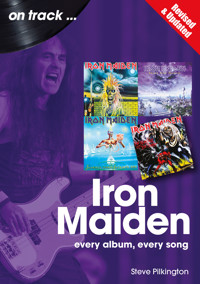
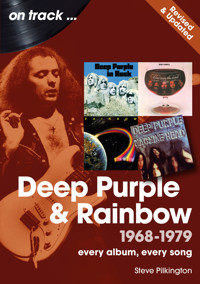
Mention the words' heavy metal' and chances are one of the first names you'll get back is Iron Maiden. From their early days as front-runners of the New Wave Of British Heavy Metal in 1980, through to their epic and progressive works of more recent times, the band have been all things to all men in the metal world. Such is their profile that even the non-metal fan would probably cite them as a key example of the genre. This book lifts the lid on every single track recorded by the band, album by album, from the punk-ish debut with original vocalist Paul DiAnno, via the glory years fronted by Bruce Dickinson, through to the band’s most recent albums Book Of Souls and Senjutsu.
By way of facts, anecdotes, analysis and a dollop of opinion, Steve Pilkington provides both an informative companion for the die-hard fan and a perfect road-map for the more casual listener to follow. From 'Prowler' to 'Hell On Earth', through each and every line-up change, this is every Number recorded by The Beast – the ultimate recording history of Iron Maiden.
Steve Pilkington is a music journalist, editor and broadcaster. He was Editor in Chief for the Classic Rock Society Magazine Rock Society and is now co-administrator of the rock website Velvet Thunder as well as presenting a weekly internet radio show called A Saucerful Of Prog. Before taking on this work full-time, he spent years writing for fanzines and an Internet music review site on a part-time basis. He has recently published Deep Purple and Rainbow On Track, The Rolling Stones On Track and Supertramp – Crime Of The Century, all for Sonicbond, and has also written the official biography of legendary guitarist Gordon Giltrap. He lives in Wigan, Lancashire, UK.
Das E-Book können Sie in Legimi-Apps oder einer beliebigen App lesen, die das folgende Format unterstützen:
Seitenzahl: 369
Veröffentlichungsjahr: 2025
Ähnliche
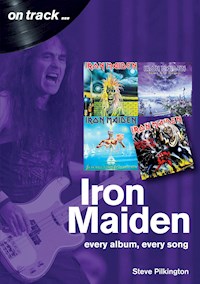














Iron Maiden
Steve Pilkington
Contents
Acknowledgments
Author’s Note
Introduction
1. Iron Maiden
2. Killers
3. The Number Of The Beast
4. Piece Of Mind
5. Powerslave
6. Somewhere In Time
7. Seventh Son Of A Seventh Son
8. No Prayer For The Dying
9. Fear Of The Dark
10. The X Factor
11. Virtual XI
12. Brave New World
13. Dance Of Death
14. A Matter Of Life And Death
15. The Final Frontier
16. The Book Of Souls
17. Senjutsu
18. Live Albums, Videos And Compilations
Afterword: 30 Numbers Of The Beast – Author’s Maiden Playlist
Bibliography
Acknowledgments
Thanks to Stephen Lambe for his continuing faith in me by commissioning this book for a second edition! Will he never learn?
Thanks to Janet, my late wife, for hearing about Iron Maiden until the words had lost all meaning, and still not complaining. Sadly missed.
Thanks to Bryan Cline, for happening to have a camera handy in the US in the early ‘80s!
Thanks to all the people I hung out with at various rock pubs and clubs back in 1980, when the crucible of the New Wave Of British Heavy Metal forged so much great music. What times.
Thanks to everyone at the Velvet Thunder website, in particular, fellow Maiden fan Lee Vickers.
Finally, thanks to all of the Maiden guys for inspiration and joy over the years, particularly Bruce Dickinson, the finest heavy metal vocalist of all time (or at least in a death match with Dio) and Janick Gers, who particularly inspired me when I first saw him with White Spirit (who were a magnificent band).
And of course, you who hold this in your hands now. I truly hope you enjoy it!
Up The Irons!
Author’s Note
When this book was first published in 2020, it seemed a fair bet that Book Of Souls, the double album statement which was the most recent Iron Maiden album at that time, would be the band’s last. Bruce Dickinson’s health problems at the time of that recording only made this seem more probable. Not for the first time, however, they proceeded to defy expectations by producing not only another album, but another double. With the release of Senjutsu is became clear that a revised version of the book – updated to include it – would be a good idea and requests from people have subsequently proved that.
With this in mind, I have not only included a chapter on the Senjutsu album, but have also given the whole book a little ‘spit and polish’, with some parts tidied up a little and a couple of mistakes which slipped through now rectified. It has been a delight to revisit the book, and it is hopefully as rewarding to read as it has been to (re)write.
Up the Irons!
Steve Pilkington
September 2025
Introduction
The history of Iron Maiden is inextricably bound up with founder member and bassist Steve Harris. A native of Leytonstone, in East London, Harris formed the very first Iron Maiden incarnation on Christmas Day 1975, having previously cut his teeth in bands called Gypsy’s Kiss and Smiler. He was 19 at the time. This initial lineup, with Paul Day on vocals, guitarists Terry Rance and Dave Sullivan, and drummer Ron Matthews, didn’t last too long. Vocalist Day (who would later front the band More with some success) was replaced in 1976 by Dennis Wilcock, allegedly for his lack of stage presence. This issue was certainly addressed by the recruitment of the flamboyant Wilcock, a Kiss fan who brought blood capsules and face paint to the band’s shows!
A good friend of Wilcock was guitarist Dave Murray, whom Harris wanted to bring into the band. This was met with significant resistance from Rance, however, and to allow the recruitment of Murray to take place, Harris disbanded Maiden in December 1976, only to reform the band shortly afterwards with Murray as the sole guitarist. Things didn’t remain stable for too long, however, with the seemingly volatile Wilcock convincing Harris to fire both Matthews and Murray, while a second guitarist named Bob Sawyer was soon ousted after he pretended to play the guitar with his teeth on stage in less than successful fashion, with the audience all fully able to see it was a trick. Down to a duo, Harris now put together a completely new lineup in the second half of 1977, including guitarist Terry Wapram, drummer Barry Purkis (aka Thunderstick, who would go on to play in Samson, along with a certain Bruce Dickinson) and keyboard player Tony Moore (later of Cutting Crew). Needless to say, this didn’t last long either – especially so in the case of Thunderstick and Moore, who were both ousted after a single gig, Thunderstick having played appallingly and Moore let go as Harris realised the keyboard experiment wasn’t working.
Drummer Doug Sampson was brought in to replace Thunderstick, having been in the audience for the outgoing man’s only show. After a conversation with an exasperated Harris, he joined that very evening. Things were starting to look a little Spinal Tap on the drummer front, but the next replacements would be in the guitar and vocal roles, with Wilcock deciding to leave, having had enough, the firing of the whole band repeatedly seemingly not agreeing with him, and with that departure, the door was held open long enough for Murray to immediately be reinstated. The new vocalist was also significant, with Paul Di’Anno coming in to fill Wilcock’s shoes after a chance meeting with Harris in a Leytonstone pub. At this point, Murray could be forgiven for getting something of a persecution complex, as Wapram, having only ever been the sole guitarist, objected so strongly to Murray’s return that he was himself sacked!
At this point, the band embarked on a guitarist revolving-door policy, which made their earlier drum stool rotation seem the very model of stability, as guitarist Paul Cairns was brought in to replace Wapram. He lasted three months, leaving in early 1979, after failing to fit in properly by most accounts. Perhaps his nickname of ‘Mad Mac’ should have rung some alarm bells. His replacement was a man named Paul Todd, who lasted a week before having to leave because, according to Harris, his girlfriend wouldn’t let him play live! He was, in turn, replaced by Tony Parsons, who lasted a few weeks before exiting because, put bluntly, he was not thought to be up to the required standard. Finally, the fourth partner in less than a year for the surely-by-now- paranoid Murray arrived in the shape of Dennis Stratton. With that, the lineup, which would record the band’s debut album, was finally put in place in December 1979, when drummer Sampson, who was unable to cope with the band’s touring schedule, was replaced by Clive Burr, who was brought into the band at the suggestion of Stratton, on 26 December – four years and a day (and 16 band members!) since Harris assembled the first lineup.
After the release of the debut album and prestigious support tours with Kiss and Judas Priest, Stratton was dismissed with ‘personal and creative differences’ being cited, and he was replaced by Murray’s childhood friend Adrian Smith. Smith had been asked to join a year earlier, but he declined because of his commitment to his band Urchin, and Stratton was hired instead. The partnership of Murray and Smith remained intact for the next decade, but the single most significant personnel change of the band’s career was waiting in the wings.
After the release of the second album, Killers, in 1981, Paul Di’Anno, who had become steadily more unreliable following increased alcohol and drug use, was fired from the band to the shock and bemusement of much of the band’s fanbase. A large part of the band’s ‘punky’, ‘New Wave of British Heavy Metal’ attitude had been embodied by Di’Anno’s leather jacket and short hair image, and the stark choice was whether to go for a like-for-like replacement or try to open up the band’s appeal to a wider audience. They went for the latter, with the recruitment of Bruce Dickinson, the man who largely personifies Maiden, along with Harris, in the public’s perception of the band.
Dickinson had been fronting the band Samson (which included Thunderstick at the time) under the stage name of Bruce Bruce (a nickname derived from the Monty Python ‘Bruces’ sketch) and had recorded two albums with them. He first encountered Maiden when they actually supported Samson at a gig at the Music Machine in London in 1980, and right from that moment, he knew he wanted to join them. When that offer came, a year later, he needed little persuasion, and the band almost immediately changed. Gone were the short, sharp songs about life on the streets, such as ‘Running Free’ and ‘Sanctuary’, replaced by a much greater concentration on highly literate, storytelling lyrics and a more mature, progressive element to the band’s sound. Dickinson’s on-stage appearance with long hair and a voice dubbed the ‘air raid siren’ cemented this change and led to an immediate career jump with The Number Of The Beast album. There would be one further lineup change, with the increasingly erratic Burr being replaced on drums by Nicko McBrain after the tour to promote the record (once again, this meeting had come about through a show together, when McBrain’s band Trust supported Maiden), but this lineup would then remain in place throughout the 1980s.
The next change occurred in 1990 when Adrian Smith left the band during work on the album No Prayer For The Dying, after musical differences with Harris, and he was replaced by Janick Gers, formerly with White Spirit and Gillan. Following one further album, Dickinson himself dropped the bombshell of leaving in 1993, to concentrate on a solo career, and the band had their first real crisis in a long time. Blaze Bayley, from the band Wolfsbane, was brought in to replace him, which was only partially successful, and after two more albums, he was dismissed in 1999. At this point, while replacement singers were being considered, the band’s manager, Rod Smallwood, persuaded Harris that they should approach Dickinson about coming back. After some deliberation, this was done, and the pair buried the hatchet, to the delight of fans. To add to this, Adrian Smith also returned and, with Gers being retained, the band now had a three-guitar six-piece lineup, which continues to this day.
Iron Maiden
Personnel:
Paul Di’Anno: vocals
Dave Murray: guitars
Dennis Stratton: guitars
Steve Harris: bass guitar
Clive Burr: drums
Record label: EMI (UK), Harvest/Capitol (US)
Recorded in January 1980
Produced by Will Malone
UK release date: 14 April 1980
US release date: August 1980
Highest chart places: UK: 4, US: did not chart
Running time: 37:35
The seeds of this album date back to the final two days of 1978, when the band, as it was (including Sampson on drums and an uncredited Paul Cairns on guitar), spent two days recording a four-track demo tape at Spaceward Studios in Cambridge. The songs in question were ‘Prowler’, ‘Iron Maiden’, ‘Invasion’ and ‘Strange World’.
Due to the master tapes being wiped, the band were unable to record some overdubs as they planned, and were left with those rough recordings. Early in 1979, Steve Harris gave a copy of the tape to Neal Kay, the influential metal DJ at the ‘Bandwagon Soundhouse’ venue in North London, and he began playing it regularly. With the songs (particularly ‘Prowler’) featuring in the ‘Soundhouse Heavy Metal Chart’ published in Sounds, fans started asking for the material to be made available. Accordingly, in November 1979, 5000 copies were pressed up and released on the band’s own Rock Hard label as The Soundhouse Tapes, featuring three tracks (‘Strange World’ was considered not to be of good enough quality). The red cover featured a photo of a shirtless Di’Anno on stage, with notes written by Neal Kay on the reverse. Original copies of this are now a sought-after collector’s item.
A month after the release of the EP, and no doubt largely on the back of the demand for it, the band signed a recording contract with EMI, and almost immediately went into the studio to begin work on their first album. Recorded in January 1980, the album was produced by Will Malone, who arranged the strings (as The Flux Fiddlers) on Black Sabbath’s landmark album Sabbath Bloody Sabbath. The union was not entirely successful, however, with Harris later claiming that Malone had little interest in the project and that the band were largely left to finish it off themselves over the course of two weeks. Various band members have often been quoted as saying that they regarded the production as lifeless and generally substandard. However, a vocal minority of fans loudly proclaim it as being the perfect distillation of the band’s raw and dirty incarnation at that time.
The album appeared in April 1980, but two months before this (after recording was completed but before the release), two Iron Maiden tracks appeared on the album Metal For Muthas, which was compiled by Neal Kay and featured a selection of the New Wave Of British Heavy Metal (generally known as NWOBHM) bands. The two Maiden tracks, versions of ‘Sanctuary’ and ‘Wrathchild’, were, in fact, demo versions recorded as a four-piece shortly before Stratton’s arrival, and featured Sampson on drums. The album reached number 12 on the UK album charts – a great showing for a compilation of this type – and therefore these two demos became very heavily listened to by fans.
Album Cover
The album cover art is by the man who would become the band’s long-time regular artist, Derek Riggs. It features an early (and rather rudimentary) rendition of the band’s mascot, ‘Eddie’ (named from the fact that the mask, which was the original Eddie, was known as ‘The Head’, which, in the band’s East London accent, became ‘The ‘Ead’). On the album cover, he is standing in front of a wall at night, with street lamps and an overflowing litter bin in the background. Eddie had made his first appearance in February on the cover of the single ‘Running Free’, where he is seen standing in the shadows holding a broken bottle. On that single, his face is obscured by the shadow because the band wanted his full appearance to be saved for the album – somewhat of an anti-climax in all honesty, as he does look somewhat ‘gormless’ as opposed to menacing! The covers of contemporary singles by the band had arguably better artwork: ‘Running Free’ has a long-haired youth running through an alley with Eddie looming behind (the names of bands such as Scorpions, Led Zep, AC/DC and Judas Priest can be seen as graffiti, along with ‘Hammers’, representing Harris’s beloved West Ham United football team); ‘Sanctuary’ sees him standing over a prone Margaret Thatcher, knife in hand; while ‘Women In Uniform’ depicts Thatcher as miraculously reborn, and lying in wait in military garb as Eddie strolls past with a nurse and a schoolgirl!
Riggs used to incorporate a small version of his own logo in all of his cover art, and on the Iron Maiden album cover, it can be seen on a brick in the wall just to the left of Eddie. On the cover of ‘Running Free’, it is on a box; on the cover of the ‘Sanctuary’ single, it is on a poster peeling off a wall; and on ‘Women In Uniform’, it is just below Margaret Thatcher’s elbow.
‘Prowler’ (Harris)
Opening with a strident, wah-wah-driven guitar riff, this is a great way for Maiden to kick off their album debut. After the first appearances of that riff, the band kick straight into high gear and a propulsive, irresistible tempo. The riff reappears after the first verse and chorus, this time riding the thunder of the whole band, and it’s glorious. Things get a little confused after this point, however, with an awkward break and a slightly clumsy-sounding riff appearing just at the point when the momentum is at full pace. The energy thus built up is dissipated slightly here, though things are soon back on track with Murray’s fluid and exciting solo. All is forgiven as that great wah-wah figure reappears to whirl the listener away to the song’s climax. This is early Iron Maiden in a nutshell.
Lyrically, the track is rather undemanding, telling as it does the insalubrious tale of a ‘flasher’ at large, ‘crawling through the bushes’ and ‘feeling myself’, but it does fit the raw, untamed feel of the music to a tee. The earlier version on The Soundhouse Tapes is rawer still, with much more of a ‘live’ feel to it, and for sheer energy and breathless excitement, it may even be said to surpass the album version. Certainly, the band (and Di’Anno, it must be said) sound lean, hungry and playing as if their very lives are at stake.
‘Remember Tomorrow’ (Harris, Di’Anno)
For those who still swear that Maiden were a better band with Di’Anno, this astonishing song is, without a doubt, one of their strongest arguments. A slow-tempo ballad with crushingly heavy sections, the song certainly contains more than the occasional echo of ‘Beyond The Realms Of Death’ by Judas Priest, but creates its own strong identity for all of that. Di’Anno pours real soul into his vocal, and the way he soars into the word ‘sky’ at the end of the second verse recalls Rob Halford at his absolute best. The first guitar solo is by Dave Murray, while the second, from around 3:08, is Stratton.
The lyrics are beautifully oblique, with no clear meaning yet always hinting at something profound that is just out of reach. Di’Anno, who wrote the words, has said on more than one occasion that it was inspired by his grandfather. In an interview with journalist Greg Prato, he explained that his grandfather died from complications arising from diabetes in 1980, and that ‘Remember Tomorrow’ was a ‘catch-phrase’ of his, claiming that he used to say, ‘Remember tomorrow – it might be a better day’. It has been widely claimed that Di’Anno’s grandfather was, in fact, a pilot during the Second World War and that the imagery in the lyrics comes directly from that, but while it does fit the interpretation, there is no hard evidence to support the theory.
‘Running Free’ (Harris, Di’Anno)
From the sublime to the ... well, different. This song, the first single released by the band, also has a Di’Anno lyric but has absolutely none of the atmosphere, subtlety or soul of ‘Remember Tomorrow’, which is not necessarily a criticism; it is simply a very different type of song. The lyrical content in this one is clear for all to see, as it eulogises the teenage pleasures of being a rebel and ‘running free’, with no responsibilities. Musically, it is very simple, with the drumbeat anchoring the whole thing to a very repetitive, yet catchy, verse-chorus structure. Harris and Di’Anno both claimed to have come up with the musical idea, with Harris claiming he wrote the riff around Doug Sampson’s drum part in the first place, while Di’Anno claims to have taken the almost tribal drumbeat from the single ‘Rock And Roll, Parts One And Two’ by the now-disgraced Gary Glitter.
Whatever the truth of the matter, it is a song that does its job and does it well enough, without ever claiming to be great art. The instrumental section of the track is unusual as, instead of a solo, there is a sort of call-and- response between Harris’s basslines and quickfire guitar fills. In fact, early versions of the song had a Murray guitar solo included, but this was dropped before the final recording.
As an aside, listening to the power chords in the song’s intro gives a definite feeling of Black Sabbath’s ‘Children Of The Grave’. It is undeniably true that, at this point, Maiden – and largely Harris, of course – wore their influences proudly on their sleeves, as with the Judas Priest echoes in the previous track. Rather than originality, the Maiden modus operandi at this point in their career was one of taking the influences they loved and forging them into their own vision, and one has to say they did it pretty well.
Note: when Maiden were invited onto the BBC’s Top Of The Pops to perform the song, they refused to lip-synch to a backing track, which was the norm, and insisted that they would only perform if they could play live. This made them the first band to do so since The Who, some six years earlier.
‘Phantom Of The Opera’ (Harris)
Probably the most enduring and celebrated track on the debut in terms of audience popularity, ‘Phantom Of The Opera’ marks the first indication of Steve Harris’ prog-rock leanings and love of literary and historical lyrical influences. In this case, of course, the song is inspired by the 1910 novel by Gaston Leroux, which has been filmed several times and also turned into the famous musical by Andrew Lloyd Webber. It is clear, however, that Harris does not want to steer the ship too far into proggy waters just yet, as, despite its seven-minute duration and numerous twists and turns along the way, the riff is still king, and the lyric is relatively brief at only 16 lines.
The intro to the song is utterly iconic, with the band kicking into a galloping riff as Di’Anno shouts ‘Oh yeah!’. This part of the track never gets old, and indeed displayed its innate sense of momentum and energy when it was later used in a TV advert for Lucozade, kicking into gear just as athlete Daley Thompson left the starting blocks – a perfect combination of music and visuals. After a couple of initial verses, there is a break into an instrumental section going through transitions from slow to fast and heavy, with the first two solos (one slow, one fast) taken by Murray and the third by Stratton before the first part of the song reasserts itself for the coda. Following a short break at the end, after a sudden climax, Di’Anno’s voice suddenly returns, heavily distorted, repeating the line ‘you torture me back at your lair’.
As excellent as the song is, it isn’t perfect. The band’s songwriting skills were still evolving at this point, and there are examples of that here (as in parts of ‘Prowler’, for example), where it tries to get a little too complex and slightly overreaches the band’s abilities at the time. When Di’Anno first comes in, the lines have so many words crammed in that he has to uncomfortably babble them as fast as he can, to the point of being almost indecipherable, with the fact that he is doubling the guitar melody making this feel a little clumsy. Furthermore, some of the changes in the instrumental section are too stark, with no feeling of flowing naturally. Nevertheless, this was still an impressive achievement for this early time in the band’s career, and it has gone on to be very effective on stage. Harris’s bass is especially compelling and well used in the piece.
‘Transylvania’ (Harris)
Unusually for Iron Maiden, this side two opener is an instrumental (they only ever recorded four, though two of the other three are on the following album Killers, with only one after Dickinson joined. Make of that what you will). In fact, ‘Transylvania’ was originally intended to have lyrics, with the vocal melody line written, but the band decided it sounded so good as it was that writing a lyric for the sake of it would be pointless.
This was a good decision, as the track stands on its own as truly excellent. After a short intro, a galloping, moderately fast section kicks off with the dual lead guitars of Murray and Stratton combining on a theme rather reminiscent of Thin Lizzy’s classic ‘Emerald’ – and none the worse for that. After a couple of minutes, the tempo kicks up to double time, and in an almost ‘Freebird’-esque conclusion, the guitarists solo over this stampeding, heavy backing for the remainder of the track, Stratton on this occasion taking the first solo.
The title is something of a mystery, as there is nothing innate in the sound of the piece to suggest creepy vampiric activity, and indeed, if anything, that first section conjures up more of a Celtic air than anything else. Maybe the lyrics had already been planned to reference vampires (Transylvania, situated in modern-day Romania, was, of course, the setting for Bram Stoker’s Dracula, and has remained synonymous with the undead in public perception). On the other hand, perhaps Steve Harris simply fancied backpacking around Eastern Europe if he got the time! Whatever the truth, the band have not expanded upon it – to the best of my knowledge.
‘Strange World’ (Harris)
If there is one song which divides fans, it is this one. Slow and dreamlike, it bears some comparisons with ‘Remember Tomorrow’, but without the heavy sections that still anchor that track to the metal world. In fact, ‘Strange World’ is a masterful song, virtually forgotten by all but the diehard fans. At this time, it was actually a live favourite, and the band did record it for the demo tape, which became The Soundhouse Tapes, though they dropped it, feeling the production was poor.
The guitars carry this song beautifully, with subtle and evocative use of harmonics, and the two solos are magnificent (Stratton taking the opening one this time out). Lyrically, it is very obtuse, and open to a wealth of interpretations, but primarily it talks about the issues of living in the real world, and the strange delights of the protagonist’s ‘new strange world’, where you never grow old, girls drink ‘plasma wine’ and cries are left unheard. This strange world could refer to getting high or retreating into one’s mind to escape the real world, or it may even point to the central character committing suicide and the ‘strange world’ being the afterlife. It has even been claimed that the segue from ‘Transylvania’ into this song indicates a vampiric lyrical theme, with lines such as the girls drinking plasma wine pointing to the act of drinking blood, but this is somewhat tenuous, and the fact that ‘Transylvania’ was originally intended to have its own lyrics makes it still more unlikely.
Whatever the interpretation, this is one of the strongest moments of the whole Di’Anno era, and one which Harris has hinted may be revived on stage at some point. He has commented that Stratton tended to prefer this sort of material over the more direct metal songs, and also that Murray loved playing the solo at live shows, and it would make a fascinating ‘deep cut’ to unearth. Interestingly, when the band brought back much of the material from the first four albums for the Eddie Rips Up The World tour in 2005, ‘Transylvania’ and ‘Strange World’ were the only songs from this album not featured.
‘Charlotte The Harlot’ (Murray)
Back to rather more prosaic lyrical concerns here with this tale of a London ‘working girl’, in a song penned solely by Dave Murray – his only solo writing credit with the band. It’s very much ‘business as usual’ musically, as the first part of the song clatters by riding a fast, punky riff and a hugely catchy chorus, but at around 1:40, there is an unexpected change. From the lusty descriptions of Charlotte’s lifestyle and inimitable charms, suddenly the music breaks down to a slow, reflective passage as the lyric turns to the singer reminiscing about the love he had for Charlotte and how it was shattered. It’s an unexpected and surprisingly affecting interlude before the band come in again, and Murray and Stratton take two extremely quick guitar solos of around ten seconds each! From this, it’s back to the donner und blitzen of the first part of the song again, and it is, appropriately, ‘wham, bam, thank you ma’am’ up to the end. It’s very formative Maiden, of course (like much of the album), but it’s rather good for all that.
The question as to who Charlotte was, if indeed she was based on a real person, has been asked many times, but a clear answer has never been forthcoming. The one exception to that was a few years ago in an interview with the metal website Battle Helm, when Di’Anno suddenly turned all ‘supergrass’ and delivered an explanation saying that she was a Walthamstow ‘legend’ named High Hill Lil, complete with the street she lived on. However, it may be that too much credence should not necessarily be placed on this. The singer has been well known over the years for ‘embroidering’ stories somewhat, and this does seem rather a lot of information, after decades of silence on the matter. There was a follow-up of sorts to this song in the shape of ‘22 Acacia Avenue’ on The Number Of The Beast in a couple of years, and ‘Charlotte’ itself had one more turn in the spotlight as it was re-recorded for a B-side some eight years later.
Trivia fact: ‘Charlotte The Harlot’ was the name of an American B-26 Marauder aeroplane flown in the Second World War by a pilot with the unlikely name of First Lieutenant Basil B. ‘Bumstead’ Burnstad, 319th Bombardier Group, US Air Force. The name, with an accompanying graphic, was painted on the side in a similar fashion to the famous ‘Memphis Belle’, so it may be that Murray had seen this and took the name from it. Charlotte, sadly, was downed over Italy in 1943, hit by flak.
‘Iron Maiden’ (Harris)
The band’s signature song, which has been played at the end of every Maiden show since it was first released. It is unquestionably iconic and is one of the most recognisable Maiden tracks to this day, but is it as good as its hallmark reputation would suggest?
The answer to the question is, in purely musical and lyrical terms, probably not. It certainly starts well, with a tremendous guitar riff opening proceedings, and a lightning-fast (and catchy) chorus and verse, but after a minute or so, there isn’t really a lot more going on. The same verse and chorus are repeated three times in exactly the same way, and the only contrast offered over the three-and-a-half minutes is a short instrumental break around the two-minute mark. Essentially, it’s just a bit too repetitive, and when the band come in after the introductory guitar riff, Burr sounds rather leaden behind the kit.
It’s a great live song. It’s a great ‘signature’ song. It’s a great riff, come to that, but it isn’t quite a great song in itself. It closes the album in exciting fashion, though, so it does its job there.
Related Songs
‘Sanctuary’ (Harris, Di’Anno, Murray)
Originally a non-album single in the UK, ‘Sanctuary’ was added to the tracklisting when the album was released in the US. The reason for it being omitted from the UK album is claimed to be that an earlier recording of it was released on the compilation album Metal For Muthas (which also included ‘Wrathchild’, which was held over to the second album, for presumably the same reason). The compilation was on the same EMI label as the UK album, so if this is the case, it rather appears to be an example of the label restricting themselves! There is also some question over the actual writers of the song; the original single release credits it to the band collectively, though there have been strong claims that it was actually written by guitarist Rob D’Angelo in 1977, and that he was paid to relinquish the credit. From 1998 onward, when it appeared on the UK CD version of the album, the song is credited to Harris, Di’Anno and Murray.
Whatever the story behind the track, it is a serviceable, if somewhat untaxing romp, in much the same way as the first single ‘Running Free’. The band are tight and aggressive, and the riff is razor-sharp, but there is a feeling of energy over substance. The Metal For Muthas version was recorded as a four-piece, with Doug Sampson on drums, just before Stratton’s arrival, and is a curious beast, in a way. It is certainly rawer and less polished than the later single recording, but there is a punch to it that the rather sterile production job, credited to Malone, lacks. It’s quite hard to say which is the better version. Stratton and Murray (in that order) trade solos, whereas Murray is the sole guitarist on the earlier version, but there isn’t much to put between the two recordings on that basis.
The B-side of the single contained two live tracks on the 12” single version, one a version of ‘Drifter’, which would appear in studio form on the next album (featuring here a rather unconvincing audience participation section) and which was the sole 7” flip side. The other was a cover of the Montrose song ‘I’ve Got The Fire’, with Di’Anno clearly struggling in the vocal department. A studio rendition of this latter track would appear in superior form in 1983 as the B-side of the single ‘Flight Of Icarus’.
The notorious single artwork, depicting Eddie standing over the body of Margaret Thatcher with a knife, was explained by artist Derek Riggs as being a reference to the fact that Thatcher had been dubbed the Iron Maiden in some quarters after her tough stance with the USSR, with Eddie taking offence to this. She has apparently been ripping down a Maiden poster when he takes his revenge! It’s all very tongue-in-cheek but also done with an eye on baiting the media and getting some press, which worked like a charm.
‘Burning Ambition’ (Harris)
The B-side to the ‘Running Free’ single, this is another track which was recorded as a four-piece with Sampson on drums (and the only one officially released apart from the two tracks on Metal For Muthas). It was written by Harris back in his pre-Maiden days with Gypsy’s Kiss, and sounds almost nothing like Maiden! A light, upbeat and cheery-sounding song with some delightfully uplifting double-tracked guitar from Murray, it bears more of a resemblance to early Rush with a little Wishbone Ash thrown in than it does to Maiden circa 1980. A rather nice curio, and a refreshing change, it is a shame it was not better known – though it did eventually see a CD release on the album Best Of The ‘B’ Sides, part of the Eddie’s Archive box set, in 2002.
‘Women In Uniform’ (Macainsh)
The band’s third and last single release with Dennis Stratton in the lineup, and one which they would rather be forgotten. The song is a cover of a track by Australian band Skyhooks, which they were persuaded to do by their publishing company. Harris was unsure about the idea but relented when AC/ DC producer Tony Platt was hired. This backfired spectacularly when Platt (with the aid of Stratton) was found to be remixing the band’s heavy arrangement to make it sound much more commercial. The preferred mix was restored, but Harris was furious, and Platt was fired on the spot. It can’t have strengthened Stratton’s position either.
It’s perhaps better than the band’s relentlessly negative opinion of it, but in truth, it is a poor fit for Maiden, despite its catchy quality. An official promo video shows the band performing the song at The Rainbow Theatre in London, with Di’Anno trying manfully to look convincing and Harris just appearing embarrassed. It was disowned by the band and has rarely appeared on CD. It is notable as one of only four songs in the entire Maiden catalogue to fade out (the others being ‘Stranger In A Strange Land’, ‘The Prophecy’ and their cover of Golden Earring’s ‘Kill Me (Ce Soir)’). The B-side was ‘Invaders’, discussed below.
The single cover art saw Riggs continuing the theme from ‘Sanctuary’, with an armed Thatcher waiting around a corner to exact revenge on Eddie, who is with, yes, two women in uniform.
‘Invasion’ (Harris)
An early Harris composition about a Viking invasion, this is much more up the Maiden alley than its A-side, ‘Women In Uniform’, but it is still unremarkable. In truth, this recording sounds somewhat weak in comparison to the original recording on The Soundhouse Tapes, which is taken at a slower tempo but possesses more power. The chorus (‘The Norsemen are coming, the Norsemen are coming...’) is a far cry from the big roof-raising choruses that Maiden would become known for, and it is easy to understand why the track did not make the debut album. It was reworked later as the song ‘Invaders’ on The Number Of The Beast and was certainly an improvement.
Killers
Personnel:
Paul Di’Anno: vocals
Dave Murray: guitars
Adrian Smith: guitars
Steve Harris: bass guitar
Clive Burr: drums
Record label: EMI (UK), Harvest/Capitol (US)
Recorded between November 1980 and January 1981
Produced by Martin Birch
UK release date: 2 Feb 1981
US release date: 6 June 1981
Highest chart places: UK: 12, US: 78
Running time: 38:18
Following the release of the debut album, a rift had begun to grow between Dennis Stratton and the rest of the band, particularly Harris, who commented on the fact that he seemed more keen on the lighter, more introspective material, such as ‘Strange World’ and ‘Remember Tomorrow’. In fact, during the recording of the album, Stratton was discovered putting multi-layered guitars and Queen-esque backing vocals onto ‘Phantom Of The Opera’, which were immediately removed. With his similar assistance in the tweaking of the ‘Women In Uniform’ recording, it was clear that things were not going to work, and he was dismissed following the tour in support of the album in October 1980. Meanwhile, Adrian Smith, who had turned the band down out of loyalty to his own band Urchin, was regretting that decision after Urchin themselves split up early in 1980. After a chance meeting with Harris and Murray, he was asked to reconsider and, after a successful audition, joined the band in November 1980, just a month after Stratton’s departure.
One thing the band were adamant about was that, after the Malone debacle, the production had to improve for this next effort. This was all but assured when the services of Martin Birch were secured. Birch, who had cut his engineering and production teeth with Deep Purple during a long association, went on to enjoy a similar lengthy relationship with Maiden, lasting until his retirement in 1992. Most of the songs that ended up on Killers had already been written before the debut, with only ‘Murders In The Rue Morgue’ and ‘Prodigal Son’ composed specially for the album. None of the tracks had previously been recorded, however, with the sole exception of ‘Wrathchild’, which featured in demo form on Metal For Muthas. The album was recorded at Battery Studios, London, between November 1980 and January 1981.
Album Cover
Another Derek Riggs cover, of course, this time featuring Eddie, dripping axe in hand, pictured seemingly in mid-attack in front of some urban buildings, which appear to be flats. Eddie looks far more like the finished article this time out, compared to the lobotomised scarecrow which he resembled on the first album: Riggs had his hand in with the character now! The back cover of the album depicts a dramatic photo of the band onstage, all lights and pyrotechnics, with band photos and credits beneath. Interestingly, there is also a photo of Martin Birch, who is credited as ‘Martin ‘Headmaster’ Birch’, in contrast to his days with Deep Purple when he was known by the nickname ‘The Wasp’.
The Riggs logo on the album can be seen in one of the windows in the building to the right of Eddie. The two singles released at the time also had Riggs’ artwork, with the non-album single ‘Twilight Zone’ featuring a young woman (Eddie’s lover from the song’s lyric) sitting at a dressing table as his ghost looms behind her, while the follow-up, ‘Purgatory’, shows a devil’s face decaying to reveal Eddie beneath. Interestingly, the original artwork for ‘Purgatory’ was what became the cover of the band’s next album, Number Of The Beast – they held it back as it was felt to be especially effective – and Riggs had to hastily come up with the replacement art for the single. The Riggs logo is carved into the nightstand on ‘Twilight Zone’ and is just beside the devil’s face on ‘Purgatory’.
‘The Ides Of March’ (Harris)
At only a minute and 44 seconds, this instrumental is the shortest track ever recorded by Iron Maiden. It has been remarked upon many times that this is essentially the same track as ‘Thunderburst’ by Samson, included on their album Head On, released in 1980 and the first of their albums to feature Bruce Dickinson. The simple reason for this is that the track was written by Harris with Samson drummer Thunderstick during the short time he was a member of Maiden. Both elected to use it for their respective bands – though oddly, while the Samson version is credited to both of them, Harris claims sole credit for this version.
In fact, it is an effective and dramatic album opener, driven by a hypnotic and almost tribal drum pattern, which can probably be assumed to be Thunderstick’s contribution. At around 40 seconds, Adrian Smith comes in with his first Maiden guitar solo, followed by Murray taking over at the minute mark. The Samson track loses out by not having this strong guitar work, but it is possibly more strident and powerful in its sound, so the two versions both have their merits. ‘Thunderburst’ has an acoustic intro not used on ‘The Ides Of March’, but with the drum backbone still present, losing the Thunderstick credit seems strange.
The title, of course, comes from the name given to the 15th of March in Roman times, and the date on which Julius Caesar is said to have been murdered – making this an early example of Steve Harris’s love of historical references. On the subsequent tour, this was played as the intro music, with the band immediately going into ‘Wrathchild’, in exactly the same way as it does on the album...
‘Wrathchild’ (Harris)
Probably the most celebrated and enduring song from Killers, and with good reason, ‘Wrathchild’ follows on from ‘The Ides Of March’ seamlessly, the lyrics telling of the vengeful protagonist hunting down the father who abandoned him. Right from the bass-driven opening, courtesy of Harris, this is ‘old school’ metal with its flag proudly flying, owing far more to Mk III Deep Purple and Rising-period Rainbow than the punkier moments of the debut, settling into a loping groove and remorselessly pursuing it. There are notable differences between this and the earlier Metal For Muthas take of the song, most notably that this is taken at a faster pace with Smith weaving guitar embellishments over the riff, which were not present previously. The Killers recording is, without doubt, tighter and more polished, but the earlier version does have a certain raw power, deriving from the slightly slower tempo. The central riff bears a significant resemblance to Deep Purple’s ‘Stormbringer’ (never a bad thing), which is far more obvious on that first recording.
With this opening one-two, Maiden made it quite clear to anyone listening that they had upped their game from spirited rockers full of youthful energy to a serious metal force, and Martin Birch must take great credit for that.
‘Murders In The Rue Morgue’ (Harris)




