


9,99 €
Mehr erfahren.
- Herausgeber: Sonicbond Publishing
- Kategorie: Geisteswissenschaft
- Serie: Decades
- Sprache: Englisch
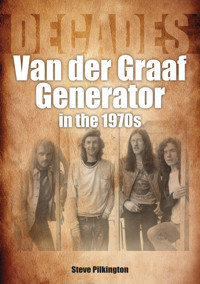
There were many very different bands in progressive rock’s ‘golden age’ of the 1970s. Some tended toward symphonic grandeur, others towards jazz fusion, and yet others ploughed the more immediate end of the spectrum, not to mention the left-field eccentrics and the ‘difficult’ bands. Apart from it all, however, there was Van der Graaf Generator. In a decade stuffed with a wild array of influences and styles, there can be few that pushed so clsoe to the definition ‘unique’ as the four musicians who made up the ‘classic’ line-up of Van der Graaf.
For a start, there was the astonishing songwriting and vocal skills of Peter Hammill. But there was much more behind the band to set these men apart. Their unparalleled instrumental configuration saw little or no guitar while organist Hugh Banton handled the bass parts on pedals. David Jackson pioneered an astonishing saxophone style, sometimes playing two instruments at once and using a full effects pedalboard. Drummer Guy Evans filled in everything else. It was and remains a sound quite like no other.
Discussing all the band’s albums and Hammill’s solo work at the time, this book documents their incredibly influential first decade as prog’s ultimate ‘outsiders’. It’s quite a ride.
Steve Pilkington is a music journalist, editor and broadcaster. He was Editor in Chief for the Classic Rock Society Magazine and is now co-administrator of the rock website Velvet Thunder, as well as presenting a weekly internet radio show called A Saucerful Of Prog. As well as writing CD booklet notes, his previously published books include Led Zeppelin On Track, Decades: Uriah Heep In The 1970s, Iron Maiden On Track, Deep Purple and Rainbow On Track,and The Rolling Stones On Track, all for Sonicbond. He has also written the official biography of legendary guitarist Gordon Giltrap, entitled Perilous Journey. He lives in Wigan, Lancashire, UK.
Das E-Book können Sie in Legimi-Apps oder einer beliebigen App lesen, die das folgende Format unterstützen:
Seitenzahl: 327
Veröffentlichungsjahr: 2025
Ähnliche














Van Der Graaf Generator in the 1970s
Decades
Steve Pilkington
Contents
Acknowledgments
1. Introduction – Van der Graaf Generator: A Personal Journey
2. Starting The Van – Pre-1970 Beginnings
3. 1970 – Not Drowning, But Waving
4. 1971 – Lemmings, Angels, Lighthouse Keepers
5. 1972 – I Prophesy Disaster
6. 1973 – Chameleons And Long Hellos
7. 1974 – A Silent Stage Is Not A Home
8. 1975 – The Undercover Men
9. 1976 – Now The Immortals Are Here
10. 1977 – Still Possessed By The Promise Of The Pleasure Dome
11. 1978 – The Ship Of Fools Runs Aground
12. 1979 And Beyond – The Final Reel
13. Appendix: The Organs of Van der Graaf Generator
Acknowledgments
Firstly, I would like to thank all of the members of Van der Graaf Generator, past and present, for the remarkable body of work they have left us with. It remains unparallelled.
Particular thanks are due to Hugh Banton and Guy Evans, who have been very generous with their time in speaking to me for this book – their recollections have proven invaluable.
I would also like to give notable thanks to Peter Hammill, for having been a gracious and polite conversationalist in the past when I have had the pleasure of interviewing him – and also for the inspiration which his words in particular have provided me with over the years. To paraphrase Bob Dylan’s decades-old quote about Smokey Robinson, I have long contended that ‘Peter Hammill is England’s Greatest Living Poet’.
I would also like to thank Stephen Lambe of Sonicbond Publishing, whose continued support of my writings has been a thing of gratefully accepted wonder over the years, and makes me think I must be doing something right…
Thanks as well to my wife Janet, who has patiently provided a listening post to this evolving document, firstly to assist in spotting any errors, but eventually being drawn into the strange saga of VdGG!
Acknowledgement is especially due to the expansive tome Van Der Graaf Generator: The Book by Phil Smart and Jim Christopulos, which is an invaluable work. Additional thanks are due to Phil for assistance with photographs, and both for their support and encouragement.
Finally, and as alluded to in the introduction to this story, this book is gratefully dedicated to the man whose name is lost to my imperfect memory yet who set me on my own personal VdGG journey over four decades ago. If you are reading this, a sincere and long-belated ‘thank you’.
Introduction – Van der Graaf Generator: A Personal Journey
My own journey with Van der Graaf Generator began in a faltering way in early 1976 when, aged 14, I bought a copy of Still Life after reading a glowing review. I say ‘faltering’, because I sold it again almost immediately! My 14-year-old musical mind, while happy to absorb the likes of Zeppelin, Floyd, Sabbath and ELP, was woefully unprepared for its initiation into the VdGG circle, and for a few years, that seemed to be that.
Fast forward to 1981 and, aged 20, I was living in a Halls of Residence in London, attending the Central London Polytechnic. One night, I was in a gathering of people when a guy (whose name is lost to me over the mists of time) mentioned Peter Hammill. I remembered my brief encounter with Still Life and told him about it. ‘Do you have a cassette player here?’ he asked, and I replied that yes, indeed I did – as my vinyl albums and stereo system had been too bulky to transport from home. He immediately went and fetched a tape which had the Still Life album on it. ‘Just do this for me,’ he said. ‘Take this and listen to it once each evening for ten days. Then give it back to me. If you still don’t care for it, we’ll never mention it again.’
Intrigued, I took it and dutifully listened to the album each evening. For the first two or three days, it still wasn’t really grabbing me, but then, around day number four, things started coming together and making musical sense. From that point, as each day went by, more and more pieces of this incredible musical jigsaw moved themselves into place in my brain, and by the tenth day, I not only handed him the tape back but also showed him the vinyl copy I had gone out and bought that same day. It had me, and I was hooked. So much so that I went on to carry that forward, and over the subsequent years, I lent a copy of that album to anyone who I thought may be receptive to it, with those same ‘ten days’ instructions. The hit rate was very high.
Following that, I picked up a copy of the compilation 68–71 and got a taste of the earlier material. Once again, I wasn’t sure at first, but this time it took only a couple of listens before I was sucked in. From there, I launched myself entirely and happily into fandom. I tracked down and devoured all of the band’s albums, moving on then to everything Peter Hammill had released solo up to that point, and even a second-hand copy I was delighted to find of The Long Hello, the album recorded by the rest of the band without Hammill.
I even attended a poetry reading evening one night in those student days (there was free food, I was a student, that’s how it was), and I got up and recited the lyrics to the song ‘Still Life’. It is testament to the genius of Peter Hammill as a wordsmith that not only did it elicit enthusiastic applause, but not a single person in the room had any idea it was in fact a song lyric until I told them. Decades later, when I finally met and interviewed Peter himself, I told him that story, and was proud to do so. It has often been said that the best music is that which takes time to reveal its full charms. That maxim is certainly true in the case of Van der Graaf Generator, as to this day, almost without exception, whenever I have heard an album for the first time I have initially thought, ‘Hmm, no, not quite the top shelf stuff, this,’ only for those metaphorical jigsaw pieces to arrange themselves in my mind once again and work their magic.
It has also often been said that once you are hooked into the world of VdGG, you are in for good. Nothing could be truer. I will admit that, of course, as with every artist, not everything produced by VdGG or, indeed, Hammill solo has me believing it to be faultless. For example, I still reserve slightly less enthusiasm for the VdG (without the ‘Generator’) period of the late 1970s. However, taken as a whole, the material put out by Van der Graaf Generator and Peter Hammill over the course of the 1970s is as close to perfect as any band I could name. And Still Life is, to this day, still my favourite album of all time, by anyone.
As I said, I cannot remember the name of that unknown ambassador of Van der Graaf back in 1981 – but nonetheless, this book is dedicated to him with my eternal gratitude. If he is reading this, perhaps he will get in touch. Stranger things have happened in the world of Van der Graaf Generator – and a lot of them will be revealed in these pages.
Starting The Van – Pre-1970 Beginnings
The Aerosol Grey Machine
Personnel:
Peter Hammill: lead vocals, acoustic guitar
Hugh Banton: organ, piano, percussion, backing vocals
Keith Ellis: bass guitar
Guy Evans: drums
Additional personnel:
Jeff Peach: flute on ‘Running Back’
Recorded at Marquee and Trident Studios, January, July and August 1969
Produced by John Anthony
Released: September 1969 (Initially US only, Mercury)
Highest chart places: Did not chart
Running time: 46:58
Tracklisting:
1. ‘Afterwards’ (Hammill) 4.55, 2. ‘Orthentian Street’ (Hammill) 6.18, 3. ‘Running Back’ (Hammill) 6.35, 4. ‘Into A Game’ (Hammill, Banton, Ellis, Evans) 6.57, 5. ‘Aerosol Grey Machine’ (Hammill) 0.47, 6. ‘Black Smoke Yen’ (Banton, Ellis, Evans) 1.26, 7. ‘Aquarian’ (Hammill) 8.22, 8. ‘Necromancer’ (Hammill) 3.30, 9. ‘Octopus’ (Hammill) 8.00
The story of Van der Graaf Generator is, undeniably and inextricably, bound up with that of Peter Hammill. Founder, vocalist, chief songwriter and – to most people at least – de facto bandleader, he is inevitably the focal point when the band gets discussed – although they were in fact run in the main on a very democratic basis.
Peter Joseph Andrew Hammill was born on 5 November 1948 in Ealing, Surrey, though he moved to Derby with his parents when he was 12 years old. After attending the prestigious Roman Catholic public school, Beaumont College (near to Eton, in Old Windsor), Hammill went to study the rather nebulous-sounding Liberal Studies in Science at Manchester University in 1967, and it is at this point where the Van der Graaf Generator story really starts. Soon after his arrival in Manchester, Hammill met Chris Judge Smith (Judge was his actual middle name – he has said that he liked to use the name Judge Smith as it got him better service in restaurants), a flamboyant and somewhat eccentric character who had recently returned from a trip across the USA which had fired his imagination and inspired him to, as he put it, ‘write weird music’. An already arresting figure at a thin and gangly six feet-plus, he enhanced that appearance with his prematurely balding hairline, round owlish spectacles and a penchant for retro-styled three-piece suits and a pocket watch on a chain. Even among students in the late 1960s, that wasn’t a regular look.
Living on a large campus residential site called, rather grandly, Fallowfield Student Village, people forming bands was a not uncommon occurrence, and it was here that the very first fledgling VdGG played their inaugural performance. A core trio of Hammill on guitar, Smith on drums and another student named Nick Pearne on guitar had already played a show of sorts, providing music for a poetry event called ‘Outcome’, and the trio formed the first rough incarnation of VdGG after responding to an advertisement for musicians placed by Colin Wilkinson, a harmonica player among other things. Pearne was normally a keyboard player, despite that earlier appearance. There were also, in one of the most incongruous pairings that could be imagined, two ‘go-go dancers’ named Keren and Maggie augmenting the band’s show! They didn’t last too long, in fairness, but one has to imagine that, when considering seemingly tall tales to relate to people, ‘I was a dancing girl for Van der Graaf Generator’ might be quite hard to beat. Already a prolific songwriter – if one still very much honing his craft – Hammill had first met Judge Smith when the latter chanced upon him playing guitar and singing one of his compositions. Asked by the impressed Smith how many he had written, his answer was apparently ‘about 75’. Not bad for someone just turning 19 years old, all in all. The band name, incidentally, came from a list drawn up by the science-influenced Smith, although the reason for the correct spelling of the Van de Graaff generator machine itself being changed for the band name is unclear. Still, we can be grateful that other names on the list were decided against, as the mooted Zeiss Manifold and the Shrieking Plasma might have been a little dramatic for some tastes.
VdGG played several times for the Student Union around that time, with the shows generally being somewhat anarchic, featuring such delights as Judge Smith playing a typewriter as percussion, setting fire to his drumsticks and chasing people away from the stage dressed as a werewolf complete with dripping blood capsules. It got them noticed, at any rate. The biggest gig they played at the time was when they got to support Jimi Hendrix at the Student Union, but it was to be another show which was the biggest influence on the development of the band; that being when they witnessed The Crazy World of Arthur Brown, in November 1967.
Arthur Brown was already notorious for singing his hit ‘Fire’ with his head ablaze, wearing a ‘helmet’ which looked disturbingly like an upside- down sink colander. For this particular show, he also turned up with a broken leg. This would not be unheard of in itself, but the explanation he gave to the Manchester Independent newspaper certainly was. According to Arthur, he sustained this injury when, while standing on the edge of a cliff, a seagull landed on his head. This made him overbalance and plummet down to the rocks below, only for certain death to be averted when the Devil, in the form of a conveniently passing shark, recognised him as one of his sons and saved his life. Sadly, in actual fact, he had fallen out of a van. Whatever the circumstances surrounding his condition, the show made a huge impression on the watching Smith and Hammill – in particular, organist Vincent Crane, who would later go on to form Atomic Rooster. Normally the Crazy World had a guitarist, but on this occasion consisted just of organ and drums, but so distinctive was the sound produced by Crane that both Smith and Hammill vowed that whatever happened to the VdGG line-up in the future, it would always include an organist.
After a series of shows featuring a sometimes fluid line-up revolving around the trio of Hammill, Smith and Pearne, along with Wilkinson, the core threesome split from the others and kept the name – with the blessing of Wilkinson, who had initially brought the band together but bore no objection or ill will towards them. Hammill, meanwhile, continued churning out songs, sometimes co-writing with Smith, and several would go on to be used on future recordings. Around this time they acquired their first manager, of sorts – an eccentric electronics wizard named Caleb Bradley, who would fashion amplifiers for the band’s equipment by recycling old TVs for the purpose – in a highly dangerous fashion as these makeshift amps would be wired up directly to the mains. Miraculously, no one was electrocuted and, in his most meaningful contribution to the band’s story, Bradley arranged for them to record a couple of tracks in a studio. The word ‘studio’ is a little loose in this context as it consisted of the front room and conservatory of his parent’s house near Brighton. Nevertheless, he kitted it out with all of the required gear, although it must be said that, even for the time, one microphone shared between Hammill and Smith, incorrectly wired co-axial cable and a single reel-to-reel tape recorder did not constitute Abbey Road. Still, with Hammill armed with a new Hagstrom ED46 guitar which he had bought (with Caleb Bradley’s money) for the occasion, the band went on to commit versions of the songs ‘Firebrand’ and ‘Sunshine’ to tape. Even at this point, VdGG were proving anything but the norm, with Pearne deciding to adorn ‘Sunshine’ with an introductory passage taken directly from Widor’s Organ Symphony No 5 played on harmonium. He later admitted that he had no idea why he had chosen to do this. Bradley sent copies of the demo tape out to several record companies and radio DJs and waited.
During this waiting period, a few things started to happen. The three- piece VdGG played their first gig at the university, headlining what was billed as a ‘happening’ (as things were back then). Hundreds of people turned up, but the gig was apparently a complete disaster. Keren and Maggie, the ‘hippy dancers’ took part as well, but nothing could save the evening. At around the same time, Caleb Bradley and Judge Smith both joined the local branch of Scientology and Hammill and Smith played a show as a duo supporting Tyrannosaurus Rex at another Manchester venue. Eventually, one of the fish bit at the demo tape, with Lou Reizner, then head of A&R at Mercury Records, inviting the band down to London to meet up, where they stayed for a week or so hanging with the ‘in crowd’ as it were, at some of the trendy venues of the time. At the end of that week, they headed down to Littlehampton for a photo session on the beach, arranged by the Manchester Independent newspaper, who were taking an interest in the band by this time. The resulting photos are odd, to say the least, Pearne posing with a huge, snake-like, 18th-century wind instrument called a Serpent, Smith with a strange instrument called a Phonofiddle, and Hammill with – for no discernible reason – a Vox guitar covered in rabbit fur and a bust of Wagner.
Caleb Bradley took his leave from the band’s employment around this time – after successfully reclaiming the Hagstrom guitar – and went back to his university studies. The band, meanwhile, spent a short time being ‘mentored’, after a fashion, by Graham Bond, the deeply strange musician from The Graham Bond Organisation who cultivated a heroic alcohol and hard drug habit, became utterly obsessed with the ‘White Magick’ side of the occult, and finally threw himself in front of a Tube train in 1974. Unless, as some believe, it was murder and he was pushed. He was in a strange phase of his never-exactly-normal life at this point in 1968, but he gave the young VdGG a lot of his time and advice. It was seemingly too much for Nick Pearne, however, who left the band in May 1968, preferring to ‘stick to being an amateur’, and went back to his studies full-time. The pair were now actively seeking a replacement keyboard player, and this arrived as a result of a talk with a friend of theirs who had been in the band’s circle for some time, Alastair Banton. He recommended his brother Hugh, and with the band having a contract with Mercury, he took little persuading to sign up. The rest, as they say, is history.
* * *
Hugh Banton was born in April 1949 in Yeovil, Somerset, taking piano lessons from the age of seven, before the family moved north to Edinburgh in 1961. Hugh ended up attending a public school in Yorkshire called Silcoates, where he took to a rather grand Walker pipe organ in the school chapel with great enthusiasm. In his latter days there, he took up the position of ‘school organist’, playing for all the chapel services, and studying the instrument with a teacher, Percy Saunders, who was also the organist at Wakefield Cathedral.
On leaving the school in 1966, he went to work for the BBC for a while, while switching his musical allegiance to becoming a Hendrix-influenced guitarist. In fact, in a similar way to Hammill and Smith, it was seeing Vincent Crane play in early 1968 which set him on the road to being a rock organist. He actually became friends with Crane later, as his wife Sue and Crane’s wife-to-be Jeannie had known each other since before meeting Hugh and Vincent. Hugh and Sue were guests at Vincent and Jeannie’s wedding in 1977, and in fact, took the wedding photographs. An undeniably brilliant musician, Vincent Crane suffered for years with bipolar disorder, and tragically took his own life in 1989, at the age of 45.
Banton was already developing a keen interest in modifying his own instruments, and it became a regular sight in his flat to see an organ stripped down and in the process of being rebuilt in Frankenstein fashion. When he first joined the band, he borrowed Judge Smith’s Farfisa Compact Duo organ and set about cannibalising it to install rotating speakers in the manner of the famous Leslie system, and hooking it up to a distortion box and another amplifier. Judge never did get the instrument back!
Another bizarre photo session was arranged by Mercury, again down on the south coast, this time with Banton dressed, oddly, as Beethoven, while Smith modelled an authentic-looking Dracula cape in dramatic fashion. This was only marking time, however, and it was clear that they had to find new management and also expand the line-up. Banton, as the newcomer, was dispatched to drum up management interest and new musicians, armed with another demo tape recorded just before his arrival by Smith and Hammill. Touting around a recording you didn’t even play on must have been somewhat dispiriting, but nevertheless, tout it he did.
The first thing he did was to head to the offices of the counter- culture magazine it (International Times) to see about placing an ad for musicians wanted. He met the advertising manager and, while placing the advertisement, also obtained a list of useful phone numbers. He called all of the numbers but got nowhere except for Tony Stratton-Smith, with whom he secured an appointment. ‘Strat’, as he was always known, liked the tape and agreed to take them on. He would soon, of course, start up his own record label, Charisma, and was also managing The Nice, featuring Keith Emerson, at this time.
In the meantime the ad for musicians ran in it, though it was entirely useless. Intended to be for a drummer and guitarist, it actually read ‘need organist, bass and guitarist’ which, since Banton was himself the new organist and also had designs on playing bass himself using organ pedals, he had, in effect, advertised for his own job. The band also elected not to use a guitarist at all, which makes the whole thing completely redundant and a heroic failure. In fact, their first new recruit came from Stratton- Smith – and it was indeed a bass player.
Strat had gone into band management in the mid-1960s, having earlier been a sports journalist, and one of the bands he represented were a Liverpool group called The Koobas, who spent around six years appealing to almost nobody in the UK, despite touring the country with The Beatles and The Moody Blues in 1965. Their bass player, however, caught the eye of Strat, who recommended him to his new VdGG charges after The Koobas split up in 1968. His name was Keith Ellis. As a side note to this, the first band Ellis joined after leaving school was another Liverpool group called Vince Earl and The Talismen. While they never even released a record, interestingly, bandleader Vince Earl went on to be an actor, most famously playing the character Ron Dixon in the soap opera Brookside for a couple of decades – thus providing an unexpected ‘what’s the connection between…’ quiz question!
So they were four, but a drummer was still urgently required, and this duly arrived, for all future incarnations of the band, in the shape of Birmingham-born Guy Evans. Born Guy Randolph Evans in June 1947, he took up a course in Economics and Sociology at Warwick University in 1965 – the first year it opened. A drummer with a keen interest in jazz as well as blues and popular music, he joined his first band during his second university year. Now, just in case you happen to think Van der Graaf Generator is something of an unwieldy name, spare a thought for Guy’s band, who went under the snappy banner of The Fixed Price Keynesian Economic Model. Indeed. They did later shorten the name to The New Economic Model, which was marginally better, but would have still been likely to see them having their lunch money stolen by tougher bands. There were also seven of them, which, ironically, was not at all economical. They only lasted two years. Guy then joined a ‘psychedelic power trio’ called The Green Marble Mind, who bizarrely played at Germaine Greer’s wedding party but appear to have done little else. To put this into context, Greer was a lecturer at Warwick University at the time. The psychedelic distractions of The Green Marble Mind do not appear to have done much for the happy couple, as the marriage lasted all of three weeks.
At this point, having completed his degree and done time keeping the wolf from the door driving a lorry and laying kerbstones, Guy was introduced to VdGG by a contact at it who remembered them looking for a drummer. He travelled to London and auditioned at Hugh’s flat above an ice cream parlour. The audition was not exactly a wild success, with the band not thinking Guy was as good as he thought he was, and Guy not thinking the band were as good as they thought they were. In the exhaustive biography Van der Graaf Generator: The Book, Guy memorably described his first impressions thus:
My hopes that I might hook up with some kind of credible jazz/blues powerhouse were confounded by the spectacle of a falsetto choirboy with an endless supply of material veering between mutant pop and weird shit about the supernatural, a very odd second singer who constantly switched between vocals, ocarina, slide saxophone and stuff in a bag, a church organist playing a Farfisa Compact Duo and a bass player who looked like he’d stumbled in by mistake from the Star Club. I liked them enormously but didn’t hold out much hope of persuading them to play some proper music.
Despite these musical reservations, the fact that Guy and the band got along so well straight away overrode any doubts and he took the position. Now they were five, but before too long, they would be four again.
Strat had arranged for the band to record a single at Marquee Studios by this time (October 1968), consisting of the songs ‘People You Were Going To’ and ‘Firebrand’, to be released on Tetragrammaton Records. The recording was quite successful, with Banton unusually playing guitar on ‘Firebrand’ (a Fender Mustang), but Judge Smith was starting to realise he was becoming a little surplus to requirements. The band’s sound had now become significantly heavier and more professional, and his – as he put it – ‘hippy nose flutes and typewriters’ were no longer required. He also had ceased playing the drums, and so began to see his role as little more than a backing singer. Admirably, he stepped aside from the group he had been instrumental in founding, and left with his pride intact and no ill feeling. Occasionally, he will reappear in this story. But now, once again, they were four.
* * *
The new band’s first gig ended up in farcical disaster, in an event which surely must have given them all manner of gloomy portents for the future. Securing a booking back in Manchester, they set off from London in a transit van, only for them to suffer a puncture on the M1 and have to be rescued, as they had no spare. During the long wait for assistance, Hugh Banton needed to relieve himself, stepped over a wall for privacy and promptly fell down a sheer drop onto a railway line. Amazingly he escaped serious injury other than to his pride, and a chastened band all trooped in to Strat’s haunt at the La Chasse club to explain that they had spent about seven hours on the M1 and missed the gig.
Things soon picked up after this inauspicious beginning, however, with gigs starting to be played in notable venues such as a show supporting Yes at the Marquee (even if they were amusingly billed on this occasion as ‘Van de Graff Generation’), while on 18 November they were invited to the BBC (Banton’s old employers) to record a radio session for Top Gear. It was aired on the 29th by John Peel, who by now was becoming enamoured of the group, and comprised the tracks ‘People You Were Going To’, ‘Afterwards’, ‘Necromancer’ and ‘Octopus’ in their first recorded incarnations.
With the Tetragrammaton single finally being released on 17 January 1969, the band made another vital contact when they met up with influential venue MC and DJ John Anthony at a show at the Speakeasy in Central London. Things seemed to be going from strength to strength, but once again, things conspired against them when, following positive reviews for the new single, it emerged that Hammill and Smith were still under their old contract with Mercury Records. They promptly threatened legal action and the single was withdrawn. Undeterred, the band went back into Marquee Studios to record another two songs in the hope of a single release; versions of ‘Afterwards’ and ‘Necromancer’. The producer was John Anthony – beginning his association with the band in that role.
The band were certainly pressing on with their plans and not looking back following the burying of the Tetragrammaton single, so one might hope that at this point in the story fortune might smile on the beleaguered group. Unfortunately, at the end of January, their van containing a whole pile of their gear was stolen. It is believed to have been taken while parked outside a hotel in Paddington, though this is not conclusive but what is beyond doubt is that neither the van nor its contents were ever seen again, despite a reward of £100 for information leading to its return being offered via an announcement in Melody Maker. One casualty of the theft was Judge Smith’s Farfisa organ which Hugh Banton still had officially on loan, and another was Banton’s Fender Mustang guitar. Guy Evans was badly hit as two drum kits were in the van. This led to the cash-strapped band having to play gigs on borrowed equipment as best they could – a situation not relished by any of them but especially not by the ‘mad professor’ Banton with his home-modified equipment. He remembers playing a couple of gigs with borrowed keyboards (a Vox Continental for one show and a Hammond A100 organ for another), and playing different instruments for each show was clearly an entirely untenable long-term option. Guy Evans had managed to borrow a drum kit belonging to Bob Henrit – later to find success with Argent – so he was marginally better off. Banton, at the end of his tether with the situation, managed to wheedle money out of Strat for a new Farfisa Professional organ, bought just ahead of a show at the Speakeasy.
If all this sounds as if life in VdGG at this point was perpetually glum, this wasn’t always the case, as Guy Evans has told of a show at University College in Central London, where they all travelled separately and met up at the venue. Keith Ellis, who was there first, led them up to the dressing room, which was on the fourth floor. On entering the room, Ellis suddenly announced in dramatic fashion that he could go on no longer and immediately jumped out of the window. Clearly, this alarmed the others, until it was discovered that Ellis – an inveterate practical joker – had already realised that there was a ledge just below the window!
Things looked up for real soon after this, when – in an echo of that early Jimi Hendrix show at Manchester University – they had been given the chance to open for Hendrix again, only this time at the far more prestigious surroundings of the Albert Hall. The only drawback was that the gig was such short notice that they found out on the same day, and had to travel there immediately. Less time for stage fright to develop, at least, one would imagine. Also on the bill, in between VdGG and Hendrix, were Fat Mattress, featuring Hendrix’s old Experience bassist Noel Redding, and by all accounts, VdGG – in stage clothes hastily bought that afternoon in Kensington Market – went down pretty well. They didn’t get the chance to meet the headliners, which is a shame as the show turned out to be Hendrix’s last UK show before his Isle of Wight Festival appearance the following year, shortly before his untimely death in September 1970.
The band continued playing shows up and down the country, but the problems with the still largely unreplaced gear continued. Added to this were increasingly sour relations with Mercury Records, who were at odds with Stratton-Smith, to say the least. He felt that the deal signed with them by the Hammill/Smith/Pearne line-up was a very poor one, and as a matter of principle he refused to let Banton, Evans or Ellis sign with them. Mercury for their part believed that they should have the whole of the band by default by virtue of the earlier contract, but Strat would have none of this. There was therefore a situation whereby only one of them was signed to Mercury, but they could not sign with anyone else as a band because of this. Thus the ‘Afterwards’ / ‘Necromancer’ would-be single had not been released and, worse still, Mercury banned the group from making any more recordings until the matter was resolved, which frankly didn’t look likely without the imminent involvement of a UN peacekeeping force.
With this impasse added to the continuing strain of using borrowed equipment (with the exception of Banton’s organ), the band decided – for the first time but certainly not the last – to split up following one last show. Peter Hammill remembered this in the later CD compilation release The Box:
So not only could we not record, but we had no equipment to play. Strat was in the States with The Nice and the Bonzos [Bonzo Dog Doo-Dah Band], so we were completely kippered. But we did do one final show using borrowed gear at Notts County Football Ground.
That show in Nottingham was in fact, a festival which took place on 10 May 1969, compered by John Peel and Ed Stewart. As well as VdGG, there was a tremendous line-up of acts, including Pink Floyd, Fleetwood Mac, Love Sculpture, Status Quo, Georgie Fame, The Keef Hartley Band and, somewhat incongruously, the Tremeloes. Most of the VdGG equipment was borrowed for the performance from The Keef Hartley Band, but despite this – or perhaps even born out of the frustration – the band reportedly played a very intense and dramatic set, and received calls for an encore from an impressed crowd, as opposed to their merciless heckling of the hapless Tremeloes earlier in the day. Still, there was no going back for now, and John Peel reluctantly informed the crowd that they had just witnessed the final VdGG show. Or so everyone thought…
* * *
Having thus gone, for the moment at least, their separate ways, the Van der Graaf men busied themselves to greater or lesser degrees with other work. Peter Hammill began doing a regular half-hour slot at a weekly Friday Night ‘midnight until dawn’ show at the Lyceum in London; known as ‘The Midnight Court’, it often featured other up-and-coming or established names such as Yes, The Nice, The Bonzo Dog Doo-Dah Band and Renaissance, with several of these regular bands having connections to the ubiquitous Tony Stratton-Smith, who seemed to have his fingers in more pies than there were pies at the time; and with things such as Charisma Records, began inventing his own pies! Hugh Banton, meanwhile, was less busy, having had auditions for a few bands, without any of them leading to anything concrete. These included Wishbone Ash as it happens – a band who famously pioneered the twin-guitar sound with no keyboards, so it’s interesting to speculate how things might have been different had that union come about! Guy Evans, meanwhile, got involved with a band called The Misunderstood – a link which would directly impact the future of VdGG soon afterwards.
The Misunderstood were a psychedelic band originally from California in 1966, who had gone through line-up changes, a split and a reformation, with various members being respectively drafted into the US military or deported back to America from the UK. By March 1969, the two men who by now constituted what remained of the band, singer Steve Hoard and guitarist Glenn Campbell (no, not that one), were in London again. After a short-lived line-up including ex-Nice guitarist David O’List on bass collapsed after releasing a hopelessly titled single ‘You’re Tuff Enough’, Guy Evans ended up joining, along with a 16-year-old bassist called Nic Potter, who would soon enter the VdGG story himself. The Misunderstood seemed to be on a trajectory, making that of VdGG seem almost mundane, playing gigs at venues as absurdly different to one another as the Royal Albert Hall and the teen fashion department in Harrods in the same month. That Albert Hall appearance was notable as it was as part of an event called ‘The Pop Proms’, at which they appeared amid a near-riot. They were opening for Chuck Berry, who was headlining that day (and, as Guy confirms, also for The Who the following day), and wild scenes between Mods and Rockers broke out – although one would have thought such rivalry was defunct by 1969. Not so in this case, as the appearance of Berry attracted a large number of hardcore old biker/rockers and The Misunderstood played their set accompanied by sharpened coins, cans and even bicycle chains raining down on them. By all accounts, they went down well, so we can only imagine the scenes had they not done so …
By this time, Keith Ellis had got together with Suzie O’List, David’s sister, and they were living in Islington. Knowing The Misunderstood guys, he took a trip over to Germany with them as they were to make a TV appearance over there, an event which redefines the phrase ‘stranger than fiction’. Hoard and Campbell, the cornerstones of the band, had both been refused entry to Germany for the recording, leaving the band as just new recruits Potter and Evans. The band’s manager, Nigel Thomas, wasn’t going to let a small thing like having no band stop him, however. They would be miming, so he devised a cunning plan to use Keith Ellis as a stand-in for Campbell and future Juicy Lucy singer Ray Owen as Hoard. They may have been miming, but there still appeared to be notable holes in this plan, not least that Ray Owen was black and Steve Hoard was white. The appearance was performing the ’You’re Tuff Enough’ single, and so the spectacle was of these four people miming to a song that none of them had appeared on. They got away with it, unbelievably, but the triumph didn’t last long, as Nigel Thomas took them out to a pricey restaurant in a limousine, explaining over dinner that he had incurred huge debts while over there and they should immediately run for the airport! He sent them off in separate cabs, saying he would meet them there, and after waiting with some concern for quite a while, Thomas rushed in, explaining that he was in a little trouble and they should head for the plane straight away. They did so, only to be confronted by a group of German policemen as they tried to board, pointing machine guns at them and shouting, ‘Halt!’ They halted. Having been taken to a room containing not only the police but also all of the people Thomas owed money to, somehow he got away with paying them off, using all the money they had earned from the TV appearance. As soon as they got back to London, Thomas announced that there was no need to worry, as he had another plan, which was to attempt to sell the story to the Daily Mirror. He did try this. They didn’t get rich from the proceeds, and The Misunderstood ceased to be after a final show on 3 August. As Guy remembers the incident now:




