


9,49 €
Mehr erfahren.
- Herausgeber: Sonicbond Publishing
- Kategorie: Geisteswissenschaft
- Serie: Decades
- Sprache: Englisch
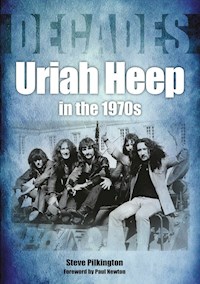
Incredibly, Uriah Heep have now been active for a full fifty years. However, few would argue that the period which has come to define them the most, and during which they were at their most influential, was from 1970-1980. During this decade, they released an incredible thirteen studio albums and a legendary double live album, as well as having a regular turnaround of musicians in all but the guitar and keyboard roles. This remarkable decade began with the first three albums, as the band sought to find a stable line-up, followed by the classic run begun by the Demons And Wizards album featuring the definitive Box/Hensley/Byron/Kerslake/Thain line-up.
When charismatic frontman David Byron departed, there was a period of some uncertainty, but still some remarkable music was made. This book, which features a foreword from founding member Paul Newton, is a year-by-year journey through that decade, looking at the albums, the often-gruelling touring schedules and the ups and downs of the relationships within the band. Never quite attaining the sales and success of some of their rivals at the time, Uriah Heep nevertheless released some of the most extraordinary music of the 1970s – and this book takes you through it all.
The author: Steve Pilkington is a music journalist, editor and broadcaster. He was Editor in Chief for the Classic Rock Society Magazine Rock Society and is now co-administrator of the rock website Velvet Thunder as well as presenting a weekly internet radio show called A Saucerful Of Prog. Before taking on this work full-time, he spent years writing for fanzines and an Internet music review site on a part-time basis. He has recently published books on Deep Purple and Rainbow, The Rolling Stones and Iron Maiden, all for Sonicbond, and has also written the official biography of legendary guitarist Gordon Giltrap. He lives in Wigan, Lancashire, UK.
Das E-Book können Sie in Legimi-Apps oder einer beliebigen App lesen, die das folgende Format unterstützen:
Seitenzahl: 280
Veröffentlichungsjahr: 2022
Ähnliche














Sonicbond Publishing Limitedwww.sonicbondpublishing.co.ukEmail: [email protected]
First Published in the United Kingdom2021First Published in the United States 2021This digital edition 2022
British Library Cataloguing in Publication Data:A Catalogue record for this book is available from the British Library
Copyright Steve Pilkington 2021
ISBN 978-1-78952-103-0
The right of Steve Pilkington to be identified as the author of this work has been asserted by him in accordance with the Copyright, Designs and Patents Act 1988.
All rights reserved. No part of this publication may be reproduced, stored in a retrieval system or transmitted in any form or by any means, electronic, mechanical, photocopying, recording or otherwise, without prior permission in writing from Sonicbond Publishing Limited
Printed and bound in England
Graphic design and typesetting: Full Moon Media
Acknowledgements
Firstly, I would like to thank the members of Uriah Heep, who have been so helpful and generous with their time. Paul Newton, for his helpful information, kindly providing some personal photographs and writing a foreword for the book; Ken Hensley, who was also very generous and helpful with his time in talking to me only a relatively short time before his tragic passing; and Mick Box, who I have interviewed on past occasions, and whose friendly, open and expansive conversations have proved of great assistance.
I would also like to thank Stephen Lambe of Sonicbond Publishing, who keeps allowing me to write these things! Will he never learn?
Thanks as well to my wife Janet, who has patiently listened to me reading this text aloud, to aid my spotting of errors!
Also, I would like to thank all of the half-forgotten and unsung men on the Heep journey – Alex Napier, Keith Baker and Iain Clark in particular, who helped lay the foundations.
Acknowledgement is due to Dave Ling’s fine book Wizards And Demons, which supplied quite a number of band quotes for this work, and is an excellent read.
My personal interviews with Ken Hensley and Paul Newton took place in 2020.
My personal interviews with Mick Box took place in 2011 and 2014 on behalf of the Classic Rock Society.
Finally, I’d like to thank all of the many Uriah Heep fans I have spent time and shared listening with since I bought my first Heep album just over 45 years ago. If any of you read this and we’ve lost touch – hi, and I hope you’re still listening!
This book is respectfully dedicated to the memory of Lee Kerslake, Ken Hensley, David Byron, Gary Thain, Trevor Bolder and John Wetton.
Contents
Foreword – by Paul Newton
Prologue: ‘Umble Origins ...
1970 – Wake Up (Set Your Sights)
Very ‘Eavy … Very ‘Umble
1971 – With The Strength Of A New Day Dawning
Salisbury
Look At Yourself
1972 – Let The Party Carry On
Demons And Wizards
The Magician’s Birthday
1973 – Battles Won & Victory Cheers
Uriah Heep Live
Sweet Freedom
1974 – So Tired
Wonderworld
1975 – Return To Fantasy
Return To Fantasy
1976 – Can’t Keep A Good
Band Down
High And Mighty
1977 – Rollin’ On
Firefly
Innocent Victim
1978 – Falling Angels
Fallen Angel
1979-1980 – It Ain’t Easy
Conquest
Postscript: Box Of Delights – What Happened Next
Appendix One
1970s Playlist
Appendix Two
Heep Roll Of Honour
Foreword – by Paul Newton
Steve contacted me in the autumn of 2020 and explained that he was writing a book on the history of Uriah Heep, and asked if I would be interested in backtracking fifty years to the origins of the band and provide some thoughts, memories and opinions of my time as the bass player through the first three albums, 1969-1971. Talking to Steve convinced me that he was keen to get honest facts and would do a good job of presenting them, and so I confirmed that I would be more than happy to assist. Of course, memories of that time sometimes become a little hazy, and it is not surprising that those of us there at the time sometimes have slightly different recollections. Between us, we have, hopefully, established a fairly accurate overview of all that has taken place, but I apologise for any inaccuracies on my part.
I am writing this in December 2020, nearing the end of what has possibly been one of the worst years in the history of the planet, with everyone across the globe being affected in some way by the pandemic that is upon us, and many lives changed forever. As 2020 was the 50th anniversary of the release of Very ‘Eavy Very ‘Umble, it was to be a very special year for all those who have been connected to the band – especially Mick, Bernie, Phil, Russell and Davey, who continue to work so hard travelling the globe to play the music. Sadly, all tours and celebrations had to be cancelled until the world can function normally again, but we all remain optimistic for the future.
In 1968, when I first joined Mick and David in Spice, it was inconceivable to think that we had created something that would survive as Uriah Heep fifty years on, but here we are. Mick Box has always had the tenacity and drive to maintain this legend, and although, sadly, members have been lost over the years, there is still a band out there and I am immensely proud to have been a small part of this amazing story.
Steve Pilkington has carried out much work and in-depth research for this book, and collated information from band members both old and new to produce an interesting insight into the development and longevity, which has resulted in a well written, interesting and fair story of the band’s development and progression, which was sometimes turbulent and difficult for all concerned, but ultimately constructive. I sincerely thank him for the hours he has devoted to working on this project.
I hope you enjoy reading this as much as I have and that you may find some answers to questions. Music is a very important factor in many people’s lives and I hope that we have produced and played songs that you enjoy listening to.
Paul Newton
Ledbury
Herefordshire
Prologue: ‘Umble Origins ...
The origins of the band which would become Uriah Heep mainly lie in the line-ups of two late-‘60s bands, Spice, and The Gods, spawning between them most of the key figures in the band’s early development. Firstly, however, let’s go back a little further and look at the musical awakening of the only ever-present member in the 50 years of the Heep existence: Mick Box.
Born in Walthamstow, East London, in 1947, Box was a keen footballer and boxer while still at school, representing London Schoolboys at football (though sadly never his beloved Tottenham Hotspur, for whom he did have trials). For a while, this looked as if it would be his overriding passion and most likely escape from real work, but after seeing a show by Johnny Kidd And The Pirates, a latent interest in music blossomed into an obsession. After persuading his mother to buy him his first electric guitar (a low priced Hofner copy called a Telsten) for £12 from a Walthamstow pawn shop, he never looked back. From such roots are legends grown!
In 1965, the now proficient Box joined his first serious band. Named The Stalkers, they played shows at any parties, weddings or Barmitzvahs that would have them, while Mick worked in a London export firm to keep the wolf from the door – and pay off his guitar! After a while, the band’s singer decided to leave and a significant event took place when the band’s drummer, Roger Penlington, suggested his cousin audition for the gig. The cousin in question was an Essex-born individual named David Garrick, who was to become much better known under the name David Byron.
Hailing from Essex, David had already sung the odd rock and roll standard with The Stalkers after he had partaken of a few pints, and Box remembers him not needing much persuasion: ‘He always had more front than Woolworths’, he was later to remark. Byron – as we shall refer to him immediately to avoid confusion – was actually working as a stockbroker at the time, but he indeed took to the frontman role like a duck to the proverbial water. By 1967, both Box and Byron took the decision to take the plunge and turn professional, something which the remaining Stalkers were unwilling to do. Consequently, they were left looking to form a new band and thus was born of necessity, the original Spice lineup. They brought in bassist, Alf Raynor (followed soon by Barry Green), and a drummer, with the latter being none other than Nigel Pegrum, who was later to find fame behind the kit in the classic lineup of folk-rock band, Steeleye Span. At this point, Mick lived with his mother above a butcher’s shop and, since they couldn’t afford the electricity for the band to practise, they used to sneak down into the shop and play crouched down behind the counter for fear of being caught and potentially evicted! Bizarrely, from such unlikely (and uncomfortable) conditions, some of the songs which would appear on the first Uriah Heep album began to take shape.
The band were getting more and more gigs. But one such show, at Walthamstow Avenue Football Club, featured an on-stage accident which foreshadowed a similar tragic occurrence some years later. Mick Box had gone to grab a microphone when he got a substantial electric shock. Seeing this, Byron rushed over to unplug his guitar, but in doing so received an even greater shock himself which reportedly sent him flying over a table. Both men, with electrical burns, had to go to hospital as a result, but thankfully on this occasion, no permanent harm was done.
Around November 1968, that other key band, The Gods, entered the picture for the first time. Despite being little known today (outside of the odd compilation released on the back of the Heep connection), the band’s various line-ups read like a veritable who’s-who of British 1960s and 1970s rock. As well as future Heep men, Ken Hensley, Lee Kerslake and Paul Newton, the band had Greg Lake in their ranks before he left for King Crimson, and an early line-up even featured future Rolling Stones guitarist, Mick Taylor. Bassist was John Glascock – who would go on to play for several years in Jethro Tull before his untimely death in 1979 – and future Babe Ruth guitarist Alan Shacklock, also passed through their ranks. For the moment, however, we will concentrate on the first man to move from the Gods side of the tree to the Spice side: bassist Paul Newton. The band had just recorded a single for United Artists entitled ‘What About The Music’, and Newton arrived – via a music paper ad – just in time to play on the uninspiringly titled B-Side, ‘In Love’. Released at the end of November, the A-Side was a cover of a song which was later released in 1971 by Northern Soul artist, Billy Harner, while ‘In Love’ – which was a formative Box/Byron composition (credited to Garrick/Box) – was heavier and a little more of a pointer to the Heep recordings to come. The band recorded a few tracks for United Artists over the following few months, though these remained unreleased until 1993 when they appeared as part of the compilation The Lansdowne Tapes.
Aside from his bass playing, another important thing Paul Newton brought to the band was, oddly enough, his father. Paul senior ran a dance hall in Andover, Hampshire, and began getting the band gigs via the contacts he had and arranging return gigs with other venues. He began looking after the band’s affairs, becoming, effectively, their manager, and his assistance was absolutely vital. He embarked on a campaign of letter-writing, which secured the band their first residency, at the Marquee in London, Mick Box claiming in 2002 that without him, the band ‘would not be here now’. Perhaps even more importantly, one of those letters went to someone who was to play an overwhelming part in Heep’s first decade: Gerry Bron.
Bron was involved with Vertigo Records at the time, and also very well connected when it came to arranging gigs, plus he had his own studio space. So Newton’s letter was a smart move, and as luck would have it, Bron happened to decide to read it – largely, he claims because it was five pages long and all written in block capitals! He came along to see the band at a venue called the Blues Loft, in High Wycombe. ‘I agreed to sign them there and then’, he said later, ‘but what we signed was nothing like what the band eventually became’. It was around this time that David Garrick officially became David Byron – surprisingly enough, after a comment made by Paul Newton’s mother! There was another David Garrick on the scene at the time, and he was thinking about changing his name to avoid confusion, so when Mrs Newton happened to remark that he reminded her of the poet Lord Byron, the rest, as they say, was history.
Work on recording what was still planned to be the debut Spice album commenced in July 1969, initially by the Box-Byron-Newton-Pegrum line up. But before the album was completed in April the following year, two more lineup changes, and of course a name change, would take place. The first change was that Nigel Pegrum departed to make way for a hard and feisty Scot named Alex Napier – a man who reportedly had a wife and three children, but insisted to the band for some time that the woman in his flat was his sister! Pegrum was an excellent drummer, but it was decided that his style was a little too light as the band’s music got heavier and more bluesy – he went on to join the progressive band Gnidrolog (an almost-anagram of the Goldring brothers who formed the group, incidentally), before going on to find fame and fortune with Steeleye Span.
As work continued on the album, it was clear that something was lacking in the Spice sound, and it was Gerry Bron who first suggested bringing in a keyboard player – a move agreed by the band, who were big admirers of Vanilla Fudge. What was less universally approved was that, after identifying a schoolteacher named Colin Wood for the position, Bron reportedly offered him the job without consulting anyone else, as Mick Box asserted later. In any case, Wood had teaching duties which precluded him from accepting the position, so, after a short time in which he played keyboards on a couple of tracks, the band were suddenly urgently on the lookout for a full-time keyboard man. Enter Paul Newton’s Gods connection again, as he suggested his old bandmate, Ken Hensley. The most significant recruit to the line-up was about to drop into position.
By mid-1969, The Gods were about to splinter. Singer Cliff Bennett (late of The Rebel Rousers) was looking to form a new band and brought in Hensley, along with John Glascock and Lee Kerslake from The Gods. The band needed a name, though it could be argued that they didn’t necessarily need the name Toe Fat, reportedly decided upon by Bennett along with his manager, in an attempt to choose the most unpalatable name they could think of. A self-titled album was released in 1970, boasting an unforgettable cover image featuring several people on a beach with giant toes superimposed over their heads, though by the time of its release, Hensley had already made the move over to the Spice camp, at the suggestion of his former bandmate, Newton.
Ken Hensley was born in London in 1945, and began playing guitar at the age of 12. Playing his first gig in the less than glamorous sounding Mentmore Pen Factory in Stevenage in 1960, he went through a series of bands – such as The Blue Notes, Ken And The Cousins and Kit And The Saracens – before ascending to The Gods in 1965. Despite his virtuosity on both keyboards and guitar, he had no formal training, though he did concede that it may have been in his blood as his mother was herself a classical pianist.
Almost as soon as Ken arrived in the Spice fold, in the spirit of new names they also realised they wanted a more distinctive one than the somewhat ironically bland Spice. In fact, before settling on that name, they had entertained, among others, the rather wonderful Corrugated Dandruff, so there was clearly some receptiveness to what one might call out of the box thinking! It was Gerry Bron who came up with the suggestion of Uriah Heep, after a trip to the cinema to watch a film adaptation of Charles Dickens’ David Copperfield, with it being the centenary of the great writer’s death. He came back to the band and announced that they must change their name to that of the obsequious, villainous character from the story. The band were unconvinced at first, but it grew on them, as Box later commented: ‘It’s a great thing to take a character from one of the great English novelists around the world with you. It also looked good in print, because at the time you had Black Sabbath and Deep Purple, and the U really stood out’.
And so, with that, the name was in place, as was the recording contract and the line-up of Box, Byron, Hensley, Newton and Napier. 1970 had arrived and Uriah Heep were set to take their first steps up the ladder...
1970 – Wake Up (Set Your Sights)
Very ‘Eavy … Very ‘Umble
Personnel:
David Byron: lead vocals
Ken Hensley: keyboards, guitar, vocals (except ‘Come Away Melinda’ and ‘Wake Up (Set Your Sights)’)
Mick Box: lead and acoustic guitars, vocals
Paul Newton: bass guitar, vocals
Alex Napier: drums (except ‘Lucy Blues’, ‘Dreammare’ and ‘Bird Of Prey’)
Additional personnel:
Nigel Olsson: drums on ‘Lucy Blues’ and ‘Dreammare’
Keith Baker: drums on ‘Bird Of Prey’
Colin Wood: keyboards on ‘Come Away Melinda’ and ‘Wake Up (Set Your Sights)’
Recorded at Lansdowne Studios, London, July 1969-April 1970
Produced by Gerry Bron
Released: June 1970 (UK), August 1970 (US – as Uriah Heep)
Highest chart places: Did not chart in UK or US top hundred.
Running time: 40:07
Tracklisting:
1. ‘Gypsy’ (Box, Byron) 6:37, 2. ‘Walking In Your Shadow’ (Byron, Newton) 4:31, 3. ‘Come Away Melinda’ (Hellerman, Minkoff) 3:46, 4. ‘Lucy Blues’ (Box, Byron) 5:08, 5. ‘Dreammare’ (Newton) 4:39, 6. ‘Real Turned On’ (Box, Byron, Newton) 3:37, 7. ‘I’ll Keep On Trying’ (Box, Byron) 5:24, 8. ‘Wake Up (Set Your Sights)’ (Box, Byron) 6:22
As the 1970s dawned, all of the pieces were arranged on the board for Uriah Heep: the debut album was getting toward completion, the new name had been settled on, audiences were climbing and Ken Hensley was on board, completing the final massive piece in the jigsaw puzzle of their unmistakeable sound. Well, almost the final piece that is, as there was to be one further lineup change before the album would be completed, and it concerned the drum stool.
Alex Napier was a good player, of that there was no doubt. But questions had begun to be raised about him with regards to the essential chemistry of the band. He was, by everyone’s consensus, a hard man who would sometimes have a tendency to leap to conflict. Mick Box himself recalled that they had to be ‘careful how far to take it’ if they had occasion to criticise the drumming and that Napier would sometimes challenge them to ‘settle it outside’. Paul Newton backed this up in 2020:
I always got on with Alex, I’m still in touch with him today, but there’s no denying he was a hard nut. He was brought up in the Gorbals area of Glasgow, and he’d had some tough times. He had a scar down his neck where somebody had knifed him, so you get the idea! He was a lovely guy in the main, but you had to be careful not to take something too far with him, that’s for sure.
Essentially, Alex was clearly a good guy, but the best description appears to settle around the ‘shortfuse’ idea, and walking on eggshells was causing some cracks to appear (as eggshells do, of course!). The feeling was that the other four were a tight unit with their own musical ideas and direction as well and that they had outgrown their drummer a little in the year or so that he had been in the band.
The decision having been taken to let him go, the immediate conversation then had to concern who would be brave enough to tell him! According to how Paul Newton recalls it, the answer was ‘no one’, as he was directed up to the management office so that he could hear it from someone else. As it happened, they needn’t have worried, as his immediate reaction appeared to be a sense of relief as he could now spend a little more time with his family, though as Paul put it: ‘Gerry got away with that as Alex took it on the chin, but if it had gone the other way he could just as easily have ended up in hospital!’. So, one problem had been solved, but another one had of course been created: the matter of an empty drum stool with an album to finish.
The man who came in to fill the vacancy was someone who would become a very recognisable name: Nigel Olsson, the man who went on to be the drummer in Elton John’s band on and off for the next five decades, eventually playing over 2000 shows with Elton. He was unquestionably a notable talent and filled in smoothly and effortlessly in Napier’s position, to finish the album and play with the band on a UK tour following its release. However, with Elton’s star very much in the ascendancy following the success of his self-titled second album, and with Olsson having played on one of the tracks from his debut record, Elton wanted him for his touring band. The band were sorry to lose him. But as Mick Box remembers it, there were no hard feelings, as it was an offer which was too good to turn down when Olsson was offered around ten times what he was earning with Heep. ‘He just went vooom’, said Mick later. ‘I’ve never seen him since!’ Olsson was replaced by Keith Baker, who had been the first drummer with Supertramp, albeit when they still went under the hopeless moniker of ‘Daddy’. He would also prove to be a somewhat short-term solution, as we will see.
Meanwhile, the album was finished, with Nigel Olssen finishing off the final two tracks. The recording was not without its issues for the band, with Mick Box relating the following to the author as regards the somewhat different recording conditions.
We didn’t really know what we were doing, to be honest. I remember the first thing the engineer did was put my cabinet facing the wall, with a microphone between it and the wall, a few inches apart, and when I started playing it was all muffled – I thought “What’s this all about? I’ve got no sustain, I’m used to having this all coming up my backside!”. There was so much innocence then – I mean, if an engineer had told me to stand at the back of the studio in a fire bucket and play a solo, I probably would have!
With the album ready to be released, the cover had to be designed, with the iconic front cover photo coming about in a quite unexpected way. The idea for the cover had been for the Dickensian theme to be extended, with a photo of a drawing-room sort of layout, reflecting the Victorian times in which Dickens lived and worked. It was apparently all very professional and worthy, but for Box at least, it all looked rather dull, and not at all what Heep were about. Unhappy with it, and becoming rather bored with the session, he left the studio, as he put it ‘for a couple of pints’, and when he returned, they were still working on it. One of the things they had to give the room its period feel was a sort of cobweb machine, which was loaded up with a kind of glue substance and sprayed out a sticky material which closely resembled cobwebs. Mick picked up the device, tapped David Byron on the shoulder, and sprayed it into the unsuspecting singer’s face. Fortunately, the photographer had the presence of mind to immediately capture Byron’s shocked, cobweb-ridden face, and a legendary cover was born. In truth, it does have very much the appearance of some kind of animated corpse from a horror B-movie, and was probably worth the time it took the furious Byron to get it all out of his hair! It may appear as if the web-strewn hands on the reverse were also the hapless Byron, but according to Box, these actually belonged to the studio tea-boy, getting his ‘moment of fame’. The inner gatefold shows the band performing at the Lyceum, London. Although he had not been with the band long, Ken Hensley completed the packaging by penning some notes about each song, something he did for the following few releases as well.
The album was already scheduled to come out in the UK on Vertigo, but there was a further bonus when a representative from Mercury Records in the USA agreed to fly over to the UK to check out a show, with a view to signing the band. Mick was duly dispatched to pick him up from the airport, but on their return, an over-zealous doorman refused to let them in without a ticket! The exasperated Box’s appeals concerning the fact that not only was he the guitarist and the band would vouch for him, but also that his guitar case (which he was carrying) actually had Uriah Heep painted on it, came to nothing, and the Mercury representative actually had to go and buy two tickets so that they could get in. Thankfully, the signing took place, so the tickets – for which he claims they were never reimbursed – were not entirely wasted. According to Box, Ken Hensley had let several friends and family in, and to this day he believes that may have had some bearing on proceedings.
The album opens with the band’s first major statement of intent, ‘Gypsy’, which has been played at virtually every Heep show to this day. If ever a band were laying their stall out early, this was it. A Box/Byron composition, it opens with an instrumental intro taking up the first minute, which was written by Byron in fact – ‘on a piano. Like playing chopsticks’, according to Box – but played on keyboards and organ, both by Hensley, in the finished track. After a minute, the main guitar riff comes in, and the band’s identity is sealed within seconds. The monolithic, primal power of that riff is something which has metaphorically been preserved in amber for the past five decades, as a distillation of prime Uriah Heep. Byron’s lyric about his ‘Gypsy queen’, and facing up to her vengeful father, is pure outlaw hokum, yet works so well with the music that it has become hard to imagine either without the other. This was also the point where the Uriah Heep use of block harmony vocals began. Box said about the writing of the track: ‘The funny thing was we wrote it at the Hamwell Community Centre, Shepherds Bush, and Deep Purple were rehearsing in the room next door to us. You can imagine the kind of racket we were both making between us!’.
In truth, nothing else on the album has worn quite so well as that opening monster, but there is still plenty of strong material. ‘Walking In Your Shadow’, by Byron and Newton, is up next, a very Cream-influenced piece of mid-paced heavy rock, and it’s a decent enough track, even if it starts to sag a little by the end. On the subject of the songwriting, while Hensley receives no credits, he nevertheless explained to me that this was partially down to publishing rights, saying ‘I actually did nibble away at the writing of that album, though some of it had already been written of course. The truth is that anything I did had to be anonymous, as I was already signed to another publishing contract at the time’. The third track ‘Come Away Melinda’ is probably the album’s second most-remembered song, and is in fact a cover version which the band had been playing since quite early in their Spice days. Written by Fred Hellerman and Fran Minkoff from US protest-folk band, The Weavers, it was first played by The Weavers themselves in concerts in 1963, though their own recorded version was beaten to the punch by Harry Belafonte, of all unlikely people, that same year. A very powerful anti-war song, it concerns the girl of the title digging up an old photo album from before an unspecified war, and asking her father questions about people in the pictures, such as several other little girls and also her mother who has been killed in the conflict. Much is left to the imagination, and it is a haunting song which stays with the listener for a time after hearing it. The band first came across it in a version by Tim Rose, but Mick changed the finger-picking style to give Heep’s version a new slant. Colin Wood provides the keyboards on this. There is also, notably, a version by UFO, released on their first album just a few months after the Heep recording, and it is probable that this album would be where they picked it up. Theirs is a superb version also, and arguably these are the two definitive renditions.
The original first side comes to a slightly less memorable close with the straight blues song, ‘Lucy Blues’. According to Box, they used to do this in the Spice days without a title, and with Byron improvising whatever words he felt like over the top, but actual lyrics and a title were added for the album. Nigel Olsson plays the drums on this, but it’s not exactly the most challenging workout he ever had. There is some nice keyboard work by Hensley in the mid-section, but it’s probably the least essential track on the album. Much better is the largely unheralded ‘Dreammare’ which opened the original Side Two. Written by Paul Newton alone, and again with Olsson behind the kit, it’s a powerful heavy rock track with squalls of lead guitar from Box overlaid throughout, with a lyric literally describing nightmares which we are told, quite alarmingly, ‘crucify his head’. Which does sound painful. According to Newton, the song sort of had its genesis in something as simple as the fact that he would always tend to dream quite vividly, and as he says now, ‘The way that came about was when I’d gone to visit my parents’ house one time, I’d been out for a couple of beers and when I got back, I was in their back lounge. I remember the riff coming to me, and the idea of the lyric just came about as a result of the fact that, even to this day, I seem to dream an awful lot’. A much-underrated song in fact – as is the following ‘Real Turned On’, a simplistic sort of track which scores courtesy of a great loping guitar riff driving it along throughout. It won’t rewrite any musical history, but it’s a fine rock song.
‘I’ll Keep On Trying’ is much more adventurous musically, very progressively structured with some early examples of the trademark Heep harmony vocals, and some very unusual guitar and keyboard sections. If there is a single most underrated song on the album, this buried gem is arguably it. The closing track ‘Wake Up (Set Your Sights)’, ups the progressive ante a little further, with an anti-war lyric from Byron and a rather jazz-influenced feel in the guitar work throughout. A Box/Byron composition, it is actually one which dates right back to being worked out behind that butcher’s counter, which makes the construction of the piece all the more impressive. There are definite hints of early Yes here, with the feel of their first two albums, and while the track could have perhaps been polished up a little, it remains popular among the more prog-oriented section of the band’s fan base. Indeed, Ken Hensley has said that the track (which featured Colin Wood playing) was one of the first things he heard when he joined and that the adventurous nature of it really appealed to him. There was an out-take from the sessions, the Box/Byron ‘Born In A Trunk’, which dated back to the Spice days. It’s obvious, to be honest, that it’s an older song as it sounds very much rooted in the late ‘60s (things were moving so fast at that time that one or two years dated something!), and it’s fairly inessential. It has appeared several times as a bonus track and on rarities collections. In addition, appearing on future CD releases is a track called ‘Magic Lantern’, but it can scarcely be called a song, strictly speaking. A pre-Hensley Spice recording, it is essentially nine minutes of the band jamming and trying out a few ideas. It starts off quite nicely and has a few good moments which could have been developed, but it is unfocused rambling jazzy psychedelia, and it does test the patience.
The album was released to the waiting world on the UK side of the Atlantic in April 1970. But over in America, it didn’t appear until August, and even then there were some changes to the UK release, both in design and tracklisting. Firstly, and most significantly, the title was changed to simply Uriah Heep, in a triumph of unimaginative marketing. Bafflingly, the cover design was also changed, to depict an utterly terrifying giant centipede-like creature which wrapped around the gatefold. It’s certainly striking, but it is also hideous, and the whole package is certainly the worse of the two in terms of looks. Musically there was one change, as the unremarkable ‘Lucy Blues’ was dropped in favour of the clearly superior ‘Bird Of Prey’, so the American centipede-purchasers did get the advantage there. Of course, ‘Bird Of Prey’ was re-recorded and used for the second album Salisbury




