


9,49 €
Mehr erfahren.
- Herausgeber: Sonicbond Publishing
- Kategorie: Geisteswissenschaft
- Serie: On Track
- Sprache: Englisch
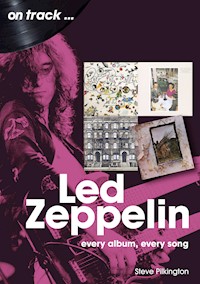
Led Zeppelin on track
Sie lesen das E-Book in den Legimi-Apps auf:
Seitenzahl: 389
Veröffentlichungsjahr: 2022
Ähnliche














Sonicbond Publishing Limited
www.sonicbondpublishing.co.uk
Email: [email protected]
First Published in the United Kingdom 2021
First Published in the United States 2021
This digital edition 2022
British Library Cataloguing in Publication Data:
A Catalogue record for this book is available from the British Library
Copyright Steve Pilkington 2021
ISBN 978-1-78952-151-1
The right of Steve Pilkington to be identified
as the author of this work has been asserted by him
in accordance with the Copyright, Designs and Patents Act 1988.
All rights reserved. No part of this publication may be reproduced, stored in a retrieval system or transmitted in any form or by any means, electronic, mechanical, photocopying, recording or otherwise, without prior permission in writing from Sonicbond Publishing Limited
Printed and bound in England
Graphic design and typesetting: Full Moon Media
Acknowledgements
Thanks as always to Stephen Lambe, who continues to publish my scribbling – gawd bless ‘im!
Thanks to Janet, for being a willing sounding-board, pointing out flaws and generally being an all-round massive help
Thanks to all of the other Zeppelin fans at school in the 1970s, aiding and abetting in my growing infatuation for the band. If they’re reading this, they know who they are!
Of course, the biggest thanks of all must go to Page, Plant, Bonham and Jones – the four elements of that glorious piece of rock and roll alchemy known as Led Zeppelin. Sheer magic.
Finally, thanks through gritted teeth must go to the stranger who I met in a chip shop in North Wales the day after the first Knebworth performance – which I had missed owing to a pre-arranged holiday – only for him to regale my impressionable ears with wondrous tales of just what I had missed. This strengthened my resolve to catch a Zeppelin show ‘next time around’, but we know what happened there...
Contents
Introduction
Led Zeppelin
Led Zeppelin II
Led Zeppelin III
Led Zeppelin IV (A.K.A ‘Four Symbols’, ‘Untitled’)
Houses Of The Holy
Physical Graffiti
Presence
In Through The Out Door
Coda
Video/DVD, Live Albums, and Reunion Appearances
Appendix One: Whole Lotta Led – Author’s 25-track Zeppelin Playlist
Appendix Two: Led Zeppelin Concert Milestones
Bibliography
Introduction
Mention the name Led Zeppelin to just about anyone with the remotest interest in music, and the image which will probably spring to their minds first, is of the globe-straddling colossus that they became by the mid-’70s – private jet, the whole Rock and Roll nine yards – and also of them as a powerhouse heavy rock machine. The truth, however, as fans know only too well, is that Zeppelin were always a far more multi-faceted entity than that, with a keen intelligence and scholarly side hiding behind Robert Plant’s ‘rock god’ persona, and Jimmy Page’s well-publicised obsession with the occult and the arcane. Musically, there was far more to Zeppelin than ‘heavy’, despite the fact that they were one of the world’s foremost exponents of that particular element. Indeed, as well as their initial blues roots – which never entirely went away – their music has been heavily intertwined with traditional folk and, latterly, the World Music which they encountered on their travels to such exotic locations as Morocco. Led Zeppelin was in a way a sort of ‘all things to all men’, which goes some way to explaining their quite extraordinary success, which defines the 1970’s in a way no other band quite can.
The origins of Led Zeppelin, as is well known, lie in The Yardbirds. In 1968, Jimmy Page found himself as the ‘last man standing’ from the band in which he had replaced Jeff Beck, and with a tour of Scandinavia already booked, he set about recruiting members for a new band, which would initially go out under the name of The New Yardbirds.
Page was born James Patrick Page in Heston, West London in 1944 – later moving to Epsom, Surrey, where he grew up. By 1963, he had already started working as a session guitarist, playing on a dizzying array of recordings over the following few years, but the crucial move came in 1966 when he joined the Yardbirds – originally as bassist, since Jeff Beck was already in the band, but soon switching to second guitarist, as rhythm guitarist Chris Dreja moved over to bass duties. The Beck/Page line-up recorded the single ‘Happenings Ten Years Time Ago’ (on which the bass duties were performed by a pre-Zeppelin John Paul Jones – Page can be heard playing bass on the B-Side, the unremarkable ‘Psycho Daisies’), but Beck left the band in November ‘66 after a dramatic bust-up on the road, when the band were appearing on the ghastly-sounding Dick Clark’s Caravan of Stars revue tour. Page took over as sole lead guitarist, and this line-up remained until June 1968, when Keith Relf and Jim McCarty left to form the embryonic original Renaissance line-up, leaving Page and Dreja. The plan was originally to enlist just a new singer and drummer, but Dreja changed his mind and decided to bow out, electing to follow his other passion as a photographer. Significantly, Peter Grant had begun managing the Yardbirds by this time, so he was already in place as the man who would guide Zeppelin’s career from a business perspective.
Page’s initial choices for vocalist were Steve Marriott or Terry Reid. Marriott proved unobtainable, and Reid was forced to turn down the offer, being under contract himself with Mickey Most – a contract which would lead to the less-than-legendary album Bang Bang You’re Terry Reid – a baffling and frankly hopeless title. The world largely agreed, and despite critical acclaim for his later albums, River and Seed of Memory, Reid has remained largely a footnote in rock history, and has surely had many a bout of self-recrimination for the missed opportunity! Instead, he suggested a young singer named Robert Plant, who was currently in a band going by the peculiar name of Obbstweedle. It’s hard to imagine Obbstweedle IV going on to become a massive-selling album, I think it’s fair to say...
Robert Anthony Plant was born in West Bromwich in 1968, from a musical family, including a violin-playing father, and a grandfather who had founded a local brass band. In the late 1950s, the family moved to Halesowen, near Kidderminster, living in a house very close to the Clent Hills – supposedly an inspiration for J. R. R. Tolkien’s creation of Middle Earth. Possibly as a connection to this fact, Plant began immersing himself not only in Tolkien’s fantasy world but also in the rich seam of Celtic and Welsh folklore – all strands which would show up time and again in his lyrics. In 1964, aged sixteen, Plant joined Kidderminster band, The Crawling King Snakes, forming a friendship with the band’s drummer, one John Bonham. He and Bonham both went on to join Band of Joy later, who began to make some waves with support from John Peel, recording a demo, but breaking up after a contract failed to materialise. Obbstweedle awaited, and then the world...
The aforementioned John Henry Bonham was born in 1948 in Redditch, Worcestershire, before moving to Kidderminster, and thus entering the orbit of Plant in the Crawling King Snakes. Apart from his time in that outfit, and also Band of Joy, Bonham did time in a substantial list of Midlands groups, including one called The Nicky James Movement, which also featured not only Roy Wood and Bev Bevan, later of the Move and ELO, but also future Moody Blue Mike Pinder. Another local band called A Way of Life had him forming the rhythm section alongside Dave Pegg of Fairport and Jethro Tull renown. By the time Plant joined up with Page, Bonzo (as he would soon be nicknamed) was playing with Tim Rose – with whom Page saw him perform, and decided he wanted him for his fledgling Zeppelin. In fact, it was a hard sell, because Bonham already had offers from Joe Cocker and Chris Farlowe, and despite a barrage of requests from Page, Plant and Peter Grant, he kept his distance – until he finally gave in and agreed to come to one rehearsal to see if anything developed. His reluctance was largely because he believed the Yardbirds were a spent force, and that the tail-end of their career would lead to nothing. But after playing with Page and Plant for that initial rehearsal, he decided that he preferred the music they could make to that of the more established Cocker or Farlowe, and he signed up accordingly.
By this time, Chris Dreja had taken his decision to step away and become a photographer – a decision which ultimately amounted to, essentially, ‘running away from the circus’. This left one remaining piece of the jigsaw to be found, and it came in the shape of John Paul Jones, born John Baldwin in Sidcup, Kent, in 1946. His mother was a singer, and his father a pianist and noted Big Band arranger, so it was no surprise when the young John developed an early, and somewhat precocious, musical talent, teaching himself piano at the age of six. By the time he was fourteen, he had assumed the position of choirmaster and organist at his local church, earning the money in that way to buy his first bass guitar, having a belief that the electric bass would become an important instrument in popular music. After spending some time playing with ex-Shadow Jet Harris in a band along with Tony Meehan, he entered the world of the session musician, playing with Jimmy Page on several of those engagements, and changed his name to John Paul Jones at the suggestion of Rolling Stones manager Andrew Loog Oldham – who had himself got the idea from a 1959 film which was called John Paul Jones. By 1966, he had risen to the position of musical director for Mickie Most and Robert Stigwood, contributing string arrangements to a host of artists’ records, including Donovan, Lulu, Herman’s Hermits, Car Stevens, Tom Jones, The Everley Brothers, Marianne Faithfull – and a couple of songs by none other than The Yardbirds! The celebrated string arrangement on the Rolling Stones track ‘She’s A Rainbow’ is courtesy of Jones. By 1968 he had decided that writing up to fifty arrangements a month had long since become a sheer drudge, and he began looking for a group to join – and his wife Maureen, who he had married the year before, pointed him in the direction of an advertisement placed by Page in Disc magazine. He got in touch, offered his services on bass, and unsurprisingly given his experience and also familiarity with Page, was hired to complete the line-up.
The foursome – christened The New Yardbirds for now – had a Scandinavian tour lined up, but before departing for that particular jaunt, they took part in a recording session for the singer P. J. Proby which would see the first occasion that all four putative Zeppelins would appear on the same recording. Proby had become mainly known for the absurd furore that erupted after he split his trousers on stage in England, essentially leaving him run out of town by an angry mob with pitchforks under the still remarkably conservative values of the mid-1960s. Of course, he did himself no favours, as he milked the situation shamelessly by having the seams in his pants weakened so that the same thing would happen again, but then they do say that any publicity is good publicity. In this case that maxim was arguable, as by the time of the Zeppelin-assisted album in question, Three Week Hero, few seemed aware of its release and even fewer bought it. Still, it transpired that it made history, as an unassuming piece with the monumentally dull title of ‘Jim’s Blues’, appearing as the middle of a three-song medley, marked the first song to feature all of Led Zeppelin on it, which is a little like George Best, Bobby Charlton and Denis Law making their debuts together in a non-league outing in front of 30 people before they joined Manchester United.
Following the Scandinavian trek – taking in Denmark, Sweden and Norway in September 1968 – the band returned to the UK to play some more gigs. Around this time, the name of Led Zeppelin had been arrived upon, and although exact accounts differ as to how this came to be suggested, it is generally agreed that Keith Moon was involved in the discussion. It has been widely claimed that there had been some wild talk of Moon and Entwistle leaving The Who and taking up with Page and Beck in a supergroup, and while this, of course, never transpired, the story goes that Moon said the plan would go down like a ‘lead balloon’, prompting Entwistle to jokingly suggest ‘Lead Zeppelin’ as the name. Peter Grant filed this away in his memory banks for later use, taking the wise decision to change the spelling to avoid mispronunciation of it as in ‘lead guitar’.
The first shows in the UK in October 1968 were still under the New Yardbirds name, with Page complaining bitterly that, while they tried to bill the shows as ‘Led Zeppelin’, promoters and venues fearful of dumping the established name still insisted as using the ‘New Yardbirds’ name. The first show they performed under the name Led Zeppelin came at the University of Surrey, in Battersea, on 25 October 1968.
By that time, the recording of the first album had just been completed, and history was waiting.
Led Zeppelin
Personnel:
Robert Plant: vocals, harmonica
Jimmy Page: guitars, backing vocals
John Paul Jones: bass guitar, keyboards, backing vocals
John Bonham: drums, backing vocals
Additional Musicians:
Viram Jasani: tabla on ‘Black Mountain Side’
Produced by Jimmy Page.
Record Label: Atlantic
Recorded September-October 1968.
UK release date: 31 March 1969; US release date: 12 January 1969.
Highest chart places: UK: 6, USA: 10
Running time: 44:56
As soon as the band returned from the short September jaunt over to Scandinavia in New Yardbirds guise, they decamped to Olympic Studios in London to record their debut album. In actual fact, to be strictly accurate, they didn’t so much ‘decamp’ as ‘drop in for the occasional visit’, since despite Grant having booked the studio for three weeks, the entire recording of the album was reportedly accomplished in three days – 27 September, and the third and 15th of October. They were also in the studio on 10 October, but the only track recorded on that day was ‘Baby Come On Home’, which didn’t make the cut for the final album. That was a total of around thirty hours, including the extra track – not a bad effort with which to make history, and an album which cost under £2,000 to make – including the sleeve – and has sold over thirteen million copies to date. A tick in the ‘profit’ column there, then.
There was one small thing missing when they recorded the album: namely, an actual recording contract. Peter Grant was very comfortable with this, however, because he knew what he had. Once the tapes were in his possession, he hopped on a plane to New York and headed straight for the offices of Atlantic Records, who had already expressed an interest. The result was an advance of over $200,000, the highest ever paid to a new artist for their debut album. Considering Robert Plant’s highest weekly wage before this was around £25, this was a life-changing sum, to say the very least! The disappointed party in this whole situation were Columbia/Epic Records, who had the Yardbirds on the label, and were convinced that they would have Zeppelin as a natural continuation, with Page being contracted to them via his previous band. What they failed to realise was that Page had never signed an exclusivity clause with Epic when joining the Yardbirds, and so had no ties. The story goes that Peter Grant went to see Columbia president Clive Davis, and spent some time in his office with him making small talk and chatting about other artists before Davis asked when they were going to discuss the Zeppelin signing. Grant allegedly informed him in a matter-of-fact way that he had already made a deal with Atlantic, and strode out calmly while Davis raged behind him!
The album was released in the United States on 12 January 1969, two months before the UK release at the end of March. This was to tie in with the band’s first US tour, which had begun on 16 December and would run until 15 February. Initial reviews of the record in the US were rather mixed, whereas, in the UK, they were far more positive. Audience reaction over in America was notably more enthusiastic than the press, however, with audiences taking the band to their hearts immediately. This contrasted sharply with the difficulties they had been facing at home, with gigs being promoted under the New Yardbirds name against their wishes, and a general lack of enthusiasm for the new project. Thus began a relationship with the US, which was to last for the entire Zeppelin career.
Album Cover
The front cover of the album – designed by George Hardie, who would go on to work with Hipgnosis, and later be responsible for such iconic covers as Pink Floyd’s Dark Side Of The Moon and Wish You Were Here – was certainly a striking image, but it must be said perhaps a somewhat obvious choice. The photo forming the basis of the cover image, and chosen by Page, was a monochrome photograph of the Hindenburg airship disaster in 1937 in New Jersey, in which 36 people perished, and is a fairly blunt evocation of the band’s name! The photograph, originally taken by Sam Shere, was reproduced by Hardie in ink and then with a printing technique known as mezzotint, which was popular between the 17th and early 19th century, but less commonly used since. The band name and Atlantic logo were printed over the image in turquoise on the initial release but changed to orange within a year, making the turquoise copies a dream for collectors.
The back cover featured a photograph of the four band members reproduced in a soft orange tint – a photograph taken by none other than our heroic new lensman Chris Dreja! It was undeniably a great opportunity handed to him by Page as he embarked on his newly chosen career, but the ‘21 guineas’ which he has oddly reported as being the sum he was paid, does represent the smallest of possible potatoes compared to the reward he would have reaped had he remained as bass player. The rear cover also featured the musician credits and list of songs and songwriter credits – the latter being a subject we shall return to quite frequently!
Note that the small alternative zeppelin image used at the bottom of the back cover (and also on the back of the second album) is a reduced size version of an alternative design that Hardie offered for the front cover. It has been used regularly on posters, T-shirts and the like since.
‘Good Times Bad Times’ (Page/Jones/Bonham)
Opening with a heavy two-chord guitar riff which would be echoed a year later by Black Sabbath on ‘The Wizard’, the first track on the first Zeppelin album may sound like a fairly simplistic song to today’s ears. Casting one’s mind back to the musical climate when it emerged in early 1969, however, reveals it as a supremely effective calling card for the new band. Each of the four members shine in their own ways on the relatively short song, and leave the listener in no doubt as to their individual quality and collective chemistry. Page is concise and disciplined, firing off a twenty-second solo in the middle of the track, and accompanying Plant’s seeming ad-libs in the coda by spraying short lead guitar bursts like crackling electricity. Jones – who came up with the main riff – is not only tight and metronomic anchoring the rhythm section, but also gets in one or two little bass outbursts of his own, to let the listener know he’s there. Plant is very up-front and powerful from the word ‘go’, partly through the means of a clever little production trick, which sees his double-tracked vocals harmonising with himself during the verses and then accompanying himself an octave apart in the chorus. The contrast provided by this is subtle yet striking. Not that it is anything remarkable lyrically – Plant seems at pains to stress that his woman left home ‘with a brown-eyed man’ (though he ‘still don’t seem to care’, he assures us), when the colour of this philandering Lothario’s eyes would seem to be a fairly insignificant detail in the whole scenario...
It is Bonham, however, who perhaps shines the most here. Throughout the song, he punctuates his playing with lightning-fast bass drum triplets (you can hear one clearly about 30 seconds in), which are made all the more remarkable by virtue of the fact that he was playing them with a single bass drum kick pedal, at a speed which would seem almost impossible for the average foot! Interestingly, he actually thought he was copying this trick, while he was actually inventing it – he told Carmine Appice that he took the particular pattern from one that Appice did on Vanilla Fudge’s version of ‘Ticket To Ride’ from their debut album. What he didn’t realise until he spoke with Appice about this later, was that for the Vanilla Fudge track, Appice was using a double-kick bass drum augmented by his drumsticks as well. Bonham heard it, just assumed it to be a fast foot, and played the seemingly impossible. That’s a way to announce yourself to the world.
Note that Plant received no songwriting credits on the initial release of the album, owing to his having an existing contract with CBS at the time.
The song was not often played live, and never after 1970, until the 2007 reunion show at the O2 Arena in London, when the band fittingly decided to open with it.
‘Babe I’m Gonna Leave You’(Page/Plant/Anne Bredon)
The songwriting credits for this song have a story in themselves, as not for the last time there would be a later revision to the credit. This time, however, Zeppelin were blameless in the situation. Page heard the song initially from a version by Joan Baez on her 1962 album, In Concert, where it was credited merely as ‘Traditional’. Baez had heard it herself sung by a student named Janet Smith and assumed it to be a traditional folk song, whereas it was actually written by a fellow student of Smith’s named Anne Bredon. The Zeppelin version was originally credited as ‘Traditional, arranged by Page’, until 20 years later, when Janet Smith heard it and mentioned it to Bredon, who naturally alerted Zeppelin and Atlantic to the situation. The credits were then amended for all pressings going forward.
The contrast between this version and that of Baez is profound. Page described the Baez interpretation as ‘haunting’, and that assessment is undeniable, with her busy fingerpicked guitar underpinning the astonishingly pure vibrato in her voice. It may last less than three minutes, but it is a significant achievement nonetheless, and one which reportedly inspired Page as to the direction he envisioned for Zeppelin (‘light and shade’ as he put it). The Zeppelin version opens in similar fashion, with the same gentle verses backed by Page playing with both plectrum and fingers to create an intricate-sounding backdrop (for this, he used a Gibson J-200 acoustic guitar, which he actually borrowed from Mickie Most). Plant takes the original melody as a starting point, but twists, turns and stretches it in a way that makes it completely his own – in a heartfelt, tortured way. A couple of heavier punctuations come in dramatically where a chorus would be, but after a couple of repetitions of this, the tempo shifts up into a big, propulsive heavy rock momentum, driven by Bonham’s urgent drums and crashing cymbal work. The tone drops again before once again revving up in a way that creates that light and shade talked about by Page to perfection. Jones is again outstanding, and at one point in the second verse section, can even be heard playing harmonics on his bass as a masterful touch.
At around the 1:40 mark, Plant’s voice can be heard foreshadowing the line ‘I can hear it calling me’, as a sort of pre-emptive echo effect, and while this works very effectively, it is believed to have been a happy accident, owing to his voice bleeding through from a previous take. Towards the end of the song, careful listening can detect Page’s guitar doing the same thing. Overall, this track is a pivotal, if rarely acknowledged, moment in the development of electric folk-rock.
‘You Shook Me’(Willie Dixon/J.B. Lenoir)
Another song which had a somewhat confusing genesis in terms of songwriting, this was originally credited to bluesman Willie Dixon alone, but was later amended to include Lenoir. In actual fact, there is more to it than that, though not from the Zeppelin end. In 1961, blues guitarist Earl Hooker recorded an impromptu instrumental with his band, which was later titled ‘Blue Guitar’ and released as a single, with Hooker listed as performer and writer. At that time, Leonard Chess of Chess Records, wanted to get Muddy Waters back into the studio and recording, and he chose this track as being the music which would fit the task perfectly. To that end, he agreed a deal with Hooker, which saw new lyrics being added by Dixon and Lenoir (another blues musician who passed away in 1967), and retitled as ‘You Shook Me’. The writing credit bore no mention of Hooker. Oddly enough, the original Waters single release itself listed Dixon as the sole writer without Lenoir, so it is no surprise that the Zeppelin version did the same. It’s all rather, well, muddy, to be honest – and illustrates that, while Zeppelin were sometimes remiss in giving due credit in terms of songwriting, they were far from alone at the time.
The more serious accusation surrounding this track came from Jeff Beck, who had released a version on his own Truth album the year before, which was far from identical but close enough to indicate a similar approach to the song. Furious at what he saw as Page stealing his ideas, he launched a bitter attack on the Zeppelin version, but Page has always claimed that he was unaware of Beck’s recording. This itself is somewhat odd, as Peter Grant has claimed to have given Page an advance copy of Truth, and moreover, John Paul Jones himself played on the Beck version. The matter has never had a definitive resolution, but it soured relations between Beck and Page severely at the time.
Whatever the facts may be as regards that, let’s look at the track itself. At six and a half minutes, it stretches out from the original significantly, and incorporates three solos – firstly from Jones on a slightly cheesy-sounding Hammond organ, then Plant on harmonica, before Page takes the honours with a searing guitar solo. From the beginning, Page’s guitar tone is absolutely filthy and suits the sleazy nature of the song perfectly. In fact, unlike the rest of the album where he uses (unusually) a Fender Telecaster throughout, here he plays a Gibson Flying V, which he had been urged to try out, as he was being persuaded to consider buying it (he didn’t). Plant sings Dixon’s lyric, but also adds in some lines from Robert Johnson’s song ‘Stones in My Passway’ in the shape of the metaphorical ‘I have a bird that whistles, and I have birds that sing’ – by which he is not referring to caged songbirds, naturally. In fact, the band seem to find this amusing, as laughter can clearly be heard following the line at one point. Toward the song’s end, Page uses a ‘backwards echo’ technique, which led to angry exchanges between himself and engineer Glyn Johns, who apparently swore that it would not be technically possible, only for a furious Page to prove that, in fact, it was.
All told, while the track was remarkable at the time in the wake of the British ‘blues boom’ of the late 1960s, it has not aged well compared to much of the rest of the album, and one’s enjoyment of it is in direct proportion to one’s liking for relatively straight twelve-bar blues. It’s a good track, but it isn’t a highlight on the record.
‘Dazed And Confused’(Page, inspired by Jake Holmes)
And here we go with the amended credits again! This song was originally credited to Page alone, but that changed when Jake Holmes decided he had been unfairly treated and began to complain, quite justifiably, to be honest. A young singer-songwriter, Holmes had written the song which formed the basis for this track in the same way that the Baez version of ‘Babe I’m Gonna Leave You’ did for that one, and recorded it on his album The Under Ground Sound Of Jake Holmes. It had some different words but was musically inescapably the same song and had the exact same title, ‘Dazed And Confused’. Holmes supported The Yardbirds at a couple of shows in Greenwich Village in August 1967, a month or two after his album’s release. Page was impressed enough with what he heard that he went out and bought the Holmes album, and shortly afterwards, The Yardbirds began including a version in their own set. It is absolutely right that Holmes should feel aggrieved at this, yet for some unfathomable reason, he waited forty-two years before complaining about it, which seems to be taking lethargy a little too far! An amicable agreement was reached in 2012, and the credits were amended to afford him the ‘inspired by’ tag.
All of which is rather a shame, and certainly shouldn’t overshadow the Zeppelin track itself, which is not only an outstanding moment on the album but in the whole Zeppelin catalogue – and the song and the phrase itself have since very much entered both rock history and the public consciousness. In the Zeppelin version, Plant is consumed by vengeful bitterness towards the woman who has ‘hurt and abused’ him, with ‘all of her lies’ – though the dramatic declaration that the ‘soul of a woman was created below’ seems a little harsh!
The song is given a very progressive arrangement, and is somewhat groundbreaking for its time. Opening with an iconic descending bass run from Jones, with squalling guitar effects added by Page, Plant contributes a remarkable vocal, sounding tormented and tortured in the extreme – an impression only added to by the entry of a huge heavy rock rendition of that same descending theme, with distant wails to be heard in the background. If the woman’s soul really was created below, it might have sounded something like this...
After two minutes comes a switch to a rather abstract section featuring Page famously using a violin bow on his guitar – not a new technique exactly, and indeed he had already used it on the Yardbirds track ‘Tinker, Tailor, Soldier, Sailor’ in 1967, but still far from commonplace. According to Page, the suggestion that he use the bow came from the violinist David McCallum, the father of Man From UNCLE actor David McCallum Jr. McCallum senior also contributed the violin to the Beatles’ ‘A Day in the Life’, as it happens. Note that, at the beginning of this section, Plant’s voice can be heard ‘bleeding’ into the track again, in a similar way to ‘Babe I’m Gonna Leave You’.
‘Dazed And Confused’ hasn’t finished dazing us yet, however, as the tempo picks up to a fast rock beat as Page peels off an extremely fast solo on his Telecaster before we come back to the sturm und drang of the opening section to see us out. At six and a half minutes, it’s another quite long track, though nothing in comparison with later live renditions, which would commonly go on for over half an hour. Once the song went straight into the Zeppelin set list, it never came out again. This is the sound of real history being made, perhaps for the first true time in the Zeppelin story.
To get a sense of how much Plant brings to the party here, seek out a live recording of the Yardbirds doing it. By comparison, Keith Relf sounds as if he is politely ordering a plate of cucumber sandwiches. With the crusts cut off. He also, incidentally, sticks to Holmes’ original lyric for Yardbirds performances, proving the song’s origin beyond all doubt. This one is so remarkable that giving the correct credit initially would have done nothing to even blunt its impact, and ‘Holmes, arranged by Page’ would seem to be accurate.
‘Your Time Is Gonna Come’(Page, Jones)
Opening the second side of the original vinyl, this country-influenced folky song provides something of a comedown from the apocalyptic bluster of ‘Dazed And Confused’. Somewhat incongruously, it opens with a minute or so of Jones playing an introduction on the Hammond organ which, at times, appears to draw on his church-organ background. It’s nice enough for sure, but seems a little at odds with the track as a whole. When the song proper begins, it moves along nicely in the verses, with Page’s lyric once again swearing vengeance on a woman who has wronged him – a definite pattern developing by now, it would seem. In this case, she has apparently been ‘messing around with every man in town’, which would suggest that it is either a very small town or else she can’t have been home very much. To be fair to Page, he has said that he was uncomfortable with his own lyric writing, and wanted Plant to ‘take care of that side of things’. The folky feel, with what sounds like some slide guitar augmentation from Page, unravels a little in the rather simplistic chorus, which simply has the band members declaiming the song title four times in succession to a rather negligible melody, and coming over a little like a first cousin of the Rolling Stones’ ‘You Can’t Always Get What You Want’.
At one point, after the chorus, listen out for Page getting a rather unusual sound by striking the strings of his J-200 acoustic guitar with the flat of his right hand rather than strumming or picking it. The chords can still be heard but in a most unfamiliar manner.
This relatively slight song (very rarely performed live) does, however, carry its own piece of history, by way of being the first Zeppelin song ever to be covered by another artist. The artist in question was the very unlikely figure of barefoot Eurovision-winner Sandie Shaw, who included the song on her album Reviewing The Situation later in 1969. She was unlikely to have a stab at ‘Dazed And Confused’, to be fair...
‘Black Mountain Side’(Page)
Another convoluted compositional tangle here, as Page offers an interpretation of, or a development from, a track called ‘Black Water Side’, recorded by Pentangle guitarist Bert Jansch on his album Jack Orion. However, it isn’t as simple as denying Jansch a credit in this case, as his piece, in turn, was itself an adaptation of the traditional ‘Down By Blackwaterside’, which Page admitted he had heard played live on occasion by Annie Briggs. An example of naturally evolving traditional material, no-one was being denied credit – although an acknowledgement to Jansch might have seemed fitting, given how similar Page’s playing is to his recording in places. Where things do get a little more questionable is that Page claimed the writing credit as solely himself, rather than ‘Traditional, arranged by...’. But then again, ‘Black Mountain Side’ was essentially a mixture of the above piece with some parts of ‘White Summer’, which Page used to play with the Yardbirds. The credit has never been changed (though legal advice was sought at one time), so we should perhaps put it down to the nebulous nature of traditional material and leave it at that.
To emphasise what he saw as the Indian feel of the piece, Page utilised Viram Jasani on tabla; a musician also skilled at the sitar who would contribute to a number of film soundtracks. The piece only lasts for two minutes, making it the shortest on the album.
‘Communication Breakdown’(Page/Jones/Bonham)
In a complete contrast to the previous track (in fact, the previous two tracks), ‘Communication Breakdown’ is simply two and a half minutes of what could be described as prototype speed-metal. No delicate acoustic work or meticulous light-and-shade, just Page hammering out a staccato riff using some fast downward strokes, and the rest of the band throwing in for the ride. In fact, Page said he found the fast down-stroke technique difficult, or at least uncomfortable, but it certainly sparked a reaction in the future Johnny Ramone, who reportedly so loved the track that he took the form essentially as his career template and made it his own.
At the end of the second chorus, Plant’s voice can be heard wailing away into the distance, concluding with an enthusiastic ‘Oh, suck!’ – his voice is double-tracked in this part of the song, and that extended note is one of the tracks continuing on after the other. There is a little organ added in the closing section alongside some slightly clumsy backing vocals and Page’s sustained lead outbursts, but this track isn’t about the subtlety, and it had an enormous impact in early 1969.
The band were already playing the song live on the Scandinavian ‘New Yardbirds’ trek, and they opened their shows with it for some time after this album was released, which really begs the question as to why they buried it halfway through the second side when it cries out to be the opening track...
‘I Can’t Quit You Baby’(Dixon)
It’s back to the blues now, and indeed back to Willie Dixon again, for a song he wrote which was originally recorded by Otis Rush in 1956. It has been covered by a host of people, but the Otis Rush version is the one Zeppelin took as their template. It’s pretty standard twelve-bar blues, with the one exception of the end of each twelve-bar cycle when the band add in a chord change from A to B flat – a power-chord effect which gives just the right amount of ‘Zeppelin juice’ to make it their own. In truth, other than that, it isn’t the most remarkable track in the Zep catalogue – Plant puts it across well, hamming it up in a deliberately scenery-chewing way, and Page is all over the place throughout, making the whole song almost into one long guitar showcase, though he isn’t at his precise best, as a few mistakes creep in, which to his credit he leaves as they are. At about the 1:30 mark, for example, he appears to ‘fall over his own fingers’, figuratively speaking – he has admitted this, and it is refreshing to see the odd mistake left as is, in order to keep the ‘feel’ of the piece. The song was in the live set until the advent of the third Zeppelin album in 1970, at which point it made way as the ‘blues number’ for the far superior ‘Since I’ve Been Loving You’.
‘How Many More Times’(Page/Plant/Jones/Bonham)
The final track on the album is also its longest, at just over eight and a half minutes. Credited to the four band members (excepting Plant on the original credits owing to his contract situation), again, it does borrow from a number of blues legends. These are mere stepping stones, however, to an extraordinary workout that rivals ‘Dazed And Confused’ as the trailblazing experimental highlights of the record. The first three minutes are driven by an irresistible bass riff from Jones, taken up by Page and given a tremendous swing feel by Bonham’s drums. At around the three and a half minute mark, we see the beginning of a lengthy mid-song break, similar to that employed on the classic ‘Whole Lotta Love’ on the next album.
It is in this psychedelic-sounding freak-out part of the track that Page once again uses the violin bow technique from ‘Dazed And Confused’, as Plant’s often spoken word contribution relates a tale about him having ten children, and ‘another on the way, that makes eleven’ – interestingly, Plant actually did have a child on the way, as his daughter Carmen Jane was born only a couple of weeks after the recording, though that made one at the time, rather than eleven! Later he uses the words ‘Little Robert Anthony wants to play’, which clearly refers to himself, Anthony being his middle name.
At this point, an overt homage to the Albert King song ‘The Hunter’ (written by Booker T and the MGs and famously covered by Free on their debut album) sees a verse or so of the song practically dropped in wholesale. After the lengthy mid-section, the initial riff comes back for one last outing and verse, as the song ends the album on a very strong note.
It is often claimed that the Howlin’ Wolf song ‘How Many More Years’ was a big point of reference for this song, but in fact, the two have little in common. Another Wolf song called ‘No Place To Go’, or sometimes known as ‘You Wreck My Life’, actually has significant lyrical similarities. The bass line is very similar to the Yardbirds’ version of another blues classic, ‘Smokestack Lightning’. Other than perhaps that latter resemblance and the verse from ‘The Hunter’, the song is more a tip of the hat to other songs, such as Plant’s lyrical allusions to two songs he had previously played with Alexis Korner (‘O Rosie’ and ‘Steal Away’), and also Robert Johnson’s ‘Travelling Riverside Blues’, and it cannot be dismissed as theft or withholding of credit in the same way as the ‘Dazed And Confused’ saga, for example. The song as a whole is essentially a jackdaw-like accumulation of bits and pieces performed by the Zeppelin foursome in their former bands. It isn’t any sort of cover version exactly, but it certainly does use a lot of ingredients to make up the new recipe!
Related Songs:
‘Baby Come On Home’ (Page/Plant/Bert Berns)
Recorded on 10 October, the only track completed that day, this song was recorded as a tribute to the songwriter Bert Berns (co-composer of ‘Twist And Shout’ and also Janis Joplin’s ‘Piece Of My Heart’, among others), who had passed away the previous year and had been a friend of Page. The song is only loosely based on a Berns song of the same name. This track was also known as ‘Tribute To Bert Burns’ (note the mis-spelling) on a master tape which was reportedly lost for two decades before allegedly turning up in a bin outside Olympic Studios during renovations in 1991, and first appeared as part of the Led Zeppelin Boxed Set 2 release in 1993, and subsequently the expanded release of Coda.
A fairly strong song in its own right, it is easy to see why it was left off the album originally, as it would have stood out like a sore thumb, stylistically. Essentially it’s a soul-blues ballad somewhat in the vein of a mid-’60s Rolling Stones track, with rather atypical yet effectively done vocals by Plant. John Paul Jones contributes Hammond organ and piano as well as bass on this one, and is in some ways the predominant force apart from Plant.
‘Sugar Mama’(Page/Plant)
Another track recorded during the album sessions but left off the album, this also emerged eventually on the deluxe release of Coda. At just under three minutes, it’s a pretty good driving rock shuffle, and could easily have made it onto the album. To my mind, it could have been added in place of ‘I Can’t Quit You Baby’ and certainly should have been on the original Coda release.
Led Zeppelin II
Personnel:
Robert Plant: vocals, harmonica
Jimmy Page: guitars, backing vocals, theremin
John Paul Jones: bass guitar, keyboards, backing vocals
John Bonham: drums, backing vocals
Produced by Jimmy Page.
Record Label: Atlantic
Recorded April-August 1969.
UK release date: 31 October 1969; US release date: 22 October 1969
Highest chart places: UK: 1; USA: 1
Running time: 41:38
1969 was an astonishing year for Zeppelin, into which they seemed to cram an entire career’s worth of work and development! During those twelve months, they released their first album, recorded and released their second, toured America four times and toured the UK and Europe three times, playing around 160 shows. It paid dividends as, while the US had taken the band to their hearts as soon as the first album was released during a run of four shows at the Fillmore West in San Francisco, the UK dates following that tour were performed largely to a wave of indifference and a collective shrug of the shoulders. The second run of UK shows in May and June saw interest begin quickly picking up, and by the end of the year, the second album – released in October – had reached Number one on both sides of the Atlantic. Not a bad year’s work.
Interestingly, however, despite Robert Plant’s reputation now as one of the rock frontmen par excellence, those early months were far from plain sailing, with road manager Richard Cole later claiming that on the second US tour, in particular, Page was unhappy with Plant’s performances, and that it was ‘touch and go’ whether he would stay with the band. Fortunately, sanity prevailed, and by 1970, the world was, to all intents and purposes, theirs.
Initial sessions for the album began, ludicrously, in April 1969, only a matter of days since the debut came out in the UK, and three months after the US release, owing to the insistence by Ahmet Ertegun at Atlantic Records that they get a second album out by the summer. Fortunately, this lunacy was thought better of, and the record was prevented from being recorded in about three hours in between transatlantic flights, as the release date was put back to a slightly more manageable October. In that short time in April, however, ‘Whole Lotta Love’ and ‘What Is and What Should Never Be’ had already been recorded, and presumably by coincidence, they also ended up being the opening two tracks on the final release. Those first recordings were done at Olympic Studios in London, but owing to the insane touring schedule that year, recordings were also done in another twelve different studios, in London (again), Los Angeles, Memphis, New York and Canada (the latter being R&D studios, which Jimmy Page would later describe in the Deluxe Edition sleeve notes as ‘a hut in Vancouver’). Five different studios were used in LA alone. It is astonishing that the album has the consistency that it does, as it could easily have ended up as a mish-mash of different-sounding pieces had Page, in particular, not had such a keen grip on the production. Indeed, Page has said since that by the time the album was completed, they had lost confidence in it completely, owing to the disjointed and rushed nature of the recordings. The final mixing was done with Eddie Kramer at A&R Studios in Manhattan, New York, using what Kramer described in Mick Wall’s book When Giants Walked The Earth as ‘the most primitive console imaginable’.
When the album was released on 22 October, it had been pre-ordered by almost half a million fans in the US alone, and would go on to knock the Beatles’ Abbey Road




