


Erhalten Sie Zugang zu diesem und mehr als 300000 Büchern ab EUR 5,99 monatlich.
- Herausgeber: Gesellschaft für Schweizerische Kunstgeschichte GSK
- Kategorie: Geisteswissenschaft
- Sprache: Englisch
The last monks left Ittingen Charterhouse in 1848. The buildings, which had been built over centuries, passed into the possession of the Canton of Thurgau and later private owners, who used them as a stately residence and model farm. Since 1977, the Ittingen Charterhouse Foundation has operated the complex as a cultural and meeting centre, which also houses two cantonal museums. The excellently preserved site provides a lively insight into the history of the place and its former inhabitants. The monks’ cells, cloister gardens and richly furnished rococo church allow visitors to form a direct impression of how the Carthusians perceived of themselves as hermits in the community.
Sie lesen das E-Book in den Legimi-Apps auf:
Seitenzahl: 77
Veröffentlichungsjahr: 2022
Das E-Book (TTS) können Sie hören im Abo „Legimi Premium” in Legimi-Apps auf:
Ähnliche


















Felix Ackermann
Ittingen Charterhouse
Canton of Thurgau
Introduction
The location
The monastery walls
Within the walls
Outside the walls
History
From country estate to monastery
The monastery of the Augustinian canons
Ittingen as a charterhouse
After the dissolution of the monastery: from state ownership to a private farming estate
The Stiftung Kartause Ittingen and its partners
Premises
Areas of the monastery open to the general public
West wing
The large wine cellar
South wing
East wing
The monastery church
Architectural history
The choir stalls
Wall and ceiling frescoes
Stucco decoration
Altars
Appendix
South gate of the monastery, crowned with a statue of St Bruno, founder of the Carthusian order. To the left, the estate manager’s house, built in 1910 as an extension of the old monastery forge.
Introduction
The location
The Carthusian monastery in Ittingen is one of the most famous historical monastery complexes in Switzerland. A substantial portion of the buildings abandoned by the monks in 1848 has been preserved. The site has been open to the general public since 1983. The current owner, the Stiftung Kartause Ittingen, farms the land surrounding the monastery and runs a hotel with a conference centre and a restaurant in the complex itself. The Canton of Thurgau is responsible for the Ittinger Museum and the Kunstmuseum Thurgau, both of which are also housed in the building complex.
The monastery is situated about four kilometres to the northwest of the capital of the canton of Thurgau, Frauenfeld, on the road between the villages of Warth and Uesslingen, and is surrounded by woods, farming land and vineyards. The south-facing slopes stretching down to the Thur plain make this an attractive area for winegrowing: And it was thanks to its wine that the Ittingen Charterhouse became extremely prosperous in the 17th and 18th centuries. Nowadays, the monastery’s unspoiled and richly varied surroundings are part of the allure that makes Ittingen such an attractive destination for excursions.
The monastery walls
Monasteries were usually enclosed by a surrounding wall. These walls protected the community living within them, but they also had symbolic significance: Entering a monastery was regarded as ‘leaving the world behind’. The walls were thus also the symbolic boundaries between the realm dedicated to the worship of God and the outside world.
The surrounding walls of Ittingen Charterhouse are preserved in their entirety. The road between Warth and Uesslingen passes right along the monastery wall. The south gate, historically the main entrance to the complex, opens onto this road. The pediment of the gate bears a statue of St Bruno, the founder of the Carthusian order.
The wall to the right of the south gate is preserved in its original, closed-off state, its surface broken only by small barred openings. To the left of the gate, in contrast, a generously windowed, half-timber house juts out over the wall – this house was constructed in 1910, as an extension of what had been the monastery’s forge, during the period when Ittingen was a private farming estate.
There are other gates to the east and west which are still connected today, as they were in the past, by an almost straight path crossing through the grounds of the monastery.
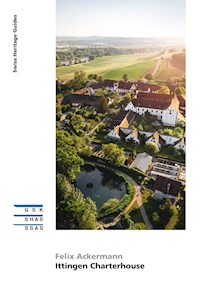
Aerial photo of Ittingen Charterhouse from the south.
Within the walls
The south gate leads to the old monastery economic yard, nowadays the hub of a lively range of activities taking place within the complex. To the right the former stables stretch along the wall. These days they house a bar; the workshops of the Stiftung Kartause Ittingen; and the dairy. The building to the left, the converted monastery forge, serves as the reception area of the hotel. Further to the left, extending along the west face of the monastery wall, the immense former barn edifice now houses hotel rooms, conference and seminar rooms and the Ittingen Stiftung Kartause Ittingen shop. The ground slopes upwards to the north of the farmyard. There is an oval water basin partially embedded at the edge of this slope. In the records this ‘horse pond’, as it is referred to, was used to collect the water flowing from various sources, which could then be channelled to the mills situated below the road on the slopes down to the Thur plain.
The angled façade of the restaurant is visible to the right of the horse pond. It was constructed in this form in 2008/09. The dining areas of the restaurant were laid out in front of the old monastery mill and bakery buildings. There is a large fountain in front of the restaurant, the column of which is surmounted with a statue of St Lawrence, the patron saint of Ittingen Charterhouse.
The passageway between the mill and the stable buildings is straddled by a wing of the building, timber-framed and supported by pillars: this used to be the monastery granary and nowadays it serves as the banqueting hall of the restaurant.
The earliest photograph of Ittingen Charterhouse (1870s?). View from the economic yard towards the monastery buildings. To the right the building with the bakehouse and the mill; in front of it the fountain of St Lawrence; in the foreground the horse pond. On the left, the right avant-corps of the west façade as it looked before addition of the loggia.
Part of the former economic yard. In the centre the granary, to the right the stables, both constructed at the beginning of the 18th century, on the left the 2009 extension to the restaurant (former mill and bakehouse).
The ground slopes upwards between the barn buildings and the horse pond. The West Gate can be seen to the left, and to the right of the gate, there are more former farm buildings now converted for the use of the Stiftung Kartause Ittingen. To the north of these buildings, along the northwest corner of the monastery wall, are buildings dating to 1983, with more hotel and seminar rooms.
The path below the wall leading to the monks’ garden; in the foreground two monks’ cells.
On the other side of the meadow, to the right of the path, stand the actual monastery buildings with the cloisters and church, which from this angle reveals its mighty west façade with two avant-corps. The round-arched portal, right next to the avant-corps on the left, is now the entrance to the museum.
To the south of the monastery buildings, the path which leads to the east gate runs along a wall which used to support the walls – now vanished – surrounding the monks’ private gardens, in front of their cells.
Outside the walls
There is a pond in front of the east gate which was originally the reservoir used to operate the monastery’s watermills. At the foot of the vineyard stands a small half-timbered building, the old monastery washhouse. Visible to its left, a slight distance apart and built into the hillside, is the impoundment of the spring which has been supplying the monastery with drinking water for hundreds of years.
A pen-and-ink drawing of the monastery dating from 1719
Some of the plans or views of Ittingen Charterhouse have keys indicating the functions of the various buildings or parts of buildings and thus help us to understand the functional set-up of the monastery. The oldest such view is a drawing dating from 1719. The most significant difference compared to its present state is the absence of the west wing, which was only constructed in the 1720s, and was intended to conceal the previously free-standing church façade. When you compare this key with those of later plans, it is clear that there was a continuity in how the buildings were used: the function of the buildings was not altered in later renovations. Which is why the functions identified in the overview plan of the situation in 1836, which was compiled on the basis of sources including this drawing, can be used as a reference.
As is the case for most of the surviving depictions, the monastery is shown from the south; visitors generally enter the monastery grounds through the south gate.
The large building depicted directly beyond the south gate was demolished in 1844. There is now a meadow where it once stood. The ground floor of this building was comprised of large rooms with troughs and the upper floor of rooms for the servants. To the right of the mill is a garden, laid out geometrically: the kitchen garden.
The monks’ cells are arranged in rows around the main cloister. Those to the south and east are still preserved, but the annexes and the walls that surrounded the monks’ private gardens have disappeared.
Pen and ink sketch of Ittingen Charterhouse as it stood in 1719. This sketch has a detailed key indicating the functions of the buildings. See the designations on the general layout plan (inside cover).
The building just in front of the south gate was constructed in 1844, as a tavern, by the public stewardship of the monastery estates. Down below, you can see the historical buildings of the former monastery mills still preserved, and even further down, on the plain towards the River Thur, are the modern farm buildings and stables of the current farm of the Stiftung Kartause Ittingen.
Other buildings used by the economy these days are situated in front of the west gate, built onto the back wall of the great barn: On the ground floor they house workrooms and workshops and in the basement the winery.




