


Erhalten Sie Zugang zu diesem und mehr als 300000 Büchern ab EUR 5,99 monatlich.
- Herausgeber: Kamera Books
- Kategorie: Geisteswissenschaft
- Sprache: Englisch
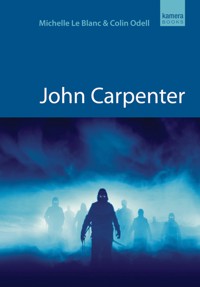
Tension. Fear. Exhilaration. Atmospheric synthesizers. You're in John Carpenter territory. One of the most iconic directors of American cinema John Carpenter has astonished audiences the world over with his tightly crafted horror, thriller and science-fiction films. Not just a director, Carpenter's talents also extend to writing the screenplays and soundtracks to many of his films. From the existential comedy classic Dark Star through to the terrifying smash hit Halloween, the taut siege of Assault on Precinct 13 to the visceral Vampires there's action and tension all around. But it's not all ghosts from The Fog or horrific mutations in The Thing, there's time for romance in the science-fiction road movie Starman and even for The King himself in the superior bio-pic Elvis - The Movie. John Carpenter's films are always memorable, distinctive and unashamed of their genre roots. The John Carpenter Kamera Book explores his films and his work as a director, composer, writer and producer. It examines Carpenter's influences and style and the films that have, in turn, been influenced by him. An indispensable guide to the ultimate cult auteur.
Sie lesen das E-Book in den Legimi-Apps auf:
Seitenzahl: 224
Veröffentlichungsjahr: 2011
Das E-Book (TTS) können Sie hören im Abo „Legimi Premium” in Legimi-Apps auf:
Ähnliche



















Colin Odell and Michelle Le Blanc
JOHN CARPENTER
For Joan and John (aka G&G), with love, even though they probably haven’t seen any of these film
ACKNOWLEDGEMENTS
Our thanks for the usual distractions to: Paul and Lizbeth, Gavin and Hanako, John and Elli and Andy B. A big hug for Marika. Our love to Christine and Tony Le Blanc, Truus Odell and Marc Le Blanc and Vicky Campo.
Thanks also to Hannah Patterson, Ion Mills and Anne Hudson.
CONTENTS
Title Page
Dedication
Acknowledgements
1. John Carpenter – American Auteur
2. Attention, Incoming Communication
3. The Shape of Terror
4. Hollywood Calling
5. Back to Basics
6. ‘He Who Has the Gold Makes the Rules’
7. Other Projects
8. The More Things Change, the More They Stay the Same: the Legacy
Bibliography
Copyright
Plates
Advertisement
JOHN CARPENTER – AMERICAN AUTEUR
John Carpenter is one of Hollywood’s most consistent storytellers. He is an independent film artist with a strong personal vision, as well as a talented writer and composer and his name alone will draw people into the cinemas. Ultimately his reputation is built on one overriding talent – his ability to tell a story and tell it well, whether you are shivering at the Shape, rooting for Starman’s return home, gazing wide-eyed at the grotesqueries of the Thing, singing with Elvis, grimacing with Snake or running out of gum with Nada. Those that label him a director of ‘mere’ genre entertainment are ignoring his role as torch-bearer for the continuation of formalised Hollywood narrative form, an art usually swamped by fads and a myriad of showy techniques in modern cinema. For over 30 years his films have entertained audiences but many have hardly dated compared with some of their contemporaries – Assault on Precinct 13, for example, looks as fresh as the day it was first screened; its violence is still shocking, its soundtrack still effective and both the dialogue and its delivery are top notch, all in a film whose $100,000 budget wouldn’t satisfy the catering demands of the average Hollywood picture. This is because there is an overriding vision, a consistency to Carpenter’s work that rewards repeat viewing and presents a single unifying world view. He is an auteur.
‘In France, I’m an auteur.
In England, I’m a horror movie director.
In Germany, I’m a filmmaker.
In the US, I’m a bum.’
John Carpenter in SFX November 1996
The basis of les politiques des auteurs was structured, somewhat haphazardly, in Cahiers du Cinéma in the 1950s and expanded upon by Andrew Sarris, among others. Nowadays the term is either derided as naïve or used with abandon by critics who attach the label to any director they see fit. In Cahiers’ terms, auteurs are those directors whose authorial stamp transcends the formulaic genre material with which they work. In some sense directors like Peter Greenaway or David Lynch are not true auteurs because their material is ‘art’ – these directors don’t make ‘popcorn’ movies but pursue a personal vision with their material and its execution. Whilst Carpenter often writes as well as directs, he is, nevertheless, a filmmaker whose body of work is generally based in traditionally ‘lowbrow’ corners of the market – science fiction, action and horror genres. That he has worked with lower-budget films probably explains his description of being treated as ‘a bum’ in the US, but he has consistently shown that, when given complete control over a film (which is why commanding higher budgets is more difficult – studios are notoriously twitchy about allowing creative control with large amounts of their cash), the end results are worth the creative struggle in realising them. It is this integrity as an artist that has resulted in such a high hit rate of great movies.
‘…the meaning of the film of an auteur is constructed a posteriori; the meaning – semantic, rather than stylistic or expressive – of the films of a metteur en scène exists a priori.’
Peter Wollen, Signs and Meaning in the Cinema
Carpenter’s position as an auteur is evident following the cumulative effect of watching his films. They are distinctly his because of the control he has over their execution, and not a result of the scripts he has either written or been given to direct. To emphasise this it is worth looking at some films that he wrote but did not direct – any of these could have been made, by Carpenter, into a John Carpenter film. The Eyes of Laura Mars, Black Moon Rising and The Philadelphia Experiment all had reasonable budgets, respected actors, wide distribution and were based upon screenplays written by Carpenter. Not one of them bears the hallmarks of his direction. Enjoyable but disposable, they are the works of metteurs en scène, their meaning is constructed ‘a priori’ in the (often re-written) screenplays. Carpenter’s gift lies in storytelling, in the dramatic way that he interprets the material and not necessarily in the material itself. On virtually every one of his cinematic films from Assault on Precinct 13 onwards, the titles of his movies have been preceded by the tag ‘John Carpenter’s’; and with good reason, since he fights, and sometimes even pays financially with lower budgets, for this credit because he recognises the director’s position as primary cinematic creator. This again points to why perhaps he is not so respected in America:
‘Since most American film critics are orientated toward literature or journalism, rather than toward future filmmaking, most American film criticism is directed toward the script instead of toward the screen.’
Andrew Sarris, Notes on the auteur theory, 1962
With John Carpenter’s films, the screen is undoubtedly the primary consideration.
GOTTERDAMMERUNG, PROFESSIONALISM AND OTHER THEMES
The question of auteurship, then, refers to those who work on genre films, i.e. those that are considered ‘less worthy’ of study as art, for example westerns and musicals or, heaven forbid, horror and science fiction. Carpenter works entirely in this marketplace, but what makes his films interesting is that he often blends elements external to the single genre to create a hybrid. In many ways he repeats the same few movies in his own inimitable style, but keeps the material fresh by approaching it from radically different angles. Thus Escape from New York (sci-fi/action/road movie) is completely different from Starman (sci-fi/romance/road movie) or Dark Star (sci-fi/comedy). Similarly there’s The Thing (sci-fi/horror/siege), Ghosts of Mars (sci-fi/horror/siege) and Assault on Precinct 13 (contemporary western/siege), Vampires (contemporary western/supernatural horror), Someone’s Watching Me! (thriller/horror), Halloween and The Ward (thriller/supernatural horror). Almost all of Carpenter’s output looks further than just the ‘type’ of film it nominally is; Big Trouble in Little China seemingly throws in every genre with glorious abandon and to great effect. This is why his films work; as an audience you can enjoy them as they comprise easy-to-understand conventions, but these conventions are manipulated and mixed to produce something altogether more interesting, unexpected and satisfying.
Because of the nature of Carpenter’s themes and motifs, be aware that the following paragraphs – and the film commentaries – contain spoilers.
Carpenter heroes are often of the type characterised by his favourite movie director, Howard Hawks. They may have flaws to their characters, indeed many are anti-heroes, but they all show Hawksian professionalism – there is no universal redemptive solution and they cannot necessarily rely on others. The job well done sees its rewards on a personal level and does not need to be spelled out, because that would be superficial. In Escape from New York, Snake Plissken rescues the President against unfathomable odds but no one really gives a damn. In Assault on Precinct 13, Lieutenant Bishop’s comforting but hollow words – ‘You did good’ – are met with the stern response – ‘If I were any good she’d still be alive.’ This mirrors Cary Grant’s words in Only Angels Have Wings (1939) when dead comrade Joe is given the epitaph ‘He just wasn’t good enough.’
Occasionally, though, Carpenter twists the audience’s preconceptions about the nature of heroism and the effectiveness of the individual to deconstruct commonly held ideals about male machismo. Jack Burton (Big Trouble in Little China) is one such parody and, to a lesser extent, Nada (They Live) is another. At the other end of the spectrum, the heroic male is taken to testosterone-drenched limits in the figure of Jack Crow (Vampires) who has no qualms about throwing his machismo around to achieve his aims, even if it does make him a deeply nasty individual. Women are usually treated as equals in Carpenter’s films – Laurie Strode (Halloween), Stevie Wayne (The Fog), Leigh Michaels (Someone’s Watching Me!), Leigh (Assault on Precinct 13), Melanie Ballard (Ghosts of Mars) and Kristen (The Ward) are all rounded, spunky characters; they are just as brave as any man, intelligent and capable. Leigh Michaels even talks witty, snappy dialogue that is reminiscent of Rosalind Russell in His Girl Friday (1940).
Carpenter never gives his heroes a break. The protagonists’ situations are usually severe and extreme. Of course, in any film, it’s necessary to set up some aim or adversary otherwise there’s not much entertainment value, but Carpenter sets up circumstances that appear nigh-on impossible. In Vampires, Jack Crow doesn’t face any old master vamp, he’s up against the one who started it all. The supernatural entities of The Thing, Prince of Darkness and In the Mouth of Madness are ancient, even alien, beings, powerful beyond human comprehension. Michael Myers, a little boy at the beginning of Halloween, acquires unnatural characteristics and is seemingly impervious to pain. Even non-paranormal situations appear insurmountable, such as the trio facing an entire army of hoodlums in Assault on Precinct 13. Very often, the hero is the individual against the horde, or the individual against authority – sometimes both. There is a vein of distrust for authoritative figures and organisations, especially when they betray the people they are meant to be protecting. This runs most obviously in the Snake Plissken films, but can also be seen in the attitudes portrayed by certain, apparently moral, institutions. The Catholic Church is criticised in Vampires; in Prince of Darkness, the very basis of Christian faith is hidden by the Vatican elite; and in The Fog, the foundation of an outwardly respectable community is shown to have been derived from blood money. Kristen in The Ward has to endeavour to escape from the routines defined by the staff at a psychiatric hospital. The establishment is also ripe for criticism – as illustrated by the incompetence that leads to the release of Michael Myers, the fanatical self-interest of leaders such as the President in Escapefrom New York, and the conniving government conspiracies of They Live and Village of the Damned.
Possibly one of the reasons that Carpenter has remained relatively marginalised in Hollywood is that, despite their upbeat pacing and witty dialogue, most of his films end on a downbeat note. Even when the heroes triumph their victory is Pyrrhic; the protagonists have lost as much as they have gained. Halloween ends with the killer still at large; Dark Star (a comedy!) ends with the characters dead. Both Snake Plissken movies conclude with the human race facing, if not extinction, at least severe hardship, and The Thing’s ambiguous ending sees the survivors unsure as to their fate. Nada’s victory over the aliens in They Live doesn’t rule out possible retaliation but he’s too dead to find out anyway, while In the Mouth of Madness shows the entire world going insane. Even Memoirs of an Invisible Man’s ‘boy and girl walking off into the credits’ finds no solution for Chevy Chase’s predicament. All this pessimism is anathema to Hollywood, which expects the audience to feel good leaving the cinema; but, paradoxically, the films never feel downbeat while you are watching them. The fact that the endings are rarely rosy goes some way to help the audience believe in the characters. They become more real because hardships don’t magically disappear at the film’s close and the heroes still bear the scars.
INTELLIGENT COMMERCIAL AMERICAN FILMMAKERS? I HEARD THEY WERE DEAD…
‘Some directors put a stamp on their work and some don’t. Some are good storytellers and some aren’t.’
Howard Hawks
‘As an audience member I have to identify with characters on the screen and the things that happen to them.’
John Carpenter in Horror Cafe (1990)
Carpenter is fond of predominantly ‘transparent’ cinema in that most of his shots are there for the purpose of telling the story. Whilst this may seem the obvious way to film anything, it is, certainly in modern cinema, something of a rarity – especially in the action genre. Carpenter’s reputation boils down to the emotional connection between the audience and his characters. Hawks often said that his primary concern as a director was to tell a story and, for the most part, this is what Carpenter does too. This is not to say he follows Hawks’s technique; instead he adopts the ethos, deviating from these ideals when necessary. In the Mouth of Madness, for example, has a fragmentary structure that is designed to disorientate the viewer. The current trend towards dizzying pyrotechnics and ‘look at me’ camerawork has little place in his oeuvre, as these ultimately detract from the tale. The camerawork is certainly not bland; it just doesn’t draw attention to itself. In many ways, Carpenter brings modern technology and innovation to classical Hollywood techniques. Take the opening of Halloween, a technical tour de force and ostensibly a stylistic device, one of the first major uses of Panaglide in a feature film. Technical prowess aside, the shot simultaneously hides the identity of the killer (and, importantly, his age), implicates the audience in the viewing process as complicit in the killing (like Peeping Tom [1960]) but succinctly tells us about Michael, his sister, his motives and his psychosis. In The Thing, much of the technical advances are in the field of special-effects work. Instead of relying upon swift editing or shadow play, the camera usually remains impassive to record the astounding and grotesque events as they unfold before our eyes. In the scenes leading up to the effects sequences, Carpenter employs a more standard form of storytelling. The use of unflinching camerawork to reveal the atrocities ensures that the viewers stare in as much wide-eyed disbelief as the characters, which allows the audience to empathise with their predicament.
Generally, Carpenter films as economically as possible and does not reject classical Hollywood practices, such as the 180° rule. Indeed, much of his work relies on shot/countershot, track-in cuts and other transparent devices that enable full audience engagement but also offer him the malleability of time. The key to manipulating an audience is not to let them know you are doing so. Despite the proficiency of technique, the fluidity of the tracking (a Carpenter track, especially in Escape from New York, is a wonder to behold) and the elegance of the composition, you rarely gasp at the camerawork like you would, say, in a Sam Raimi, Stanley Donen or Dario Argento film, as this is simply not its purpose. There is one aspect of Carpenter’s work that is impossible to ignore – his love of anamorphic Panavision. From early on in his career he has insisted on the format despite its additional expense and the technical difficulties – widescreen films are notoriously unforgiving when it comes to focusing and depth of field, as well as having a tendency to ‘lose it’ at the edges. Whatever the logistical problems of filming in widescreen, the benefits are manifold – Carpenter’s pictures are sweeping in scale and vibrant in colour. For this reason alone, they are designed to be watched, first and foremost, in the cinema. Television cannot do justice to the richness of his canvas. To make matters worse, until relatively recently his films have tended to be shown on television in pan ‘n’ scan mode, where the composition of the image is compromised in order to fit snugly on a TV screen. His works that do play well on television are those designed for it: Someone’s Watching Me!, Elvis and Body Bags.
As a director working in genres that particularly rely on tension and audience engagement, Carpenter has to employ certain techniques to elicit an emotional response. One such device is the act of depicting nothing. An empty room is ominous because cinema is generally concerned with action – emptiness represents suspicion or disruption of order. Carpenter uses the principle to elicit concern in the viewer and create anticipation. There are two main ways that he uses the device, the first to compound unease and the second to lead up to a revelation, be it plot based or simply a scare. Sometimes both are employed. The Thing has a long sequence of shots showing the empty Antarctic station, which builds up audience anticipation to expect something unpleasant to happen. In The Fog there are two major montage sequences showing the town deserted and silent after midnight – it makes the sudden jolt of the car horns and lights spontaneously bursting into action all the more jumpy. Similar shots are used in the opening section of Body Bags, there are rooms with possible intruders in Halloween and Someone’s Watching Me!, and even in Dark Star we survey the ship passively prior to the computer malfunction revelation. In the Mouth of Madness has the silence of a town deserted during the daytime being broken by unnatural children with malicious intent. The visual absence of a known threat is sometimes more terrifying than the threat itself because, paradoxically, the revelation of a horror provides relief from the tension for the audience, replacing it with excitement and exhilaration. Also, the absence of a definitive horrific stimulus plays upon the viewer’s darkest personal fears.
Carpenter tends to get the exposition in his films over with quickly, as to delay purpose can often hinder an audience’s identification with the main characters. In Escape from New York, Snake’s mission is explained at the beginning where it can do least damage to the narrative flow, but it also allows us to formulate further opinions on his character. Similarly, Halloween’s entire premise is given directly to the audience at the very opening and Kristen is thrown into the world of The Ward with virtually no backstory. Generally the themes are explained at the start but occasionally, for example in Prince of Darkness and Vampires, there are some intense scenes of exposition part way through. In the former, the theories drive forward the magnitude of the evil and compound the film’s meaning; in the latter, however, the explanations of Valek’s origins, while giving Jack his mission and providing us with a more rounded background, slow the narrative drive of the film, although it does result in a rare opportunity to empathise with an otherwise despicable character.
An oft-neglected area of film study is that of sound design, something Carpenter excels at, often using sound to make his films appear more expansive than their budgets would otherwise suggest. He mainly uses sound in three ways:
As Mood: mood tones set up suspense in a scene. They often take the form of ominous bass drones, occasionally accompanied by continuous staccato rhythms, to prepare the audience for ‘something’.As Jolt: sound often emphasises an action; even when a noise is diegetic (i.e. part of the film world as opposed to the score) there is often an additional element which reinforces events on screen. Accentuating the sound with a non-diegetic crash or shout is a staple of the horror/thriller genre but Carpenter’s use of this technique is exemplary. Take the scene towards the end of In the Mouth of Madness where Sam Neill slowly walks through the burning asylum. A drone builds up tension, so we expect something to leap out at him, but instead the surprise comes in the foreground in the shape of a humanoid shadow passing in front of the camera. The accompanying accentuating note jolts the audience, but it doesn’t result in a cathartic act of violence or relief at false alarm, so the tension of the initial drone remains right through to the next shot.As Tune: Carpenter is normally fairly dismissive of his work as a composer, citing that he uses himself because he’s cheap and hits deadlines. This self-effacing stance doesn’t really hold up in the light of some of the most distinctive and driving soundtracks committed to celluloid – with very few exceptions you can spot a Carpenter composition at a hundred paces. What sets them apart from the normal cinema experience is that they do not merely serve as wallpaper but enhance the action on screen; indeed, prior to recording the score for The Fog, Carpenter was convinced he had made a dud. The soundtrack allowed the film’s intent to come through. We are not talking occasional dabbles either; most of the films feature his original compositions and those that do not (especially Someone’s Watching Me!) tend to suffer because of this. The exceptions are Elvis (it’s about Elvis Presley, after all), The Thing (which, despite being by Ennio Morricone, does feature a couple of passages that are Carpenter in all but name) and The Ward (Mark Kilian’s eclectic soundtrack really enhances the foetid atmosphere).CARPENTER COLLABORATORS
No commercial filmmaker can work in a vacuum and all projects require others’ involvement, even if they are following instructions – film is, for better or worse, a collaborative process. The contention about the director being the auteur of a film often rests on the amount of control they have over the final product. Carpenter has stated that, if it were down to him, he would be responsible for every part of his movies (Chic Magazine, 1979), an impractical idea but one which has the appeal of a vision undiluted by others – Carpenter is one of the few directors (Robert Rodriguez, Russ Meyer and Shinya Tsukamoto are among the scant others) who maintain a hands-on approach to their work. Indeed, Carpenter’s most satisfactory films are precisely those where he has asserted the greatest amount of control and normally been involved with many of the other filmmaking processes as well. With that in mind, there are a number of collaborators who feature prominently on Carpenter’s productions, people he trusts and uses time and again to help realise his visions.
Probably the most frustrating part of the filmmaking process is the co-ordinating and financing. Perhaps this is why Carpenter has tended to collaborate with the same producers, often in partnership, to get a project off the ground and into production. Debra Hill (born in Haddonfield, home of Michael Myers) was crucial in the production of Carpenter’s early films, co-writing Halloween and The Fog, too, and even returning to the old hits by producing Escape from LA. In the intervening time she produced films with such directors as David Cronenberg and Terry Gilliam but sadly passed away in 2005. Larry J Franco saw his run of Carpenter films cover the gamut of budgets, from the modest Escape from New York, They Live and Prince of Darkness to larger productions like The Thing, Christine, Starman and Big Trouble in Little China, also acting as an assistant director on all these films as well as having cameo roles in The Thing and They Live. Sandy King has acted in a production capacity on Carpenter’s later films, from They Live to Ghosts of Mars, also executive producing the Vampires sequel Los Muertos. She is currently married to Carpenter. It is worth noting that, with a few exceptions, Carpenter has mainly collaborated with two cinematographers throughout his career – Dean Cundey, up to and including Big Trouble in Little China, and Gary Kibbe, from Prince of Darkness onwards.
Actors are central to the way that an audience relates to the screen. Kurt Russell is the quintessential Carpenter lead; he was an A-list actor in Hollywood in such productions as Tequila Sunrise (1988), Tango & Cash (1989) and Backdraft (1991), but it’s his iconic roles for Carpenter that are so memorable – Snake Plissken, Jack Burton, Elvis and RJ MacReady. Another regular actor, normally in support roles, is the prolific Charles Cyphers, who started out as Starker in Assault on Precinct 13 before playing roles in everything from Elvis to Escape from New York. With over 200 films to his name, Donald Pleasence added significant gravitas to Halloween, reviving the character of Sam Loomis over the series, even after Carpenter had left it. His performance as the snivelling President of the US in Escape from New York adds to that film’s caricatured charm. Husky-voiced Adrienne Barbeau became a popular figure in early 80s cinema, appearing in films by Wes Craven and George A Romero, after featuring in a number of Carpenter productions, notably the tense TV movie Someone’s Watching Me!,The Fog and Escape from New York.
Tommy Lee Wallace, long-time friend of Carpenter and a member of Carpenter’s band the Coupe de Villes, collaborated on a number of productions in a bewildering array of roles, often on the same film – editor (Halloween, The Fog), sound (Assaulton Precinct 13), art direction (Assault on Precinct 13, DarkStar), and even shot second unit work on Big Trouble in LittleChina. He also went on to co-write and direct the sequels Halloween3 and Vampires 2 as well as co-write El Diablo.
CARPENTER’S INFLUENCE AND GENRE FILMS TODAY
Although Carpenter’s films show a strong background in classical Hollywood narrative techniques, they have nevertheless often paved the ground for future filmmakers. Up until the early 1990s, a large part of Carpenter’s output, despite the classical nuances, was ahead of its time or marked the origins of a trend. Although it wasn’t the first film of its type, Halloween launched a slew of slashers in its wake and its influence on that sub-genre is impossible to ignore. Escape from New York (along with George Miller’s Mad Max 2 [1981]) inspired a wave of grungy, post-apocalyptic action films. The Thing, too, although a commercial flop at the time, is widely acknowledged as a seminal example of the genre and a bona fide classic – the talk of a remake and a belated computer-game tie-in a testament to its lasting effect when many of its more successful contemporaries have faded from the public consciousness. Similarly, Big Troublein Little China was way ahead of the game – Hollywood would take some time to accept the glories of exaggerated wirework, the influence of kung-fu outside of exploitation cinema and particularly the deconstruction of the western male hero as seen in Jack Burton. At the time, action heroes were all about blood, body count and explosions. Adding comedy to the equation was just too forward looking – Ghostbusters successfully pushed the envelope a little; Big Trouble threw it out of sight.
In terms of cerebral horror, In the Mouth of Madness is still a hugely underrated film, and maybe it will remain an oddity because the genre has since moved in different directions. The same year’s similarly (financially) unsuccessful Wes Craven’s New Nightmare (1994) eventually ushered in the postmodern horror movement as typified by films such as Scream (1996), knowingly bringing the conventions of films like Halloween to a new generation – ‘Don’t have sex, don’t do drugs and never say “I’ll be right back”’ – but perhaps In the Mouth of Madness was just too meta for a trend to develop. Creepy Asian horror such as Ringu (Japan [1998]) and slow-burners such as The Sixth Sense




