


16,99 €
Mehr erfahren.
- Herausgeber: Alexander Verlag Berlin
- Kategorie: Geisteswissenschaft
- Sprache: Englisch
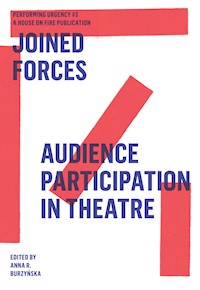
Band 3 der von Florian Malzacher herausgegebenen englischsprachigen Reihe Performing Urgency. Im Kontext heutiger Politik, Wirtschaft und sich permanent verändernden kulturellen Trends kommt das traditionelle Theater mit seiner Trennung von aktiven Darstellern und passiven Zuschauern immer mehr aus der Mode. Zeitgenössische Künstler emanzipieren ihr Publikum, laden es auf die Bühne und in die Performance ein, beleidigen und provozieren es und erproben verschiedenste Techniken der Teilhabe. Das Buch verbindet zahlreiche Beispiele von Publikumsbeteiligung mit Problemen der Partizipation in Demokratie und sozial engagierter Kunst. The nineteenth century was a century of actors. The twentieth century was a century of directors. The twenty-first century is a century of spectators. With Jacques Rancière's The Emancipated Spectator (2009) being the most discussed theatre-related text of the last decade, there is an increase in scholarly and curatorial interest in the most mysterious, potentially dangerous and, in fact, most important participant of the performance, who stays silent, motionless, and hidden in darkness: the audience. And similarly, artists desire to finally 'meet the spectators': to let them speak, get into a dialogue with them, invite them to involve themselves in pursuing the performance.
Das E-Book können Sie in Legimi-Apps oder einer beliebigen App lesen, die das folgende Format unterstützen:
Veröffentlichungsjahr: 2016
Ähnliche




















JOINED FORCES
AUDIENCE PARTICIPATION IN THEATRE
Edited by
Anna R. Burzyńska
JOINED FORCES
AUDIENCE PARTICIPATION IN THEATRE
Performing Urgency #3
Edited by:
Anna R. Burzyńska
Performing Urgency Series Editor:
Florian Malzacher
Graphic Design:
R2
Copy Editing:
Harriet Curtis
Editorial Management:
Laura Lopes
Translations:
John Barrett, Jane Bemont, Leonilda Saraiva dos Anjos (1, 2, 3, 4), Peter Welchman
Publisher:
Alexander Verlag Berlin
Fredericiastraße 8
D-14050 Berlin
Co-publisher:
Live Art Development Agency
The White Building
Unit 7, Queen’s Yard
White Post Lane, London E9 5EN
Photos:
Adelheid|Female Economy (1, 2), Pamela Albarracín, David Baltzer (1, 2, 3, 4), Julia Bauer, Blenda, Kristien Van den Brande, Richard Duyck, Zuzanna Głowacka (1, 2, 3, 4), InCompany, Kamerich & Budwilowitz, Sjoerd Knibbeler,Daniel Koch, Gunnar Lusch, Luca Mattei, Opavivará! (1, 2), Rimini Protokoll (1, 2), TeatroValleOccupato, Benno Tobler, Tea Tupajić (1, 2, 3, 4, 5, 6, 7), Antonio Vuković
ISBN 978-3-89581-449-5
Legal Deposit 417855/16
© 2016 the authors and House on Fire
All rights reserved, including the right of reproduction in whole or in part in any form.
A publication by House on Fire
House on Fire is supported by the Culture Programme of the European Union.
The European Commission support for the production of this publication does not constitute an endorsement of the contents which reflects the views only of the authors, and the Commission cannot be held responsible for any use which may be made of the information contained therein.
House on Fire are:
Archa Theatre (Prague), bit Teatergarasjen (Bergen), brut Wien (Vienna), Frascati Theater (Amsterdam),
hau Hebbel am Ufer (Berlin), Kaaitheater (Brussels), lift (London), Malta Festival Poznań,
Maria Matos Teatro Municipal / egeac (Lisbon) and Théâtre Garonne (Toulouse).
Introduction
LANDSCAPES
Jan Sowa
It’s Political Economy, Stupid! Towards Progressive Modes of Participation
Dominique Nduhura
To Participate or Not to Participate: A Closer Look into Forum Theatre and Freedom of Expression in Africa
Antoine Pickels
Let Me Participate and I’ll Tell You Who I Am
PLACES
Justine Boutens
‘Every art proposition can potentially be experienced as participatory’
Elena Basteri in Conversation with Miriam Tscholl
Citytalk
ANTI-MANIFESTOS
Roger Bernat & Roberto Fratini Serafide
Seeing Oneself Living
Ophelia Patricio Arrabal
Public Moment!
Ana Vujanović
The Emancipated Society
EXPERIENCES
Tobi Müller in conversation with Helgard Haug, Stefan Kaegi and Daniel Wetzel (Rimini Protokoll)
Spectator Reincarnated
Lotte van den Berg
The Unspoken Conversation
Tea Tupajić
Too Real to be Theatre
Tom Sellar in conversation with Adelheid Roosen
The Only Playground Where We Can All Live
Wojtek Ziemilski
Participation, and Some Discontent
Adam Czirak in conversation with Johanna Freiburg and Bastian Trost (Gob Squad)
‘It could have been me!’
House on Fire
Authors
INTRODUCTION
The nineteenth century was a century of actors. The twentieth century was a century of directors. The twenty-first century is a century of spectators. With Jacques Rancière’s The Emancipated Spectator (2009) being the most discussed theatre-related text of the last decade, there is an increase in scholarly and curatorial interest in the most mysterious, potentially dangerous and, in fact, most important participant of the performance, who stays silent, motionless, and hidden in darkness: the audience. And similarly, artists desire to finally ‘meet the spectators’: to let them speak, get into a dialogue with them, invite them to involve themselves in pursuing the performance. To liberate the audience.
There are many different factors that contribute to this unexpected turn. Probably the most important one is the importance of political theatre today: artists engage in contemporary social and political issues, and scholars highlight performative aspects of political life and political aspects of theatre performances. In the world where democracy, activism, and freedom of speech become more and more important (and more and more endangered) values, theatre shouldn’t be a place where one is supposed to remain passive and silent and to accept everything that is said. Just the opposite: theatre has the potential to become a kind of ‘rehearsal space’ for democracy, a place where one’s encouraged not only to observe, but to be critical, active, and responsible for what is happening (like in Bertolt Brecht’s ‘Lehrstücke’ (‘Learning Plays’) and in Augusto Boal’s idea of ‘spect-actors’). Instead of traditional theatre that focused on the idea of passive people whose fate and destiny buzwas decided by the gods (like puppets on strings controlled from above by artists), the contemporary world demands a different model: showing people that fate and destiny is their hands and they can change the plot of their lives (and change the world) in each moment. Just as they can change the shape of performances participating in them.
But there are other important factors as well. One of them is how new media have changed the way information is received – in interactive, selective, and dialogical ways. The gap between ‘old-fashioned’ spectators sitting in front of the radio or television and today’s video game players and internet users is huge – new consumers of information and entertainment literally take matters into their own hands, choosing preferred content, navigating the story in non-linear, network style, commenting, and adding their own content.
There’s also been a significant shift in theory that has put the audience into the spotlight. Performance studies stretched the meaning behind the word ‘performance’ far beyond traditional theatre with stage and audience, incorporating ideas of contemporary anthropology, sociology, and philosophy of language into theatre studies, proving that in our everyday life we are all performers and spectators – at the same time. Also postdramatic theatre – as described by Hans-Thies Lehmann (2006) – very often requires the spectators to become active co-writers of the performance.
For a very long time, one of the most powerful weapons of political theatre (from fin-de-siècle cabaret through Dadaists, Futurists, and Bertolt Brecht to Christoph Schlingensief) was offending the audience (to quote the title of the Peter Handke’s play from 1966). Revolted, left-wing artists tried to provoke conservative middle class audiences in the principle of ‘épater le bourgeois’. Now strategies are different: more and more, artists try to invite members of the audience – especially those who are for some reason (economic, racial, cultural, religious, gender, language, etc.) excluded from society, have no political power and no chance to make their voices heard – to make theatre together. Art becomes much more powerful when performers and spectators join forces. Hence the title of this book.
Joined Forces: Audience Participation in Theatre presents various examples of audience participation in theatre linking them to problems of participation in democracy and to socially engaged art. Making theatre is always a political statement – asking about audience participation practices is asking about the possibilities of making changes both in art and in politics.
The book opens with three introductory texts that serve as the theoretical foundation for the rest of the publication. Jan Sowa reflects upon political modes of participation, analysing how the notions of ‘the public’ and ‘the common’ change in the era of Occupy movement. Dominique Nduhura diagnoses the uneasy and ever changing relationship between forum theatre and politics in the African context, and Antoine Pickels examines the current revival of participatory art forms in Europe as a big opportunity and a big risk at the same time, since making participation ‘fashionable’ leads to destroying the very sense of the idea.
The core part of the book consist of 11 essays and interviews. Artists from different countries were asked to reflect on the idea of participation, to share their experiences and write about their successes and failures, hopes and doubts. While it’s impossible to create a map of participatory art, choosing (nearly) a dozen various representative and remarkable examples can help to outline the situation of contemporary political, audience-engaging theatre as seen by its creators themselves.
The first two texts focus on places: institutions that became meeting points and enabled potential spectators, who had previously been excluded, not only to watch performances but to actively participate in them. Justine Boutens introduces a group of different artists working at the Flemish CAMPO art centre in Ghent, and Miriam Tscholl in conversation with Elena Basteri presents Bürgerbühne in Dresden as a place that enables direct communication between ‘punks, bankers, followers of Judaism and Islam, midwives, undertakers, fans of the Dynamo Dresden football team and men in the midst of a midlife crisis’.
The next part of the book is entitled ‘Anti-manifestos’, as it challenges apparent dichotomies between a mechanism of participation as a promise of emancipation and a traditional mechanism as a guarantee of oppression (Roger Bernat and Roberto Fratini Serafide), individual and collective (Ophélia Patrício Arrabal), political and aesthetic (Ana Vujanović). The authors balance artistic, curatorial, and academic point of views, setting together different theories, notions, and ideas and calling the ‘participatory utopia’ into question.
The final six contributions describe artists’ experiences, including successful and failed attempts to invite the audience to co-create theatre. Tobi Müller interviews Rimini Protokoll members (Helgard Haug, Stefan Kaegi, and Daniel Wetzel) whose idea of replacing professional actors with ‘experts of the everyday’ has become emblematic for contemporary documentary theatre. Lotte van den Berg writes about her long-term project Building Conversation, that examines conversation‘as a joint creation, a collective improvisation, a work of art’. Tea Tupajić recalls her work in Israel and events that inspired the creation of a performative installation The Disco. Adelheid Roosen speaks to Tom Sellar about projects created via her foundation Adelheid|Female Economy that challenge the new ethos of intercultural exchange. Wojtek Ziemilski makes a list of different problems with participation that he has encountered when trying to activate his audience and create a common space for both artists and spectators. Finally, Johanna Freiburg and Bastian Trost from Gob Squad in conversation with Adam Czirak discuss different strategies of involving not only theatre-goers, but also passers-by into their performances.
Of course, the book lacks many important names: from ‘founding fathers’ (and mothers) like Augusto Boal, Guillermo Gómez-Peña, and members of the Living Theatre through Jeremy Deller, inviting huge masses of people to take part in his reenactments of historical events, to diverse young artists such as duo deufert&plischke, experimenting with participative choreography, and Laila Soliman, whose performances are genuine ‘lessons of revolting’ for spectators in Arab countries. Some of these artists already appeared in Not Just a Mirror: Looking for the Political Theatre of Today and Turn, Turtle! Reenacting the Institute, the first and the second part of the publication series Performing Urgency; the list of important politically involved theatre artists around the world, whose work deserves analysis, could go on and on. I hope that the end of this book will be a beginning of another.
Anna R. Burzyńska
LANDSCAPES
Jan Sowa
It’s Political Economy, Stupid! Towards Progressive Modes Of Participation
Crisis, or a moment of judgement
The feeling of crisis and exhaustion of the mainstream politics has become widespread in contemporary societies and as such it cuts across the spectrum of social positions and ideological worldviews. Patterns of socio-political life deeply entrenched in many societies in the postwar period are eroding among a popular conviction that the politicians of various levels – from local to international – elected to represent us and to govern in our interest fail to enact this obligation in their everyday decisions.
Symptoms of this exhaustion take various forms. The most visible one is the career of the so called anti-establishment candidates and parties that successfully challenge well established figures and formations of mainstream politics. It is happening all over the world from the United States to the Philippines, to Austria, to Spain, to Poland. Other symptoms include calls for restitution of monarchy, conservative attempts to save the remains of the past from ubiquitous and accelerating transformations, right-wing populisms successfully conquering the votes of those who fall victim to the status quo yet do not have enough social and cultural capital to opt for a more progressive solution and – last but not least – actions of individuals and groups striving for more participation as a solution to the chronic political crisiswe have found ourselves in. These progressive demands prove that we are also facing an opportunity. The word ‘crisis’ derives from Greek κρίσις, meaning also ‘a turning point’ and ‘a moment of judgement’. Any future turn of events depends ultimately on our ability to properly judge the situation we are in.
Paradoxically enough, the demands for more participative social and political arrangements come from two fundamentally opposing political positions and for this reason they convey a radically different message, even if they use the same words such as ‘citizen’, ‘bottom-up’, ‘civic activity’, ‘autonomy’, ‘initiative’, etc. On the one hand participation is a buzzword for the liberal centre and, in this tradition, it is best articulated by the concept of ‘civil society’ (as explored by such authors as Seymour Martin Lipset in his book Political Man, 1960, or Robert D. Putnam in Making Democracy Work, 1993). On the other, inclusion and participation occupy a central position in the leftwing rhetoric and epitomise a broader project of ‘radical’ or ‘real democracy’. Even if these terms may refer to various practical solutions (for example, see C. Douglas Lummis, Radical Democracy, 1997; David Trend (ed.), Radical Democracy: Identity, Citizenship, and the State, 1996; and Michael Hardt and Antonio Negri, ‘The Fight for “Real Democracy” at the Heart of Occupy Wall Street’, in Foreign Affairs, 2011), its main goal boils down to reinvigoration of ailing democratic institutions by encouraging and enabling people to take part in a more open political process. This complex and in many ways paradoxical theoretical and ideological landscape is mirrored closely in rhizomatic nature of global social and political struggle as it was revealed by the events of 2011 in Middle East, Northern Africa, Europe, and the United States. It was the year that can justly be called ‘the year of the people’ as it was marked by intense and widespread mobilisation against the powers that be and ubiquitous calls for more participation in political decision making. Its synchronization within a space of a dozen months should come as no surprise. We are dealing here with a global cycle of struggles starting with anti-globalisation protest in 1999 in Seattle, developing through opposition to wars in Iraq and Afghanistan, amplified by failures of mainstream political, social, and economic institutions revealed by the financial crisis of 2008, and culminating in the formidable ‘year of dreaming dangerously’ – as Slavoj Žižek in The Year of Dreaming Dangerously (2013) called this period – in 2011.
The link between the movements in the Middle East/North Africa and Europe/United States has been underlined and expressed by activists, such as Anna Curcio and Gigi Roggero, or a multitude of occupiers on Liberty Plaza in New York on many occasions (see Curcio and Roggero: ‘Tunisia is our University – Notes and Reflections from the Liberation Without Borders Tour’, in University in Crisis, 2011; and ‘Protests of 2011 Timeline’, in The Occupied Wall Street Journal, 2011). However, putting various events of the year 2011 in a unified conceptual frame may seem a little bit far-fetched, to put it mildly. We can very well understand why, for example, people in Egypt or Tunisia were fighting for democracy – in other words, for a bigger participation in political life. They were citizens of brutal dictatorships deprived of liberties typical for western democracies, especially of the right to take part in unbiased electoral process. But how is it possible that citizens of democratic states were fighting for democracy? After all, the protests erupted within the European Union and the United States – political formations believed to be democratic and thus allowing for their citizens to participate in political process in various forms: voting, engaging in election campaigns, running for office, petitioning media, taking concerns to court, etc. The democratic Western regimes seem to be built on the idea of political inclusion and participation, so how can one ‘fight for democracy’ there when it does not come to pathologies such as corruption or stolen elections? This widespread political commonsense clearly coincides with the equally common conviction that political systems in the West have become alienated, do not allow for proper participation, and thus should be regarded as un-democratic. In order to make something out of this confusion we need to briefly trace back in time development of Western parliamentary regime. It will also allow us to articulate the difference between the liberal and progressive modes of participation, casting more light on the contemporary social, political, and ideological landscape surrounding the ideas and practices of participation.
Democracy versus parliamentarism, or two modes of participation
Popular convictions and linguistic usus tend to equate parliamentarism with democracy. This confusion goes sometimes as far as identification of parliamentarism with the ‘rule of the people’ as the very term ‘demo-cracy’ conveys. As a matter of fact the latter existed in Ancient Greece and had little to do with contemporary democratic regimes. Not only because the large part of the Greek demos was excluded from any participation in political power – mostly women, slaves, and ‘foreign residents’ or μέτοικοi – but mainly due to a very particular and singular organisation of political life. Ancient Greeks did not vote. They exercised a combination of direct democracy – mass rallies – and administrative rule, however the members of administration were not voted in, they were chosen by lot. For this reason contemporary attempts to put our political institutions in line with Greek inspirations – such as, for example, the idea of ‘demarchy’, put forward by Australian philosopher John Burnheim (cited in Brian Martin, ‘Demarchy: A Democratic Alternative to Electoral Politics’, 1992) – sometimes go under a wholesale label of ‘lottocracy’ (see Alexander Guerro, ‘The Lottocracy’, 2014). Contrary to contemporary notions of what democracy is, the Ancient Greeks did not consider election process to be the best embodiment of the idea of equal participation in power. It looks like they were very aware of the same dangers that devour contemporary parliamentary regimes. They wanted to get rid of demagogy – which literary means ‘a leadership of the mob’ – by which outspoken and cunning individuals exercise power via rhetorical means over uneducated masses, making them act in the interest of the demagogue and thus fatally influencing any electoral process (we do not need to look far to see what they dreaded: Donald Trump). They were aware that rich, intelligent, and good-looking people have a much better chance of succeeding in elections than the poor, uneducated, and ugly – due to, precisely, their wealth (i.e. resources and influence), knowledge (tools to manipulate the masses), and physical appeal (see John Dunn (ed.), Democracy: The Unfinished Journey 508 BC to AD 1993, 1993). What’s more, the election process opens up a career path for the most power hungry individuals and the Ancient Greeks believed, as Jacques Rancière points out in his book On the Shores of Politics (2007), that the most eager to rule should not be allowed to hold power as they are the ones who become tyrants. Choosing the rulers by lot eliminated all these dangers and allowed for construction of a government more representative of people’s opinions and ideas. We can right away grasp what the Greeks meant if we refer to the methodology of contemporary social research (in academia or in opinion polls): the most representative research sample is the one randomly composed.
It would be difficult to find procedural resemblances between the ancient and modern democracies. They are mainly connected by the word ‘democracy’ used to describe both of them and by a general conviction that people should take part in exercising power. Besides this very vague similarity we live in a very different system. Its essence lies not in ‘government of the people’ but in balancing the influence of various social agents – individuals, classes, organisations, status groups, etc. – and as such it stems from the feudal practice of consultation between the king and the nobles that evolved into liberal representative institutions known as national parliaments. The founding document of contemporary democracy did not originate in ancient Greece or Rome but in Northern Europe – it is the Magna Carta from 1215, a testimony of a compromise between the king and aristocratic class.
Exploring the genealogy of parliamentarism goes far beyond the scope of this text. However, one detail needs to be underlined: the mechanism of parliamentary representation through universal suffrage was devised as a compromise between the emerging political subjectivity of the people and elites’ eagerness to keep it under control. It is clearly visible in discussions that led to the establishment of the first fully functioning parliamentary regime – the United States of America. Its founding fathers made a definite distinction between democracy and republic, deliberately distancing themselves from the former and aiming at the latter. Democracy was the rule of the people, republic – rule of their representatives. Alexander Hamilton and James Madison were particularly clear about it (see Hamilton, ‘The Union as a Safeguard Against Domestic Faction and Insurrection’, 1787; Madison, ‘The Same Subject Continued’, 1787, and ‘The Senate Continued’, 1788). As Madison suggests, what characterised the American representative government was ‘the total exclusion of the people, in their collective capa, from any share in the latter [i.e. in the government]’. This is the reason why the US Constitution does not envision a possibility of conducting a federal referendum as it is a form of popular power in its ‘collective capacity’, while on the federal level, power resides solely in the hands of the representatives, thus people do not participate directly in power.
To complete this image we have to ponder for a moment upon the voting process itself. Isn’t it the very mechanism of participation, of expressing our will and of directly shaping the government? We have, after all, also passive voting rights, which means that technically any and each of us can be elected to any position. There are several problems here that help to explain why the demands and ideas of participation are so appealing to critics of Western democracies.
Let’s start with the question of general eligibility to run in elections. This is precisely where we seem to be much dumber than the Ancients: guarantee of equal passive suffrage – right to be elected – for everyone is an empty formal rule never fulfilled in any actual existing society. If we want a genuine and general participation in power as the factual outcome of the political process and not just a formal presupposition devoid of any meaning, electing representatives is not the way to go. It is rather an opportunity for the rich, the good-looking, and the outspoken to obtain unproportioned share in power. Theoretically every citizen can become a president or a prime minister, however the situation is very different in practical terms. Money translates into more impact in the media and more outreach in direct campaigning. Cultural and social capital also matter and it is not an accident that an important part of British political establishment comes from Eaton and many French politicians, regardless of their political convictions, graduated from École nationale d’administration.
There are pertinent sociological and politological theories that grasp this anti-democratic element of parliamentary regimes. Joseph Schumpeter in his book Capitalism, Socialism, and Democracy (2008) coined the term ‘competitive leadership’, suggesting that the election process allows citizens not to rule but to decide which contesting candidate they want to be ruled by. Parliamentary government is not an expression of people’s will or sovereignty, but of their consent. It is a major difference that we understand right away when it is put in these terms: actively willing something is very different from just passively agreeing on something to happen. The latter is very far from participation and it is precisely this feature of parliamentarism that creates a feeling of alienation – the opposite of participation – so widespread among citizens of contemporary democracy.
American political scientist Robert Dahl suggested, in his book Polyarchy: Participation and Opposition (1971), a better name for what we call democracy: a polyarchy. ‘Poly’ stands for ‘many’ and ‘archy’ for loci of power – parliamentarism is a combination of many heterodox forms of power. It has got a democratic component, but also an oligarchic one (for example the influence of money on politics) and aristocratic one (unproportioned influence of social elites). As a result, only a fraction of actual power lies in the hands of popular sovereign. Citizens of a parliamentary state participate in power, but only to a limited degree, as they have to share it with other undemocratic groups and institutions; not what we have in mind when we talk about parliamentarism as ‘sovereignty of the people’.




