


8,99 €
Mehr erfahren.
- Herausgeber: Notting Hill Editions
- Kategorie: Lebensstil
- Sprache: Englisch
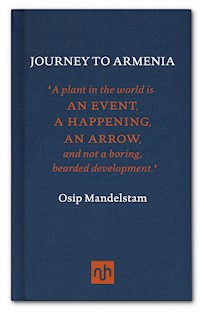
Osip Mandelstam (1891-1938) was a Russian poet and essayist. He visited Armenia in 1930 and was inspired to write an experimental meditation on the country and its ancient culture. Includes the companion piece Conversation About Dante. 'It takes its place among the outstanding masterpieces of twentieth century literature.' - Bruce Chatwin.
Das E-Book können Sie in Legimi-Apps oder einer beliebigen App lesen, die das folgende Format unterstützen:
Veröffentlichungsjahr: 2016
Ähnliche


















Osip Mandelstam visited Armenia in 1930, and during the eight months of his stay he rediscovered his poetic voice and was inspired to write an experimental meditation on the country and its ancient culture. ‘Armenia brought him back to his true self, a self depending on the “inner ear” which could never play a poet false. There was everything congenial to him in this country of red and ochre landscape, ancient churches, and resonant pottery’ (Henry Gifford). Conversation about Dante, Mandelstam’s incomparable apologia for poetic freedom and challenge to the Bolshevik establishment, was dictated by the poet to his wife, Nadezhda Mandelstam, in 1934–5, during the last phase of his itinerant life. It has close ties to the Journey.
Osip Mandelstam was born in Warsaw in 1891 and raised in St Petersburg. He published his first collection of poems, Stone, in 1913, and joined with Akhmatova in the Acmeist movement. Arrested in 1934 for an epigram he had written about Stalin, Mandelstam died in a gulag near Vladivostok in 1938.
Sidney Monas is Professor Emeritus in the Department of History at the University of Texas, Austin. Henry Gifford was Winterstoke Professor of English Literature and Professor of Comparative Literature at Bristol University. Clarence Brown is the author of several works on Osip Mandelstam, is Professor Emeritus of Comparative Literature at Princeton University and editor of The Portable Twentieth-Century Russian Reader.
Osip Mandelstam
—
JOURNEY TO ARMENIA & CONVERSATION ABOUT DANTE
—
‘Mandelstam and the Journey’ by Henry Gifford ‘Journey to Armenia’ translated by Sidney Monas ‘Conversation about Dante’ translated by Clarence Brown and Robert Hughes
Contents
Henry Gifford
– Mandelstam and the Journey–
I
In 1930, at the end of the decade that brought Mandelstam more unhappiness than any other, Bukharin was able to arrange for the poet and his wife to visit Armenia. Ten years before he had seen its neighboring country, Georgia, and written about the enduring appeal for Russian poets of ‘the Georgian myth, first proclaimed by Pushkin’. At that time it had struck him as curious that their ‘promised land’ should not have been Armenia. This he explained by the attraction of the Georgian temper, variously manifested in its art – ‘a kind of melancholy and festive headiness in which is plunged the soul of this people’. Pasternak in 1931 was to be carried away by that headiness and the congeniality of the Georgian poets who became his friends. It was the experience of going to Georgia with Zinaida Neuhaus, afterward his second wife, that he celebrated in a book of poems called Second Birth, and Georgia would remain for him ‘a second homeland’.
In this, as in so much else, Mandelstam and Pasternak were near to one another and very different. The group of Georgian Symbolist poets known as ‘The Blue Horns’, two of whose leaders were to form close personal ties with Pasternak, seemed to Mandelstam naive in the neglect of their own culture. He had been much impressed by the paintings of Niko Pirosmanishvili, the folk artist about whom a sensitive and endearing film, , was made in Soviet Georgia a few years ago. Pirosmanishvili’s ‘powerful art’ with its simple effects is related to ‘the real victory of Georgian art over the orient’ through the work of anonymous painters to be seen in the national museum. Pasternak was inspired by the high culture of Georgian poets fully at home in Russian and Western literature. Mandelstam sought out the abiding traditions of Georgia, an emblem for which he found in the local custom of preserving wine in long narrow which were then buried.
Lesen Sie weiter in der vollständigen Ausgabe!
Lesen Sie weiter in der vollständigen Ausgabe!
Lesen Sie weiter in der vollständigen Ausgabe!
Lesen Sie weiter in der vollständigen Ausgabe!
Lesen Sie weiter in der vollständigen Ausgabe!
Lesen Sie weiter in der vollständigen Ausgabe!
Lesen Sie weiter in der vollständigen Ausgabe!




