


Erhalten Sie Zugang zu diesem und mehr als 300000 Büchern ab EUR 5,99 monatlich.
- Herausgeber: The History Press
- Kategorie: Geisteswissenschaft
- Sprache: Englisch
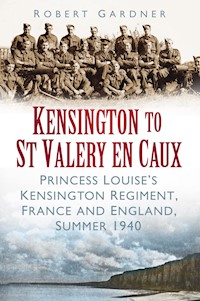
This is a story of summer 1940, of a little known territorial battalion and an almost forgotten British military disaster. In April 1940 the Princess Louise's Kensington Regiment left England to join the British Expeditionary Force in France. It was attached to the 51st (Highland) Division which was moving to the Saar region to defend the Maginot Line. From May until mid-June the Kensingtons were in continuous action, first on the Saar, then on the Somme, and finally in a fighting withdrawal along the channel coast in an attempt to reach Le Havre. Outnumbered four to one the division was cornered at the little seaside town of St Valery en Caux and forced to surrender on 13 June. Three companies of the Kensingtons launched a daring escape through Le Havre to return to England and take part in the invasion defences on the Kent coast.
Sie lesen das E-Book in den Legimi-Apps auf:
Seitenzahl: 394
Veröffentlichungsjahr: 2012
Das E-Book (TTS) können Sie hören im Abo „Legimi Premium” in Legimi-Apps auf:
Ähnliche


















In Memorium
Ted Simmons
ACKNOWLEDGEMENTS
My thanks are due to the following:
Ann Ash, née Simmons, who provided copies of official records relating to her father Ted Simmons. Richard Ashton, who read the manuscript and made valuable suggestions. Peter Gardner, for the account of the death of Charles Frost and for providing photographs of him. Richard Hills, my oldest friend and fellow HAC gunner, for writing the foreword. Mrs Vera Knott, née Simmons, for the account of Ted Simmons arriving at Bournemouth. Professor Philip M’pherson, who read the manuscript and gave advice. Linda Parker, who suggested the book’s title. Brian Simmons, son of Ted Simmons, who provided the photographs of B Company at Reculver in August 1940, and of the sergeants’ mess at Hothfield Place and gave permission for them to be reproduced. John Simmons, for providing background information about his brother Ted. Dr Allan Spence, for contacting Mrs Wood on my behalf, for providing tables of officers and copies of battalion orders, and for providing the photograph of machine-gun training in 1939. The Daily Telegraph, for permission to reproduce the photograph of machine-gun training in 1939. Mrs Marjory Wood, for permission to quote freely from the diary of her late husband Col B.R. Wood OBE, SBStJ., TD, DL and for permission to reproduce the two photographs of Lt Wood (as he then was) and the photograph of five officers of A and D Companies when prisoners of war. My thanks also go to Major R.J. Cannon MC and the Princess Louise’s Kensington Regimental Association for permission to quote extracts from the regimental history The Kensingtons; to The National Archives, Kew, Surrey, for providing copies of war diaries and other documents and giving guidance on their use; to HMSO for guidance on the use of Crown Copyright publications; and to Andrew Bradford for permission to quote from Escape from St Valery. Finally I must thank my wife for her support and much-needed sense of humour.
CONTENTS
Title
Dedication
Acknowledgements
List of Illustrations and Maps
Glossary and Abbreviations
Foreword
Preface
1 Joining the BEF
2 Operations on the Saar
3 Operations on the Somme
4 St Valery en Caux
5 Ark Force Escapes Via Le Havre
6 Defending the Invasion Coast
7 Prisoners of War, Casualties and Conclusions
Appendix I: Tables
Appendix II: Composition of 51st (Highland) Division
Appendix III: Senior Commanders
Bibliography
Plates
Copyright
LIST OF ILLUSTRATIONS AND MAPS
PLATES
1 Charles Frost, at Pirbight soon after enlisting in March 1938.
2 Sgt Thompson instructing in gun drill, 1939.
3 Cpl Ted Simmons, 1939.
4 Lt Reg Wood.
5 No.1 Section, 8 Platoon, B Company Kensingtons. Reculver, August 1940.
6 1st Kensingtons, sergeants’ mess, Hothfield Place, Ashford, September 1940.
7 Sgt Ted Simmons, 1940.
8 Sgt Ted Simmons, 1942.
9 Lt Reg Wood on his wedding day, VJ Day, 1945.
10 Charles Frost WO3 Platoon Commander.
MAPS
1 Saar front, British sector.
2 The Maginot Line.
3 Saar to the Somme.
4 Somme to Le Havre.
5 St Valery en Caux.
6 The invasion coast.
GLOSSARY AND ABBREVIATIONS
AFV
Armoured Fighting Vehicle, e.g. tanks and armoured cars.
Artillery
Wheeled large-calibre guns, in 1940 always towed by gun tractors not self propelled, capable of firing explosive shells long distances. Artillery regiments are either heavy, medium, field or anti-tank regiments.
Battalion
An infantry formation of about 750 men, divided into companies and commanded by a lieutenant colonel.
Battery
A sub-unit of an artillery regiment. There were usually three batteries to a regiment, each having two troops of four guns.
BEF
British Expeditionary Force. The British Army in France. By early October 1939 four British divisions grouped into I and II Corps were moving into forward positions. By May 1940 the BEF had expanded to ten divisions in three corps, a total of 394,000 men.
Bn
Abbreviation for battalion.
Bofors gun
A light, quick-firing anti-aircraft gun of Swedish origin, in service with both the British and German armies. Sometimes used against ground targets.
Bren gun
British light machine gun of Czechoslovakian design. It fired a magazine of thirty standard rifle rounds, though to prevent jamming many preferred to load only twenty-eight. Rate of fire was 500 rounds per minute. Usually fired from the prone position.
Brigade
In 1940 a formation of three infantry battalions or armoured regiments. Commanded by a brigadier.
Carrier
Lightly armoured, open, tracked vehicle in service from 1939. Used in a multiplicity of tasks, carriers had originally been designed to carry a light machine gun with a crew of two in addition to a driver.
CO
Commanding Officer. The senior officer in charge of a battalion or regiment, usually a lieutenant colonel.
Colour Sergeant
Infantry rank, one rank above sergeant. Same as staff sergeant in non-infantry units.
Company
A sub-unit of an infantry battalion, commanded by a major or captain. Usually five to a battalion. A machine-gun battalion had four machine-gun companies of twelve guns each plus a HQ company.
Company Cmdr
The officer in command of a company.
Corps
A formation of two or more divisions commanded by a lieutenant general. In May 1940 there were three corps in the BEF.
Coy
Abbreviation for company.
CQMS
Company Quartermaster Sergeant. Infantry rank, in charge of issue and control of all stores in his company and responsible to the regimental quartermaster sergeant (RQMS). Equivalent to the squadron quartermaster sergeant (SQMS) in armoured and signals regiments or battery quartermaster sergeant (BQMS) in the artillery.
CSM
Company Sergeant Major. One per company, a WO2.
Defensive Fire (DF)
Usually artillery fire laid down on previously identified positions, the co-ordinates of which have been surveyed and recorded to allow instant fire in defence of own troops. Guns not in action, e.g. during periods of rest, are often ‘laid’ loaded on the co-ordinates of a DF target ready to be fired instantly if required.
DR
Despatch Riders. DRs on motorbikes carried out a variety of tasks such as carrying reports and orders from battalion headquarters, escorting convoys and reconnaissance. When the battalion left Ilminster, the column of 183 vehicles included sixty-one motorbikes.
Division
In 1940 an infantry division was a formation of three brigades together with supporting arms, e.g. artillery, signals, medical and supply units, commanded by a major general.
DCM
Distinguished Conduct Medal. Highly prestigious gallantry award for non-commissioned ranks.
DSO
Distinguished Service Order. Award for commissioned ranks showing gallantry or exceptional leadership.
Echelon
B Echelon is most frequently referred to, usually meaning the formation of cooks, storemen and other personnel supporting troops. A Echelon is the transport for replenishment of the battalion’s forward troops during or after action. F Echelon is the immediate fighting equipment of the battalion such as carriers.
FOO
Forward Observation Officer. A Royal Artillery officer, usually a subaltern, who identifies a target and directs fire on to it.
GSO1
General staff officer 1. A senior officer (lieutenant colonel) at Divisional HQ.
HQ
Headquarters.
IBD
Infantry Base Depot.
LAD
Light Aid Detachment. A Royal Electrical and Mechanical Engineers (REME) formation attached to a battalion or regiment to provide assistance to MT such as breakdown repair.
Lee-Enfield
The standard British-issue .303in single-shot bolt-action rifle.
MC
Military Cross. Commissioned ranks’ gallantry award.
MGTC
Machine Gun Training Centre.
MM
Military Medal. Non-commissioned ranks’ gallantry award.
MMG
Medium machine gun (see Vickers).
MO
Medical Officer. A doctor attached to the battalion or regiment from the RAMC.
Mortar
An infantry weapon resembling a drainpipe on a stand, which could lob high-explosive shells called bombs in a high trajectory at low velocity. The 2in mortar could manage a rate of fire of eight bombs per minute over a range of 500 yards. British mortars were generally considered to be outclassed by German versions.
MT
Motor Transport of a battalion.
MTO
Motor Transport Officer. The officer in charge of all aspects of a battalion’s motor transport, such as servicing and repair.
NCO
Non-Commissioned Officer (lance corporal, corporal, sergeant, colour sergeant, staff sergeant).
OC
Officer Commmanding, as in ‘OC B Company’. It does not mean the same as commanding officer, which is the battalion’s most senior officer and commands it.
Pioneers
Soldiers whose main duties are labouring, e.g. digging trenches.
Platoon
An infantry formation of about thirty soldiers commanded by a subaltern. In a machine-gun battalion there were three platoons to a company with four guns in each platoon.
Pn
Abbreviation for platoon.
POW
Prisoner of war.
Provost
Regimental police, frequently used for traffic control.
PSM
Platoon Sergeant Major. A warrant officer class 3 commanding a platoon. Discontinued after 1940.
QM
Quartermaster. An officer, frequently in the rank of captain. Has overall responsibility for all battalion stores. Assisted by the RQMS.
RA
Royal Artillery, nicknamed ‘the gunners’.
RAMC
Royal Army Medical Corps.
RAP
Regimental Aid Post. This would be set up by the battalion medical officer at a secure location behind the front line, but close enough to receive battalion casualties and give treatment.
RAOC
Royal Army Ordnance Corps. Military engineers and fitters concerned with maintenance of explosives, ammunition and firearms.
RASC
Royal Army Service Corps. Supply and transport of most supplies including rations, fuel, ammunition and general stores. Also troops.
RE
Royal Engineers, nicknamed ‘sappers’.
Recce
Reconnaisance.
RNF
Royal Northumberland Fusiliers. A machine-gun regiment similar to the Kensingtons.
RHA
Royal Horse Artillery. An elite regiment of the Royal Artillery.
RQMS
Regimental Quartermaster Sergeant. A warrant officer class 2. In charge of issue and control of a battalion’s or regiment’s stores. Responsible to the quartermaster and senior to the individual company quartermaster sergeants (CQMS).
RSM
Regimental Sergeant Major, a warrant officer class 1. There is only one RSM in every regiment or battalion. It is the highest non-commissioned rank, and the RSM always works in close touch with the commanding officer.
RV
Rendezvous. A pre-arranged location at which troops or vehicles will meet.
Section
In infantry a sub-division of a platoon, being eight men commanded by an NCO. There were three sections to a platoon. In machine-gun battalions there were two guns to a section, which were sometimes divided into two sub-sections of one gun each. In artillery a section is a sub-division of a troop.
Squadron
A sub-unit in armoured, signals and other regiments. Equivalent to a battery (in the artillery) or a company (in the infantry). Commanded by a major.
SSM
Squadron Sergeant Major. A warrant officer class 2. Equivalent to a BSM (artillery) or CSM (infantry).
Staff Sergeant
A rank in non-infantry regiments. One rank above sergeant but below sergeant major. It is the equivalent of an infantry colour sergeant.
Sub-Unit
A general term to describe component parts. A company is a sub-unit of a battalion. A platoon is a sub-unit of a company.
Subaltern
A lieutenant or second lieutenant, often commanding a platoon.
TA
Territorial Army.
Troop
A sub-unit of an artillery battery or an armoured squadron.
Unit
Generic term for groups such as regiment, battalion, squadron, company, battery, troop. They can all be a ‘unit’.
Vickers gun
Medium machine gun, belt fed, water cooled, firing .303in ammunition. Rate of fire 500 rounds per minute, range approx 4,000 yards. Crew of two, gunner and loader, augmented by a third if battalion up to full strength. Entered service in 1912. Still in service in 1960s.
FOREWORD
History is a tale about people that has no beginning and no end. Dates and place names merely put men’s actions and thoughts into a logical structure and sequence. Sadly and too frequently historians kill wonderful tales by drowning them in unnecessary clutter and forgetting that it is only men who make history. In this book Rob Gardner has told a gripping story of one regiment of the British Army and the actions of its men over a few months from their arrival in France in April 1940 to the regiment’s near destruction two months later, followed by its anti-invasion role. This is a difficult story to tell because the reader must be given a considerable amount of information in order to understand what is going on and to keep pace with the unfolding action. Despite this necessity Rob has kept the story alive and intimate by drawing on the diaries, memories and anecdotes of the men who made this history.
My association with Rob goes back to September 1979. While lining up to give a blood sample as part of the induction process into the Honourable Artillery Company (HAC), an ancient City of London territorial regiment, the man behind me lent forward and whispered, ‘make sure they don’t take a pint’. We became firm friends, and over the next few years took it upon ourselves to enjoy the HAC experience as much as we could while trying equally hard to be effective while battling against the sometimes astonishing decisions of our superiors.
Rob’s natural gift for understanding how the army works and how to control this vast machine from the bottom up must spring from his Civil Service background. Taking orders absolutely at face value could cause considerable confusion, as could asking ridiculous questions with a straight face, for example after a lecture on the relief of Ladysmith: ‘Where exactly were the Germans again, sir?’ I can only imagine that in war the ability to laugh at all around you must be the single most important ingredient that allows men to do the impossible and be willing to face overwhelming odds.
The story of the Kensingtons comes to life for me because of the human side of this tale. Not only is this book a scholarly work that any serious historian would be proud of, but it is also living history – real men telling us what they were thinking at the time. It reveals the confusion, the fear and the sadness – that nearly overpowering brew of human emotions that only men fighting for their country’s survival can endure.
Richard Hills
Guernsey
PREFACE
I wrote most of this book during the seventieth anniversary year of the events described in it. One day during the early summer I was astonished to hear a young-sounding woman being interviewed for BBC radio saying that she had never heard of the Battle of Britain. A question about the Dunkirk evacuation could easily elicit the same response, although there will probably be some who will know that Dunkirk was the port from which the army was rescued in 1940, and you may even be told about the part played by the ‘little ships’. Ask about St Valery en Caux, however, and hardly anybody will have heard of it or of what happened there over seventy years ago. From the end of April until 12 June 1940 the 51st (Highland) Division was in almost continuous action many miles away from the rest of the British Expeditionary Force (BEF), first in Lorraine, then on the Somme and finally in Normandy. It was still carrying out a fighting withdrawal along the Normandy coast almost two weeks after the successful conclusion of the Dunkirk evacuation. Sadly there was to be no Dunkirk for the Highland Division. Held back by the need to support the slow-moving French, whose transport was largely horse-drawn and whose infantry were mainly footsloggers, the division lost the opportunity to reach Le Havre and safety. With its back to the Channel at St Valery en Caux, exhausted, heavily outnumbered, short of food and, above all, of ammunition, and with German tanks and artillery commanding the clifftops overlooking the burning town, the division surrendered.
One of the individual units that made up the Highland Division was the 1st Princess Louise’s Kensington Regiment. Two companies of the battalion were present at St Valery; the remaining three reached Le Havre and safety. Of those two companies at St Valery, totalling some 240 men, only a handful escaped. The rest were killed or taken prisoner. This book is my account of six months of war fought by this now little-remembered but typical London Territorial Army battalion, from its arrival in France in April 1940 to the catastrophe of St Valery in June, and the climax of the Battle of Britain in September.
The period covered was originally to have been from April to June 1940. During the writing process, however, I gradually came to the decision to extend it. The book therefore now includes the part played by the Kensingtons in the extraordinary events of July to September 1940, the summer that became our ‘finest hour’. I had initially been disinclined to take this course, feeling that it would somehow detract from the conciseness of the story of how a London Territorial Army regiment was pitched untested into three continuous months of total war. On reflection I felt that the later events of the summer of 1940 were so unprecedented that I should include those months as a postscript to the events in France. I have therefore included a chapter describing the experiences of the remnants of the battalion as they were deployed along the ‘invasion coast’ of east Kent during the critical months of July, August and September 1940.
I was extremely fortunate to be given permission by Mrs Marjory Wood to quote freely from the diary of her late husband, Col Reg Wood, who served as a platoon commander in A Company of the Kensingtons. The diary is particularly detailed and is all the more valuable because of the relative scarcity of material relating to the regiment.
Other important primary source material has been the Kensingtons’ war diary from the National Archives, which contains not only the battalion’s daily diary of events but also an extensive cache of maps, operations orders, reports and messages. Amongst these papers I was lucky to find a four-page typed report on the final hours at St Valery by the officer commanding A Company, Kensingtons, and a report by the second lieutenant commanding two platoons which were cut off behind enemy lines. In addition to the war diary a small amount of other material also came from the National Archives, namely a recommendation for the award of a DCM and a report of an escape from a prisoner-of-war column and their subsequent return to England. The war diary happily survived the evacuation from France unlike some others that fell into enemy hands or were destroyed.
The war diary and Reg Wood’s diary provided a foundation on to which I have applied material from secondary sources such as Eric Linklater’s 1942 publication The Highland Division. This was written immediately after the events it describes and included in its list of consultees are senior officers of the 51st Division, officers such as Brig. Stanley-Clarke, the commander of 154 Brigade and subsequently of Ark Force. Major Ellis’ The War in France and Flanders (HMSO 1953) and Basil Collier’s The Defence of the United Kingdom (HMSO 1957) are two other works that I have found invaluable.
In recent years authors have enjoyed the huge benefit of access to material that was previously classified and therefore unavailable. Now this material can often be accessed via the internet without the author needing to travel at all; indeed in my own case photocopies of the war diaries were most efficiently made and despatched to me by the staff of the Record Copying Department of the National Archives. I have also been helped by a number of recent publications (all are listed in the Bibliography); the most extensive and detailed of these is, in my opinion, Saul David’s definitive work Churchill’s Sacrifice of the Highland Division. Published by Brassey’s in 1994, it took three years to research and write. David was meticulous in tracing and interviewing more than 100 survivors of the campaign.
I must also mention The Kensingtons, an account of the first and second battalions during the Second World War, published in 1952 by the Regimental Old Comrades’ Association as a tribute to those who died while serving with the regiment.
What I have written is not an attempt to produce another detailed account of the campaign fought by the Highland Division in 1940. My intention was simply to present as detailed a record as possible of the part played in the war from April to September 1940 by the 1st Battalion Princess Louise’s Kensington Regiment. To do this I have had to balance the relatively scarce amount of available material relating to the Kensingtons against the considerable volume of material relating to the division and to other units in it. Some of the latter was obviously essential to the reader’s understanding of the Kensingtons’ part in the campaign, but if too much had been included the main subject matter would have been swamped. It was a question of balance, and deciding what had to be excluded presented a continuous challenge. In the end I included virtually everything that related specifically to the Kensingtons and excluded anything else that I thought was not essential to an understanding of the progress of the campaign. Much that I would have liked to include about other units, such as the exploits of the fighting patrols in the Saar and the gallant work of the Lothians and Border Yeomanry, has therefore regrettably been left out. The result, I hope, is a balanced book in which the story of the Kensington Regiment in the battle for France remains the prime subject.
I have explained how, in writing the book, I have grafted material from other sources on to the framework created by the war diaries; much of this material is in the form of direct quotations. The danger in this approach, as will be appreciated, is that the author can easily be regarded as simply a compiler and editor. Nevertheless, I hope that writing in this way presents a clearer picture to the reader together with a sense of actually being present at the time, which can result from the use of contemporary material. Above all I hope that I have been able to add to the account rather than detracting from it. All such sources have been cited and referenced and please note that all original spellings have been retained in the direct quotations.
Finally, some personal comments. I have been inspired in the writing of this account by my admiration and affection for my late uncle Edward Simmons, who served in the Kensingtons and escaped from St Valery, and for his young TA colleagues such as Charles Frost (my aunt’s brother) who served with him over seventy years ago. As a result of the 1940 campaign alone, many of them spent five long years as prisoners of war and eight, including Charles Frost, were killed in action. Others died of wounds or died in captivity.
Like Ted Simmons, I joined a London Territorial Army unit when a young man. That is now over thirty years ago and yet those years seem to have passed in a moment. In my experience it was not usual for people to discuss what motivated them to join the TA. Nobody ever suggested to me that it was out of a sense of patriotic duty and yet in reality that was probably the most common reason. In 1980 the Cold War with the USSR was still continuing and the country lived under the shadow of the ‘four-minute warning’, the length of time from the sounding of the warning sirens to the arrival of the first ballistic nuclear missile. In 1937 the perceived threat was similar but Armageddon was expected to be delivered from a sky black with German bombers. I had just returned from three years abroad in a country where young men were conscripted for twelve months and it had prompted a desire in me to follow the example of my father, two grandfathers and two uncles and make my own, albeit inadequate, contribution. I am relieved to see that the British Army does not appear to have suffered any lasting damage as a result.
Ted Simmons transferred to the Royal West African Frontier Force in November 1940, joining his new regiment in West Africa and later serving with the West African forces during the bitter fighting of the South-East Asia campaign. After the war he chose not to accept a commission and to remain in the regular army, and was transferred to the Army Reserve. His military conduct was assessed as exemplary and his testimonial reads as follows:
C/Sgt Simmons, who began his military career as a territorial in 1937, has served continuously since august 1939. He embarked for overseas service in November 1940 and served in W. Africa and the S.E. Asia campaign until his return home in May 1945. His commanders in the field have reported very favourably on his services and, since joining this unit, his work has been first class.
He has performed a very difficult administrative job in a very creditable manner and has proved beyond doubt that he is in every way efficient, honest and thoroughly trustworthy. I am pleased to recommend him as a man of pleasant personality who will certainly prove an asset to any employer.
He was a member of D Company and was present when Charles Frost was killed on the night that B Company relieved D in the Bois de Busch on the Saar. He also escaped from St Valery and the best guess is that he was among the group from D Company who escaped from Veules les Roses in a rowing boat with CSM Satchwell. That is all there is to tell and my inevitable regret is that this book was not written twenty years ago before the memories of so many personal experiences were lost forever. Ted Simmons died on 23 September 1992 at the unfairly early age of seventy-two. Patriot, exemplary soldier and good friend, he served his country in the dark days of 1940, later in the swamps and jungles of West Africa, and finally in the bitter fighting in the Arrakan, Burma, against a ruthless enemy.
It is to his memory that this book is dedicated.
Robert Gardner
Isle of Ely
1
JOINING THE BEF
The history of the Kensington Regiment – Kensingtons converted to a machine-gun battalion – Declaration of war and mobilisation of the Territorial Army – Illminster, Somerset – Kensingtons move to France and are attached to the 51st (Highland) Division – Strengthening the 51st (Highland) Division – A brief assessment of the BEF’s equipment – Move to the Saar region and positions forward of the Maginot Line – Topography of the Saar region and tactics for troops deployed.
THE HISTORY OF THE KENSINGTON REGIMENT
Princess Louise’s Kensington Regiment, known in two world wars simply as ‘The Kensingtons’, was originally a volunteer infantry battalion. In 1908, as a result of the well-known army reforms of Richard Haldane, Secretary of State for War in the Liberal government, the Territorial Force was formed. All yeomanry and volunteers became part of the new TF, which in 1921 became the Territorial Army (TA). The Kensingtons had become closely associated with Queen Victoria’s sixth child, Princess Louise, who lived in Kensington Palace, and in 1914 had adopted the title ‘13th Princess Louise’s Kensington Battalion, The London Regiment’, which later became ‘Princess Louise’s Kensington Regiment’.
KENSINGTONS CONVERTED TO A MACHINE-GUN BATTALION
Like all territorial units, the Kensington Regiment was formed of paid part-time volunteer soldiers whose basic military commitment was to attend a minimum of twenty evening drill nights each year and a fortnight’s annual camp. For this the soldier received, in addition to pay for drill nights, an annual ‘bounty’, which in 1938 was £5. The Kensingtons were at this time a rifle battalion, but in 1938 it was announced that they were to be converted from a standard infantry unit to a fully mechanised machine-gun battalion. This is therefore an obvious point at which to examine both the organisation and function of machine-gun battalions in 1938. A battalion was organised into five companies: a headquarters (HQ) company and four machine-gun companies. The latter were each equipped with twelve Vickers medium machine guns. Each machine-gun company was divided into three platoons of four guns each, with each platoon sub-divided into two sections of two guns each. In addition to the forty-eight Vickers guns the battalion had eighteen Bren light machine guns and, as personal weapons, 175 pistols and 559 rifles. The full complement was about 740.1 The function of a machine-gun battalion was to provide firepower in support of other units, either offensively or defensively. In practice this meant that the Kensingtons hardly ever fought together as a single unit of four machine-gun companies, if at all. Sub-units, usually at company strength, would be deployed as required by the division or brigade. They in turn would deploy their three platoons to the unit or units being supported, and the platoons would very likely provide that support by sections or even sub-sections of guns in different locations determined by the circumstances. It will be seen that these tactics meant that at times units of the Kensingtons could be very widely spread, and companies and platoons could be under pressure to change locations quickly to meet new threats at times when the enemy was attacking in strength. Eric Linklater wrote:
Both on the Saar front and later … the two machine-gun battalions, Northumberland Fusiliers and Kensingtons, were for tactical purposes divided among the brigades, and because they did not fight as a whole it is difficult to assess or describe their work. But wherever the infantry were in action there were machine gunners to support them, and perhaps it is sufficient to say that the battalions which had Kensingtons attached to them speak well of the Kensingtons, while those which were assisted by the Northumberland Fusiliers were convinced that they had the better support. The conclusion is that both were good.2
By February 1939 tension was rising. German troops entered Prague on 15 March 1939, and the dreadful prospect of a second European war in twenty-one years seemed to creep closer. On 29 March the Secretary of State for War announced that the strength of the TA was to be doubled and that each TA battalion or regiment was to raise a ‘duplicate’. Soon after this conscription was introduced, but any man who joined the TA was exempted. For the Kensingtons this meant the creation of a second battalion. It may perhaps emphasise the seriousness of the situation if it is looked at in the context of the following extract from Collier:
The British Government responded by joining the French in guarantees to Poland; taking measures to bring the twelve divisions of the Territorial Army up to strength and then double them; introducing conscription; and setting up a Ministry of Supply to find the weapons needed by a rapidly expanding army … Thereafter the home defences passed gradually from their peacetime state to one of readiness for war … Anti-aircraft formations of the Territorial Army were called out in four contingents for one month at a time and guns were moved to pepared positions in a belt twenty-five miles deep extending from Newcastle to Plymouth.3
Princess Louise’s Kensington Regiment was undoubtedly a prestigious territorial battalion. Yet it was more than just a matter of normal regimental pride. Her Royal Highness Princess Louise herself, daughter of Queen Victoria, regarded the Kensingtons as her own regiment. She had presided over the ladies who worked the new colours presented to the regiment by King Edward VII in 1909. In 1913 she consented to the use of her name in the regiment’s new title, and in 1928 to the use of her personal cipher as a design for a new collar badge. On returning from camp in 1936 the Kensingtons marched from Victoria station to Kensington Palace where Princess Louise inspected them, and on Armistice Day she laid a wreath at the drill hall and took the salute as the troops marched past the Cenotaph and the Kensington War Memorial. There was also a civic connection. The regimental cap badge depicted the arms of the Royal Borough of Kensington and the regiment played a full part in civic ceremonial, carrying out such duties as route lining, providing guards of honour and parading at the civic Sunday service. Sporting events included the Brigade Boxing Championship, which the Kensingtons won for the eighth time in 1937. The cadet corps of Latymer School was affiliated to the regiment. There was also a large and active Old Comrades Association, and in 1936 many of its members enrolled in the newly formed Kensington Defence Company, a predecessor of the Home Guard. Its function in wartime was to take over guard duties and similar work that would free up troops. Although not of ancient origin, the Kensingtons had a respectable lineage reaching back to the mid-nineteenth century, and a highly respectable war record from 1914–18 during which 1,205 Kensingtons were killed and thirty battle honours were awarded, including ‘Somme 1916’. As the second war loomed they could be, and were, proud of their new role as a machine-gun battalion. Not one single facet of the battalion’s life but the fusion of them all made the Kensingtons one of the country’s finest territorial units. At the end of the war an inspecting officer was to write: ‘there may be territorial regiments as good as this but there can be none better than the Kensingtons with their admirable history and high tradition.’4
DECLARATION OF WAR AND MOBILISATION OF THE TERRITORIAL ARMY
The TA soldiers resumed their civilian lives after the annual camp of 1939, but it would be just a fortnight before they were back in uniform and this time it would be for six years. Many of these young men became prisoners of war in 1940. Many others paid the ultimate price and would never return to their homes and families. TA anti-aircraft regiments were mobilised on 21 August as the relentless and seemingly inexorable drift to war continued. Finally Germany invaded Poland on Friday 1 September 1939 and at 3 p.m. that day mobilisation of the 206,000-strong TA commenced. Many were contacted at their homes by the military police with orders to report to their drill halls. Ted Simmons was woken at home in Chiswick at 2 a.m. by military police5 and some soldiers were on duty before the end of August. On Sunday 3 September Britain declared war on Germany.
The Kensingtons’ immediate role was to provide military support to the civil authorities, with each company attached to a police station. On duty at all times were a liaison officer and a despatch rider who would relay to company HQ any police request for military assistance in instances such as looting and rioting during air raids. This arrangement continued until late October, by which time there had been neither air raids nor rioting and the Kensingtons were placed on duties that involved guarding ‘Vulnerable Points’.6 The routine of those early days of the war was captured in his diary by Lt Reg Wood of A Company:
Sept 2nd. Advance Battn H.Qs at Hammersmith Police Station. Breakfast arrived supplied by Messrs Chance of Acton until we went onto R.A.S.C. rations. Food poor. Sgt Froblich made A/CSM. Relieved Mike at police station, met Inspector Fraser, D/Supt May, Det Sgts Cade, Green and Burns. ‘Officers Mess’ in room in basement. Detectives search foreigners and take down their particulars. In case of looting or rioting during air raids L.O’s job at police station was to send back to Coy HQs for troops. Lunch at Crown Hotel opposite; Mrs Neil proprietor. Hammond relieved me at 15.00hrs. P.S.I. Sgt Parnell (Middlesex Regt) arrived attached to Coy. Big thunderstorm in evening. Scheme evolved of 1 P.C. on duty, 1 in reserve, 1 free – latter to go out in near area but to return at once on air raid warning.
Sept 3rd. Arms drill taken by Sgt Parnell in garden behind house. Announcement of Declaration of War on wireless at 11o/c. Air raid warning at 12.00hrs, six men of Coy without respirators. Mustard gas detectors fixed to sentries’ bayonets. Lunch at Crown. Tom off to town to get black-out paint for windows. Went home in afternoon, put steel helmet, carried on shoulder, through bus window. Returned at 20.00hrs to sleep at police station. Air raid warning 03.00hrs, went into street.
Sept 4th. Relieved by Ham at 07.00hrs. David managed to obtain Cam House, Camden Hill Road (late millionaire’s house) as a billet. Large lawn, Italian garden, garage, paved court yard. Moved in 11.00hrs. Large ballroom on first floor as our bedroom, camp beds etc set up. In future 1 P.C. and officer concerned to be off duty from 17.00hrs to 22.00hrs. Arms drill in morning, and PT. in afternoon. M.G. instruction in garden. At 18.00hrs guard mounted. 2 trucks per Coy, 1 to collect rations from Chances at Acton and for any other purposes, the other for driving instruction. David’s car also taken over. Canteen opened, Truman’s beer obtained by Mike, chocolates and cigarettes by Q.M.S. Minski from Harrods. Eardley left Coy to become O/C B Coy and Harley sent to M.G.T.C. Alderley.
Sept 5th. Early morning PT started at 06.15hrs. Cooker obtained from Gas, Light & Coke Co. Stones and Pyne sent to Depot. Sammy Lohan (T.A.R.O.) I.O.
Sept 6th. Air raid alarm 06.00hrs. David in bath – Coy, except sentries, go to basements. All clear 2 hrs later.
Sept 7th. Hammond to Netheravon with Wasey, Walker and Kent. J. Evans replaces him in our Coy. Ray Milton (transport Sgt) commissioned. Chimay on S.O. course. Beginning staff course Camberley. NCOs courses at L.D.S.I. Moor Park and Richmond. Parnell appointed C.S.M. A Coy. Few NCOs sent as instructors to depot and 2nd Middlesex at Gosport. ORs as batmen to GHQ France.
Sept 9th. David breaks ankle playing rugger – stays at Cam House. Duties at police station revised, only D.R. at police station during day but officer at night. M.G. training in full swing – route marches round Kensington. Lectures by Howard 2I/C ‘Unexpected Always Happens in War’ and ‘The Regiment’ etc.
Oct 21st. Leaving Kensington for V.P. (Vulnerable Point) duties at Stanmore aerodrome. Acting 2I/C took estate agent round Cam House – Damages £185. Gas, Light & Coke Co claimed we had bought cooker for £115, we said we hired it. Left in first coach for Stanmore to take over from E Coy 2nd Kensingtons. Arrived Stanmore 11.00hrs took over from Capt Belol. No sentry duties etc laid down, all very inefficient, Troops billets good – officers mess excellent, also bedrooms, central heating, H & C, telephone. O.I/C Station Wing Commander Bold (late Indian Army) referred to all youngsters in balloon barrage as useless wingless wonders, amongst them C. Gadney, rugger referee. Coy arrived at 14.00hrs. Took David round. Troops’ duties fairly severe 48 hrs on, 12 hrs off, guarding Camp and Manor House (Air Ministry), Cipher station, also roving sentries at night. Officers duties practically nil but orderly officer had to go round posts at night, David, Ham and I shared this duty which meant that we were on duty all day and night one in three, otherwise we were free after lunch on the other two days. I used to go home some days which meant four changes of train or go up west with the other off duty. When O.O. I used to stay in mess playing cards, darts etc or listen to wireless to 00.15hrs then go round posts taking about half an hour, back to bed, then round again at 06.00hrs. After breakfast in the morning we attended Coy office, then did M.G. tactics by ourselves, then PT. No opportunity to give troops M.G. training as they were on guard always, and all kit given to D Coy who were running NCOs courses at Chiswick under Capt Garston, Middx. Very inefficient but Howard thought wonderful. On Tuesdays and Fridays dances were held which were very well attended. On Wednesday night an E.N.S.A. show. Troops food excellent, three hot meals a day. Our mess also excellent.
Oct 23rd. Orderly Officer. E.N.S.A. show. Renee Hunter came over to Sgts mess afterwards. Squadron Leader in plain clothes tried to get into Manor House. Nearly shot by guard. Told him not to try to be clever with us.
Oct 26th. Went to dinner at Berkeley with David, Eardley and Muriel and then on to Cabaret club.
Oct 30th. E.N.S.A. show. Jack Buchanan.
Oct 31st. Refereed boxing contests at R.A.F. vs ourselves. Howard, Laurie and Bryar came over to watch.
Nov 3rd. Mike returned from L.D.S.I. course and Ham went in his place.
Nov 5th. Went over to Depot at Mill Hill and met Howard’s and my old Pl Sgt who is now instructor there and Jimmy Nevin, England rugger international, also Howard Pyne and Dennis Stones.
Nov 6th. Went with Mike to first night of George Black’s show ‘Black Velvet’ at Hippodrome. Danced with Rosa Beaumont. Had dinner at Regents Palace afterwards and met two girls.
Nov 7th. Told on telephone that Security police wished to know what information I had given girl the previous evening – None. Turned out later to be Sammy Lohan who knew girl well.
Nov 9th. Went to Windmill theatre with David. Dinner at Piccadilly.
Nov 11th. David & I went to St Mary Abbots church for Armistice Day service and had lunch at Battn HQ.
Nov 13/15th. 48 hrs leave. Went to Trocadero.
ILLMINSTER, SOMERSET
On 17 November Lt Col Hancocks relinquished command of the battalion and Lt Col Howard took over. On the same day it was announced that the Kensingtons were to move to Ilminster, Somerset, joining 44th (Home Counties) Division. Other ranks younger than 20 years old and those earmarked for officer training were posted to the 2nd Battalion. It could be inferred from this that overseas service was imminent. Reg Wood described in his diary the battalion’s journey to Somerset and the settling-in period:
Nov 19th. Parade 06.15hrs. Group Captain Bold said how sorry they all were we were going etc etc. March to Stanmore station. Arrived at Mill Hill station and joined up with B and C Coys. Scots Guards dug out Captain smoking cigar in turban and teddy bear coat, R.T.O. Got on train next stop Addison Road to be joined by D Coy, HQ Coy, and Battn HQs. Large crowd on platform. Col Campbell, Lt Col and Mrs Hancocks, Col Sir D. Banks, Mayor of Kensington etc. Hands shaken all round. Train drew out at 10.00hrs for Ilminster. David, Mike, Charles, Eardley, John Smith and myself in one carriage. Good luncheon baskets. Played Vingt et un. Arrived Taunton at 15.00hrs, tea. Ilminster 16.00hrs. Troops marched from station to large shirt factory in main square, taken over as billet, and given hot meal. D Coy officers and Sgts had arrived week earlier to do the billeting. C and D Coys with Battn HQs and HQ Coy to be billeted in Ilminster in old factories, schools, etc. Officers in George hotel, Howard, Hoare and Chimay in Shrubbery Hotel. Cookhouse in old blacksmiths forge in main square. Sgts mess in old hall. R.A.P. in disused house, hospital in old chapel staffed by V.A.D. nurses. Battn HQ in empty house. After meal A and B Coy officers and men left in coaches for South Petherton, village about 8 miles away just off Ilminster–Yeovil road. Troops then billeted in village halls, skittle alleys etc. A Coy had 4 Pl in hall of Crown hotel, 5 Pl in hall and skittle alley of Wheatsheaf and 6 Pl in old school. Troops had to sleep on palliases only. Mike and I billeted in Crown hotel in main square of village, Proprietors Mr & Mrs Wood. Fairly comfortable and improved as we stayed on. Cookhouse and messing hall in large empty garage. Coy offices in second floor of empty house. QM and MG stores with guard room on ground floor.
Nov 20th et seq. Efforts were made to make men more comfortable by hiring gas heaters and putting in electric light etc. Lectures were arranged to take place in dance hall of George hotel, Ilminster every evening except Friday at 17.15hrs given by Tregonning and Chimay on what they had learnt, obviously very little. Officers from South Petherton went over in a truck and we were generally late, incurring Howard’s displeasure. Chimay had had colossal row with Proprietors of George hotel over the taking over of the hall and Howard had ordered all the officers to leave there and go to the Shrubbery or find other billets. The bar was also put out of bounds to all ranks. During the week drafts arrived of conscripts, reservists and regulars from K.R.R. depot, Y & L, E Yorks, Beds & Herts etc. All the reservists were ex machine gunners. Whilst our trained Sgts took the men on gun drill, classes in fire orders etc were arranged for the NCOs. Mike, Ham, Laurie and myself took these classes at South Petherton in requisitioned rooms of Coy HQ billets etc, and although we had all been on courses it meant a good deal of swotting so we had little time in the evenings for ourselves. In afternoon, route marches, respirators drill, PT, guard mounting with regimental band on alternate days at Ilminster and South Petherton took place in the respective squares. Rather a farce at South Petherton with buses and sheep always getting in the way. This was later stopped by the Major Gen. The Toc H in the village opened a canteen and the locals all invited our troops and also gave them baths as no public baths were available. Dances were held every Saturday night in local hall and at Ilminster Sgts mess held a dance in George hotel dance room for full Corporals and above but of course bar could not be used. Every Wednesday night an ancient film was shown in the local hall at South Petherton but Ilminster had one flea-pit of a cinema.
Training was started:
Dec 9th. All Coy Cdrs went off with C.O. to Batcombe Down to carry out recce for Divisional digging exercise the next week. Our Coy was to be in position on Monday morning, dig M.G. emplacements etc, stay in position the whole night and be relieved the following night at 20.00hrs by B Coy and so on. Meanwhile Mike, Peter and myself went into Yeovil to the cinema, had dinner at the Mermaid and then went on to Montacute.
Dec 10th. Although a Sunday, David wanted to do recce with Pl Cdrs for scheme on Monday – rather annoyed as wanted to go to Montacute. Mike was O.O. and acting 2 I/C of Coy so I took David and Ham in car. No 5 Pl was in reserve and would not be digging. On arrival at Batcombe Down decided on platoon positions. One of my sections was to be in hedge just off main road, the other about 100 yards away in hedge in field, Pl HQs between the two at a track. Went down steep hill, brakes none too good, hair pin bend to place selected for Coy HQs. On way back puncture outside Crewkerne. David and Ham changed wheel. On return arranged details with Pl Sgt.
Dec 11th.




