


Erhalten Sie Zugang zu diesem und mehr als 300000 Büchern ab EUR 5,99 monatlich.
- Herausgeber: The History Press
- Kategorie: Sachliteratur, Reportagen, Biografien
- Sprache: Englisch
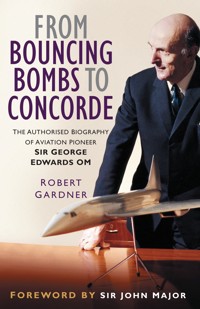
'We all owe a great deal to George Edwards, though few people will know how much until they read this biography' - Sir John Major He was the designer of Britain's first V-bomber, the leader of the British Concorde team, and the man who made the bouncing bomb bounce. Yet George Edwards's name is all but forgotten today. The son of a widowed tobacconist from the East End of London, Edwards started his career in aviation in 1935, when he became a junior draughtsman in Vickers Aviation's Surrey factory for the princely sum of 5 guineas a week. Within ten years he was their chief designer; within thirty-five he was the managing director of British Aircraft Corporation. Written using thirty hours of exclusive interviews with Edwards himself, From Bouncing Bombs to Concorde is an illuminating look at a man who helped shape post-war Britain's aviation industry.
Sie lesen das E-Book in den Legimi-Apps auf:
Seitenzahl: 677
Veröffentlichungsjahr: 2006
Das E-Book (TTS) können Sie hören im Abo „Legimi Premium” in Legimi-Apps auf:
Ähnliche


















FROM BOUNCING BOMBS TO CONCORDE
To my wife Charlotte, and in memory of my old friend the aviation journalist Arthur Reed
FROM BOUNCING BOMBS TO CONCORDE
THE AUTHORISED BIOGRAPHY OF AVIATION PIONEER
Sir George Edwards OM
ROBERT GARDNER
First published in 2006
The History Press The Mill, Brimscombe Port Stroud, Gloucestershire, Gl5 2QGwww.thehistorypress.co.uk
This ebook edition first published in 2013
All rights reserved © Robert Gardner, 2006, 2013
The right of Robert Gardner to be identified as the Author of this work has been asserted in accordance with the Copyrights, Designs and Patents Act 1988.
This ebook is copyright material and must not be copied, reproduced, transferred, distributed, leased, licensed or publicly performed or used in any way except as specifically permitted in writing by the publishers, as allowed under the terms and conditions under which it was purchased or as strictly permitted by applicable copyright law. Any unauthorised distribution or use of this text may be a direct infringement of the author’s and publisher’s rights, and those responsible may be liable in law accordingly.
EPUB ISBN 978 0 7524 9603 0
Original typesetting by The History Press
Contents
Foreword
Acknowledgements
Author’s Note
1
In the Beginning
2
A Job at Vickers
3
Preparing for War
4
‘Down with ’Itler’
5
Working for Beaverbrook
6
Bouncing Bombs
7
Mission to Germany
8
Chief Designer
9
‘The Heat and Burden of the Viscount’
10
‘Falling in Love with the Viscount’
11
Britain’s First V-bomber
12
Managing Director
13
Ethel Merman, Bob Six, but Mostly Howard Hughes
14
‘The Biggest Blunder of All’
15
Accolades, Worries and the Vanguard
16
The VC10 – ‘A Sorry Story’
17
Rationalisation
18
TSR.2 and a New Partner
19
British Aircraft Corporation
20
TSR.2 – the Beginning of the End
21
TSR.2 – the End
22
Life After Death, but Only Just
23
Concorde – the Beginnings
24
‘She Flies’
25
Trouble with the French
26
Guided Weapons and Defence Contracts
27
His Last Aircraft
28
Enter the Wide-Bodies
29
Changes at the Top
30
‘Merger-itis’ and Nationalisation
31
Into Retirement
32
Pastimes, Painting and ‘Cricket, Lovely Cricket’
33
The University of Surrey and a Personal Crusade
34
‘A Man of Absolute Rectitude’
35
Last Overs
Envoi
Appendix One: Abbreviations
Appendix Two: Chronology
Bibliography
Foreword
by The Rt Hon. Sir John Major, KG CH
Very few people rise from the very bottom to the very top, build up achievements as they go, and leave a beneficial legacy behind them. One such is George Edwards. George Edwards was a rounded man, a man with a hinterland far wider than his genius for engineering. From his boyhood he had a love of cricket and used his knowledge of the game to help Barnes Wallis make the ‘bouncing bomb’ bounce in the Second World War. The dams of the Ruhr were destroyed by leg spin. George loved painting, a passion that came to him late in life, and was sufficiently good at it to have a canvas accepted for the Summer Exhibition at the Royal Academy at the age of 92. It was an achievement that gave him great satisfaction. We all owe a great deal to George Edwards, though few people will know how much until they read this biography. His life merged with history at key moments in war and peace, and his genius for innovation shaped events in the Second World War and in the general history of aviation. In wartime, apart from helping to destroy the great German dams, he designed an innovative system to detonate enemy magnetic mines to protect our shipping lanes, modified aircraft for special assignments, and was a member of the team that uncovered vital aeronautical information from Germany at the war’s end. In peacetime, in his work for Vickers, he led the programme on the TSR.2 supersonic strike aircraft and the BAC One-Eleven jet-liner. He had earlier headed the design teams responsible for the Viking and Viscount airliners and the Valiant, Britain’s first V-bomber. Later he was instrumental in the development of the most famous airliner of all: the Anglo-French Concorde. I first met Sir George Edwards, OM, designer, inventor and former chairman of BAC, at The Oval. An elderly, modest, undemonstrative man, a flat cap perched on his head, his vowels less precise than his remarkable mind, he sat quietly while watching the cricket. Beside him were two fellow spectators talking of their respective fathers’ significant contributions to the Second World War. If only they had known . . . This biography will enable many more to know that George Edwards is part of our nation’s history; and it is time his story was told.
Acknowledgements
There are many people I wish to thank for their assistance in the preparation of this biography, not least of whom is Sir George Edwards himself, who patiently spent some 30hr with me, describing his life and career. To the Edwards family, especially his daughter, Angela ‘Dingle’ Jeffreys, who encouraged, supported and managed the project before and after the death of Sir George in 2003; Richard and Clair, his grandchildren; Clair’s husband, Gary; his relatives Grant Edwards, who researched his early years, and ‘Uncle George’ Thurgood, his brother-in law, I extend my heartfelt thanks for their co-operation and generous help.
I am indebted to many colleagues from my old company, the British Aircraft Corporation (BAC) and British Aerospace: Dr Norman Barfield, who was closely associated with Sir George for over fifty years, provided and researched much essential information, as well as proofreading the entire work; John Motum, whose considerable background knowledge and guidance were both illuminating and encouraging; Don McClen, who gave his expert advice on the chapter on Saudi Arabia; Brian Cookson, formerly the company legal director, who cast his eagle eye over the BAC chapters; and Bob Gladwell, who worked for the company in America for many years, and recalled the heady days when Vickers and BAC airliners filled the US skies. Special thanks must also go to Roger Steel, once the company personnel manager and personal art tutor to Sir George, and Mrs Joyce Brixey, his secretary for fifty years.
The recollections of two famous test pilots, G.R. ‘Jock’ Bryce of Vickers-Armstrongs and BAC, and Capt Eric ‘Winkle’ Brown of the Royal Aircraft Establishment, have given me much invaluable and enlightening information.
Others from the company or associated with it have also provided me with technical assistance and other help, notably Ron Hedges, keeper of the BAC heritage; film-maker Paul Drew of Communicator Ltd; Peter Gibbon of MGA Ltd; and Barbara Ferguson, formerly of BAC. From the book world I received most helpful guidance from Neil Clayton, Nick Cook and Stephen Chalk. I am extremely grateful to them all.
This biography has been greatly enhanced by several distinguished people who were good enough to give me their time for interviews, and who have provided testimony about George Edwards. I would like to thank sincerely the Rt Hon. Sir John Major, who has written the foreword for the book; Sir Richard ‘Dick’ Evans, who later succeeded Sir George as chairman of the company, and who contributed the concluding chapter; and the Rt Hon. Tony Benn, who not only gave me the most entertaining interview, but was good enough to research every reference to Sir George from his diaries.
Others were able to recall Sir George’s life outside the aircraft industry. From the cricket world, Sir Alec and Eric Bedser took part in the most amusing three-way conversation with Sir George for my benefit. Bernie Coleman, Derek Newton and Raman Subba Row, from the Surrey County Cricket Club, not only remembered the days when Sir George was president, but their conviviality was much appreciated. To Prof Patrick Dowling, until recently Vice-Chancellor of the University of Surrey, and Duncan Simpson, formerly Hawker’s chief test pilot and neighbour, who served St Martha’s on the Hill, as did Sir George, I offer my grateful thanks.
Lastly, this book could not have been written without the help of Sir George’s oldest colleague and friend, the late Norman ‘Spud’ Boorer, whose astonishing memory and vivid description of George Edwards from the earliest days at Vickers has added the essential colour and detail to his story. I only hope I have done it justice.
Robert Gardner
March 2006
Author’s Note
As far as possible, the story of George Edwards has been told through the eyes of Sir George himself, whose recall, perceptiveness and wit had not deserted him even in his nineties. It has been compiled through a series of interviews with him, together with interviews with his family, colleagues and others. To convey the immediacy of Sir George’s contribution I have used the present tense, as I have with the other contemporary interviews.
The author has also been given access to Sir George’s personal papers, which include correspondence with ministers and Board minutes. References from other books and papers have been fully acknowledged both in the narrative (I dislike margin notes) and in the appendices.
On Sunday 2 March 2003, the anniversary of the first Concorde flight, at the age of 94, George Edwards died peacefully at home in Guildford, Surrey, surrounded by his family. By his own wish this authorised biography has been written on the strict understanding that it would not be published until after his death. I hope it captures something of the fortitude, spirit and humour of a truly great Englishman.
CHAPTER ONE
In the Beginning
In January 1935 George Edwards, then 27 years old and working as a junior structural engineer in London’s docks, travelled from his home in Highams Park, Essex, for a job interview at the Vickers Aviation company at Weybridge in Surrey. It was his second visit to the famous Vickers factory built alongside the Brooklands motor circuit, now described as the birthplace of aviation and motor racing in England. On the first occasion he had applied for a job as an aircraft stressman, and had been interviewed by the head of the stress office, Mr Pratt. But Pratt could only offer £5 a week, the same as George was already getting in the docks. ‘Pratt was a decent bloke, but had been given some pretty rigid rules and regulations about pay,’ Edwards remembers, adding with a grin: ‘I wasn’t going to go to a slum like Weybridge for no extra money!’
Shortly afterwards, Vickers wrote to him, suggesting the company might be able ‘to do a bit better’ if he applied for a job as a draughtsman in the drawing office. So once again young George set out for the Weybridge factory, but this time he was interviewed by Paul Wyand, the chief draughtsman. Wyand offered 5s a week more, bringing his weekly wage packet to a princely 5 guineas. Edwards needed the extra money, as he planned to marry Dinah Thurgood, his sweetheart from college days, later that year. This time he accepted the offer, which he later described as ‘not extravagant’.
George Edwards had headed towards the aircraft industry and Vickers after being tipped off by a colleague in the docks, named Watts. Watts knew Barnes Wallis, who had already established a reputation as the designer of the successful R100 airship and was now designing aircraft at Weybridge. Wallis had told Watts that Vickers was cranking up against the threatening war with Nazi Germany and was recruiting people, particularly structural engineers, from outside the aircraft industry. Watts suggested to Edwards that there was not much future in the docks. ‘The place is not big enough for you,’ he told him, and said that if he could get a job at Vickers, or somewhere like it, he stood a good chance of ‘going places’.
So, in February 1935, George Edwards went to work as a draughtsman in the drawing office at Vickers Aviation at Weybridge. His section leader was the experienced George Stannard, and his senior mentors were the gifted Barnes Wallis himself, with whom he was to have an uneasy but respectful relationship, and the less volatile but equally distinguished designer Rex Pierson.
‘I had the great fortune to join Vickers at Weybridge under two very remarkable men – Barnes Wallis and Rex Pierson – and I learned a lot from both of them,’ he said many years later. He added: ‘They were two different people with quite different characters and approaches. Wallis was determined to achieve quality at almost any cost; Pierson was equally determined that an aeroplane should be a properly balanced product, with each specialist demand getting its fair share and no more. Rex Pierson, in my view, was a much underrated man, overshadowed as he was by Wallis’s strong personality, but he was a first-class aeroplane designer.’
Thus, overseen by two of the greatest aircraft designers of their time, George Edwards began a career which, from such humble beginnings, was soon to blossom along a path of accelerated promotion. Within five years he became experimental manager, working on some of the most secret and ingenious wartime inventions. Within ten years he was chief designer, introducing the world to gas-turbine-powered aircraft. By 1953 he was managing director, and ten years later he took command of the most powerful aerospace company in Europe.
George Robert Freeman Edwards was born above his father’s toyshop at 12 The Parade, Highams Park, Essex, on 9 July 1908. His start in life was poor; in fact it could not have been worse. A twin sister died at childbirth, and his mother died two weeks later from childbirth fever. His father was unable to cope on his own, and baby George was placed in the care of his mother’s sister and husband, Bill and Sal Medlock. They lived ‘round the corner’ in a small terraced house in Handsworth Avenue, in which George was to spend all of his formative years.
Highams Park is a small suburb of Walthamstow on the north-eastern fringes of London. Through its centre runs what was the Great Eastern Railway, between Chingford and London Liverpool Street, with its level crossing, signal box (still standing) and station. The neighbourhood is full of rows of small Victorian and Edwardian terraces, and in such a building, a three-storey Edwardian house with ground-floor shop, George was born. The building is still there, now numbered 499 Hale End Road; the toy shop has gone, replaced by a solicitor’s office. On the wall above is placed a blue oval Waltham Forest Heritage plaque commemorating Edwards’s birth and achievements. George’s paternal family were true cockneys, having been born and bred in the East End of London for generations, within the sound of Bow bells. His grandfather and great-grandfather were cabinetmakers, and it was not until 1900 that his father and uncle Charles moved into Highams Park. George Edwards has always been proud of his cockney roots, and says: ‘We were proper working class, and I was born among a lot of cockneys. I talked the same language and I still do.’
His father, Edwin, was one of three brothers, and appears to have been the most enterprising of the three. From a job as a chemist’s packer he went on to join industrial chemist Burroughs Wellcome as a salesman, and was sent to South Africa as a sales representative. He returned to England in 1907 and married Mary Freeman, one of ten children whose father came originally from Northamptonshire but was now working as a gardener at the Church of Holy Trinity in Roehampton, Middlesex. Her mother’s family were from Cambridgeshire.
After his marriage, and with money saved while abroad, Edwin, with his brother Charles, acquired the shop in Hale End Road together with a second shop opposite. One was a newsagent and tobacconists, which Edwin ran himself, while across the road the toy and fancy goods shop, above which George was born, was looked after by his brother. The third brother was not involved and ran a bookmaker’s business in Clapton, later described by his nephew as ‘a bit of a racket’.
Despite the difficulties after his mother’s death, George Edwards’s childhood was comfortable and caring. His ‘beloved’ aunt had worked as a cook in a nearby big house, Beech Hill Park. His uncle was the local policeman. ‘They were proper working class, and had been brought up in the country. He came from Huntingdonshire and was a copper while I was growing up. But their main job was to keep me fed and going,’ he says. His cousin was Bob Gregory, a famous Surrey cricketer who toured with England and taught him to play and love the game, a passion he retained for the rest of his life.
Although Edwin was somewhat removed from his young son’s upbringing, he kept a fatherly eye on him. ‘My father was no fool. He wasn’t well, that was his trouble, he suffered from curvature of the spine,’ says George. ‘He was pretty bright, and I talked to him quite a bit. That is where I probably got it from. He eventually killed himself because, being a tobacconist, he had just to put his hand out and there was another cigarette.’ In later years he remarried, but both he and his new wife remained remote.
George’s earliest childhood memories include a series of German air raids over London during the First World War. His home was beneath the Zeppelins’ route from Germany, the airships making landfall at Harwich, then flying on to the east of London and the docks. He remembers going out to watch, and stood ‘marvelling’ at the great airships lit up by searchlights, and ack-ack guns going off. A scrap of metal from a Zeppelin shot down by a Royal Flying Corps pilot landed in his garden, and was retrieved by him, becoming a treasured possession. ‘People talk about the barrage in the last war, but it was absolute peanuts to the one I listened to in the First War,’ Edwards says.
The Germans also mounted many daylight raids, bomber aircraft sweeping low over the area in large arrowhead formations. On one occasion his aunt dragged George from school to the safety of their home, where he saw them fly right across Highams Park. ‘For a small boy of eight years old this was moderately spectacular,’ he recalls. But such experience of the new flying machines was not the inspiration for a future career; that came later, as a practical response to his mathematical and logical mind. At that time he and other people thought only about the war and their hatred of the Germans. ‘There was no European “let’s all be friends together” in those days,’ he says.
As a toddler, George had been sent to a small private school which had written on a board outside: ‘The Warner College for Ladies – Little Boys accepted’. Young George was one of the little boys accepted. ‘It was run by two old ducks who were really brilliant. I could speak French when I was ten, which is more than I could do since,’ he says. But money was short, and at 11 years old he was ‘shovelled off’ to the local elementary school in Selwyn Avenue. The school, which continues to enjoy a high reputation, remains today very much as it did in George’s time. He was a bright boy who did well at his lessons, and his name was put down by his father for a scholarship to the local Sir George Monoux’s grammar school. Applications were sent off, but to his lasting dismay he was then told his birthday was three days too late for him to sit the exam.
In later years George looked back on this rejection with profound regret. It probably had the greatest impact on his life, though conversely it was to be the spur to his future career and achievements. ‘They wrote to me and said they were sorry I was too old, and I went back to the staff and said this is what had come in the post; they don’t want me. I remember vividly. I was surrounded by three or four teachers who said “What are we going to do with young George? He’s pretty bright.” Then somebody said, “There’s always the Tech.”’
So to the ‘Tech’ he went, having won a scholarship to what was then the Walthamstow Technical Institute Engineering and Trade School (later called the Junior Technical School and subsequently the South West Essex Technical College). Since then he has often wondered what would have become of him had he gone to grammar school. ‘I could have been a barrister, or something like that,’ he says.
By some act of providence George Edwards had the ‘great good fortune’ of having two inspired maths teachers: Harry Brown, with whom he kept in touch for many years, and later an Irishman called Graham, a brilliant mathematician. ‘We used to go in for a maths session and old man Graham used to say: “Well now Mister Edwards, what would you like us to do today?” I used to look bright and sparkling and say I enjoyed identities [a mathematical term, defined as ‘statements of equality between known or unknown quantities, which hold true for all values of the unknown quantities’], and so identities it was,’ he remembers. ‘The rest of the lads went on doing their football pools or something while there was I having a private lesson.’
By buttoning on first to Brown and then to Graham, young Edwards emerged as being ‘pretty capable’ in maths. He also received a good grounding in basic design, physics and chemistry, all the ingredients for an engineering career. ‘I was spurred on, as far as I could understand the words, to go into engineering,’ he says. ‘For most of the chaps I knocked about with, their great ambition was to become a bank clerk or something like that. I could see that had no future. What I had to do in life was manageable because I knew, roughly speaking, how to get the numbers right.’ He adds: ‘The Lord had given me the right mixture of molecules to start with, and I have seen young chaps who had not got the right mixture flogging their guts out trying to cope with identities and the rest of it. They hadn’t got a prayer.’
His technical college reports reflect his progress, and from the autumn of 1922 to the summer of 1926 he finished either top or, at worst, third in his form, excelling in maths and the sciences. The principal of the college, Mr James Edwards, described his overall performance as ‘excellent’ and in 1925 appointed him school captain. Encouraged by this and by Mr Graham, George Edwards realised the ‘smart thing’ to do was gain a higher academic qualification. ‘There was dangled before me this great mysterious thing of London University,’ he says. ‘I was told I could have a go at an external degree if I worked as I never worked before, because the standard was so high. So I put my head down and went nearly mad until the small hours of the morning. I duly got it [a BSc (Eng)], and it opened the door to all sorts of places and people who didn’t care what you had got until you said you had a London degree, particularly an external one, which said you had worked.’
Edwards left the technical school in 1926, carrying a glowing and highly perceptive testimonial from Mr Edwards, who wrote: ‘His progress in all subjects of the curriculum has been exceedingly good. He is especially good at mathematics and his ability to reason and apply the same to practical problems has placed him far above the average youth in the form. His practical work in science and other subjects has been of a high standard. In fact, I have no hesitation in stating that he is one of the best boys we have ever had in the school.’ He added: ‘As school captain during his last year he showed tact and ability which was admired by both staff and scholars and showed him capable of organising and carrying out definite plans.’ For any boy, however bright, the prospect of finding a good job in 1926, the year of the General Strike, was bleak. As a precautionary measure, young George sat and passed the examination as a probationer inspector in the engineering department of the General Post Office (GPO). Although he was subsequently offered a job, he chose not to take it, preferring to join the clerical staff of the Ocean Accident & Guarantee Corporation in Moorgate in March 1927. Again he was recognised as a bright lad, and within three months he was transferred to their engineering department, with responsibility for ‘periodical inspection of all machinery under insurance’. A year later, having seen an advertisement in the Daily Telegraph, he applied for and got the job as a junior technical engineer at Hay’s Wharf in the London docks. It was his first real step up the ladder.
In those days Dockland was still the commercial heart of the British Empire, teeming with river traffic of all kinds. The Pool of London, administered by the Port of London Authority, covered more than 2,500 acres and employed thousands of people. The new job involved what Edwards described as: ‘a pretty clear spread of rough engineering’. This included checking, testing and certificating cranes, elevators and bridges; laying out engines for cold-storage depots or for diesel tugs; and many other things.
George Edwards remembers clearly those early days in the docks.
What I was landed with when I first went there was some new Act of Parliament, which required every piece of lifting tackle, be it a crane or a hoist, to be certificated by somebody to say it was properly stressed. The appropriate tests had to be carried out to ensure it was in good working order and didn’t break when you put the stated load on it. I knew enough about strength and structures, and I used to be told to do the certification on a particular crane. That meant I had to collect the drawings and organise a testing programme, which was a fairly hairy operation. This involved climbing to the top of the jib of the crane about 150ft above sea level in the dark, often in the middle of winter with snow on the frame.
Edwards, having shown signs of ‘moderate intelligence’, soon became ‘lumbered’ with work of most interest to him: engineering and building cranes. He had been particularly impressed by the clever design and mechanisms of those built by the famous West Country firm of Stothart & Pitt. So when the Docks Authority decided to build their own, he volunteered for the job and was teamed with an experienced colleague. ‘Bit by bit I began to find out what he was up to, and bit by bit I began to find out what I was up to; so after a time, I became a pretty hard-arsed engineer,’ he says.
To prove it, in July 1930 he took and passed the entrance exam for the Institution of Structural Engineers, and became an associate member. It was his first professional qualification, and it gave him the confidence to progress his career. And so, after seven years in the docks, and encouraged by his friend Watts, Edwards was ready to move. As he put it: ‘A strut is a strut and a tie is a tie, whether it is on an aircraft or a crane.’ He adds: ‘An aeroplane – the vital part of an aeroplane – is its structure. It’s no good the engines going along quite happily if the wings fall off!’ Armed with such logic, membership of the Structural Engineers, and his continuing studies for his London University degree (for which he was attending classes at the West Ham Municipal College), he applied for and eventually got the job at Vickers.
CHAPTER TWO
A Job at Vickers
Vickers (Aviation) Ltd at Weybridge, to which George Edwards was now destined to be attached for the rest of his working life, was, in 1935, just awakening from a long period of stagnation. The inevitable reduction in military requirements at the end of the 1914–18 war had been followed by an industrial slump and economic recession in the second half of the 1920s. Britain’s aircraft builders, although brim-full with new ideas and design concepts, many of which were being proved with successful record-breaking attempts, were short of work. At Weybridge, where wartime output had reached thirty fighters a week, there was now piecemeal production and experimental work, though in time this would reap rich rewards.
For George Edwards, both the mighty Vickers company and the historic Brooklands site had special historic meaning and lasting value. They were synonymous with the advancement of aviation in this country since the earliest pioneering days. Brooklands was still a magical place for the motor racing and the flying fraternities, who encamped there after its opening as the world’s first banked motor circuit in 1907. The first flying attempts were made in 1907 and 1908, A.V. Roe making a number of short powered hops in an aeroplane of his own design on a grass strip by the racetrack. Roe was followed by many other early aviators, such as Tom Sopwith, who Edwards was later to get to know well, and the Australian Harry Hawker, who lent his name to the famous aircraft company and died young.
In 1912 Vickers arrived at Brooklands, establishing one of the world’s first flying schools in four sheds near the Byfleet banking of the race track. Among its early pupils were Lord Trenchard, founder of the Royal Air Force, Air Chief Marshal Lord Dowding, who directed the fighter squadrons in the Battle of Britain, and the man who was to have such a huge influence on Edwards’s career, Rex Pierson. The Vickers school used aircraft of the company’s own design, built at their engineering works at Erith in Kent, where they had begun manufacture in 1911.
This was not Vickers’s first experience with flying machines. In 1908 they had built Britain’s first rigid airship at their famous Barrow shipbuilding works, but this had been wrecked by a sudden gust of wind when it emerged from its shed. Undaunted, three years later, the company began aircraft building at Erith, extending the work to its plants at nearby Crayford and Bexleyheath. It was a natural development for this great company with its roots in Sheffield iron and steel in the 1820s. Vickers and its men were known and respected throughout the world. Its warships, submarines and guns had established it at the heart of the British armaments and heavy engineering industry. The move into aircraft was totally predictable.
With the outbreak of war in 1914 Vickers was subcontracted by the War Office to build a large number of Royal Aircraft Factory-designed aircraft. For this purpose, in 1915, the company acquired the old Itala motor works at Brooklands, situated on the eastern side of the race track, and progressively transferred all the work from the other sites to the new factory, which became, and remained, the centre of its activities. Before long the Vickers aviation company was turning out aircraft such as the B.E.2c reconnaissance biplane, designed by the Royal Aircraft Factory at Farnborough. Later, and more significantly, it began producing its own in-house designed Gunbus, considered to be the world’s first real fighter aircraft. Later still, it also built Royal Aircraft Factory S.E.5a fighters.
But the most famous Vickers aircraft of the wartime period to emerge from the Brooklands works at Weybridge came too late to see action. This was the Vimy bomber, designed by Rex Pierson, who had been appointed chief designer at the age of only 26. The Vimy was to gain immortality as the first aircraft to fly the North Atlantic non-stop in the hands of Alcock and Brown in 1919. It also pioneered the Empire routes to Australia and South Africa. But its enduring properties were to be of more value to the peacetime Vickers company, for its commercial and military derivatives provided production continuity in the lean years ahead.
The industrial decline at this time was so serious that, in 1927, it forced Vickers to merge with its rival, Armstrong Whitworth, though that company’s aircraft interests were not included in the deal. One year later the renamed Vickers-Armstrongs Ltd acquired the Supermarine company, primarily as an investment in the talents of its brilliant designer, R.J. Mitchell.
Now, in 1935, the threat of a new war was quickening activity again. As Edwards clocked in for the first time as a design draughtsman, he knew things were changing and he was going to be part of it. A year earlier the Cabinet had decided to make good the deficiencies in the armed forces. Progressively, but painfully slowly, Britain’s rearmament programme built up, coinciding with Hitler’s remilitarisation of the Rhineland. On the drawing boards and in development at Weybridge were two new twin-engine bombers incorporating Barnes Wallis’s revolutionary ‘geodetic’ or ‘basket-weave’ construction method. (A geodetic line is defined as the shortest line between two points on a curved surface, and is known in global navigation as a ‘great circle’ route. As defined by Wallis in lattice form applied to aircraft structural design, it resulted in an ideal form of load-balance and fail-safe construction.)
Across the track in the Hawker sheds, Sydney Camm and his design team were about to fly the new monoplane Hurricane fighter. In Southampton at Supermarine, Mitchell was putting the finishing touches to the Spitfire.
On his first day at Weybridge Edwards toured the factory. The first thing he saw was what he described as: ‘an enormous bully-looking man, who was stripped to the waist, who I later discovered was the works manager, Archie Knight. He led a gang of men with large sledgehammers, who were breaking up what looked to me to be an absolutely new aeroplane.’ Why they were doing this Edwards never did discover, but the experience left a lasting impression. In a paper to the Fellowship of Engineering, many years later, he reflected: ‘That was my first indication that selling aeroplanes was pretty difficult – although I never had to resort to breaking them up. The second thing that was dawning upon me was that this was no ordinary industry that I had strayed into, and I must say that nothing has happened since to make me change my view.’
It later transpired that the aircraft being scrapped was almost certainly the first prototype Viastra transport, though some believed it to have been the Viastra X allocated to the Prince of Wales, which had been little used by him. This aircraft was broken up at Croydon when it reached the end of its useful life.
During his factory tour Edwards saw a number of older biplanes being assembled. They included a Vildebeest torpedo-bomber, some Victoria troop transports, another Viastra, and a line of Hawker Harts being built under a subcontract to fill a production gap. More significantly, he inspected the Vickers G.4/31 military general-purpose biplane, which, although old-fashioned looking, was the first aircraft to use Wallis’s geodetic construction, in its rear fuselage section. It was soon to be the subject of an astonishing decision. Accompanying Edwards on his walk round was George Stannard, a senior section leader in the drawing office who was now George’s boss. He remembers him fondly. ‘He was a typical old Vickers chap who came from Erith and was a real good-un. He was a plain straight-arsed engineer.’ Edwards always appreciated the help and contribution Stannard made to his life and his career: ‘He knew I knew damn all about aeroplanes. He had to hold my hand to make sure I really knew the difference between a strut and a tie, or a beam and a continuous beam. I was eternally grateful for that,’ he says. In addition to Stannard’s job in the drawing office, he had to oversee the many other new recruits who were now arriving in increasing numbers from outside the industry, particularly from other parts of the ‘Vickers Empire’ such as Newcastle and Barrow. Edwards reckons they had a ‘pretty good training’ and soon adapted into this ‘new line of business’.
So George Edwards took up his job, working in a newly completed but traditional open-plan drawing office, in which he was given a ‘pitch’ near the front of rows of drawing boards. He describes himself as being a ‘very lowly’ person engaged in what was ‘pretty humble’ work alongside more than 100 other people. ‘We were in one big room, not dissimilar to being in a big greenhouse. The drawing office itself, I would say, had something like a juvenile air about it; it was as though you were in a large high-powered school classroom.’ Sitting above them on a raised platform at the back of the room were the ‘hierarchy’, such as chief draughtsman Paul Wyand, who had interviewed him, and his assistant Joe Bewsher; and ‘tucked away’ in the corner were the offices of chief designer Rex Pierson and Barnes Wallis, chief designer (structures).
Initially the work was not up to Edwards’s expectations, and much later he recorded his disillusionment. ‘My first impressions were almost beyond belief. Whereas before I would take responsibility for a pretty hefty engineering undertaking – design it, stress it, go outside and get it put up, do the tests and sign the test certificate, for the first of God knows how many months at Vickers I was drawing little gusset plates like biscuits. It was like a tin of Peak Frean’s [biscuits], only made out of metal. The shapes were almost the same, and this didn’t seem to me a very rewarding sort of task. For a time I got pretty brassed off with it.’
Happily, Edwards stuck with it, and by May of that year he was promoted and put in charge of a small sub-section. The first permanent arrivals to his team, who were all to spend the rest of their careers with him, were Ernie Marshall, who became chief engineer in post-war days, Les Booth, who became a senior design draughtsman, and Norman ‘Spud’ Boorer, who was to be his closest colleague and friend. Both Marshall and Boorer were graduates of the Kingston Junior Technical College, known in the works as the ‘Vickers academy’. They were exact contemporaries, having joined the company in 1931 and worked their way up from the workshops. Boorer says that joining Edwards was ‘the luckiest day in my life’.
That Edwards was promoted and shortly afterwards put on the much-prized higher monthly staff grade came as no surprise to his colleagues. Spud Boorer says he was known in the place as ‘a bright bloke, and his name was being bandied about’. Both Stannard and Wyand had recognised his talent. His experience as a structural engineer in the docks and his ability to lead men had quickly become an asset.
More important jobs were now to come his way, bringing him into direct contact with both Wallis and Pierson. The influence of these two men was to have a profound effect. Edwards wrote years later: ‘It is given to few mortals to have to deal with two men of their calibre at the same time.’ Of the two, Edwards was to have more early involvement with the enigmatic Barnes Wallis, particularly over structural matters and the application of the geodetic principle, which was to cause friction between the two for many years.
Wallis had arrived at Weybridge five years earlier, having begun his career with Vickers in 1913, designing airships for the re-established factory at Barrow. By 1917 he was put in total charge of airship development at the age of only 26. With the war’s end Vickers temporarily abandoned the work and the lull gave Wallis the opportunity to do what George Edwards did years later: take an external engineering degree at London University. For, surprisingly, he had risen to great heights without any real qualification other than his own instinctive genius and, again like Edwards, an intuitive command of mathematics.
Wallis returned to Vickers in 1923 after the government decided to fund two new airships for long-range passenger services: the Vickers R100 and the rival government-backed R101. He recruited as his chief calculator Neville Shute Norway, later to become famous for his novels, who wrote: ‘To my mind Wallis was the greatest engineer in England at that time and for twenty years afterwards. It was an education and a privilege to work under him and I count myself lucky to do so.’
By 1929 his work on the R100, particularly his application of the new lightweight duralumin aluminium alloy, brought Wallis to the attention of Sir Robert McLean, the chairman of Vickers Aviation, and Rex Pierson. They quickly realised its potential for aeroplane structures, and persuaded Wallis to join them at Weybridge. This was even before his R100 had made what was to be a highly successful proving flight to Canada.
Wallis’s move proved to be fortuitous, for less than a year later the rival R101 crashed in France on its maiden flight, costing many lives, including the government minister responsible. This ended any further airship development, including the R100. But by now Wallis was already deeply engaged in applying the use of light alloys to geodetic construction. The advantages were greater strength at lighter weights, and unobstructed space to carry more fuel, cargo or passengers inside. The structure would be covered by fabric, which had the advantage of being easily replaced. It was to become the accepted building method for all Vickers aircraft for the next 15 years.
So, in 1935, Edwards, sharing the same structural engineering background and passion for mathematics, came face to face with Wallis himself. ‘I was confronted with Wallis, which I must say was a new experience. I got on well with Rex Pierson all right, that was no problem, but Wallis always was a problem, because he was determined that whatever was going to be done was going to be done his way.’
Like other colleagues, he was often disturbed by Wallis’s style of working. ‘He used to appear and wander round the drawing boards to see what was on them since his last visit. He had the ability to drive chaps mad. Having told a lad how he wanted something done a week or two before, the lad would do his best and burst his boiler to make it look decent. Then Wallis would turn up and say a few words like: “I’ve never seen such rubbish”. The group leader would then be hauled over the coals and told to do a lot better. It went on like that, but we accepted it as a way of life at Vickers.’
Years later, in a television interview, Edwards was able to appreciate the other side of Wallis. ‘I used to grizzle about the number of times that I had to do what seemed to me as relatively simple things. But this was the outward and visible sign of Wallis’s obsession with quality. I learnt a lot, and I think all those who worked for Wallis learnt a lot about the need to search for quality in this very exacting business. He wasn’t easily turned from a course he was on, but he was a chap of great inventive genius and could see things that lesser mortals couldn’t see.’
Appropriately, the first aircraft Edwards worked on was the experimental G.4/31 biplane with the geodetic rear fuselage structure, which he had seen on his first-day tour. It had been designed to meet an Air Ministry specification for a general-purpose bombing and torpedo-carrying aircraft. Edwards says his involvement was: ‘only negligible – an alteration to the trailing edge of the wing that somebody else thought they had got right!’
Flight trials of the G.4/31 soon showed that the geodetic tail offered huge performance and structural advantage, which resulted in an amazing and courageous decision by Sir Robert McLean. A contract had already been won from the Ministry for 150 of these aircraft. However, the Vickers team, led by Pierson and armed with encouraging flight-test results, believed it to be old fashioned and the specification too pedestrian. They were now sufficiently confident to propose an all-geodetic monoplane with high aerodynamic efficiency and greater range by virtue of its high-aspect-ratio wing, which would enable it to greatly outperform the biplane. (Aspect ratio is the ratio between the wing span and its breadth, or chord. A high-aspect-ratio wing of long span and narrow chord is more efficient and therefore better for long-range operations, while low aspect ratio is required for high-performance, manoeuvrable aircraft such as fighters.) As Edwards explained later, the structural design techniques and materials now employed allowed the wings to be built in a long continuous span, ‘without it snapping off at the root, which is inconvenient to everybody!’ McLean, a steely Scot who had been a magnate with the Indian State Railways, had been appointed by the Vickers Board in 1927 to oversee the Vickers (and later Supermarine) aircraft operations. Having complete faith in his Weybridge team, he famously wrote to the Air Ministry, rejecting their order for the biplane, which he described as, ‘not a modern machine’, and stated that the company would start work, as a private initiative, on the monoplane. George Edwards says: ‘The state we were in you didn’t turn down an order for 150 aircraft without some pretty hefty drinking and thinking.’ The decision was soon to be justified, and a new order was forthcoming for what became the Wellesley bomber, which soon made its mark by capturing the world long-distance record, and entered RAF service in 1937.
In addition to the Wellesley, Vickers was working on a new bomber, conceived by Rex Pierson, to meet Air Ministry Specification B.9/32. This was Vickers’s second response to the Ministry requirement, the first, proposing an all-metal high-wing monoplane, having been rejected. The new proposal was for an aircraft of mid-wing configuration with a geodetic structure, and a prototype, K4049, was authorised. This would have double the range and carry twice the bomb load of the earlier submission. At first it was called Crecy, but later was named the Wellington.
By now the design office had been reorganised into specialist groups, of which Edwards’s was one, tasked to do what he calls ‘a big chunk’ of the tail unit for the prototype. Edwards was responsible for designing the fin, rudder, tailplane and elevator, while his team detailed it up. His initials, ‘GRE’, can still be seen on surviving drawings and, as was the custom, it was by his initials that he was ever to be known within the company, and by the aircraft industry at large. For by now, for reasons unknown even to the family, he had dropped his second middle name ‘Freeman’, his mother’s maiden name.
Work on the prototype was not without its problems. Spud Boorer found things were far from easy because they had to keep ‘re-doing’ the tailplane or rudder about once a week as Wallis kept altering it. To help the situation, and to visualise its exact shape, Edwards went to see Rex Pierson, who suggested he talk to Mutt Summers, the much revered chief test pilot who, in six months’ time, was to become the first man to fly the Spitfire. Pierson said that Summers had pretty definite views on how fin and rudders should be, and was very keen on the way it was on the Vickers-Supermarine Stranraer flying boat. ‘I was instructed to go and get a bit of tracing paper and trace over the Stranraer fin and rudder and put that on our aircraft, which is what I did. It worked; it was quite good.’ Edwards says.
Edwards was also able to show his initiative in a rather dramatic way when confronted with a rudder overbalance problem on the prototype, as Spud Boorer remembers. ‘He simply cut off some of the ribs, adding a new wooden nose-piece to build up the rear of the fin horn balance. All done and flown the same day.’ In June 1936 the prototype made a successful first flight from Brooklands in the hands of Mutt Summers. Edwards and his small team were ‘too lowly’ to watch it.
In July 1935, after seven years of grindingly hard work, George Edwards eventually received his Bachelor of Science (Engineering) degree from London University. He later recalled just how hard it was. ‘I was working in the office until seven o’clock in the evening before going back to my Byfleet lodgings and having my sparse meal, with which I was expected to stay alive. I then worked on until about twelve and got up at five to do some more work before getting back to the office by nine. That was the process by which you had to get external degrees in those days. There were no grants for students. It was just plain straight hard work. It paid off.’
Edwards has always been grateful for the system at London University that allowed him to take his degree in the way he did. It was therefore a matter of great pride to him when the university conferred on him, in 1970, an honorary degree of Doctor of Science, which he received from the Chancellor, The Queen Mother. He took the opportunity to pay tribute to the university, which he said: ‘has made more fundamental and far-reaching contributions to the spread and strengthening of higher education than any seat of learning in the world, bar none’. He added: ‘Thus it was London University which enabled people (and I was one of them) who were unable to attend full-time university courses, to take external degrees and to acquire the hallmark – and the training and discipline that has to go with it – of a London degree.’
Three months after receiving his degree, in October 1935, there was reason for further celebration when George Edwards married Marjorie Annie ‘Dinah’ Thurgood at All Saints Church, Highams Park. She had lived close by George’s home in Selwyn Avenue, opposite the little school they had both attended. Later, they travelled together by train on the short journey to Walthamstow to go to technical school. He was head boy, and she was head girl of the adjoining commercial college. George says: ‘She always maintained that I used to be a very decent fellow and carry her bag. I’m sure I never did, because all the other chaps would have laughed at me.’
His best man was Dinah’s brother, George, who shared an interest in engineering, motor cars and cricket. He says his mother and father were pleased about their daughter’s marriage: ‘he was a decent bloke’. He did not think either had a boy-or girlfriend before.
The occasion was well recorded in the local paper, the Walthamstow Guardian, in a story headed ‘Well-known newsagent’s son married’, and describing the event as ‘an interesting wedding’. The bride was given away by her father, and ‘looked charming in a gown of white cloque and carried a bouquet of crimson roses’. The reception for over seventy guests was held in the Scouts’ hut, and afterwards the couple spent their honeymoon in Torquay. ‘It was a very proper but working-class occasion,’ George says.
The couple came to live in West Byfleet and built a ‘little house’ in Dartnell Park, where they were to stay until after the Second World War. In 1943 their daughter Angela, forever to be known as ‘Dingle’, was born.
CHAPTER THREE
Preparing for War
The years leading to the impending war with Nazi Germany were years of ferocious activity in Britain’s aircraft industry, as it struggled to keep pace with the massive German military output. In the late summer of 1935 the British government introduced a vast industrial expansion scheme, Scheme F, which required an increase in production from some 3,800 aircraft in two years to over 8,000 in three years. At Weybridge the first and welcome effect was a third order for 80 Wellesleys and, particularly, an order for 150 Wellingtons, to which there would soon be added 227 more.
Since the Wellington’s first flight, three months earlier, great efforts had been made to translate the promise of the prototype into a production aircraft. The performance advantages of the geodetic construction had resulted in significant improvements over the specified requirements in range and bomb-carrying capability, which was almost doubled. The production version, with more powerful Bristol Pegasus engines, was much modified and improved, and the Edwards ‘traced’ rudder had now been revised. Much benefit had also been derived from the parallel design work on the larger and heavier Warwick, which was to follow the Wellington on the assembly lines.
Edwards played only a minor part on Warwick development, but it was not his favourite aeroplane, despite the design contribution it made to the Wellington. ‘It wasn’t the world’s best aeroplane, as it had a flagging rudder. It crashed on the edge of St George’s Hill Golf Club,’ he says. His lack of enthusiasm for the Warwick as a bomber, which also suffered from engine development problems, proved justified, and only 845 were built, compared with a total of 11,460 Wellingtons. Warwicks were later used for air-sea rescue and general-reconnaissance duties, their long range and spacious cabin suiting them well to these roles.
While design improvements were being incorporated into the Wellington, the works engineers were struggling to produce the bomber. The complexity of its geodetic structure and the complicated curvatures were such that the first aircraft had to be virtually hand built. This was clearly unacceptable, both in man-hour costs and output volume.
The recruitment from Supermarine of Trevor Westbrook as general manager at Weybridge soon helped solve this. According to Spud Boorer, Westbrook said he would get Wallis’s geodetics working, provided Wallis did not interfere. So, supported by Jack East, a tool designer whose ‘fertile brain’ was inspired by Westbrook, and Tony Deedman, a good tool engineer, they set about inventing a remarkable new machine. This could roll a geodetic channel from a flat metal strip and form it automatically to the correct curvatures. ‘You would put in a bit of strip in one end, and the right curvature would come out the other; a very clever machine,’ says Boorer.
George Edwards maintains that Westbrook and East, who actually designed the machine, have never really been given the credit they deserve for putting geodetics into production. ‘I used to be pretty unpopular for saying that the remarkable thing about the Wellington being built was the process by which Westbrook and East got it into production. Had it not been for them being there at the time, nobody would ever have built the Wellington.’
While the production staff were grappling with geodetics, the drawing office was engaged in other new projects, including a high-speed twin-engine fighter of metal construction (in which Edwards was shortly to play a major part), and a long-range four-engine bomber in response to Ministry Specification B.12/36. Both Supermarine and Vickers had tendered for the bomber, but it was a shock to Weybridge that the Supermarine design, the last by R.J. Mitchell, was chosen. The Ministry, however, softened the blow to Weybridge pride by saying they had too much on their plates to do it, anyway.
Although disappointed, Edwards was full of admiration for Mitchell, whom he had met briefly once or twice at Weybridge. ‘For the B.12/36, Mitchell produced a design that won hands down, even though he had never done a big aeroplane in his life before. Look at the wing, it was absolutely brilliant. He did a D-shaped box, which was regarded by the blokes who knew as a classic piece of aircraft wing design.’ He adds: ‘There was gloom and despondency at Weybridge, where it was reckoned that they were the big-aeroplane part of the Vickers aircraft company. They were despondent because these little pipsqueaks who built little fighters down at Southampton had been given the job.’
Nobody would ever know how good the Mitchell bomber was. Both prototypes were destroyed by a German air raid on the Itchen works in September 1940, and that was the end of it. Edwards reckons: ‘I don’t imagine the Germans had any idea that this was going to be a war-winner, but they took very good care that it wasn’t.’
George Edwards rates Mitchell as ‘the most versatile’ of all the aircraft designers of that time. ‘When you look at the range of aeroplanes he did, starting off with stunt planes, to flying boats, to fighters and ending up with B.12/36, it is quite inconceivable. He didn’t only have a go, he made them work.’ He also felt empathy towards Mitchell. ‘The thing that gladdened my heart was that he was just a rough old Midlands engineer, like I was a rough old Southern one. There isn’t anybody else on either side of the Atlantic that I know of who could claim the versatility of Mitchell.’
By early 1937, deliveries from Weybridge had fallen behind the demands of the government’s Scheme F expansion plan. The arrival in January of Trevor Westbrook, and a large investment in new plant and machinery, were yet to yield any benefit. This was despite an increase in the labour force from around 1,500 in 1934 to over 3,000 by the end of 1936. Unfortunately, a lack of skilled men and a shortage of production capacity, which was soon to lead to the establishment of government-owned ‘shadow factories’, frustrated progress.
The situation became even more serious during the next few months as British industry slipped further behind the Germans. The true nature of a widening gap was reported back to Vickers by Mutt Summers, who even then retained high-level contact with both the German industry and air force. The Germans recognised his achievements and valued his opinion, while the British valued his intelligence reports. In October 1937 Summers returned from one of his regular trips to Germany in a state of ‘complete depression’, having seen and flown some of their latest types. He told of their new twin-engine bomber, which was being produced at the rate of two a day, and which, with its new Mercedes engines, could attain speeds in the order of 300mph. He also flew their new dive-bomber and actually tested it in a dive, saying afterwards that he would not want to be on the receiving end (as British troops were soon to find out). His findings were passed on to the Air Ministry, who this time did not appreciate Summers’s comments. The Secretary of State wrote to the Vickers chairman: ‘Kindly tell your pilots to mind their own bloody business.’
Edwards says that Summers’s ‘special and privileged’ relationship with the German air force was through his long friendship with Gen Milch, the Chief of Staff, who is credited by many as the true creator of Goering’s Luftwaffe. But if the Ministry were unimpressed by his latest reports, Edwards says the Vickers chief designer was not. ‘Rex Pierson certainly took notice of Mutt, but Wallis, I think, thought he drank and smoked too much.’ As for his boss, Sir Robert McLean, it strengthened his view that the Air Ministry had not absorbed the seriousness of the situation.
The Air Ministry’s tardy rebuff was also further evidence of a growing strain in relationships with the Vickers aircraft companies. The Ministry had become increasingly irritated by their fiercely guarded independence, and now by their failure to meet the required production rates. This provided the Ministry with the opportunity (and excuse) to exert pressure on Vickers to make top-level organisational changes, which would inevitably bring into question the role of McLean himself.




