


9,99 €
Mehr erfahren.
- Herausgeber: Allen & Unwin
- Kategorie: Lebensstil
- Sprache: Englisch
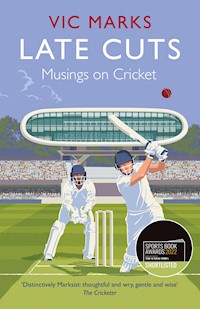
What follows, which explores some of the charms, the quirks and the peculiar allure of cricket from a variety of perspectives, is not intended as a memorial for long-lost sepia days. The game is still alive. Whether it turns out to be therapy for me or entertainment for you remains to be seen. To achieve both would be a bonus. From Somerset stalwart to acclaimed writer and broadcaster, Vic Marks has lived a life steeped in cricket. In Late Cuts he takes us beyond the boundary rope, sharing the parts of the game fans don't get to see, from the food served at lunchtime (then - sweaty ham; now - quinoa, cranberry and feta salad) to the politics of the dressing room. Whether revisiting his playing days to reveal the secrets of bowling a killer spell and what it feels like to be heckled by a riled-up crowd, or ruminating on the current state of the game (don't mention The Hundred!), this amusing and insightful collection will delight all cricket lovers.
Das E-Book können Sie in Legimi-Apps oder einer beliebigen App lesen, die das folgende Format unterstützen:
Veröffentlichungsjahr: 2021
Ähnliche


















First published in Great Britain in 2021 by Allen & Unwin
Copyright © Vic Marks, 2021
The moral right of Vic Marks to be identified as the author of this work has been asserted by him in accordance with the Copyright, Designs and Patents Act of 1988.
All rights reserved. No part of this book may be reproduced or transmitted in any form or by any means, electronic or mechanical, including photocopying, recording or by any information storage and retrieval system, without prior permission in writing from the publisher.
Every effort has been made to trace or contact all copyright holders. The publishers will be pleased to make good any omissions or rectify any mistakes brought to their attention at the earliest opportunity.
Allen & Unwin
c/o Atlantic Books
Ormond House
26–27 Boswell Street
London WC1N 3JZ
Phone: 020 7269 1610
Fax: 020 7430 0916
Email: [email protected]
Web: www.allenandunwin.com/uk
A CIP catalogue record for this book is available from the British Library.
Hardback ISBN 978 1 83895 304 1
E-Book ISBN 978 1 83895 305 8
Printed in
10 9 8 7 6 5 4 3 2 1
[leave room for FSC logo]
Contents
Preface
1. Selection
2. Captains
3. Partnerships
4. The Spell
5. Declarations
6. Crowds
7. Failure
8. Food
9. Twelfth Man
10. Press Conferences
11. The Library
12. Somerset
Afterword
Acknowledgements
Index
Preface
WELCOME to a work in progress. It’s time to find a title. That can’t be too difficult, can it?
Just as they say never judge a cricketer by watching him in the nets, so we should never judge a book by its cover. But suddenly I’m not so sure about that. When Javed Miandad was watching the teenage Wasim Akram in the nets in 1984 or Misbah ul-Haq was casting an eye over an even younger Naseem Shah in 2019, they both decided straightaway that they wanted to catapult these young fast bowlers into the national team. And clearly they were right to trust their gut instincts. It only took them a glance to reach their conclusions.
So perhaps the title – and the cover – matter after all, which sends the mind into a giddy top spin that prevents any coherent thought – or the discovery of a decent title. Ah… Top Spin? How about that? A sort of sequel to Original Spin, which I hope you enjoyed. I know there is a slippery slope out there populated by tired cricket book titles and I have started sliding down it. I am staring at some of them. For wicketkeepers The Gloves Are (always) Off; for former captains there are Final Declarations; those retiring gracefully sign off with Over and Out. Someone is always Following On. This is going to be trickier than I thought. The Americans seem to do this so much better: To Kill a Mockingbird, Catcher in the Rye, One Flew Over the Cuckoo’s Nest. Now these are proper titles and extraordinary books. Which came first, I wonder?
For the very first time I’m experiencing some sympathy with the architects of The Hundred, who decided they had to come up with exciting titles for the eight squads they created in their brainstorming session in some darkened room at the offices of the England and Wales Cricket Board. Now I can just about see how, in desperation, they got to ‘Welsh Fire’ for a squad that was supposed to embrace the counties of Gloucestershire and Somerset as well as Glamorgan and which, after the first draft of players had been completed in 2019, contained no Welshmen at all. ‘Trent Rockets’ still sounds like a permatanned, soft-porn actor of the 1960s. As for the other names of the teams in the competition, I’m afraid I can’t remember them despite a barrage of publicity from the ECB.
The Hundred has not yet captured my imagination. It is a competition that has become increasingly derided – and increasingly superfluous – except for those employed at considerable expense to play, coach, broadcast and administer it, all of whom think it is a jolly good idea (and here are my bank details). Moreover, it is sponsored by a company that produces junk food in abundance at a time when obesity is an ever more dangerous and prevalent problem. As cricket seeks to restore its roots after the Covid-induced devastation of 2020, this is what I’m supposed to be excited about.
What follows here was triggered by Covid-19. Don’t worry, it does not dwell long on the pandemic – or The Hundred, for that matter. The lockdown that began in March 2020 eventually drove me to the laptop and I had ample time to return there at the end of the year during the third lockdown. There was nowhere to go and not much to do. Soon after the start of the first lockdown I was asked to keep a very brief fortnightly diary. On 3 April I noted, ‘The novelty [of the lockdown] soon wore off, as did the determination to read Shakespeare, Dickens and Joyce. Within a week all the fine ideas of self-improvement slithered away as a new routine evolved. Initially I became a news junkie, soaking up every detail; for a few days those 5 p.m. press conferences from Downing Street became compulsory viewing. But enthusiasm for that did not last long either… as the passing on of vital guidance and information was increasingly replaced by barely concealed attempts to justify the handling of the problem.’
I added that ‘the 2020 edition of Wisden, published later this week, will not mention the disease because it erupted too late to be included. The glorious cricketing summer of 2019 is therefore unsullied.’ I decided that I would be better off turning my mind to something I knew about in an attempt to escape the deepening gloom that was evident from an entry of 2 May: ‘What is clear – and this may be a surprise to some of the arch-Brexiteers – is that we are no better, and arguably worse, at dealing with this pandemic than our European neighbours despite the wisdom of Chris Whitty, the one I instinctively trust whenever I watch those afternoon press conferences.’
So during that lockdown I started writing about cricket and not Covid (though I was briefly taken by the title Covid’s Metamorphoses). After six decades consumed by the game, this was my specialist subject. Whether what follows turns out to be therapy for me or entertainment for you remains to be seen. To achieve both outcomes would be a bonus.
Initially it looked as if there would be no cricket at all in the summer of 2020 so there would be plenty of time to contemplate various aspects of the game and to write about them. But then the ECB, despite its self-destructive obsession with The Hundred, reacted with a rare mix of flexibility and creativity that was in stark contrast to their attempts to woo women and children to their wondrous new competition. They undertook to deliver international cricket behind closed doors with Steve Elworthy, who had overseen what now seemed like the straightforward task of organizing a 50-over World Cup in 2019, to the fore. First and foremost the ECB needed the money from their lucrative TV deal to diminish the size of the losses caused by the pandemic, but there was also the nobler urgency to keep the game alive. And they did it.
They had to overcome a range of unprecedented obstacles, which began with persuading the government and the touring teams that cricket was safe and feasible behind closed doors. There was no cricket anywhere in the country until the second week of July, which left us correspondents endlessly debating whether it would ever happen and whether it would be worthwhile if it did. We rarely bothered to consider what might constitute England’s best bowling attack or who should open the batting, since such topics seemed of secondary importance and maybe there was no point in giving any attention to such minutiae anyway. There might be too many hurdles to overcome for any cricket to take place.
Suddenly being a cricket correspondent had become a solitary profession. There were no press boxes to inhabit, no gossip, no random cricket chat. In fact, in the summer of 2020 I did not see any of my writing colleagues until 8 September at the first T20 fixture against Australia in Southampton. When attending Test matches or ODIs before then, I was in a different bubble – the broadcasters’ inner bubble rather than the outer one occupied by the writers – and under no circumstances were we allowed to mingle. However, when the Test series against the West Indies began on 8 July 2020, I was on my sofa. The cricket was on the television and this was the only way to watch it except for a hundred or so workers at the Ageas Bowl, the out-of-town home of Hampshire CCC. I settled down with a coffee and a mixture of anticipation and trepidation. I was hungry for some cricket to report – after all, this was how I was supposed to earn a living – but I was fearful the game would not work in a deserted, sterile stadium. And then it rained and this was magical.
The Test match was taking place in the wake of the death of George Floyd in Minneapolis, which had prompted protests all around the globe from Black Lives Matter. Sky TV caught the mood brilliantly. Their audience tuned in eagerly for the novelty of some live sport but, after all the intricate preparations, rain was going to delay the start. So Sky played a superb, pre-recorded fifteen-minute piece featuring Michael Holding and Ebony Rainford-Brent. The film began with a quote from James Baldwin: ‘Not everything that is faced can be changed, but nothing can be changed until it is faced,’ and from this point onwards we were transfixed.
Both Michael and Ebony spoke candidly of their early experiences in the game and the prejudice, at times unwitting, that they had endured along the way. It was impossible to desert the screen. This was potent stuff way beyond the scope of any normal sports broadcast. Michael was Michael: eloquent, heartfelt but also open to an extent that even surprised some members of his own family. And we saw a different Ebony. Her default position in all the time she has decorated radio and TV commentary boxes has seen her with a constant, beaming smile, twinkling eyes and a light-hearted, optimistic view of the world. But here the eyes were moist and the smile was gone as she recounted the ingrained prejudice she had come across in her years as a young cricketer.
My coffee went cold and the rain continued to fall at Southampton. So Sky’s presenter, Ian Ward, followed on by hosting a live conversation on a balcony at the Ageas Bowl. By now Michael was off his long run – and, as we all know, he had the most graceful of long runs the game has ever seen. He delivered a memorable monologue that ranged from Judas Iscariot to the inventor Lewis Howard Latimer. Nasser Hussain was alongside him and spoke for many of us: ‘People will be tuning in and saying: “Not this again.” All I’ll say to those people who say “not again” is that a few weeks ago I watched a black man being killed in front of my eyes on Channel 4 News and my natural reaction was to look away. Next time that footage came on, I forced myself to watch because I felt something inside of myself say: “You’ve been looking away too long.”’ Hussain is a private man but his barriers had been blown away. He did not even pretend he had been watching the horrors in Minneapolis on Sky News rather than Channel 4.
Well, this was so much more mesmerizing than watching Dom Sibley bat. But for the rain, I might have missed half an hour of the most riveting television imaginable. The players of both sides took the knee before the start. On that first day only 17.4 overs were bowled; England were 35-1 at the close but the series and a bizarre summer of international cricket had been well and truly launched. And everyone was talking about it – or at least they were talking about the candid recollections of Michael and Ebony.
The rain did not go away for long in the late summer of 2020, but when it relented we were treated to some surprisingly compelling cricket. I watched the first two Tests from the sofa before entering the inner bubble at Old Trafford for the third match against the West Indies. By now I had an ECB passport hidden away somewhere on my phone, upon which I had to log the absence of any coughs and sneezes during the previous twenty-four hours and without which it was impossible to gain entry to the ground. Already I had been tested at the ECB’s considerable expense. My tester drove from Cardiff to Exeter, a journey of about two and a quarter hours. He put a swab in my throat and up my nose, which took about thirty seconds, whereupon he turned around and went back to Wales.
Upon arrival at Old Trafford it took a while to get to the hotel that overlooks the ground, which was where the players and the broadcasters were staying. Naturally, locating and operating the Covid passport on my phone was the first obstacle and it required expert assistance from a medic, who fortunately possessed sufficient IT skills. Then I was given my ‘inner bubble’ accreditation, plus a tag that would monitor my every movement while on the site, and there were strict instructions that both the accreditation and the tag should be worn constantly. In stark contrast to the rest of the country, a ‘world-class’ track-and-trace operation was already up and running within the confines of the Old Trafford bubble.
In the car park a chicane had been constructed that led to the first thermal tent. I got out of the car, flashed my new accreditation and then was finally able to drive around to the hotel. Before entering, there was another temperature tent to go through, then another check of my accreditation. Finally I was inside and my heart was sinking. At reception and in the nearby dining area there were masks, pale-blue rubber gloves and Perspex screens everywhere. From behind one of those a friendly receptionist signed me in, disinfected my little suitcase and eventually handed over a key before I headed off to my room/cell. By now I was pining for my own sofa.
In fact the room was one of the better ones (I think it had been occupied by a knight of the realm, Sir Alastair Cook, during the previous Test) since it faced the ground rather than the car park. I was informed that, on health and safety grounds, it would not be serviced during my stay. How could such a venerable broadcaster possibly survive in such squalor? Soon I was briefed by a BBC assistant producer about the rules relating to masks, social distancing and dining procedures before she warned ‘and, whatever happens, keep away from the turquoise arrows. They are for the players only.’ All around the Old Trafford complex there were arrows of different colours on the tarmac, which indicated where everyone was allowed to walk. Apparently I was only permitted on the yellow ones. To step on the turquoise ones might mean exile.
Just after my arrival at the hotel I saw a couple of players in a corridor near my room; I could briefly greet Jack Leach. But this was obviously an aberration; it should not have happened. Indeed it did not happen again. The broadcasters and the players were completely separated even though we were staying in the same hotel. Then I went to the media centre on the other side of the ground, where the broadcasters – but not the writers, who were situated on the top tier of the pavilion throughout the game – were stationed, in order to find the Test Match Special commentary box, where I had been asked to contribute to a preview of the match.
The sign outside the box declared ‘Maximum of Five People Permitted’. The producer, Adam Mountford, had his workplace at the back of the box, a chair and a table bearing vital bits of machinery all surrounded by Perspex. On the other side of the room this was mirrored by the berth of Andy Zaltzman, the scorer/statistician and the one genuine comedian in the team. The commentary positions at the front of the box were socially distanced; we all had our own set of microphones and we could use no others. Only I could touch my microphone, which may explain some of the unusually long delays in commentary when I was handing over to the next summarizer. It took a while to master plugging myself in and out.
Initially this was all very depressing. I had descended into some dystopian world in order to watch a dozen white-clad figures running around an empty stadium and going through some arcane and incomprehensible (to the majority of the world’s population) ritual out on the grass during the breaks in the rain. Back at the hotel it was time for dinner and at last a little light was shed. I was surprisingly pleased to see my broadcasting colleagues. I had been in lockdown for almost four months and here was a gathering of familiar, mostly smiling faces who did not seem at all bothered by the bizarre restrictions that had been imposed upon them. Having already broadcast two Test matches, this was all routine to them; they had evolved a matter-of-fact acceptance that this was the way it was. We sat at our individual, socially distanced tables and ate and chatted more loudly than normal. Within a couple of hours I was also managing to adjust to this strange new normal amid the odd realization that I had communicated with far more people on that first evening at Old Trafford than had been the case throughout the previous four months in Devon.
Somehow the cricket worked behind closed doors. And it worked especially well during the Test matches. The games kept coming and it was as if they were replacing the television soap operas that had run out of episodes due to the lockdown. Characters emerged from the cameras, some of whom were not household names: on the West Indies side was Jason Holder, an impeccable leader, forever vibrant and smiling; there was Jermaine Blackwood, impishly attempting lofted drives that were not supposed to happen in Test cricket; there was also Shannon Gabriel, bustling up to the crease and bowling fast before retreating to mid-on, where he seemed barely capable of moving at all in between his overs. For England there was Sibley, with a batting style that even Heath Robinson would have rejected as being too quirky, and he was becoming something of a folk hero. Ben Stokes, now a Test captain, had already achieved this status, while Stuart Broad’s renaissance was becoming a source of wonder. To the little seam of viewers on Sky television and many more watching the BBC highlights, they all became familiar characters. On the radio the commentary may have provided some compensation for the absence of The Archers, who all seemed to be on furlough.
The cricket took over to the extent that we started to fret about England’s top three again rather than whether the series would be completed. After the West Indies’ first Test victory at the Ageas Bowl the outcome was always in the balance. A month later the first Test against Pakistan delivered the most compelling cricket of the summer at Old Trafford in a game that England were losing until the final afternoon when Jos Buttler and Chris Woakes joined forces in spectacular style.
So it became apparent that Covid-19 had produced a little silver lining. All the restrictions had seemed certain to diminish any sporting contests to the point that they may as well be written off as a waste of time and energy. Yet, despite all the obvious limitations, Test match cricket was offering up an engrossing product and a rather better one than most other sports could deliver. Covid was doing the game a favour. And so were the players of all the international sides who were prepared to come to England in 2020. As the cameras zoomed in, it was obvious that they all cared hugely about the outcome of the matches, that they respected the game and their opponents, and with barely an aberration they also respected the confines of their bubbles, which proved to be beyond some of the big names in other sports.
The white-ball games followed suit. Ireland, after two desultory defeats to England at the Ageas Bowl, emulated their famous Bangalore victory of 2012, though they did it rather more quietly this time. Then the advent of Australia for six white-ball matches in September delivered what suddenly seemed to be a sequence of unmissable clashes. It helped that an engaging England side demonstrated a melodramatic never-say-die attitude. They had come back from probable defeat against Pakistan in the first Test, and they did the same in two games against Australia, which cheered just about everyone up. On both occasions the cameras latched on to a grim-faced Justin Langer, Australia’s head coach. He cared all right. No surprise there, but so did everyone else as the glum faces of the Australians and the beaming smiles of the England players, who had just picked their pockets, confirmed.
All this served as a reminder that somehow the game still mattered. Test cricket was perhaps the greatest beneficiary. Those matches in July and August provided a surprisingly gripping escape from the pandemic while the white-ball formats also offered a welcome end-of-season diversion before the football saturation took over.
There would soon be spectacular confirmation of the magic of Test cricket, when India toured Australia in December and January. In the first Test at Adelaide, India were bowled out for 36 and lost by eight wickets. Their captain, Virat Kohli, as planned, then left the tour to become a father. The pundits, all the usual suspects in the Australian commentary boxes, and the odd Englishman (who does not like to be outdone) predicted a clean sweep for the Aussies. Ajinkya Rahane took over the captaincy from Kohli rather brilliantly and, despite a catalogue of injuries to senior members of his bowling attack, India contrived to win, 2-1, late in the final session of the final day at the Gabba where Australia had not lost for thirty-two years.
The series had provided breathtaking drama to lift the spirits. ‘Thanks, India. Thanks a lot. What else can you say? Thanks for one of the classic series. Thank you for one of the more extraordinary days. When Washington Sundar, a 21-year-old stripling on Test debut, hooks the best Australian fast bowler of his generation for six to give this match and series its final wrench, what other can you say?’ wrote Greg Baum, who always seems to catch the mood, in The Age. Then England’s victory over India in Chennai in the first Test startled an unusually large television audience back at home after Channel 4 had won the rights – three days before the series began. The millions who rely only on free-to-air television for their sport could see for themselves why Joe Root was being hailed as a minor genius.
Despite the Covid restrictions, cricket was alive and well. At its best the Test match remains the pinnacle of the sport, capable of conjuring drama and revealing character in a manner beyond most other sports. The three old(ish) formats of the game were working rather well together. This only served to strengthen the view that the introduction of a gimmicky fourth format in 2021 in England and Wales, involving teams with no genuine support base, was an act of folly.
In the meantime, on the domestic front in the UK, the Bob Willis Trophy – a competition hastily arranged to replace the County Championship in the final six weeks of the 2020 season – was validated by the presence of the two best county sides in the country (Essex and Somerset) reaching a five-day final at Lord’s at the end of September (more of which later). No spectators were allowed but it was still possible for members of the public to watch. Even the octogenarian supporters out there discovered the delights of streaming the action – something the counties had undertaken with increasing sophistication.
Against all the odds, the 2020 season had been a minor triumph. Due to the pandemic the game was poorer yet more popular. Despite all the impediments, there was reason to celebrate and to be optimistic about the future. So what follows, which explores some of the charms, the quirks and the peculiar allure of cricket from a variety of perspectives, is not intended as a memorial for long-lost sepia days. The game is still alive. Somehow it survived 2020. With enlightened guardians it can do better than that in the years to come.
But what about that title? Well, surprise, surprise, we haven’t been able to match those of Harper Lee, J. D. Salinger or Ken Kesey. In the end we settled upon Late Cuts. I’ve played a few of those in my time, not always with success, as you will discover when I find myself facing Derek Underwood on page 246. I also have to recognize the passage of time and the fact that I am not so actively involved with the game now. The pandemic – even though at the time of writing I’ve managed to avoid it – has something to do with that. So do the newspapers I have worked for over the last three decades.
Back in 1989 the Observer sought me out to be their cricket correspondent; they were offering me considerably more money and a much longer career than Somerset CCC could ever do. So, after a bit of agonizing, I retired from professional cricket at the age of 34 and a few people had the good grace to ask me why, implying they did not necessarily think I was over the hill yet. Having stayed with the Observer for thirty-one years, I guess there is no reason to regret that decision.
By 2020 I had been working for the Guardian for a dozen years as well, but the pandemic had taken its toll and the group was looking for volunteers for redundancy in the sports department. Once again I was confronted with a hard-to-refuse offer from a newspaper, but this time it involved leaving rather than joining. I’ll miss working with sympathetic, civilized employers and colleagues and – who knows? – maybe I’ll reappear in their columns occasionally in the future. But at least – as when leaving Somerset all those years ago – I have been spared listening to someone from above having to initiate an uncomfortable conversation about my future. It seems I have managed to shrewdly go before splitting too many infinitives.
I have enjoyed being the cricket correspondent of the Observer and the Guardian; these have been great posts to hold and I’m aware they have been occupied by some wonderful correspondents in the past. I guess I’ll miss the position as much as the work, and in 2021 I’m sure I’ll be pining for the odd bit of press-box banter and the free pass to another Test match but I will not miss that blank screen miles from home late on a damp Sunday night. And at least there is now no compulsion to watch The Hundred, which I’ll try not to mention again in whatever follows here.
1
Selection
‘My God, look what they’ve sent me.’
England captain A. C. MacLaren, 1902
THEY KEPT PICKING him for fifteen years but Ian Botham’s description of a Test selector, delivered at a cricket dinner in the 1980s, was none too flattering. ‘They bring him out of the loft, take the dust sheet off, give him a pink gin and sit him there. He can’t go out of a 30-mile radius of London because he’s normally too pissed to get back.’
Well, this would have raised a laugh. In that era the selectors were sometimes old amateurs, who were more likely to be gin-slingers, and – expenses apart – they were unpaid. I’m not sure they were all drunkards, though. In fact, the chairman of selectors when Ian was England captain was Alec Bedser, very much the professional’s professional as a player, and he held the post longer than anyone in history – for thirteen seasons.
Ray Illingworth, another old pro, was the first chairman to be paid, partly because he was dovetailing as England’s team manager in the mid-1990s. Ever since then it has been a job with a salary, during which time David Graveney, Geoff Miller, James Whitaker and Ed Smith have held the post now known as the national selector. Smith, in particular, is well paid. He certainly cannot afford to be seen with a pink gin during working hours. However, idiosyncratic sunglasses are permitted.
The task of a selector is simple: he/she has to deliver teams/touring squads and then let the coach and captain get on with it. The basics of the job are so straightforward that there are thousands of armchair selectors out there with thousands of different theories who think they can do better. We can all pluck out a dozen names or more and then offer our expert opinion with absolute confidence, in the comforting knowledge that we will seldom be held to account. No one will remember our crackpot theories for long. But it is trickier for the real selectors; their mistakes are remembered far more frequently than any triumphs.
In reality it is very rarely a matter of making brilliant, trailblazing choices that no one else has ever contemplated before. More often it is a case of taking the least bad option as events dictate the next move. Consider England’s leading run-scorer, Alastair Cook. He was always going to play Test cricket but his elevation to the team did not come about as the final step of a carefully crafted plan. Rather, in March 2006, he was rushed halfway around the world to Nagpur from the Caribbean, where he was touring with the England A team, after both Marcus Trescothick and Michael Vaughan were suddenly unable to play in the first Test against India. Upon arrival in Nagpur, Cook was catapulted straight into the team; he hit 60 in his first innings and an unbeaten century in his second. There followed 160 more Test matches for Cook without ever being dropped. Yet he needed a couple of sudden absentees to get started.
Successful selection is dependent on solid research, sound judgement, the odd hunch, a bit of luck and a reservoir of decent players. It can be hampered by tunnel vision, a desperation to pursue fairness rather than the best side, inflexibility, prejudice, wishful thinking and a dearth of good players. We remember the bad selections far more easily than the good ones and they are usually more fun to revisit. But let’s try to identify some of the good ones first.
In fact the Lancashire captain, A. C. MacLaren, a stately galleon of a cricketer at the start of the twentieth century, will appear in both categories. MacLaren was an amateur, of course, but often an impecunious one, and it may be that he was capable of starting an argument in an empty room. He went to Harrow, where he declared that his fag was ‘quite useless’ and ‘a snotty little bugger’, which is a rare description of Winston Churchill.
Neville Cardus hero-worshipped MacLaren, partly because he was the captain of his beloved Lancashire, but perhaps also because Cardus was indebted to him for enhancing his career as a journalist. At the age of 50 MacLaren led a scratch side to victory over the almost invincible Australians of 1921 and Cardus was, of course, there to report it. In fact, having badgered his office to let him cover the match in Eastbourne, it transpired that he was the only leading journalist present to record this staggering defeat of the tourists. This was one of just two games that the Australians lost on their thirty-eightmatch tour. Cardus was in clover at Eastbourne, while his peers were elsewhere.
Cardus described his hero as ‘the noblest Roman of them all… there never was a cricketer with more than the grandeur of A. C. MacLaren’. Lancashire’s autocratic captain was obviously a formidable batsman, capable of scoring runs in isolation and, occasionally, in bulk – he hit 424 not out against Somerset at Taunton in 1895, which became the highest score ever recorded in first-class cricket at the time. Alan Gibson took a slightly different view of him to Cardus (though he might not have expressed it too readily in his presence): ‘England may have had worse captains but I would be hard put to name two or three,’ he wrote in a wonderful book, The Cricket Captains of England, that surveyed England’s leaders on the field up to Mike Gatting. However, Gibson acknowledges that MacLaren was box office, though he puts it more elegantly than that; in the twenty-first century we would have made sure that we did not miss any of his press conferences. ‘England under MacLaren must have been a good side to watch, save for the partisans, but an uncomfortable side in which to play,’ he wrote.
The bald statistics are not in MacLaren’s favour. He led England in four Ashes series – in 1899, 1901/02, 1902 and 1909 – and Australia won all of them. Yet MacLaren’s selection of S. F. Barnes for the tour of 1901/02 was surely a good one – and Barnes was not necessarily an obvious choice at the time. He was already 28 years of age but had only appeared in seven first-class matches in his life as he preferred to play in league cricket and for his beloved Staffordshire in the Minor Counties competition. In 1901, when a professional in the Lancashire League, Barnes was invited to bowl at MacLaren in the nets at Old Trafford. Cardus recalls the event and quotes MacLaren: ‘He thumped me on the left thigh. He hit my gloves from a length. He actually said, “Sorry, sir!” and I said, “Don’t be sorry, Barnes. You’re coming to Australia with me.”’
And so he did. Barnes took seven wickets in his first Test in Sydney and England won the match. But by the third game he was injured through over-bowling and the series was eventually lost 4-1. Nonetheless, selecting Barnes in the first place was assuredly a good decision – just as Javed Miandad thrusting Wasim Akram, who had hardly played any first-class cricket at the time, into the Pakistan Test side in 1985 was soon justified. Of course, both cases look like the most obvious selections imaginable with hindsight since Barnes and Akram proved to be such brilliant, innovative bowlers.
Sydney Barnes was extremely single-minded, stubborn, difficult to handle and always determined to be properly remunerated for his skills. And MacLaren was MacLaren, haughty and intransigent. The relationship was bound to be spiky, to say the least. On the trip home from that Ashes series the boat hit rough seas and MacLaren, never known for his cheery optimism, famously remarked, ‘At least if we go down we’ll take that bugger Barnes down with us.’
Barnes took 189 wickets in twenty-seven Test matches at 16.43 apiece. No bowler has taken wickets so swiftly or cheaply for England. He was the ultimate craftsman, capable of spinning the ball, not cutting it, as he was always keen to point out, in both directions at medium pace. After his retirement he became a calligrapher. In the 2012 Wisden Peter Gibbs – once of Oxford University, Derbyshire and Staffordshire – wrote a lovely piece in which he describes being the youngster in the side given the daunting task of looking after Barnes, now into his nineties, while he was watching Staffordshire playing. Gibbs was asked to get some autographs from Barnes, an undertaking he attempted with some trepidation and a biro. Barnes demanded a fountain pen. ‘Giving him a biro was like asking Yehudi Menuhin to play the ukulele,’ wrote Gibbs.
A good selection may come in the form of omitting someone surprising. Alec Bedser might be the nearest any England bowler has come to Barnes. He cut the ball, rather than spinning it, as well as propelling inswingers for which Godfrey Evans often stood up at the stumps. After the Second World War Bedser carried the England bowling tirelessly with modest support, the ball shrinking into his massive hands for over after over. I once disappointed my wife when looking at Michelangelo’s David in Florence by observing ‘Blimey, he’s got hands like Alec Bedser.’
Eventually some assistance for Bedser was at hand in the form of Brian Statham, Fred Trueman and Frank Tyson. As ever, the first Test of the 1954/55 Ashes series was in Brisbane, a venue that has prompted some odd decisions by England captains. In recent times, if 2002 still counts, Nasser Hussain inserted Australia, who were 364-2 at the close of play on the first day. The match was lost by 384 runs. Hussain was lambasted for his decision but he found himself in good company.
In 1954 Len Hutton, having omitted all his spinners – and he had some good ones available in Johnny Wardle and Bob Appleyard – put Australia in at the Gabba. They made 601-8 and won the match by an innings and 154 runs. Bedser, who had been recovering from shingles, took 1-131 from 37 overs and witnessed as many as seven catches go down off his bowling. Neither Statham nor Tyson were any more effective.
Three weeks later England were in Sydney for the second Test – tours were more leisurely expeditions then – and Hutton, after much agonizing, made a momentous decision. He dropped Bedser, the backbone of the England side for so long. The attack was given more variety with the inclusion of the two spinners but the critical difference was that something clicked for Tyson, who had by now moved to a shorter run-up. In Sydney, Tyson shredded the Australian batting line-up through magnificent, unadulterated speed and the pattern was set for the series.
Hutton, England’s first professional captain, had made the right decision, albeit in the wrong way. After all Hutton’s deliberating, Bedser only learned of his omission when looking at the team sheet pinned up in the dressing room half an hour before the start of play. The strategy was rather better than the man-management in an era when the captain had to do everything himself. England, with Tyson running riot, won the series 3-1. Bedser played just one more Test match against South Africa in the summer of 1955.
In 1956 England obviously decided that the touring Australian batsmen would be fragile on turning pitches especially against the spinners, Jim Laker and Tony Lock. But England’s batting was none too sturdy either. The first Test at Nottingham, a wet one, was drawn. Australia won the second at Lord’s by 185 runs. The selection panel – chaired by Gubby Allen and including Les Ames, Wilf Wooller and Cyril Washbrook – was by now very concerned about England’s batting line-up. As they were mulling over the team for the third Test at Leeds, Allen instructed Washbrook to go and get some beer. By the time he returned, his fellow selectors had chosen him for the next match. Washbrook, once the regular opening partner of Hutton and the first professional captain of Lancashire, was 41 and he had not played Test cricket since the 1950/51 tour of Australia. ‘Surely the situation isn’t as desperate as that,’ he said. Beyond the portals of Lord’s there was consternation and despair that the selectors had chosen one of their own committee.
A few days later at Headingley Peter May won a good toss since the pitch was expected to assist the spinners, but England were soon 17-3. May was still at the crease and he recalled afterwards, ‘I have never felt so glad in my life as when I saw who was coming in.’ It was Washbrook. This pair shared a partnership of 187, May making 101 and Washbrook 98 before being lbw to Richie Benaud. England’s total of 325 was enough to ensure an innings victory as Laker and Lock set to work on a deteriorating surface. Now the press and the public hailed a masterstroke. Washbrook failed to reach double figures in his two other innings in the series, but the tide had been turned. After Laker’s 19 wickets in the next match at Old Trafford and a soggy draw at The Oval, England won the series 2-1. The recall of Washbrook had not been such a bad idea after all.
Of course, anyone can select the exceptional players. It would not have taken too much insight to see that David Gower, Mike Atherton, Ian Bell or Mark Ramprakash were high-quality batsmen destined for Test cricket (even though the latter provides a reminder that nothing is guaranteed once you get there). So the unlikely selections that come good are a better indication of the fertile, lateral thinking that leads to the odd inspired selection. In the modern era, which encompasses players I have played against or watched, Tony Greig and his selection panel (Ken Barrington, Len Hutton and the former umpire Charlie Elliott, along with Bedser) produced one of those.




