


11,49 €
Mehr erfahren.
- Herausgeber: Allen & Unwin
- Kategorie: Lebensstil
- Sprache: Englisch
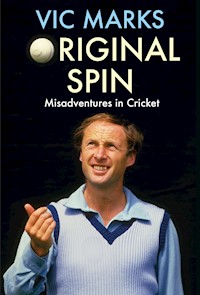
The much-loved former England player, Guardian cricket correspondent and TMS broadcaster tells the story of his life in cricket for the first time. In April 1974 new recruits Viv Richards, Ian Botham, Peter Roebuck and Vic Marks reported for duty at Somerset County Cricket Club. Apart from Richards, 'all of us were eighteen years old, though Botham seemed to have lived a bit longer - or at least more vigorously - than the rest.' In this irresistible memoir of a life lived in cricket, Vic Marks returns to the heady days when Richards and Botham were young men yet to unleash their talents on the world stage while he and Roebuck looked on in awe. After the high-octane dramas of Somerset, playing for England was almost an anti-climax for Marks, who became an unlikely all-rounder in the mercurial side of the 1980s. Moving from the dressing room to the press box, with trenchant observations about the modern game along the way, Original Spin is a charmingly wry, shrewdly observed account of a golden age in cricket.
Das E-Book können Sie in Legimi-Apps oder einer beliebigen App lesen, die das folgende Format unterstützen:
Veröffentlichungsjahr: 2019
Ähnliche


















ORIGINAL SPIN
First published in Great Britain in 2019 by Allen & Unwin
This Paperback edition first published in Great Britain in 2020 by Allen & Unwin
Copyright © Vic Marks, 2019
The moral right of Vic Marks to be identified as the authorof this work has been asserted by him in accordance withthe Copyright, Designs and Patents Act of 1988.
All rights reserved. No part of this book may be reproduced ortransmitted in any form or by any means, electronic or mechanical,including photocopying, recording or by any information storage andretrieval system, without prior permission in writing from the publisher.
Every effort has been made to trace or contact all copyright holders. Thepublishers will be pleased to make good any omissions or rectify anymistakes brought to their attention at the earliest opportunity.
All images in the photo inserts, unless otherwise credited,are the property of the author.
Allen & Unwinc/o Atlantic BooksOrmond House26–27 Boswell StreetLondon WC1N 3JZ
Phone: 020 7269 1610
Fax: 020 7430 0916
Email: [email protected]
Web: www.allenandunwin.com/uk
A CIP catalogue record for this book is availablefrom the British Library.
Internal design by Patty Rennie
Paperback ISBN 978 1 91163 020 3
E-Book ISBN 978 1 76063 548 0
Printed in
1 3 5 7 9 10 8 6 4 2
For the Crackington Crew
CONTENTS
1 Taunton 1974
2 On the farm
3 Oxford
4 Full-time pro
5 Great losses
6 Great wins
7 Caps no. 55 and 499
8 One-day cricketer
9 On tour
10 Perth
11 Trouble over Bridgwater
12 Retired hurt
13 The Observer
14 Test Match Special (then)
15 Test Match Special (now)
16 Loose ends
Acknowledgements
Index
ONE
__________________
TAUNTON 1974
‘WELL, WE’RE NOT GOING to get into the team ahead of him.’ Peter Roebuck and I stared at one another and simultaneously came to the same conclusion.
It was April 1974 at the County Ground and the Somerset players were having their first middle practice. A gangling pace bowler from Burnham-on-Sea, Bob Clapp, who would one day become a far better teacher, raced in and hurled the ball down as fast as he could. The delivery was not too bad, a fraction short perhaps and a little wide. There was the crack of willow on leather and the ball disappeared to the cover point boundary at staggering speed. A square cut of awesome power and certainty. Clapp looked a little puzzled and crestfallen. Meanwhile the batsman made ready for the second delivery of his practice session, although it took some time for the first one to be retrieved from beyond the greyhound track that encircled the playing area. Isaac Vivian Alexander Richards had arrived in Taunton.
Richards was barely known outside Antigua and Lansdown in Bath, where he had played a season of club cricket in 1973. That state of affairs would not last for long. Those who had played with or against Richards at Lansdown had soon recognized something special. Within a decade it was tricky to argue with the assertion that here was the best batsman of his era. I never bothered to try. He was the best.
Maybe it was Richards’ exploits for Lansdown the previous summer that allowed him to change in the main dressing room of the old pavilion when he first reported as a Somerset cricketer in that spring of 1974. There he found himself alongside three giants of the county game: Brian Close, an exile from Yorkshire having been controversially sacked in 1970, was the captain of the club; Tom Cartwright, once of Warwickshire and an exquisite bowling machine, was now Somerset’s player/coach; and in his last season as a professional there was ‘Gentleman’ Jim Parks, who had spent most of his career caressing the ball up and down the slope at Hove.
There were also some old Somerset stalwarts sitting under their usual pegs in that homely dressing room (well, there were a couple of sofas and an old gas fire in between the cricket bags) in the bucolic figures of Mervyn Kitchen and Graham Burgess, and some young ones, too – namely a pair of athletic blonds from Weston-Super-Mare, Brian Rose and Peter Denning. To augment the locals there was an assortment of cricketers from elsewhere: within the last few years Derek Taylor, the wicketkeeper, had come from Surrey; fast bowler Hallam Moseley from Barbados; left-arm spinner Dennis Breakwell from Northampton; and from Sussex Allan Jones, who would end up bowling fast for a good percentage of the clubs on the county circuit before sending batsmen on their way with his right index finger as an umpire.
At the back of the pavilion was a little alleyway beyond which was a dingy stone-floored room, which in later years would serve far more appropriately as modest toilets for gentlemen spectators. There was one tiny, thin window near the ceiling, a couple of benches and a few pegs on the wall. This was where the new recruits to Somerset were housed since there was not enough room in the main dressing room for the entire staff. That room no longer exists; it was demolished to make way for the suave, state-of-the-art Somerset Pavilion in 2015. There were no preservation orders to overcome in that process.
Back in the winter of 1973 the chairman of cricket, Roy Kerslake, who had captained Somerset in 1968, had successfully advocated a youth policy to the committee. Hence there were five newcomers in addition to Richards: Phil Slocombe, another batsman from Weston-Super-Mare; John Hook, a tall, gentle, prematurely deaf off-spinner, who was also from Weston; Roebuck and Marks, who had both been enlisted as batsmen (I’ll explain later) and a young man from Yeovil named Ian Botham. We were the occupants of the makeshift dressing room. All of us were eighteen years old though Botham seemed to have lived a bit longer – or at least more vigorously – than the rest. He tended to dominate proceedings even then, especially in our claustrophobic dressing room.
In that cubby hole a pattern emerged in those first few weeks. Ian rubbed along happily with Peter Roebuck, who was a very bright, Cambridge University-bound Dylan fan with huge feet, far more prepared to lower the drawbridge as a teenager than in later life. Ian and I were two South Somerset boys – I had grown up on a farm near Yeovil – and we got on perfectly well. Fairly early on in our relationship I learnt the necessity of identifying some form of escape route late in the evening when in Ian’s company. In Somerset I did not have to use it very often since I always had a forty-minute drive back home; hence the nocturnal haunts available in Taunton were never my specialist subject. By and large it always seemed wiser to avoid a serious argument with the young Botham if at all possible, a philosophy I maintained in later life.
Ian did not take so easily to Phil Slocombe; he sensed too many airs and graces, real or imagined. The point to remember, given how Somerset would disintegrate a dozen years later, was that Roebuck and Botham were once in the same camp, both intrigued by their obvious differences and enjoying one another’s company for the best part of a decade. They would argue merrily about most things and they would even write a book together, It Sort of Clicks, a task that, unsurprisingly, fell largely – no, entirely – upon the shoulders of Roebuck.
Slocombe, Roebuck and I had all come to the fore as cricketers by excelling to various degrees at local independent schools. Phil and Pete had played together, not necessarily in perfect harmony, at Millfield while I had been at Blundell’s School in Tiverton just across the border in Devon. Along the way we had all played cricket for the county in the school holidays – sometimes in youth sides run chaotically by the old Somerset cricketer Bill Andrews, who, according to the title of his autobiography, possessed the hand that bowled Bradman (for 202) – and later for the second team. That has been a pattern repeated frequently with the Somerset sides of the twenty-first century (minus the endearing, larger-than-life Andrews). Whatever the merits of the system, James Hildreth, Arul Suppiah, Jos Buttler, Craig Kieswetter, the Overton twins, Tom Abell, Dom Bess, Eddie Byrom, George Bartlett and Tom Banton have all progressed in a similar manner, though, as Jack Leach has demonstrated, other routes are still possible.
Meanwhile Ian had spent two years on the Lord’s groundstaff, a more fertile training ground then than it is now when every county boasts its own academy. That was a hard, boisterous, old-fashioned school, which may have suited him well. Botham had probably become more streetwise and more confident – not that he has ever been lacking in these departments – after spending two teenage summers in London rather than Yeovil.
Richards’ path to Somerset had been more unorthodox. In early 1973 Len Creed, a mischievous Bath bookmaker, was visiting Antigua with a touring side, the Mendip Acorns. In his wallet he had a cutting from The Cricketer magazine in which Colin Cowdrey had noted, ‘There was a chap called Vivian Richards who looked promising.’ Creed met Richards, watched him score a brisk 30 and was impressed. He phoned the club’s chairman, their former captain Colin Atkinson, because he had decided that he wanted to bring Richards back to Somerset. Atkinson was understandably reluctant to agree to this since it would involve the club in a risky outlay of cash on the recommendation of just one man. Then Creed suggested that he would bring Richards over to England himself to play for Lansdown CC, on the understanding that Somerset would cover the expenses incurred if the young batsman proved good enough to be granted a contract having served his qualification year. Atkinson thought this was a much better idea.
So, upon the hunch of a Bath bookmaker, never previously renowned for his cricketing nous, Somerset hit upon a jewel. Creed could dine out on the tale for the rest of his life – no one could ever begrudge him that – and for one season Lansdown CC became one of the most feared clubs in the county. Such a glorious sequence of events would not have been possible in 2019. Now it is necessary for an overseas signing to have played the requisite number of international matches in the previous year for him to be allowed into county cricket. A bookmaker’s hunch would not be enough.
This was an interesting time to join Somerset. Yet my first day as a professional cricketer was a bit of a disappointment. I arrived wide-eyed, eager for the fray and scrupulously punctual after the drive from home in a fifteen-year-old black VW beetle with no fuel gauge and orange indicators that protruded from the side of the car like arrows when they deigned to work. It was raining at Taunton, but there was never any intention among the players to leap straight into the nets to hone the strokes that we had been working on in the indoor net sessions, on Thursday nights throughout the winter, under the omniscient eye of Tom Cartwright.
There were more important matters to discuss as we huddled around the gas fire in the main dressing room. ‘This petrol money is bloody diabolical,’ said Merv Kitchen, ‘and you couldn’t feed a mouse on our meal money.’ Of course such crucial minutiae had not crossed my mind as I contemplated the season ahead but it’d be the duty of our player’s representative, Derek Taylor, to go off to see the secretary, Jimmy James, to haggle for a more reasonable rate. It was not quite the big, happy family I had envisaged. Throughout that period the players had absolute faith in Kerslake, the cricket chairman, but that confidence did not necessarily extend to every member of the committee – and there were plenty of them.
Once the rain stopped we did something rather modern. We played football. In 2019 England do that for about fifteen minutes before every day’s play and I can understand why, despite the risk of the odd embarrassing injury. It cheers everyone up. Just about every cricketer thinks he is a very fine footballer and there were times at Somerset when the despair among those not selected for the football team for those end-of-season benefit games was far more obvious than when they were omitted from a County Championship match at Derby.
When today’s England team play football before the start of a Test match there are understandable restrictions, rigorously applied. It is a two-touch game with a lot of noise but no tackling. At the County Ground in 1974 there was also plenty of noise but no tackling ban. The matches were often extremely competitive and the tackles reflected the influence of Norman Hunter of Leeds United and Ron Harris of Chelsea; arguments raged and decisions were fiercely disputed. Sometimes these games would end abruptly as they overheated. ‘Come on,’ said Kitchen to his faithful dog, Thumper, who often came to pre-season training with him, ‘we’re buggering off now.’ That meant the game was over because it was Merv’s ball.
At some point we would disappear down the road to Wellington Sports Centre for a few days of fitness training. We dutifully donned a motley range of tracksuits (there were no sponsors for them in 1974), ran up and down hills and were detailed to complete devious training circuits. It was not that scientific. Even D. B. Close, who was forty-three, would do some press-ups. To be more precise, he would do two: one for the BBC cameras and one for those of HTV, which was the local ITV station.
Soon the cricket took over. I remember being in the twelve travelling to Warwickshire for a warm-up match and nervously discovering that the room list read ‘Parks and Marks’. I was twelfth man and when Close asked me to sandpaper his bat while the side was out in the field I set to work with a zealous determination to impress my old, new captain. I found the Stuart Surridge bat bearing the initials DB and I cleaned it up meticulously. There was not a blemish to be seen. My pride was soon dented when the team returned to the dressing room and a puzzled Dennis Breakwell picked up his bat to find it mysteriously spotless.
In that first summer I was never entirely sure that Close could tell all of the newcomers apart. For some reason it did not take him long to work out which one was Botham, who would end up playing in sixteen of the twenty Championship matches. After that he might have been guessing whether it was ‘Pete lad’, ‘Phil lad’ or ‘Vic lad’. When carrying out the twelfth man duties we all happily made Close his pots of tea upon which he seemed to survive throughout a day of county cricket. I was not quite so adept at placing bets on his behalf down at the bookies, which may have saved him a bit of money.
Despite an injury to Cartwright, from which he never really recovered, Somerset had a successful season. Viv Richards made his mark in his first game for the club against Glamorgan at Swan-sea in the Benson & Hedges (B&H) Cup on 27 April. He hit 81 not out with thirteen fours and one six to win the match. Close apparently delivered the immortal words, ‘You’ll do for me, lad.’ It was all too much for Len Creed, who was in tears.
Soon it was evident that Richards was touched with genius and destined for a long international career. It was never so obvious with Ian. We watched eagerly when he played in the first team in the knowledge that anything might happen. If he succeeded that cheered us all up because here was a positive sign: if Ian, our peer, could hold his own, then perhaps we could as well at some point in the not too distant future. Ian was captivating, but one of England’s greatest all-rounders, a future knight of the realm? There was more chance of a band comprised of furry creatures of dubious provenance making the top ten in the hit parade (mind you, that happened to the Wombles in 1974).
However, on 12 June at Taunton in front of 6,500 spectators Botham’s performance suggested that, like Richards, he had something special. This was the B&H quarter-final against Hampshire. I watched almost every ball of that match. I had been stationed along with Roebuck inside the old, brown scoreboard almost opposite the pavilion. It was our job to operate it by pulling levers left and right and then leaning out of the window to plonk a few figures on the outside. We had a direct telephone line to the scorer just in case we occasionally lost track of the score, but with two alert young men who would soon be Oxbridge undergraduates, what could possibly go wrong?
When Hampshire batted Botham yielded 33 runs from his eleven overs and took two wickets, Peter Sainsbury and, rather more memorably, Barry Richards, who at the time was arguably the best batsman in county cricket, if not the world. However, the most instructive recollection is the manner of Richards’ dismissal. He was bowled by Botham yet he was very reluctant to leave the crease because he thought that our wicketkeeper, Derek Taylor, whose twin brother, Mike, was playing for Hampshire, had inadvertently knocked off the bails. So here is evidence that in 1974 Botham bowled at little more than medium pace. The wicketkeeper – and Taylor was especially adept at this against seamers – stood up to the stumps to him most of the time. Over the next few years, encouraged by Close and tutored by Cartwright, Botham added pace in abundance. But at the start he propelled gentle away-swingers.
Hampshire scored 182, which looked more than enough when Hallam Moseley joined Botham at the crease with Somerset languishing at 113–8. I now know exactly what would have been happening in the press box. Everyone, recognizing a Hampshire victory as a foregone conclusion, would have been writing up feverishly to meet their paper’s deadline and to get the job done as quickly as possible.
Andy Roberts, Viv’s mate from Antigua and the most fearsome bowler on the circuit, was recalled. Yet with Moseley surpassing all expectations alongside Botham the score reached 150. Roberts now bounced Botham and the ball hit him in the face, loosening some teeth and spilling some blood. Another bouncer and the Somerset faithful were jeering Roberts angrily. Then Botham clipped a delivery from Mike Taylor for six, just clearing Roberts on the boundary. Now the crowd sensed an impossible victory while those in the press box began to anticipate an inconvenient rewrite. Botham hit another six and when Moseley was lbw to Roberts only seven more runs were required.
By now there was chaos inside the scoreboard as Roebuck and I lost control, whether it was through excitement or sheer incompetence I can’t quite recall. We completely miscalculated how many overs had been bowled and were corrected by the shouts of thousands in the crowd. There was no guarantee that the score was right either. The telephone was ringing incessantly.
It was just as tense out in the middle. Last man Bob Clapp was neither the best of batsmen nor the fastest of runners. Somehow, amid a flurry of dust generated by a desperate dive he survived a run-out appeal and then, from the last ball of the penultimate over, Botham unveiled a flowing cover drive that sped to the boundary. The match was won though I’m not so sure that the scoreboard ever registered the victory. Here was a vivid reminder not to under-estimate the young Botham.
After that we did not see Botham in the second team again. In August Roebuck played two games in the senior side, while the rest of us from the outhouse were exclusively in the second XI, playing against Minor County sides or in the newly formed, Under 25 forty-over competition among the counties. Roy Kerslake or Peter Robinson, who would be employed by the club for four decades as player, assistant groundsman, coach and security officer, would usually captain the team. There would be the occasional, inevitable mishap. Early on there was an administrative/selectorial cock-up, which saw us turn up for an Under 25 match without a wicketkeeper. After a desperate process of elimination I was given the gloves – further confirmation that my bowling was an irrelevance at this stage of my career. Unlike Taylor I stood back to Botham and Richards and also, for the last over of the match, the off-breaks of Kerslake.
Robinson as captain was canny and occasionally carping as befits an old pro; Kerslake was cavalier as befits an old amateur, refusing to let any two-day game fizzle out into a dull draw by making some preposterously generous declarations. He would often claim afterwards: ‘Oh, I thought stumps was six-thirty rather than seven.’ In their differing ways they both kept a kindly eye upon us from Truro to Macclesfield. So did Tom Cartwright who put his heart and soul into the nurture of Somerset’s new, young players. He was tough, stubborn, occasionally severe yet utterly devoted to us with an impish sense of humour, which surfaced with a mischievous chuckle. He knew the game inside out and he cared.
And so the season passed. In between working the scoreboard and shunting deckchairs around Bath and Weston for the festivals there, I scored enough runs to justify my contract without ever threatening to break into the first team. And I barely bowled a ball. At the weekends the club had arranged for Roebuck and me to turn out for Taunton CC, who played many of their games at the County Ground. There we were given every opportunity to bat up the order. They even gave me a bowl.
There could not have been a better way to spend the summer of 1974 but at the time I did not appreciate how fortunate I was. Somehow I had ended up alongside a couple of youngsters, Viv and Ian, who would become two of the greatest cricketers of the twentieth century. In the same dressing room was Close, who would become an inspiration as well as a constant source of merriment – almost always unwittingly – to those newcomers at Somerset. Botham and Richards, decades on, never stint in their admiration of their first captain and the impact he had on their careers. And there was the wisdom and warmth of Cartwright.
They will reappear, along with a few others who inhabited a Somerset dressing room that was seldom dull as I meander around a life, which, to my amazement, has centred upon cricket for more than four decades. Sometimes it seems I have not travelled far even though the game has taken me to Vancouver, Suva, Chittagong and Hinckley. I’ve graduated from playing cricket to writing and talking about it. When I first joined the press corps I may have annoyed my new colleagues by suggesting that it was much tougher to play the game than report it. Three decades on I stick by that. After a bad day in the press box there are no figures of 0/100 next to your name. But a few positive reviews of what follows would be handy.
At this point I’m not precisely sure what will follow. It takes some of the spice out of writing if you know exactly what you are going to say. However, do not anticipate passages specifically designed for lucrative serializations in the national press. There may be a few insights into some of the foremost cricketing characters of the last four decades; don’t expect too many revelations.
But you might be interested to learn about some of the following: how my first Test appearance triggered a decade or more of hostility between the great cricketing nations of England and Pakistan; Botham’s peculiar addiction on the 1982/3 tour of Australia (calm down, I’m talking cribbage here); memories of the ‘sex, drugs and rock and roll’ tour of 1983/4 (but if I can remember that infamous trip could I really have been there?); Christopher Martin-Jenkins shopping in Marks and Spencer’s; my time at Oxford with Tony Blair and Theresa May – though there is no guarantee that I actually met them; drinking with Tavaré, driving with Roebuck; Henry Blofeld unplugged…
So please plough on.
TWO
__________________
ON THE FARM
IN OUR HOUSE THE telephone was situated in a draughty, windowless hall, which did not encourage long conversations. It was the sort of phone that was inconvenient for those with farmer’s fingers – like my father – since the holes on the dial were so small. It was sombre black and would now serve as a handy prop for an Agatha Christie play, especially since the home number possessed just three digits: Chiselborough 223.
Just before the Christmas of 1973 I received two calls on that phone and they were very welcome ones, which were to have a major impact on the rest of my life. The first came from Roy Kerslake, the cricket chairman at Somerset CCC, offering me a contract with the county for the 1974 season, which was worth £15 a week from April to September. The second informed me that I had been offered a place at St John’s College, Oxford, to read Classics – or Literae Humaniores as they liked to call it.
The philistine truth is that I was more excited by the first offer than the second partly because I understood its implications more easily. I had been down to the indoor nets at Taunton several times and had played some games for Somerset’s second XI. So I had a rough idea of how it all worked. Moreover I had been infatuated by the game of cricket for as long as I could remember and I knew that I was quite good at it. So this was unadulterated good news. There would be no haggling over pay.
I was far less sure about what going to Oxford would entail. None of my immediate family and none of my cousins had been to university. To say that I was infatuated by the study of Latin and Greek would, to put it mildly, be stretching the truth to breaking point, as would the notion that I was peculiarly gifted at those subjects. One headmaster’s report hinted at that; perhaps Clive Gimson was lamenting my lack of curiosity and creativity when he concluded that ‘we need Athenians not Spartans’, an observation that would have meant absolutely nothing to my father and mother.
I had been sent away to public school at Blundell’s in Tiverton on the eastern fringes of Devon and there it was assumed that you would proceed to university if at all possible. So I automatically kept following that path. It was a surprise that it took me to Oxford. I subsequently came to realize that the ratio of applicants to places was far more favourable for those intending to read Classics than almost any other subject. Perhaps my cricketing prowess helped a bit – I had played for England Schools XIs – but if that were the case this was an advantage that very soon disappeared for those hoping to go to Oxford, not entirely because of the decision to offer me a place, I hope.
I had no real idea what awaited me at Oxford although I did know that the university cricket team played first-class matches against the counties. So that offer, while more intimidating than the one from Somerset, was good news as well. The masters at Blundell’s, no doubt hiding their astonishment adroitly, kept telling me so.
Just about everyone in my family was a farmer with the exception of one uncle, who had diversified; he was a butcher. We lived as long-term tenants in a grand-looking Elizabethan farmhouse in the little village of Middle Chinnock in south Somerset. It was an old-fashioned mixed farm with the dairy herd being the main source of income.
My father was a gentle soul, who did not say much and who pined for a quiet life. There was a warmth about him, most easily sensed by children, including my two daughters, who liked to cuddle up to him in the all too brief time that they knew him. My mother was a hands-on farmer’s wife, who kept the account books meticulously and calculated the farmworkers’ wages each week as well as rearing calves and orphaned lambs, and looking after the chickens. She made most of the big decisions. In between all that she would, increasingly often, ferry me around the county to play in some cricket match somewhere that seemed, to me at least, of vital importance.
She was a tough, determined woman, who was averse to any waste or extravagance, qualities that eventually enabled the farm to prosper. But occasionally she surprised me. Well into her seventies and long since widowed she announced that she was going to the Caribbean while England were on tour there, with me following in their wake in the press pack. She had been invited to accompany the mother of the man who had bought our old farmhouse, which was just up the road from her cottage. Before that expedition her travels had barely taken her out of the country. So I have a clear memory on that tour to the West Indies of flying over to Tobago from Trinidad to visit her and going for a ride with her fellow holidaymakers in a Mini Moke. We started driving down an overgrown lane in a deserted part of the island and suddenly were confronted by a mighty bullock in the middle of the track, which showed no sign of letting us pass. Most of us were still staring at the animal as my mother resignedly clambered out of the Mini Moke with her stick, advanced on the bullock and expertly shooed it out of the way. She was always the farmer’s daughter/wife; she was the one in our party who knew best how to deal with the problem without any fuss. And so she did.
I have a brother, John, and a sister, Sue, twelve and eight years older than me respectively, the offspring of my father’s first marriage, which ended tragically when his wife died at the time of my sister’s birth. Somewhere I have a team photo from the farm. There was old Joe, the carter, who still looked after the two carthorses that were now in retirement partly because of their age but also due to the advent of a couple of Massey Fergusons. Charlie was the shepherd and Fred the handyman, who was especially skilled at laying hedges. None of this trio knew how to drive but Lionel, a Lancastrian who always wore a beret, did. Which probably explains why he was the tractor driver. Lionel had other useful qualities: he could play cricket.
In the back row, where the newcomers always reside in any team photo, was ‘young’ Arthur, who was Joe’s son and the cowman. Now he could drive brilliantly. He could reverse tractors and trailers bearing hay and straw in the confined space of the covered yard, through gates and around pillars, as if there were no obstacles there at all, a skill I never threatened to master. As all these farmworkers reached retirement age they were never replaced. Finally there were John and my father. They could play cricket as well.
We played on the lawn at the back of the house, which was just long enough to provide a realistic pitch. I did more batting than bowling – as least that is what my brother keeps telling me. John, Lionel and my dad could all bowl, though in his time my father may have had the odd square-leg umpire peering hard at his action. From the age of six one of them sometimes bowled at me after work in the summer and I loved that.
I’m sure the topography of our lawn dictated how I batted in the years to come. There was a greenhouse at mid-wicket and a privet hedge, about two or three feet high, beyond a path on the offside. So it was dangerous to hit anything to mid-wicket or there would be the grim tinkle of broken glass; but there were no such hazards on the offside.
So it may not be so surprising that I developed an inside-out swing of the bat that had a tendency to send the ball square on the offside, where the hedge was. But I was never so adept at hitting the ball smoothly through the onside, where the greenhouse was situated. We obviously needed more hedges for me to become a batsman of classical orthodoxy.
I can’t recall seeing my dad play – except in one father’s match at school – but I’ve glimpsed scorebooks of North Perrott Cricket Club, where he used to turn out occasionally. His innings look as if they must have been brief but eventful: 6, 4, 6 and out. My brother played some games for that club as well and so did I in my teens. Now that a plush new pavilion has been built Somerset second XI often have a fixture there. It is a lovely ground.
Later on my brother helped to re-form the cricket club in the village of Middle Chinnock. He prepared the pitches, found the players – mostly local youngsters – and captained the side. Along with his friend Henry Simon, a lively opening bowler and auctioneer, and their guitars he would sometimes sing in the pub afterwards. They would do the same each New Year’s Eve in a pub in the depths of south Somerset when I was allowed to go along with them despite my tender years, usually without mishap. Wherever they played they always seemed to start with ‘Sloop John B’ and finish with ‘Hi Ho Silver Lining’, songs which have served them well over half a century.
John is still preparing the pitch in his seventies and, occasionally, still singing. He is another gentle soul, though much more gregarious than my father ever was. He does not relish confrontation either, which makes the fact that he once sent off one of his own team for boorish behaviour all the more admirable. In some ways that’s as impressive as anything I ever managed on a cricket field.
One match in 1988 at Middle Chinnock was played in the best of spirits when we were on opposite sides. It was my benefit year, and Somerset with Martin Crowe and the rest of the first XI were all there for the game against the village. John and I were the captains and we both opened the batting and the bowling for our teams and thoroughly enjoyed ourselves. I can’t speak for the other twenty players involved.
Away from the back lawn there might be mini-Test matches up at the vicarage with Andy and Phil Nichols, the vicar’s sons. There it was necessary for the bowler’s run-up to start on the other side of the road before progressing up the steps and into their back yard just before the delivery stride. Fortunately there was barely any traffic in the village to disturb the bowler’s rhythm.
In more solitary games with a tennis ball in my own back yard I would try to ape the great players I had glimpsed on television. The greatest was Garry Sobers so, despite being right-handed, I often bowled left-arm spin and pace to invisible batsmen, doing my best to emulate Sobers’ action in the process. Over twenty years later towards the end of a Test match in Faisalabad I bowled left-arm spin again. Unfortunately the batsman was not so invisible; it was Zaheer Abbas, who ruthlessly sidled down the pitch to hit a respectable, though very slow, delivery through the covers for four. In county cricket I tried the same ploy, more seriously – and more desperately – against Les Taylor, Leicestershire’s number eleven. I didn’t get him out either.
Sometimes, I’m often reminded, I would take an old stick and then pick up a little stone from the driveway that I’d toss in the air and try to hit – I think Don Bradman’s youthful practice routine was a bit more scientific. So my enthusiasm for cricket must have been obvious from an early age. Miss Casson, a chiropodist from Lancashire, who lived in one of the farm cottages, gave me my first Wisden, the 1962 edition, and she continued that tradition for several years, for which I was very grateful. Hence I’ve always been well versed in the 1961 Australian tour of England when captain Richie Benaud contrived one of the most improbable Ashes victories in Manchester, a game that probably curtailed Brian Close’s Test career. In the second innings Close was one of Benaud’s six victims, caught on the leg-side boundary. My impression is that Close was always an easy scapegoat; he did not play again for England for another two years. It may not have been a great shot but surely the defeat was not all his fault – Peter May was bowled for a duck, sweeping. I was later intrigued to hear that when Benaud, the victorious captain, returned to the dressing room he just burst out laughing at Australia’s great escape alongside his old mate, Neil Harvey. I could name both sides of the 1961 series now. By contrast the 1960 season is a blank.
Occasionally my father took me down to Taunton to watch Somerset. I saw Australians young and old, Bill Alley and Greg Chappell, and was mesmerized by their batting; the only autographs to survive were those of Fred Rumsey, one of the architects of the Professional Cricketers’ Association (PCA), and Peter Robinson. Yeovil was nearer to the farm and there in 1969 I witnessed Brian Langford bowl eight overs, all maidens, in the newly formed John Player League in which there were forty overs per side. Most of his deliveries were to Essex’s Brian Ward, who in his own mind heroically fended off Langford’s off-breaks on a helpful pitch. Keith Boyce, a formidable hitter from Barbados, faced one ball from Langford and swung with great intent. A single ensued and a leg bye was signalled. Whisper it softly but some say there was a hint of an inside edge.
One other oddity of that match was that it marked the last appearance of Doug Insole in county cricket. He had retired six years earlier but in that era clubs like Essex and Somerset had threadbare staffs. An injury crisis had left Essex short of manpower. So Insole undertook the tortuous journey down to the south-west to make up the eleven on that Sunday afternoon. This might have worked out well for Essex since the one thing that Insole, the batsman, could do better than most was to sweep off-spinners like Langford. After his selfless response to this call-to arms Insole was run out without facing.
In the mid-sixties Somerset had one of the better sides in their history and they progressed to the final of the Gillette Cup at Lord’s in 1967. To my unfettered delight my father acquired two tickets for the match against Kent. There were only 5,250 available for Somerset and the club secretary, Richard Robinson, reckoned he could have sold three times this miserly allocation.
I had hardly been to London before, let alone Lord’s. I remember going once with my parents because we had to trek to Harrods to buy the school uniform for a pretentious local prep school, which, unsurprisingly, soon went bust. Running ahead on the underground the doors shut automatically and I was separated from my parents, which was momentarily alarming. We managed to reunite at the next station so no obvious traumas ensued, though it seems I still remember this mishap over a half a century later.
So the trip to Lord’s for the final was quite an expedition. We were in the grandstand by 10.30 and looked over towards the Tavern where the most boisterous of Somerset’s supporters were stationed. To satisfy the stereotypers they were clad in smocks and sucking straws. They also had a pact to down a pint of scrumpy every time Somerset took a wicket. In the morning they stayed thirsty. At lunch Kent had lost just one batsman, Mike Denness. But after the break and a session of almost complete abstinence nine Kent wickets fell in 90 minutes. No doubt those in the Tavern rose to the challenge. By then even sober Somerset supporters thought there was a good chance of the club’s first ever trophy. But a target of 194 in sixty overs, not such a bad score in 1967 yet a trifling one today, was too much. It had been a brilliant, captivating, exhausting day marred only by the result and the fact that we left our sandwich bag at St John’s Wood tube station.
My only other visit to Lord’s before I played there was in 1968 when I was taken to the second day of the Test against Australia by Bruce Broker, the master in charge of cricket at my prep school. After the demise of the school at East Coker just down the road (with its uniform from Harrods), I was sent to St Dunstan’s School in Burnham-on-Sea as a boarder at the age of nine.
Initially I was bewildered and distressed that I had to stay away from home. But I was soon enjoying the experience not least because there were so many sporting opportunities and some very good sportsmen at the school. Here I first met up with Jeremy Lloyds, who would also go on to Blundell’s. With the odd interruption I was his scrum-half for the best part of a decade and we would play cricket together at Somerset before he joined Gloucestershire in 1985. Charles Kent, ‘Crash Ball Charlie’, who won five England caps in the centre, was two years older. I would follow his path from Burnham to Blundell’s to Oxford.
At Lord’s with Mr Broker, a stern English teacher when he was not running the cricket and football, I was enthralled again. In the morning we watched Geoff Boycott and Colin Milburn bat with the latter to the fore. There was the mighty frame of Milburn attacking Graham McKenzie and Neil Hawke before hitting the first ball of the day from Bob Cowper, a modest off-spinner, way up into the grandstand, threatening the tranquillity of Old Father Time in the process. Oddly it was the delicacy of Milburn’s batting, despite his massive frame, that was most striking; he never seemed to be trying to hit the ball hard. Boycott was almost as enchanting. The next time I saw him batting at Lord’s was in my debut for England in a one-day international (ODI) against the West Indies in 1980 – when he won the man of the match award even though he was no longer around to collect it.
At thirteen I arrived at Blundell’s with the reassuring knowledge that there would be a few fellow pupils – like Jerry Lloyds – that I would recognise. It was a good, friendly school with a rounded, unstuffy outlook, which valued sporting achievement as well as many other activities beyond the classroom, and that suited me well. It is still a good school though this distant assessment may be coloured by the fact that it currently employs my daughter and son-in-law. I enjoyed the majority of my time there and was happy to be asked back to Speech Day a few years ago, albeit at very short notice because The Stig from Top Gear, an old boy, was suddenly unavailable. This allowed me to ask the gathering of parents, pupils and staff, ‘How can you be so sure that I’m not The Stig?’
Back in 1968 it was no coincidence that I was directed to Francis House, whose housemaster, Chris Reichwald, was the master in charge of cricket. This particular house seems to specialize in producing off-spinning all-rounders. Roger Davis, a regular in Glamorgan’s Championship winning side of 1969, was in Francis House; so too were Lloyds and Marks and more recently Dom Bess, who made such spectacular progress as a Somerset cricketer in 2016 and 2017 and who became an England one in 2018. Hugh Morris, the other notable old Blundellian cricketer of recent times, was in a different house but then he was always a useless off-spinner.
Reichwald was an old school housemaster in the best sense and he was much respected. He had won the Military Cross in the war when serving in the Queen’s Royal Regiment in Italy and North Africa. His right leg was severely shattered by a shell, which eventually caused him to be invalided out of the Army. He was six and a half feet tall and walked with a pronounced limp for the rest of his life, but he would never let this stop him playing cricket or rugby fives and drinking Bass.
He ran the house by the book though he seldom sought out any trouble, not that he was ever particularly adept at creeping up on anyone committing indiscretions. Because of his limp and the hard stone floors of Francis House his arrival on the boys’ side of the house could be identified from a distance. The distinctive ‘clip clop’ of his steps way up the corridor was reminiscent of the crocodile that swallowed a clock in Peter Pan and proved a most reliable early warning system. Reichwald taught modern languages very efficiently, though there were suggestions that when he went on holiday to France the locals had a bit of bother deciphering what he was talking about.
He was more fluent when speaking of cricket or fives. For two of the four years that I was in the first XI at Blundell’s Chris kept an eye on me – especially so in my first season when I was tiny and struggling to hit the ball off the square but still capable of staying in for a long time. As a housemaster he did the same, overseeing my academic progress, which was not quite so obvious. Reichwald also ensured that in the winter I would play the far more civilized game of rugby fives rather than squash.
I once defeated Alastair Hignell at fives in the semi-final of the national Under 19 competition, a triumph that exhausted me so much that I was a spent force in the final. For those unfamiliar with fives you will have to make do with this definition from an old Oxford friend, John Claughton: ‘a game played by few, watched by none and conducted in a court like a rhinoceros enclosure at a zoo’. In fact it’s squash with gloves rather than a racket. Hignell gained easy revenge on the rugby field. To my horror I found myself opposing him at scrum-half when he was at Denstone College and I waved him through several times. Forty-five years on I would still encounter one master from Blundell’s, Paddy Armstrong, who would recall my ‘quick hands’ on the rugby field and my cowardice, which he politely described as an ‘enhanced instinct for survival’.
I was better at cricket. Twice I played for an Under 15 Public Schools XI, which was run by Hubert Doggart, an England Test cricketer of the fifties and subsequently a headmaster, against the English Schools Cricket Association (ESCA). I failed miserably in Norwich in 1970 but scored a few runs in Liverpool the following year when opening the batting with my captain, Peter Roebuck. We won the match there partly because the selection of our opposition side may have been flawed.
The ESCA side was chosen after teams from the North, South, East and West had played in a quadrangular tournament earlier in the week. In their wisdom the selectors invited one of the cricketers from the West, Ian Botham, to be their thirteenth man. This was not an invitation that the young Botham was inclined to accept and he immediately returned to Yeovil in high dudgeon, though he may have put it less delicately.
A couple of years later I was selected for ESCA sides to play against touring teams from overseas, one from India and another from the West Indies. The only Test cricketer from that Indian team was the captain and wicketkeeper, Bharat Reddy; the West Indies side contained Jeffrey Dujon, then just a batsman, and Wayne Daniel. None of us had ever encountered anyone who could bowl as fast as Daniel; nor were we accustomed to dealing with bouncers. We all put on our new ESCA caps for extra protection.
England’s side contained some fine batsmen: Nigel Briers was the captain. Paul Parker and Hignell scored some runs and fielded brilliantly but the best player was Chris Tavaré with his free-flowing front-foot drives on either side of the wicket. He would become a good friend and colleague at university and beyond; he was there when I first met my wife, Anna; indeed he was partially responsible for that meeting – on a punt, as it happens. He also has the distinction, for want of a better word, of playing in my first and last first-class match.
In my last two summers at Blundell’s John Patrick, who had played cricket with the Nawab of Pataudi at Winchester College as well as in the odd game at Oxford, had taken over from Reichwald as master-in-charge of cricket. Earlier in my schooldays I had been taught English by John for a brief period, a subject he taught pragmatically. Our written work always needed to be adorned with a few incisive lines from the literature we were studying. When I wrote the required definitive essay on Othello, for example, there would be John’s curt assessment at the bottom. ‘Not too bad… but where are the quotes?’ – a refrain that I subsequently heard from a succession of sports editors a few decades later.
John was a swarthy man, capable of biting sarcasm when riled or let down, but very soon he became a guide and mentor to whom I was devoted. During the winter John and his great friend Paddy Armstrong would organize football matches with a few staff and boys forming a team to play against local villages on Sunday mornings (at the time Blundell’s was resolutely a rugby school). So Jerry Lloyds was no longer Barry John but Martin Chivers whenever I tried to manoeuvre the ball in his direction.
The cricket was an altogether more serious matter. John’s commitment when running the team was absolute; he would give up every spare moment for that extra practice if he thought it necessary. He did not much like losing. Despite my mild exterior neither did I and in my last year I was his captain, a role that I soon realised was a source of enjoyment and much-needed confidence. We lost just one game in what now seems a golden summer. John and I talked of cricket, of our cricketers and many other things, and we shared a similar sense of humour. We became great friends.
The following year on 10 October 1974, on my second day as an Oxford undergraduate, I had the bleakest phone call from Jerry Lloyds. He said that John had died suddenly from a heart attack after playing squash in Devon two days earlier. I was devastated. I could talk to John more easily than just about anyone else. He was the first person, to whom I was close, who had died. In my dreams he was still alive and I was talking to him about everything.
Just over two weeks later I went back to Blundell’s for John’s memorial service in the school chapel. There was Sally, John’s wife, defiant in a bright red dress alongside their two young children, whom I used to babysit. The organ pumped out ‘The King of Love, My Shepherd Is’. Why? Because it was one of John’s quiz questions. It is the hymn that contains three Test cricketers in the first line. Years later Anna and I chose it for our wedding, not so much for the Test cricketers but in memory of John.
He would have been intrigued and maybe a little surprised at what became of me. Progressing to be a county cricketer may not have startled him too much, but he might have been mildly astonished that I became a Test cricketer, a national cricket correspondent and broadcaster though any praise would have been artfully coded. He did not gush. But how he might have relished a post-mortem on those experiences; how I would have enjoyed that too.
At the end of the day of the memorial service at Blundell’s Sally gave me two treasured gifts, John’s Oxford University Cricket Club (OUCC) tie and the tie of Vincent’s Club, which is the sporting club at the university. I still wear the Vincent’s tie often. Back in 1974 it would not be long before I was entitled to wear both of them.
THREE
__________________
OXFORD
‘I THINK I CAN bowl as well as the others,’ I said to my Oxford University captain, Trevor Glover. This was a rare expression of self-confidence on my part, which Glover, a squat Lancastrian with a warm heart, a rugby blue and a pragmatic technique when opening the batting, took on board. Every captain craves as many options as possible in the field, and when playing for a university side against the professionals you can spend an awfully long time out there.




