


Erhalten Sie Zugang zu diesem und mehr als 300000 Büchern ab EUR 5,99 monatlich.
- Herausgeber: Allen & Unwin
- Kategorie: Lebensstil
- Sprache: Englisch
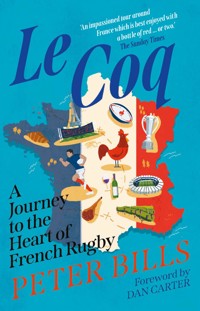
'An impassioned tour around France which is best enjoyed with a bottle of red ... or two.' The Sunday Times 'I've known Peter for some years and I'm sure you will enjoy his personal journey to the heart of rugby in this superb country.' Dan Carter, Former All Black and Rugby World Cup winner 'Bills' wondrous travelogue features so many great tales from the mouths of legends.' Irish Independent 'I really enjoyed this book ... A great memoir of France and its people through the eyes of rugby.' Michael Lynagh, TV analyst and Australian Rugby World Cup winner 'Wonderful! This is a great read. I simply loved it and I am sure that many others will also.' Bob Dwyer, Australian World Cup winning coach 1991 From French rugby's origins in Le Havre to the Catalan coast, acclaimed rugby writer Peter Bills travels the length and breadth of France, visiting the big cities and regional heartlands of the game, to reveal a country whose deep love of rugby has created a culture and playing style like no other. Featuring exclusive interviews with many of the greatest international players to have played club rugby in France, from Ronan O'Gara to Dan Carter, as well as French legends of the sport, from Serge Blanco and Jean-Pierre Rives to Antoine Dupont, Le Coq brings to life the passion, colour, excitement, characters, anecdotes, locations and great moments of French rugby's near 150 years of existence. Former French Grand Slam captain Jacques Fouroux talked of 'Rugby; the game, the life'. This book will show you exactly what he meant.
Sie lesen das E-Book in den Legimi-Apps auf:
Seitenzahl: 513
Veröffentlichungsjahr: 2023
Das E-Book (TTS) können Sie hören im Abo „Legimi Premium” in Legimi-Apps auf:
Ähnliche

















To Gabriel, in the hope he too will come to love La Belle France.
And to my great friends throughoutFrance whose generosity and kindness have been omnipresent down the years.
Peter Bills was chief rugby writer worldwide for the Independent newspaper group, contributing to publications in London, Dublin, Auckland, Belfast, Cape Town and Johannesburg.
He was also the Number 2 rugby writer for The Times in London and has been a columnist for Midi Olympique in France and the Sydney Morning Herald in Australia.
His most recent book, The Jersey, an exclusive inside account of the All Blacks and New Zealand rugby, has become an international bestseller.
First published in hardback in Great Britain in 2023 byAllen & Unwin, an imprint of Atlantic Books Ltd.
This paperback edition published in 2024.
Copyright © Peter Bills, 2023
The moral right of Peter Bills to be identified as the author of this work has been asserted by him in accordance with the Copyright, Designs and Patents Act of 1988.
All rights reserved. No part of this publication may be reproduced, stored in a retrieval system, or transmitted in any form or by any means, electronic, mechanical, photocopying, recording, or otherwise, without the prior permission of both the copyright owner and the above publisher of this book.
Photography credits: Pages 231 and 237, photographs by Stade Toulousain; all other featured images courtesy of the author.
Every effort has been made to trace or contact all copyright holders. The publishers will be pleased to make good any omissions or rectify any mistakes brought to their attention at the earliest opportunity.
10 9 8 7 6 5 4 3 2 1
A CIP catalogue record for this book is available from the British Library.
Paperback ISBN: 978 1 83895 605 9E-book ISBN: 978 1 83895 604 2
Printed in Great Britain
Allen & UnwinAn imprint of Atlantic Books LtdOrmond House26–27 Boswell StreetLondonWC1N 3JZ
www.atlantic-books.co.uk
Contents
Foreword by Dan Carter
Prologue
1 The Ruggers of HAC: Le Havre–Paris
2 City of Mayhem: Paris
3 The Journey South: Paris–Bourges–Vichy–Clermont–Ferrand
4 The Lost Corridor: Strasbourg–Lille–Besançon–Dijon–Mâcon–La Voulte-sur-Rhône–Cavaillon–Nice
5 A Day at The Lake: Sète
6 A Litany of Tragedies: Sète–Béziers
7 Split Personalities: A small town, a quiet South of France café. For reflection on the violence...
8 The Elixir of Life... and a Force of Nature: Béziers–Narbonne
9 La Ville Rose: Narbonne–Castelnaudary–Toulouse–Auch
10 Peter Pan and The Legend of Lourdes: Auch–Lourdes–Bagnères-de-Bigorre
11 The Man Who Put Men To Sleep: Biarritz–Bayonne–Perpignan
12 Way Out West: Mont-de-Marsan–La Rochelle
13 A Golden Era: Toulouse–Castres–Narbonne–Perpignan
14 The Rugby-Loving Abbot: Clermont Auvergne–Toulouse–Albi–La Rochelle
Acknowledgements
Bibliography
Foreword by
Dan Carter
I fell in love with rugby when I was five years old and it was all off the back of the inaugural Rugby World Cup in 1987.
I still remember very vividly the World Cup final, the All Blacks against France. Yes, we went on to win that World Cup and, from that moment, I always wanted to be an All Black. But at the same time, I learned about this French style of play, about Serge Blanco, Philippe Sella and French flair rugby. It captured my imagination. Then fast-forward to 2009 when I got the opportunity to come to play in France. I wanted to experience it for myself.
I was lucky enough to come and play on a short-term contract at Perpignan and it was an amazing insight into the passion of French rugby. I always knew from the TV the style of rugby they played, but I didn’t understand the passion of the fans. Going to the holy grail, I remember the stadium in Perpignan, the Aimé Giral, and to see their supporters and the chants and the singing, they just put their heart and soul into the team that they were supporting. That blew me away; I hadn’t experienced anything like it.
I decided to go on and help them that season, even though I got injured. I stayed because I wanted to support the team and they went on to win their first Bouclier de Brennus in fifty-four years. I will never forget that night.
The final was played in Paris and then we flew back the next morning to Perpignan. We landed at the airport and there were people all the way from the airport to the city centre, cheering and being so joyful. They wanted to celebrate with us. We went into the city centre to present the Bouclier to the city and there were tens of thousands of people who’d come to celebrate with us.
There were supporters in tears. It was incredible to see how much it meant to them, and in the world we live in it’s nice to be able to give the people of the city that you play for so much joy to take their minds off the distractions or difficulties they have in their lives. It was about coming together for a common cause, to support their team and in turn to have success and bring such joy. It’s a great part of the game that I really enjoy.
It’s so hard to describe in words the feeling, the emotion, it’s almost like being a part of the supporters’ lives. It was a very proud moment of my career.
That whole experience just ingrained another level of how much passion there is for this game in France and even though it was only a short-term contract, there was a part of me that said I needed to come back and play in France longer.
I went back to New Zealand to continue my career and the opportunity came about again at the end of the 2015 Rugby World Cup when I had finished playing for the All Blacks. At that stage my focus was to come back to France and play for a team that had huge aspirations to be successful and to win titles. I found that with Racing 92.
The Racing Club de France has an incredible history dating way back so when I came to Racing, I was trying to experience this tradition. The best way to do that was to try and win a Top 14 title.
Happily, we managed to do that in the most incredible fashion. Even better, it was in a game in Barcelona at the massive Nou Camp, a stadium that I used to go to all the time when I was living down in Perpignan to watch the Barcelona football games. To be suddenly playing in front of 100,000 people in a Top 14 final was mind-blowing, an amazing experience. I loved being a part of that. To have come to Racing and had success straight away, I could see how much it meant to the club.
For me, the toughest places to go and play rugby in France were down south. Somewhere like Toulon. If I had to play against Perpignan, I’m sure that would be one of them. But Toulon was a very hostile environment. They’d had a lot of success at the time I was playing there. But then every little place has its own character. Like Clermont Auvergne who at one stage, in 2014, had gone seventy-seven matches unbeaten at their Stade Marcel Michelin. You could almost go through all the different teams and see how passionate their supporters were.
Paris has its challenges when it comes to rugby. But even though the history with Racing and Stade Français goes back such a long time, you still know about the rugby down in the south, it’s a way of life down there. In Paris with there being so many other competing sports, there was plenty to occupy people at weekends so it didn’t quite feel the same.
But at Racing we had a very loyal supporter base that would always be there. We played in an environment at Stade Colombes that had so much history at the stadium. I’m sure teams didn’t like going to play at Colombes under the old grandstand that felt almost like it was going to creak and fall down before the game. But I absolutely loved that.
When it came to cuisine, I’m happy to say, I tried it all from frogs’ legs to snails! I had to give it a go to immerse myself in the culture – the foie gras, cheese, pastries; it was a very dangerous place. I had to make sure I did plenty of training to burn off the incredible food that I was able to experience.
The French take so much pride in their cuisine, the food is amazing. Just the number of different restaurants that you can go to that are world class, is incredible. It’s not like you’re trying to pick the top five or six world-class restaurants, they are all superb.
Just going down to the local boulangerie, the local bar or brasserie, just hanging out with the locals close to where I lived, was something I enjoyed doing as well.
I came to France wanting to immerse myself in the culture, and wine is a huge part of that. I wanted to learn about wine but I was a bit intimidated because there is so much history of wine in France, I didn’t know where to start.
But looking at Paris, so close to the Champagne region, I focused on champagne. My wife and I love drinking champagne, so we’d spend quite a few of our free weekends heading out to the area and experiencing the cellars of the different maisons and just learning about the history.
It meant I gravitated towards champagne, but with Jacky Lorenzetti (Racing’s president) owning several chateaux in Bordeaux, he steered us in the right direction to some good Bordeaux wine too. Obviously coming from New Zealand, where the major grape variety is pinot noir, it’s hard to go past a good Burgundy as well. So you are spoiled for choice here in France.
My whole French adventure contained experiences that my wife and I will always look back on with pride and pleasure. To have experienced the French way of life is something we’ll treasure forever.
Now, we just love coming back because we’re not tourists any more. We have our favourite restaurants, our favourite bars that we love visiting again and again. And then there are the people and characters who feature so prominently in this book by Peter Bills.
I’ve known Peter for some years and I’m sure you will enjoy his personal journey to the heart of rugby in this superb country.
Prologue
In 2021, amid the Covid pandemic that had engulfed the world, a rugby match was played in France deep in the heart of the Basque country. Biarritz and Bayonne had long been rivals, the two pre-eminent clubs of the entire Pays Basque region since the diminishing of Saint-Jean-de-Luz as a playing power.
But this was no ordinary game, early as it was in the opening up of French sport to spectators after the long nights of self-isolation caused by the disease. Bayonne, clinging on to their prized Top 14 place all season, had to beat their fierce local rivals in the play-off to remain in the top flight. Biarritz, five-time champions of France and European Cup runners-up in 2006 and 2010, needed victory to return to the top level for the first time since 2014.
Given that this would be a match attended by spectators for the first time, just twenty-four days after the government announced a partial lifting of the restrictions that had closed stadium grounds, this was a delicate, significant occasion. Discussions with the authorities concluded with agreement that 5000 would be the maximum number permitted inside Biarritz’s Stade Aguilera; 2500 tickets for the home club, 1500 for Bayonne with 1000 for assorted others.
Long before a ball was kicked on a hot, sunny and increasingly dramatic afternoon, it was obvious that the authorities, in attempting to keep a lid on Basque passion for rugby, had filled a large bottle with nitroglycerine and then given it a good shake.
Within fifteen or twenty minutes of the start, even those without tickets outside the ground had found the stadium’s defences porous. So, in they poured. There are 9500 seats in the Stade Aguilera; 4950 in the Kampf stand, 4500 in the Blanco stand. The total capacity is 13,400.
For the play-off, not a spare seat was to be found. Add on another 4000 or so just milling around and finding whatever vantage point they could, and you had a crowd of about 13,000.
The local prefect, party to the agreement that no more than 5000 should attend, watched this invasion of the hordes with increasing dismay. A nervous club official offered a hurried explanation.
‘It would appear,’ he said with an air of solemnity, ‘we have had a problem with the automatic ticketing system.’
Only problem was, Biarritz did not possess an automatic ticketing system.
The prefect, his face darkening by the moment, stood up theatrically at half-time and announced, ‘I have been deceived.’ At which point, he left the ground.
Alas, it got worse. Much worse.
A match wracked with tension throughout finished level at full time with the score 3-all. Then, an extra twenty minutes were played. At the end of which it was 6-6. Amid fever-pitch excitement, a hasty conflab ensued. A penalty-kick competition then began with the first ten kicks, five each side, successful from the 22-metre line in front of the posts. People were beside themselves with passion and tension, sharing bottles of champagne and wine, kissing each other, singing and waving their flags. Some just couldn’t look, others were already crying. This outpouring of emotion spoke of the Basques’ undiluted love for this game.
Alas for poor Bayonne, their sixth attempt failed. Up stepped an Englishman, Biarritz’s Steffon Armitage, to land the kick that sent his club back to the Top 14 after eight years. Mayhem ensued.
Firecrackers exploded, smoke beacons lit, more bottles of champagne and wine plus cans of lager were opened and shared around. Thousands invaded the field. The Biarritz players were hugged and hoisted shoulder-high; their fans danced deliriously with delight. Not a soul gave a thought to social distancing, that novel phrase of those times, nor indeed even the wearing of a mask. Health considerations had vanished.
Nor did anyone imagine that just twelve months later, in June 2022, the roles would be reversed. Biarritz would tumble back down to Pro D2 league, a final day 80-7 thrashing at Toulouse confirming their inadequacy for the Top 14. But who should be sailing past them in the other direction at the end of the 2021/22 season? Bayonne, after hammering their rivals Mont-de-Marsan 49-20 in the play-offs. How times change.
Twelve months earlier, the authorities had spoken furiously of sanctions in the light of events at the Biarritz ground. But this surely was just another example of French flouting of laws and rules, allied to an intense passion for the sport.
Unbelievably, it got worse that night. A strict French government Covid curfew had been in place from December 2020. In June 2021, it had been stretched to 11 p.m., but it still applied throughout France. I happened to be at dinner at a small, delightful restaurant near the centre of Biarritz, and glanced at my watch. It was 10.30.
‘I suppose then we’d better head back to the hotel,’ I suggested to my French travelling companion. He looked bemused, as if I had ordered a bottle of English beer with the Chateaubriand. ‘A curfew? In this town tonight? There isn’t a policeman in the whole Pays Basque who would dare enforce a curfew tonight.’
The author can vouch for the veracity of that statement. Closer to half past one in the morning, with supporters still streaming through the town and drinking at the bars that remained open, there wasn’t a single policeman in sight. Curfews might be for some but not Biarritz on the night of their promotion. The French make their own rules in such circumstances.
As French rugby legend Serge Blanco, a Biarritz man all his career, said afterwards, ‘We beat Bayonne, a Basque match. It was fantastic, like we had won the World Championship.’
And speaking personally, it was fantastic to be back in the heartland of French rugby. That always induced a frisson of pleasure. Not to say excitement. Past games re-entered the mind, the soul and spirit lifted by thoughts of great rugby men encountered. On and off the field.
For me, it has been so throughout my life. I first went to Paris to see an international match in 1970 at Stade Colombes. But four years earlier, I had stood on the terraces at the old Cardiff Arms Park to witness the flair and innovation of a French team that included both Boniface brothers, Michel Crauste, Walter Spanghero, Jean Gachassin, Christian Darrouy and Lilian Camberabero. Among others!
I first encountered a French Rugby Championship final in 1973, Dax v Tarbes. The drama, colour and excitement made it like watching the game on another planet compared to the sober, sane games played at that time in English club rugby.
Just 22 miles separates England from France. But in almost every way, it could be tens of thousands of miles. Everything is different. Language, philosophy, mentality, cuisine, customs and attitude towards sport. Especially rugby...
* * *
Pierre-Auguste Renoir could paint an alluring scene of such beauty, viewers sometimes sat entranced for long periods, studying a single work.
Then there was Claude Debussy, who penned a musical line of such serenity that even fighting cats might stop and listen. As for Sacha Distel, well, let’s just say he could croon with the best of them.
Each Frenchman illuminated his own genre, contributing richly to his nation’s culture.
Others in myriad fields offered their own talents. Take the men of French rugby. With a glorious enthusiasm for the game and an often total disregard for its rules, skilful Gallic rugby men down the years have ensured that rugby has become as embedded in the French psyche as a plump clove of garlic. The game has contributed richly to French culture.
For rugby was, and remains, an endemic part of French life. Mind you, complex would be a wholly inadequate way of describing this association, this love affair with a game.
As someone once wrote, ‘If you want to interest a Frenchman in a game, you tell him it’s a war. But if you want to interest an Englishman in a war, you tell him it’s a game.’
A game for gentlemen? Tell that to the victims of French brutality on the rugby field, those searching a muddied field in the after-match gloaming for a couple of uprooted teeth, lost amid the more fractious moments of a so-called game. Try telling that to the family of the now deceased Racing Club forward Armand Clerc, blinded in an eye for the remainder of his life by a punch thrown into his defenceless face amid the hurly burly of a line-out.
Then there were the fist fights where grown men squabbled like territorial geese.
Of course, you would never find such acts mentioned in rugby’s rule book. But that was the key in understanding why France fell so passionately in love with a game introduced to them by the English. The obvious capacity to evade or simply ignore most of the rules struck a warming chord with the French mentality. It chimed with an inherent French trait.
In 2022, it was the 150th anniversary of the first rugby club establishing firm roots on French soil. The club, at Le Havre on the French north coast, was founded mostly by students living and working in the Channel port from Oxford and Cambridge universities.
With precision timing, the French national team marked the occasion by winning a rare Six Nations Championship Grand Slam, their first for twelve years. But what was of far greater significance was that it was achieved with a perfect mixture of traditional French style allied to the demands of the modern game: discipline, defensive security and concentration, plus kicking for strategic benefit. They were patient, too. In both attack and defence. So unlike the French. But this was the new France being created before our eyes.
The old style of French teams, cheerfully prepared to fling a risky high-percentage pass and see an entire movement consequently founder, had been replaced by a pragmatism demanded by the rigours of the modern game. Yet gloriously, France showed they could still craft thrilling, precise tries that lit up the stage, just as their most exciting players used to do. It was their hallmark, a spark residual in their souls.
But this new Gallic squad of players also demonstrated the progress they had made in coming to terms with rugby of this age. Gone, to a large degree, was the petulance, the emotional explosions that so often ruined any chance of continuity. Acts of wilful violence had likewise been largely discarded. This was radically different to days gone by.
In its place came dedication to a clear strategy. For example, only Italy kicked more times than France in that Six Nations season. The Italians booted the ball 169 times in five matches, France 151. Yet they kicked for territorial advantage and all the while retained that inbuilt ability to captivate an audience with a stunning moment of elan and style, most often executed at pace.
By clinching the coveted Grand Slam, these French players revived again all France’s great love for this game. Their achievement fitted neatly into the intriguing overall story of how rugby union energised the entire French nation from the start.
Rugby spread at such a rapid rate across France because it offered activities so beloved of Frenchmen down the ages. Personal differences could be settled without recourse to the law. The arbitre, the referee, was no more than a token presence. Those wishing to sort out opponents for whatever reason could do so largely with impunity. Perhaps there might be a disapproving, wagging finger in response. But this was not serious retribution.
For breaking the rules was always a significant element of French culture. It is buried deep in their DNA. I have a friend who used to boast that he hadn’t paid a single parking fine in over three years. By then, whilst living in Paris, he had amassed well over sixty tickets. Many lined his living-room wall, a kind of constant taunt to the French traffic authorities. Frenchmen from all walks of life like to feel they have ‘got one over’ the authorities.
For the truth is, real power in France lies not in the hands of those in the National Assembly or the Senate. Still less, the Élysée Palace. It is in the grasp of those on the streets. If the French public announce themselves against a new law, a decree, then presidential wishes go up in smoke, like a pack of Gauloises.
People don’t go to their representatives to complain about things. They take to the streets.
Late in the year of 2018, a new protest movement sprang up in France. It was called les gilets jaunes, the yellow vests movement. A populist grass roots protest movement for economic justice, it sought to remind French President Emmanuel Macron of the capacity of the people to cause mayhem on French streets. What is more, the protests that ensued were a mirror image of some of the violence often seen in French rugby. Certainly, in earlier days, if there wasn’t violence on the streets on a particular day, the next likeliest place to find it would be the rugby ground.
All this struck a deep chord with those of a historical bent. Robespierre’s day may have been long done, but the spirit of protest and resistance to authority flourishes to this day in France. As renowned ex-French President Charles de Gaulle once remarked sulkily, ‘How can anyone govern a nation that has 246 different kinds of cheese?’
Of course, it has got much worse since De Gaulle’s day. France now has more than 2000 cheesemakers in its midst.
Daft laws seem to bedevil the French. At a recent count it was found that there are around 10,500 laws and 127,000 decrees in France. Until recently, these included the right to marry a dead person (honestly, I am not joking), or your first cousin. I called up the guy in charge of the marrying the dead programme to find out more.
I mean, after all, how does that actually work? Do they exhume the skeleton from its grave and then call in a very good ventriloquist to speak the actual words of the marriage vow?
‘Do you take this man to be your lawful wedded husband?’
‘Well, I do but there was not much choice.’
But the bloke running that department, a guy by the name of Frank N. Stein, wasn’t very communicative. And I got short shrift when I dropped it into the conversation with a cousin that maybe we should get hitched.
Until as recently as 2013, there was a law in France which banned women from wearing trousers in Paris. Even today, board shorts are still forbidden in public pools. Meanwhile, photos taken of the Eiffel Tower at night still violate French copyright law. Good luck with enforcing that one now the coachloads of tourists are returning to the French capital.
Mind you, it isn’t just the French who have to live with stupid laws. For a long time, it was still legal for an Englishman to shoot someone from Wales with a longbow. I’m surprised no one thought of that when Gareth Edwards was torturing England’s rugby men on an annual basis through the late 1960s and 1970s.
For years, the French were deemed unsuitable competitors in the Five Nations Championship.
The four Home Unions – England, Scotland, Wales and Ireland – gathered in 1931 in response to reports of French illegalities in their rugby and declared, ‘Matches will not be resumed with the French until the control and conduct of the game in France has been placed on a satisfactory basis.’ The ban lasted until 1947.
It was said that twelve French clubs were openly paying players, something abhorred by the Home Unions in a strictly amateur game. Just as bad, player violence in French rugby was seen as endemic by the home nations. Although, for Welshmen familiar with robust, full-blooded (and bloodied) affairs within their own highly competitive club structure to sit in judgement on the French, surely risked accusations of the pot calling the kettle noir.
But the French rugby authorities could not stop or control their own clubs or players for a simple reason. No one could. The French had taken to this new game with such relish that they transferred that lingering delight for street protests, the flouncing of authority and punch-ups on to the rugby field.
Better still, the presence of thirty players on the same field offered wondrous opportunities for retribution. Hidden within the inner confines of a scrum, ruck, maul or even line-out, all kinds of nefarious activities were possible, from the sly kick to the sudden punch. Why, you could even hide the odd psychopath or two within the bowels of the scrummage. Several clubs did. All was seen as fair activity in love and war. The French were largely bemused by their ban from the Five Nations Championship.
What was a rogue boot here and there, a punch of passion amid the intensity of the game? It mystified Frenchmen then, and still does to this day, that such activities were tolerated in England, Scotland, Wales and Ireland with the traditional blind eye, but abhorred whenever they occurred in France. What if the occasional blind eye resulted?
As a French friend of mine said, ‘For me, playing rugby was like playing truant from school, taking my role models from extraordinary characters in the game, and their attitude to life.’
In other words, being unconventional. But alas, the English didn’t really understand such mentalities. Mutual suspicion and loathing, the long-held elements of the fractious Anglo-French relationship down the ages, again took root. These old foes regard each other with the snarling suspicion of cat and dog.
The French film actor Jean Gabin put the old, troubled relationship into context when arriving in New York during the Second World War. Asked about the French attitude towards the British, he responded, ‘We are both pro-British and anti-British. Those who are pro-British say every night in their prayers, “Dear God, let the gallant British win quickly.” Those who are anti-British pray, “Dear God, let the filthy British win very soon.”’
Given that the game of rugby was first seen on French soil in the early 1870s, it might be reasonable to speculate that the English felt France may have been in need of some sporting distraction, after the tragedies of the 1871 Paris Commune. The short-lived Commune was ended by the intervention of the French Army during a bloody week in May 1871. Thousands of Communards who had rushed to defend democracy and their rights died either in battle or on the guillotine. Officially, authorities said six to seven thousand perished; others estimated it to be nearer 20,000.
Georges Darboy, the Archbishop of Paris, and others were taken hostage and shot in retaliation. The whole affair underlined French citizens’ suspicion or hatred for the authorities. It is a flame that continues to burn to this day.
Yet against this unlikely backdrop, a simple game invented by the English was taken up with fervour by many Frenchmen. What is more, once it arrived, it spread like a forest fire. Quickly, great swathes of France were caught up in the excitement of the new game.
But then, as we shall see in these pages, it was not just the game itself which quickly captivated the French. As a contest and an element in social life, it represented many different things to different people. This new game appealed to many Frenchmen’s sense of joie de vivre, their concept of fun. They loved the social aspect of the game, the fact that when hostilities ended on the field, the tradition was for all, teammates and opponents, to gather and enjoy a drink together.
Uniquely, and unlike in England, it was a game that crossed all social classes and wasn’t confined to elite schools. The local butcher might scrummage with a café owner and a fireman beside him. A young farm worker might deliver the ball into a scrum and a lawyer receive it when it was heeled. A dashing wing could be a medical student, with a builder playing inside him.
This intermingling of all French social classes was one of the triumphs of the young seedling inspired by the students of Oxford and Cambridge. It broke down barriers and brought complete strangers from all walks of life together. It was never like that in the UK, which may explain why rugby in Britain and Ireland has never become THE national sport.
Most of all, it was regarded as a game where what happened on the field, stayed on it. What was the odd missing tooth or bloodied eye? One well-known French rugby forward had his nose broken thirty-seven times during his career.
Another factor proved a strong element in the game’s growth and popularity. Local pride and honour have always been imposing aspects of French life. It was true then and remains so to this day, albeit perhaps weakened somewhat by the tide of professionalism and pursuit of money.
Although, as we will see, money was changing hands in French rugby from comparatively early times. But with a few of those traditional Gallic shrugs, the French just kept on ignoring the rules.
If they didn’t like them, they simply carried on regardless. Something of the sort still applies today in most walks of life in France. Changing that philosophy would be about as easy as moving the Eiffel Tower a bit to the left.
As the former Castres player, Stade Français coach and current coach of Argentina, Michael Cheika, says, ‘I just think there is something much more tribal about French rugby than any other place. It applies at all age groups and all levels. It’s so different. Over here, you are playing for your town or city and the town’s evolution is all wrapped up in the development of its rugby club.
‘That’s one of the reasons why so many multinationals based all over France are associated with local clubs. The people who run those organisations grew up in a lot of these towns and understood the rugby association and what it meant. They knew how important rugby was in the landscape. They get involved because they see it’s a great way of getting kudos in their local area. Because, in reality, these rugby clubs are very often the talk of the town. The president of the rugby club is the boss of the town in many ways.’
What of that tribalism which outsiders like Cheika attribute to local pride? In some of these regions, there have been local conflicts or battles going back centuries. When these local teams play each other, sometimes you can imagine what went on all those years before.
Cheika says, ‘There is a lot more of that bravado in France, like “Don’t cross my city’s lines” sort of thing. The Anglo-Saxons are physical, but they will keep more within the laws of the game. The French are different. You have to put a lot of focus on the area around regions and towns such as Narbonne, Béziers, Perpignan, Castres. Perhaps it goes back to the history of such areas and the way they used to fight amongst each other.
‘Every team thinks the other is worse but of course it’s like the pot calling the kettle black. It is about bravado, about players thinking they don’t want to be seen as weak and therefore they will impose themselves right from the start.
‘But I think the French are quite good in the sense that they accept it for what it was in those times. Back in those days, the players who did those things like fighting, throwing punches, were lauded as heroes of the town.’
Finally, there was yet another intrinsic reason why the French took so readily to this Anglo-Saxon activity. To engage in this sport, particularly to catch a ball, seek open space and then run like the wind for the opposition line for the glory of scoring a try, represented one of the core elements of the French creed. Namely, liberté, égalité, fraternité.
This trait remains to the present day. Listen to France fly half Romain Ntamack after his brilliant attacking run from his own goal line, in a match against New Zealand in November 2021.
‘I thought of nothing! It was so quick, I didn’t have time to think at all. It was two seconds... in which time... I took the decision to try to get myself out [of his in-goal area] and from the moment when I broke the first tackle, I just accelerated downfield. But I had no time to reflect on what to do.’
It proved that spirit of adventurism, the innate pleasure of feeling ball in hand and the opportunity to run free, remains a critical element of the French rugby player’s DNA. Welshmen, Irishmen, Englishmen, Scotsmen, South Africans, Australians and New Zealanders – we should all celebrate that. For the game is immeasurably richer for such talent.
To feel liberated within a game, running from those wishing to tackle and ensnare you, appealed to every participant. Égalité meant social and political equality, eminently suitable for a game played by all classes of people from every background.
Meanwhile a fraternity, strictly speaking, was an organisation, society, club or fraternal order traditionally of men closely linked to various religious or secular aims.
It was a short hop from there to adapt the so-called club or organisation to a rugby club. Thus, France’s core elements of its society in the nineteenth century fitted rugby’s requirements like a glove.
What the French brought to this new game was a cornucopia of creativity and invention. They are an inspirational, creative people. How else could they fill all those wonderful museums throughout their land with brilliant paintings, sculptures, etc?
On the rugby field, they created space and movement, offering scoring opportunities not just for themselves but those around them. As Australia’s 1991 World Cup-winning coach Bob Dwyer says, ‘The French are able to make space for those around them on a rugby field better than any other nationality I know. Most countries’ players can make space for themselves. Few can make it for their colleagues, certainly not to the degree achieved by the French.’
In the artist’s gallery or music room, men like Renoir, Debussy and Distel flourished in creating beautiful paintings or sounds. Others applied their great artistic bent to the kitchen, so much so that they established for their nation a traditional position of world leaders in the field of cuisine. All settled comfortably into the category of great creativity. It is only fair to say, rugby union the world over has benefited immeasurably from the application of that creative French talent.
There had to be other reasons for the French embracing this game so wholeheartedly, other than a basic desire to duff up some guy from the next village whom they didn’t particularly like. These were some of them.
Yet too much tut-tutting from the other side of the English Channel and the Irish Sea bedevilled relationships with French rugby men for too long. Thus, it is appropriate, in telling the story of how France embraced an enduring love affair with this game, that we should celebrate the qualities brought to the sport by the French. They are many and varied and have contributed richly to the game’s huge global following in contemporary times.
The French took up rugby union with all the zeal and freneticism of two lovers beginning a relationship. Of course, as with lovers, sparks have flown, but the passion of France for this game remains true to this day. To see and share that intrinsic love and support for the game is to experience a unique atmosphere and pleasure.
In this book I set out to retrace the original spread of rugby south from Paris to most of the regions. I wanted to discover the soul of French rugby and explore why it has become so integral a part of French culture.
I knew that the south-west represented the core of rugby in this land. But by no means only the south-west. And not only at the level of senior clubs, the likes of Toulouse, La Rochelle and Montpellier, the 2022 French champions. Junior clubs abound and flourish.
I wanted to meet some of the great living characters of the game and pay tribute to past greats now sadly departed. Above all, I wanted to see just how this game continues to capture the imagination of people at all clubs.
The journey was truly a trip to la France profonde.
CHAPTER 1
The Ruggers of HAC
Le Havre–Paris
September 1872. France is a nation in dire need of stimulus, a better tomorrow than today.
By May 1871, the Paris Commune has been brutally suppressed by the French national army. Spirits are low, times difficult. Yet certain elements will come together to raise hopes, expectations. Napoleon III’s rebuilding of Paris, masterminded by Baron Haussmann from 1853 to 1870, is largely completed. Old medieval neighbourhoods have been demolished, the city has been beautified and doubled in size. Citizens stroll in popular locations like the Tuileries Garden as much to be seen as to see. For the better off, it is a world of music, books and lively debate.
Yet an odd time, you might just think, to launch a new sport. Its name is rugby.
It is launched in an even odder place. Yet with business and trade booming as the 1870s develop, a group of students from Oxford and Cambridge universities find themselves working in the Channel port of Le Havre. Together with some other expats, like railway worker F. F. Langstaff who is helping develop a rail system in that region, it is they who introduce the new game, rugby union, into the country.
Together with friends, Langstaff becomes the first president (1872–84) of the Havre Athletic Club (HAC), which he starts to organise. The early idea of a hybrid version of soccer and rugby is quietly dropped, leaving two sections, one for association football, the other for rugby.
They find an appropriate site in a nearby commune connected to Le Havre: Sanvic. Located in front of the church this land, rented for 600 francs a year, begins to be used from 1882. It is still used by the rugby section and was given the name Langstaff Stadium.
Around 430 miles away, something similar was happening on the Atlantic coast at Bordeaux, where young Britons were trading in the wine business. Here, too, the message was being spread about this new game. Before too long, a club formed at Bordeaux would become one of the best. Stade Bordelais would win seven French Championship titles between 1899 and 1911.
At Le Havre, they called their young players ‘the ruggers of HAC’. They sought fun and frivolity in a social and sporting activity.
The first Le Havre club, founded on 14 September 1872, had the name ‘Havre Football Club’ until 1884 when it was rebranded as ‘Havre Athletic Club’. Thereafter, Le Havre revelled in its reputation as the cradle of both sports in France.
Yet for all the optimism of its early founders, the new club on the French coast had a rude awakening at its first match, on the other side of the Channel at Southampton. It was a game of twelve-a-side and the expats got a hammering.
The Hampshire Advertiser newspaper dated 15–22 February 1873, announced it thus:
GRAND FOOTBALL CONTEST.
Havre v Portswood Park Football Club.
A match will be played at the Antelope ground (in Southampton) on Wednesday, the 19th instant, between the Havre and Portswood Park Football Clubs at 3 p.m. A dinner will be given at the Philharmonic Rooms at 6.30 p.m. the same evening. Tickets (including wine) 15s. To be had of Mr. Dartnall, High Street.
A large attendance is expected and those who are present may be sure of witnessing some good and spirited play on both sides.
So they set off, these brave pioneers of this new game, boarding the steamer Fannie at Le Havre docks. The irony was that Portswood had initially invited them over to play a cricket match, not rugby or football.
The result was:
Portswood Park: 1 goal, 11 touchdowns, 11 rouges (an undefined score).
Havre: 1 rouge.
So, twenty-three ‘scores’ to one. And lucky to get the one, as someone might have said.
The report went on: ‘At the [after match] dinner, the viands [meats], dessert, wines being all that could be desired. Admirable catering by Mr. T. Dartnall. The room was decorated with flags and tables were decorated with some choice flowers and plants.’
One of the Havre players, George Washington who was Reverend of the Anglican church in Le Havre and a professor at the lycée in the town, said simply of his team’s day, ‘Battu, mais content’, (beaten, but content).
The report concluded, after many toasts had been drunk to notable members of each club, Her Majesty Queen Victoria and the French President Adolphe Thiers: ‘The Havre team returned to Havre in the Fannie at 12 o’clock (midnight), many who were present at the dinner accompanying them to the docks and bidding them good-bye.’
Few could have imagined that their exertions that day would pave the way for a sporting contest between English and French clubs that would last for 150 years and more. Truly, from small acorns grow mighty oaks.
For those involved in founding the first club on French soil, the likes of Frederick Field Langstaff (the club’s first president), his son William Ramsay and other keen protagonists like C. E. Gabain, the day’s outcome must have come as a rude shock.
The oldest image of these men surviving to this day shows a team photograph, the players seated or standing casually with Langstaff senior proudly seated in the middle of the front row. Among his young charges in their playing kit, he is wearing a dark coat, top hat and gloves. He sports a bushy white beard over much of his face.
Early in French rugby’s days, probably in the late 1880s or 1890s, another intriguing photograph was taken.
The image, captured from behind one touchline at a match, shows a line of twenty-five men, all seemingly in suits. Most are wearing bowler hats; a couple have cloth caps. Some are seated on rough wooden benches, others lean against a metal rail. On the extreme right, there are two ladies in long dresses, wearing bonnets. Not a face is turned to the photographer; all are studying the play intently.
On the field, just about every visible player has a moustache.
The fashion of those times decreed that many players took to those early matches wearing black berets. Some had belts around their waists, too. Today, more than a century later, you look into their eyes as they face the camera for a team photograph, and you know their fate. The horrors of the First World War would ensnare far too many.
Unlike in England where it became a sport chiefly for the upper classes, nurtured in private schools, in France rugby was never going to remain exclusive to a small grouping for one reason. The French working class quickly took up the game.
This catapulted the game into the villages and towns of the land. Once there, it attracted all social classes and became emblematic of a contest that challenged local rivalries. A village or town could take on its nearest rivals for local bragging rights. It might sound trite or unsophisticated to twenty-firstcentury attitudes, but in an era when the focus of everyday life was on local areas, when universal travel had not yet become commonplace, it was the ideal activity to assert supremacy.
Yet there is a major uncertainty over all this. For the fact is, there may well have been a sporting precedent for this new game, buried deep in the archives of French history.
La Soule was a ball sport played in medieval times in France. It could often involve hundreds of players and spread over a vast terrain. The idea was to seize the ‘ball’ from any number of opponents and, with the help of your friends or teammates, take it back to a specified ‘goal’ in your home town or village.
The ball, named a soule, could be made of leather or even the odd pig’s bladder. The leather variety was usually stuffed with horsehair or hay. It is said to have originated in the Normandy and Picardy regions of northern France.
What is fascinating is that in the mid-1800s, a Frenchman named J. L. Conde sat and sketched a scene from this very game. A large throng is seen as the central focus of the sketch. At the front, several characters appear to be scrapping for possession of some object, presumably the ball.
One man is on his knees with another splayed out below him on the ground, with the suggestion some blow is about to be struck against a rival. I looked closely and thought I could detect the assailant wearing a Pontypridd rugby shirt. But I may have been mistaken. No matter, hats are hurled into the air.
Meanwhile, from behind a large tree, two petrified-looking women observe the scene. They protect their youngsters carefully from the mob which is more than 100-strong.
In the background, there are some typical French nineteenth-century buildings.
The pencil sketch was published in a French newspaper, L’Illustration. Intriguingly, the caption reads ‘La soule, en Basse-Normandie.’ It is dated February 1852 – almost exactly twenty years BEFORE it is widely believed rugby was introduced to France, in Normandy. Remember, Liverpool FC rugby club, the oldest in the world, was not founded until 1857.
So were the French, in fact, playing a larger, albeit more disorganised version of rugby football even before the English? It may be possible. Rather like a form of ‘football’ was played across Britain in the centuries before association football and rugby football was ever invented. Perhaps La Soule was only another version of this sort of traditional sport played out between communities and teams of many dozens of players.
What this medieval game or pursuit of local roots may also reveal is the origins of that near fanatical pride among Frenchmen in their home town or village, a trait that remains to this day. Whether it be engaged in La Soule or the coming game of rugby union, Frenchmen defended the reputation of their territory with a zeal that often spilled over into violence.
What is clear is that this was intrinsically a rough sporting challenge. If teeth got loosened or opponents knocked out, that was seen as no more than par for the course. Fair retribution was similarly a key ingredient.
At Le Havre, they had started playing on ground near the Avenue Foch and the Boulevard François 1er, but in 1882, after what was described as ‘several misadventures’, a ground was lent to them near the Église Sanvic.
Inevitably, the growing club attracted those visiting the town or sent there in pursuit of their business, like the Welshman, Basil G. Wood, said to be a trader in coal, and Julius Meyer, a cotton trader. As the club progressed, men such as W. H. Crichton and E. W. Lewis became French internationals. Crichton won two caps, against New Zealand and England, in 1906, Lewis a sole cap against England the same year.
So, Le Havre boasts a rich history. Yet I feel sorry for the place.
It’s the big, ugly sister to two beautiful little siblings close by: Honfleur and Harfleur. I know it’s going back a year or two, but the importance of the duo began to wane around 1517 when their harbours started silting up.
In medieval times, Honfleur and Harfleur were important fishing ports of the Normandy coast. Nevertheless, Francis I recognised the need for a bigger port and decided on Le Havre. That was where its problems began.
Back in the day, Le Havre might have seemed the ideal place to introduce a new sport into France.
It was an elegant, well-to-do town on the French coast in the early 1870s. Smart, genteel. Its citizens lived a calm, pleasing life. A port of growing size and importance, visitors from Britain and as far afield as the United States and the West Indies sailed into its large harbour.
Trouble was, Le Havre always had one distinct disadvantage. Just about everyone who went there, left. Quite soon after the new sport had been introduced into France, most of those Oxbridge young gentlemen moved on, many lured to Paris by the attractions, business and social, of the capital.
Then there were the passengers on the outgoing transatlantic liners that used the port. Naturally, they all waved goodbye to the town.
In 1914, many of Le Havre’s young men also had to leave, for the trenches of the First World War. A horrific 6000 of them would never return.
In 1944, once Adolf Hitler had declared Le Havre a Festung, or fortress, which must be held to the last deluded soldier, the Americans and British decided there was only one way to get the Germans out of the place. Flatten it. The aerial bombardment, which lasted two days in September 1944, destroyed just about everything in sight. Then those Germans who were still alive retreated.
Once the Le Havre club had been established, the rugby men of Oxbridge argued passionately about the colour of the jerseys the new club should wear. ‘Oxford blue,’ said the Oxonians; ‘Cambridge blue,’ insisted the Cantabs. Of course, in the end they had to compromise. Oxford and Cambridge colours. It is the same today.
Le Havre might still be one of the top rugby clubs in France but for two considerable factors. One was the strong counter-attraction of Paris with its huge numbers of potential players and support. The second was its location.
I mean, can you imagine a well-travelled young man enticing his lady love to a weekend in France with the immortal words, ‘Darling, we are going to Le Havre for the weekend.’ It really doesn’t quite have the cachet of Paris, does it?
Alas, what happened after the last of the Allied planes had bombed the hell out of the French coastal port in 1944 ensured Le Havre would never be on anyone’s favourite weekend destination list again.
Five thousand people were killed, 12,500 buildings destroyed and the port wrecked (with some assistance from the retreating Germans) by the Allied planes. It became known as ‘the storm of iron and fire’. Most traces of the original Le Havre were obliterated.
Unfortunately, what rose from the ruins was an aberration. UNESCO called the development at Le Havre ‘An outstanding post-war example of urban planning and architecture based on the unity of methodology and the use of pre-fabrication, the systematic utilisation of a modular grid, and the innovative exploitation of the potential of concrete.’
I think that meant they liked it.
Presumably, UNESCO’s men were attending, after the Second World War, the official opening of every lovely architecturally designed building all over countries like Bulgaria, Poland and Romania under the withering designer pencil of the Soviets. Perhaps the truth was better conveyed by someone who wrote ‘New Le Havre would make a Cold War East German architect feel at home.’
When I last went there, I hurried as quickly as I could to the port to catch a ferry back to England. But I did notice a ghastly concrete block tapered down to a fine point at one end, the whole standing on ugly concrete stilts. It was a sort of nightmare creation of Legoland. Much of the city is like that.
Where once stood, in the 1870s, elegant, wide boulevards and classical nineteenth-century buildings, now exists a concrete jungle. The modern architects responsible for this abomination were a Frenchman, Auguste Perret, and the Brazilian architect and communist idealist, Oscar Niemeyer.
As for the rugby in those early days, who knows? Perhaps those early Englishmen working in the Normandy coastal port could already see the potential of this thrilling game to light up a nation. Whatever the reason, the birthplace of the sport on French soil proved to be only a starting point for the game as it rushed south. It wouldn’t be here, on the Channel coast, where rugby union would explode, as it did in the south and south-west. After all, in the end the game bypassed most of Normandy and Brittany.
Of course, several junior clubs in those départements gradually emerged. And their enthusiasm for the game continues to this day.
But in recent times, only really at Rouen, near the mouth of the River Seine, and RC Vannes and Rennes in Brittany, are there clubs with ambitions of Top 14 rugby, albeit as Pro D2 (or lower) clubs at present. But perhaps we should beware dismissing rugby too soon in these regions.
In season 2020/21, the ambitious Bretons at Vannes missed promotion to the Top 14 by a whisker. The much-anticipated 2021/22 season was a failure with Vannes in mid-table mediocrity. Not that that diminished their ambition. Even before the last games, they were out recruiting several players, notable among them prop forward John Afoa, a former New Zealand All Black.
Afoa might have been thirty-eight by then, but he arrived from Bristol Bears in the English Premiership, fresh for the new challenge on the Brittany coast. His experience will be of incalculable value to the club at every level.
If RC Vannes, founded in 1950, are to succeed in climbing into the top flight, it would be a heady achievement, not to mention a landmark moment for the French Rugby Federation (FFR) and their attempts to spread the game from its traditional heartlands.
A Top 14 club on the Brittany coast? What’s not to like? Bring it on.
Meanwhile, today, Le Havre Athletic play in Pool 8 of French League Fédérale 2. They’re an amateur club, having fun, and there’s nothing wrong with that.
They have a neat stadium, are enthusiastic rugby folk and love the game. You are never far from photographs of teams here, a testimony to their history. Long may they respect the game and that distinguished provenance.
But rugby was potentially too big a game, to an increasing extent too popular a sport, to be confined to a small region on the French coast. It was growing, mushrooming out of northern France.
Barely two hours away from Le Havre lay a city beloved of the world. Paris. But much more than that, Paris in the 1880s was a burgeoning city, the ‘new Paris’ as it became known. Haussmann’s radical redesign of the centre of the city, with its splendid new wide boulevards and classical buildings, had heralded a new life for those living in or visiting the French capital.
Just as Parisian society embraced the considerable challenges of Impressionism in the art world, so it swept up the fascination of the new sport in its midst, one that created a fervour right from the start.
The dash south had begun...
CHAPTER 2
City of Mayhem
Paris
If arteries are the lifeblood of human beings, then railway systems represent the vibrancy of nations. For sure, the railway played a key role in the expansion of the new game of rugby in France.
Initially, the French had seemed well placed to lead Europe, if not the world, in railway development. A French engineer, Pierre Michel Moisson-Desroches, proposed building seven national lines as early as 1810, just two years before an inspired Napoleon awoke one morning in sunny Paris, threw open the windows of his Palais and exclaimed, ‘I know what my troops would like most of all. A nice walk to Moscow.’
Only trouble was, when they got there, they found the natives distinctly unfriendly and had to walk back, too. Menaced by Cossacks part of the way.
Someone else who was destined to see his grand plans go up in smoke was Moisson-Desroches. Just think how useful it could have been if he’d managed to lay the tracks as far as Moscow by 1812. Instead, his plan just evaporated.
Even as late as 1842, the French government was rejecting all major rail projects. Fear put off some investors. ‘What will these metal beasts be that rush through tunnels at speed and asphyxiate every passenger?’ one is said to have cried.
‘Who said anything about going so fast people may die?’ said a rather shrewder banker.
Even so, by 1842 Britain had almost 2000 miles of railways up and running. France had managed just 300.
But within a few decades, the French railways had received support from a very unexpected source. The Impressionist artists. Scorned at first in their own country, just like the railway system, the Impressionists began to turn the tide of public opinion. Painting trains in beautiful settings was a key part of that from the early 1870s onwards.




