


Erhalten Sie Zugang zu diesem und mehr als 300000 Büchern ab EUR 5,99 monatlich.
- Herausgeber: Allen & Unwin
- Kategorie: Lebensstil
- Sprache: Englisch
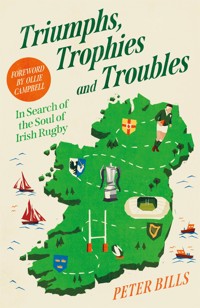
'An entertaining and whimsical search for "the soul of Irish rugby"... Peppered with astute observations' Irish Times 'Triumphs, Trophies and Troubles has got Irish rugby just right in this the 150th anniversary season of the IRFU' Willie John McBride FOREWORD by former Ireland fly half Ollie Campbell 'In a world going all too fast, Peter Bills has the time, the wit and the attention to detail for stories that would otherwise be lost. His is an easy style, a remembering of times and values not just of the Saturday internationals past but of the grassroots members who keep rugby alive to this day.' Keith Wood In late 2024 Ireland, with a population of just 7 million people, stood at the top of rugby union's world rankings. Ireland's rise to such an exalted position has been the great triumph of rugby's professional era. For a nation that fought tooth and nail to keep the game amateur, their progress since 2000 has been extraordinary. The trophies, once so rare in Irish rugby hands, have become almost commonplace. Six Nations Championships, Triple Crowns, Millennium Trophies have all stood in the IRFU offices in Dublin. But that is the top tier of the game. What is the health of the sport at other levels all around Ireland? In this book award-winning international rugby writer Peter Bills seeks to take the pulse of the game at every level - schools, clubs, provinces - as well as the fast-expanding women's game. For if rugby at grassroots level withers, the decline will affect everyone. And how can rugby learn to live side by side with the ubiquitous GAA? Featuring interviews with some legendary names of Irish rugby, such as Keith Wood, Willie John McBride, Tony Ward, Bill Mulcahy, Gordon D'Arcy, Trevor Ringland, Nigel Carr and Tommy Bowe, we also hear from men and women from junior and club rugby, at clubs like Dingle, Kinsale, Monkstown, Boyne, Westport, City of Derry, Donegal Town, Omagh and Oughterard. All of them are doing stirring work behind the scenes for their local clubs and communities as Bills goes in search of the soul of Irish rugby.
Sie lesen das E-Book in den Legimi-Apps auf:
Seitenzahl: 438
Veröffentlichungsjahr: 2025
Das E-Book (TTS) können Sie hören im Abo „Legimi Premium” in Legimi-Apps auf:
Ähnliche


















Peter Bills is a former rugby columnist for both the Irish Independent and Belfast Telegraph and the author of 22 books, including Passion in Exile: 100 years of London Irish RFC. He is also the author of the 2018 worldwide best-selling book on the New Zealand All Blacks The Jersey, which reached No. 1 in New Zealand’s bestseller lists and No. 2 in Ireland. His most recent book is Le Coq: A Journey to the Heart of French Rugby.
First published in hardback in Great Britain in 2025 by Allen & Unwin, an imprint of Atlantic Books Ltd.
This paperback edition published in 2026 by Allen & Unwin.
Copyright © Peter Bills, 2025
The moral right of Peter Bills to be identified as the author of this work has been asserted by him in accordance with the Copyright, Designs and Patents Act of 1988.
All rights reserved. No part of this publication may be reproduced, stored in a retrieval system, or transmitted in any form or by any means, electronic, mechanical, photocopying, recording, or otherwise, without the prior permission of both the copyright owner and the above publisher of this book.
No part of this book may be used in any manner in the learning, training or development of generative artificial intelligence technologies (including but not limited to machine learning models and large language models (LLMs)), whether by data scraping, data mining or use in any way to create or form a part of data sets or in any other way.
Every effort has been made to trace or contact all copyright holders. The publishers will be pleased to make good any omissions or rectify any mistakes brought to their attention at the earliest opportunity.
10 9 8 7 6 5 4 3 2 1
A CIP catalogue record for this book is available from the British Library.
Paperback ISBN: 978 1 80546 140 1
E-book ISBN: 978 1 80546 139 5
Printed in Great Britain
Allen & Unwin
An imprint of Atlantic Books Ltd
Ormond House
26–27 Boswell Street
London
WC1N 3JZ
www.atlantic-books.co.uk
Product safety EU representative: Authorised Rep Compliance Ltd., Ground Floor, 71 Lower Baggot Street, Dublin, D02 P593, Ireland. www.arccompliance.com
In Memory of Tony O’Reilly
7 May 1936 to 18 May 2024
A commentator wrote…
‘He was a hero from a time when Ireland was short of heroes.’
Contents
Foreword by Ollie Campbell
Introduction
Chapter 1: The Military Men
Chapter 2: Monkstown: Proudly Contributing
Chapter 3: Clontarf
Chapter 4: Skerries
Chapter 5: Balbriggan
Chapter 6: Battles by the Boyne (Delvin, Drogheda, Boyne)
Chapter 7: Carlingford and Jack Kyle Country
Chapter 8: The Border
Chapter 9: Trevor Ringland
Chapter 10: City of Derry RFC
Chapter 11: Willie John McBride
Chapter 12: Inishowen
Chapter 13: Omagh
Chapter 14: Dave Gallaher
Chapter 15: Heading West (Donegal)
Chapter 16: Sligo
Chapter 17: An Englishman’s Words
Chapter 18: Westport
Chapter 19: Oughterard
Chapter 20: The Wild Men
Chapter 21: Rugbaí Chorca Dhuibhne (Dingle)
Chapter 22: The Men of Munster
Chapter 23: Kinsale and Clonakilty
Chapter 24: The Leinster Conundrum
Chapter 25: Tommy Bowe
Chapter 26: And Finally…
Acknowledgements
Foreword by
Ollie Campbell
It is here that patience and humility course through the veins; this is where character is demanded; these are the people for whom honesty of effort is valued above all else; here is the spirit, the determination to succeed; and here you will find the camaraderie that sets us apart; this is our land and it is all of this that we are proud to represent. This is rugby country.
These are the inspiring words of the Guinness advert that first appeared on our TV screens promoting Irish rugby about a decade or so ago.
For over 150 years, rugby has been an integral part of the sporting life of this country. When I began playing rugby in Belvedere College in Dublin (when a try was worth just 3 points!) rugby in Ireland was viewed as elitist and largely restricted to fee paying schools. Limerick was, of course, an honourable exception to this. It has always been said that rugby there was played by all classes – from dockers to doctors.
Back then who could have imagined that rugby would have the profile or the popularity it has in Ireland today, where it is passionately played, watched and followed by so many boys and girls and men and women throughout the whole island.
It is said that winning solves everything, and the fact that in the past 25 years or so Ireland has enjoyed unprecedented success has been a major driving force in making the game so popular, with the men’s team winning three Grand Slams and the women’s team one in that period, not to forget the two recent consecutive men’s U20 Grand Slams and their World Cup final appearance in South Africa last year, too. In addition, Ulster, Munster and Leinster have each tasted European glory with Connacht also winning the Pro12.
Michael Cusack, the legendary founder of the GAA, actually founded a rugby club in Dublin called Cusack’s Academy five years before he founded the GAA. But even a visionary like him could hardly have ever imagined that one day over 80,000 people would fill the hallowed Croke Park for a rugby match, as happened when Leinster recently hosted Munster in the URC, at a time when Ireland was also ranked No. 1 in the World.
So, how did all this happen?
In what I am sure was a labour of love, this is what Peter Bills addresses in this revealing book. In his search for the soul of Irish rugby he travels the highways and byways of Ireland to meet a great cross section of male and female rugby people in many rugby clubs, big and small, as well as explores the crucial role of the schools and the provinces.
He has also interviewed some of the great and the good of Irish rugby to help throw even more light on this twenty-firstcentury Irish rugby revolution.
I hope you will find it as informative, as interesting and as entertaining as I did and will especially enjoy discovering how it is that Ireland can now so publicly and comfortably be referred to as ‘rugby country’.
Introduction
The trophies have lain strewn at their feet, just like the conquered in times of war. In recent years, they have come in all shapes and sizes for Ireland’s rugby players.
The Six Nations Championship Trophy, The Triple Crown plate, the Millennium Trophy, the Centenary Quaich Trophy. And that’s just for the Irish national team. What of the provinces, the likes of Leinster, Munster and Ulster, all of whom have won the European Rugby Champions Cup?
Alexander Pope’s memorable quote stirs images of Ireland’s rugby participants in future retirement:
Our generals now, retired to their estates,
hang their old trophies o’er the garden gates.
In life’s cool evening, satiate of applause.
As the year 2024 unfolded, Ireland’s international rugby players could reflect upon an astonishing era of success. ‘Satiate of applause’, for sure.
They had won nothing in almost twenty years from 1986 to 2004. As for a Grand Slam, those Irishmen who achieved the unique feat for them for the first time back in 1948 were almost all long gone when a new Ireland finally laid the bogey, winning the Six Nations Grand Slam in 2009.
But since 2004, the trophies have fairly tumbled into the grasp of eager Irishmen. There were more Grand Slams, in 2018 and 2023, with the nation also finishing as Six Nations champions (without a Grand Slam) in 2014, 2015 and 2024.
As for the ultimate cherry on the cake, Ireland sat proudly as the number one side in the world rankings from 2022 to the start of the tenth Rugby World Cup in September 2023. Not least because, in 2022, they went to New Zealand and beat the mighty All Blacks 2-1 in the three-match Test series. Then, in July 2024, they went to South Africa and beat the reigning world champions in Durban to tie the two-match series.
These remarkable, record-breaking achievements catapulted Ireland into rarefied air at the top of the world game. Yet in the late 1980s, Ireland had languished in an anonymous eighth place in the world rankings, with New Zealand in their customary first place.
Go further back than that, to 1984, and Ireland were in an undistinguished tenth position in an unofficial ranking of the world’s top ten countries. Even a nation like Romania was listed above them.
This was intriguing. For decades, the country with a minuscule population sitting at the top of world rugby was New Zealand. They might have had a population of only 5.12 million even early in the twenty-first century, yet they dominated the sport throughout the twentieth century with the consistent excellence of their teams.
Until, that is, a country with an equally small population nudged them off the world rankings top spot. Ireland, north and south, could muster a combined population of just 7.1 million at the time of the 2023 Rugby World Cup.
For many long years, New Zealand seemed to hold a mesmerising control over the men in green. From 1905 when they first met to 2016, New Zealand enjoyed an overwhelming supremacy. At one stage, Ireland had played twenty-eight Tests against them and lost twenty-seven. One match was drawn.
But from 2016 onwards, suddenly the tables were reversed. Then, with characteristic unpredictability, Ireland beat the All Blacks five times in their next eight encounters. The tormentor had been toppled; the era of tumbling trophies was nigh.
Whatever had caused this seismic change, this shifting of the rugby tectonic plates that run across the world? For it had occurred at a time when many were forecasting doom for the game in whichever land, at whatever level. With excessive physicality at times bordering on violence and legal cases mounting against some of the governing bodies concerning alleged cases of dementia, rugby had acquired an unwanted reputation for danger.
As you will read later in this book, one former Leinster CEO, asked to identify the biggest problem confronting the game of the future, replied with a single word.
Concussion.
Furthermore, the truth was that Ireland’s greatest era was taking place against a backdrop of growing calamity and concern at the state of the game at club level. Indeed, financial problems in countries the world over were threatening the traditional core elements of the sport.
In England, for example, three professional Premiership clubs – Worcester, Wasps and London Irish – went to the wall in a single season, 2022/23. That left just ten clubs in English rugby’s number one club competition. Then, the Jersey Reds club, Championship winners in May 2023, likewise collapsed five months later.
In August 2024, England announced they were selling the naming rights for Twickenham Stadium, an act long refused, for about £100 million. These and other subsequent events confirmed no one could make the sums add up. Thus, images came to mind of flogging the family silver, just for survival.
In Wales, too, dwindling support, financial shortcomings and the presence of an unwanted franchise system threatened seismic change. Nor were things much better across the world in Australia where rugby increasingly struggled for a foothold on the national sporting ladder.
Then, in August 2024, came news that Ulster were facing a deficit of between £2.5 and £3 million, according to their chief executive Hugh McCaughey. Optimistically, McCaughey boldly said he expected the province ‘to break even within two to three seasons’.
Fact is, if you or I ran a business and announced a deficit of up to £3 million, it’s highly unlikely we would be allowed to continue trading. And as for banks owed money and asked for time to reschedule payments, forget it. As Tony O’Reilly found out to his cost.
Yet in other parts of Ireland and especially on the international scene, the game was roaring. Fuelled by the achievements of the national team and pride in their nation, Irish men, women and children flocked to the game, as players and spectators. Yet rugby was still only rated as the fourth most popular sport in the land, behind Gaelic football in first place, soccer in second and hurling third.
That rugby, with a playing population of around 160,000 in Ireland (compared to 2.2 million in England) should have seized the nation’s attention, was extraordinary. Not least of the triumphs was the emergence and growing strength of women’s and girls’ rugby, an issue which will be dealt with in some depth later in the book.
Successful Irish players, a champagne glass at their lips, luxury sponsored cars outside their doors and the constant target of adulatory supporters, stumbled into this new world like novices on the stage, blinded by the lights. Yet they hardly missed a beat.
True, dreams of World Cup glory in 2023 would ultimately disappear, an agonising four-point defeat to New Zealand in the quarter-finals sending Ireland home after they had beaten the eventual champions South Africa 13-8 in an earlier pool match.
A few months later, they retreated to Dublin in more disappointment, a Grand Slam campaign in the Six Nations unexpectedly derailed by England at Twickenham. Yet just a week later, Ireland beat Scotland to land another Six Nations Championship title.
By now, wherever they played, Ireland’s top players took with them the best wishes and undying support of an entire nation. For they were competing vigorously and often highly successfully at rugby’s top table.
Sure, you win some, you lose some. But the margins defining victory or defeat at this level were wafer-thin. Beaten by four points by the All Blacks in the World Cup. Defeated by one point by England in the 2024 Six Nations. Victors over South Africa in July 2024 by a single point.
But as the former Ulster, Ireland and British & Irish Lions wing Tommy Bowe said after Ireland’s narrow defeat to New Zealand in that 2023 Rugby World Cup quarter-final: ‘When I played, if we had lost the scrum battle, the battle in the air and the line-outs against New Zealand we would have lost by forty points. That all happened this time round, and they only lost by four points. They were very unfortunate.’
Quite deliberately, at around the same time as Ireland flew to France for that 2023 World Cup, I began a journey in the opposite direction. I spent time researching in Dublin, visiting renowned clubs like Monkstown, Clontarf and Trinity College, where the game had first begun in 1854.
Then, to begin my circumnavigation of Ireland, I headed up the east coast, stopping off at towns like Skerries, Balbriggan and Drogheda before going further north, past Carlingford and into Northern Ireland.
For rugby is unique in one sense alone in Ireland. It is a leading sport that is unified, played by and against teams from all over the land. Good rugby devotees of the time clung to that moniker during the Troubles that engulfed the north from the late 1960s to the late 1990s.
As I journeyed on, across the north, then to County Donegal, down the beautiful Wild Atlantic Way on the west coast to visit clubs in areas such as Sligo and the Dingle Peninsula, I stopped to take the pulse of the game at all levels. I wanted to ascertain whether there was still a future for so many clubs or whether rugby will increasingly focus only really on the top echelon with little interest beneath.
This is not a journey in search only of those with dozens of caps for Ireland or a Lions jersey, now under attack from the moths in some musty old cupboard. By no means did I seek to talk only with the biggest and the best of traditional clubs, the likes of Ballymena, Dungannon, Garryowen, Cork Constitution and Blackrock College.
There are renowned internationals included. Their views offer a variety of analyses.
But I also wanted to hear the voice of little clubs, like Oughterard beyond Galway, Inishowen, the most northerly club in Ireland, little Rugbaí Chorca Dhuibhne (Dingle) in the far west and Boyne, the product of two amalgamated Drogheda clubs in the 1990s.
I talked to the great and the good but essentially, the largely anonymous yet loyal, quietly determined hard-working rugby people, some of whom have spent decades in the service of their local clubs; simply to ensure that when their time comes to depart, they will pass on a secure, vibrant club that continues to serve its community with zeal and care.
Their stories, whether it be Nigel Carr in Belfast recounting the day he almost died (and his rugby career ended) at the hands of terrorists, or the dynamic, rugby-loving club president Anne Scott at Inishowen telling of how this game and the exceptional people it unearths helped get her through the tragic loss of her husband, comprise a potpourri of examples of how rugby changed lives. For good and bad.
On this journey, I try to answer some of the most intriguing questions of the time: how could Ireland, so small a nation and traditionally always opposed to professionalism, have masterminded so effectively the eventual road to success in a professional era?
How have they unearthed such a production line of young talent? But is there a future role for junior clubs, the long-neglected grassroots element of the sport without which there can be no serious long-term future for the game? In any country…
A final thought. Please permit this Englishman to delve deep into the annals of Irish rugby. He comes with no baggage, no prejudices or political points to enforce. My remit was to question, debate and listen. I did plenty of all three.
There is, I believe, a great value in the outsider assessing another’s nation and sport. The concept worked well in The Jersey, my 2018 published bestseller on New Zealand rugby.
It is my hope this approach in the Emerald Isle proves equally revealing to the reader.
CHAPTER 1
The Military Men
Summer 2023. They come to meet me on a typical Belfast day. Early sunshine and its promise; scudding low clouds and rain by noon.
No matter. This is a special occasion. James Joseph McCoy, J. J. or Jimmy to one and all, and Brian McCall, once warrior brothers in the famous green jersey, have not met for twenty years. Today, at my behest, they come to Belfast to share memories of their times, days when rugby’s entire future as a unified sport on this island, seemed imperilled.
They greet each other with a warm, powerful embrace. McCall has journeyed here from the country on his Harley-Davidson – ‘his over-sixties, crisis time of life vehicle’ – as McCoy jokes. McCall, shaven-headed, rather bulkier than in his playing days, admits it.
‘It’s true. Most men of my age who buy a Harley are going through a midlife crisis. You’ll find the dealerships full of balding, middle-aged men.’
In his playing days for Ireland from 1985 to 1986, Brian McCall stood 6ft 3ins tall and weighed in at 17st 10lbs. But such statistics would impress few today looking for an international second row forward. He jokingly describes himself as the last of the 6ft 3in locks. At best, he’d be a No. 6, a blind side flanker. If he had the pace.
Even men once regarded as physically intimidating, like the great Willie John McBride, just don’t match up in height or weight with their modern-day counterparts.
Yet height and weight alone can never override the warrior spirit. Without the latter, the former is an irrelevance. My guests this day epitomised that in their time. Listen to McCall on McCoy, his old prop forward pal.
‘It was great meeting him again. I have always had a huge amount of respect for him. He was a player who never took a backward step. He was the sort of guy you go to war with. He was always a physical specimen. He was that size when he was seventeen, playing for Portora Royal School at Enniskillen. He was a beast in schoolboy rugby. After all, he’s a County Fermanagh man. Tough as hell.
‘Unlike me, who was flying in and out to play matches in Ireland from my UK base, Jimmy was there the whole time.’ That, he added, put a unique strain and pressure on a man from the services in those days.
Likewise, tight head prop McCoy clearly has a deep respect for his old mucker. Squat, steely and wiry, with a good shock of hair, he still bears the unmistakable frame of an old prop forward.
‘We shook hands and then gave each other a big hug. It was probably more like two bears hugging as we are two big men. Even though we hadn’t seen each other for about twenty years it was just normal and natural, as if we had never been apart at all.’
Over lunch, they chatted about their families, health, careers, pensions. They discussed past Ulster and Irish teammates, plus the current Ulster set-up. It has to be said, the reviews of the latter were not especially complimentary.
They talked together and then to me. Then they made a firm pledge. It wouldn’t be another twenty years before they met again!
For they have great memories to share. McCoy, a steely, strong prop forward made his debut for Ireland, against Wales, in 1984. He went on to win sixteen caps, his last in 1989 against New Zealand.
McCall, a moustachioed, industrious second row forward afraid of no one and nothing, won his first cap in 1985 in what would be Ireland’s Triple Crown-winning team. He was strong, in body and mind.
They played alongside each other just three times, against France, England and Scotland, and featured in Ireland’s 1985 Five Nations Championship and Triple Crown successes. In the 1986 match against England at Twickenham, McCall scored a try, a rare moment for lock forwards in those times.
But both players had nudged the Irish selectors by their performances for Ulster in their 1984 victory over the touring Australians at Ravenhill. An Australian team of Lynagh, Burke, Hawker, Lawton and Campese could not quell Ulster’s fire and fell to a 15-13 defeat. As the Wallabies cleaned up the Grand Slam with wins over England, Scotland, Wales and Ireland – the first Australians ever to do it – the magnitude of Ulster’s triumph became clearer. A commentator described McCall’s performance that day as ‘majestic’. They called the team the ‘Ulster immortals’.
The Troubles in Northern Ireland, which began in the late 1960s and ground on until 1998 and the signing of the Good Friday Agreement, affected these two men in special ways. Even so, one, an officer in the British Army, and the other, an officer in the Royal Ulster Constabulary (RUC) came together to play international rugby for Ireland.
For each man, never mind their greatly differing backgrounds, it was the culmination of a lifelong dream. Yet the era the gods had chosen for them to climb on to the ultimate sporting stage was notorious.
Explosions of social unrest presaged explosions of a more lethal kind. Good men, women and children from all communities were dying cruel, vicious deaths. Bombs destroyed bodies, families, lives.
Yet critically, rugby ploughed on in search of its dream. What is more, its adherents mingled and forged friendships with the boys from the south, some of them from families who had long ago fought the British Army for independence. Collectively, rugby offered the nation, north and south, a template of how the different communities could come together, even amidst terrible adversity, to join forces on Ireland’s behalf. To wear the famous green jersey. As McCall reflected, rugby was and still is the game that unites the nation.
From the comfort of our armchairs in a Belfast hotel room, those dark times may seem long ago. In the minds of some of today’s youngsters, it is a scenario they can barely understand.
But the memories and realities, the agonising personal experiences, remain tangible for these two men. Strong they are and have always remained, even in the face of tragedy. But they struggle to forget a time when the entire pattern of their lives was dictated by events.
McCoy was a tough, nuggety prop forward for Dungannon (until 1985) and then Bangor. Lock forward McCall, later to rise to the rank of brigadier in the British Army, was taller but likewise as tough as teak. They needed to be.
McCall was based in the UK, hence his connections with the London Irish club. But whenever he flew home, to play for Ulster or, on three occasions, Ireland’s national team, he was always escorted by a Garda Síochána close protection detail.
McCall is quick to pay tribute to the Garda Síochána Special Branch, without whom he says he would never have been able to play for Ireland.
‘The security situation was such that the Army couldn’t have agreed to the whole enterprise unless the Garda were willing to provide the security on the ground.’
But the routine was demanding. Every Saturday evening, he was flying to Dublin for Sunday training. Wherever London Irish were playing, he would find the nearest airport and book a flight to Dublin.
It sounds like great fun, but eventually it just became exhausting. So he applied for a job that was coming up at Army HQ at Lisburn. He was keen to do it. His travelling would have been cut to the minimum. But the Army turned him down, not for reasons of proficiency but security.
‘They told me, “We are happy for you to fly into Dublin each weekend but we’re not happy with you crossing the border in a car each weekend.” So they put a stop to the job for me.’
But, as McCall acknowledges, it was the right call. Just a couple of seasons later, three of his Ulster and Irish teammates were caught up in a border bomb attack on the eve of the inaugural Rugby World Cup in 1987.
‘My circumstances were unusual because after my time at university (Queen’s, Belfast) I went to Sandhurst and was commissioned into the Army. When I was at university, like a lot of young men in the province, we were wild and reckless, much more so than our English counterparts. I have always felt that was the influence of the Troubles.
‘We were devil-may-care because there were bombs going off and people getting shot. When you live in a society like that, it affects you.’
By the time he went to Sandhurst, McCall had played for Ireland B and was an Irish trialist. It had been many years since the Army had had an international rugby player within their ranks and the likes of former Scotland international Mike Campbell-Lamerton (then still serving as a colonel) pulled him aside and promised that the Army would give him every support possible to become a full Irish international.
McCall recounted how the former Lions captain told him that his regimental side, the Duke of Wellington’s Regiment, used to turn out a Regimental 1st XV during the days of National Service that was comprised entirely of internationals and British & Irish Lions.
In fact, when Campbell-Lamerton, the Lions captain in New Zealand in 1966, first joined the regiment, he couldn’t get into the side. McCall remembered the honours board at the Army Stadium clubhouse in Aldershot listing all the players who had gained international honours whilst serving in the Army and how the names ceased in the early 1970s.
‘But what struck me most was the Ireland board – there were huge numbers of players who had gained their Irish caps post the 1920s. Most of them were from southern Ireland. I thought to myself, If I am going to make it, I would be the exception, an Ulsterman!
When the moment came, when the door became open to a full Irish cap, McCall understood the debt he owed to the Garda, once he was over the border.
He knew that was crucial. ‘They could easily have turned round and said to the RUC and British Army, “No, we can’t provide close protection details for these guys coming down from the north.” That would have been the end of it for me.’
Mind you, the Garda boys came to see the job as one to be coveted. They suddenly found themselves in the heart of the Irish rugby team.
McCall describes the close bonds that were formed with his Garda Close Protection detail. ‘I’m sure that they initially thought, what on earth are we doing babysitting this Brit, but once they realised that they were living cheek by jowl with the Irish rugby team, it soon became a much sought-after duty.’
Brian McCall, who won three caps for Ireland in 1985 and 1986. He was a member of their 1985 Triple Crown winning side.
Jimmy McCoy was invited to the wedding of one of the Garda plain clothes guys. Even to the players in those tense circumstances, there was something to smile at. ‘The minders stuck out a mile in their jackets and ties. The Irish team was wearing shell suits. It couldn’t have been more obvious they were police officers,’ said McCoy.
‘When we went down to Dublin for a training weekend, there might have been four of them there. But when it was an international weekend and the game was on, there might be twenty minders because they got in to watch the game for free.
‘They got to go to the dinner afterwards, too. They were fighting each other for that duty. We couldn’t even go for a walk without a minder.’
The protection continued when McCoy was playing a club rugby match south of the border, somewhere in the Republic like Galway. He had to notify his people at HQ in the north he was going to play rugby in the south that weekend. They would make arrangements with the Garda.
‘You would arrive at the hotel and they would be there waiting.’
But familiarity with the Garda threw up a problem. McCall remembered one particular night before an England international in Dublin that summed up the relationship players had with the Garda by then. In those days, before professionalism, the six replacements on the Irish bench were allowed to go out on Friday night for a drink, if they wanted.
On this occasion, the Garda officers announced they would like to invite the guys on the bench for a wee drink. McCall thought that was fine. They had a couple of beers in a city pub and then, with the clock ticking past 11 p.m., McCall said, ‘Time to go now, boys.’
But the Garda officers had other ideas. ‘No, no. We want to take you to our social club for a last beer,’ they said. McCall agreed but admitted later, ‘As soon as we walked into that clubhouse, I realised I had made a strategic mistake. They had told everyone they were going to bring the bench guys to the club and the place was packed.’
A ‘last beer’ multiplied. They finally left the club at 3 o’clock on the morning of the match. Much the worse for wear.
Later that day, sitting on the bench with his pals, McCall asked, ‘Do you fancy getting on today?’
‘Absolutely not, I feel bloody awful,’ someone replied.
Such a philosophy epitomised the era. McCall remembered his first Irish trial when he was still at university and rooming with back row forward Willie Duggan at the hotel in Dublin. Duggan was a hell of a fine player, probably the best No. 8 in the northern hemisphere at that time. But quintessentially, he was a glorious throwback to the times of fun in the game.
Born in 1950, he won forty-one caps for Ireland from 1975 to 1984, including a spell as captain. He went to New Zealand with the 1977 Lions. In Irish club rugby, he played for the Cork club Sundays Well and also Blackrock College.
He was respected by players all around the world for his fearlessness, ball handling, quality and strength.
But he was a heavy smoker and absolutely hated training.
Once, he ran on to the ground for a match against France smoking a cigarette. He passed it to the Scottish referee, a bemused Alan Hosie, as he ambled past him on to the pitch.
One of his coaches once suggested that if he gave up smoking he would be faster around the field, to which Duggan replied, ‘Ah yes, but then I would spend most of the match offside.’
In January 1977, together with the Welsh lock Geoff Wheel with whom he enjoyed a lively ‘how’s your father’ type of punch-up, he became the first player to be sent off in a Five Nations international. But according to his fellow Irish forward Moss Keane, Duggan did not consider himself to have been sent off, simply being asked by the referee, ‘Would he mind leaving the field.’ He is said to have replied, ‘Sure, not at all. I was buggered anyway.’
Apocryphal or not, the tale tells everything of Duggan. Brian McCall said, ‘What an experience that night was in the Dublin hotel. He was smoking in the room, smoking everywhere. They said he was getting through sixty a day.’
But his faith in Duggan as a player was confirmed when he watched Ireland’s first match of the Five Nations Championship a week or two later. ‘Duggan was the standout player. Some people just had the talent. Duggan was a wonderful guy and a great character.’
But the stark reality of everyday life in the north, especially for McCoy as a serving officer in the RUC, washed away the smiles, like the tide on sand. They travelled around the province in unmarked cars as well as Army vehicles. Sometimes, they had to do searches, route clearances in conjunction with the Army. Occasionally, they would be flown into a dangerous area by helicopters, alleviating the risks of approaching the border on foot, by road or field.
‘You would be walking up a road looking for trip wires. You knew the terrorists could be watching you. So the thought was always there. Sometimes, you had to search a house at four or five in the morning. A light would go on when we banged on the door and someone inside would say, “Oh, they have brought the big feckin’ rugby player.” They knew me through the game.’
At the end of the day, back in RUC barracks or HQ, McCoy would ponder a short time and reflect on his day. ‘You always had one overriding thought: There’s another shift over.
‘Perhaps it is only now that I realise I was quite lucky. A lot of people did lose their lives. You knew that people were always watching. It could have happened. It didn’t happen to me, but it did to a lot of other people.’
Not least when a barrage of mortars rained down on an RUC base at Newry, near the border, in February 1985. The attack killed nine RUC officers and injured another forty. McCall remembered, ‘I know for a fact, that day of the Newry bombing what J. J. went through.
‘I saw him that morning in the Shelbourne Hotel in Dublin and emotionally, he was completely in bits. The guys that died weren’t necessarily his best mates. But he would have known all of them. And he could easily have been there himself.’
McCoy nodded, sadly. ‘I was not personal friends with any of the victims. But I knew a lot of those guys who were killed.’
It was the closest he ever came to standing down from a game. He wrestled with his decision for some while. But his love for rugby and firm conviction that it had to continue as a sport of unity, made his decision for him.
He said later, ‘People forget so many police officers were playing club rugby through all this. They were crossing the border every weekend to play the game. We had no problem with opposition players and that worked both ways. We would slag each other off and call one another names. But there wasn’t any bother; it was good-natured craic.’
McCall concurred. ‘We played with a lot of the guys from down south at underage levels for Ireland. Those guys from the south were great friends and we got to know them very well. We came through the age groups together. So it wasn’t a case of the rest of the Irish team suddenly having to get to know an RUC man or a British Army officer – we had all known each other from schoolboy rugby.’
Thus, somehow, rugby carried on. North and south of the border. By doing so, by mixing freely and sharing fun with their pals whatever their background, wherever they lived and whichever school they had attended, they were demonstrating rugby’s age-old creed: this is a game for all people, all sizes and classes, whatever their background or circumstances. It is a game that unites, not divides, people.
McCall said, ‘It is a truism that men who have shared physical hardship together form closer bonds than those that haven’t. Any successful rugby team that endures physical (and mental) hardship and has to show courage and bravery, comes together. It’s the classic ‘Band of Brothers’ thing. When you see these guys again, you just pick up where you left off.’
McCall insists there was never a danger that rugby would split, that cross-border journeys and relationships would fracture. ‘If the bad boys had targeted rugby, it would have been a massive own goal because rugby is the one true sport in Ireland that unites a nation. Cricket is a united Ireland sport, but it doesn’t have the gravitas rugby enjoys.
‘They have talked for years about the football teams being united. But that will never happen.
‘Every time the Irish rugby team plays, it unites the nation. It brings everyone together from all over Ireland; north and south. There is no other sport that does it to that extent.’
Ironically, the violence aimed at Belfast city centre offered rugby clubs in other towns a paramount opportunity to do what rugby clubs have always done. Bring people together.
‘Clubs in places like Malone and Armagh were places of safety to go for a drink, certainly compared to the pubs of Belfast. People wouldn’t go into the centre of Belfast; it wasn’t safe. So they stayed out at the clubs,’ said McCoy.
McCall highlighted the mixing of the communities. ‘When you were outside Belfast, particularly at small clubs near the border, quite often you had a little bit of cross community. There might have been half a dozen players in the club who were Catholics, GAA guys. That was wonderful. Otherwise, it was absolute opposites. There was nothing in the middle.
‘In Armagh, and at clubs like Enniskillen, you would have some guys from a GAA background and you were able to socialise with them. That was a godsend. It wasn’t going on anywhere else in society.’
You can hardly expect men like Jimmy McCoy to forget those times. Especially his own near miss, in terms of proximity to a violent death. The prop forward who still has a handshake more like a mincer than a human hold, had been a serving officer in the RUC based at Dungannon on the tough west side of the town. ‘I was in Dungannon for a number of years. It was fairly hairy at times, and you had to be careful where you trod.’
Mixing rugby with work was hard enough. Add on the mental toll of knowing your life was constantly on the line and you have the potential for serious exhaustion, mental and physical. He would go and do a training session with Ulster and afterwards clock in around 11 p.m. for a night shift with the RUC that didn’t end until 7 a.m.
Some nights, if he was lucky, he’d start at 11 p.m. and finish early at 3 a.m. so he could go and get some sleep before a big game the next day.
He was in Dungannon one day, out on the beat, when he got a call on his radio and a curt message. ‘A car is coming. It will pick you up.’ The line went dead.
‘The car came almost instantly and I got inside. The chief inspector was sitting there and said, ‘A threat has come in and you’re no longer working in Dungannon.’
A credible threat had been uncovered targeting the big rugby man’s life. He wasn’t married at the time and admits he was somewhat gung-ho. ‘I didn’t worry about it and I never went into the details of the threat. But apparently it was for real.
‘With hindsight, it was probably always going to happen. They couldn’t stand by and let me walk around in a police uniform when I was known through my rugby.’
McCoy had a sister living in North Down, almost 50 miles away, and he was whisked away to stay there. He arrived on St Patrick’s Day, 17 March 1985. He found a new life in more ways than one.
‘I found a huge difference in terms of policing when I moved from Dungannon. It was like night and day. People in Bangor would call into the station and say, “A seagull has just pooped on my washing.”
‘When you got a call at Dungannon maybe reporting an accident, we would have to check and make sure it was safe to go out there and there were no booby traps.’
McCoy served twenty-two years in Bangor and admitted that when he retired, he thought the threat was over. After all, Ireland is like a different country now in so many ways, compared to the 1970s and 1980s. Likewise, Belfast is a transformed city.
Yet he concedes, even at Bangor, there were still threats. ‘Out in the country, people notice things. There’s a stranger in town – what car is he driving? Take Brian. People would know he is Army-trained from the way he walks. People note these things. So if you’ve no need to go to these places, why would you?
‘As for Belfast, there are still places I wouldn’t go there.’
McCall echoed his old friend’s sentiments. ‘Life now is immeasurably better in the province, but if you want to be totally accurate, there still is a threat. It’s not a very big one but there still is that threat. They haven’t all gone away. The bad people are still there, lurking in the shadows. It would be foolish of me not to acknowledge that.
‘In 2023, a police officer in Omagh thought he was safe coaching kids at football. You think you are safe, but you never know.’
This is what they live with, the everyday reality of their lives.
On the evening of 23 February 2023, Detective Chief Inspector John Caldwell was loading up footballs into his car, with his young son, after taking a training session for local youngsters. Caldwell was shot multiple times by three gunmen and suffered ‘life-changing’ injuries.
‘It brings back hard memories for the people of this town,’ said a local woman.
McCall remembered the time back in 1972 when he was just a wee lad. He’d bought an old motorcycle for use on the family farm and needed to get some parts for it.
‘The motorcycle shop in Armagh was on the other side of town, if you understand what I mean by that phrase.’
McCall went to the Royal School, Armagh and after school one day, he set off to the shop for the parts. ‘A man was standing outside. He would have been about thirty-five years old. He said, “Where are you going?”
‘I said, “I’m going to Danny McShane’s motorcycle shop.”
‘He said, “No you’re not. Fuck off back to your side of the town.”
‘I have never forgotten that. I was twelve years old and shit-scared. I didn’t even know there were different sides of the town.’
Is that hatred still there, on both sides? McCoy admitted, ‘In certain areas, there are still families entrenched in their views. But overall, not as much.’
McCall shrugged. ‘There are hard-core elements that will never change on both sides.’
McCoy conceded it was still there. But he said, ‘It is a triumph that rugby stayed united. There were lots of rugby guys killed from both sides of the communities.’
McCall remembers especially Henry Livingstone of Armagh, a man he called a big bachelor farmer, a prop forward and a real gentleman. ‘When you joined the club straight from school, he always kept an eye out for the youngsters.’
He was a farmer in what McCall termed ‘a very nationalist area’ and was in a barn feeding the cattle one morning. ‘Gunmen came on to the farm and shot him dead. His death was pure ethnic cleansing. He was a lovely gentle giant of a man, only about thirty-eight or forty. He was just an easy target.’
It happened on both sides. Such acts devastated and broke hearts in both communities. Of course, rugby clubs suffered, just like anywhere else.
Yet somehow life went on. It had to, even against such a background. Rugby clubs, for example, worked harder on their cross-border relationships, determined to retain the unity they enjoyed with clubs from the north or south. As McCall said, ‘There might have been rioting on the Falls Road but people in Stormont were having cocktail parties the same night. Life went on. It had to.’
McCoy grimaced at some of his memories from those times. ‘I attended a couple of horror scenes after explosions, picking up and putting parts of bodies in bags. It was your job, you had to do it. Once, a senior officer was leading the recovery of body parts but we could not find the head. We had to look everywhere to find it. We did, in the end.
‘Luckily, I had rugby as a release. I had to go and train and play. It didn’t blanket your mind completely, but it dulled the senses a bit.’
Just a bit.
But now, today, around fifty years after those times, Ireland and rugby union have taken quantum leaps forward.
They put up the ‘Sold out’ signs for the big games at the RDS in Dublin, at Thomond Park and in Ulster. There is always a lively crowd at The Sportsground in Connacht.
Yet what is the true legacy of those men of the 1960s, 1970s and 1980s? Can we say they left Ireland’s rugby team in a better place than when they first encountered it? Or were other events and powerful voices critical to steering Irish rugby on to sunlit uplands it had scarcely dared to dream of all those years ago?
In assessing the health of this unified sport in a land where at times unity seemed to be hanging on by little more than a thread, we must examine each level, whichever part of this island we are considering. Only by talking to rugby people of all backgrounds from both communities, those charged with ensuring the ongoing progress and prosperity of the game overall, can we glean a true picture of the state of the sport in Ireland.
CHAPTER 2
Monkstown: Proudly Contributing
In the mid-1850s, Irishmen were achieving some extraordinary things all around the world.
Take Charles Davis Lucas, a native of Poyntzpass, County Armagh. On 21 June 1854, during the Crimean War, Lucas was on board HMS Hecla as she fired at the shore defences of Bomarsund, a fort off the Finnish coast in the Baltic Sea.
Guns in the fort returned fire and a live shell landed on the deck of the ship, its fuse still fizzing. Immediately, every man flung himself flat in an attempt to minimise the effects of the inevitable explosion.
But Lucas, just twenty years of age and a Master’s mate, had other ideas. Dashing forward, he picked up the shell and hurled it overboard. It had barely hit the water when a mighty explosion shook all the ships close by.
It might have given any passing fish a bit of a headache. But on HMS Hecla, not a man was killed or seriously wounded. For his act, the young Royal Navy officer was instantly promoted to lieutenant. More importantly, he became the first recipient of the Victoria Cross, the highest award for gallantry in the face of the enemy that can be awarded. Fewer than 1400 recipients worldwide have since won the medal.
Lucas would go on to become a rear admiral and live until he was eighty.
By 1854, Irishmen made up around 35 per cent of the British Army. They came from towns and villages all over Ireland to sign up. More than 30,000 served in the Crimean War and in all, Irish-born soldiers and seamen won twenty-eight Victoria Crosses in that conflict, a remarkable testimony to their courage and bravery.
Meanwhile, 1854 was proving a memorable year in other ways, too. At 21 Westland Row, Dublin on 16 October that year, a son was born to Sir William Wilde and his wife, Jane. The new baby was named Oscar.
But the background to these times was distressing. The Great Famine that raged from 1845 to 1852 had cost the lives of around 1 million people. Another million fled. In fact, between 1845 and 1855, at least 2.1 million people left Ireland. A report of the time stated: ‘Dublin has the worst living conditions in Europe.’ Poverty and disease were omnipresent.
A strange time, then, you might think for a group of young men to come together and make the first attempts to introduce a new game into Ireland. It was called rugby football and it was brought into the country at the start of the 1850s by students returning home from public schools and universities in England.
The first organised club was Dublin University, formed in 1854, followed just a few years later by a new club in the north, North of Ireland Football Club (NIFC) in 1868. Queen’s University Belfast followed a year later and back in Dublin, the Wanderers club was founded the same year.
Early enthusiasm for the game was such that clubs began to shoot up like mushrooms in the night. Another Dublin club, Lansdowne, was set up in 1872/73, with Dungannon established the same year. Others, like County Carlow, University College Cork and Ballinasloe all quickly followed.
The game was taking off all over Ireland.
By the end of 1874, the Irish Football Union had been formed to administer the game. They wasted little time in arranging a first international match. In early February 1875, having boarded a steamer at Dublin docks, a group of intrepid young Irishmen set out for London and a rugby match against England. It was played on 15 February at Kennington Oval in London. England won 7-0 against an Irish side that contained twelve players from Leinster and eight from Ulster.
But the chief curiosity was that each side fielded twenty players. It would be three more years before playing numbers came down to fifteen a side.
In those early times, separate bodies administered the game in different regions: the Irish Football Union with jurisdiction over clubs in Leinster, Munster and parts of Ulster. But the Northern Football Union of Ireland, formed in 1875, was in charge of clubs in the Belfast area.
That was until 1879 when the IRFU was formed as an amalgamation of the two different bodies. The same year, both Leinster and Munster were inaugurated.
England were keen to cement early relationships on the rugby field. They travelled to Dublin in 1876 and 1878, winning both matches. In fact, Ireland would have to wait until 1887 for their first victory over England.
Young Irishmen, like young men in France, Wales, Scotland, England and other nations, took to the game for its physical challenge and commitment. They liked, too, the sense of comradeship and fun once the final whistle had been blown.
Rugby was the new sport in town. Its almost instant popularity ensured it was a game here to stay.




