


16,99 €
Mehr erfahren.
- Herausgeber: John Wiley & Sons
- Kategorie: Fachliteratur
- Sprache: Englisch
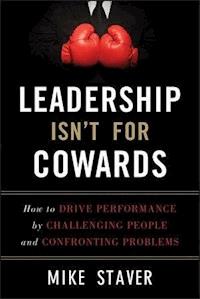
A no-nonsense guide to driving performance while still maintaining a great place to work Leadership Isn't For Cowards offers straightforward steps to leading courageously and practical tips for driving performance. Courageous leadership means toughening your approach by being rigorous in the application of your values through the company culture. It means confronting and challenging people, and not letting them get away with being less than you know they can be. The path to courageous leadership has six components: Accept Your Current Circumstances, Take Responsibility, Take Action, Acknowledge Progress, Commit to Lifelong Learning, and Kindle Relationships. These manageable steps include: * Identify the area in your business or life where a gap exists between your current reality and your desired reality * Align yourself with a person or a group of people who can commit to holding you accountable for closing the gap * Make a specific commitment to the outcome(s) you want and assign dates to them With courageous leadership, you'll create a culture and a mindset that encourages and demands excellence! Follow these steps to bring out the best in your employees and lead your company to significant success.
Sie lesen das E-Book in den Legimi-Apps auf:
Seitenzahl: 290
Veröffentlichungsjahr: 2012
Ähnliche



















Contents
Acknowledgments
Section 1: You are Messing with People’s Lives
Chapter 1: Do You Know What You Are Doing?
Chapter 2: How Much of an Impact Are You Really Having?
Chapter 3: Are You a Coward?
Chapter 4: Is Culture Overrated?
Attack
Section 2: Accept Your Circumstances
Chapter 5: How Great Is Denial?
Chapter 6: What Are You Pretending Not to Know?
Chapter 7: Are You Honest?
Factual Accuracy
Usefulness for the Listener
Constructive Delivery
Chapter 8: What Is Real?
Chapter 9: Where Is Your Focus?
Section 3: Take Action
Chapter 10: Are You Good at Analyzing?
Chapter 11: When Are You Ready?
Chapter 12: How Present Are You?
Chapter 13: Do You Remember a Time when You Hesitated and Lost?
Chapter 14: Are You In, or Aren’t You?
Section 4: Take Responsibility
Chapter 15: Want to Responsibly Scare Some People?
Chapter 16: How Much Blame Can You Take?
Chapter 17: What Difference Do You Make?
Chapter 18: What Kinds of Responsibility Are You Taking?
Choices
Attitudes and Mindsets
Performance
Chapter 19: Are You Truly Free?
Section 5: Acknowledge Progress
Chapter 20: How Goal-Driven Are You?
Chapter 21: Are You Too Harsh?
Chapter 22: Are You an Over-Recognizer?
Gushing
Fake Recognition
Failure to Recognize the Right People
Chapter 23: What, When, and How?
Chapter 24: Are You about Effort or Achievement?
Section 6: Commit to New Habits
Chapter 25: Just How Much Accountability Can One Person Stand?
Chapter 26: Do You Need to Be Committed?
Solving Problems Independently
Communicating Powerfully
Playing Well with Others
Chapter 27: Just How Different Are You?
Chapter 28: What’s That Weight on Your Back?
Section 7: Kindle
Chapter 29: Is It Really Just an e-Reader?
Chapter 30: How Are You Feeling?
Chapter 31: Did You Seriously Think That Would Work?
Chapter 32: Do You Ever Notice?
Chapter 33: Ever Given Birth?
Section 8: Now What?
Chapter 34: Do You Want To?
Chapter 35: Are You Willing?
High-Gain Activity
Chapter 36: Can You Please Just Get On With It?
Index
Copyright © 2012 by Mike Staver. All rights reserved.
Published by John Wiley & Sons, Inc., Hoboken, New Jersey.
Published simultaneously in Canada.
No part of this publication may be reproduced, stored in a retrieval system, or transmitted in any form or by any means, electronic, mechanical, photocopying, recording, scanning, or otherwise, except as permitted under Section 107 or 108 of the 1976 United States Copyright Act, without either the prior written permission of the Publisher, or authorization through payment of the appropriate per-copy fee to the Copyright Clearance Center, Inc., 222 Rosewood Drive, Danvers, MA 01923, (978) 750-8400, fax (978) 646-8600, or on the web at www.copyright.com. Requests to the Publisher for permission should be addressed to the Permissions Department, John Wiley & Sons, Inc., 111 River Street, Hoboken, NJ 07030, (201) 748-6011, fax (201) 748-6008, or online at http://www.wiley.com/go/permissions.
Limit of Liability/Disclaimer of Warranty: While the publisher and author have used their best efforts in preparing this book, they make no representations or warranties with respect to the accuracy or completeness of the contents of this book and specifically disclaim any implied warranties of merchantability or fitness for a particular purpose. No warranty may be created or extended by sales representatives or written sales materials. The advice and strategies contained herein may not be suitable for your situation. You should consult with a professional where appropriate. Neither the publisher nor author shall be liable for any loss of profit or any other commercial damages, including but not limited to special, incidental, consequential, or other damages.
For general information on our other products and services or for technical support, please contact our Customer Care Department within the United States at (800) 762-2974, outside the United States at (317) 572-3993 or fax (317) 572-4002.
Wiley publishes in a variety of print and electronic formats and by print-on-demand. Some material included with standard print versions of this book may not be included in e-books or in print-on-demand. If this book refers to media such as a CD or DVD that is not included in the version you purchased, you may download this material at http://booksupport.wiley.com. For more information about Wiley products, visit www.wiley.com.
ISBN 978-1-118-17683-2 (cloth); ISBN 978-1-118-22713-8 (ebk); ISBN 978-1-118-24023-6 (ebk); ISBN 978-1-118-26484-3 (ebk)
Acknowledgments
Years ago I wrote the keynote “Leadership Isn’t for Cowards.” Thousands of people have heard it in various versions. To all of you, thank you for unknowingly helping me create this book. Your participation in those keynotes helped me form my thoughts and solidify what I believe it means to live and lead with courage.
My deepest thanks to my coaching clients who prove every day that leading courageously really is the best way to lead. In particular I am thankful to the members of StaverConnect. Your leadership and willingness to share openly and honestly with each other is an outstanding example of courageous leadership.
To the team at The Staver Group, Bobbie Stanton, Mary Anne Rybak, Sondra Ulin, and Maxx McInerney, thank you for keeping our customers happy, things running smoothly, and me sane. I am grateful for your unique and important contributions to the lives of the leaders we serve.
Deborah Schindlar, Peter Knox, Tiffany Colon, and everyone at John Wiley & Sons, thank you for all you have done to make this project successful. You have each been supportive and smart, and that is a great combination! A special thanks to Dan Ambrosio, editor at Wiley, from our initial conversation right through the entire project you have had a perfect blend of enthusiasm and guidance. Thank you for this opportunity.
Amy Claire, not only are you an amazing artist of the English language but you are also the perfect blend of insight, critique, and support. Your understanding of my style and voice combined with your editorial skill gave me great peace of mind and confidence! Thank you. I am forever grateful to Michael for introducing us.
Finally to all of my friends and family who have encouraged, and believed in me and this work! I noticed and I appreciate you very much!
Section 1
YOU ARE MESSING WITH PEOPLE’S LIVES
This section lays the foundation for all that follows in the rest of the book. You will be challenged to understand the depth and breadth of leadership and to see how doing so can transform the way you lead. You will receive a clearer understanding of organizational culture and realize the true extent of your own impact. The journey begins here.
Chapter 1
Do You Know What You Are Doing?
For your sake, let’s hope you answered that question with a resounding “sometimes.” I hope you are like the rest of us, having to stop on some days and wonder what you were thinking when you said yes to leadership. The fact is, most leaders have times in their lives when they find themselves asking, “Do I know what I’m doing?” It’s a normal and expected part of being in a role where you influence people.
You first have to know and accept one major thing that you are doing as a leader . . .
You are messing with people’s lives!
(I’m not sure how much more clearly I can say that.)
The day you said yes to someone, somewhere up in your organization, and decided to join the ranks of leaders, you decided (with complete false confidence) that you had the willingness and ability to tell other people what to do.
Or maybe you didn’t. Maybe you were recruited—placed in a leadership class and given three points and a poem on how to lead before you were tossed the keys and wished good luck.
Maybe you entered into a management training program with wide-eyed enthusiasm and a commitment to change the world.
Maybe you decided that you would take a stab at starting your own business. Spreading your entrepreneurial wings, you jumped into the world of business ownership with all of its thrills and risks.
Whatever the case, your decision to say yes to leadership was driven by something—a need to help others, to make more money, to save the world, to boost your self-esteem, to make a difference, or some other reason. Regardless of your reason, your choice resulted in one simple fact: You began messing with people’s lives. You may not have realized it or wanted it, but that’s what happened.
Unfortunately, most leaders do not start with that knowledge. They don’t start with a clear and compelling understanding of the real challenges facing them. Their understanding is diluted with operational plans, goal setting, revenue and sales forecasts, cash flow, HR compliance, and the magical bottom line. While all of those are important, they’re not the most important. How you influence others is the most important.
It takes courage to accept the challenge of influencing another person. Do not underestimate that challenge. In most cases, the people who report directly to you will spend more time with you than with their families. You will occupy their thoughts (positively or negatively) more than most other people, and you will be the subject of stories around the bar or the dinner table more times than you can imagine. When they go to lunch they will talk about you. When you lead meetings they will evaluate you. You are on their minds, whether you want to be or not. Leadership is not a job for cowards!
It’s time to adjust your perspective on your job as a leader. You do not lead an organization, department, or group, and your people do not follow strategic plans, fancy goals, or year-end reports. They follow a person. If you are their leader, that person needs to be you. Begin with the idea of influence and your role will start to take shape.
I sat in a room with ten high-level executives from the same industry. I had been invited to speak to them about courage. It was a train wreck. After the train wreck there was dinner and a reception. At the reception, I was talking with the senior vice president of a large company. Once he loosened up a little and realized I wasn’t there to coach him or diagnose him, he shared an interesting story.
He had been a top salesperson in his company for years. He was relentless in his pursuit of the numbers and the prestige that comes with being a top performer. He always exceeded expectations and thought he was more or less guaranteed the highest and best awards the company had. He was promoted to sales manager and, true to form, his team hit it out of the park every quarter. He was clearly a star and wasn’t afraid to throw his success and influence around to get what he wanted.
One day his boss called him into his office and told him that if things didn’t change, he would be fired. He almost fell off the chair. “Me? The superhero? The guy who led the most successful team in the company? How could this be?”
Then his boss hit him right between the eyes. He told him that his team hated him, the other teams disrespected him, and he didn’t have a clue about how to relate to people. People were just a means to an end for him. The next thing he knew, they had hired a coach for him and he began the most difficult transformation of his career. Without the intervention of his insightful boss, it is likely his career would have been derailed. With all of the prizes and plaques and accolades, he still would have failed.
Now before you go off saying, “Oh, I’m nothing like that,” just take a step back and look at the real moral of that story. Don’t compare your behavior to his; compare your awareness. His trouble was as much about his awareness as it was his actual behavior. Even though he was wildly successful, he didn’t know what he was doing. Oh, he had the technical expertise, but he didn’t have any insight into the extent to which he was messing with people’s lives. He didn’t understand that his award-winning results had a great price. He made money but lost the respect of those he worked with and, worse, he damaged the relationships that were necessary to his success. He was blinded by his great results and lack of awareness.
In his case, he was lucky enough to have a boss who stopped him in his tracks and plainly said, “Hey, not only are you messing with people’s lives, but you are also messing up people’s lives.” What’s fortunate is that his boss was courageous enough to tell him, in so many words, that all his success was not worth it to the company unless he made some major changes. His boss understood how to be influential in a constructive way. He possessed and demonstrated an understanding of his influence.
Do you know what you are doing? Do you have the courage to honestly answer that question? Here are five questions to get you started:
For a download of a worksheet for this chapter and others please go to www.leadershipisntforcowards.com or scan the QR code.
Chapter 2
How Much of an Impact Are You Really Having?
Don’t worry for a second about whether or not you are having an impact. You are. The question is whether the impact you are having is the impact that will make you proud years from now. Are you satisfied that you hit the numbers and brought home the profit, or do your values demand that you have greater and more profound impact on your workplace and on the people you influence?
Consider this on a variety of levels: What impact are you having on the values of your people? Do you model the kind of character that would make you a compelling figure to follow? What impact are you having on your direct reports’ emotional states? Are they happy to work for you? Do they feel good about their work? Are they fairly compensated? Do you encourage personal development? To what extent do your followers feel better about who they are because of the way you lead?
Lesen Sie weiter in der vollständigen Ausgabe!
Lesen Sie weiter in der vollständigen Ausgabe!
Lesen Sie weiter in der vollständigen Ausgabe!
Lesen Sie weiter in der vollständigen Ausgabe!
Lesen Sie weiter in der vollständigen Ausgabe!
Lesen Sie weiter in der vollständigen Ausgabe!
Lesen Sie weiter in der vollständigen Ausgabe!
Lesen Sie weiter in der vollständigen Ausgabe!
Lesen Sie weiter in der vollständigen Ausgabe!
Lesen Sie weiter in der vollständigen Ausgabe!
Lesen Sie weiter in der vollständigen Ausgabe!
Lesen Sie weiter in der vollständigen Ausgabe!
Lesen Sie weiter in der vollständigen Ausgabe!
Lesen Sie weiter in der vollständigen Ausgabe!
Lesen Sie weiter in der vollständigen Ausgabe!
Lesen Sie weiter in der vollständigen Ausgabe!
Lesen Sie weiter in der vollständigen Ausgabe!
Lesen Sie weiter in der vollständigen Ausgabe!
Lesen Sie weiter in der vollständigen Ausgabe!
Lesen Sie weiter in der vollständigen Ausgabe!
Lesen Sie weiter in der vollständigen Ausgabe!
Lesen Sie weiter in der vollständigen Ausgabe!
Lesen Sie weiter in der vollständigen Ausgabe!
Lesen Sie weiter in der vollständigen Ausgabe!
Lesen Sie weiter in der vollständigen Ausgabe!
Lesen Sie weiter in der vollständigen Ausgabe!
Lesen Sie weiter in der vollständigen Ausgabe!
Lesen Sie weiter in der vollständigen Ausgabe!
Lesen Sie weiter in der vollständigen Ausgabe!
Lesen Sie weiter in der vollständigen Ausgabe!
Lesen Sie weiter in der vollständigen Ausgabe!
Lesen Sie weiter in der vollständigen Ausgabe!
Lesen Sie weiter in der vollständigen Ausgabe!
Lesen Sie weiter in der vollständigen Ausgabe!
Lesen Sie weiter in der vollständigen Ausgabe!
Lesen Sie weiter in der vollständigen Ausgabe!
Lesen Sie weiter in der vollständigen Ausgabe!
Lesen Sie weiter in der vollständigen Ausgabe!
Lesen Sie weiter in der vollständigen Ausgabe!
Lesen Sie weiter in der vollständigen Ausgabe!
Lesen Sie weiter in der vollständigen Ausgabe!
Lesen Sie weiter in der vollständigen Ausgabe!
Lesen Sie weiter in der vollständigen Ausgabe!




