


Erhalten Sie Zugang zu diesem und mehr als 300000 Büchern ab EUR 5,99 monatlich.
- Herausgeber: McNidder and Grace
- Kategorie: Geisteswissenschaft
- Sprache: Englisch
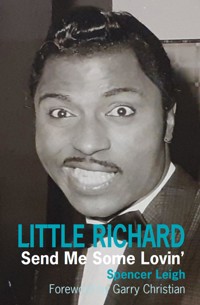
Born Richard Wayne Penniman, Little Richard said he invented rock 'n' roll. Spencer Leigh claims he didn't, but the world would have been very different without 'Tutti Frutti', two minutes of wild exhibitionism, recorded in 1955. It transformed American music and world culture. There still would have been the Beatles, Jimi Hendrix, David Bowie and Prince without Little Richard but their careers would have been different. Little Richard: Send Me Some Lovin' is a fun-packed biography about an influential and charismatic man who lived his life as though he were continually on stage. An influential and charismatic man who lived his life as though he were continually on stage. Page after page, you will be exclaiming 'Ooh! My Soul'. Come and meet Lucille, Long Tall Sally, Jenny Jenny, Miss Ann and Good Golly Miss Molly. Come and enjoy the company.
Sie lesen das E-Book in den Legimi-Apps auf:
Seitenzahl: 505
Veröffentlichungsjahr: 2023
Das E-Book (TTS) können Sie hören im Abo „Legimi Premium” in Legimi-Apps auf:
Ähnliche

















‘Only those who will risk going too far can possibly find out how far one can go.’
T. S Eliot
‘I wouldn’t say I started it all, but I don’t remember anyone else before me playing that stuff.’
Little Richard
‘Great people follow their own path.’
Bob Dylan
‘You do somethin’ no one else can.’
Little Richard (‘Miss Ann’)
‘You do somethin’ no one else can.’
(Everybody else)
Foreword
Little Richard to me is a timeless genius and as important as Elvis Presley. We think of his rock’n’roll power songs as having been around forever, but ‘Tutti Frutti’, ‘Long Tall Sally’, ‘Lucille’ and ‘Good Golly Miss Molly’ all appeared in an incredible creative burst between 1955 and 1958. He was a timeless genius but got sidelined in the 1960s, possibly because of the rich plethora of talent around like Sam Cooke, Otis Redding and James Brown.
This book tells us so much about Little Richard – a man who was always happy in his shoes and in what he was doing in a time where people were overtly judgemental (as opposed to the covertly judgemental masses who stalk social media today).
With his inimitable gender-crossing style, he must surely have been the main inspiration for Prince and many others – a black man wearing make-up and flamboyantly gender-neutral clothes, talking about religion and singing his lungs out … it must have been beautiful to watch.
Wish I’d seen in him in Liverpool in 1963, just casually strutting the stage holding a chair in his teeth (as you do).
I thought we’d had some pretty wild times in The Christians but reading Spencer’s depictions of Little Richard’s times with Larry Williams and Esquerita, I feel like our nights were pretty tame.
This book is an excellent read from a time when music led the way.
Garry Christian of the Christians, Liverpool 2023 vi
Contents
Introduction
At five minutes to midnight on New Year’s Eve 1999, I said to my wife Anne that we must start the Millennium by playing something joyous, optimistic and full of life, and she said, ‘Well, that rules out Leonard Cohen.’ I began with the war cry of rock’n’roll – Little Richard’s ‘Tutti Frutti’, released in the UK in 1956 and a record that told you that life would never be the same again.
Little Richard recorded some of rock’n’roll’s biggest hits, including ‘Long Tall Sally’, ‘Rip It Up’, ‘Lucille’ and ‘Good Golly Miss Molly’. Many other rockers including Elvis Presley, Eddie Cochran, Buddy Holly, Jerry Lee Lewis and the Everly Brothers recorded his songs, but Little Richard has not left a large legacy of tracks known to the general public – perhaps 12 as a generous assessment. That’s only half an hour’s music and his first album, Here’s Little Richard, contained half of them.
The discography I’ve compiled took me by surprise because I kept coming across excellent records which didn’t sell. Little Richard’s approach was set in aspic, and nobody wanted anything different from him. ‘I Don’t Know What You’ve Got (But It’s Got Me)’, made with Jimi Hendrix in 1965, is a wonderful example of deep soul music, but it has been ignored. Even by Richard himself – he doesn’t even mention it in his autobiography.
Bill Medley of the Righteous Brothers told me that when he was growing up, ‘I would put my ear to the speaker for a Little Richard record and I could sing along with it pretty good. Soon I could do exactly what he was doing.’
He’s not the only one. Little Richard was a prime influence on the beat groups of the British Invasion, and the Beatles included ‘Long Tall Sally’ in nearly all their stage shows. Indeed, Paul McCartney said, ‘The first song I ever sang in public was ‘Long Tall Sally’ at a holiday camp.’ It was the Beatles’ most performed song and they also wrote songs which aped Little Richard, notably ‘I’m Down’. What is the Whoo! in ‘From Me to You’ but 100% Richard? Then in the 1970s, Little Richard influenced Elton John, David Bowie and Michael Jackson. Glam was a reboot of Little Richard. In the ’80s, Prince updated Richard’s look, style and general mischievousness when writing about sex.
The so-called rock’n’roll lifestyle starts with Little Richard, and the link between sexuality and religion is a key component of both Little Richard’s and Leonard Cohen’s work, admittedly in very different ways.
I’ve followed Little Richard from the time I heard ‘Tutti Frutti’ and ‘Long Tall Sally’ in 1956. I’ve bulky files of press cuttings but, outside of his autobiography and a Rolling Stone interview, Richard avoided conversations with the media and, like a seasoned politician, had set responses. There was little of the antagonism associated with his compadres, Chuck Berry and Jerry Lee Lewis, but it was often nonsense accompanied by an enormous smile.
My good friend, Chas White, collaborated with him on that book, published in 1984 – a masterful work to be sure, one of the best -ever rock books, but he had to accept Little Richard on Little Richard’s own assessment. Chas’ book doesn’t question his outlandish claims, but it is a fabulous work, akin to David Niven’s outrageous Hollywood memoir, The Moon’s a Balloon (1971).
Chas described Little Richard to me as ‘a totally fascinating human being’ and I can buy into that. It has been enormous fun to research this book and then write about him. Where I part company with Chas is that I believe the key to Little Richard is that he was 2acting the entire time, and I would say the same of David Bowie, although Bowie was always expanding on what he had created.
Comparing Little Richard to an opera singer, Chas says that Little Richard makes Pavarotti sound like ‘a squeaky mouse’. Maybe with appropriate training, Richard could have sung opera, but the key difference between opera and rock voices is in interpretation. Bob Dylan, Neil Young and Tom Waits have shown that not being able to carry a tune perfectly is no drawback. It is the ability to convey the meaning of the words that counts, and some performers are more like actors than professional singers in that regard.
Little Richard’s influences are discussed in some detail. When he burst open the UK scene, no one had witnessed anything like it, but as Send Me Some Lovin’ shows he had taken a bit from this and a bit from that and certainly his songwriting was a patchwork quilt. I don’t, however, think that this diminishes his achievements. The way he brought it together was unique – and Little Richard showed that there was something new under the sun.
Furthermore, Little Richard was a Black, bisexual man in an era of segregation. His outlandish clothes, his pompadour and his make-up challenged the norm, so maybe he was a protest singer. His songs changed society as much as Bob Dylan’s.
Little Richard’s ego was monstrous. I thought before writing this book that he was funny and entertaining. I still think that but find him even more of a comedian than I expected, and, primarily, this is a book about a man who always wanted to be the centre of attention. Little Richard is an absolute gift for a writer and one thing is certain: neither I nor anyone else could have invented him. Little Richard is unique – and then some. Some books are a hard slog, but this one has been total entertainment.
By a quirk of fate, Little Richard was precisely in the right place at the right time to match the absurdity of his personality with the ridiculousness of rock’n’roll.
Obviously, in a book about a little richard, you’re going to get penis jokes. There’s the first one. Enjoy the book.
CHAPTER 1
Georgia on My Mind
I. Peach Pickin’ Time down in Georgia
Georgia in the south-east of America is an average-sized state, smaller than the UK and with a population of 10 million. The official state song is the truly exceptional ‘Georgia on My Mind’, written by two friends Hoagy Carmichael and Stuart Gorrell, who both came from Indiana. At a party in 1930, Carmichael played his new melody, and Gorrell asked if he could write a lyric, even though he had never written one before. It was a cold night in Indiana and the lyric was full of warmth and sunshine.
Hoagy Carmichael sensed it was a wonderful song, but although it was published in 1930, it didn’t find fame until 1941 when it was recorded by both Anita O’Day and Billie Holiday. In 1960 there was a brilliant interpretation by Ray Charles for his album The Genius Hits the Road, and it became a million-selling single. Actually, Charles hadn’t hit the road at all: he was born in Albany, Georgia, about 160 km (100 miles) from Macon where Little Richard was raised.
In 1968 the song was jokingly referenced by the Beatles in ‘Back in the USSR’ when John Lennon and Paul McCartney used its title to refer to the country in the Soviet Union. In 1978 ‘Georgia On My Mind’ was a key track on Willie Nelson’s album of standards, Stardust, the title song also being a Hoagy Carmichael tune.
Despite his exceptional lyric, Stuart Gorrell didn’t consider himself a songwriter. He became a banker and never published another song. When people asked him if ‘Georgia on My Mind’ was about a girl or about the state, he would answer, ‘What do you think?’ Clever move: the mystery endures to this day. Although there are hundreds of versions, Little Richard never recorded it, but he didn’t often record standards and his views about Georgia were mixed: he loved the state but there was danger all around him as he was growing up. This was a region where Black men were lynched.
In 1987 Ray Charles told the American writer, Joe Smith. “The biggest thing that ever happened to me was when ‘Georgia on My Mind’ became the state song. That really touched me. This state used to lynch people like me.”
Little Richard sometimes called himself the Georgia Peach because the state has the perfect climate for growing fruit and vegetables. Just off the coast are St. Simons Island and Cumberland Island, and in the sixteenth century Franciscan monks introduced peaches to the area. The sweetness of Georgia’s peaches is renowned.
Richard Penniman was born in Macon, Georgia, 80 miles south-east of Atlanta. The city was established in 1823 as a cotton port on the Ocmulgee River. As a transport hub, Macon was crucial. Its elegant train station from 1916 was designed by Alfred T. Fellheimer, whose CV included Grand Central Station, New York in 1903. Old photographs feature the prominent sign, ‘Colored Waiting Rooms’.
Many of the antebellum houses have been preserved and there is a cherry blossom festival every March. The city now has a population of 150,000 and is aware of its musical heritage with statues of James Brown and Otis Redding and talk of one for Little Richard. 4
The Georgia Music Hall of Fame opened on Martin Luther King Boulevard in 1996 and represented over 400 artists from Georgia, including REM. It displayed a photograph of James Brown meeting Pope John Paul II. Unfortunately, we don’t know what the two leaders were discussing. The museum closed in 2011, due to a lack of visitors – an indication that music tourism doesn’t always work.
Still, there is an Allman Brothers Museum, and Duane Allman was inspired to write ‘Little Martha’ by the statue of Martha Ellis in Rose Hill Cemetery. It’s on their 1972 album Eat a Peach, the title being another reference to Georgia’s produce.
Although there isn’t a Little Richard statue yet, you can travel along Little Richard Penniman Boulevard to Mercer University. The university was established in 1833 and named after a Baptist minister and community leader. There’s no connection with the Georgian songwriter Johnny Mercer, who was born 160km (100 miles) away in the coastal city of Savannah, his tribute to the area being ‘Moon River’ for Audrey Hepburn in the film Breakfast at Tiffany’s (1961). There was a Moon River close to Savannah and ‘my huckleberry friend’ presumably means that it was blue: again, another mysterious phrase that the songwriter didn’t explain.
The Little Richard House Resource Center is situated in Little Richard’s childhood home in Craft Street. It is opposite Jefferson Park, and stages social and musical events. The single-storey house isn’t where it used to be on Pleasant Hill. For a time, it was going to be demolished to make way for a highway, but then the whole premises was transported a mile away. Considering it is about a hundred years old, it has endured very well, especially as the small building had been a home to the Penniman family with their 12 children.
The Center is not a Little Richard museum, offering information about health, literacy and employment, how to fill in a job application, and how to learn about modern technology. It does, however, pay tribute to Little Richard’s life and when Richard heard about the Center in 2019, he said, ‘Thank you for everything you’ve ever done for my old house. That old house has a lot of tutti frutti, aw rutti.’
So too does the Greyhound bus station. It was there that Little Richard washed dishes and dreamt of being a star, though he was worried that constant dishwashing might ruin his pretty hands.
II. Open the Door, Richard
In the liner notes for his first LP, Here’s Little Richard (1956), Richard gave his date of birth as Christmas Day, 1935, a date that, though much repeated, is wrong. Choosing Christ’s birthday and making himself three years younger is narcissism on both counts and the key to Little Richard’s life.
Richard Wayne Penniman was born in the Pleasant Hill neighbourhood of Macon on Monday, 5 December 1932. This was to be his home, although he often lived away from it, until he had a major hit single with ‘Tutti Frutti’ at the start of 1956.
His grandfather, his uncle and a cousin were all preachers, and worship was to play a major role in Little Richard’s life.
For most of his adult years, Little Richard was attracted to the Seventh-day Adventists, and was an evangelist for them from the early 1960s.
Although Little Richard’s comments on religion can be inconsistent, he was accepted into the ministry of the Seventh-day Adventists. They have modified their beliefs in recent 5decades and are now part of the Christian family of churches. They have Observer status at the World Council of Churches and are on good terms with the evangelical wing. They differ from Jehovah’s Witnesses who are still something of an outpost in Christian belief.
Seventh-day Adventists practise strict temperance and as the name suggests, they observe the Sabbath from sunset on Friday to sunset on Saturday – that is, the same as the Jewish Sabbath. They have 20,000 pastors but Little Richard was never responsible for a congregation.
Hopefully, I report Little Richard’s thoughts about religion accurately in this book, but by and large, I will not be commenting further. The whole study of rock and religion and what various performers have believed merits a book in itself and would involve Elvis Presley, Little Richard, George Harrison, Pete Townshend, Bob Dylan, Leonard Cohen, Al Green, Sinéad O’Connor, Cliff Richard and the Singing Nun. I’ve got a title: I Say a Little Prayer.
When I saw Little Richard in Liverpool in 2000, he asked the Jewish people in the audience to raise their hands. At the time, I thought, ‘This is interesting. They’ve come to see a rock’n’roll legend and now they’ll be told to turn to Christ.’ But no, once the hands were raised, he said: ‘I’m Jewish myself’ and continued on his rockin’ way.
The rock musician and writer Sid Griffin had the same experience as he told me, ‘Richard stopped the show, acknowledged the applause and then said, “How many Jewish people do we have in the audience tonight?” It was a weird tangent but it was as entertaining as the rest of the show.’ And that’s it precisely – no matter what he is doing, Richard is mesmerising.
Little Richard had religion in his family. His grandfather, Walter Penniman, was a pastor for the African Methodist Episcopal Church. Walter had six sons and four daughters and his first son, Charles, known as Bud, was Little Richard’s father. His life was built around more worldly pursuits: raising a large family and working hard to provide. He was a skilled bricklayer and stonemason who developed a profitable sideline in moonshine – that is, illegal whiskey usually made at night (hence the name) which flaunted the strict Prohibition laws of the 1920s. He did go to church and help with the services, but his real interest was in his family and selling bootleg booze. Indeed, he opened his own Tip-in Inn.
Richard’s mother, Leva Mae Stewart, was the youngest in a family of eight. Richard would say that there was American Indian blood in the family, basing this on his grand-mother’s long silver hair and high cheekbones. Leva Mae was deeply religious and in Macon, she was an active member of the New Hope Baptist Church. Her brother, Louis, became a Baptist pastor in Philadelphia.
Bud met Leva at a church meeting, and they married when she was only 14, something that was common at that time in the Deep South. Their first child Elnora was born the following year: the name was chosen by Bud’s mother, but everybody called her Peggie. Then there was Charles, named after his father and sometimes called Bobby, followed by Richard Wayne. He was going to be Ricardo Wayne Penniman, after Leva’s father, but the clerk made a mistake and wrote ‘Richard Wayne’.
It is often reported that Richard was born with the right leg shorter than the other, maybe by as much as three inches. However, there is plenty of footage of Richard walking over the years and only occasionally is there a noticeable limp. Also, he appears to be wearing standard shoes with no built-up heel on one foot. Richard has said that this imbalance gave him a feminine walk when he was young and he was mocked for it, but again you 6should take a lot of what Richard says with 20 pinches of salt. Indeed, he sometimes joked that he invented hip-hop.
There is colour footage of Richard performing ‘Rip It Up’ on TV in 1963 and he is obliged to walk up and down a staircase – looks perfectly okay to me. Similarly, he goes down a staircase to a lower deck in the film, Catalina Caper (1967), again without difficulty.
After Richard, there were nine more children, the later ones being Marquette de Lafayette, Walter Maurice (named after Bud’s father), Horace Dearcy (known as Tony), Robert Realdo, Leva La Leda (known as Silvia), Artis Elaine, (Deanie), Gail June, Freka Diedra (known as Peaches) and Peyton Larry. Leva said of her last daughter, ‘I wanted a name that I’d never heard before.’
They lived on Pleasant Hill in a Black neighbourhood in this single-storeyed house near the railway track, so the children had to take care. They had electricity and running water, but their home was on a dirt road. The white families lived a couple of roads away on paved streets.
Bud built swings and slides for his growing family and they had such fun that white kids would come over to find out what was going on. Black families were not allowed in the white shops, and neither Richard nor his siblings dared venture into their territory.
Leva took her children to the New Hope Baptist Church on Third Avenue in Macon on Sunday mornings and some of her children, including Richard, sang as the Tiny Tots or the Penniman Singers.
The Pennimans had a piano which had belonged to Leva’s father, and Richard taught himself the rudiments. That, he thought, was all he needed and he never seriously studied the instrument, although he did assimilate some techniques along the way. By and large, he adapted the songs to his abilities and took it from there.
Richard would sometimes go with his grandmother to the Fountain Tempa, an African Methodist Episcopal church on Sunday evenings. He enjoyed the loud and lively gospel music at their services.
Richard said, ‘When Black people go to church, they want to shout. They are the shoutingest people I have ever seen in my life. I’ve seen an old lady do a James Brown right across the floor. Black people are very emotional.’
Right from the get-go, Richard was mischievous, often in trouble with his family, the church and the authorities. His brother Charles thought that it was part of his nature: Richard always wanted attention.
Richard had fun with his waste products. He said, ‘I pooped in a jelly jar, and I closed up the jar and put it in the cabinet with mother’s preserves.’ Another time he wrapped a turd and gave it as a peace offering to a neighbour who had criticised him. Leva once threw a bottle at him which accidentally hit his head and drew blood.
Richard was encouraged by his cousin Bertha May, known as Boodlum. They once locked up a grocer in his own store. When Bud got a Model T Ford, they pushed it down a hill.
Charles was taught to box by his father and sometimes defended Richard from his detractors, but he didn’t recognise his early musical ability. ‘He would beat on tin cans and I thought he couldn’t sing at the time. It was just a noise.’ Nevertheless, Richard sang in the church choir and as a young teenager, he was putting his flamboyance to good use, getting ready to perform as Little Richard.
Richard attended both Methodist and Baptist services in Macon, but one of his sisters, 7Peggie, went to hear a Seventh-day Adventist preacher, Elder Ward. Richard recalled, ‘His wife was playing the piano, and the girls was going to the tent because Elder Ward was a very good-looking guy. They were all going to the meeting, trying to get this woman’s husband, He was just smiling at them – then he hit them with the truth, so he was a very good preacher.’
This led to some family trouble. Even though Bud’s father was an Adventist minister, that brand of religion was not for him. Richard recalled, ‘Peggie became an Adventist. She threw the pork chops in the backyard as she had read that God didn’t want us to eat that kind of food. The Bible tells us what is clean and what is not clean. My daddy was mad with her and at the time I was mad with her too as I wanted my pork chops.’
Richard attended Macon’s Ballard-Hudson High School but he had little application and was a below-average student. He did learn a little saxophone, joining his school’s marching band.
As a teenager, Richard sang in the Macon Sanctified church. Often associated with Black communities, this branch of Christianity offered an energetic form of worship: believers reliving their experience and everybody singing with great fervour. Even by these standards, Little Richard was seen as too enthusiastic and was nicknamed the War Hawk. Richard said in 1959, ‘Religion is essentially a happy thing and something you should enjoy. That also showed up in my piano playing. One day in church I was enjoying myself so much that I added a boogie woogie rhythm to the hymns. That didn’t please the minister and at the age of 14, I was sacked for it.’
At the same show, Richard sang with Dr Hudson’s Medicine Show, its main function being to sell snake oil in sideshows at carnivals. Dr Hudson was from Macon and Richard sometimes travelled with him. The snake oil was $2 a bottle and said to be good for anything. Well, good for nothing really.
Bud didn’t object to Richard going away for a few days: an exhibitionistic child in a small house takes up a lot of space. He told Leva, ‘He doesn’t want to go to school, so let him go. He has our phone number.’ The Ballard-Hudson High School made no attempt to retain him, although a board outside the school today proudly acknowledges that Little Richard and Otis Redding were former pupils.
If only Richard had paid attention in the maths classes, he would have handled his contracts better in the mid-50s. He did, however, love music by musicians such as Cecil Gant, and he heard what he could in clubs and on the radio.
* * *
When Private Cecil Gant returned to Los Angeles in 1944 after war service, he recorded ‘I Wonder’ for the small Gilt-Edge label. Not many copies were pressed because of a shortage of shellac, but everybody wanted this song which captured the mood of the times. Secret deals were made for shellac and the record sold a million copies. Entrepreneurs realised that there was a market for R & B. Gant himself became depressed and died in 1951 but ‘I Wonder’ had kick-started the independent record business. As Little Richard reached his teenage years, there was a great array of wonderful records on the radio.
Even if Little Richard hadn’t mentioned his influences, we could guess them. Outside of gospel music, Richard’s prime influence was Louis Jordan and His Tympany Five. Their R & B hits were often humorous. Jordan was fond of rolling his eyes and pulling comic faces: see, for example, the YouTube clips of ‘Beware Brother Beware’ and ‘Deacon Jones’. 8The first secular song that Richard performed in public was ‘Caledonia’, a No.1 R & B record for Jordan in the summer of 1945. Louis Jordan, Jack McVea, Dusty Fletcher, the Three Flames and the Count Basie Orchestra all recorded hit versions of ‘Open the Door, Richard’, a novelty R & B hit from 1947. Richard loved its rhythm, its words and naturally, its title.
Louis Jordan spent a record-breaking 113 weeks at the top of Billboard’s R & B charts and his classic ‘Saturday Night Fish Fry’ from 1949 has a repeated refrain, ‘It was rockin’, it was rockin’’. As well as Jordan’s showmanship influencing Little Richard, his band line-up was copied by Fats Domino, his arrangements by Bill Haley, his sly humour by Ray Charles, and his lyrical style by Chuck Berry.
Although a Black artist, Louis Jordan even made the US country charts with ‘Ration Blues’ (a truly topical song from 1944) and ‘Is You Is or Is You Ain’t My Baby?’ (1947).
Little Richard’s debt to Jordan is obvious: his explosive but repetitive ‘Keep-a Knockin’’ sounds as though it was written on the spot, but its origin lies in a 1928 piano blues by Bert Mays, ‘(No use a-knockin’ ’cause) You Can’t Come In’, which went into Louis Jordan’s repertoire. Jordan, an audacious, pop-eyed dancer, also pioneered jump music, which was wilder than swing. He was among the first to make music videos and he made a Western in which he is playing a saxophone while riding a horse.
More recently, Louis Jordan’s music was celebrated in the theatrical success, Five Guys Named Moe. Jordan had it all – and he knew it: he said, ‘Rock’n’roll was not a marriage of rhythm and blues and country and western. That’s white publicity. Rock’n’roll was just a white imitation of what we did.’ Louis Jordan was inducted into the Rock and Roll Hall of Fame in 1987.
As for Jordan himself, his prime influence was the jazz singer and trumpeter Louis Armstrong. In 1926, while Armstrong was recording a hectic novelty, ‘Heebie Jeebies’, the sheet music fell to the floor and rather than stop singing, Louis improvised his vocal. His nonsense syllables have come to be known as ‘scat’, a style copied by Ella Fitzgerald, Little Richard and Van Morrison, to name but three. The song itself has a nonsense title but there are numerous examples of silly titles in rock’n’roll. Richard’s own ‘Heeby-Jeebies’ is a different song with the same title.
Fats Domino was also listening to Louis Armstrong’s wonderful ‘Blueberry Hill’ (1949), one of Richard’s favourite songs.
Slim Gaillard was a marvellous entertainer, mixing jazz and comedy in a very personal way. Like a hip Stanley Unwin, he invented his own jive talk, called Vout-o-Reenee, which ended words with ‘o-reenee’ or ‘o-roonie’. One record, ‘Flat Foot Floogie (with a Floy Floy)’, was about a prostitute with gonorrhoea. His double act with bassist Slam Stewart was a radio success and they had a pop hit as Slim & Sam with a piece of nonsense based on the Italian phrase for chopped fruit, ‘Tutti Frutti’. Most likely, this developed into a dirty song which, in turn, was cleaned up by Little Richard for his first hit single in 1955. Gaillard performed well into the 1980s, being the subject of a BBC-TV documentary and a host for the Wigan Jazz Festival.
In 1943 Carmen Miranda, with a greengrocer’s store on her head, sang ‘The Lady in the Tutti Frutti Hat’ for the Busby Berkeley musical The Gang’s All Here.
Then there’s ‘Be-baba-leba’ by Helen Humes from 1945. The high-pitched vocalist made this record with the Bill Doggett Octet, and Bill went on to make a memorable rock’n’roll instrumental, ‘Honky Tonk’, which you will know even if you don’t recognise the 9title. Helen had been one of Count Basie’s vocalists – and lovers – but had to leave when his wife found out about their affair. The nonsense song, a development of the phrase ‘be bop’ was an inspiration for Little Richard (‘Awopbopaloobop Alopbamboom’) and Joe ‘Mr Piano’ Henderson (‘Hey! Ba Ba Re Bop’).
‘The House of Blue Lights’ by Freddie Slack and his Orchestra from 1946 is an early example of white folk singing R & B. Freddie Slack was a pianist and arranger whose vocalist was Ella Mae Morse. She refers to him as ‘Daddy-O’ during the song, the first time that the term was put on record. The song itself was a variation of ‘Pinetop’s Boogie Woogie’ (1929), and it was subsequently associated with the singing pianist Merrill E Moore, a strong influence on Jerry Lee Lewis. Little Richard, you’ll remember, saw Miss Molly dancing at the House of Blue Light.
Joe Lutcher, brother of Nellie, sang with Nat King Cole. His energetic big band music was influential, notably ‘Rockin’ Boogie’ (1947) and the fast-moving R & B number ‘Rockola’ (1948), which was in praise of the famous jukebox: ‘Rock, rock, rock, Rockola’. David Rockola, who gave the company his perfect name, died in 1993 at age of 96. Joe Lutcher left music to join the church – and, in time would encourage Little Richard to do the same.
Art Rupe, the owner of Specialty Records recalled, ‘Joe Lutcher was one of our early artists and he had become a minister. His mission was to convert pop singers to the church with his old superstition that it is evil to sing pop. He got to Little Richard, and Little Richard began to believe the idea.’
Willie Lee Perryman from Hampton, Georgia, better known as Piano Red, released ‘Rockin’ with Red’ on RCA in 1950 – just before Little Richard joined the label. It is full of sexual innuendo: ‘She knows how to rock, If you’ve even been rocked, you’ll know just what I mean.’ The words and melody are almost identical to Richard’s 1957 hit, ‘She Knows How to Rock’, now listed with Richard as the composer.
There were many songs packed with innuendo like Wynonie Harris’ ‘I Like My Baby’s Pudding’ which was used, possibly without appreciating its implications, in The Great British Bake-Off on Channel 4.
Wynonie Harris’ repertoire was high on sexual content – ‘Lollipop Mama’, ‘I Want My Fanny Brown’ and even his most famous record, ‘Good Rockin’ Tonight’ in 1948. It was no act, either: he was foul-mouthed and would record his one-night liaisons and play them on the tour bus the following day. He put up a sign outside his house, ‘This is where the greatest blues singer in the world lives’, until the authorities made him remove it.
Harris added a dance beat to the blues, but straight-down-the-line, undiluted blues were also popular. One of the biggest R & B records of 1952 was ‘Dust My Broom’ by Elmore James with Sonny Boy Williamson on harmonica.
Chris Smither, a contemporary blues performer who writes for Bonnie Raitt, says: ‘Almost everyone who plays blues learns ‘Dust My Broom’. For one thing, it is so appealing because it is so obviously an early progenitor of rock’n’roll. Originally it was a woman’s song: ‘Get up in the morning and I believe I’ll dust my broom.’ It meant that she was going to get rid of her old man, ‘I will dust my broom on the back of this guy.’ That’s the only explanation I have of it: the song just sounds good and I like the way the vowels come together.’
Although Little Richard was to stand out from the crowd, the world of blues and rhythm and blues was populated with eccentric, one-off performers, none more so than 10Professor ‘Fess’ Longhair, the New Orleans blues singer and pianist. Fess once got so excited that he kicked a hole in his piano, and Chas White recalls, ‘A lot of rock’n’roll is about spontaneity and some of the best New Orleans records came from Professor Longhair coming in and playing rhumba boogies. They got the tapes rolling and that was it. He is as important as Ry Cooder as he brought in South American rhythms and American Indian tribal music.’ Richard would see him and think, ‘I can do this. I can do just what I want.’
From the age of 14, Little Richard would sing from time to time in a Macon bar, the Tic Toc Room, which was owned by a white couple, Ann and Johnny Howard. It was years ahead of its time: it had a mixed clientele and was also a gay meeting place. Richard said, ‘When I was 13. I played there and the people went mad. I played ‘Guitar Rag’ on the piano.’
Richard would also sell Cokes at the Macon City Auditorium, working for local promoter Clint Brantley. There was a constant stream of stars performing or waiting to leave for the next town.
Bud kicked Richard out of the house for his effeminate behaviour and the Howards allowed him to stay on their premises. Richard said of the Howards, ‘They adopted me and bought me a car. I went to school and Ann was like my mother for many years. Johnny passed away and I got famous but she wouldn’t take any money from me. They had a lot to do with me loving people today.’ Richard never forgot their kindness and sometimes dedicated ‘Miss Ann’ to her (‘When I’m with Miss Ann, I’m livin’ in paradise.’)
Richard often performed at the Tic Toc Room, invariably performing ‘Caledonia’. He also had bookings drumming up support for Dr Nubillo’s medicine show. Richard’s interest in turbans and capes was down to Dr Nubillo, who also ‘carried a black stick and exhibited something he called the Devil’s child—the dried-up body of a baby with claw feet like a bird and horns on its head.’
The trumpet break in ‘Atlanta Boogie’, a 1951 record from Tommy Brown, may not sound very hip, but otherwise this is rock’n’roll all the way. Tommy Brown from Atlanta influenced many Georgian musicians, including Little Richard and James Brown and possibly Johnnie Ray, whose ‘Cry’ is like his ‘Weepin’ and Cryin’’.
Ike Turner’s Kings of Rhythm Band featured Ike’s cousin, Jackie Brenston. On 5 March 1951 they recorded ‘Rocket 88’ for Sam Phillips in Memphis. It was largely instrumental with three short vocals: its energy has made Phillips call it ‘the first rock’n’roll record’, but then that would have to be something he’d produced. The record was released on Chess and topped the R & B charts, but there was friction as Ike Turner resented the billing, which implied Brenston was the star.
‘I always liked that record,’ admitted Little Richard, ‘and I used the riff in my act. When we were looking for a lead-in for ‘Good Golly Miss Molly’, I used that and it fitted.’ In several later interviews, Richard says he wrote ‘Good Golly Miss Molly’ in Macon, but, according to the record label, it is not even his song.
Little Richard was never taken to court for breach of copyright, but it is possible that backroom deals were made to credit and compensate original songwriters and publishers.
All these links to earlier records have changed my perspective on Little Richard: he wasn’t the great originator that I thought he was in the 1950s. Nevertheless, he brought this wonderful stuff to our attention and added his own magnificent spin. It simply illustrates that nobody lives in a vacuum. 11
In 1950, 17-year-old Richard was approached by Ethel Wynnes, who ran the Winsetta Patio club, 160km (100 miles) south of Macon in Fitzgerald, Georgia. The singer with B Brown and his Orchestra was sick and following a recommendation, she invited Richard to join them for a few dates. When the band played to white audiences in Georgia, Richard sang some contemporary hits (’Goodnight Irene’, ‘Mona Lisa’), which were well received.
B Brown told him to bill himself as Little Richard, echoing the stage names of many blues performers. There was Little Willie Littlefield and Little Walter before him and Little Willie John and Little Milton shortly afterwards. Sometimes the ‘Little’ denotes their youth.
There was also Big Joe Turner, which sounded good although in his case, he was mocking his obesity. Fats Domino with his first record ‘The Fat Man’ was getting the joke in first. On the female front, there was Big Mama Thornton and Little Esther, who later performed as Esther Phillips. In 1952 Little Esther and Little Willie (Littlefield) recorded a duet, ‘Last Laugh Blues’, an early Jerry Leiber and Mike Stoller song, for Federal.
In June 1952 the jazz and standards singer Billy Eckstine was given a gold record by the Harlem Record Dealers Association. He was touring as ‘the biggest boon to the record business in a decade’, but he never made the R & B charts again: things were changing.
Little Richard also toured with Sugarfoot Sam’s Minstrel Show from Alabama, on the chitlin circuit, clubs for Black performers which took their name from the food associated with the Southern poor, especially Blacks. With the Minstrel Show he was not just Little Richard but also Princess Lavonne. Because the audiences regarded it as good clean fun, many of the Black clubs in the South featured drag artists, even having an annual ball in New Orleans. The entertainment had developed from the minstrel shows, to offer fun and entertainment rather make than any political point, and Little Richard loved it.
Richard also developed an interest in doo-wop. Henry Nash knew Richard from school, where Richard was interested in the sounds Henry could make with a saxophone. When Henry was forming a doo-wop group, the Dominions, Richard was with them for some months, but he was never really a team player.
He did, however, love doo-wop, commenting on the Spaniels: ‘Yeah, those boys could sing. They’re on it, especially that bass man and my man, the smooth voice of Pookie Hudson. My goodness, if I was in a group, I’d like to be in the Spaniels.” When asked which Spaniels’ records he liked best, he named ‘Baby, It’s You’, ‘Stormy Weather’ and ‘Goodnight, Sweetheart, Goodnight’.
Richard also sang with a travelling circus owned by the King Brothers and then he was invited to join the Tidy Jolly Steppers, again performing in drag, for $10 a week. After that, he teamed up with two other drag artists and they worked on the L J Heath Show at Bailey’s 81 Theatre in Atlanta, where Richard performed four times a day. Their Broadway Follies production toured the South. Another vocalist on the show was Chuck Willis, later known for ‘What Am I Living For’. Willis had a hang-up about his balding head and always wore a turban, turning what would have been a liability into an asset.
Richard also found himself working alongside B.B. King and Jimmy Witherspoon – all good experience.
The most significant influence, though, was Billy Wright, the self-proclaimed Prince of the Blues, though he mixed blues with gospel and boogie-woogie. He had his first Top 10 R & B successes with ‘Blues for My Baby’ and You Satisfy’ in 1949 for the Savoy label. He had a similar style to Louis Jordan. ‘Billy’s Boogie Blues’ (1949) contains the line, ‘That gal 12rocks me, rocks me with a steady roll’ and has a playout that was copied by Frankie Lymon in ‘Baby, Baby’.
I’m partial to his 1950 single ‘Stacked Deck’: he’s going to play cards with his girlfriend but as he goes through the cards, rather like ‘Deck of Cards’, you realise he is going to win because he is the King with his crown. It’s a shame that Richard never recorded a tribute album to his early heroes: it would been good to have heard contemporary versions of songs like these.
Billy with coal black hair and gold teeth was in his early 30s and wore loud clothes. He had had his hair curled, and he applied heavy make-up for the stage. Billy encouraged Richard to be flamboyant, have a pompadour and slap on Pancake 31. Wright was also a female impersonator, so Richard was impressed.
Wright introduced Richard to a white disc jockey, Zenas Sears, who played Black records on Radio WGST in Atlanta. As a result, Little Richard was signed to RCA and was recorded on 16 October 1951 at that radio station using Billy Wright’s musicians. So Little Richard was on RCA some four years before Elvis, although this is not as impressive as it sounds. RCA released his two singles with little promotion, so why did they bother?
In ‘Every Hour’, you can hear strains of the agonised blues that Richard later recorded, such as ‘Can’t Believe You Wanna Leave’ and ‘Early One Morning’. ‘Why Did You Leave Me’ is darker and Richard is writing about California, a place he only knew from a map.
The famed jazz critic Leonard Feather (born in London in 1914) wrote the entertaining ‘Get Rich Quick’ with his wife Jane, while Jane and Little Richard wrote ‘Taxi Blues’, an odd song about a singer beating up his girlfriend. Still, that was common in songs of the period: Big Joe Turner in ‘Honey Hush’ is threatening his partner with a baseball bat.
The first single was released by RCA in December 1951 and reviewed in the trade paper Billboard: ‘From Macon, Georgia comes Little Richard, an 18-year-old blues shouter with a voice high in pitch but stylistically lowdown. Currently making personal appearances in Kentucky and along the Dixie circuit, he is presented among new RCA Victor discs with ‘Taxi Blues’ and ‘Every Hour’.’ So, Billboard had the correct information on Richard’s age though they never referred back to it. As ‘Every Hour’ sold quite well, Billy Wright’s record company asked him to record it – instead, he wrote a companion song, ‘Every Evenin’’.
Through Zenas Sears’ airplay, Richard’s single had some local success. ‘Every Hour’ was regularly played on Randy’s Record Store, a programme from Nashville. Bud Penniman had changed his mind: he was impressed with his son and made sure it was on the jukebox at the Tip-In Inn on Woodliff Street, Macon.
Around this time, a piano-pounding R & B shouter from the South would take the stage sporting a six-inch pompadour, rhinestone shades, embossed shirts, heavy lipstick, and heavier jewellery – and his name was not Little Richard.
His name was Esquerita.
Well, actually his dad was Eskew Reeder and he was born Stephen Quincy Reeder (S Q Reeder) in Greenville, South Carolina in 1935. He played piano from a young age and his roots were in gospel. He dropped out of high school when he was 15 and joined the Heavenly Echoes in New York. They took him on the road and he recorded with them. In a world of eccentrics, Esquerita was distinctive. ‘Esquerita was the first with the high wavy piled-up hair, lipstick and women’s sunglasses,’ says Dr John.
Esquerita played the chitlin circuit in the Deep South and he was gay, Black and camp. He was over six foot and looked crazy and was bringing humour to rock’n’roll. A powerful 13pianist, he used his huge hands to good effect, but his voice was not as strong or flexible as Richard’s.
When Richard was playing for Sister Rosa, who sold ‘blessed bread’ at the Macon bus station, as well his regular chore of washing dishes, Esquerita came into town. Richard called him ‘Excreta’, though not to his face: indeed, they used to refer to each other as ‘Miss Thing’.
When Richard invited him home, Esquerita played ‘One Mint Julep’ on the treble keys of the family piano and Richard was impressed: he was now determined to be a pianist as well as a vocalist. Richard said, ‘He also taught me his obligato holler, the “Whoo!”.’
But Richard wouldn’t use this yet.
RCA thought that Little Richard had made a promising start but needed better material. The bandleader Joe Thomas and the pianist Howard Biggs had a songwriting partnership in New York and the company asked them to submit songs for the next session. There was a jump blues ‘I Brought It All on Myself ’, a very confident, Louis Jordan-styled ‘Ain’t Nothin’ Happenin’’ and a slow blues ‘Please Have Mercy on Me’, which was derivative of Percy Mayfield’s ballad, ‘Please Send Me Someone to Love’. In 1956 Joe and Howard had one of their songs recorded by Elvis Presley, ‘I’m Gonna Sit Right Down and Cry (Over You)’.
Richard himself wrote ‘Thinkin’ ’Bout My Mother’, an autobiographical song about a boy who works away from home and is thinking fondly of his mum.
This session on 12 January 1952, like the first, took place at WGST. The songs had professional arrangements and are good performances. Richard had increased confidence but wasn’t yet the Richard that we know and love.
One of his favourite singers was Ruth Brown and he loved her 1953 record ‘Mama, He Treats Your Daughter Mean’. Herb Abramson of Atlantic Records talked about her ‘million-dollar squeal’ and now we can see how easily Little Richard incorporated that into his own performances. But not just yet.
Richard read of Ruth Brown being robbed of $10,000 in jewellery and furs from her car. At the time, she was eating in the Bailey Hotel in Pittsburgh en route to New Jersey for a show. The report told Richard that she was doing well and that there was money to be made if you had the talent and the right breaks. But Little Richard’s day-dreaming was forgotten as he had to confront reality.
On Valentine’s Day 1952 Bud and his daughter Peggie were drinking at the Tip-In Inn with his buddy, Frank Tanner. Frank was throwing firecrackers into the stove and laughing. Bud told him to leave but outside with his friends, he made an even greater noise. When Bud went to quieten them, he was shot dead. Frank was arrested and was convicted by a jury on 5 June`1952, but the case was later dismissed. Ten years later Frank asked the Penniman family to forgive him ‘and we did’, said Little Richard.
‘The police were quite glad that Bud had gone,’ reflected Richard. At the time, Leva was pregnant and her twelfth and final child, Peyton, was born two months later, on what would have been Bud’s birthday, 5 April 1952.
RCA released ‘Get Rich Quick’ and ‘Thinkin’ ’bout My Mother’’ as a single, but Little Richard was in no state to promote it. Billboard commented in its inimitable style, ‘Ork and chanter cut this raucous, carefree number solidly. Backing is in ragtime style.’
This was followed by ‘Ain’t Nothing Happenin’’ combined with ‘Why Did You Leave Me?’ from the first session. The fourth RCA single was ‘Please Have Mercy on Me’ and ‘I 14Brought It All on Myself’. ‘The warbler turns in a good vocal on this blues-weeper as he asks his girl to show him a little mercy. Ork backs him in bluesy style,’ said Billboard in November 1952.
A New York manager, Horace Edwards, asked Little Richard to join Percy Welch and his Orchestra for a tour of military bases around Macon. Their pianist Luke Gondor gave Richard some advice on playing the piano.
The US R & B chart in Billboard is, as you would expect packed with Black records, but not exclusively. In 1952 one of their No.1 records was Johnnie Ray’s ‘Cry’, which shows that crossovers were in both directions. To my astonishment, Pat Boone had four US R & B hits, including ‘Love Letters in the Sand’. Clearly, white artists were picking up sales in Black areas. Similarly, Billboard reported that Fats Domino and his six-man band had a month’s residency at Grady’s Supper Club in Nashville for $2,500 a week.
R & B accounted for only 5% of the total record sales in 1952 but it was possible for a big hit to sell 250,000 copies. Million sellers by R & B artists were rare, but that was to change.
A major film in 1953 was the 3D extra-terrestrial drama, It Came from Outer Space, based on a Ray Bradbury story. It is mentioned in ‘Science Fiction/Double Feature’ from The Rocky Horror Show (1973) and its title predicted the rise of Little Richard. (Come to think of it, there is certainly a Little Richard element to The Rocky Horror Show. ‘Sweet Transvestite’ would have been perfect for him.)
As Richard’s elder brother, Charles was fighting with the marines in Korea, Richard was the principal breadwinner and needed regular employment, no matter how menial. He was back washing dishes at the Greyhound station in Macon for $15 a week. When Richard wanted to criticise his boss, he would go ‘Awopbopaloobop Alopbamboom’, little knowing that he had created his passport to fame.
The Macon promoter Clint Brantley owned the Two Spot on Fifth Street and booked bigger attractions for Macon City Auditorium. As a former musician, Brantley recognised Little Richard’s talent. He told him, “Get yourself a band – there’s plenty of work available.”
CHAPTER 2
Specialty Acts
I. Art for Art’s Sake
In the 1990s it amused me that Virgin Records was described as an independent record company. Indies weren’t meant to be giant conglomerates like Virgin, although Virgin had started as one.
The real indies are to be found among the American record companies of the 1940s and ’50s. The larger companies were slow to appreciate the potential of Black artists and their music and although there were major stars (Louis Armstrong, Duke Ellington, Count Basie, Fats Waller), most Black performers recorded for smaller labels. This was an opportunity for businessmen in the big cities, where they formed companies, created dedicated radio stations and opened record stores. Some were opportunistic, some were gangsters, but most of them were enthusiasts like Art Rupe.
Art Rupe (Arthur Milton Goldberg) was born in Greensburg, Pennsylvania on 5 September 1917 and was raised in nearby McKeesport, both close to Pittsburgh. He was the son of a second-hand furniture salesman. The family did not have much money but he did well at school, attended a business course at Miami University, and then went to Los Angeles. He had a vivid imagination and had hopes of being a screenwriter in the developing film industry called Hollywood. Life, though, had other plans, not least war service maintaining Liberty ships. Their steel became brittle in the North Atlantic and he learned the importance of getting things right.
Art Rupe found it difficult to break into films but he could make a living by producing and selling records to the Black community. The record industry faced problems after the war, notably a shortage of shellac, which had mostly come from Japan. This made it harder and more expensive to press records, although a vinyl alternative was being developed, and it also meant that the majors like RCA and Decca were reducing their rosters. Good artists were looking for new homes.
Rupe had $600 and he spent $200 in buying some current R & B, blues and gospel releases and playing them over and over to determine what worked and what didn’t. He looked at the structure of the songs, the rhythms, the instruments used, the length of instrumental passages, and how the singers performed. With his knowledge of business administration, he considered how records were marketed and he appreciated that success was built around jukeboxes.
So, with two business partners, he started the Juke Box label and they knew from the start that would not be able to finance big band recordings. Their first release was ‘Boogie No.1’ by the Sepia Tones in 1944. It was fun but the music was too frantic for dancing. Still, it sold several thousand copies and gave Juke Box a good start. 16
Juke Box had its first big R & B success early in 1946 with ‘R.M. Blues’ for Roy Milton and his Solid Senders, a jump blues outfit. The track had an accentuated offbeat and is one of the precursors of rock’n’roll. It was one of the first records to sell a million copies in what was regarded as a race market, although Ella Fitzgerald and Billy Eckstine won Gold Discs with crossover sales.
Roy Milton continued with hit records until 1953, including ‘The Hucklebuck’ (1949) which laid the foundation for twist records. Frank Sinatra famously hated rock’n’roll but he covered ‘The Hucklebuck’. Milton was also a drummer and he often had a snare drum by his microphone which gave his records a stronger beat.
Looking for gimmicks, Rupe had the unusual idea of calling Roosevelt Sykes the Blues Man and Marion Abernathy the Blues Woman. The public might like to guess who the Blues Man and the Blues Woman were. The first hit was with the Blues Woman’s ‘Voo-It, Voo-It!’ and its innuendo-packed lines, “I’ve got a man that gives boogie all night long.”
After a second Roy Milton hit, ‘Milton’s Boogie’, Rupe realised his partners were crooked and so he left Juke Box and set up Specialty Records with Milton as his first artist. He created a distinctive yellow, black and white label for brand awareness.
Rupe saw his main audience as being in Los Angeles which, because of the war, now had a large Black population. If the records could also sell in the south and perhaps nationally, so much the better.
Milton’s glamorous pianist Camille Howard had her own singles including ‘X-temperaneous Boogie’ in 1948, and ‘Money Blues’, a rewrite of ‘Why Don’t You Do Right?’ in 1951.
Art Rupe was friendly with two brothers who were bandleaders – the elder Joe Liggins, with his Honeydrippers, and the younger Jimmy Liggins, with his Drops of Joy. Joe was doing exceptionally well on the Exclusive label, topping the R & B chart for 18 weeks with ‘The Honeydripper’ in 1943.
The owners of Exclusive, Leon and Otis René, owned a shellac pressing plant, but they didn’t have the facilities or the finances to utilise the new vinyl format. As a result of the shellac shortage, they were selling ‘The Honeydripper’ over the odds at $1.85. It was still a huge success despite cheaper covers from Roosevelt Sykes at 50 cents (RCA’s subsidiary Bluebird label) and Jimmie Lunceford (Decca) at 75 cents, an indication that RCA and Decca wanted Exclusive out of the way.
Soon Exclusive ran into financial difficulties and in 1950, Joe Liggins brought his band over to Specialty, where Jimmy was doing okay. Their successes included ‘Tear Drop Blues’ (Jimmy, 1948), ‘Rag Mop’ (Joe, a great dance track released in 1950), ‘Pink Champagne’ (Joe, R & B No.1 for 13 weeks in 1950: not quite rock’n’roll but getting there) and ‘Drunk’ (Jimmy, 1953). On ‘Drunk’, the band was billed as Jimmy Liggins and his 3-D Music as Rupe was always looking for gimmicks. Jimmy’s was an unlikely success story as he had been shot in the mouth. ‘Rag Mop’, incidentally, was a Black cover of a white original, which was a pop hit for the Ames Brothers.
By 1948 the price of singles had levelled out to 79 cents, but there was a new threat to record companies from the Petrillo ban. The president of the American Federation of Musicians, James Petrillo, called on union musicians to boycott recording studios until increased levels of pay were agreed.
And that was the reason for ‘X-temperaneous Boogie’. Roy Milton had been in the studio close to midnight when the ban took effect. They had a few minutes left and Rupe 17said, ‘What can we do?’ Milton’s pianist, Camille Howard, improvised a boogie, hence the title and another hit was born.
As the ban didn’t involve the singers themselves, ingenious ways were found to circumvent this, both Frank Sinatra and Bing Crosby recording a cappella. Columbia had a studio in Mexico and some American recordings were made there.
Although Art Rupe was Jewish with no strong beliefs, he loved the sound of gospel music and much of that was a cappella. It made sense to sign a gospel group, the six-piece Pilgrim Travelers. They tapped their feet as they sang, causing Rupe to publicise them as ‘Something New – Walking Rhythm Spirituals’. They harmonised (and tapped their feet) beautifully on ‘Jesus Met the Woman at the Well’.
In 1951 Art Rupe added the Soul Stirrers to the label and their first single, ‘Jesus Gave Me Water’ sold 65,000. This record was preserved for all time by the Library of Congress in 2022, inducted at the same time as Queen’s ‘Bohemian Rhapsody’. Part of the reason for its preservation was because the Soul Stirrers was featuring their young singer, Sam Cooke, and perhaps for the first time, there was sex appeal with a spiritual group. Girls would be screaming when the Soul Stirrers performed and Cooke realised in 1957 that he should be stirring his soul elsewhere – but more of this later.




