


19,99 €
Mehr erfahren.
- Herausgeber: ibidem
- Kategorie: Geisteswissenschaft
- Serie: An Interdisciplinary Series of the Centre for Intercultural and European Studies - CINTEUS
- Sprache: Englisch
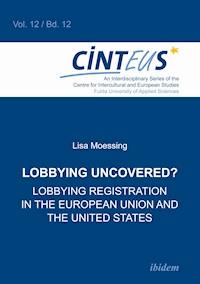
To the public`s eye, lobbying is still a highly obscure trade. Lobbyists are generally perceived to work behind closed doors in order to influence legislation—what really happens is unknown to the public. To make interest representatives more visible, both the European Union and the United States have developed mechanisms to register lobbyists. However, while US legislation now forces lobbyists to register and report their influential work by fixed deadlines, the EU`s registration remains voluntary due to the lack of a legal basis. This book takes the reader closer to today`s concept of lobbying, especially in regard to the EU`s registration mechanism. Lisa Moessing compares both the US and the EU registration systems by their technical composition, accessibility, and handling and contrasts their efficiency and effectiveness. Providing a forum for 17 lobbyists, watch dog members, and political representatives to discuss lobbying registration, this book defines starting points for improvement and emphasizes the importance of listening to those who deal with the registers in everyday practice.
Das E-Book können Sie in Legimi-Apps oder einer beliebigen App lesen, die das folgende Format unterstützen:
Seitenzahl: 280
Veröffentlichungsjahr: 2014
Ähnliche




















ibidemPress, Stuttgart
Editorial
This series is intended as a publication panel of the Centre of Intercultural and European Studies (CINTEUS) at Fulda University of Applied Sciences. The series aims at making research results, anthologies, conference readers, study books and selected qualification theses accessible to the general public. It comprises of scientific and interdisciplinary works on inter- and transculturality; the European Union from an interior and a global perspective; and problems of social welfare and social law in Europe. Each of thesearefields of research and teaching in the Social- and Cultural Studies Faculty at Fulda University of Applied Sciences and its Centre for Intercultural and European Studies. We also invite contributions from outside the faculty that share and enrich our research.
Gudrun Hentges, Volker Hinnenkamp, Anne Honer & Hans-Wolfgang Platzer
Editorial
Die Buchreihe versteht sich als Publikationsforum des Centrums für interkulturelle und europäische Studien (CINTEUS) der Hochschule Fulda. Ziel der CINTEUS-Reihe ist es, Forschungsergebnisse, Anthologien, Kongressreader, Studienbücher und ausgewählte Qualifikationsarbeiten einer interessierten Öffentlichkeit zugänglich zu machen. Die Reihe umfasst fachwissenschaftliche und interdisziplinäre Arbeiten aus den Bereichen Inter- und Transkulturalität, Europäische Union aus Binnen- und globaler Perspektive sowie wohlfahrtsstaatliche und sozialrechtliche Probleme Europas. All dies sind Fachgebiete, die im Fachbereich Sozial- und Kulturwissenschaften der Hochschule Fulda University of Applied Sciences und dem angegliederten Centrum für interkulturelle und Europastudien gelehrt und erforscht werden.Ausdrücklich eingeladen an der Publikationsreihe mitzuwirken sind auch solche Studien, die nicht ‘im Hause’ entstanden sind, aber CINTEUS-Schwerpunkte berühren und bereichern.
Gudrun Hentges, Volker Hinnenkamp, Anne Honer & Hans-Wolfgang Platzer
Foreword
Ever since its early days, the process of European Integration has been accompanied by interest intermediation of societal actors. During the past decades, the scene of EU lobby organizations has been continuously growing. This development and the important role lobbyism plays in EU decision making processes have caused heavy interest among academic researchers. Today EU lobbyism can be seen as one of the most important research fields within EU Studies.
The study at hand is a valuable and innovative contribution to the scientific research in EU lobbyism for several reasons.
Itsoverall researchperspective isto exploretheEU’s efforts in making lobbyism more transparent. After years of discussions and contested negotiations, the EU established avoluntary Transparency Registerin 2011.
Thisbook isone of the first systematiccomparisons of thevoluntary Transparency Register of the European Unionwith the mandatoryTransparency Registerofthe United States. An essential part of the study is shaped by the perceptions of personnel of European institutions, Brussels-based lobbyists, and lobby critics. These qualitative empirical findings, gained by semi-structured interviews, allow for deep insights into the practical working mechanisms of the EU’s Transparency Register, its applicability and efficiency, its problems and shortcomings.
Dealing with the topic of “democratic EU governance―transparency―EU lobbyism,” this book addresses a broad audience of politically interested readers.
Hans-Wolfgang Platzer
Fulda, June 2014
Contents
Foreword
Index of abbreviations
1Introduction
1.1Problem statement
1.2Research objectives
1.3State of research
1.4Research question
1.5Method
1.5.1Choice of method and implementation
1.5.2Restrictions of research design
1.5.3Evaluation
1.6Structure of the book
2Conceptual background
2.1Political systems of the EU and the United States
2.1.1Political system of the EU
2.1.2Decision-making in the EU
2.1.3Political system of the United States
2.1.4Decision-making in the United States
2.2Influencing political decision-making
2.2.1Lobbying
2.2.2Interest groups
2.2.3History of lobbying regulation in the EU
2.2.4Lobbying in the EU
2.2.5History of lobbying regulation in the United States
2.2.6Lobbying in the United States
2.2.7Interim conclusion
2.3Regulation and registration
2.4Transparency
3Comparison of lobbying registration in the EU and the United States
3.1The European Union
3.1.1Implementation of the Transparency Register
3.1.2Legal basis
3.1.3Instruments of control and penalties
3.1.4Effectiveness and criticism
3.2The United States of America
3.2.1Implementation of the Lobbying Disclosure Act
3.2.2Legal basis
3.2.3Instruments of control and penalties
3.2.4
Index of abbreviations
ABBREVIATIONS
ALTER-EU Alliance for Lobbying Transparency and EthicsRegulation
BDI Bundesverband der Deutschen Industrie e.V.(The Voice of German Industry)
BM Burson-Marsteller
CHR Clerk of the House of Representatives
COREPER Committee of Permanent Representatives
CRP Center for Responsive Politics
DG Directorate-General
DLR Deutsches Zentrum für Luft- und Raumfahrt(German Aerospace Center)
ECJ European Court of Justice
ECSC European Coal and Steel Community
EP European Parliament
ETI European Transparency Initiative
EU European Union
FARA Foreign Agents Registration Act
FRLA Federal Regulation of Lobbying Act
GAO US Government Accountability Office
GSC General Secretariat of the Council
HLOGA Honest Leadership and Open Government Act
IIA Interinstitutional Agreement
JTRS Joint Transparency Register Secretariat
LDA Lobbying Disclosure Act
LD-1 Lobbying registration (United States)
LD-2 Activity-related and financial reports (United States)
LD-203 Certain contributions reports (United States)
MEP Member of European Parliament
MP Member of Parliament
OECD Organisation for Economic Co-operation and Development
OLP Ordinary Legislative Procedure
PAC Political Action Committee
ROIR Register of Interest Representatives
SOS Secretary of the Senate
TEU Treaty on EU
TFEU Treaty on the Functioning of the EU
TR Transparency Register
WWF World Wide Fund for Nature
Preamble
Themotivation forbringing aboutthis bookoriginated from the generalquestionwhether lobbying proves to be as opaque, influential,and malicious as the image of the profession seems to be publicly maintained, and which measures of control can beimposed. Considering that the mandatory registration system installed in the United States is obviouslyperceived as a role model forthe disclosure of lobbying, it has been a key incentive for the author to examine itin detail, which further allowsidentifyingpossible weaknesses of this model register as well. Moreover, by recommending measures of improvement, the author actively participates in the discussion about the revision ofthe European Union’s Transparency Register.Special thanks are dedicated to all interviewees, who have contributed to this book through personal, e-mail,or phone interviewsorsimply by providing additional information. Particularly with regard to personal expertise with registration mechanisms, the scope of research ofthis book and its constructive analysis would not have been possible without the inputs from key respondents. Thereason for some interviewees to be quoted in anonymity is not only based on the fact that lobbyism is still a sensitive issue, but alsothat,in some cases,views arepersonal and cannot be authorized as an official view of the entityrepresented bythe individual.Therefore, especially the statements made by the interviewed Council Official cannot be regarded as an official opinion.[1]
1Introduction
1.1Problem statement
Today lobbying tends to be approached as a rather mysteriousand nontransparent profession,which seeks to tailorlegislation to its ends andis seen to occur as a gray area of politics.[2]Several regulative mechanisms have been implemented in the pastto monitor such activitiesin various democratic countries in an effort to increase the transparency of lobbying and to enhance an opendialoguebetween political leadership, interest representatives, and the public. One of the most recent mechanisms is theTransparency Register (TR) oftheEuropean Union(EU), whichwas launched in 2011 jointly by the European Parliament(EP)and theEuropeanCommission as part of the EuropeanTransparency Initiative(ETI). Despite the ambitious approach and an increasing amount of registrants, regulation remains voluntary. The register lacks a clear and detaileddefinitionof ‘the lobbyist’ as such, disclosure requirements are partially misleading,and sufficient incentives for registration are still intensively debated. In contrast, the mandatory register inthe United States isoften referred to as one of the most advanced concepts of lobbying disclosure and frequently serves as an argumentused bycritics of the EU’s voluntary approach.The US register wasa result of theLobbying Disclosure Act(LDA)in 1995; however, it is still imperfect in its conception. Thestudy at hand contrasts both approaches by their scope and legal basis, identifiescurrent weaknessesand strengths, and points out criticism. Based on these findings and by the involvement of personal expertise of lobbyists, EU andUSofficials, scholars and lobby critics, this thesis identifies areas of the European model that require improvement. Thebookis also designed to enlighten its readersthat even if the profession of lobbyists still maintains a huge influential power on political decision-making, it is not necessarily as opaque and negative as usually conveyed, if one only takes a closer look.
The findings of thisbookcan be a complementary input to the revision process ofthe TR for variousreasons: First, since the Europeanregister has been launched in 2011, it is still relatively new and without a doubt has still not been examined to a satisfactory extent. Second, apolicy process created and shaped by 28 Member States obviously requires critical input from its citizens.Third, specific measures, regulations, and instruments of a certain political system should permanently be contrasted with other existingconcepts, which isrealized by this book throughits analysis of a North American register. Finally,as research willdisclose, resources ofthe Joint Transparency Register Secretariat (JTRS) are limited. Thus, the possibilityfor the conduction of broader research related to the register is assumed to be restricted as well.
1.2Research objectives
Thestudyat hand is not designed to merely provide a comparison between two different registrationsystems,it also aims at extending its scope beyond.Its unique approach lies in itscombination of a detailed comparison between a voluntaryTR(EU) and a mandatory register (United States),complemented by acritical discussion on the European registration method in particular. Therefore, this work is one of the first to contrast theUS registration systemwiththeTR as themost recent and advanced discl
Lesen Sie weiter in der vollständigen Ausgabe!
Lesen Sie weiter in der vollständigen Ausgabe!
Lesen Sie weiter in der vollständigen Ausgabe!
Lesen Sie weiter in der vollständigen Ausgabe!
Lesen Sie weiter in der vollständigen Ausgabe!
Lesen Sie weiter in der vollständigen Ausgabe!
Lesen Sie weiter in der vollständigen Ausgabe!
Lesen Sie weiter in der vollständigen Ausgabe!
Lesen Sie weiter in der vollständigen Ausgabe!
Lesen Sie weiter in der vollständigen Ausgabe!
Lesen Sie weiter in der vollständigen Ausgabe!
Lesen Sie weiter in der vollständigen Ausgabe!
Lesen Sie weiter in der vollständigen Ausgabe!
Lesen Sie weiter in der vollständigen Ausgabe!
Lesen Sie weiter in der vollständigen Ausgabe!
Lesen Sie weiter in der vollständigen Ausgabe!
Lesen Sie weiter in der vollständigen Ausgabe!
Lesen Sie weiter in der vollständigen Ausgabe!
Lesen Sie weiter in der vollständigen Ausgabe!
Lesen Sie weiter in der vollständigen Ausgabe!
Lesen Sie weiter in der vollständigen Ausgabe!
Lesen Sie weiter in der vollständigen Ausgabe!




