


Erhalten Sie Zugang zu diesem und mehr als 300000 Büchern ab EUR 5,99 monatlich.
- Herausgeber: Captivating Travels
- Kategorie: Lebensstil
- Sprache: Englisch
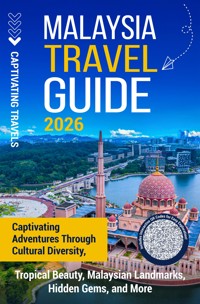
Explore Malaysia with Confidence — Includes Maps, QR Codes, and 90+ Images This guide helps you make the most of your trip to Malaysia — from the fast pace of Kuala Lumpur to quiet mountain towns, rainforest trails, and island coastlines. It's packed with well-researched tips, practical advice, and helpful visuals so you can plan with ease and travel without second-guessing. What you'll find inside: - Easy-to-follow regional guides — covering cities, coastal areas, and nature spots across both Peninsular Malaysia and Borneo. - Cultural context that matters — a clear explanation of Malaysia's mix of Malay, Chinese, Indian, and Indigenous traditions, with etiquette pointers, local customs, and major festivals. - Things to do outdoors — hiking, snorkeling, wildlife, beaches, and ideas for slow travel or day trips. - Big sights + smaller favorites — from well-known places like the Petronas Towers and George Town to lesser-known spots that are worth your time. - Useful planning tools — suggested itineraries, essential Malay phrases, a basic photo guide, and clear QR links to bonus resources. - And more to help you stay organized and explore with confidence. Whether you're planning your first visit or coming back for more, this book is a helpful, straightforward companion for your trip. Click "Add to Cart" to start planning your time in Malaysia.
Sie lesen das E-Book in den Legimi-Apps auf:
Seitenzahl: 98
Veröffentlichungsjahr: 2025
Das E-Book (TTS) können Sie hören im Abo „Legimi Premium” in Legimi-Apps auf:
Ähnliche

Malaysia Travel Guide
Captivating Adventures through Cultural Diversity, Tropical Beauty, Malaysian Landmarks, Hidden Gems, and More
Table of Contents
Title Page
Malaysia Travel Guide
Introduction
Chapter 1: Get to Know Malaysia
Chapter 2: Arriving in Malaysia
Chapter 3: Kuala Lumpur: The Dynamic Capital
Chapter 4: Tropical Islands & Sun-Kissed Beafches
Chapter 5: Malaysian Borneo: Wildlife & Rainforests
Chapter 6: Historic Cities & Culinary Delights
Chapter 7: Highlands & Nature Parks
Chapter 8: East Coast Malaysia: Cultural Tapestry & Unspoiled Shores
Chapter 9: Diving & Marine Sanctuaries
Chapter 10: Malaysian Culture, Customs, and Etiquette
Chapter 11: Top 20 Must-See Locations in Malaysia
Chapter 12: Suggested Travel Itineraries
Chapter 13: Best Places for Photography in Malaysia
Appendix: Quick Reference for Key Locations in This Guide
© Copyright 2025 - All rights reserved.
The content contained within this book may not be reproduced, duplicated, or transmitted without direct written permission from the author or the publisher.
Under no circumstances will any blame or legal responsibility be held against the publisher, or author, for any damages, reparation, or monetary loss due to the information contained within this book, either directly or indirectly.
Legal Notice:
This book is copyright protected. It is only for personal use. You cannot amend, distribute, sell, use, quote, or paraphrase any part, or the content within this book, without the consent of the author or publisher.
Disclaimer Notice:
Please note the information contained within this document is for educational and entertainment purposes only. All effort has been executed to present accurate, up-to-date, reliable, and complete information. No warranties of any kind are declared or implied. Readers acknowledge that the author is not engaging in the rendering of legal, financial, medical, or professional advice. The content within this book has been derived from various sources. Please consult a licensed professional before attempting any techniques outlined in this book.
By reading this document, the reader agrees that under no circumstances is the author responsible for any losses, direct or indirect, that are incurred as a result of the use of the information contained within this document, including, but not limited to, errors, omissions, or inaccuracies.
No part of this publication may be reproduced, distributed, or transmitted in any form or by any means, including photocopying, recording, or other electronic or mechanical methods, without the prior written permission of the publisher, except in the case of brief quotations embodied in critical reviews and certain other noncommercial uses permitted by copyright law. Travel information can change rapidly, and readers are advised to verify details such as prices, opening hours, and travel regulations independently.
Introduction
Kek Lok Si Temple on Penang island, Georgetown, Malaysia.
Welcome to the enchanting realm of Malaysia, a land where ancient rainforests meet futuristic skylines, where a mosaic of cultures thrives in harmony, and where every corner promises a new discovery. This is your personal compass to navigating the captivating tapestry that is Malaysia, designed to give you an insider's perspective on its most treasured secrets and celebrated highlights.
From the bustling street food havens of Penang to the serene, mist-shrouded tea plantations of the Cameron Highlands, and from the vibrant marine life of Borneo's underwater paradises to the iconic Petronas Twin Towers piercing Kuala Lumpur's sky, Malaysia offers an unparalleled blend of experiences. It’s a country that seamlessly weaves together Malay, Chinese, Indian, and indigenous influences, creating a unique cultural fabric evident in its festivals, cuisine, and everyday life.
What to expect inside
The Kuala Lumpur skyline.
This guide is crafted with you, the curious and adventurous traveler, in mind. We've gone beyond the usual tourist trails to uncover hidden gems, share local tips, and help you truly immerse yourself in the Malaysian way of life. To make your journey even smoother and more visually engaging, this guide is packed with vibrant, full-color images that bring Malaysia to life. You'll also find maps to help you orient yourself and explore with confidence, and for ultimate convenience, we’ve included QR codes throughout the chapters that you can scan with your smartphone for quick access to online resources, exact locations, and additional insights.
Interactive map to Malaysia
Planning your trip?
The best times to visit Peninsular Malaysia are generally from March to September, when the weather is drier and sunnier, perfect for island hopping and beach activities on the east coast, and for exploring cities like Kuala Lumpur and Penang. For the islands on the west coast (like Langkawi), the dry season typically runs from November to April. If your adventure takes you to Malaysian Borneo, the drier months are usually March to October, which is ideal for jungle trekking, wildlife spotting, and climbing Mount Kinabalu. While Malaysia is a year-round destination, keeping these peak seasons in mind will help you make the most of your tropical escape.
So, get ready to embark on an unforgettable adventure. Whether you're a first-time visitor or a seasoned traveler, prepare to be captivated by Malaysia's diverse landscapes, rich heritage, and the warm smiles of its people. Your Malaysian adventure begins now!
Chapter map guide
Map view of Malaysia.
www.openstreetmap.org
Chapter 1: Get to Know Malaysia
Water bungalows at Mabul Island, Borneo.
To truly appreciate the wonders of Malaysia, it helps to understand its foundational elements: its geography, its journey through history, its people, and the essence of its culture. This chapter provides a concise, comprehensive overview, setting the stage for your adventures.
Geography and Regions: Understanding Peninsular Malaysia and Malaysian Borneo
Kapalai resort at Kapalai Island, Borneo.
Malaysia is a captivating country in Southeast Asia, distinguished by its unique geography. It's essentially divided into two main parts, separated by the South China Sea:
Peninsular Malaysia:
This is the western part, bordering Thailand to the north and connected to Singapore by a causeway in the south. It's more developed and densely populated, home to the capital, Kuala Lumpur, and states like Penang, Malacca, and Selangor. The Titiwangsa Mountains run down the spine of the peninsula, creating distinct climatic zones and diverse landscapes, from pristine beaches on both coasts to lush rainforests and cool highlands.
Malaysian Borneo:
Comprising the states of Sabah and Sarawak, along with the federal territory of Labuan, this eastern part shares the island of Borneo with Brunei and Indonesia. It's renowned for its ancient rainforests, incredible biodiversity, indigenous cultures, and towering peaks like Mount Kinabalu. This region offers a more raw and adventurous experience, focusing on wildlife, nature, and cultural immersion with various tribal communities.
Key States and Their Distinct Characteristics:
Selangor.
Kuala Lumpur (Federal Territory):
The dynamic capital, a melting pot of modernity and heritage.
Interactive map of Kuala Lumpur (Federal Territory)
Selangor:
Surrounds Kuala Lumpur, offering a mix of urban sprawl, industrial zones, and natural attractions.
Interactive map of Selangor
Penang:
A UNESCO World Heritage island, famous for its food, street art, and colonial architecture.
Interactive map of Penang
Malacca (Melaka):
Another UNESCO site, rich in history with Portuguese, Dutch, and British influences.
Interactive map of Malacca
Perak:
Known for its tin mining history, colonial towns like Ipoh, and stunning cave temples.
Interactive map to Perak
Pahang:
Malaysia's largest state in Peninsular Malaysia, home to Taman Negara, Cameron Highlands, and beaches.
Interactive map to Pahang
Terengganu & Kelantan:
East Coast states known for their strong Malay culture, traditional arts, and beautiful islands.
Map view of Terengganu & Kelantan.
www.openstreetmap.org
Kedah & Perlis:
Northern agricultural states, wit+h Kedah home to the popular island of Langkawi.
Map view of Kedah & Perlis.
www.openstreetmap.org
Sabah (Borneo):
"Land Below the Wind," famed for Mount Kinabalu, orangutans, and world-class diving.
Interactive map to Sabah
Sarawak (Borneo):
"Land of the Hornbills," offering ancient rainforests, indigenous longhouses, and Mulu Caves.
Interactive map to Sarawak
Climate and Best Times to Visit:
An aerial view of Rawa Island, Malaysia.
Malaysia experiences a tropical climate characterized by high temperatures and humidity year-round, along with two distinct monsoon seasons. This means you can visit Malaysia at any time of the year, but understanding the regional weather patterns will help you plan your activities.
East Coast Peninsular Malaysia (e.g., Perhentian Islands, Redang, Tioman):
The dry season is typically from
March to September
, making it the best time for beach activities, snorkeling, and diving. The monsoon season (October to February) brings heavy rains and many resorts close down.
West Coast Peninsular Malaysia (e.g., Kuala Lumpur, Penang, Langkawi):
This region experiences rain throughout the year, but the wetter months are generally September to November. The
dryer, sunnier period is from December to February
, which is often considered the best time to visit these areas.
Malaysian Borneo (Sabah & Sarawak):
While it rains year-round, the
dryer season is usually from March to October
, ideal for jungle trekking, wildlife spotting, and climbing Mount Kinabalu. The monsoon season (November to February) sees heavier rainfall.
A Brief History: From Ancient Kingdoms to Modern Nation
Kek Lok Si Temple in Penang.
Malaysia's history is a rich tapestry woven from indigenous empires, colonial influences, and a resilient journey towards independence.
Early Kingdoms and Trade:
For centuries, the Malay Peninsula was a vital hub in ancient trade routes, attracting merchants from China, India, and the Middle East. Powerful kingdoms like Langkasuka and Srivijaya flourished, heavily influenced by Hinduism and Buddhism.
Rise of Islam:
In the 14th century, Islam arrived and rapidly spread, leading to the emergence of the Malacca Sultanate in the 15th century, which became a powerful trading empire and a center for Islamic learning.
Colonial Era:
The strategic location attracted European powers. The Portuguese conquered Malacca in 1511, followed by the Dutch in 1641, and finally the British, who gradually established control over various Malay states from the late 18th century. British influence led to significant immigration of Chinese and Indian laborers, shaping Malaysia's multicultural demography.
World War II and Japanese Occupation:
The occupation from 1942-1945 significantly weakened British authority and fueled nationalist sentiments.
Road to Independence:
Post-WWII, a struggle for independence ensued, culminating in the formation of the Federation of Malaya in 1957. In 1963, Malaya united with Sabah, Sarawak, and Singapore to form Malaysia. Singapore later separated in 1965.
Demographics and Society
A woman sightseeing at Batu Caves in Kuala Lumpur.
Malaysia is renowned for its incredible cultural diversity, a harmonious blend of several major ethnic groups living side-by-side.
Malay:
The largest ethnic group, predominantly Muslim, and considered the indigenous people (Bumiputera). Their culture forms the foundational identity of Malaysia.
Chinese:
Descendants of immigrants who arrived primarily during the British colonial era. They are largely Buddhist, Taoist, or Christian, and have traditionally played a significant role in business and trade.
Indian:
Descendants of migrants from India, primarily during British rule. They are mostly Hindu, with significant Christian, Sikh, and Muslim minorities, and contribute richly to the country's culinary and cultural landscape.
Indigenous Peoples:
Found predominantly in Malaysian Borneo (e.g., Dayaks, Kadazan-Dusun, Iban, Bidayuh, Orang Ulu) and smaller groups in Peninsular Malaysia (Orang Asli). These groups possess distinct languages, traditions, and spiritual beliefs, often deeply connected to their ancestral lands and rainforests.
This multiculturalism is one of Malaysia's greatest strengths, reflected in its festivals, food, languages, and social interactions.
Malaysian Culture at a Glance: Religion, Traditions, and Values
A craftsman is shown making a traditional batik.
Shubert Ciencia, CC BY 2.0 <https://creativecommons.org/licenses/by/2.0>, via Wikimedia Commons https://commons.wikimedia.org/w/index.php?curid=28102766
Malaysian culture is a fascinating blend of these diverse influences, characterized by respect, hospitality, and a strong sense of community.
Religion:
Islam is the official religion of Malaysia, but freedom of religion is enshrined in the constitution. Alongside Islam, Buddhism, Christianity, Hinduism, Sikhism, and various indigenous spiritual beliefs are practiced openly. This religious diversity contributes to a vibrant calendar of festivals celebrated nationwide.
Traditions and Customs:




