


18,49 €
Mehr erfahren.
- Herausgeber: The History Press
- Kategorie: Geisteswissenschaft
- Sprache: Englisch
In the Medieval Period the English Channel was a particularly perilous stretch of water. It had two distinct (and often conflicting) functions: as a rich commercial seaway, on which the rising economy of the Western world depended; and secondly as a wide, lawless, political frontier between two belligerent monarchies, whose kings encouraged piracy as a cheap alternative to warfare, and enjoyed their own cut. Pirates prospered. They stole ships and cargoes, at sea or in port, and they carried out long-lasting vendettas against other groups. They ransomed the richest of their captives, but tipped innumerable sailors overboard. While kings were ambivalent, foreign relations were imperilled, and although it was briefly quelled by Henry V, piracy was never defeated during this turbulent epoch. Breaking new ground, on a subject that remains topical today, Jill Eddison explores medieval piracy as it waxed and waned, setting dramatic life stories against the better-known landmarks of history.
Das E-Book können Sie in Legimi-Apps oder einer beliebigen App lesen, die das folgende Format unterstützen:
Veröffentlichungsjahr: 2013
Ähnliche




















‘Merchant and pirate were for a long period one and the same person.’
Friedrich Nietzsche (1844–1900),
German classical scholar, philosopher and critic of culture
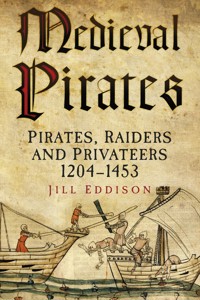
Cover illustration: Cogs in Action c. 1330. Cogs had a single square sail. Castles were added to give height. Here, the taller ship is winning the contest, while sailors falling overboard from the other indicate defeat. (BL Royal 10 E IV f.19. Published with permission of Bridgeman Art Library)
Acknowledgements
Dr Joan Thirsk and Dr, later Professor, Richard Smith, did much to encourage and promote my interest in medieval history. Dr Mark Bailey provided further insight into the period and into its sources at summer courses at Madingley Hall, Cambridge. Dr Mark Gardiner, medieval archaeologist from whom I had already learnt a great deal, discussed this project in advance and made valuable comments on an early draft of this book.
The basic research was carried out in the Canterbury Cathedral Archives and in the Templeman Library at the University of Kent at Canterbury. Occasionally I also visited the East Sussex Record Office. In all of them, I was grateful for the efficiency and cheerfulness of the staff. Charlotte Deane, who also helped as a picture researcher, kindly provided reference material which was available in London but not in Kent. Towards the end, my cousin, Captain David Balston, Royal Navy Rtd, alerted me to the challenges of present-day piracy, and provided a lot of detailed information.
In addition, the ten years covered by this project saw great technological changes and expansion of horizons for research. In 2003 Dr G.R. Boynton of the Libraries at the University of Iowa pioneered the way by making the Calendar of the Patent Rolls available on the web, free of charge. More recently the Dictionary of National Biography and much other material also became available there, so that some research could be carried out at home.
Joanna Hitchcock, friend from our student days and former director of the University of Texas Press, has, as ever, provided enthusiastic support and offered much very helpful advice. The late Dottie Gray spurred me on through the early years. More recently, Jane Lushington read painstakingly through each chapter in turn and provided valuable comments.
Ever since we acquired our first personal computer some thirty years ago, my son James Eddison has updated the equipment and guided my use of various systems. Patiently, he saw all the material into the Dropbox which took it to The History Press. Lastly, he compiled the index. Minh Tran also took a hand, upgrading my equipment. Throughout this time my husband David has kept the home fires burning, giving me the freedom to follow other interests.
Without the help, support and expertise of all these people, in all their varied fields, the material could not have been assembled, nor the book written, and it certainly could have not reached the publisher. I am profoundly grateful to them all. The interpretation of the story is, however, entirely my own.
Jill Eddison
June 2013
Fair digital copies of my manuscript maps were made by Philip Stickler in the Cartography Unit, Department of Geography, University of Cambridge.
Contents
Title
Dedication
Acknowledgements
Sources
Forewordby Professor Richard Smith
Preface
1.
A Lawless Domain
2.
The Passing Trade
3.
Ships, Shipping and Trade Routes
4.
The English Channel: A New Frontier
5.
The Cinque Ports
6.
Insolvency and Famine
7.
Portrait of a Pirate: John Crabbe (c. 1290–1352)
8.
Raids, Devastation and Fear 1337–89
9.
Privateers of the West Country
10.
Henry V: Pirates Suppressed
11.
Henry VI: Resurgence of Piracy
12.
Then and Now
Appendix
Bibliography
Plates
Copyright
Sources
Pirates left no official records. They were not in business to leave neat series of connected accounts for historians to assess several centuries later, and indeed it was probably that lack which explains why medieval pirates have escaped literary attention so far. As a result of the absence of systematic sources, the information for this book has had to be gathered from occasional, scattered, records found elsewhere. It has come from three distinct directions: the monastic chronicles; the official national records of government; and the large and varied bank of published, secondary, work.
The monastic chronicles are believed to have originated with Bede in the eighth century. The eleventh and twelfth centuries saw the foundation and flowering of an increasing number of religious houses, and by the thirteenth, chroniclers were busily recording not only the internal management of their own house and its estates, but were also interacting with local townsfolk and passing travellers to record the affairs of the wider world. They built up a picture of history, past and ongoing. They were, in fact, becoming the keepers of the nation’s memory.
One of the best informed and most frequently quoted of the chroniclers was Matthew Paris (c. 1200–59), a monk who began by assisting Roger of Wendover, the chronicler of St Albans, from 1217 onwards, before succeeding him in 1236. He spent nearly all his life in that abbey, strategically well placed beside the Great North Road only 20 miles from London. Having a roving interest and remarkably broad understanding, he collected the latest news and opinions from travellers, messengers and from the royal court which was constantly on the move. He went further, and developed a personal relationship with both Henry III and his influential brother, Richard of Cornwall. Not one to conceal his own opinions, it is clear that Paris respected the king for his religion, but deprecated his inadequate political management: he openly criticised Henry’s use of foreign relatives as his advisors. This exceptionally talented man illustrated his documents with easily recognisable pictures, and his maps (including one of Britain and another illustrating in a sequence of pictures the night-stops and the seas crossed on the route to the Holy Land) predated the advent of sophisticated, precise surveying techniques by some 300 years.
The Dissolution of the Monasteries in the late 1530s was a time of great upheaval which imperilled the survival of all these monastic documents. However, as the chronicles were recognised as such valuable collections of national history, and also because they were almost all conveniently written in books kept in libraries, separate from other documents, they were among the first to be rescued by the Tudor scholars. Matthew Parker, destined to be Elizabeth’s Archbishop of Canterbury (in 1559–75), made sure that many of them were transferred to college libraries and there they have survived. Ultimately, beginning in 1857, government funding was directed to meticulous editing of these documents by Victorian scholars, an operation which continued for fifty years. In all, 100 chronicles were transcribed, calendared (summarised) and printed in 253 volumes, mostly remaining in Latin but accompanied by lengthy introductions in English. Those volumes are now generally available on the shelves of the larger libraries and archive offices.
While the chronicles are indispensable, often as the only records of early events, they do have their limitations. Matthew Paris and the others, like modern newsmen, delighted in drama, hence their stories are likely to be exaggerated or biased – and are by no means indisputable. Sometimes, where French and English accounts of the same occasion can be compared, they are scarcely recognisable. Some unsuccessful events were virtually ignored by the scribes on one or other side of the Channel. Memory is conveniently selective.
The Patent Rolls and the Close Rolls (and other series to a lesser extent), which were also calendared and printed, in English, towards the end of the nineteenth century, contain innumerable references to piracy, either complaints by foreign heads of state on behalf of their merchants in respect of losses to English pirates, or directions to various mariners not to ‘intermeddle’ with the ships of others. Here, the problem is that these edicts were instructions, and there is no guarantee or, usually, evidence that the recipients carried them out. They may have simply amounted to wishful thinking. However, it was during a trawl through the Patent Rolls thirty years ago, following up another interest (historic sea floods) that this author was originally alerted to the intensity of complaints about piracy and their potential as a source of history.
In 1909 R.G. Marsden wrote on early prize jurisdiction, and in 1915 he published a pioneering collection of Documents relating to Law and Custom of the Sea. Three studies of the commercial life of south coast ports are also outstanding. Hugh Watkin’s book on pre-Reformation Dartmouth was published in 1935, as one of a series of ‘parochial histories’ by the Devonshire Association. The title of the series belies the importance of this book. Watkin transcribed, compiled, précised (rather reluctantly, one feels) and indexed a large collection of records beginning in Saxon times, which had been jealously guarded as a record of the privileges and possessions of the borough and port over many centuries. Of particular value here are sixty pages of medieval naval and commercial records.
The other two books deal with different aspects of Southampton, always the most important port on the south coast. The first, Italian Merchants and Shipping in Southampton, 1270–1600 by Alwyn Ruddock, was published in 1951. She deals with relations with the Italian traders, the source of the town’s wealth in the time of its greatest historical prosperity – when the port was not only a gateway to the woollen wealth of Wessex and an entrepôt for the tin from the West Country, but also served as an outport of London. Ruddock therefore provides much detail of the exotic cargoes arriving at Southampton.
Before 1973 Colin Platt, later (1983–99) Professor of Archaeology at Southampton University, had spent four seasons as Director of Excavations in Southampton during a time when much good evidence was still exposed as a result of war-time bombing. His principal published work on the subject was a pioneering, multi-disciplinary study of Medieval Southampton. In this he combined the archaeological results and topographical observations with a much wider consideration of national and international history. He looked at the life of the town, the management and operation of the port and the men who made up its trading community, highlighting their close-knit personal relationships, the close connection with the continental ports, and the changing nature of trade over the centuries. In doing so, he brought to light the activities of some of the traders whose alternative career was piracy.
All these three authors mentioned pirates and some of the effects of their activities on the commercial world, but did so only occasionally, en passant. None of them attempted collation or analysis of the pirates or their activities. The people who did notice, and who researched some of those individuals in greater detail, were three American scholars. In 1912, Henry Lewin Cannon of Stanford University published a paper on Eustace the Monk in the context of the Battle of Sandwich in the English Historical Review. Henry S. Lucas of the University of Washington wrote up John Crabbe in Speculum in 1945. Stephen Pistono of the University of Wisconsin discussed the relationship of Henry IV with English privateers, principally John Hawley, in English journals in the 1970s.
The raw materials and the manufactured goods which formed the cargoes, the currency of the pirates, are essential to this story. It may, however, come as a surprise that the academic study of this, the economic aspect of history, began only towards the middle of the twentieth century. And, as a last point, it is also interesting to note that the pioneers of the study of much of the medieval trade, in wool and cloth, wine, and Spanish iron were lady scholars, of whom Professor Eleanor Carus-Wilson was the leader.
AUTHOR’S NOTE
Medieval spellings, which were notoriously irregular, have been modernised and made consistent. Those place-names which cannot be traced are printed in italics.
The names Spain and Italy are used to identify their respective areas long before, in fact, such countries existed. Spain did not emerge as a unified country until 1492, following the recovery of the last part of the country from Muslim domination, the completion of the Reconquista. Italy did not become a united country until 1861, and even that date is disputed.
Sums of money are given as in the original documents, i.e.:
l. stands for livres parisien, and lt. for livres tourois, both ancient forms of French currency. English currency was expressed as l. sterling or, alternatively, as pounds. The latter was written £ s d. Every pound comprised 20s (shillings), and each shilling 12d (pence). Sometimes sums were quoted in marks, each of which was worth 13s 4d.
Foreword
Author Jill Eddison, who has made important contributions to our understanding of the history of the physical landscape and the economy of that stretch of the English coastline associated with Romney Marsh, brings us in this book a highly original study of another specific aspect of maritime history. No comparison to this book exists that tackles the study of medieval piracy in this fashion. Its focus is principally, although not exclusively, on the Channel from the early thirteenth to the mid-fifteenth century, and as such deals with a period initiated by the loss of Normandy in 1204 from what was a very substantial Anglo-Norman Angevin empire. As a result, England was faced on the opposite side of the Channel by a hostile France with which it engaged in recurrent phases of military conflict that culminated in the Hundred Years War. The concluding date of the study comes at the end of Henry VI’s reign, when the Normandy coastline which had been temporarily retrieved by Henry V was once again firmly in French hands, as were most of the lands that had earlier formed substantial English possessions across northern and western France. Eddison shows how the lack of strong political controls on either coast bordering the Channel made that waterway vulnerable to disorder, indeed at times anarchy, and in particular privateering. She sets this vulnerability against a backcloth in which she effectively draws out the allure to privateers of English trade both through the eastern end of the Channel with Flanders and through the Western Approaches with Gascony and northern Spain. She reminds us forcefully how sailing techniques and maritime technology exposed ships to great risks in open water, thereby inclining mariners to hug the coastline on their voyages and therefore exposing them to attack from privateers who could identify them from coastal vantage points and when they dropped anchor in bays or estuaries.
The distinctive strength of this book derives from the manner in which the author is able to show readily how frequently merchants, so intimately involved in seaborne trade, supplemented their income and that of their home ports by resorting to privateering. In so doing it is powerfully revealed how there was no clear demarcation between legitimate trade and illegal piracy. Indeed, too many persons in authority had an interest in the proceeds of piracy, since English and French monarchs were quick to use such individuals (some assessed in detail in this book, such as Eustace the Monk or John Hawley) to supply them with vessels for their fleets in times of warfare, which in effect gave them licence to engage in acts of illicit plunder and thefts at sea, and in opportunistic raids on both home and enemy ports. Only in the reign of Henry V, who for a brief period had control of both Channel coastlines as far west as Cornwall and Brittany, was some semblance of order achieved that significantly reduced the scale of privateering and its impact on Channel shipping and ports.
This book will be of great value to any reader, specialist or general, who has an interest in the history of Anglo-French relations, but also who wishes to know how a wide-ranging scholar is able to weave together a knowledge of maritime geography and environments with that of international trade and state development to create a very novel account of the inherent instability of maritime life through the Channel and the Western Approaches over two and a half medieval centuries. As a bonus, in a final chapter Eddison makes some highly perceptive comparisons between piracy in the medieval Channel and that occurring in the contemporary Indian Ocean.
Richard Smith
Cambridge
August 2013
Preface
Pirates have plundered shipping from time immemorial, ever since man first went to sea, and they still hit the headlines today. Historically, they have gripped the imagination, and so they have featured prominently in literature – in mythology, in fiction, in fact. Numerous books and films have dealt with their exploits off the coasts of the Americas, off the Barbary Coast of North Africa and in the South China Sea. But, remarkably, almost all of those are set far from home, and in the Elizabethan era or later. Earlier generations of pirates, those who operated in European waters during the medieval period, have scarcely been mentioned.
This book takes up that new subject, medieval piracy. It focuses principally on the English Channel, but since many of the ships which sailed that waterway and even more, the cargoes they carried, came from much further away, this story inevitably ranges widely too. As well as the trade and, essentially, the politics of England and France, it involves Flanders and Scotland in one direction, and Gascony, Iberia and some of the Mediterranean states in the other.
The period covered is just 250 years. The story begins in AD 1204, with the opening of a new chapter in history. In that year Normandy, which had been allied to England since 1066, fell to the expanding French monarchy. Thus the Channel became a wide and lawless frontier zone between two conflicting powers, conditions under which piracy was bound to flourish. Fortuitously, the beginning of the thirteenth century was also the time from which historical documents begin to survive, and to produce evidence of that piracy.
The story ends in 1453, at the conclusion of another chapter of history, the Hundred Years War. That was the year in which, having recently left Normandy, England lost Bordeaux, the last of her French possessions except Calais. English maritime strength was temporarily sapped (except, perhaps, in the south-west) and the country was becoming immersed in civil war. By coincidence, in the same year the advancing Ottoman Turks put an end to the Genoese monopoly of the alum trade, and thus made a significant change in maritime trade.
By that time too, the seafaring world was expanding its sights. It had already begun to look to Iceland and explore further west and south. As we leave it, maritime history was entering a new phase, and European pirates were on the brink of extending their operations across a much wider world. A new, very different chapter was beginning.
1
A Lawless Domain
The sea was a lawless domain beyond the borders of civilised society and the seaport a real frontier town.1
Piracy was endemic in the Middle Ages. Men stole each other’s ships; they looted each other’s cargoes at sea or in port; they demanded ransoms from those captives likely to be able to pay and they threw useless crew members overboard into the sea. Life was cheap and often short. In an age when men easily and quickly resorted to violence, these were universal, accepted facts of life.
This book explores the role of piracy in its widest sense, unofficial or semi-official activity in a fast-moving, volatile political world. It centres particularly on the English Channel, an exceptionally interesting stretch of water which served two different and frequently conflicting functions. On the one hand the Channel was a highly important seaway, a rich commercial artery, an essential link in the trade which formed the foundation for the rising economy of the western world. On the other hand, it was also a political frontier between two evolving, ambitious and belligerent monarchies, England and France. Throughout this period those two countries were hostile to each other. Short bouts of declared war in the thirteenth century led on to longer spells of warfare punctuated by periods of truce, lasting from 1337 to 1453, and described (much later) by historians as the ‘Hundred Years’ War’.
While the commercial world needed stability in order to function satisfactorily and to the benefit of nearly everyone, the political world, represented by the whims of a very small number of rulers, was far from stable. And political, dynastic and military considerations almost always prevailed. On the grounds of both expense and war-weariness of the troops, however, it was beyond the means of any monarch to continue declared, open warfare for more than a few years. It was much cheaper, and incidentally almost invariably more swift and effective, to operate unofficially. One means of doing so was to encourage piracy.
Piracy took many forms – which merged into each other, so there are no firm dividing lines. Trade, including fishing, was always competitive and, for commercial reasons or simply to satisfy personal greed, it easily and frequently escalated into violent appropriation of other people’s goods. Ships risked being pilfered when they put into ports for supplies of water or victuals, or when they were seeking shelter from storms, and passing vessels risked being captured and ransacked.
Competition easily developed into feuds. Adjacent ports, often on the same estuary, like those on the Exe below Exeter or like Sandwich and Stonor on the Kentish Stour, fought each other over installation of weirs which obstructed shipping, over rights to bring in cargoes, to levy customs, to take the dues on ferries across their estuary. There, and on a wider scale, long-running vendettas raged between groups of ports, sometimes against their fellow countrymen but often against foreigners. The rivalry between the Cinque Ports and Yarmouth, based on shared facilities at the annual nine-week herring fair, amounted to a petty war whose history went back to the Saxon period, lasted for centuries and influenced international politics.
Raids on opponents’ ports, sometimes based on feuds, sometimes politically motivated, were an extension of the same activity. The basic pattern of a raid was remarkably simple. Armed invaders sailed into a port on a high tide, plundered any goods they found, ransacked houses and warehouses, set fire to what they left behind, and departed on the high tide of the next day, before effective defence could be mounted. The success of these hit-and-run episodes depended on surprise attack spreading instant alarm among the local inhabitants: there was seldom any resistance. Those individuals who were fit enough made themselves scarce; the weaker members – the old, the women and children – remained behind and were killed or maltreated. A succession of raids could be extremely effective as a tool to achieve political ends, as the French showed in the fourteenth century: by disabling the south-coast ports they wiped out much of the commercial capability of England.
The latter half of the fourteenth century saw the evolution of a new form of organisation. The scale of maritime trade had increased but, because of excessive wartime expenditure, the resources available to the monarchs were seriously reduced. They therefore resorted to commissioning certain leading merchants to assemble their own fleets and go to sea to harry ‘the king’s enemies’. Given this official authority to attack their rivals, and with the promise of keeping most, sometimes all, of the prizes they captured, the merchants were happy to oblige. On these conditions they became known to the English as privateers, while to the French and Spanish they were corsairs.
It is evident that piracy was used as much as a political tool as a means of achieving personal profit or settling personal scores. Rivalry was easily and frequently exploited and stoked up by political leaders for their own ends – but always carried the risk of the violence backfiring and becoming beyond control. It was also a very short step for the mariners to set off independently, entirely in their own interests.
A political map of western Europe in 1204, had there been one, would have been very different from that of today. England, the major part of this offshore island, was already a single kingdom although her Celtic boundaries were by no means fixed: both the principality of Wales and the kingdom of Scotland were still independent and one or the other was almost continuously troublesome. Edward I (1272–1307) officially subdued Wales, although later on rebel armies were still able to issue forth from their sanctuary in the mountains of Snowdonia to trouble him and his successors. At much the same time as Wales was officially subjugated, relations with Scotland deteriorated abruptly after the last strong king, Alexander III, died as a result of falling off his horse in the dark in 1286.
The English Channel, 1204.
In contrast to the more or less consolidated English kingdom, in 1200 the French king ruled only a small area, consisting of the Ile de France, which surrounded his stronghold in Paris. Beyond that, the rest of present-day France was a patchwork of large quasi-independent states, each of which was led by its own duke or count. These included Brittany, which commanded a long and important coastline, and retained its independence beyond the end of this period. Most importantly, the King of England was feudal overlord of about half of the area of modern France, including the entire coastline from the River Somme south to the Spanish border. But in 1200 the pendulum of power was already swinging: Henry II’s Anglo-Norman-Angevin empire was about to break up. By 1224 a large part of that English-dominated land, including that bordering the Channel, had been regained by France, although England continued to hold Aquitaine, her land in the south.
To the north of France lay the County of Flanders whose name, Vlaanderen, derived from Middle Dutch, meaning ‘flooded land’. It consisted of the very low-lying ground, on the border between land and sea, which now includes the area of France from Calais northwards, with much of Belgium and the south of Holland. In 1200 this area was already established as a centre of the woollen industry, and was the economic powerhouse of northern Europe.
Each of these three states, England, France and Flanders, was manoeuvring to increase its territory and to maintain or expand its commerce at the expense of the others. Friction was frequent. Relations between France and Flanders, for instance, were never good. France was intensely jealous of the industrial strength of her northern neighbour. She also coveted the Zwin, a sheltered inlet of the North Sea which provided an extensive anchorage near Bruges and Sluys, which has long since silted up and disappeared but was then an exceptional asset. It was essential as a harbour, used not only for commercial shipping but also for assembling fleets for various French attempts to invade England. Conversely, it was a threat to France, because it was one of few places where England was able to land troops in large numbers before they made their way south. Franco-Flemish animosity was therefore continuous and France made several attempts to invade and conquer Flanders, all of them unsuccessful and counterproductive. The most she achieved were minor advances and the destruction of the industrial centres which she had sought to control.
In contrast, at the beginning of our period Flanders had a very strong, long-established commercial connection with England and, presumably on account of that, their political relations were much better than those between Flanders and France. But from 1265 onwards difficulties with Countess Margaret of Flanders gave rise to nearly continuous embargoes and confiscations, and led on to intense Anglo-Flemish piracy and reprisals in the North Sea. By the end of that century Flanders was supporting Scotland in her wars against England.2
Because France was perpetually opposed to England, she too naturally took the opportunity of supporting Scotland. She also supported Wales on various occasions when that principality was rebelling against heavy-handed English rule. By the fifteenth century the Dukes of Burgundy, who controlled a large part of present-day eastern France, were also the Counts of Flanders, and their claim to the French throne resulted in a lengthy war.
The states which lay to the south also had an interest in the English Channel. Aquitaine had a strong political and commercial relationship with England, an arrangement which went back to 1152, when the future Henry II of England had married Eleanor of Aquitaine. But in due course, building up from the mid-thirteenth century, it was the status of English ownership of Gascony which was to become one of the main bones of contention between England and France.
Trade with the South, 1250. Until 1278 trade with the Mediterranean was either carried over the Alps or went partially overland, via Bordeaux and Carcassonne.
During the first half of the thirteenth century, independent merchants from Castile were beginning to establish trading connections with the north.3 The area of present-day Spain, like that of France, consisted of a number of smaller states. Then, in the 1230s and 1240s, Alfonso VIII of Castile extended his boundaries to include a broad north-south swathe of the Iberian peninsula, between Portugal on the west side and Aragon on the east. These boundaries, which remained constant until the marriage of Isabella of Castile and Ferdinand of Aragon in 1469, after the end of our period, gave Castilian merchants access to the sea in three directions, to the Bay of Biscay in the north, to the Atlantic at Seville and Huelva in the south-west, and to the Mediterranean in the south-east, including Cartagena.
Relations with England were generally friendly, but only after his internal reorganisation was the King of Castile ready to consider formal arrangements for external trade. Then, on 1 March 1254, a treaty was signed with England, and the future Edward I of England married Eleanor of Castile, sister of the king. This heralded thirty years of prosperous Anglo-Castilian trade.4
The trading giants in the Mediterranean were the Genoese and the Venetians, but 1204 was too early for direct maritime contact with them, because it was considered that the inward (eastward) current which flows continuously through the Straits of Gibraltar, combined with prevailing winds blowing in the same direction, made it impracticable for the craft of the day to make the outward passage. Goods travelling to and from the Mediterranean had to be transferred to flat-bottomed boats and taken along inland waterways, and carried some of the way overland by mules, via Bordeaux and Carcassonne. But, in time, commercial developments within the Mediterranean stimulated pioneering attempts to travel westward, and the earliest record of a cargo shipped from the Mediterranean to England by that route was one of alum from Asia Minor, brought by a group of Genoese merchants in 1278.5 This was followed, spasmodically at first, by a growing number of ships from Genoa, Venice, the Balearic Islands and Valencia. As well as physical hazards on the long voyage up the Atlantic coast of Europe and up the English Channel, those ships had to contend with French pirates based at La Rochelle and on the islands in the Bay of Biscay and with multi-national pirates off Brittany.
Sooner or later these southern states were drawn into the Anglo-French conflict in a variety of ways – when their commerce was caught up in the piracy in the Channel, when their men and ships were employed as mercenaries chartered by one of the main contenders, or as the result of political alliances. Altogether, international relations were always volatile and frequently changing.
Internally, too, the governments of both England and France were often unstable, and weak government afforded enhanced opportunities for piracy. Powerful and power-hungry great lords, known respectively as barons and vassals, were always waiting in the wings. Both countries suffered spasmodically from weak leaders, domestic disturbances, civil wars and the occasional coup d’état. The English deposed two of their kings in the fourteenth century. It was always tempting, and possible, to exploit the internal weakness of opposing governments. Thus for numerous powerful and interacting reasons, the political background was unpredictable and continuously changing, and a general pattern emerges showing that greater instability on land was always accompanied by an increased level of piracy at sea.
The ports are central to this story, and it is impossible to overemphasise their importance, especially to England, an island nation which depended on the sea for all communications with the outside world, not least for its commerce and its wealth. The smooth and continuous operation of the ports was essential to economic prosperity. When the ports flourished, so did the commercial life of the country. And for that very reason they were frontier towns, who bore the brunt when foreigners attacked, as (Great) Yarmouth complained in anguish in the disastrous circumstances of 1386. Just as in 1940 the Luftwaffe went for the ports and railway junctions, the means of communication, so in the medieval period the French attacked the English ports, especially after the political tide had turned in their favour in the decades after 1360. When the ports succumbed, trade diminished and royal revenues fell with the consequence that the whole economy, the whole country, suffered.
To understand the special nature of these coastal communities, and how they operated, it is necessary to look back to their origins and evolution. Almost all of them started life as small settlements focussing on the twin activities of fishing, providing a vital source of protein, and boat-building. Of necessity, they all grew up in sheltered positions where they were protected from the rough water of the open sea. Hence each one was either situated on a river estuary, where they had the additional advantage of good communication further up river into the hinterland, or behind a substantial barrier of shingle and sand. (The barriers were ephemeral and liable to succumb to erosion, so that the geography of many of the medieval ports is now unrecognisable.) The communities in the ports were exceptionally close-knit, because of their commercial interdependence and because of the dangers which they faced together at sea. The seafarers depended on each other for their lives as well as their livelihoods. The vessels they built had to be safe enough for them, their families and neighbours to use as they went about their daily occupations. On both sides of the Channel, everyone involved, the owner of the ship, the master who took it to sea, everyone who provided supplies of any kind, down to the ordinary sailors, benefitted from a ‘share’ in the profits of the day’s catch, or cargo, in proportion to their investment in the enterprise. This custom extended to include sharing out the proceeds of piracy.6
Well before the dawn of the thirteenth century, every port must have become involved in trade to a greater or lesser extent. A few, in especially favoured locations, had evolved into impressive towns, complex trading centres which required sophisticated management. London stood out in a class of its own. Southampton, Winchelsea and Sandwich were the largest on the south coast, with Shoreham and Seaford in the second rank. Throughout the period covered by this book, the ports were led by small groups of entrepreneurs – people with courage and initiative, who had management and business skills as well as seafaring expertise. They were the merchants, who had the interests of their communities – and of themselves – at heart. Most importantly, they had never been part of the feudal system and so had never been subject to the kind of regulations which controlled the rest of society. They travelled, spreading trade, prosperity and culture across Europe. A class apart, they, exceptionally, were able to operate independently of authority except, up to a point, that of the king.




