


7,00 €
Mehr erfahren.
- Herausgeber: Garnet Publishing
- Kategorie: Geisteswissenschaft
- Sprache: Englisch
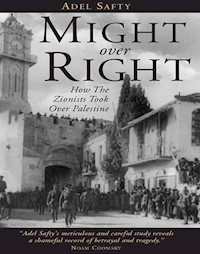
"Might Over Right" provides a critical account of one of the most remarkable stories in the twenty century's history of international relations - the history of how in the relatively short time of 30 years, Zionist leaders, managed, with the help of Western supporters but mainly the British, to wrestle a country away from its inhabitants, and in the process to profoundly affect the course of international relations and fundamentally transform the history of the Middle East. Extensively documented, relying mostly on Zionist, British, and Israeli sources, and sweeping in scope, the book makes a crucial contribution to the growing effort to challenge the simplistic and reductive accounts in media and scholarship in the West - one of the principal causes of the perpetuation of the conflict. "Might Over Right" goes beyond the Israeli new historians' accounts that focus on specific aspects of the Zionist-Palestinian confrontation. It also goes beyond the establishment of the state of Israel in 1948 to critically analyze the latest dimensions of the Arab-Israeli conflict, and of the continued Israeli-Palestinian confrontation.
Das E-Book können Sie in Legimi-Apps oder einer beliebigen App lesen, die das folgende Format unterstützen:
Veröffentlichungsjahr: 2009
Ähnliche




















MIGHT OVER RIGHT
.
How The Zionists Took Over PalestineADEL SAFTY
Foreword
In 1896, Theodor Herzl, the founder of modern Zionism, claimed that as far as Europe was concerned the Zionists in Palestine would “constitute . . . part of the rampart against Asia, we would occupy the outposts of civilization, stemming the tide of barbarism”. Some early British Zionists, such as Arthur Balfour, doubtless believed him, and because of the unceasing barrage of Israeli propaganda in the US media many Americans still cling to this view.
In his crisp and eloquent book, Might Over Right, Adel Safty puts the record straight. With scholarly care he vividly demonstrates how the Zionists’ inexorable annexation of Palestine at the expense of its rightful inhabitants has rather led them to behave like an outpost of ‘barbarism’, relentlessly destroying an almost defenceless Palestinian ‘civilization’. For the last hundred years or so the Palestinians have almost invariably had ‘right’ on their side, yet the Zionists or Israelis have always had ‘might’ on theirs. And of course ‘might’ has easily won the unequal struggle.
From 1917 until the period after the Second World War, Zionist ‘might’ was largely supplied by Britain. Since then it has come from the Israelis themselves and from their American sponsors. We in Britain have become so accustomed to the strength of the pro-Israeli lobbies in Washington and to the outrageous bias of successive American administrations in favour of Israel – at the UN in the past 30 years the United States has cast 34 vetoes in favour of Israel, many of them defying international law, as well as supplying Israel with cascades of military weapons and billions of dollars – that it is salutary to be reminded by Mr Safty that Britain played a similar if not so crudely partisan role for most of the 30 years after 1917.
Britain’s Balfour Declaration in 1917 promised something to a third party which was not hers to give, that it is to say Palestine. Even then this third party had every intention of displacing the existing inhabitants, and the Declaration was and is inexcusable. This is not just hindsight. Men like Lord Curzon realized at the time that Balfour’s folly would have disastrous consequences. And there was no doubt even then about the Zionist objective. When asked at the Versailles Peace Conference in 1919 to spell out the true aim of his movement, the supposedly moderate Zionist, Chaim Weizmann, said that it was to make “Palestine as Jewish as England is English”. With the population of Palestine then being less than 10% Jewish, that could only mean removing most of the other 90% at some point.
Balfour was well aware that the Jews were in a small minority in Palestine. “The weak point of our position”, he told the Prime Minister, Lloyd George, “is that in the case of Palestine we deliberately and rightly decline to accept the principle of self-determination”. A few months later he cynically confessed that “so far as Palestine is concerned the Powers have made no statement of fact which is not admittedly wrong, and no declaration of policy which at least in the letter they have not always intended to violate”. As a Foreign Office official justly commented, “Palestine is to go to the Zionists irrespective of the wishes of the great bulk of the population . . . The idea that [this] will entail bloodshed and military repression never seems to have occurred to [Balfour]”.
The Palestinians did eventually revolt, as they were bound to do when they saw that the Zionists intended to establish in Palestine a foreign state which would oppress its Arab subjects and/or expel them. But the British bloodily trampled down the Arab rebels, evidently not realizing that it was they themselves who had caused the inevitable rebellion. The Zionist leader knew better. David Ben-Gurion, later Israel’s first and greatest Prime Minister, said that “were he an Arab . . . he would also rebel, with even greater intensity, and with greater bitterness and despair”. Unfortunately, that understanding did not influence his subsequent conduct.
Zionism has never been a humanitarian movement; it has always been an aggressively nationalist one. During the pre-war Nazi persecution of the Jews, the British government proposed that thousands of JewishGerman children be admitted into Britain. Yet Ben-Gurion strongly opposed that humanitarian suggestion. He told his fellow Zionists that if he knew that “it would be possible to save all the children in Germany by bringing them over to England, and only half of them by transporting them to Eretz Israel, then [he] would opt for the second alternative”. Zionist fanaticism thus led Ben-Gurion to a position worthy of King Herod.
A similar level of ruthless cynicism and absence of scruple was evident in the proposal by a Jewish terrorist group, the Stern Gang, (to which the future Israeli Prime Minister Itzhak Shamir prominently belonged) that there should be an alliance between Nazi Germany and a future Jewish state. Despite that flirtation, in 1943 Ben-Gurion opened what the pro-Israeli historian, Christopher Sykes, whom I was lucky enough to know, called “a new phase in Zionist propaganda: henceforth to be anti-Zionist was to be anti-Semitic; to disapprove of Jewish territorial nationalism was to be a Nazi”. However discreditable this position, it proved a potent propaganda tool and remains so, especially in the United States.
Israel is now strongly opposed to ‘terrorism’, stigmatizing as ‘terrorist’ even fully legitimate Palestinian acts of resistance against Israel’s brutal army of occupation. Nevertheless the state of Israel was of course itself created by terrorism – both against the British and the Palestinians. In April 1948 the Irgun, the terrorist organization led by Menachem Begin (who later became Prime Minister of Israel), committed a particularly appalling atrocity – the massacre of Deir Yassein. Not long afterwards a number of prominent Jewish Americans, including Albert Einstein, objected to Begin visiting the United States, saying that his political party, the ‘Freedom Party’, the predecessor of Ariel Sharon’s Likud Party, was “closely akin in its organization, methods, political philosophy, and social appeal to the Nazi and Fascist parties”.
The Arab world has always had so strong a case on the issue of Palestine that extraordinary incompetence and inefficiency has been required for the message not to get across, yet it has rarely done so, an abject and disastrous failure which is rightly criticized in this book. The complete master of his subject, Adel Safty graphically recounts how the Zionists achieved their aim of dispossessing and driving out most of the indigenous inhabitants of Palestine. Through his liberal use of telling quotations, Adel Safty enables the Zionists to condemn themselves out of their own mouths. He has produced a masterly and unanswerable indictment of Zionist and Israeli policies past and present.
Introduction
This book is about one of the most incredible stories in 20th-century international relations; it is about how a group of people with nothing more at their disposal than a grand design, managed, in less than 50 years, to bring about the implementation of that design, and in the process to profoundly affect the course of international relations and fundamentally transform the history of the Middle East.
The grand design was as incredibly ambitious as it was astonishingly daring, for it involved nothing less than the taking over of a whole country and the displacement of its people. The architects of this plan were the leaders of the Zionist movement and their grand design was to take over Palestine.
At the end of the 19th century and the early part of the 20th century, political Zionism faced two major challenges: firstly how to rally the support of the Western Powers and their influential Jewish communities for the Jewish nationalist goal of establishing a Jewish homeland in Palestine, Argentina or Cyprus. Secondly, how to colonize and turn a country like Palestine, with an overwhelming Muslim majority, into a Jewish State?
The success of the Zionists in achieving both goals was largely due to the efforts of the Zionist leaders, who preached the use of deception and force. This was cogently illustrated in the Zionists’ basic strategic approach to Palestine, succinctly put by the leader of the Zionist movement Theodor Herzl: “Might takes precedence over right.”
Zionism may have many achievements to its credit in the eyes of nationalist Jews, though none, I daresay, could match the successful implementation of the design to take over Palestine. This book does not, however, seek to tell the story of Zionism’s achievements. Zionist historians and other writers have told that side of the story countless times.
This book tells the other side of the story, which has gone largely unreported for the first 70 years or so of the conflict: the story of how, in implementing their grand design to forcibly take over Palestine, the Zionists knew that their strategy was bound to inflict gross injustices on the ill-prepared people of Palestine. The Zionists also knew, and many admitted as much then as they still admit now, that the Palestinians were innocent bystanders who had no role in the persecution of, and discrimination against, the Jews in Europe, which led to the birth of Jewish nationalism and Zionist militancy.
As Israeli Professor Beit-Hallahmi put it: “It was easy to make the Palestinians pay for 2,000 years of persecution. The Palestinians, who have felt the enormous power of this vengeance, were not the historical oppressors of the Jews. They did not put Jews into ghettoes and did not force them to wear yellow stars. They did not plan holocausts. But they had one fault. They were weak and defenceless in the face of real military might, so they were the ideal victims for an abstract revenge.”1
The strategy for taking over Palestine was as simple as it was daring: deception, alliance with imperial powers, systematic propaganda to sustain such alliances and naked force.
Deception was used to convince the British imperial leaders that Zionism was widely supported by European Jews when it was not. Deception was used to claim that Palestine was a land without a people when it was not. Deception was used to secure the support of Great Britain by claiming that all the Zionists wanted was a home in Palestine, a haven from persecution, when in fact they wanted much more. Deception was used to convince the Allied Powers, meeting after the end of World War I at the Peace Conference in Paris, that all that the Zionists wanted was to contribute to the economic development of Palestine, and that they had no intention of displacing Palestine’s original inhabitants. Deception was used to argue successfully that a historic connection with a country could give rise to political rights, when in fact such an argument had no basis of validity. And, after the successful implementation of the Zionist project of establishing a Jewish state, deception was used to successfully convince the world that the Palestinians had ‘left’ their homes and land, when in fact the Palestinian exodus was caused by terror, massacres, and expulsion. Thereafter, deception was used to systematically blame the victim.
Deception alone, of course, would not have been enough. Great Britain had its own imperial interests (proximity to the Suez Canal, protecting the land route to India, and foiling the imperial ambitions of rival France), which it thought could be served by sponsoring the Zionist project in Palestine.
Sponsoring the immigration of European Jews to Palestine with the ostensible goal of establishing a Jewish home in Palestine could only be implemented by force, since the Palestinian Arabs, about 93% of the population of Palestine at the time of the Balfour Declaration in 1917, were not going to acquiesce to the colonization of their country by an alien culture. Sir John Bagot Glubb recognized that the use of force was inherent in London’s decision to sponsor the Zionist project in Palestine: “To impose on the Arab majority of Palestine a policy so extremely distasteful to them required coercion by military force. The British Army found itself unwillingly obliged to force on the people of Palestine a policy bitterly opposed by the majority of the people. Military coercion of a civilian population has always been extremely distasteful to the people of Britain. It was one of the many ironies of the Palestine muddle that the Jews, who seemed in Europe to be an oppressed minority, arrived in Palestine in the guise of European colonizers. Many of the parties, which, in Europe and America have been the loudest to denounce European ‘imperialism’, yet support the forcible colonization of Palestine by military force.”2
The first Zionist leaders were also skilful politicians. Chaim Weizmann managed to convince Western leaders that Zionism was an extension of European imperialism. He was successful in galvanizing the support of reluctant but influential Jews in the West for the cause of Zionism. The support of influential Jews proved crucial in bringing political pressure to bear on British leaders every time they were tempted to follow the conclusions and recommendations of their own commissions of inquiry that looked into the causes of the increasingly violent and frequent Palestinian clashes with the conquering Zionist colonizers. Pressure by influential Jewish organizations in America was instrumental in bringing the Truman administration around to supporting the UN recommendation to partition Palestine, and making sure that it was not swayed by the proposal to place Palestine under a UN trusteeship. Eventually, the major Zionist organizations in Western Europe and the United States would come to exercise a remarkable degree of influence in the setting of the political agenda, especially in the United States, in all matters concerning the Israeli–Palestinian conflict and, later, the Arab–Israeli conflict.
Thus, deception, propaganda, alliance with imperial powers, and eventually naked force, were the hallmarks of the Zionist strategy for the taking over of Palestine. It was a daring strategy worthy of Niccolo Machiavelli, the 15th-century Florentine master. The Zionist strategy was, in fact, more remarkable and astonishing than Machiavelli’s own advice, for Machiavelli counselled rulers to resort to the use of brutalities, deception, crime and naked force in order to obtain and safeguard power, and protect the interests of the state. But when the Zionists started their daring odyssey they had neither power nor a state. They had just an idea: the idea that anti-Semitism was endemic in Europe, as the 1894 Alfred Dreyfus trial in France had illustrated, and that no reforms, even in the liberal democracies of the West, could eradicate it. Therefore, the Zionist leaders argued, only the establishment of a Jewish state could solve this intractable problem.
The idea of Jewish nationalism was novel because historically nationalism in Europe was based not on religious but rather on ethnic national identification, usually within an already defined territorial base. Judaism on the other hand was not an ethnic identity but a religion; there was no such a thing as a Jewish nationality; the Jews were nationals of the countries where they lived. In addition, there was no particular group of nationalist Jews living within a defined territory that collectively rebelled against the ruling regime in that territory and demanded independence. Certainly the indigenous Jews of Palestine did not revolt and demand special political rights; on the contrary, many in fact opposed Zionism and its basic philosophy, arguing that the Zionist project to establish Israel by force was morally untenable because Israel would be established only with the return of the Messiah, not by the sword of mortals like the Zionist colonizers.
The nationalism of the Zionists was thus unique in that, lacking a homogenous population base anywhere and a territorially defined base from which to agitate and struggle for the fulfilment of its nationalist aspirations, it required a homogenous population and a territory. The Zionists wanted to colonize an existing country, which they could turn into a Jewish state with a homogenous Jewish population. They selected Argentina, the Egyptian Sinai, Cyprus or Palestine as the venue for their daring colonial venture, but the British offered them only Uganda. Eventually, the Zionists insisted on Palestine because of its spiritual appeal to the Jews who were not yet converted to the nationalist message of the Zionists.
Zionism presented itself as both a nationalist movement demanding political rights for its members, and an imperial colonizing movement, one of the many contradictions and complexities inherent in the Zionist project. Whereas nationalist movements in the 19th and 20th centuries were essentially founded on the struggle of a group of people living together in a defined territory who shared history, language and culture and wanted to throw off the yoke of imperialist control over national destiny, the Zionist movement decided to be both nationalist and imperialist.
The Zionists were not only unusual nationalists they were also unique imperialists. Unlike most imperialists, the Zionists were not interested in discharging the ‘White Man’s burden’ of civilizing the savage in the way that some British imperialists had perceived and rationalized their colonial policies. Nor were they in pursuit of une certaine idée de la nation to create overseas territories that became an extension of the glorious metropolis, as many French imperialists had seen their colonial enterprise.
Maxime Rodinson has compared the Zionist movement to the French colonial settler movement in Algeria in the 19th and 20th centuries. A marked difference, however, is that the French settlers superimposed their colonial structures and their colonists over the existing population of Algeria whom they actively sought to mould in the French image, linguistically and culturally. The Zionists wanted neither to civilize nor to integrate the colonized people. They wanted to completely displace them and simply take over their country. The Zionists were the ultimate exclusivists. They were not the avant-gardes of a proselytizing religion, and they rejected any suggestion of bi-national co-existence with the Palestinian Arabs in Palestine. They were only interested, as they repeatedly made it clear, in making Palestine “as Jewish as England is English”.
The Zionists were also unusual democrats in that while they constituted themselves as a democratic polity, the Zionist movement contained, and eventually came to be dominated by, totalitarian socialnationalist thoughts. This at once explains the contradiction of Israel being a democratic state that is not the state of all of its citizens, but the state of an exclusive group of people belonging to a specific religious faith no matter where they may be around the world. It also explains the extremist views, which were originally at the margin of the Zionist movement, but which eventually came to dominate the Zionist and the Israeli body politic. While democratic imperial powers were able to accept the consequences of a changed balance of power, and of the emergence of new normative values in international relations and international law such as equality of peoples and the principle of self-determination, the Zionist movement and the Israeli body politic were unable to adapt. This was a result, in large measure, of the dominance of totalitarian thought, at least vis-à-vis the Palestinian people.
Vladimir Jabotinsky and his disciples in the new revisionist movement made no secret of their affinity for fascist and totalitarian thought. Both the revisionist Zionists and the German Zionists were anxious to conclude collaboration agreements with Hitler’s Germany. The revisionist Zionists came to dominate Israeli politics from 1977 onwards. Menachem Begin, who took pride in the Deir Yassein massacre,3 became Prime Minister. Itzhak Shamir, the leader of the Stern Gang, a would-be ally of Hitler and the plotter of two famous murders, Lord Moyne the British Resident Minister in Egypt on 6 November 1944, and Count Folk Bernadotte, the UN mediator, on 17 September 1948, eventually became Prime Minister of Israel.4 Ariel Sharon, who led Israeli troops in the Qibya massacre of 1953, and was found indirectly responsible by an Israeli commission of inquiry for the Sabra and Shatilla massacre in Beirut in 1982, was appointed to various cabinet posts before becoming Prime Minister in 2001. He then wreaked havoc on the Palestinian people, and on the same Palestinian leadership that had cooperated with previous Israeli Labour and Likud governments.
Lenni Brenner concluded his seminal study, Zionism in the Age of the Dictators, by pointing out: “When [Israeli Prime Minister Menachem] Begin appointed Shamir and honoured Stern by having postage stamps issued which bear his portrait, he did it with full knowledge of their past. There can be no better proof than this that the heritage of Zionist collusion with the Fascists, and the Nazis, and the philosophies underlying it, carries through to contemporary Israel.”5
This unique mixture of a movement democratically organized, reflecting both liberal and totalitarian thoughts, presenting itself as both nationalist and imperialist, and seeking nothing less than the total displacement of a people, necessarily required a strategy of deception, alliance with imperial powers and sheer force to displace the unwanted population of the colonized country. If the goal were displacement and replacement of a whole people in order to take over their country, the tactics could not have been otherwise. This explains why those Zionist leaders who were interested in promoting the humanitarian ideas of Judaism, or in championing co-existence with the original inhabitants of Palestine, were pushed aside as militant Zionist leaders came to dominate the Zionist movement in Palestine, and eventually implement the strategy of deception and force. And as soon as they had built up enough strength in Palestine under the protection of their imperial sponsor Great Britain, they announced that they wanted not a Jewish state in Palestine, but to turn all of Palestine into a Jewish state.
The Zionists themselves recognized that the forcible taking over of the country was inherent in their colonizing enterprise. Theodor Herzl preached that “might takes precedence over right”. Vladimir Jabotinsky, one of the right-wing Zionist leaders, wrote in 1923: “Zionism is a colonizing adventure and therefore it stands or falls by the question of armed force. It is important to build, it is important to speak Hebrew, but, unfortunately, it is even more important to be able to shoot – or else I am through with playing at colonization.”6
Many Zionist leaders, especially but not exclusively the so-called revisionist Zionists who came to dominate Israeli politics from the late 1970s on, understood and frankly admitted that the Zionist goal in Palestine necessitated a policy of conquest, displacement and, to quote from the 1979 confessions of an Israeli soldier, a strategy of terror and the occasional massacre as “a method of expulsion and extermination”.7
The April 1948 Deir Yassein massacre may have become engraved in the collective psyche of the Palestinian people as a tragic symbol of their victimization, but it was also a dramatic illustration of the Zionist strategy. As one Israeli writer put it: “Deir Yassin demonstrated the full scope of Zionist tactics. After the mass murder became known, the Jewish leadership blamed the Arabs. David Ben-Gurion, the first Prime Minister of Israel, announced that rogue Arab gangs perpetrated it. When this version of events collapsed, the Jewish leaders began the damage control procedures. They sent an apology to Emir Abdullah and BenGurion publicly distanced himself and his government from the bloody massacre, saying it stained the name of every honest Jew and that it was the work of dissident terrorists. His public relations techniques remain a source of pride for the good-hearted pro-Zionist ‘liberals’ abroad. “What a horrible, dreadful story”, a humanist Jew told an Israeli writer when he drove him by the remaining houses of Deir Yassin, and then he added: “But Ben-Gurion condemned the terrorists, and they were duly punished.” “Yes”, he responded, “they were duly punished and promoted to the highest government posts.”8
Some would say that there is nothing particularly unusual about the use of force to establish a new country. The modern international relations system, since its inception with the Westphalia Treaty in 1648, is replete with examples of the use of force, of old countries disappearing and new ones coming into existence, of border changes, population movements, and dispossession and sufferings. The Goths, Vandals and Mongols have changed the face of Europe, as the Scandinavians and the Normans did that of Britain, not to mention the forcible colonization of America and the subsequent fate of its indigenous people.
There is, of course, truth in that argument. However, the Zionist conquest of Palestine is different in at least three respects. Firstly, although it has managed to dispossess, displace and disperse the original inhabitants of Palestine, it has neither integrated them into the conquering culture, nor completely eliminated them as contenders for, and inhabitants of, the same country. In fact, one of the ironies of the Zionist conquest of Palestine, and its inevitable clash and suppression of its people, was that it stirred the Palestinian Arabs into developing a distinct sense of identity and nationalism, borne of years of struggle, resistance and suffering, thus ensuring that they would not melt into the sea of surrounding Arab culture as the Zionists had originally hoped.
Secondly, the Zionist strategy of deception was so successful that at first it managed to eliminate the Palestinian Arabs from most narratives about Palestine. At a latter stage, when such elimination of the ‘Other’ was no longer possible, the Zionists managed to successfully secure the uncritical support of opinion-makers and decision-makers in Western capitals for their necessarily distorted account of history. The result was that in the West, especially in the United States, many in the media, academia and in the corridors of power, came to blame the victim. However, this strategy, successful and effective as it may have been, is under attack. It is being challenged by the growing revelations made by Israeli historians and writers about the reality of Zionist victimization of the Palestinian people, and by the growing dissent both inside Israel and among the traditional supporters of Israel as to the viability, and increasingly the morality, of continued uncritical support for the strategy of ‘might takes precedence over right’.
Thirdly, the realization of the Zionist design of establishing a Jewish state was not the end of the Zionist project. The Zionists originally wanted a Jewish state in Palestine and the establishment of Israel in 1948 and the subsequent conquest of additional land brought about two-thirds of Palestine under Zionist control. But within thirty years, the Zionists had made their true intentions known. They now wanted all of Palestine to become a Jewish state; the conclusion is that for many Zionist leaders the establishment of Israel did not mean the end of the conquest. The Zionist project was unfinished and yet to be completed. Indeed, the Zionists’ strategy of ‘might takes precedence over right’, successful in the first half of the 20th century, continued to be used into the 21st century, despite greater awareness of the issues at stake and growing condemnation from many quarters around the world.
In all three respects, the Zionist project is different from the successful use of force in history that resulted in the total subjugation of a people, or the complete disappearance of countries, or the productions of irrevocable realities recognized by the international community. Because of this, Zionism is more closely akin to the imperialist ventures that succeeded in imposing the will of the imperial power but were increasingly challenged until the imperial adventure came to an end. The Zionists imposed their colonial will on Palestine and secured recognition for the realities they created by force when they established Israel and conquered additional lands in 1948–49. But the Israeli leaders’ continued commitment to might taking precedence over right in order to complete the taking over of all of Palestine is now widely viewed as expansionist, aggressive and unlikely to prevail.
Expansionism was inherent in the unfinished Zionist project to take over all of Palestine. Zionist leaders speak among themselves with more candour and admit realities they would not otherwise admit to in public pronouncements. For instance, even after the signing of an armistice with Egypt in 1949, Zionist leaders discussed plans for attacking the West Bank and evicting the Arab population in order to make all of Palestine a Jewish state. In a particularly revealing incident, military commander Yigal Allon submitted a proposal to Ben-Gurion calling for a military attack on the West Bank: “We shall easily find the reasons or, to be more accurate, the pretexts, to justify our offensive, as we did up to now.”9
Expansionism was also behind the lightning Israeli attack against Arab countries in June 1967. This war offers another cogent illustration of the effectiveness of the Zionist strategy of deception and force. Perhaps the biggest Zionist fabrication, after that about the Palestinian exodus, is that concerning responsibility for the 1967 war. Pro-Israeli media and academic accounts of the war unabashedly accept the Israeli version that Israel was threatened with extinction by warmongering Arab neighbours and had to launch a preventative attack against them. It is remarkable that this account still endures despite frank admissions by Israeli leaders to the contrary. Israeli Prime Minister Menachem Begin frankly admitted: “The Egyptian army concentration in the Sinai does not prove that Nasser was really about to attack us. We must be honest with ourselves. We decided to attack him.”10 A group of Israeli generals, including Haim Bar-Lev and Mattityahu Peled, were equally candid in admitting that the claim of an imminent threat to Israel’s existence was a fabrication for propaganda purposes to facilitate the implementation of expansionist designs: “All these stories about the danger of extermination had been invented word by word and were a posteriori justification for the annexation of new Arab territories.”11The pursuit by Israeli leaders of a military solution to the Palestine conflict was illustrated by the Israeli invasion of Lebanon in 1982 in order to stamp out Palestinian nationalism once and for all and facilitate the subjugation, and ‘transfer’, of the Palestinians of the occupied territories. Expansionism is illustrated by the fact that since Israeli leaders signed the Oslo Agreement with the Palestinian leadership in 1993, they have doubled the number of Jewish settlements in the West Bank and Gaza, continued the process of expropriation of land and actively pursued policies designed to ensure the political subjugation of the Palestinian people.
When Ariel Sharon became Prime Minister of Israel in 2001, he preferred a military solution to the gradual expansionism previous Israeli governments pursued under cover of the Oslo Agreement, an agreement which he denounced. The mindless violence he unleashed against the Palestinian towns and refugee camps, and the plan to discredit the Palestinian leadership and humiliate it had been prepared in advance. As Israeli writer Tanya Reinhart recently documented: “most of the military plans underlying Israel’s actions [after the first Palestinian suicide bombing occurred inside Israel on November 2, 2000], had already been conceived right at the start, in October 2000, including the destruction of the Palestinian infrastructure (the ‘Field of Thorns’ plan). The political strategies aimed at discrediting the late Palestinian leader Yasser Arafat and the Palestinian Authority were also ready right from the start. Israeli Prime Minister Ehud Barak’s political circles prepared a manuscript known as the ‘White Book’, which announced that Arafat had never abandoned the ‘option of violence’.”12 Israeli generals began speaking about the need to finish the job started in 1948.13
The story that this book tells is largely based on historical accounts and admissions made by Israeli leaders and writers. Yet despite the fact that most of these accounts are readily available in the West, they have yet to make serious cracks in the edifice of propaganda still dominant in the Western, and especially American, media and scholarship accounts of the Palestine conflict. This is a testimony to the effectiveness of the Zionist public relations efforts and their ability to suppress free debate of controversial issues that seem to be more readily debated and discussed in Israel than they are allowed to be in North America. It is my hope that this book, along with others like it, will help those readers anxious to clear the thick fog and have a better view and clearer understanding of the drama inherent in the dispossession and displacement of a whole people, and help bring an end to the morally outrageous strategy of blaming the victim.
Only then will it be possible to have the moral clarity and courage necessary to oppose the victimization of a whole people. “What is needed to give hope a chance”, stated one Israeli writer in an impassioned appeal, “is for the people of the world to intervene and stop the Israeli military Junta, which does not even represent the Israeli majority . . . My biggest hope and plea is – save the Palestinians! Make ‘Stop Israel!’ a part of any struggle against the US war in Iraq. If the governments of the world will not do that, my hope is that the people of the world still can.”14
In the end, violence begets violence, and a cycle of hatred and despair repeats itself. This vicious cycle in Palestine and Israel can only be broken by those intellectually honest voices of moral courage that are raised, increasingly in Israel and elsewhere, to condemn the continued occupation, dispossession and dehumanization of an entire people.
The story of how the Palestinians suffered gross injustices at the hands of the Zionist colonizers is only the first step in the process of confronting the inescapable realities of the conflict. Moral courage is then required to move beyond intellectually admitting the injustices inflicted on a whole people, to recognizing that the Palestinian people are entitled by right, not as an act of charity on the part of the colonizing culture, to freedom and independence, and to reparations, to help restore their shattered society and wounded human dignity.Notes
1 Quoted in Benjamin Beit-Hallahmi, Original Sins (Brooklyn, NY: Olive Branch Press, 1992), from The Ethical Spectacle, April 1995, http://www.spectacle.org. 2 John Bagot Glubb, The Story of the Arab Legion (London: Hodder & Stoughton, 1948, 1956), p. 229. 3 Lenni Brenner, Zionism in the Age of the Dictators (London: Croom Helm, 1983), p. 83. See also Mark Weber, ‘Zionism and the Third Reich’, The Journal of Historical Review, July–August 1993 (Vol. 13, No. 4), pp. 29–37 (http://www.ihr.org/jhr/v13/v13n4p29_Weber.html); Israel Shamir, ‘Genocidal Depopulation: The Deir Yassin Massacre’, The Barnes Review (http://www. barnesreview.org/html/genocidal_depopulation.html); and the letter to the New York Times from Jewish intellectuals including Albert Einstein, Hannah Arendt and Sidney Hook, on 4 December 1948. 4 Brenner, op. cit.; Akiva Eldar and Amnon Barzilay, ‘Yitzhak Shamir: Man of Mystery’, Journal of Palestine Studies, Vol. 13, No. 2 (Winter, 1984), pp. 166–99. 5 Lenni Brenner, op. cit., p. 269. 6 Quoted in The Ethical Spectacle, April 1995, http://www.spectacle.org. 7 Quoted in Livia Rokach, Israel’s Sacred Terrorism: A Study Based on Moshe Sharett’s Personal Diary and Other Documents (Belmont, MA: AAUG Press, 1986), 3rd ed., p. 5. 8 Israel Shamir, “April is the Cruelest of Months”, published at http//home. mindspring.com, April 2, 2001. 9 Yeoham Cohen, In the Light of Day and in Darkness (Hebrew, Tel-Aviv, 1969), pp. 271–74 quoted in Simha Flapan, The Birth of Israel: Myths and Realities (New York: Pantheon Books, 1987), p. 114. 10 The New York Times, August 21, 1982. 11 See Amnon Kapeliouk, “Israel était-il réellement menacé d’extermination?”, Le Monde, June 3, 1972; and Amnon Kapeliouk, “Les occasions manquées du conflit du juin 1967”, Le Monde Diplomatique, June 1992. 12 ZNet Interview with Tanya Reinhart, November 2002. 13 Ibid. 14 Ibid.
1
Formation of the Zionist Plan, 1864–1917
The Emergence of Political Zionism The Enlightenment of the 18th century and the triumph of liberal ideas in Europe presented European Jews with alternate paths for social and political development. It made possible total social integration in Europe, but it also made acceptable the possibility of separate nationalist fulfilment of political aspirations. The modernists among the Jews, particularly those of Western Europe, chose integration. However, continued pogroms and persecution of Jews in Eastern Europe encouraged some East-European Jewish leaders to reject integration in favour of the nationalist solution.
The intellectual ideals which made possible the transition from integrationism to the Zionist revolution were articulated by a number of Jewish thinkers in the second half of the 19th century. Moses Hess (1812–75), like Hegel before him, argued that history was a dialectal process and that the world was entering an age of maturity and reconciliation.
In his book Rome and Jerusalem (1862), he argued that nationalism was a natural historical growth and that although Jews may have become emancipated they would never be respected so long as they denied their origins. Assimilation was no solution. “Neither reform, nor baptism, neither education nor emancipation”, he wrote “will completely open before the Jews of Germany, the doors of social life.”1 Hess believed that without soil, there was no national life, and he therefore asserted that the reconstruction of Jewish life was the only solution. He was convinced that European powers would see benefits in helping the Jews and believed that France, once the Suez Canal was completed, could help the Jews establish colonies on its shores.
Jewish national reconstruction was to act as a synthesis of Jewish ideals and establish bridges between the “nihilism of the reform Rabbis who have learned nothing” and the “conservatism of the orthodox who have forgotten nothing”.2 It was the first systematic expression of the Zionist idea. With it, he brought the messianic ideal from the realm of idealism and spirituality to the more temporal level of a practical programme to be carried out by the Jews themselves.
Leon Pinsker (1821–91) argued in his Auto-Emancipation (1882) that anti-Semitism was not a temporary phenomenon but “an inherited aberration of the human mind” and therefore the fight to eradicate it “can only be in vain”. The emancipation of the Jews was never a matter of course and its self-interested logic could be reversed at any time. He therefore concluded that “the proper and only remedy would be the creation of a Jewish nationality, of a people living upon its own soil; the auto-emancipation of the Jews . . . The international Jewish question must receive a national solution.”3
The territory on which the tasks of self-liberation and national reconstruction were to be accomplished had to be productive and large enough for several millions but its location did not seem to matter a great deal. Pinsker thought that it “might form a small territory in North America, or a sovereign pashalik in Asiatic Turkey.”4
Pinsker presided over the first international Jewish conference at Kattowice (Poland) in 1884. In collaboration with Hoveve Zion (Lovers of Zion), he launched Zionism as Jewish self-assertion and nurtured the first Jewish agricultural settlements in Palestine. Although Pinsker was interested in agricultural Zionism, he was not enthusiastic about linking the Jewish national idea to Palestine, associated in Jewish minds with religious notions of messianic redemption. Political Zionism was more interested in acquiring a territory on which to found an independent Jewish state. This could have been any territory, not necessarily Palestine.
A Country for the Jews Theodor Herzl (1860–1904), a Hungarian journalist, was also preoccupied with anti-Semitism and first conceived political Zionism as a solution to the massive conversion of Jewish children to Catholicism. He was subsequently persuaded to drop the idea in favour of a territory-based Jewish national movement. The 1894 Dreyfus affair in France, in which a Jewish French officer was accused of spying for Germany, convinced him that anti-Semitism was a perpetual and unalterable force in Jewish life. In his search for a territory to colonize, he selected Argentina and campaigned with wealthy Jews to sponsor Jewish colonization of Argentina. In 1896, Herzl published an influential pamphlet which he called Der Judenstaat (The Jewish State). In it, he argued that anti-Semitism could be harnessed to reinforce a Jewish identity, which could freely develop in a Jewish state in either Argentina or Palestine. Herzl recognized that the idea was not new but that his contribution lay in the practical programme he was proposing: “I do not claim the idea is new . . . The only novelty lies in the method whereby I launch the idea and then organize the Society, and finally the State.”5
He proposed a specific scheme whose propelling force was the plight of the Jews. Herzl believed that assimilation had failed and that however much the assimilationist Jews tried to be loyal citizens of their native lands they would always be considered ‘aliens’ because the power relationship in the societies in which they lived favoured the majority not the minority.
Herzl was a strong believer in power politics and was contemptuous of the humanitarian ideals of the Enlightenment. His was not the humanitarian nationalism of the romantic movement of Herder, Hegel or Mazzini. The latter believed in the “sisterhood of nations” and in progress born out of the collective life of the human race, whereas Herzl held the view that “Universal brotherhood is not even a beautiful dream.” Like the post-Darwinian militarist nationalism of Treitschk, Herzl’s was based on idealizing struggle and conflict as supreme channels of human redemption. Indeed, Herzl firmly believed that “Conflict is essential to man’s highest efforts.”6
Herzl opposed the idealism of the romantic thinkers and favoured the realism of Nietzsche’s belief that the master impulse of life is power. To achieve power, no effort is too great and no hurdle too daunting. Like Machiavelli, he firmly believed will is a driving force of events, force and craft are necessary weapons, and ultimately the state is power. The emancipation of Jews being doomed to failure, the assimilation only a temporary reprieve before the unalterable ugliness of anti-Semitism struck again, the Jews had to have power; and the state being power, the Jews had to have a state: “In the world as it now is and will probably remain, for an indefinite period,” he writes, “might takes precedence over right.”7
Herzl proposed to turn anti-Semitism to the advantage of the Jews and the pursuit of power: “Affliction binds us together, and thus united, we suddenly discover our strength. Yes, we are strong enough to form a State . . . The governments of all countries scourged by anti-Semitism will be keenly interested in obtaining sovereignty for us.”8 He proposed Argentina and Palestine but warned against the method of gradual infiltration of Jews because sooner or later infiltration “is bound to end badly. For there comes the inevitable moment when the government in question, under pressure of the native populace – which feels itself threatened – puts a stop to further influx of Jews. Immigration, therefore, is futile unless it is based on our guaranteed autonomy.”9
After noting that the infiltration of Jews into Argentina had produced some discontent, he turned his attention to Palestine where he proposed that a Jewish state would “form a part of a wall of defence for Europe in Asia, an outpost of civilization against barbarism”.10 The trouble was that Palestine was already inhabited – and this fact would constitute the most fundamental problem the Zionists would have to face after securing Great Power support for their scheme.
Most Zionists and Zionist writing deliberately ignored the existence and the rights of the overwhelming Muslim and Christian majority in Palestine, even though the establishment of the exclusively Jewish state, which they preached, would necessarily entail the expulsion of the existing population.
Deception was, therefore, inherent in the Zionist project. Max Nordeau recounted with pride how he instructed the first Zionist Congress, which met in Basle in August 1897, in the art of linguistic deception: “I did my best to persuade the claimants of the Jewish state in Palestine that we might find a circumlocution that would express all that we meant by saying it in a way so as to avoid provoking the Turkish rulers of the coveted land. I suggested Heimstatte (homeland) as a synonym for ‘state’ . . . This is the history of the much commented upon expression. It was equivocal but we all understood what it meant. To us it signified Judenstaat (Jewish state) then and it signifies the same now.”11
But the first priority was to secure support for the project of colonizing Palestine, whose connections to Jewish history made its appeal more powerful in the campaign of recruiting Jewish supporters for the Zionist goal. Thus, upon being elected President of the Zionist Organization by the 1897 Zionist Congress, Herzl looked to Germany for support for “a publicly recognized, legally secured homeland in Palestine”. However, Germany had neither the power nor the influence to secure the necessary support from Constantinople, where the Sultan strongly rejected Herzl’s request for the colonization of Palestine.
The Jewish-Ottoman Land Company (JOLC) was Herzl’s blueprint for the colonization of Palestine. Intrinsic to the shared aims of the Zionist Organization and the JOLC was the concept of the transfer of the Palestinian Arabs from Palestine.
Herzl also had his own ploy for getting rid of the Muslim and Christian majority population in Palestine. He recommended that the Zionists occupy the land in Palestine and gradually spirit the penniless population out of the country by denying it employment.
During his only visit to Palestine (October 26–November 4, 1898) Herzl noted, with emotion, that a group of “daring” Zionist colonists on horseback who greeted him reminded him of “the Far West cowboys of American plains”.12
There were Jewish leaders who refused the deception and condemned the injustice inherent in the project. Hebrew essayist and humanist Ahad Ha-am had visited Palestine in 1891 and in his report entitled “The Truth from Palestine” he perceptively identified Zionism’s fundamental problem in Palestine: the Arab people. He observed and strongly disapproved of how the early Zionist colonists were dealing with the Palestinian Arabs and warned that Jewish settlers must not arouse the wrath of the people of the country: “Yet what do our brethren do in Palestine? Just the very opposite! Serfs they were in the lands of the Diaspora and suddenly they find themselves in freedom, and this change has awakened in them an inclination to despotism. They treat the Arabs with hostility and cruelty, deprive them of their rights, offend them without cause, and even boast of these deeds, and nobody among us opposes this despicable and dangerous inclination.”13 But it was Herzl, and not Ahad Ha-am, who led the Zionist Organization.
Seeking Support from the Imperial Powers The Zionists turned their attention to Britain. Jewish pogroms in Russia at the turn of the century resulted in a flood of Russian-Jewish immigrants to Britain, whose government came under pressure to restrict the flood of Jewish immigration. The Balfour government appointed a royal commission to examine the question of immigration and Theodor Herzl, the President of the Zionist Organization, persuaded the commission to hear him as an expert witness. Herzl emphasized to his British interlocutors and to the strongly anti-Zionist Lord Rothschild the community of interests that existed between Zionism and British imperialism.
Furthermore, he played to the anti-Semitism of the British Colonial Secretary Joseph Chamberlain whom he asked to allow the Zionists to colonize Cyprus. Chamberlain responded by saying that Cyprus was already inhabited by Muslims and Greeks, and he could not evict white settlers for the benefit of newcomers. Herzl suggested that with Jewish money, the Muslims would leave, and the Greeks would gladly sell their lands and return to Athens.
Herzl then tried to persuade both Chamberlain and the Minister for Foreign Affairs Lord Lansdown to allow the Zionists to colonize the Egyptian Sinai as a stepping stone to Palestine. But Lord Cromer, the British Consul-General and effective ruler of Egypt, was opposed to Zionist colonization of the Sinai and blocked the idea.
Chamberlain wanted to find an area of the British Empire that was not inhabited by white settlers. He proposed Uganda, but Herzl wanted a territory in or near Palestine and informed Chamberlain that the Zionists could also settle Uganda at a later date. Eventually Herzl recommended acceptance of the Uganda offer to the sixth Zionist Congress which met in Basle in August 1903. Although a majority voted for the Uganda proposal, the Russian delegates led by people like Chaim Weizmann, who would later emerge as the leader of the Zionists, strongly opposed it.
With Herzl’s death in 1904, the Zionists refused to consider alternatives to Palestine. Weizmann made the strategically important decision to move to Britain in order to, as he put it “reculer pour mieux sauter” (“Retreat in order to better advance”) and because Britain “seemed likely to show sympathy for a movement like ours”. He succeeded in meeting Arthur Balfour in 1906 and impressed upon him the Zionist opposition to the Uganda offer and their insistence on Palestine. The wealthy Jewish banker Lord Rothschild was also converted to Zionism and his influence, wealth and power would prove invaluable to Zionist efforts to enlist Great Britain’s support.
World War I created a change in Palestine’s circumstances. The Zionists’ were associated with the Allied Powers and the expected victory over the sick Ottoman Empire meant that the latter’s hold on Palestine would be ended and the imperial interests of European colonial powers would be imposed.
The Zionists now concentrated their efforts on securing the support of the Great Powers, particularly that of Britain and the United States, for their goal of establishing a ‘homeland’ in Palestine. They faced two major problems: how to secure international and Jewish support for the Zionist scheme; and how to deal with the anticipated Arab resistance to their designs on Palestine. An extensive propaganda campaign was launched both in the United States and Britain. Weizmann enlisted the help of C. P. Scott, the influential editor of the Manchester Guardian, who launched a pro-Zionist propaganda campaign which proved enormously valuable.
In November 1914, Weizmann wrote to Scott outlining the key points of pro-Zionist propaganda, which Scott would use with incalculable effect. They centred on the community of interests between Zionism and British imperialism. “We can reasonably say,” wrote Weizmann to Scott, “that should Palestine fall within the British sphere of influence and should Britain encourage Jewish settlement there, as a British dependency, we could have in twenty to thirty years a million Jews out there, perhaps more; they would develop the country, bring back civilization to it and form a very effective guard for the Suez Canal.”14
In December 1914, Scott introduced Weizmann to Lloyd George and Herbert Samuel, a minister in the Liberal government of Herbert Asquith and the first Jewish member of the Cabinet. Samuel informed Weizmann that he was preparing a memorandum to Prime Minister Asquith on the subject of a Jewish homeland in Palestine. Samuel’s role would prove to be one the most powerful instruments by which the Zionists influenced British decisions.
Prominent writers and figures such as Herbert Sidebotham, Norman Bentwich, later to be Attorney-General for Palestine, and Harry Sacher, a barrister who would later advocate that the British mandate over Palestine last “for ever”, were won over to the Zionist cause. They began an intensive pro-Zionist propaganda campaign, which emphasized Zionism’s strategic value to the British Empire. In the meantime, Britain was still preoccupied with winning the war, defeating Turkey, and dismantling the Ottoman Empire. For that purpose, it turned its attention to the Arabs. Its approach was a mixture of deception, betrayal and was ultimately moved by the imperial impulse to dominate.
The Anglo-Arab Agreement On October 24, 1915, Sir Henry McMahon, British High Commissioner in Egypt, sent to Sharif Hussein of Mecca what may be regarded as the most important international document in the history of the Arab national movement. On behalf of Britain, Sir McMahon made a number of pledges, which brought the Arabs into the war against Turkey and on the side of the Allies. McMahon informed Hussein that he was authorized by the British government to give a pledge to the Arabs that with the exception of certain parts of Asia Minor and Syria, “Great Britain is prepared to recognize and uphold the independence of the Arabs in all the regions lying within the frontiers proposed by the Sherif of Mecca.”15 After an exchange of a few more notes, the Anglo-Arab agreement was considered concluded. The Sherif undertook to declare an Arab revolt and to denounce Turkey as an enemy of Islam. He also undertook to use his power and material resources to help in the task of defeating Turkey. Great Britain in exchange explicitly undertook to recognize and uphold Arab independence in a defined Arab area, which included Palestine.
In fulfilment of his part of the agreement, Sherif Hussein declared, on June 5, 1916, an Arab revolt against Turkish rule and Arab forces started attacking Turkish garrisons.
The Sykes–Picot Agreement Shortly after the conclusion of the Anglo-Arab Agreement in late 1915, Britain and France renewed their negotiations aimed at reaching agreement on the division of the Middle East into zones of influence. France, which had not been reconciled to British occupation of Egypt, had made it clear from the beginning of the war that her share of Ottoman spoils should be at least equal to that claimed by Britain. As a result, France laid claim to the whole of Syria (including Lebanon and Palestine). François Georges-Picot for the French and Sir Mark Sykes for the British agreed on a scheme, which they took to Petrograd, Russia, in March 1916 and opened negotiations with the Russian government with a view to agreeing what each government should get when the Ottoman Empire was finally carved up.
The three governments agreed on a scheme whereby after the war France would be given a free hand in Syria, southern Anatolia and the Mosul region in Iraq, Russia would control Constantinople and large parts of Eastern Anatolia, and Britain would control Baghdad, Basra, the Persian Gulf and the ports of Haifa and Acre. For various political reasons all three powers wanted to control Palestine. Britain convinced her allies to postpone the question of control of Palestine for a later date and to temporarily agree on an international administration for Palestine “the form of which is to be decided upon in conjunction with the other allies and the representatives of the Sharif of Mecca”.16
The Arabs believed that the area to be declared an Arab state with the help and support of Great Britain was, according to the AngloArab Agreement, to include Palestine. Subsequently a controversy would form around whether or not the British actually promised the Arabs independence in this area. Zionist writers and some British apologists for Zionism claimed that Palestine was not included in the area that was to be proclaimed an independent Arab state.
However, the areas excluded from British pledges to support and uphold Arab independence had been specifically spelled out by MacMahon: “The district of Mersin and Alexandretta, and portions of Syria lying to the West of the districts or vilayets of Damascus, Homs, Hama and Aleppo, cannot be said to be purely Arab, and must on that account be excepted from the proposed delimitation.”
McMahon had not excluded Palestine from Arab rule. In fact, Dr Arnold Toynbee of the Foreign Office Political Intelligence Department argued that McMahon had in fact earmarked Palestine as part of the Arab state. Israeli historian Benny Morris reached a similar conclusion in his book, Righteous Victims: A History of the Zionist–Arab Conflict, 1881–1999: “The Arabs argued that, as Palestine was not to the west but to the south-west of Damascus, and as it had not been explicitly excluded, it was to be part of the Arab state. On balance it appears that they were right. McMahon had specifically set aside for ‘non-Arab’ rule Lebanon and the north-western Syrian coastal regions. Motivated by concerns for French sensibilities, he had omitted explicit reference to Palestine, and nowhere in his letters had he concerned himself with Zionism or Jewish claims.”17
By agreeing to carve up the collapsing Ottoman Empire into spheres of influence, the British were in fact knowingly violating their own pledges and commitments to the Arabs to help achieve and uphold Arab independence. “The Sykes–Picot Agreement”, wrote historian George Antonius, “is a shocking document. It is not only the product of greed at its worst, that is to say, of greed allied to suspicion and so leading to stupidity: it also stands out as a startling piece of doubledealing.”18
Zionism as an Extension of British Imperialism Although the headquarters of the Zionist movement were in Germany, it was in England that the most momentous developments were taking place. Sir Herbert Samuel, the Home Secretary who was a Jew and a Zionist, was to prove instrumental in getting Cabinet support for his plan to establish a national home for the Jews in Palestine with the help of Britain and the United States.
On November 9, 1914, Samuel started lobbying his Cabinet colleagues for support for his Zionist plans. Sir Samuel (later Viscount Samuel) published the note of his first important conversation on the subject with Sir Edward Grey, then Foreign Secretary. He told him that the Turkish Empire would soon be broken up and: “Perhaps the opportunity might arise for the fulfilment of the ancient aspiration of the Jewish people and the restoration there of a Jewish State.”19
To win Sir Edward Grey’s support for the idea, Samuel placed a particular emphasis on the Jewish state’s usefulness to British imperialism. “I thought that British influence ought to play a considerable part in the formation of such a state,” he wrote, “because the geographical situation of Palestine, and especially its proximity to Egypt, would render its goodwill to England a matter of importance to the British Empire.”20 [Author’s italics.]
Grey found the notion of the restoration of the Jewish people’s historical aspirations had a strong sentimental attraction and agreed to endorse the plan. He wanted to know, however, if Samuel thought that Syria must necessarily go with Palestine. Samuel responded by saying that “on the contrary it would be inadvisable to include such places as Beirut and Damascus, since they contained a large non-Jewish population which could not be assimilated ”.21 Samuel was careful not to tell Grey that the population of Palestine was about 93% Arab, and like their brethren in the rest of Syria “could not be assimilated”. He did make reference to the Arab presence in Palestine but only to dismiss their importance and describe them as “elements which were to be found in the present population of Palestine” as if there was only a handful of Arabs scattered here and there within the larger non-Arab body of the population.
Dissimulation of the reality of Palestine was imperative for the Zionists if they were to convince British politicians of the feasibility of their design on Palestine. After meeting Samuel for the first time in December 1914, Weizmann recorded his surprise on finding a British Cabinet member whose Zionist plans were more ambitious than his.
Samuel made his most thorough and impressive arguments in a memorandum in March 1915, which he sent to the Cabinet. He had considered the plan carefully and concluded that it was impractical to establish a Jewish state in a Palestine that was overwhelmingly Arab. The solution lay in the establishment of British control over Palestine to allow for massive Jewish immigration to transform the demographics of Palestine while denying the Arabs self-government.




