


4,49 €
Mehr erfahren.
- Herausgeber: Steeger Books
- Kategorie: Krimi
- Sprache: Englisch
It is the time of the infamous Los Angeles riots of 1965—several days of arson and looting in protest of police mistreatment of black residents of the Watts neighborhood in the southeast of the city. During this tense time, Milo March is summoned to L.A. to investigate because one of the properties that has burnt down is heavily insured, as are two of the three people who were killed Harry Masters, the wealthy owner of the building, and his brother-in-law, who owned a store on the first floor.
Milo questions whether the arson and deaths were truly the work of black rioters. Maybe the arson was separate from the rioting, a setting that merely enabled white men to cover a more serious crime. Focusing on the character and habits of Harry Masters is the key to these questions. No one makes a fortune without also making enemies; could that be why someone torched Masters’ building? People said Masters was a no-good bastard, but good at it. Maybe he had decided he wasn’t satisfied with just making a few million a year. Maybe he wanted to score big and go off somewhere with a delicious broad.
It’s possible Masters engineered the whole thing, then, with the help of a couple of cheap punks connected to the Syndicate—the same punks who are now tailing and threatening March. Masters could steal money from his own company, leaving it crippled or destroyed, and disappear. He could start over in another country and might never be found.
Milo just has to prove that he did it, how he did it, who helped him, where he was, and how to get him back to face the music. That’s all, nothing to it. But Milo has some helpers, too: One is a girlfriend of Harry’s, a voluptuous stripper who seems determined to drink Milo under the table. The other is a young black hipster from the neighborhood. Once Milo has won his trust, he proves to have access to key information that none of the white people suspect.
Das E-Book können Sie in Legimi-Apps oder einer beliebigen App lesen, die das folgende Format unterstützen:
Veröffentlichungsjahr: 2021
Ähnliche















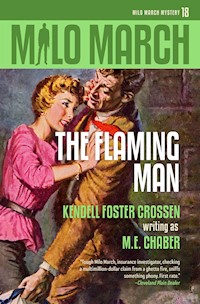
The Flaming Man
by
Kendell Foster Crossen
Writing as M.E. Chaber
With an Afterword by Kendra Crossen Burroughs
Steeger Books / 2020
Copyright Information
Published by Steeger Books
Visit steegerbooks.com for more books like this.
©1997, 2020 by Kendra Crossen Burroughs
The unabridged novel has been lightly edited by Kendra Crossen Burroughs.
All rights reserved. No part of this book may be reproduced or utilized in any form or by any means, electronic or mechanical, without permission in writing from the publisher. The scanning, uploading, and distribution of this book via the Internet or via any other means without the permission of the publisher is illegal and punishable by law.
Publishing History
Hardcover
New York: Holt, Rinehart & Winston (A Rinehart Suspense Novel), February 1969. Dust jacket by Pete Plascencia.
Toronto: Holt, Rinehart & Winston of Canada, 1969.
London: Robert Hale, 1970.
Paperback
New York: Paperback Library (63-353), A Milo March Mystery, #9, June 1970. Cover by Robert McGinnis.
Dedication
For Louise Waller
Dear Louise: “Youse is a good kid.”
M.E.C.
One
It was late spring in New York City. The weather was already a little sticky. Everyone was thinking about getting a place on the beach for the summer or putting in more air-conditioning. I was no exception. My bank account was. It looked as if the Great Society had never heard of me.
When the hot weather starts, all the rats—four-legged and two-legged—begin coming out of the woodwork and the sewers. There were rumblings and threats of riots. Murder and assassination (a political nicety for “murder”) were on the increase. Every big city was in heat, and violence was the male dog in search of the bitch.
Me? I’m March. Milo March. That’s what it says on the door of my office on Madison Avenue. It also says that I’m an insurance investigator. I wouldn’t have been sure if I hadn’t read it when I came in—business had been that bad for a few months. I was almost ready to believe that everyone had become honest and decided not to cheat the insurance companies anymore. Almost—but not quite.
I opened a desk drawer and took out a bottle of V.O. I lifted it and looked at the contents. It was almost as low as my bank account. I poured a drink anyway and tucked the bottle back in the drawer, sipping the drink slowly. I thought of picking up the morning newspaper, but rejected the idea. Then the telephone rang. I thought quickly before answering it. The bills were all paid, so it couldn’t be a creditor. I picked up the receiver and said hello.
“Milo?”
I recognized the voice. It belonged to Martin Raymond, a vice-president of Intercontinental Insurance. Most of my business comes from them. Things were looking up. I reached into the drawer and patted the V.O. bottle.
“I think so,” I said. “I’m never sure until I’ve looked in the mirror, and I haven’t had the courage to look this morning. How are you, Martin?”
“Great,” he said. His voice dripped with the molasses of clean living. The whole act was a mirage, but he had to keep up the image. “Do you have time to do a little job for us?”
“It all depends on the size of the job,” I said carefully. It never paid to be eager with Martin. “You know I can’t stand those one-night stands.”
He laughed, just to show he appreciated me. “Well, it’s slightly bigger than that. Why don’t you run up here and we’ll try it on for size?”
“I forgot my running shoes today, but I’ll slip downstairs and catch the first milk train that comes along. Don’t give away the store before I get there.” I put down the receiver.
Intercontinental owns their own building on Madison Avenue only a few blocks from my office. It’s one of those modern structures, all glass and steel, with a few stones looking as if they’d been added as an afterthought. I walked to it and took the elevator to the executive floor.
When I stepped out of the elevator, I was ankle-deep in dark blue carpeting. I didn’t even think about it. My attention was on the vision in front of me. This one was a blonde, but it didn’t make any difference; she came from the same neighborhood as the other receptionist—about 38-24-36, a nice neighborhood no matter how you looked at it. I often wondered if they had a vice-president whose sole duty was to find and hire the receptionists. Lucky man.
“May I help you, sir?” It was the blonde interrupting my thoughts.
“Sure,” I said. “What time do you get off work?”
A smile started to tug at her mouth, but she pushed it away. “Just in time to meet my husband. … Whom did you wish to see?”
I glanced at her left hand. No rings. “You’ll never get to heaven,” I said, “telling those little white lies. Oh, well, I’ll see Martin Raymond—but he’ll be a poor substitute.”
This time she did smile as she reached for the phone. “Who shall I say is calling?”
“Let’s surprise him. … No, I guess Martin wouldn’t go for that bit. Just tell his secretary that there’s a man here to pick up his Social Security in cash. She’ll know who it is.”
She was puzzled, but she picked up the phone and repeated what I’d said when she reached Martin’s secretary. She was smiling when she replaced the receiver. “You may go in, Mr. March.”
“Thank you,” I said. I walked to the door, then looked back. “You’d better get rid of that husband. I don’t think he’s any good for you—and you could help me spend Intercontinental’s money.” I stepped through the door and walked down the corridor, wading through more plush carpet.
Martin’s secretary looked up and nodded for me to go into his office, so I opened the door and entered. It looked like a vice-president’s office. It was furnished with antiques that had been altered to make them functional. An early American cupboard was now a liquor closet. A cobbler’s bench held sunken ashtrays, as well as cigarettes and matches.
“Milo, my boy, how are you?” Martin exclaimed. Suddenly I was his long-lost brother, so I knew it couldn’t be an easy case.
“Exhausted,” I said. “It was that long hike through the jungles.”
“That’s my boy. Anything for a laugh. Help yourself to a drink.”
“I thought you’d never ask.” I splashed some V.O. in a glass, and added a cube of ice from the lower part of the cupboard, while thinking that Martha Washington never had it so good. Then I went over and sat down next to the desk.
“How much did you pay for the carpeting in the corridor and the reception room?”
He looked surprised. “I don’t know. Why?”
“I was just thinking that you could have saved a lot of money and gotten the same results by covering the floor with about three inches of Jell-O.”
It took him about a minute to realize it was a joke, and then he laughed heartily. That was one thing about Martin Raymond—he didn’t have a sense of humor, but he had an instinct for knowing when he was supposed to laugh, and he always put on a good show.
I lit a cigarette and waited for him to finish the scene. “What’s the case?” I asked then.
He immediately became all efficiency. “Fire. I suppose you’ve been reading the newspapers?”
“Of course. I never miss Dick Tracy. After all, we’re more or less in the same business. Actually, I feel closer to Fearless Fosdick because he’s also underpaid.”
He gave a hollow laugh. “You underpaid? At three hundred dollars a day and expenses!” He pulled himself together and got the business look back on his face. “A man named Harry Masters. Lived in Los Angeles. President of a large corporation with holdings all over the city. Among other things, the corporation owned a fairly large building in southeast Los Angeles. There were two stores on the ground floor. One sold TV sets, radios, record players, that sort of stuff. It was owned by Masters and run by his brother-in-law. The other was a clothing store leased to a local merchant. The rest of the building consisted of offices. I understand the occupants were mostly lawyers, doctors, and dentists who worked in the community. One floor was occupied by the corporation, although they had several other offices around the city. During the riots a few days ago, it was burned down.”
“Somebody dropped a cigarette, I suppose?”
“Molotov cocktails,” he said grimly. “I don’t know how many. The building was completely gutted, however.”
“Insured, I presume?”
“Yes. By us. For two million dollars.”
“Who gets the bread?”
“The corporation.”
“If it was burned down by the rioters, don’t you still have to pay?”
“I think so,” he said.
“And you want me to go out there and smell around. You have a nasty mind, Martin. You think maybe someone burned it.”
“It’s always possible,” he said. “There were also three people who were trapped in the building and died there.”
I lit another cigarette. “So the plot thickens. Who were they?”
“Identification is not yet certain, but it is believed that two of them were Masters and his brother-in-law and the third one was the night watchman.”
“Also insured?”
“I don’t know about the watchman, but we carried policies on the other two men. There are two policies on Masters. One for two hundred thousand dollars, which his wife will collect—if he’s dead. Another one for five hundred thousand dollars. The corporation is the beneficiary. The brother-in-law had a policy for fifty thousand dollars, which goes to his sister, Mrs. Masters.”
“So we have two million, seven hundred and fifty thousand dollars,” I said. “A tidy little sum. Do you have a concrete reason for being suspicious, or is it just your nasty thoughts?”
“There is no evidence,” he said slowly, “but there’s something wrong about the case. I can feel it. You know about that.”
“I know,” I said. “Is that the whole story?”
“There’s more information in the file. My secretary has one for you. I—I suppose you want some expense money?”
“That’s the name of the game, Martin. You can’t expect me to do my best on bread and water.”
“It’s not the bread and water, it’s the martinis and the girls. Will five—” He saw my expression and broke off. He sighed. It sounded as if he’d just been told he had only two weeks to live. “All right. My secretary will see that you get a thousand dollars. But try to make it last. You have no idea how the board complains about your expense vouchers.”
I smiled at him. “I have an idea. I also have an idea that they forget about it when I save them a few million dollars. And in this case, what happens if the thousand dollars doesn’t last?”
He sighed again. “Call me, and if you seem to be getting anyplace, we’ll send you more.”
“You’re all heart,” I told him.
I went out, stopping at the secretary’s desk. “Hi, sweetheart. Want to run away with me?”
“I could afford to, on what you usually con him out of,” she said. She handed me a manila envelope. “Here’s the file on the Masters case. How much did you catch him for this time?”
“A thousand dollars.”
She shook her head. “You’re really wasting your time, Milo. You should go after the big con rackets instead of this small change.” She scribbled on a piece of paper, signed her name, then pushed it across to me. “Take that to the cashier. You should know the way; you’ve been there often enough. And don’t spend it all on that blond receptionist before you get out of the building.”
“Jealous,” I said.
I took the slip and made my way to the cashier. Two minutes later I had a handful of hundred-dollar bills. They warmed the cockles of my heart.
On my way out I gave the receptionist a smile calculated to make her regret that she had not accepted my suggestion, and stepped briskly into the elevator. When I was back on Madison Avenue, I looked at my watch. It was still too early for the good restaurants to be open. I did find a bar that was open, though, had a drink, and broke one of the big bills. Then I took a taxi down to the Blue Mill Inn on Commerce Street in the Village. Alcino was just starting to work back of the bar, and I ordered a dry martini. It was perfect, as they always are there.
After a couple of sips, I went to the phone booth, made a reservation on a flight to Los Angeles, then called my answering service and told them I’d be out of town for a few days. I went back to the bar, finished my martini, and had two more. Then I ordered a rare steak with a salad. I made it perfect with coffee and brandy.
Later I strolled up to my apartment on Perry Street and packed a bag for the trip. I set the clock and took a nap. When I awakened, I had just enough time for a cup of coffee with a shot of V.O. before I called a taxi to take me to Kennedy Airport.
I picked up my ticket, had one drink in the bar, and boarded the jet. We took off a few minutes later and I waited patiently while the Captain made his little speech over the intercom, then until the stewardess came around.
“I’ll have a dry martini,” I told her, “and go light on the dryness.”
I said it even though I knew that the martinis were already mixed and sealed in a little bottle. All the girl did was open the bottle and pour it into a glass.
“Yes, sir,” she said.
She came back a few minutes later with my drink. “I hope it’s dry enough, sir.” She was going to play it straight.
I took a sip and frowned seriously as I tasted. “Excellent,” I said. “Give my compliments to the company that bottles it.” We both had a good laugh over that. “And bring me another one,” I added.
She looked a little doubtful, but she got it.
I opened my manila envelope from Intercontinental and took out the file. I read all of it, but there wasn’t too much to add to what Martin had told me. The name of the brother-in-law was there, Larry Beld. There was also a report on Masters, which showed that he was a swinger. He and his wife had been married for thirty years and had no children. He always had at least one girlfriend somewhere nearby. He also liked to gamble and usually went to Reno, Nevada, at least once a month. Despite all this, his corporation was very solvent. The business had started as a small company making belts. At the time the report was made out, they were still in the belt business, but were also involved in real estate, and the manufacture of radar equipment for the government, and of radio and TV parts. They owned a number of shops in Los Angeles and kept a few fingers in other pies.
That was about it. There was nothing to indicate that Masters himself was in financial trouble. He spent a lot of money, but he made even more. He’d been playing footsie with a variety of girls for years, but there was no evidence that his wife or any of the girls objected.
It was like most of the cases that came my way. If there was going to be anything to work on, I’d have to dig it up myself. So I put away the file, finished my second martini, and went to sleep.
A few hours later the big plane went into a glide for International Airport. I knew it was already dark in New York, but here the sun was reflecting brightly from the Pacific Ocean. We came down in a smooth landing.
I went into the terminal, claimed my bag, reset my watch, and got a cab. The driver took me to the Continental Hotel. It made me feel I was being loyal to Intercontinental.
After I’d checked in at the hotel and settled in my room, I called room service and ordered a bottle of V.O. and a bucket of ice. I unpacked my suitcase, and by that time the waiter was knocking on the door.
As I made a drink, I considered what to do. Back in New York it was dinnertime. Here it wasn’t—though my system hadn’t accepted that yet. But it was still too late to start working. I picked up the phone and called a car-rental place I always used when I was in town. They were open and promised to deliver a car to me within a half hour.
I sipped my drink and finally decided I’d go down to Hollywood for a few drinks, and then pick a place to eat. I took a shower and changed clothes. I’d timed it perfectly. The phone rang and the desk clerk told me my car was ready. I went down and signed for it, got in, and started driving east.
I had several favorite bars in Hollywood, but I had decided I would go to one that I’d discovered the last time I was here—the Casa Del Monte on Hollywood Boulevard and Gramercy. It was run by Leonard Del Monte. Everything about the place was just enough out of focus to make it interesting.
I parked the Cadillac on Gramercy and went into the bar. It was so dark inside that I had to stand still for a minute so that my eyes could adjust. Then I moved over to a stool at the bar. There were seven or eight people sitting there and the owner was serving. He was talking to the other customers, moving back and forth in a sort of rhythmic step that reminded me of the way Bojangles Robinson used to dance. I remembered that nearly everyone called the owner Bo instead of using his real name, and that was probably the reason.
He looked up, saw me, and came down, still keeping time to the music from the jukebox.
“Hello, Bo,” I said.
He took a closer look at me. “Hi,” he said. “You’re March, aren’t you? Milo. You were here a few months ago. How’s the action in New York?”
“The same as everywhere. You throw down your chips and they pull them in.”
“Yeah,” he said. “Still drinking the same? Gin and grapefruit juice?”
“Sometimes, but I think I’ll have a martini now.”
He mixed one swiftly and poured it. “This one’s on me.” He poured himself a shot of brandy and lifted his glass. “Glad to see you back. Going to be around long?”
“I don’t know. I’m here on business. It all depends on how that turns out.”
“I remember,” he said, snapping his fingers. “You’re an insurance eye. Going to send somebody to the bucket?”
“If I’m lucky. I read that you had a pretty bad riot out here.”
“Yeah. It seems to be over now, but you never can tell. We didn’t see any of it up here, but a lot of people were pretty nervous.”
Another customer came in and he moved over to wait on him. I had two more martinis and decided I could break down and have dinner. I told Bo I’d see him again, and left. I drove up to Fairfax and stopped at a restaurant called The Jade Lady. I had a wonderful Chinese dinner and then drove back to my hotel.
I had a couple of drinks in the bar, bought a paper, and went up to my room. There were still a few emaciated ice cubes left, so I undressed, poured myself a drink, and stretched out on the bed. After I’d read the newspaper, I turned on a TV news broadcast. Everything was relatively quiet in the southeast section of Los Angeles, but it was obvious that people were still a little edgy. I turned off the TV and went to sleep.
It was early when I awakened the next morning. I phoned room service and ordered tomato juice, scrambled eggs and toast, a pot of coffee, and some ice. When they came, I had my usual morning drink and then enjoyed the breakfast. I had another small drink with my cigarette. Then I shaved, showered, and got dressed. It was time to go to work.
My first stop was to look up the records on Belters, Inc. There were some interesting things about it. Harry Masters was the president, but he held only 10 percent of the stock. His wife, Alice Masters, was the vice-president and also owned 10 percent. Larry Beld, the brother-in-law, didn’t hold any office, but did own 5 percent of the stock. Someone named Frank Jeffers was treasurer, with 5 percent. A Kitty Harris had 19 percent. But the most interesting name was a Sherry LaSalle, who was the secretary of the corporation and held a tidy 51 per cent of the stock. I was going to look forward to meeting Sherry.
Next I drove to detective headquarters. I told my troubles to a desk sergeant, who finally consented to phone a lieutenant. Two minutes later I was knocking on an office door. A voice told me to come in.
The lieutenant was a big man, probably about fifty, who looked as if he’d been working straight through for about a week. His eyes were bloodshot, his suit wrinkled, and there were cigarette ashes all over the desk and his clothes.
“You’re March?” he asked. “Let’s see your ID.”
I handed him a wallet which contained all my identification cards and waited while he went through it. Finally he tossed it on the desk where I could pick it up.
“A big man, huh?” he said. His voice was flat, so it was impossible to tell whether he was being ironic or hostile or merely indifferent. “Private detective license in New York and California. Gun permit in both states. Member of the Footprinters. Sit down. It makes me tired just to look at anyone standing.”
I took the chair next to his desk. “Not a big man, Lieutenant. Just a guy doing his job. I don’t make them. I just work at them when I’m told to.”
“Going to come out here and solve all our little problems for us, huh?”
I shrugged. “I’m only interested in one tiny part of your problems. I’m also well aware that you probably haven’t been to bed for several days, that the work is piled up over your head, and that you wish to hell that I’d go visit Disneyland or take a tour of Death Valley. I’ll try not to take up too much of your time.”
He sighed. “Yeah, it’s been a little hairy around here. Sorry if I’m jumpy. Tell me what you want and I’ll help you if I can.”
I took out a sheet of paper and placed it in front of him. “I’m interested in that building, which was one of those burned.”
He squinted at it and then stared at the wall for a minute or two. “Yeah,” he said finally, “I remember that one. It was the Belters Building. When the firemen finally dug their way through it, there were three roasts in what was left.”
“Identification?”
“Not very good, but about as good as we’ll ever get. We believe they were—” He broke off and looked in one of the folders on his desk. “Harry Masters, who owned the building; Larry Beld, his brother-in-law who ran the TV store on the ground floor; and a colored watchman named Bob Summers. We have reason to believe that they were all three there that night, and the three bodies roughly correspond to the sizes of the men. That’s all we have, and it’ll be about all we get.”
“What about dental identification?”
He shook his head. “No dental records have yet been found for Beld and the watchman. Masters wore false teeth—uppers and lowers.”
“Didn’t you find them?”
“No. We also didn’t find any belt buckles. That was an all-out fire, March. By the time it was washed down, there was nothing left but the concrete shell and several feet of ashes, which had once been the floors, the furniture—and three bodies.”
“I understand,” I said, “that the fire was started by Molotov cocktails tossed through the windows on the first floor. To do that much damage there must have been some gasoline spilled around on other floors. Did you find any evidence?”
“No. Where were we going to find it—in the ashes? The Arson Squad sifted through everything and found nothing, not even any traces of gasoline thrown into the two stores on the ground floor.”
“That’s all?”
“That’s about it,” he said heavily. “And you’ll have a lot of fun trying to find out who set that building on fire. There were quite a few people running around with torches that night. Going to cost your company much?”
“Almost three million dollars.”
“That’s a nice round sum. Well, you’ve got plenty of company.” He managed a slight smile. “Sorry I can’t be of more help, March. I can’t seem to even help myself very much.”
I took the hint and stood up. “Well, thanks a lot, Lieutenant. If I stumble over anything, I’ll let you know.”
“You do that,” he said.
I could tell by the tone of his voice that he didn’t think I’d do anything but fall on my face. I let it go at that and walked out.
I drove down to the riot area. It was quite a shock to see all the burned and scarred buildings. There were still plenty of police around, outnumbering the few sullen-looking Negroes on the street. I parked near what was left of the Belters Building and studied it. The Lieutenant was certainly right. It had been completely gutted. I walked around it. The view was the same from all sides. As I came back to the sidewalk, a cop lumbered up to me.
“Looking for something, bud?” he asked.
“Yes,” I said. “A building that isn’t here now.”
He frowned. “What are you? Some kind of nut?”
“No. Just a man looking for yesterday’s illusions and today’s realities.”
He got hung up on that one and decided to skip it. “Well, this ain’t a very safe place for a white man to be. If you ask me, you’d better get back where you came from.”
“But I didn’t ask you, officer,” I said gently. “It may be slightly bruised, but I think this is still the home of the brave and the land of the free. And I intend to stroll around for a bit. Just think of me as Diogenes without a light to aid my search.”
“Huh?” he said.
But I was already walking down the street. Most of the places of business were closed, many still bearing signs that read: Owned by a soul brother. But finally, about two blocks away from where I was parked, I found a bar that was open. I went inside.
There were maybe a dozen black men at one end of the room and a black man behind the bar. I stopped at the end nearest to the door and waited. The other customers had been drinking in silence or had stopped talking the minute I entered.
I waited patiently while the bartender shuffled his feet and pretended not to see me. Finally he tired of that game and came up to where I stood. “Yeah?” he said.
“I’ll have a bourbon with water backed.”
He scowled. “I ain’t rightly sure we got any.”
“Meaning you don’t want to serve me?” I asked. “On what grounds? I’m not drunk. I’m not disorderly. I don’t think the California ABC would like it.”
He chewed on his lower lip for a minute, then shuffled off and came back with a shot glass and a glass with water in it. He poured the drink.
“Give the bar a drink,” I said.
“How do I know you’re going to pay for it?”
I took out a ten-dollar bill and put it on the bar. He turned and served drinks to the others. He came back, took my bill, and rang up ten dollars. He didn’t bring any change. I ignored that and sipped my drink. When I’d finished it, I rapped gently on the bar with an empty glass. He came up and refilled it. I gave him a dollar and he rang it up. Again no change.
I was halfway through the second drink when I saw one young man detach himself from the group and walk toward me. I couldn’t tell whether he was coming to me or leaving the place, but I looked him over. He was young, maybe twenty-four or twenty-five, with a dark, handsome face, on the husky side and well dressed. He came to a stop about a foot from me.
“Hello, Whitey,” he said.
I looked around. “Hello, Blackie.”
There was a faint glint of humor in his eyes as he stared back at me. “Are you fuzz?” he asked.
I shook my head. “I’m allergic to fuzz. Even a peach makes me break out in a rash. Besides, I’m not strong enough to carry all that tin around with me.”
“Then what are you doing here?”




