



4,49 €
Mehr erfahren.
- Herausgeber: Steeger Books
- Kategorie: Krimi
- Sprache: Englisch
People always say it sounded like a firecracker at first. But it was a rifle shot that rang out from the fourth story of an apartment building in Cleveland, killing a handsome young Congressman as he delivered a speech. The suspect is Eugene Crown, an escaped convict who rented the apartment, but no one knows where he is now. After four weeks of intensive nationwide search, the police and the FBI have still not captured him.
Then Intercontinental Insurance gets the bright idea to hire its best investigator, Milo March, to capture the killer―as a public service, of course. They are determined to prove that a large corporation can have a soul, and they’re going to do it even if it kills Milo.
But it won’t. Milo will crisscross the country and the globe in search of the truth: Cleveland, Columbus, San Francisco, Los Angeles, Reno, Lisbon, New York City, Hong Kong, Cape Town, Paris... even a little old mining town in Arizona. All the while he is dogged by a sneering white-haired gangster determined to get to Crown before Milo does―to shut him up.
Milo doesn’t believe that Eugene Crown is the real culprit. He was a born loser by all accounts, and now, suddenly, he’s a master criminal? Clearly Crown is no more than a pawn in a well-organized game of death.
But why the Congressman? Because he was for civil rights? anti-Communist? anti-union? pro-Israel? There had to be an international conspiracy behind the deed, a group of men with a lot of money and one simple idea in common: Stir things up. Put the blame on the Left, the Right, the blacks, the whites, whoever—but scare everybody so that the men can get the things they want....
Das E-Book können Sie in Legimi-Apps oder einer beliebigen App lesen, die das folgende Format unterstützen:
Veröffentlichungsjahr: 2021
Ähnliche












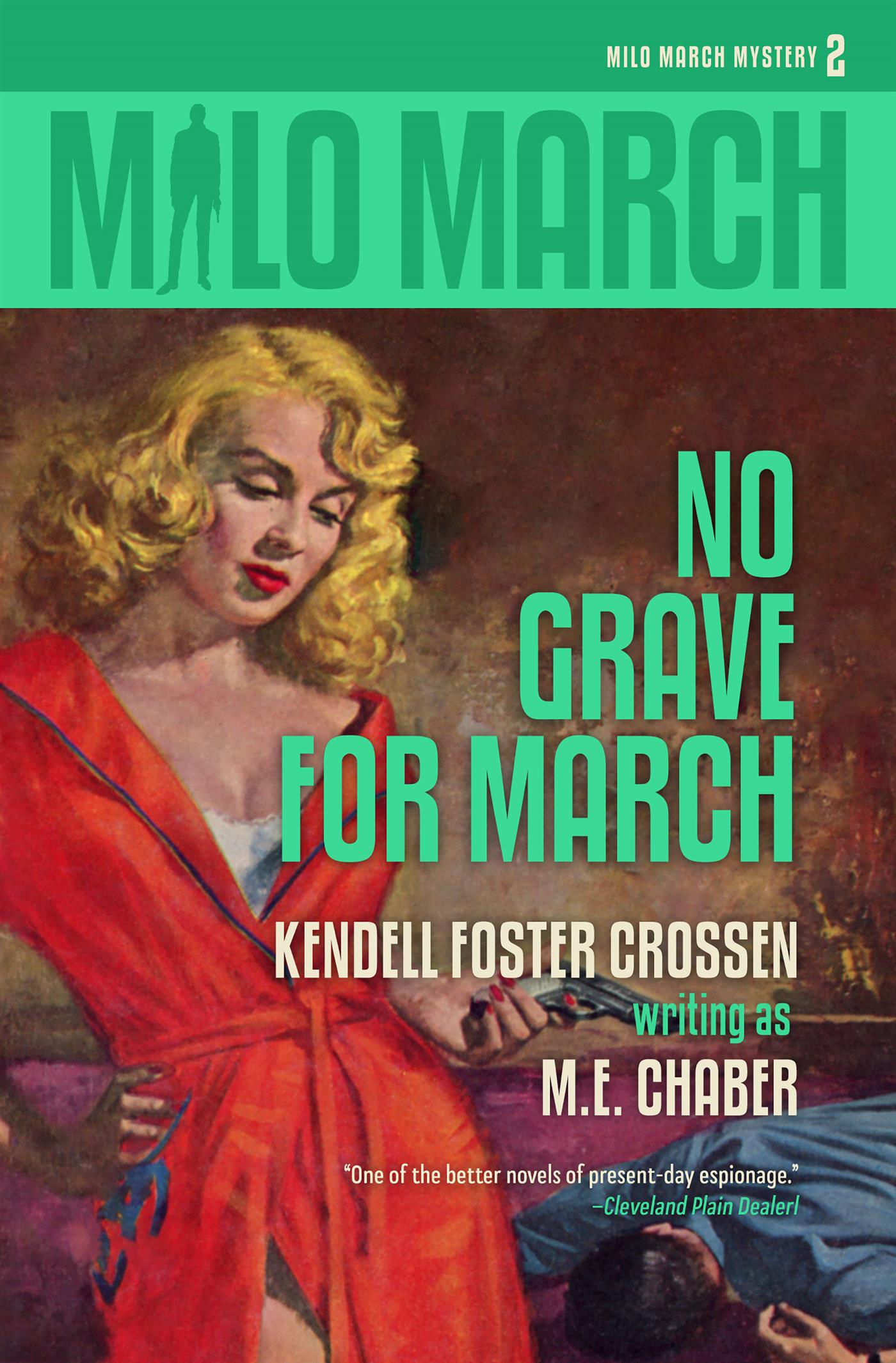

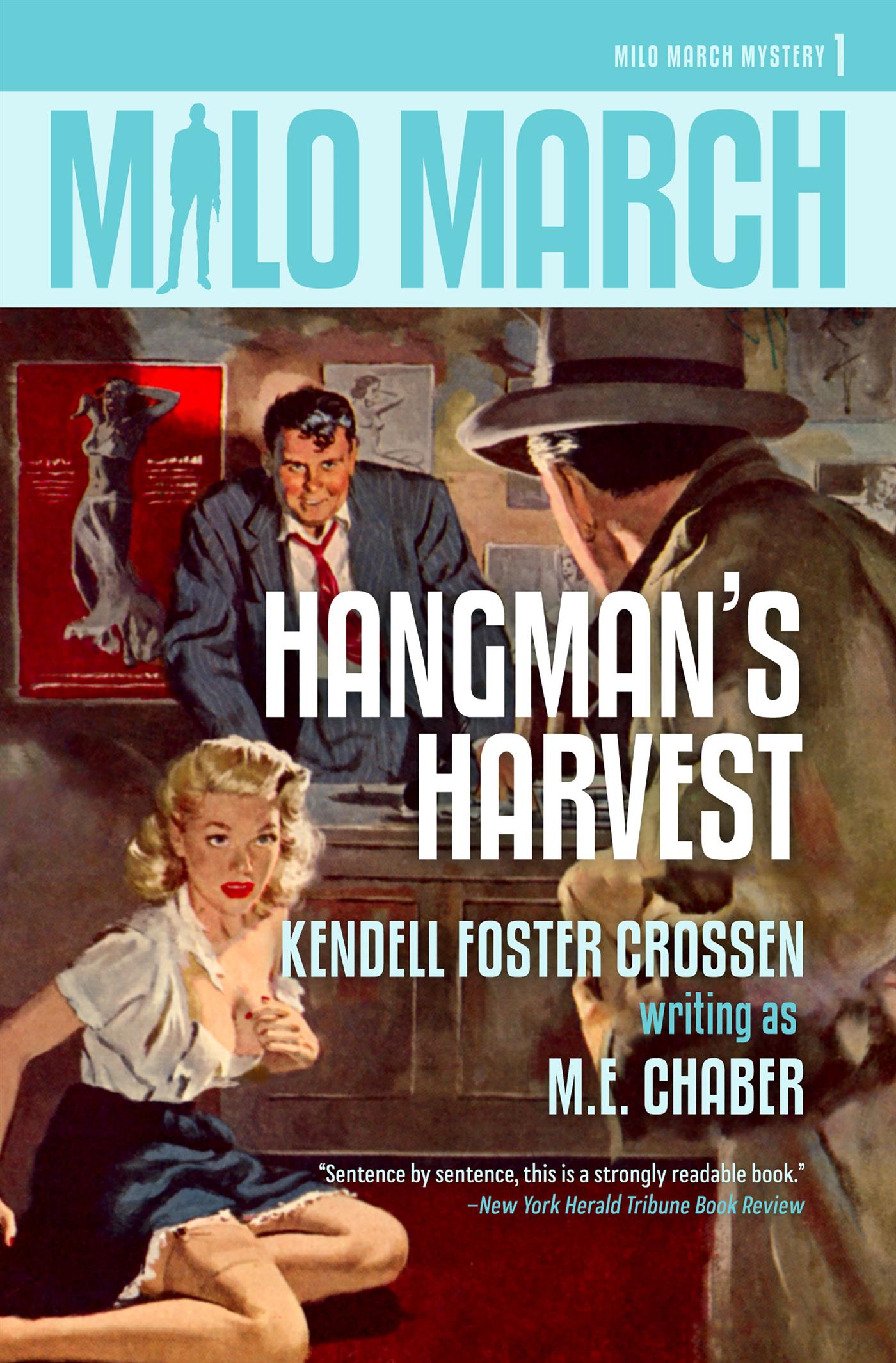

Green Grow the Graves
by
Kendell Foster Crossen
Writing as M.E. Chaber
With an Afterword by Kendra Crossen Burroughs
Steeger Books / 2021
Copyright Information
Published by Steeger Books
Visit steegerbooks.com for more books like this.
©1998, 2021 by Kendra Crossen Burroughs
The unabridged novel has been lightly edited by Kendra Crossen Burroughs.
All rights reserved. No part of this book may be reproduced or utilized in any form or by any means, electronic or mechanical, without permission in writing from the publisher. The scanning, uploading, and distribution of this book via the Internet or via any other means without the permission of the publisher is illegal and punishable by law.
Publishing History
Hardcover
New York: Holt, Rinehart & Winston (A Rinehart Suspense Novel), February 1970. Dust jacket by Stan Zagorski.
Toronto: Holt, Rinehart & Winston of Canada, February 1970.
London: Robert Hale, April 1971.
Paperback
New York: Paperback Library (63-568), A Milo March Mystery, #19, April 1971. Cover by Robert McGinnis.
Dedication
For Bo—
who is more Bojangles than Beauregards,
and for Melody—
who is one.
Author’s Note
This is the story of two men who never met and had nothing in common yet were wedded together in a bloody pageantry of puppets, neither of them aware of the invisible figures who were back of the stage pulling the strings. All characters portrayed in this novel are fictional and are not meant to represent anyone living or dead. Only the climate of violence is real in a world which has seen too much of it over the centuries.
M.E.C.
One
It was a warm day in Cleveland, Ohio. Most of the men who had gathered in the park for the political picnic wore sport shirts and no jackets. Their wives wore light summer dresses. The men on the platform, however, wore jackets and ties, pretending they felt comfortable.
Portable ovens stood around the tables, keeping the food hot, while white-jacketed servers waited to put the food on the tables the minute the speakers were through.
It was a friendly crowd, applauding in the right places and laughing at the familiar jokes, although now and then a few of the men would glance wistfully at the ovens. A few beers would have helped them wait, but there were only soft drinks. As one man said in an undertone to the man next to him, “You can’t drink much of this stuff before it starts coming out of your ears.” His neighbor nodded and grinned in appreciation.
There were five men on the platform. Four were local politicians and one was from a neighboring state. Four were there to help the local man who sat in the center. He was running in a special election for the United States Senate, and it was generally agreed that he needed help. The crowd had already heard two speakers, and the third seemed about to finish.
“… and we all know,” he said, “with what unswerving courage and faithfulness Jerry Hayes has served the people of Ohio during his long political life, and I know he will continue to do so as long as there is a breath left in his body. It is in trying times such as we now face that we need men like Jerry Hayes down there in the United States Senate. Once we have put him there, we can be sure that every minute of every day he will be doing his best for the great state of Ohio and for the United States of America.” He stopped and took a drink of water from a glass on the lectern in front of him. He put the glass down and looked at the audience.
“And now,” he continued, “I want you to meet a man who has worked closely with Jerry Hayes, knows his ability and integrity, knows his contributions and his sacrifices for his state and country. You know the man I’m about to introduce to you. You know him well. You’ve listened to him on radio, watched him on television, and read his speeches in the newspapers until you probably feel that you have known him all of your lives even though he does not come from Ohio but from one of our great neighboring states. I give you the Honorable John Randolph.”
There was considerable applause as the man seated at the end stood up and came to the center of the platform. He was a tall, handsome man, no more than forty, although his wavy hair was already quite gray at the temples. He was well dressed and the only one there who seemed not to mind the heat. As he reached the lectern, he held up his hands to stop the applause.
“My friends,” he said, “—and I have many friends in this great state—my only regret is that I can’t spend more time here so that I could get to know more of you. That, as you must know, is one of the wonderful things about being in political life. We make so many, many friends. Of course, we make a few enemies, too.”
As he waited for them to laugh, smiling back at them, one realized how often his handsome face had been seen on television or in the pages of the newspaper, how many times that mellow voice had been heard on radio, television, and at meetings such as this. It was impossible not to wonder, as his colleagues did constantly, what he wanted. It was said that he traveled more than anyone in Congress, making speeches wherever he was wanted or wherever they would have him. The networks knew that he could be counted on to appear on television even if asked at the last minute. Did he want to move from the House to the Senate? Or did his desires go further than that?
“I am going to talk to you today,” he went on, “not about politics but about America and Americans. That is the kind of talk Jerry Hayes understands and appreciates. He knows, and I know, that we need more of that kind of talk in both the lower and upper houses. We need men who are not afraid to talk about America and Americans.”
He stopped again and there was applause.
“You know me,” he cried. “John Randolph. There has been a Randolph in every generation in public service since the first Randolph in the very beginning of this nation. My ancestors owned black slaves. They also owned some white people who weren’t much better than slaves. They couldn’t quit working for us unless we said they could. But we were a poor nation, just beginning then. Now we’re the richest and the strongest and the greatest nation in the world. I say let every American who wants to be an American share in this wonderful country.
“Of course, they have to earn their share just like I did and you did. But they’ve got to have the right to do it. We can’t hand it to them on a silver platter, but we can see that they have the right to get an education and to get the same jobs that you and I get. And they’ve got the right to get the same salary, and we have to see that they get it. When we do that, they won’t have to pay a lot of money to some union to tell them what to do and when to do it, some union that will tell them to go out on strike and make them lose more in wages than they’ll get in any raise.
“If I didn’t believe in America for Americans, whether they’re black or white or green, and if I didn’t fight for that belief, what do you think would happen when I go up to meet my Maker? All those Randolphs who helped to set up this country so it could grow the way it has, they’d just look at me and want to know what I was doing there. And about all I could say was that I had spent most of my life in the Lower House and that I thought maybe I’d get a chance to sit in the Upper House.”
While the audience laughed, one of the men sitting on the platform leaned over to the man next to him. “Sometimes,” he said, “I can’t tell whether it’s Jerry or Randolph who’s running for the Senate.”
“A moment ago,” Randolph continued, “another speaker told you that Ohio needed Jerry Hayes down in Washington. I say amen to that. I also say that Washington needs Jerry down there. We need all the men like Jerry Hayes we can find.”
This time the applause was loud. Randolph waited with a friendly smile until it died out.
“I sat,” he said, “in the House with Jerry Hayes for six years. He worked with me on civil rights bills, on urban renewal bills, on antipollution bills, on anticrime bills to make the streets safe for our women and children, on anti-Communist bills, on bills to curb the power—and the abuse of that power—of unions. And I can stand here and tell you that there was never a finer man to work with than Jerry—”
It sounded like a firecracker. So much so that several people looked toward the street to see if there were any children playing there.
When they looked back, the first thing they saw was the blood streaming down the speaker’s face. Before the meaning of it could sink in, Randolph leaned forward as though he were bowing to the audience. Then, swiftly, he fell from the platform, taking the lectern and the microphone with him.
A woman screamed like a high-pitched trumpet.
Two
The morning was hot and sticky in New York City. I was sitting in my office with my coat off, my feet up on the desk, reading the morning newspaper. Almost a month had passed since the assassination of Congressman John Randolph, but he was still making the front pages almost every day. Most of it wasn’t really news, but it was the absence of news that made the papers.
They thought they’d identified the man who shot Randolph. They said his name was Eugene Crown and that he was a convict who had escaped from prison only a few weeks before the killing. They claimed to have found the murder rifle with his prints on it and to have found his car abandoned in Akron, Ohio. The police of every city and every state were working on it. So were the FBI. Nobody seemed to have any idea why he’d shot Randolph. And they didn’t have Crown. He’d been reported seen in Los Angeles, Flagstaff, St. Louis, Memphis, Atlanta, Newark, and New York City. But that’s all they had. Reports.
There was also an editorial, I think the tenth I’d seen, about what it was doing to our image in Europe. This was our fourth political assassination—fifth if you counted the killing of the man accused of committing one of them—in less than six years. Finally, I turned to the sports page.
I am Milo March. My office is on Madison Avenue in New York City. I have a license which says I am a private detective, although I’m actually an insurance investigator. A specialist. At least, that’s what I call myself when I tell the insurance companies how much I’m going to charge them. But at the moment I was an unemployed insurance investigator. I still had some money from my last job, but I was getting tired of hanging around the office. Maybe, I thought, it would be a good idea to go to some nice place with air-conditioning—like a bar, for example—when the phone rang.
I scooped it up and said hello.
“Milo, my boy, how are you?” a familiar voice said. It was Martin Raymond, vice-president of Intercontinental Insurance. I do most of my work for them.
“I’m not sure,” I said. “Nobody’s asked me until now.”
He gave his automatic laugh, which was supposed to signify that he knew a joke when he heard it. The truth of the matter was that he didn’t.
“Are you busy?” he asked.
“Nothing so busy that it would make a crash if I dropped it. Are you just making idle conversation, or do you have a job for me?” I knew he never made idle conversation.
“There might be something,” he said. He sounded different than usual. “I thought we might have lunch together and discuss it.”
“You can’t buy me for a luncheon. When and where?”
“I thought we might go to the Club. Suppose you meet me there in an hour? It’s nice and quiet there and we can talk.”
The Club was a place where he went to play handball. I don’t know how nice a place it is, but it certainly is quiet. “I’ll be there,” I said, and hung up.
I finished reading the paper and then went down to get a cab, timing it so I’d be a few minutes late. Martin Raymond was already there, glancing at his watch, when I entered the dining room. He didn’t like people to be late. Time and money and all that sort of thing.
“A bit late, aren’t you?” he said as I sat down.
“Yeah. The dogs got in a traffic jam.”
“Dogs?”
I nodded. “I always take a dog sled. Much faster than a taxi. Doesn’t everyone?”
“Oh.” He gave a short laugh, but his heart wasn’t in it. “Care for a drink?”
“I thought you’d never ask me.”
He beckoned the waiter over and ordered a manhattan. I ordered a dry martini. Nothing was said until the drinks came. I lifted my glass.
“To dear old Intercontinental,” I said. “I gather that someone is trying to dip their greedy little fingers into the family till.”
“No. Nothing like that. Not that we know about, at least.”
That was strange, I thought. As long as I’d known Martin Raymond, he had never asked me to come to the office or taken me out to lunch unless Intercontinental had a case of insurance fraud on their hands.
“Well,” I said lightly, “if this is just to buy me a farewell lunch, skip it. I’d rather have the gold watch and the touching speeches by the members of the board. On second thought, we can forget the speeches.”
He took another swallow of his drink and frowned. “As a matter of fact, this is a little unusual. And it was the board of directors that suggested you be hired. But it is not insurance fraud. In fact, we’re paying the claim promptly without any question.”
“Now I’ve heard everything,” I said. “What happened? Did the chairman get mixed up in a little badger game or something like that?”
He finished his drink, caught the waiter’s attention, and motioned for two more drinks for us. That was a bit unusual, too. Normally he would have one cocktail and then dive into the food.
He waited until the drinks came. “This is a serious moment in the life of Intercontinental Insurance,” he said. It must have been serious if he was going to ignore my levity. He also sounded as if he were going to make a speech. I held on to my martini and prepared for the worst. “Intercontinental is about to take a step which I do not believe has ever been taken by any other insurance company.” He meditated over his drink.
“If you are going to take a step,” I said, “the first thing to do is to lift one foot.”
He frowned. “Yes. Of course, you’re right. Plunge right into it. Well”—he cleared his throat and took another crack at the drink—”I imagine you’ve heard of John Randolph?”
“The name does seem to be familiar,” I said dryly. “What does he have to do with it?”
“Everything. He was the insured. We issued two policies on him. One, straight life. The other, accidental death with double indemnity. As I have said, both will be paid without question. Both, I might add, were for large amounts.”
He finished his drink and went into another reverie. I emptied my glass while I waited. Finally I cleared my throat to get his attention.
“I don’t quite see,” I said, “where I come into the picture. What do you want me to do?”
“A very good question,” he said, nodding. Then he did something I never expected to see. He ordered a third round of drinks and waited until they were served.
“John Randolph,” he said solemnly, “was a great American. He served almost twelve years in Congress with honor. He was also a friend of several of our directors. I like to think that he was my friend, too. We played handball here several times and then had lunch afterwards.”
“Martin,” I said gently when he didn’t continue, “remember me? March. Milo March. I am what we laughingly call an insurance investigator. I get three hundred dollars a day and expenses. Now, what in hell am I doing here?”
He brought his gaze back to me. “Milo, my boy, you are going to perform a public service.”
“Me?” I said in some surprise. I shrugged. “As long as I get the three bills a day and expenses, I’ll even go stand on my head in Times Square. What, may I ask, does my new image involve?”
“We had a long board meeting yesterday. We have been distressed by the meaningless killing of Congressman Randolph. We are distressed by the fact that the police and the FBI have not captured the killer after four weeks of an intensive nationwide search. We feel that as Americans and the men who guide a large American corporation, we must do something about it. Intercontinental Insurance is concerned every day of the year with life and death. We believe that it is time, in view of our knowledge and experience, for us to make a contribution to the speedy solution of this terrible crime. As a public service, of course.” He paused dramatically. “You, Milo, my boy, are going to solve the murder of John Randolph and see to it that the killer is not only identified but brought to justice—whether it’s Crown or someone else.”
“Me?” I repeated. This time I thought I sounded a little hysterical. “The best detectives of a dozen cities and states have been working on this for four weeks. So have the FBI agents. Probably two million dollars has been spent on just that. Pictures of the accused man have appeared in every newspaper and magazine and rewards have been posted, so you can guess that there are several million amateurs scurrying around. And they are no nearer a solution than they were more than three weeks ago. They haven’t even found Eugene Crown. Now you want me to leap on my little bicycle and go out all alone and correct their failures?”
“Precisely,” he said. “We have complete confidence in you, my boy. We have come to appreciate that while your methods are usually quite unorthodox, they have produced results. You have an enviable record of success with us. Therefore, we are certain that you—”
“Please,” I interrupted, holding up my hand. I was surprised to notice that it was steady. “No speeches about what a sterling fellow I am. It might go to my head. … Martin, are you quite certain you are aware that this may cost you a lot of money?”
“It’s not the time to be considering costs,” he said loftily. “But why do you bring it up?”
“Because it’s not like one of our usual cases. They are nearly always one of three or four set methods of fraud, so there is something to work on before we even start. And it hasn’t been muddled up by dozens of other people working on it. By the very nature of it, this will probably take longer and will undoubtedly involve a lot of traveling. The travel expenses alone could be pretty large.”
He waved his hand as though brushing away a fly. “We have talked about it and are in complete agreement that we must do it. We leave everything else up to you. When you need money ask for it, and you will get it.”
I whistled softly. “Boy, when you go public service you go all the way, don’t you?”
“Of course,” he said, sounding for the moment like his old self, “we shall expect the usual accounting when you render your bill.”
“Naturally,” I said dryly.
“And it may be easier than you think.”
“Why? And don’t tell me it’s because you have complete confidence in me.”
“There have been a lot of theories advanced about the killing. I’ve noticed that quite a number of people agree on one possibility. They do not think that this was just one man suddenly deciding to kill a political figure for some obscure reason. They believe it must have been a conspiracy and Crown was only a tool. Although I can’t imagine anyone conspiring against Randy.”
“Randy?”
“That’s what Randolph’s friends called him.”
“Oh.”
“If it was a conspiracy,” he went on, “then it would mean a well-organized, carefully planned act and so somewhat similar to many of the cases you’ve worked on. Just your kind of case, Milo, old boy.”
“Oh, sure.”
We ordered lunch. And about time, I thought. Martin Raymond was getting a little smashed on his three cocktails, and I had visions of him staggering into the offices.
He finished the omelet he had ordered and leaned back. “We are taking full-page ads in the leading magazines and newspapers. It will be a memorial to Representative Randolph, and below it we will announce what we are doing.”
I looked at him. “With no mention of me, I trust?”
“No mention of you,” he said. “The members wanted to include your name as our best investigator. One member even wanted to use a small photograph of you. I explained to them carefully that you wouldn’t care much for either gesture.” He laughed. “I also told them you’d probably take a full-page ad yourself, stating that you were not working on the case and never would work for us again.”
“That’s all I would need,” I said. “I could start making my own funeral arrangements the next day. Thanks, Martin. I hope you always remember that publicity is the worst present you can give any of your investigators. Especially me. When do you want me to start?”
“Right away. You can bill us starting with today.”
I shook my head. “Martin, Martin, you disappoint me. No complaining about my daily charges and an unlimited expense account? You’ve taken half the fun out of working for you.”
He waited until the waiter cleared the table and brought us our coffee. “I’m glad you reminded me,” he said with a smile. “If you stop in and see my secretary anytime this afternoon, she will have some expense money for you. I expect we’ll hear from you when it’s gone.”
“I’ll probably start by investing in a couple of drinks while I sit and brood somewhere. Hell, I don’t even know where to start on a case like this.”
“You’ll think of something. Why not start here in New York? This Crown was here for a few days, according to the papers.”
“Yeah,” I muttered.
We talked of other things while we had coffee. He signed the check, and I walked out with him. The food had apparently cleared his head, and he was none the worse for the three cocktails. Maybe I’d underestimated him. He might have gotten drunk on the idea of performing what he considered a “public service.” My instinct told me that the cops and the FBI might have a different idea about it.
I let him take the first taxi. I got in the second one and told the driver to take me to the Public Library. He looked at me as if he thought I was out in left field, but he threw the flag and drove off.
I had decided that I wouldn’t go to the office for a couple of hours, and I might as well make good use of the time. When I reached the library, I went to the periodicals room and got several issues of the New York Times, starting with the morning following the assassination. When I finished the first batch, I went and got another. I read every word faithfully and managed to keep most of the facts in my head.
At three o’clock I decided I’d had enough for one day. I made a note of the last issue I’d read and turned the newspapers in at the desk. I went out the Fifth Avenue door, crossed the street, and walked over 42nd Street to Madison Avenue.
“Milo,” I said to myself as I waited for a taxi, “it is my opinion you have just qualified for the services of a head shrinker. You have stuck your neck into the biggest damned noose ever invented.”
Three
The taxi let me out in front of the glass and stone building that was the Intercontinental Building. There were times when I thought it looked like a mausoleum; frequently when I was with Martin Raymond I was certain of it.
There was the usual beautiful receptionist sitting behind the desk when I stepped out of the elevator. I stopped to admire her.
“Yes?” she asked, looking up.
“I’m Milo March,” I said. “I sometimes labor in these vineyards. Would you please tell Mr. Raymond’s secretary that I’m here requesting permission to land?”
She smiled and nodded. She picked up her phone, pressed a button, and announced my name. She replaced the receiver, and her smile was more personal as she looked at me. “You may go in, Mr. March.”
“Thank you,” I said. I lingered for a minute. “How long have you been working in this glorified soup kitchen?”
“Three weeks.” She laughed softly. “I presume you know your way to the office?”
“I’ve been crawling to it on my hands and knees for years now. I’ll see you on the way back—if I make it through the enemy lines.” I turned to the left and went through the door, then down to the corridor to the office. Martin’s secretary had a small office directly in front of his.
“Hi, honey,” I said, stopping in front of her desk. “I hear that you have something for me.”
“Yeah,” she said dryly. She picked up a slip of paper and handed it to me. “If you ask me, I think you and Mr. Raymond have blown your cotton-picking minds.”
“Why do you say a thing like that?” I glanced at the paper in my hand and then had to take another look because I couldn’t believe what I’d seen the first time.
“It’s simple, junior. Mr. Raymond spent the entire morning acting like a kid who’s going to his first birthday party. When he came back from lunch he did everything but skip down the corridor. At first I thought he was smashed, but then I realized they don’t make booze that strong. And you! You’ve got five great big ones waiting here for you—signed by a man who screams in mortal agony when he has to give you a thousand dollars—and it takes you two hours to get around to picking it up. The whole world has gone nuts.”
“Haven’t you heard, dear one?” I said. “We’re doing a public service.”
“Yeah? You working for nothing?”
“You wound me, honey. The public part is free, but for the service part I’m charging my usual fee.”
“That’s what I thought. Okay, run along with your ill-gotten gains. The cashier will probably be so undone when she sees the paper that she’ll have to leave for the rest of the day.”
I smiled at her and went on down to the cashier’s cage. I handed the slip to the girl. I noticed that she did a double take, too. And she had to clear her throat before she spoke. “How do you want this, Mr. March?”
“In hundreds will be fine,” I said as if I did it every day.
She counted out fifty of them, waited until I had signed the slip, and gave them to me. Five thousand dollars. And that was only the advance expense money. I folded it with respect and put it in my pocket.
“Subway fare,” I told her. “I’ll see you when I get back.”
I returned to the reception room and stopped for another look at the girl. “I just tapped the company till,” I said. “Why don’t I spend some of it on lunch for you?”
“I’ve already had my lunch,” she said.
“Okay, we’ll make it dinner tonight.”
She laughed. “I’m busy tonight, Mr. March. And you’ve made me lose a dollar.”
“Me? How?”
“I was talking to one of the girls who used to work at this desk, and I told her you had just come in. She bet me a dollar that on the way out you’d ask me to go to lunch and that if I said no you’d try to make it for dinner.”
“Sorry about that. I’ll tell you what. Let’s make it for dinner tomorrow night. The dinner and a few drinks will give you a profit on the dollar. That’ll make it a fair game.”
She laughed again. “The same girl told me that if I went out with you, I’d be the game.”
“That’s the trouble with this place,” I said darkly. “There’s too damn much gossip.” I turned and went to the elevator. “You’ll regret this fifty years from now.” I stepped into the elevator and stood in dignified silence while the doors closed.
Normally at this point, I might well have taken my pocketful of money into the nearest nice bar to spend the rest of the afternoon brooding over the future. Instead, I went back to 42nd Street and browsed in the secondhand magazine stores. I found copies of Time, Life, Look, and Newsweek, as well as several less well-known magazines, covering the past four weeks. I tucked them under my arm and took a taxi to my apartment on Perry Street in Greenwich Village.
I made a pot of coffee and called my answering service and told them I was on a job and to take all messages until I got back to them. I put a cup of coffee on the end table and settled down to reading the magazines. This time I made notes.
By seven o’clock I still wasn’t through with the magazines, but my eyes felt as if they were. I got up, put my jacket on, and went out. I walked down to the Blue Mill on Commerce Street.




