



4,49 €
Mehr erfahren.
- Herausgeber: Steeger Books
- Kategorie: Krimi
- Sprache: Englisch
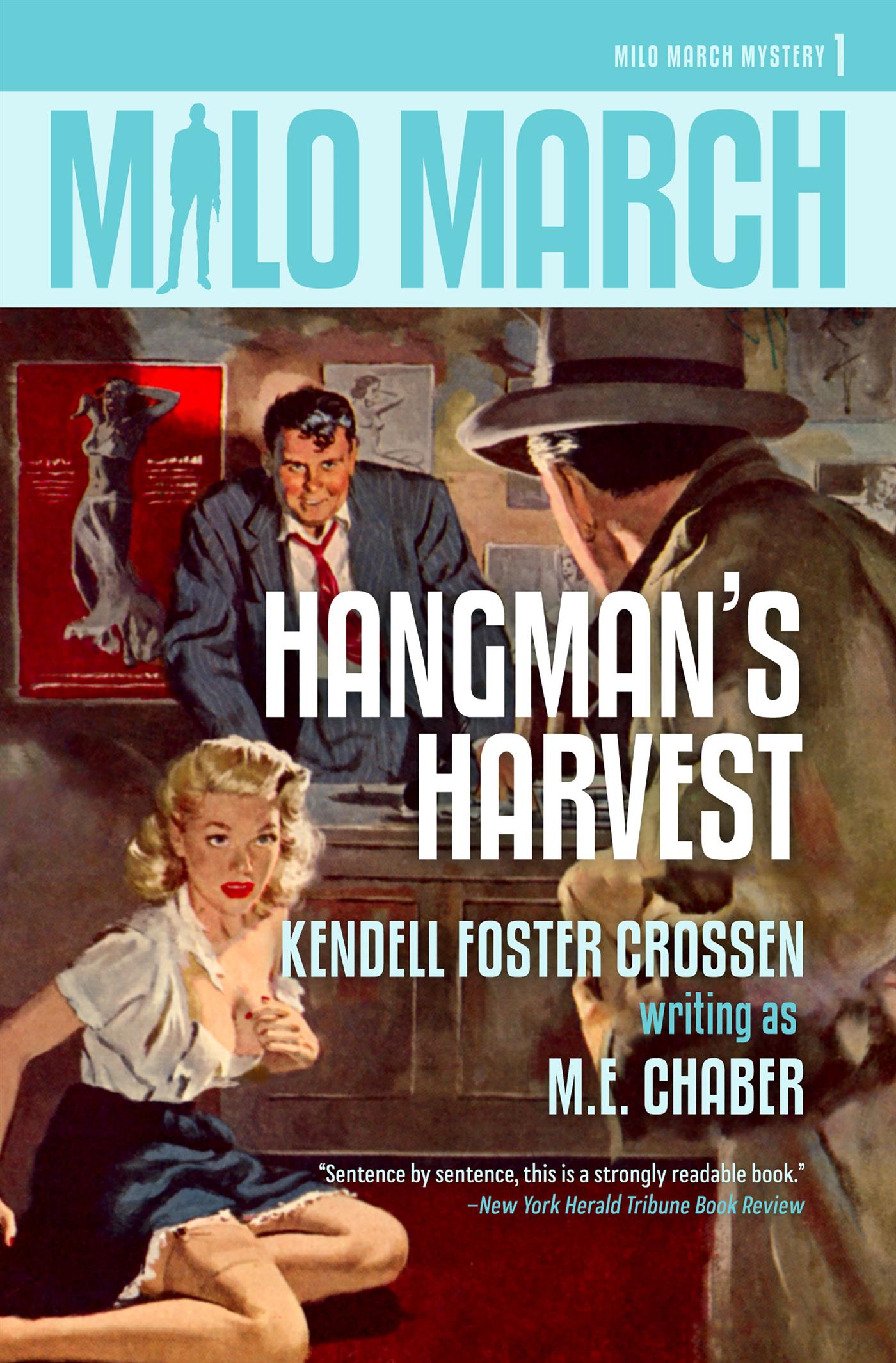
For the first time in book form—six stories from vintage men’s magazines (1952–1961) featuring Milo March, the shrewd insurance investigator and brazen secret agent created by M.E. Chaber:
- “The Jelly Roll Heist.” A series of thefts in Denver has the insurance executives biting their nails. Judging by the loss of a belly dancer’s navel gem, it looks like a seducer is preying on ladies with sparkly things. Or is there a more sinister gang behind it?
- “Hair the Color of Blood.” Milo’s on vacation at a swank Santa Monica hotel when he hears a scream. He rushes to save the damsel in distress, and the next thing he knows, he’s waking up in bed with the naked body of a red-hairedcorpse!
- “The Hot Ice Blues.” A new jewel robbery occurs every night, while Milo sits around playing Dixieland platters with a real gone chick. Is the insurance company’s star investigator reallygoofing off?
- “Murder for Madame.” Someone swipes a worthless box, tossing aside the costly pearl necklace that was inside. Now four people are desperate to retrieve the box―five if you count Milo, who can’t resist trying to figure out why.
- “The Red, Red Flowers.” Major March, U.S. Army Reserve, is sent undercover to Moscow, where a captured American U-2 pilot is on trial. As usual, Milo has no plan but makes it up as he goes along. He will have mere moments to retrieve a coded message and snatch the pilot from the Communists’ hands—but things don’t go exactly as expected.
- “The Twisted Trap.” Just because you’re paranoid doesn’t mean they’re not out to get you. A wealthy old policyholder claims that his sexy young wife and her psychiatrist lover have teamed up to poison him with a drug that mimics the symptoms of madness. If he should die “accidentally” as a result of this condition, his wife will get an enormous life insurance payout. Having escaped from a sanatorium, the old man insists that Milo must rescue him. But doing so may cost Milo his own sanity!
Das E-Book können Sie in Legimi-Apps oder einer beliebigen App lesen, die das folgende Format unterstützen:
Veröffentlichungsjahr: 2021
Ähnliche

















The Twisted Trap: Six Milo March Stories
by
Kendell Foster Crossen
Writing as M.E. Chaber
With a Foreword by Kendra Crossen Burroughs
Steeger Books / 2021
Copyright Information
Published by Steeger Books
Visit steegerbooks.com for more books like this.
©2021 by Kendra Crossen Burroughs
First Edition
The unabridged stories have been lightly edited by Kendra Crossen Burroughs.
All rights reserved. No part of this book may be reproduced or utilized in any form or by any means, electronic or mechanical, without permission in writing from the publisher. The scanning, uploading, and distribution of this book via the Internet or via any other means without the permission of the publisher is illegal and punishable by law.
Foreword
The Milo March Stories
Kendell Foster Crossen published more than sixty pieces of short fiction before deciding to write his first full-length novel. For that purpose he invented a new hero, named Milo March, a tough guy with a quick wit. “I wear a trench coat when it’s raining. I carry a gun when somebody is trying to shoot me. I chase women, but only when they get that chase-me-look in their eyes.” He has a seemingly unlimited capacity for booze. “Many people complain that I drink a lot. I do, but I also do the things that have to be done.” There are two things that have to be done: “To solve the case I’m on and to stay alive.”
Ken Crossen told an interviewer for a fanzine: “I worked out the character of Milo March, making him an insurance investigator since that was something I knew very well. I was to some degree influenced by Hemingway and Hammett, but added more of a dash of humor and more throwaway lines. Partly as a result of this, a later reviewer said that I wrote ‘soft-boiled’ novels.” Milo March can be hard-boiled, yet he can also be gentle and compassionate. I fantasize that a lesson could be learned today from Milo’s preference for shooting people without killing them. Could that be a holdover from Ken Crossen’s pulp hero The Green Lama, a Buddhist who never carried a gun and would not kill, preferring more esoteric ways of disabling villains?
Milo made his debut in Hangman’s Harvest, published in hardcover in February 1952. From there his exploits evolved into twenty more books, published between 1952 and 1973 under the pen name M.E. Chaber. The series acquired a following in the U.S. and abroad, but what really put Milo on the map was the mass-market series released by Paperback Library in 1970–1971, with the stylish, sexy cover art of Robert E. McGinnis.
Milo also appeared in nine pieces of short fiction published in magazines between 1952 and 1961. Three of them were condensed versions of full-length treatments: “Assignment: Red Berlin” is a shorter version of the novel No Grave for March; “The Man Inside” was expanded to become the novel of the same name; and “The Bodies Beautiful of Rome” is a condensed version of A Lonely Walk. Those three novels are in the present series, so the condensed versions are not included. That leaves the six short stories that are brought together in this volume.
Although the character was intended to be an insurance investigator, Milo was also in the Army during World War II and is still an officer in the Reserves. So in some of the books Major March is recalled to carry out dangerous missions for the CIA.
Oddly, Milo performs neither of these roles in the first book. In Hangman’s Harvest he’s just a plain private eye, on loan from a Denver insurance firm to clean up a vice-ridden California town. The next book in the series is a spy novel, No Grave for March, in which our hero is sent to East Germany. So Milo doesn’t actually tackle an insurance case until the first short story. “The Jelly Roll Heist” (1952) and two other stories (1953) are centered on jewel robberies, each with its own twists and surprises.
Another oddity is that even though Milo is a resident of Denver (until he moves to New York City in 1956), none of the first five novels is set there, since Milo is always traveling to other cities and countries. So only in three of the short stories does the action take place in the Mile High City.
By 1961, the publication date of the last two stories, Milo has set up his own insurance detective agency in New York City, with an office on Madison Avenue. But almost as soon as the story “The Red, Red Flowers” begins, he is summoned from the martini capital, is flown over Soviet Russia, and parachutes in, just outside Moscow. A few of the elements in “The Red, Red Flowers” are also present in two novels set in Russia—So Dead the Rose (1959) and Wild Nights in Moscow (1968). It’s not uncommon for a writer to recycle material or rework details from one story to another. What does strike me (though I don’t want to give anything away) is that in “The Red, Red Flowers” Crossen seems to have seized the opportunity to create a happier outcome, as if he wanted to go back and set things right.
The title story, “The Twisted Trap,” revisits, in a different context, the horrible predicament central to the plot of The Splintered Man (1955), in which a man is being dosed, without his knowledge, with a drug that causes schizophrenia-like symptoms such as hallucinations and distorted thinking—LSD. Crossen also explored LSD in a young adult novel, The Acid Nightmare (1967), in which a teenager experiences a good trip and then a bad trip. It’s interesting that Crossen was fascinated by LSD, yet he himself had never taken it, relying on research to write the accounts of trips. I showed the passages from The Splintered Man to a professional expert, who confirmed that the descriptions of LSD experiences are credible.
Over the course of a prolific career, Ken Crossen created many detective characters, including a book reviewer, a playwright, a crime reporter, a few police detectives, a mortician, and a Buddhist monk—in addition to insurance investigators, and even an intergalactic investigator in the humorous Manning Draco science fiction stories. The insurance investigator was a natural choice, since Ken himself had worked in that business as a young man in Ohio. But Milo March was special, becoming the author’s favorite of all the sleuths whose stories he published under five pseudonyms. So strong was the identification with that personality that Crossen would tell a columnist in the Los Angeles Times: “Milo March is simply myself.”
Kendra Crossen Burroughs
Milo March Short Fiction by M.E. Chaber
“The Jelly Roll Heist.” Popular Detective, September 1952 (vol. 43, no. 2).
“Assignment: Red Berlin.” Bluebook, December 1952 (vol. 96, no. 2).
“Hair the Color of Blood.” Bluebook, July 1953 (vol. 97, no. 3).
“The Hot Ice Blues.” Bluebook, September 1953 (vol. 97, no. 5).
“Murder for Madame.” Popular Detective, Fall 1953 (vol. 45, no 1).
“The Man Inside.” Bluebook, December 1953 (vol. 98, no. 2).
“The Bodies Beautiful of Rome.” Cavalier, July 1957 (vol. 5, no. 49).
“The Red, Red Flowers.” Bluebook, February 1961 (vol. 100, no. 3).
“The Twisted Trap.” Bluebook, June 1961 (vol. 100, no. 5).
The Jelly Roll Heist
The Inter-World Insurance Service Corporation is in the Gilmore Building in Denver. Tenth floor. Three private offices and a reception room. At the outside desk there is a receptionist. Peaches-and-cream skin and blue-black hair; built-in accessories that have made many a man forget why he came up the ten stories. The door behind her has frosted glass and small black letters that say Milo March. That’s all. Nothing to indicate that I was on the other side of the door and that I’d been there since nine in the morning, wading through reports, mostly my own, until I had diamonds in my eyes.
It was almost time to quit for the day when my phone rang. It was the peaches-and-cream skin and the blue-black hair. “You still sober, Milo?” she wanted to know.
After thinking it over, I decided to be insulted. On my desk there were two ounces of brandy that I’d been nursing since four o’clock, and there was still one sip left.
“Take your trade elsewhere, girl,” I said with dignity. “I’m too busy to see you tonight.” Which was a laugh. Our receptionist was a strictly-for-keeps girl. I knew. I’d tried enough times.
She laughed. “He wants to see you,” she said. “Now.”
I hung up and finished the brandy. “He” was Niels Bancroft, the owner and president of Inter-World. A nice guy. He never bothered me when I was working on a job, and he knew that for two weeks I’d been digging in. Somebody was working my side of the street. In six months, there had been almost a million dollars’ worth of jewelry lifted in Denver or near it. All of it from women. The individual jobs had run from $10,000, the smallest, to $150,000 in diamonds. The insurance companies were screaming, and the whole thing was my baby. So if Niels wanted to see me, it meant that there was a new case to add to the others or that the insurance companies were getting hotter.
I walked out of my office and turned to the middle door. It was solid oak, as simple looking as a thousand-dollar bill, with Niels’s name on it in the kind of letters that made it unnecessary to read further to know that it also said President and Private. I opened the door and stepped inside.
Niels Bancroft is a big man who looks like an ex-pug. His hair is gray and there are little gray tufts sticking out of his ears. He’s a chain smoker and sticks half a cigarette in his mouth. He wears $200 suits and a $500 watch, but he still lights my cigarettes with big kitchen matches. He looked up as I came in and motioned me to a chair.
“How’s it going, Milo?” he asked.
“You just asking or you want to know?” I said. “If it’s the first—fine. If it’s the second—how much time do you have?”
Niels grinned at me. We’d worked together a long time and understood each other. “I want to know,” he said. “Not all of it. Just give me a couple of high spots. You sound annoyed, so you must be getting somewhere.”
“Yes and no.” I lit a cigarette. “I talked to Selsden on the Robbery Squad first. They have so little that they might as well have left the reports on the squeal books. They think these were all one-man jobs and that all the victims were involved, because every one of them had a shaky story. Beyond that, they’re still beating the woods.”
“But you’re not?”
“I’m a city boy myself,” I said. “They’re right about the shaky stories. I talked to every woman involved, and it was plain they were all concealing something. I worked on one of them and found out why.” I grinned at him.
“Why?”
“She had a boyfriend. For a few days before the robbery and for a few days after it. Then he left. Part of her shaky story was that she came home, alone, from a party and left the sparklers on the dressing table in her bedroom. But she never heard any burglars. You know why? For thirty minutes she and the boyfriend were in the bathroom taking a shower together, just like two innocent kids. With variations, you can bet the same thing happened in the other cases.”
“Description?”
“One that wouldn’t fit any more than maybe a hundred thousand guys. Even a better description wouldn’t buy us much. You can also bet that most of these women, maybe all of them, aren’t going to make any identification downtown.”
“Why not?” he demanded.
“You’re not thinking, Niels. I’ve told you how the jobs were pulled. A pretty guy. A lot of romance. When the stage is set, the pretty boy leaves the door unlocked, takes the babe to the shower or a Simmons version of the haystack, while his friend walks in and out. All of them. Even old Mrs. Russel, who’s having her change-of-life fling. Most of them are married. None of them want a court reporter taking down such details.”
“No other leads to the guy?”
“I know who he is,” I said. “Remember a guy the newspapers called the Romantic Burglar? A few years ago.”
He nodded. “Vander, or something like that. He was sent up, wasn’t he?”
“But he’s been out a year. He’s in and around Denver. He always had a liking for jewelry. He used to work alone.”
“Teamed up?”
I nodded. “Something like that. I got a few odd pieces of information out of Whistles Naylor. He sings a pretty tune if you’re nice to him. He doesn’t know the pitch on this, but he does know that Willie Vander is around town and that he’s been moving in the upper social circles occasionally. When he’s not, he stays at that new sanatorium just out of town.”
That made his eyebrows go up. “Big-time stuff,” he said.
“Dr. Lewis Mora’s private sanatorium,” I said. “The doctor being better known as Lew Mora, on the payroll of Joe Rinchetti. Joe has been out here for his health ever since the Kefauver Committee was playing the circuit. There are other assorted buck hustlers out there, too. My guess is they’re keeping their hand in, making cigarette money and grooming Vander as their steady boy.”
“You got proof?” he asked.
“Nothing that a judge would want to hear,” I said. “All I can do is keep digging. Maybe I’ll catch him the next time out.”
“He’s already been out again,” Niels said sourly. “You ever hear of Ylla Hamal?”
I shook my head. “I missed Pogo this morning. Must be somebody new in Okefenokee.”
“Funny,” he said flatly. “Ylla Hamal is a Turkish dancer. A belly dancer, she’s called. She’s taken America by storm. Forty-nine weeks on Broadway. On her third week in Denver. At a place called Little Egypt.”
“That’s the way it goes,” I said. “Burlesque is out, belly dancers are in. You’ve got to pay a cover charge if you want to be exposed to immoral influences. I know the Little Egypt. It’s on the slumming circle for the upper fry.”
“That’s it,” Niels said. “She was robbed last night. A ten-carat ruby. Fifteen thousand dollars’ worth of insurance. You go out and see her at the club tonight.”
“Why tonight?”
“She likes to sleep in the daytime, and I hear she’s also in a hurry.” He grinned. “She wore that ruby in her navel. I guess she’s practically naked without it. Anyway, you run out and examine the scene of the crime.” He built the grin up to a chuckle.
“Funny,” I said in the same tone of voice he’d used earlier. I stood up and looked at him, “Belly dancers and navel tiaras. Someday I’m going to walk out of here and buy myself a chicken farm.”
“You wouldn’t know which end of the chicken to milk,” he said. “Run along now. You’re in charge of our navel operations.”
There was only one way to keep him from building a whole act out of it. I closed the door behind me as I stepped into the reception room. I could still hear him laughing.
“What’s with him?” our receptionist asked, looking up. “Did you ask him for a raise, or some such pleasantry?”
“He just cut himself on an old joke,” I said. “You might go in and pour a little iodine over him later. … Take a look and see if we have any pictures of Willie Vander.”
She got up and walked over to the filing cabinets. They were disguised to look like some sort of console. Even if I hadn’t wanted the picture, it would have been worth asking for it just to watch her walk.
After a bit she came back with a picture. It was a five by seven, so I could carry it without cracking the gloss. It was maybe five years old, but that was close enough. He was a good-looking guy, all right.
“Working tonight, Milo?”
“Yeah,” I said. “A belly dancer lost her family jewels.”
“Belly dancer?” She dimpled at me. “That ought to be about your speed.”
“What do you know about speed?” I said. “You’re always parked.” I left before she could think up an answer.
I went home and changed clothes and shaved, had a couple of drinks, and went out to dinner. Finally, around nine o’clock, I drove down to the Little Egypt.
It was like a thousand other nightclubs scattered throughout America. A small room with a circular bar, then a larger room with the tables almost against each other. There were only a few people in the club when I got there. An orchestra was playing Cuban music.
The headwaiter was on his toes. He met me halfway through the door, and you could tell that he’d already figured out how much my suit cost and which pocket I carried my money in. He got off his toes as soon as I told him what I wanted. He told me that Miss Hamal had not yet arrived at the club. He would tell her as soon as she did arrive. His manner suggested that it might be a good idea if I waited in the men’s room, but I went to the bar.
I had a couple of brandies. At the price, there should have been a ten-carat ruby in each drink. But it was expense account drinking, so I tossed it off as if I always paid a buck an ounce for my brandy.
I’d just finished the second drink when the headwaiter came back and indicated that I could follow him if I had nothing better to do. We skirted the main room and went backstage, where it looked as if someone was thinking of opening a line of closets. He pointed to a door and went tripping back to his chores.
I went over and knocked on the door. “Giriniz,” a voice called through the door. I opened the door and stepped inside. The dressing room was about the size and shape of a cracker box with delusions of grandeur, but I didn’t have much chance to look it over. She’d been sitting at a dressing table, but when I entered, she stood up and held out her hand.
I didn’t see her hand at first. She was tall, maybe five eight. Long black hair. Black eyes, the kind that seem to have lights in them. Her figure was all curves, every one of them nice. Dark, creamy skin. Lots of it—she was already in her costume. A strip of net over her breasts, with two little silver crescents the only part that wasn’t transparent. There was a beaded string around her waist, and just below it was a slightly larger silver crescent. That was her costume. It didn’t leave anything to the imagination, but after one look at her, you didn’t care if you ever imagined.
“Nasılsıniz?” she said. “You are from the insurance company, no?” It was a pleasant accent.
I managed to get my gaze back up to her face, and I could tell that she knew it had been a strain. A little smile was tugging at the corners of her full mouth.
“I am from the insurance company, yes,” I said. “I’m Milo March.
“I’m glad,” she said. I wasn’t sure whether she was glad I was Milo March or that I was from the insurance company. “You will forgive the costume, please? It is that I have to dance soon, but I wish to tell you about the robbery too.”
“I’ll forgive the costume,” I said, taking another look at it. Then grinned. “Bana bir ufak şişe kanyak ve taze çay getiriniz.” I managed a little chuckle.
She laughed. It was a nice laugh.
“You liked that, huh?” I said, pleased with myself.
She nodded. “Very amusing.”
“I must be improving,” I said. “That’s the first time I ever got a laugh by saying ‘Bring me a small flask of brandy and some fresh tea’ in any language. It must be my delivery.”
We stared at each other while she thought that one over. Then she laughed again. This time it was an even nicer laugh.
“Okay,” she said. “It used to be Sally Moore of Brooklyn before I changed it to Ylla Hamal. But who wants to see a Brooklyn girl do the belly dance? Was that the McCoy you spoke?”
“Yeah,” I said. “I was over there during the war. That was out of the book the Army gave me. It told you how to ask for everything but what the G.I. really wanted. Now that we have Brooklyn and Turkey straightened out, what about the ruby?”
“I really feel naked without it,” she said, patting her stomach. I didn’t point out that maybe she felt that way was because she was. “I met this guy the second week I was here. He said his name was Bob Williams, but I don’t think it was. He came around every night, and I have to admit I went for him a little. He was plenty good-looking and seemed to have money. Then, last night, he came around between the first and second shows. Later, he said he had to run home but he’d be down by the last show. After he was gone, I discovered the ruby was gone, too.” There was a wry smile on her face. You could see she didn’t like being taken.
“Okay,” I said. I gave her a cigarette and took one myself. I lit both of them. “You always just toss the ruby on the dressing room table or something in between acts?”
She gave me a long look from beneath her lashes. “I’m going to level with you, Milo,” she said slowly. “If I can’t get my ruby back, I want the insurance. But I’d rather have the ruby than the money. I didn’t tell the cops the whole story. No reason, except I don’t like cops.”
I nodded. I had a hunch that she was going to be the one who’d give us the identification. She acted as if she was mad enough.
“This guy,” she said, “was throwing passes from the first. Without getting to first base. But as I said, I was beginning to go for him. I guess I was feeling a little romantic last night. … I don’t know when he copped the ruby.”
“Where was it?”
“Where do you think?” she said. She rubbed one hand across her stomach. “Once I put the ruby on, it stays there until the last show. It’s cemented in. It doesn’t come off easy,”
I nodded, suppressing a grin. It looked as if Willie had decided he’d show the gang he could pull at least one job strictly on his own. Just to make sure, I fished the picture from my pocket and showed it to her.
“That’s him,” she said. “He’s got a record, huh?”
“One of the long-playing ones,” I said. “With some help, he’s pulled three dozen jobs in the past six months around here. All of them women.”
She mentioned a few thoughts she had about Willie’s personal habits and his immediate ancestry.
“Now,” I said, “if he’s pulled in, will you identify him? This is the big problem. I don’t think anyone else will identify him.”
“Look, Buster,” she said, and her voice was suddenly harsh, “I didn’t get that ruby from an itchy John. I bought it with my own dough. The hard way. Bumps and grinds on the runway. As far as the act’s concerned, I can get along well with the piece of red glass I’m going to use tonight. But I want that ruby back. You find the guy, and I’ll canary all over the place.”
“Okay, honey,” I said. I reached for the door and took a last look at her costume, just to show that I was still fashion-minded. “I’ll see you around.”
“Why don’t you stay and catch the show?” she asked. Her voice was soft again. “I’m good.”
“I’m sure you are,” I said, “but I’m not sure that my blood pressure could stand it. Maybe after this is over.”
I went out and found my way back to the bar, where I treated myself to a couple more brandies on the insurance companies and thought it over. This might blow the case open. If I wanted to go easy on myself, I could tip off the robbery detail, let them pick up Willie, Ylla would provide the identification, and that would be it. But I never like to have cops do my work for me. Maybe I’d push around a little first and see if something fell. I went out and climbed into my old car and headed downtown.
Whistles Naylor was a little character who’d been on the stuff a long time. A needle man. Once in a while he’d pull a purse-snatch or a small heist. That, and what he picked up for singing, kept him going. I don’t think anyone knew his first name. He’d been called Whistles for years because he’d blow the whistle on anybody if the price was right, and almost everyone knew it. In spite of this, he still managed to pick up information. He lived in a broken-down rooming house, and I figured that he’d still be in his room. Whistles’s day didn’t start until pretty late at night.
I parked the car around the corner. The front door of the house was never locked, so I went up the dark stairs. The house smelled of onions, cheap whiskey, and dirt. I knocked on his door. There was a moment of silence, then I heard a scurrying sound inside. More silence.
“Yeah?” he said through the door. His voice was high and nervous.
“Milo March,” I said.
He opened the door enough to look out, then wide enough for me to slip in. The room was lit by a weak blue bulb, which didn’t make Whistles look any prettier. Probably nothing would have helped. He was a little ratty-looking character with a twitchy face. There were only two things in his life—a hunger for heroin and the fear that he might tell too much sometime.
He blinked at me in the dim light. “Whatsa matter, Milo?” he asked. He was just nervous enough to tip that he was getting to the point of needing a shot. If he hadn’t already taken it, it was because he was broke.
“I want some more on Willie Vander,” I said.
“But I already told ya everything I know,” he said. “I wouldn’t hold out on ya, Milo, I need the dough too much. Jeez, if I only had a sawbuck—”
“You can earn it,” I interrupted. “I want the last-minute dope on Willie. Tonight. I want to know if he’s still at the sanatorium and if he’s going to stay there. I want to know who else is with him. I want to know if they’ve fenced any of the hot jewelry yet.”
“Ya know I’d do it if I could, Milo,” he whined, “but, jeez, sometimes I can pick up things and sometimes I can’t. If I go asking, they’d bump me sure. You know that, Milo,”
I looked at him. I figured that Whistles ought to have the chance for one little fling. He deserved that much, at least.
“Whistles,” I said, “if you can get what I want in the next hour or so, I’ll give you three thousand dollars. You can get away on that and still have enough for plenty of needles.”
“Three grand,” he said. His hands were shaking. “Maybe I can do it, Milo. But I’ll need a few bucks to get into a place.”
I took out five dollars. “I don’t want you getting high first, Whistles,” I said, “but here’s five bucks. The minute you get the dope, I’ll give you enough for a needle. And three grand in the morning.” I handed him the bill. He tucked it away with a furtive gesture. “In one hour back here,” I said.
He nodded, and I left the room. Downstairs, I waited in a dark place in the hallway. When Whistles came down, I followed him. I knew he hadn’t been kidding when he said he might be killed for trying to get me the information. I didn’t want that on my conscience, too, so I was going to trail along.
We went across town, and after fifteen blocks or so, Whistles ducked into a bar. I waited about five minutes before going in after him.
It was like a dozen other holes. There were three or four tables and a long bar. It looked as though there might be rooms in the back, and I was sure of it when I realized that Whistles wasn’t anywhere in sight. There were two bartenders and a waiter, all three obviously of the brotherhood of thugs. About half the customers in the place were just customers; the other half had probably never done anything more strenuous than hefting a blackjack or holding a .38. I stood at the bar and ordered a brandy.
It was forty-five minutes and four brandies later when I saw Whistles. He came out of the back. There were two men with him. Both were dressed well, with the kinds of jackets that are cut to hide a bulge under the left arm. Whistles looked pretty unhappy. One of the men stopped at an empty table, and the other went into the men’s room with Whistles. The waiter didn’t bother to go near the table.
I finished a drink and nodded to the bartender to fill it up again. Leaving my change on the bar, I walked casually in the direction of the men’s room. Practically no one was paying any attention to me, but I could feel a slow tightening in the atmosphere.
I was almost to the door when the man at the table got up and stepped in front of me.
“Where you going, chum?” he asked.
I looked at him as if he wasn’t quite in focus and gestured at the door.
“Uh-uh,” he said. “There’s somebody in there what likes privacy. You buy yourself another drink and come back later.”
“You know how it is,” I said. I gave him a foolish grin and edged a little closer. “When you gotta go, you gotta go. You let me go in and then I’ll buy both of us a drink. Huh?” I threw one arm around his shoulder and blew some brandy in his face.
“Take a powder,” he grunted, and tried to throw my arm off.
I wrestled him around until my back was to the bar. Then I reached in and pulled the .38 from my shoulder holster. I snapped the barrel up against the point of his jaw. It made a solid, satisfying sound. I caught him as he sagged. Then, as if it were still a game, I waltzed him over to the table and lowered him in the chair. I let his head rest on the table and looked around. The waiter was watching me. He started to move forward.
I twisted my body just enough, holding the gun close to my stomach. The edge of my coat hid it from the rest of the room, but the waiter could see it, all right. It was pointed at him, and he stopped, his eyes respectful.
“Some people don’t know when they’ve had enough to drink,” I said to him. “Better let him sleep it off.”
“I guess you’re right,” he said carefully. He was still watching my gun.
“I’ll still have it when I come out,” I said. “Why don’t you go wash a few dishes or order yourself a sandwich?”
I waited until he had shuffled off into the kitchen, then turned and went into the men’s room. Whistles Naylor was on the floor, and a trickle of blood was coming from one corner of his mouth. The other guy stood over him, leaning down, ready to punch again. I saw a glint of metal on his fist. He looked at me without really seeing me.
“Beat it, chump,” he said. “This is private.”
“So is this,” I said.
This time he saw the gun, and his whole body stiffened. He straightened up slowly, being careful not to make any sudden move.
“Who are you?” he asked flatly.
“Milo March,” I said. He didn’t seem to know my name. “I usually help old ladies across the street, but I guess this’ll do as a good deed. On your way, friend. Outside.”
He started to walk stiff-legged past me toward the door. As he reached me, I shifted the gun to my left hand and hit him right where his jaw hinged. He did a running stagger into one of the cubicles, sat on the seat for a minute, then slid to the floor. He was on ice for a while. I slipped the gun back in its holster and turned to Whistles.
“Come on,” I said.
He scrambled to his feet. His face was so white it made the blood look twice as bright. “They’ll kill us, Milo,” he said. He was shaking all over.
“Not until they come to, at least,” I said. “Let’s get out of here.”
This time he followed me. We went out into the bar, past the hood who was still slumped over the table. Some of the conversation was still going on, but there were a handful of men who weren’t saying anything. Their silence followed us right out onto the sidewalk.
“Can you get it near here?” I asked Whistles. I knew he wouldn’t be any good now until he’d had a shot.
“Yeah,” he said through chattering teeth. “About three blocks from here.”
“How much?”
“Double sawbuck.”
I gave him twenty dollars, and we walked down the street. I waited near an alley while he went into a ramshackle apartment building. He was back in about fifteen minutes, and we walked across town again. By the time we reached my car, he was feeling no pain.
“Did you get anything?” I asked when we were seated in the car.
“I’ll say I did,” he said. He was sounding brave now. “Willie is staying at the doctor’s joint out of town, all right. Just like I told you. There’s some big shots there from the East, and all of them are tied in with Manny Dane here in town. They’re riding high, and Willie’s going to pull another job tomorrow night.”
“Where?”




