


14,39 €
Mehr erfahren.
- Herausgeber: Luath Press
- Kategorie: Lebensstil
- Sprache: Englisch
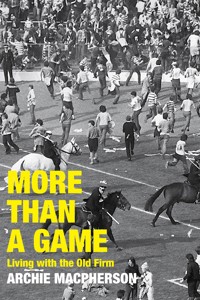
'This is like a scene from Apocalypse Now' Archie Macpherson examines the story of football's most explosive rivalry - Celtic v Rangers. In this book he centres on the infamous riot at the Old Firm Scottish Cup Final at Hampden on 10 May 1980, at which he was the match commentator, and which resulted in the banning of alcohol in football grounds. He explores his memories of the many clashes between the two clubs over his half-century broadcasting career. This leads him inevitably to the sources of the sectarianism which has characterised this fixture and the West of Scotland. He weaves his experiences, and those of others, into the complex tapestry of social issues and club loyalties and takes us through the wider political context: World War II, the invisible hand of Margaret Thatcher and Scotland's independence referendum. This vitriolic conflict is more than a game. It is a kaleidoscope of bitter dispute, and occasional violence, and Archie Macpherson provides a colourful insight into how it was to live with the Old Firm for over five decades.
Das E-Book können Sie in Legimi-Apps oder einer beliebigen App lesen, die das folgende Format unterstützen:
Seitenzahl: 455
Veröffentlichungsjahr: 2020
Ähnliche

















ARCHIE MACPHERSON was born and raised in Shettleston in the eastend of Glasgow. He was headteacher of Swinton School, Lanarkshire, before he began his broadcasting career at the BBC in 1969. It was there that he became the principal commentator and presenter on Sportscene. He has since worked with STV, Eurosport, Talksport, Radio Clyde and Setanta. He has commentated on various key sporting events including several FIFA World Cups. In 2005 he received a Scottish BAFTA for special contribution to Scottish broadcasting and was inducted into Scottish football’s Hall of Fame in 2017.
By the same author:
Adventures in the Golden Age: Scotland in the World Cup Finals 1974–1998, Black and White Publishing, 2018
Silent Thunder, Ringwood, 2014
Undefeated: The Life and Times of Jimmy Johnstone, Celtic FC, 2010
A Game of Two Halves: The Autobiography, Black and White Publishing, 2009
Flower of Scotland? A Scottish Football Odyssey, Highdown, 2005
Jock Stein: The Definitive Biography, Highdown, 2004
Action Replays, Chapmans Publishers, 1991
The Great Derbies: Blue and Green, Rangers Versus Celtic, BBC Books, 1989
First published 2020
ISBN: 978-1-912387-99-1
The author’s right to be identified as authors of this book under the Copyright, Designs and Patents Act 1988 has been asserted.
The paper used in this book is recyclable.
It is made from low chlorine pulps produced in a low energy, low emissions manner from renewable forests.
Printed and bound by
Bell & Bain Ltd, Glasgow
Typeset in 11 point Sabon by Main Point Books, Edinburgh
All images reproduced courtesy of the Daily Record except where indicated
© Archie Macpherson 2020
Contents
Acknowledgements
Timeline
Preface
PART 1: The Riot: Roots and Realities, 10 May 1980, Hampden Park
CHAPTER 1 Duel in the Sun
CHAPTER 2 Call to Action
CHAPTER 3 A Blast From the Past
CHAPTER 4 A Girl on a White Horse
CHAPTER 5 Staircase 13
CHAPTER 6 A Financial Behemoth
CHAPTER 7 Toxic Anarchy
CHAPTER 8 European Invasions
CHAPTER 9 City on Alert
PART 2: The Aftermath, 1980 to 2020
CHAPTER 10 The Blame Game
CHAPTER 11 In the Firing Line
CHAPTER 12 No Excuses
CHAPTER 13 Heroes of the Hour
CHAPTER 14 Sober Times
CHAPTER 15 The Dawn of a New Era
CHAPTER 16 No Ordinary Trial
CHAPTER 17 The Indian Rope Trick
CHAPTER 18 The Avenging Angel
CHAPTER 19 ‘Scotland’s Secret Shame’
CHAPTER 20 A Changing Landscape
CHAPTER 21 New Territory
Epilogue
To my wife Jess
Acknowledgements
THIS BOOK HAS a cast of hundreds but I would like to single out some of the people who helped marshal these numbers into formation for me. I would like to thank the following Old Firm players who were eager to relive their memories of a controversial day: Derek Johnstone, Davy Provan, Gordon Smith, Roy Aitken and Danny McGrain. I could not have gathered much of my information without the assistance of the Glasgow Police Museum and the many Strathclyde officers who contributed to the narrative but particularly to Gary Mitchell of the Scottish Police Federation who was constantly on points duty for me during my research. I am deeply grateful to Dave Scott of Nil by Mouth for his constant advice and access to valuable files. Dr Gerry Hassan’s advice on the social issues arising in the book is greatly appreciated.
I would especially like to thank the former First Minister of Scotland Lord Jack McConnell for his contribution and invaluable advice, particularly on the social issues arising from Scottish football’s controversies. Thank you to Cara Henderson, founder of Nil by Mouth, who took time out of her busy life in Switzerland to remind me of her significant foray into sectarianism, without which the narrative would have been the poorer. And thank you to Eric Craig and Elaine Mudie who went out of their way to help me portray a hero and a heroine. I’d like to thank others who helped or encouraged me along the way: Tom Brown, formerly of the Daily Record, football biographer Alex Montgomery and Pat Woods for his customary foraging through history. Special thanks to Graham Lister of the Daily Record picture desk.
Timeline
188828 May, first Old Firm match
194927 August, Cox and Tully clash at Celtic Park
196316 May, Archie Macpherson’s first Old Firm Cup Final as a reporter
1965 Jock Stein wins Scottish League Cup v Rangers
196627 April, Rangers win Scottish Cup in replay v Celtic through Kai Johansen goal
196725 May, Celtic become the first British club to win the European Cup in Lisbon
19712 January, 66 people lose their lives in the Ibrox disaster when a staircase collapses
197224 May, police and Rangers supporters clash in pitch invasion in Barcelona; Rangers win the European Cup Winners’ Cup
198010 May, many are injured in the riot at Hampden park
19811 February, the Criminal Justice (Scotland) Act 1980 comes into effect, banning the consumption of alcohol in Scottish football stadiums and on trains and coaches carrying spectators to and from these stadiums
198525 July, the Sporting Events (Control of Alcohol etc) Act bans the consumption of alcohol within sight of football grounds in England and Wales
198812 April, four Old Firm players end up in court charged with conduct likely to cause a breach of the peace: trial of Terry Butcher, Chris Woods and Graham Roberts of Rangers, and Frank McAvennie of Celtic 23 November, David Murray buys Rangers
198910 July, Mo Johnston startles the footballing world by joining Rangers
19944 March, Fergus McCann saves Celtic
19957 October, Mark Scott murdered in a Bridgeton street
2000 Nil By Mouth anti-sectarian charity founded by Cara Henderson in response to the sectarian murder of her friend Mark Scott
2002 First Minister Jack McConnell’s speech on ‘Scotland’s Secret Shame’
201214 February, Rangers in administration 31 October, Rangers in liquidation
201418 September, referendum on Scottish independence
202013 March, all Scottish football brought to a close because of COVID-19
Preface
I watched from a very safe distance under a table or behind a chair, when my parents played football in the hall. Frances represented the Celtics and Jim the Rangers. For a long time they had no idea how much noise they made. Thump, thump, whack, crash! Several shrill shrieks, a man’s rough roar, more crashes, a series of screams. THUMP, CRASH. Mrs Principal light keeper was grim. ‘It goes on much too often, I really must insist that my husband speak to Jim.’
‘Mama likes Daddy to beat her,’ I piped up. ‘She tries to beat him too, but he wins ’cause he kicks the hardest and she runs away.’
It seemed the neighbours were never quite sure how to take the explanation of the football games.
Ruth Dickson, Strangers to the Land:
Memoirs of a Lighthouse Keeper’s Daughter on the May Island
RUTH WAS AN observer of a domestic fracas, played on a tiny fragment of rock off the coast of Fife, that regularly adopted the identity of a Rangers-Celtic match. The Isle of May (near where the German fleet surrendered to the allies at the end of the First World War) still lends asylum to seals, puffins, cormorants, terns and, in Ruth’s tender years during the 1930s, a handful of humans. Two of these were subject to the Corryvreckan-like pull of a football rivalry played far away in the West of Scotland. Such was the intensity of their battle of the sexes, focused on a small ball, in one of the most elegant and expansive lighthouses along the UK coastline, that the neighbours interpreted the bruises shown on the legs of the wife as clear evidence of domestic abuse. Indeed, it may have been that the game acted as a convenient way to express a hostility that festered below the surface of the relationship. However, Ruth leaves no indication of that as she simply describes an idyllic and happy childhood.
No, the game was the thing; the role-playing was the thing; the need to vanquish was the thing. Then life went on again. It was entirely separated from the daily grind. It was Ibrox Stadium and Celtic Park imported into a tranquil spot – with scant regard for the parochial conventions of a tiny island. It mattered to husband and wife in a way that neither the inhabitants of the island nor indeed anybody from there to Timbuktu (with the exceptions of the global spread of Glaswegian exiles) would fully understand. Out there, where the distant horizon of the North Sea could invite dreams of travel to distant lands, they had opted on travelling, via fevered imaginations, to the city of Glasgow. Two people, switching from their domestic relationship into a seemingly cutthroat duel was a dramatic act of reverence for the traditional fixture itself.
It could seem at first a trivial tale. Yet, it reveals how this form of tribalism could seep into the bloodstream anywhere, like Strontium-90 from a nuclear fall-out. It persists, because the two factions feed off each other to re-energise the historic enmity in ways which are quite unique. Yes there are other traditional derbies of great intensity around the world, but none which draw strength from social and political history – the study of which ought to be the preserve of academics. The Rangers-Celtic struggle has taken to the streets with stubborn values which deeply offend many, but also encourage multitudes. It adopts the historic, social and political turmoil of another island, swallows their stories as eagerly as a crystal meth addict and filters them into the mind through virulent oral traditions which resound with the songs and chants from days of yore.
Of course, when writing this book there was ample inspiration in other aspects of Scottish football. The era of Sir Alex at Pittodrie and Jim MacLean at Tannadice which produced the New Firm, for instance. A label attached by the media to their successes, in the hope that a new dynamic was being offered to Scottish football. But that age was fated never to last. Its roots weren’t wide or deep enough to completely undermine the older, socially entrenched tradition. Eventually, with the disappearance of Sir Alex and Jim MacLean from the scene, the New Firm was to rehabilitate the Old, who were to become even stronger and more commanding than they had ever been. Let us not forget, as well, that around the world more fatal explosions of violence surrounding football matches have shocked us all from time to time. And, yes, there is probably a majority of people who regard the relationship of these two clubs as a continual corrosion of Scottish values and might cry ‘A plague on both your houses!’. Of course, thousands would have attended these games since the inception of the Old Firm enmity on 28 May 1888, returning to their loved ones without breaking any law, or expressing any sectarian sentiment, and only wishing to see a good game of football. Indeed, I know some even now. The fact, though, is that everyone who has attended these games is complicit in the enduring rivalry. Which is one of clamorous hostility.
And it is the special one, the Big Bang at Hampden, that still resounds in the head. The Riot. The Old Firm Scottish Cup Final of 10 May 1980. It altered much; although sadly not everything about the Old Firm traditions. It would dramatically change how we would watch our football in any part of the country and initiate a political controversy which has lasted to this day. The scenes of that day were eventually watched by the biggest television audience the Old firm fixture had drawn up till then – for all the wrong reasons. For after the final whistle we were all preparing to wrap up and go home, unaware. But as the events unfolded that day a whole life’s experience came flashing through my mind.
This book is my odyssey through half-a-century of broadcasting, through the games and issues that bound two historic clubs together in a self-perpetuating rivalry. It reflects on the changing values surrounding the clubs – the nervous role of the administrators, the hovering, attentive media and of how I witnessed television cover all of this – from the days when games were filmed in black and white celluloid and edited with razor-blades, right through to the dubious splendour of VAR. All along the way people have hated each other with an intensity which could suck the oxygen out of any stadium.
I have been swept along by the Old Firm like a piece of flotsam, borne on a rushing tide. From one side or the other, you were branded as indelibly as a Texan longhorn steer in the resolute belief on the terracing that nobody, but nobody, could be neutral. Of course, my experience of living with the Old Firm as if I belonged intimately within a continually warring family circle wasn’t all violence and flying bottles. It was perhaps even worse than that at times, in the sinister atmosphere of mistrust and enmity, the efforts at one-upmanship and point-scoring to discredit the other. There are many sides to this story and I have tried to make sense of them all. The day when the tribes went to war would affect so many different people: football legislators, politicians, journalists, broadcasters, police, ambulance workers, A&E medics. Their voices are heard here in their own words – mine included. Only the police horses were unable to recount how their derring-do saved the day. But there were others aplenty who could.
The Riot: Roots and Realities
10 May 1980, Hampden Park
CHAPTER 1
Duel in the Sun
10 MAY 1980. Standing at the tunnel-mouth of the main enclosure, Chief Superintendent Hamish MacBean, Commander of the ‘F’ Division, City of Glasgow Police, and regular Match Commander at Hampden Park was beginning to relax. The normal tensions surrounding a Cup Final involving the Old Firm were beginning to fade. The sun was out. The world seemed a great place for one section of the crowd, a hellish aggravation for the other. The match had just reached its conclusion, after extra time. Not in a superbly dramatic style for the football that day had been fraught with nerves and most of the players had been affected by the extremes of tension. This had come from the torrents of abuse hurled from one end of the terracings to the other. Fanatical support can sometimes depress as well as inspire. Make a mistake and you let a whole community down, a community that regards its superiority as being confirmed by triumph. But on the whole, the game was only passably entertaining. In the 107th minute a stabbed shot by the Celtic captain Danny McGrain was redirected by a leg stuck out more in hope than anything else by Celtic’s George McCluskey; the sudden deflection sent the tall, lanky Rangers goalkeeper Peter McCloy in the wrong direction and the cup was won. They thought it was all over.
It wasn’t. As McGrain ran with his team towards the Celtic end of Hampden Park, with the cup, something made Chief Superintendent MacBean instinctively turn away from that particular scene of jubilation to look at the area just below the royal box in the main stand. What he saw sent a chill through even his experienced veins. For there, in the most expensive seats, reserved for the more affluent of the Old Firm support, punches were being thrown and necks being wrung. Men in ‘£500 Crombie coats were battering the hell out of each other.’ Bodies were clashing and faces were pummelled as vitriolic anger tipped over into outright violence. Inspector Willie McMaster, who was now beside MacBean, also expressed astonishment at this spectacle. But MacBean, turning back to the pitch, stiffened at what he now saw: ‘Never mind what’s happening in the stand. Look what’s going on out there!’ The crowd were surging on to the pitch. From either end they were now charging at each other.
High above all this, safe and secure on the commentary platform which was slung below the Hampden press-box, I made the fairly reasonable assumption that when the hordes would meet about the half-way line, they would not be joining hands around the centre-circle to sing ‘Amazing Grace’. I was spectacularly correct. The attacks began. My comment which seemed to come from the depths of my bowels, might be seen, in retrospect, as absurdly obvious:
At the end of the day, let’s not kid ourselves. These supporters hate each other.
But it was, I would claim, the neatest summary of decades of sectarian history you could pack into two sentences. It was no time for a Mary Beard-like lecture on the archaeology of bitterness.
Remote though I was to the scenes below, I was certainly no stranger to the hatred, the passion, the constant mutual eyeballing of these two clubs, at both boardroom and terracing level. The fact is, I wasn’t all that shocked by what I was seeing. It was as if I had been waiting for this sort of thing all my life – this was an eruption which had the shape of destiny about it.
I had been born only a couple of miles from Celtic Park, back when there were still gaslights in our tenement close in Shettleston. From my window high on the building I could watch the streams of colour sluicing their way down the pavements, as crowds moved towards Parkhead. On the days when the Old Firm were playing people just seemed different – talking incessantly all around me as if they were under threat from an unseen force. Call it fear of losing, of being made to feel like you might end up as a pallbearer for your own tradition. Even when I pushed the clothes-packed laundry-pram up the hill to the steamie for my grannie I would hear some of the old women refer to it. I recall one old biddy saying,
He’s gaun tae the gemme. Christ, I hope he doesnae go near Deans’s before he comes back.
Deans being a pub of renown in the area, a veritable den of iniquity in the eyes of womenfolk. The smell of cordite was competing with the aroma of Parazone in that steamie. Neither was there any hush to that day for us. We could actually hear what was happening.
When we played out our fantasies in bounce games on the windswept ash pitches of Shettleston Hill during Old Firm days, tidal waves of sound from Celtic Park would sweep towards us, like a grumbling monster demanding attention. We knew when a goal was scored. That noise was special. Coming at you sharper, like a ripping of the heavens. We would stop in our tracks. But who the fuck had scored? Free from family constraints we enjoyed swearing like troupers, especially when we were held in limbo at these moments, not knowing what was occurring in that cauldron just a couple of miles away. We wouldn’t know until we saw the faces coming back down Shettleston Road. Oh, you could tell then all right, without asking, who had won. The aftermath of those days was largely benign in our area though. Yes, there was banter. Of course, there was sullen withdrawal, stoicism and silent drinking by the defeated. And there was plenty of unexpected geniality extended towards you from the victorious. All was now right for them in this best of possible worlds. And they all mixed. Indeed, my abiding memories are of the respective, staunch Old Firm supporters working actively together in politics. Everybody knew which foot anybody kicked with, but the allegiance to parties of the left, in the very early days supporting the ILP, then principally for the Labour Party and even the existing Communist Party, completely neutered any sectarian sensitivities. They bonded because of their unbridled hatred of the Tories. (Of whom it must be said, were even scarcer in Shettleston than Inuits in the Democratic Republic of the Congo.) Then they would separate into their own self-defined social networks and of course would never stand together at an Old Firm match.
This was despite the fact that we were just emerging from the effects of a world war. The carnage involved in beating Adolf Hitler seemed to have had little effect on those who encouraged the belief that on Old Firm match days the brotherhood of man was an impossible concept. Segregation was a word better known in Glasgow than anywhere outside the American Deep South. Supporters benignly accepted separate entrances and terraces in a way which astonished outsiders at the time, but which is now almost universal practice throughout the world of football. The war had done nothing to narrow the chasm between the two tribes. I had only a kind of dull awareness and acceptance of that until an incident sharpened my understanding of the toxic nature of that divide. A single day changed my whole perception of this fixture and of the simmering unrest that can lie just underneath the surface.
In 1949, a few days after an Old Firm game at Ibrox, I was on a local bus travelling northwards from Shettleston towards Carntyne. It was packed and hot on that clammy August day. Many of the men were obviously going to the well-known greyhound-track. I suddenly became aware of an argument swelling up at the front of the bus. Four men were at odds with each other, to say the least. Two in front, two behind. Perhaps it had been going on for some time before the voices were raised. When that happens in a confined space there is a counterbalance of eerie silence from the stunned on-lookers. The words were crisp, abusive, sectarian, heading towards a climax and I suddenly knew what it was all about. Cox and Tully.
These two names were being shot about like cannonballs. (The passing of time now makes the two names read like a legal firm rather than two footballers who sparked a riot.) The two had been all over the newspapers in the previous few days to my fateful bus ride. It had been alleged that in front of no less than 95,000 witnesses at Ibrox Park, on 27 August 1949. Cox had effectively assaulted Tully, and with the referee taking no action, had provoked a terracing revolt at the Celtic end, near which the alleged offence had been committed. A delusional accusation, or barefaced robbery, depending at which end you stood in the stadium. And these four men on the bus were contesting the issue to such an extent that we knew a non-aggression pact was not going to be signed before they reached the dog-track. Suddenly, they rose and went at each other which, in the confined space, meant that four shapes merged into one brawling heap. There were screams from some of the women and my stomach began to rebel. Then, charging at them, came the clippie, the Glasgow conductress, representing a species which could operate either with the tenderness of a Mother Theresa or the resolution of a King Kong. She was of the latter disposition and I recall her grabbing one of them round the neck and screaming at them as she tried to haul one to his senses. She was aided by some of the other men who rushed up and intervened as the caterwauling of ‘Fenian’ and ‘Orange’ bastard swirled around the bus.
At the time it seemed to last an eternity, although it may have only taken a couple of minutes or so before the four were separated, the bus stopped, and the four of them shoved off it to pursue God knows what. But it had made its mark. I wasn’t mature enough to be making profound judgements, but the incident stayed with me, nay, haunted me for years.
So on that Cup Final day at Hampden, looking down at the milling throng, I remembered that first fight, that first surfacing of violence, like I had been through an initiation rite that had blooded me into the rougher realities of my neighbourhood. Of course even before I had left primary school I had heard all about the past: the 1909 riot at Hampden when both sides had ganged up to wreak destruction on the sleekit Scottish Football Association (SFA) trying to con them into paying for a replay of the final; of the social changes shaping a new relationship between the two clubs brought about by the influx of workers from Belfast into the Clyde shipyards and the extenuating Protestant- Catholic polarisation in the public mind; 1690, the Easter Uprising, the lot. But all that was distant then. The Cox-Tully controversy put names, faces, flesh and blood on the incoherent, abstract rages of sectarianism around me.
I have long wanted to trace this controversy back and investigate the circumstances of that day at Ibrox which set fire to the terracings. It was when I was within the BBC, decades later, in the mid–’80s that the opportunity was presented to me to do such a thing. I grabbed it. At the very least, for my starting point, I could boast that I had seen both Cox and Tully play in my mid-teens. These were certainly fragmentary memories, but allied to other pictures, and the recollections of supporters, I could claim my descriptions of both men were fundamentally sound.
They had little in common. Cox was a beautifully balanced defender who had a tackle like a trap snapping; Tully was a dawdling, meandering ball player of genius. Cox could have marketed Brylcreem as successfully as Johnny Haynes of Fulham in a later era, while Tully wore a dishevelled look that itself seemed suited to his cavalier approach to the game. Cox belonged to, and was a direct product of, that age of supremacy engineered through the powerful influence of Rangers’ manager Bill Struth whose face still stares down the Ibrox trophy room, etched with awesome self-assurance; Tully was an import who represented the most formidable challenge to Rangers since the end of the war. Cox was an Ayrshire Protestant; Tully was a Belfast Catholic. On the terracings they could easily be identified as tribal icons. And Rangers were in ascendancy.
The statistics of the post-war era offer adequate explanation for their commanding status, and Celtic’s frustration. In three seasons, from 1946 to 1949, in 12 matches, Rangers had won nine victories to Celtic’s two, with one drawn. Then had come Charles Patrick Tully, for a fee of £8,000 from Belfast Celtic to Parkhead, something like a young, bold Lochinvar ‘riding out of the west’ to inspire his new club to an unexpected but wholly deserved 3-2 victory at Celtic Park in the first leg of sectional League Cup trophy. Two weeks later they made for Ibrox for the return game, with the thought uppermost in Celtic supporters’ minds that it was conceivable that the Struth era of invincibility was drawing to a close.
But there was an obvious problem for my investigation. The passing of time. On my first step I learned that Charlie Tully had sadly died, 27 July 1971. Sammy Cox, I learned, was in rude health, but living in Canada. Try as I may, I was not pinning him down. Perhaps, in any case, he would be reluctant to answer questions about his alleged offence. Not the best start. But there were others around at the time who would make credible witnesses if they were still alive. And these indeed were the players who were fielded that July day:
RANGERS: Brown, Young, Shaw, Cox, Woodburn, Rae, Waddell, Findlay, Thornton, Duncanson, Rutherford.
CELTIC: Miller, Mallan, Baillie, Evans, Boden, McAuley, Collins, McPhail, Johnston, Tully, Haughey.
As I listened to the first voices, I couldn’t help but feel, however much I was pursuing the origins of a day of violence, that in footballing terms I was hearing of an age of innocence compared to succeeding generations of tactical complexities. Here is the late Willie Thornton describing the make-up and ethos of the great Rangers side of the immediate post-war period, whose famed defence was called the Iron Curtain:
To be honest I got fed up hearing about the Iron Curtain. All right, we had a great defence. I know that. But, in fact, if you look back, Rangers also had one of the best forward-lines in their history. We didn’t score as many goals as some other eras, but we scored when it mattered and that’s what counts, surely. That day we got the normal brief talk from Bill Struth. As usual he advised us to kick with the wind, if we won the toss and he reminded us about the bonus. He never forgot to mention the bonus. That was the extent of our team talk.
And from John McPhail, a great Celtic player whom I watched from the schoolboys’ enclosure scoring the only goal of the game to beat Motherwell in the 1951 Scottish Cup Final, came words that seem like from another planet compared to Mourinho psycho-babble, no matter how successful that may have been:
Jimmy McGrory, our manager, was one of nature’s gentlemen and said very little to us. He was much less of an influence on us in the dressing room than Bob Kelly, the chairman. Bob could be a very stern man when he liked and autocratic, but he was also a wonderful man when you were in a crisis and he had a simple belief that football should be played with two wingers and a man going through the middle. There wasn’t really much discussion. And, of course, we were always reminded that we were playing for the jerseys above all else.
That last comment resonates now with sincerity and purity compared to the later eras of the mercenaries’ creed, ‘Have boots will travel’. But it also suggests the strength of a colour, of identity, of a cause, of the desperate need to satisfy the desires of the tribe. It was community thinking. And that Celtic community was well represented at Ibrox in the eye-watering crowd of 95,000 in 1949. They were delighted with their team’s start. According to a contemporary report:
Celtic looked as if they were playing in somebody’s benefit match. Their inter-passing was delightful.
This was hardly an unusual pattern and seems to have been repeated countless numbers of times during that decade. But, almost habitually, Celtic’s ability to entertain was far removed from their capacity to win.
For me to investigate this properly, outside of reading reports from other sources, I had to talk to Cox personally, although my search was beginning to resemble the later hunt for Lord Lucan, as the former Ranger was permanently domiciled in Canada. I needed the ultimate witness, reliable or otherwise. Of course, I could imagine his reluctance to talk about an incident which he was accused of initiating and which sparked off an unprecedented terracing uproar at the Celtic end. I also knew that the conspiracy theorists in the press-box (yes, they are a hardy breed as contemporary records show) had already, prior to kick off, surmised that something in the Ibrox team selection revealed something of a sinister plan afoot. It showed that Cox would switch from his very customary position on the left defence to right-half. Why? The theory that swept through the press was that since Tully had bamboozled Rangers defence in the previous game Struth had decided to play the uncompromisingly hard-tackling Cox in that area to ‘sort him out’, as defined by the cognoscenti.
So, what did happen?
Twenty minutes into the game and Celtic were clearly in the ascendency and looked the more likely to score. Cox and Tully, racing after the ball inside the Rangers penalty area, clashed nearer the Celtic end. It was then that Cox was seen to turn and kick Tully deliberately. The Celtic player writhed on the ground and the western-side of Ibrox Park erupted in anger which rapidly intensified, as it seemed that the referee, AR Gebbie, from Hamilton, was apparently turning a blind-eye to it. This was a signal for revolt by supporters who saw it as an unprovoked attack on an irreproachable idol. As Tully lay writhing bottles started to fly. As one report had it, ‘Bottles were merrily doing their “Pennies from Heaven”’ act. Swathes of fighting broke out. The anger became so unbridled that the supporters were simply fighting among themselves. It became so intense that a section of the crowd near the track decided, for safety’s sake, to spill over the boundary wall. In the unstable atmosphere this gave the impression that the pitch was about to be invaded, and Mr Gebbie, conspicuously indifferent to the incident on the park, must have been shaken to the core by that sight. Jack McGinn, future president of the SFA and future Celtic chairman, was in the crowd as a young teenager and ran to the top of the terracing; he recalls an old man saying, ‘If you run they’ll think you threw a bottle. Take it easy.’ He also remembers that
the sky was black with flying glass. We just had to duck and hope for the best.
John McPhail was standing some distance away, beside his marker Willie Woodburn, the Rangers’ centre-half:
I said to Ben [Woodburn’s nick-name], ‘In the name of God! If they get on the park, I bet I can beat you to the dressing room!’
Ibrox Stadium had been adequately policed this time and they stormed into action, clearing the younger elements off the track and diving in to arrest the bottle-throwers at the top of the terracing. Order was eventually restored and the game restarted after several minutes. John McPhail recalled:
We just got on with the game. There might have been more dig in the tackles but honestly nobody really went out of control – but as you know, if you’re getting a lot of aggro from the terracings it can sometimes look worse than it is. I think what did happen, though, is that we lost our rhythm. No doubt about that and certainly not surprisingly Charlie became less effective. I began to get the old feelings in the bones again that the tide was going to run against us.
It did. Rangers were to go on to win 2-0 with goals by Findlay and Waddell. So, had Tully been sorted out? Had he been taught to mind his manners? Was he being informed in the most positive way that Govan ruled? Had a Belfast man from what was perceived to be an alien culture been put in his place? That was the full flood of Celtic thinking on the spot and thereafter. Although there was widespread condemnation in the press for the bottle-throwing by some of the Celtic support, The Glasgow Herald’s judgement on the game reflected the view of the entire press-corps when their correspondent wrote:
There is no doubt at all as to what caused the trouble, the foul committed by Cox on Tully after 20 minutes play and the astonishing attitude of the referee in ignoring the offence and waving play on.
They also went on to remind their readers of recent history. After disorderly behaviour by the Celtic support in a game at Ibrox on 6 September 1941, Celtic Park had been closed down for a month by SFA edict, with warnings posted about future behaviour. For the modern proponents of strict liability (the closure of a stadium because of support misbehaviour) it probably would have been Ibrox that was closed. Not Celtic Park. The Celtic argument then was as crystal clear as it would be today. Why should a club whose players had behaved impeccably on the field be held hostage by a minority of hooligans? What then happened was not to placate those in the Celtic community who had cried ‘Injustice!’.
The Referees’ Committee of the SFA, a day after an inquiry into the incidents, announced they were
satisfied that the rowdyism on the terracings were incited by two players S Cox of Rangers and C Tully of Celtic and also, to some measure, to an error of judgement by the referee.
Again, The Glasgow Herald’s take on that was almost one of stupefaction:
It is no exaggeration to say that even Rangers followers were convinced – at the same time astonished – that their player, by his foul on his opponent was primarily responsible.
And went on to say of the SFA’s conclusions that
their finding implies that both players were equally to blame; that, so far as those who saw the incident can reason, was not the case.
All this furore about the imbalance and the unfairness of that adjudication swung the attention on Sammy Cox. At that time in the ’80s I couldn’t find anything he might have declared about the issue. Perhaps not unexpectedly. It looked at first as if I was going to lose out on him. Then fortune turned in my favour. Rangers had been invited to play a summer tournament in Canada in 1980 against European and South American opposition only a month after their Cup Final defeat. From out of the blue I received an invite by Canadian Television to be the principal commentator for the event, so I travelled with the official party to Toronto with a rapidly growing conviction that Rangers playing in Canada would attract Scottish exiles, including one Sammy Cox. A friend of a friend of a friend then got a message to him somewhere in the Ontario province, and by return I received a message that he would come to my hotel and be interviewed.
I was in the splendid King Edward Hotel, made even more splendid for meeting and chatting for hours with the great Sir Stanley Matthews, on vacation, then almost 70, a fitness fanatic who would swim several lengths in the hotel pool, and afterwards run through the streets of the city for miles, and all before breakfast, putting my much younger self to shame. Coincidentally, he had played against Sammy Cox for England against Scotland in April 1949, in the famous 3-1 victory for the Scots. The impression I still carry is one of the greatest ever wingers expressing nothing but professional admiration for this stern defender.
When Cox eventually walked in it was difficult to imagine him as the cause of the fight on a Glasgow bus almost 30 years before. He was immaculately dressed, crisply spoken, with only the slightest twang of a transatlantic accent and above all he looked like one of these fortunate mortals who never seemed to age. Time had been kind to him. Indeed, he would live until he was 91. He could not have been more courteous even though by now he must have known what I would ask him. I eased into my interview with him by firstly raising the suspicion of that game, that Rangers had switched his customary position so that he could ‘get at’ Tully. He was politely dismissive of that:
An hour before kick-off Ian McColl walked into the dressing room wearing a big heavy coat and a muffler round his neck. Remember this was August and the weather was marvellous. He announced he had a terrible cold and wasn’t fit enough to play. He hadn’t even phoned in to warn us about it. We couldn’t believe it. Mr Struth took one look at me and said, ‘Sam, move over to right-half and get Willie Rae out of the stand in your position’. Now we all knew that Willie, realising earlier that he wasn’t going to be playing, had something like a 16-course meal at the Ivy restaurant before the match, so you can imagine he was in a right good condition for it! But it had to be done. That’s how I came to be playing right-half that day.
Almost without much prompting from me he slipped into an explanation of the ‘incident’, quietly and calmly, as if he were telling a kid a bedtime story.
I went after the ball and turned, wanting to push it out of the penalty area. I knew Tully was close by me and I was certainly determined not to give him the freedom Ian McColl had given him at Celtic Park. But as I kicked it, I felt this sharp dig on my ankle and knew it was Charlie. I turned and kicked him. I admit that. I kicked him just above the shin-guard and said, ‘Don’t do that to me again’. It was a jab with the toe more than anything else and I was surprised to see him rolling about the ground as if I had booted him in the family jewels. Then I knew the crowd had reacted.
According to the stories circulating among the Celtic support, with a strength of conviction that seemed to suggest its source came from on the field of play itself, was the allegation that Cox had uttered something less than amiable to Tully. So, I had to ask him about that specific allegation:
Did you call him a Fenian bastard?
He recoiled at that, even though I’m sure he had been well acquainted with the accusation. It was visible indignation.
I never said anything of a religious nature to Charlie Tully. I know the story got around that I did, but I deny it. I never did to anyone during these games. I played hard, and why shouldn’t I have. The Celtic players did as well.
The pity is that I couldn’t hear Tully’s version, but in general terms other players were not familiar to such abuse. John McPhail told me:
Never at any time in my entire career did I hear a single religious remark made to me by any Rangers player. Sure, we were desperate to win. But it stayed at that.
The late Bobby Collins, the diminutive powerhouse of Celtic in the ’50s, endorsed that view to me:
Religion? Nobody gave it a thought. If we had really been like some of our supporters it would have been mayhem every game and, of course, it was nothing of the kind.
Although clearly, he does not claim immunity from how such an atmosphere can play on the emotions and super-charge effort.
And Tully’s reaction to the kick? Collins reflected on Tully’s personality:
I doubt if he was totally blameless. I remember he could easily drive you up the wall. He once caused me to lose my temper on the golfcourse when he deliberately made me miss a putt in a needle game. I almost went for him with my putter, then I burst out laughing. I just don’t think Cox would have kicked him for nothing.
But kick him he did. And no punishment ensued. It was an incident which fortified the Celtic belief that the establishment could not give them a fair deal; that the partisan nature of the various authorities, from the referee on the day, to the SFA themselves, sprung from social attitudes towards a club which flew the tricolour and boasted proudly of their Irish origins. In short, there was institutional prejudice. Their opponents then threw the word ‘paranoia’ at them through the generations in the unceasing ebb and flow of charge and counter charge. The Cox-Tully saga contains a mix of fact, rumour, injustice and even myth. A highly combustible concoction.
So down there on the Hampden pitch, these same elements had caught fire on 10 May 1980. A different age. A new generation. But a timeless squabble. And for me, with a familiarity that had now bred the ultimate contempt. It was loudly echoing that bitter clash which occurred on that bus going to Carntyne. This time, though, with spectacular choreography. The battle had commenced, and I found myself asking this question aloud to the now huge television audience:
And where are the police? For heaven’s sake, where are the police?
CHAPTER 2
Call to Action
PC KENNY MALGARIN, later to become an Inspector, was sitting in a transit police van with five other uniformed officers of the Pollokshaws Support Group near Cathcart Road some distance from Hampden Park. They had been given duties which departed from the normal routine. They were to operate in that area instead of close to the stadium:
We were there in case of any potential trouble that arose with people coming away from the stadium.
But Kenny added his own interpretation:
I think it’s possible their thinking was that if fewer police were in and around the stadium itself then the public would respond by behaving themselves, that it was about trust. And remember the IRA were very prominent at that time and being a major public occasion, we did a lot of patrolling in and around certain areas.
So, for the duration of the game Malgarin and his colleagues stayed in that vicinity keeping an eye on potential flashpoints particularly near well-known pubs. They were having, in fact, a relatively tranquil afternoon until they were stopped in their tracks later in the day. Malgarin recalls the words that were beamed out of Hampden.
‘All stations outside Hampden go to the stadium IMMEDIATELY!’ It was a cry for help and in itself an admission that something had gone badly wrong. That appeal was heard around the city where any policeman was in radio contact.
PC Jim Buchanan was in a car travelling to the Southern General Hospital with a prisoner who was to receive medical treatment. The prisoner was hardly at death’s door, but he had to be seen by a doctor, and that was Buchanan’s first priority. But while he was supervising the man in A&E, he received the same frantic call to drop everything and get to Hampden and could hardly ignore the urgency of the message on the radio:
I told them I had a prisoner with me. They just told me in no uncertain manner to leave him and get to Hampden. So, I handcuffed the prisoner to a bed, and I bolted for Hampden. And, do you know, because of what happened next, I have no idea what became of that prisoner. For all I know he’s still there handcuffed to a bed.
Twenty-two-year-old PC Willie Allan, who was to become a Match- Commander at St Mirren’s ground in Paisley in later life, was a part of a detail named Panda Delta patrolling the southside of the city. He had been a member of the British Judo team at one stage of his career, which was not an inappropriate ability in his line of work. F429 was his number, which he recalls like an ex-serviceman reciting their army numbers, even years later. They were early shift, starting at 7am. They had been busy, having caught five housebreakers and booked a man for urinating in the street. A humdrum day in many ways. He was looking forward to an evening off since the other late shift would take over from them. But late afternoon, came a call. He remembers it as ‘All resources get to Hampden Park NOW!’ Whatever the variation of words, in his mind it came with the same urgency felt by the others. They sped to Hampden, the klaxon serenading the streets.
Twenty-three-year-old PC Tom McLeod had started his duties at Hampden at noon, having been driven over with others from Cranstonhill police station. He was part of a total force of almost 300 inside Hampden on the day. His first duty was at one of the 129 turnstiles, where he had to be watchful for anybody appearing to be under the influence, or to be sneaking in any form of alcohol. Beside him was what you might have called the sinbin, into which bottles or cans would be deposited if discovered. And that was the problem, as he pointed out to me:
This being Glasgow, people were very cunning about how to get booze into a stadium. We couldn’t search them then. All we would say is, ‘If you don’t put it in the bin, then you don’t get in’. Simple. Then some of them would walk away to find a spot where they could guzzle it down before coming back. Not ideal. So, we just had to go with instinct I suppose. Our powers were limited.
In fact, 70,303 did go through the turnstiles and Hampden from then on was awash in booze. McLeod, just before the game started, took up his post on the track at the Celtic end where he was eventually to make a crucial decision about the crowd pressing to get on to the pitch.
WPC Elaine Mudie was at the front entrance of Hampden, having been stationed thereabouts since early in the day. She was different from the others; she was on a horse. Before the day was out the pair of them were about to shunt the Lone Ranger and Silver out of the minds of cinema devotees.
Match Commander Hamish MacBean, on the track near the halfway-line, was no soft touch. Before he had been promoted to his current level of policing, he had enjoyed a spell with the Criminal Investigation Department (CID) which he confessed to me was one of the most rewarding of his career. He could claim that on one occasion he had looked down the barrel of a gun pointed at him by a murderer who had just blown a man’s brains out, but had succeeded in staring him out calmly into laying down the weapon; a crisis which more than adequately prepared him to take on drunks at a football match, or the varied breaches of the peace that would occasionally occur in that area. But, as the crowds flooded on to the pitch, he was the first to realise that the Glasgow Police, famed for their handling of large crowds in the city, were looking mighty vulnerable.
Glaswegians, for as long as I could remember, have been almost boastful to others of how their city’s police are adept at crowd control. Justifiably so. I go back to a memory as a kid being taken on VE night into George Square, where tumultuous crowds had gathered to celebrate the end of the war in Europe, and of the police controlling a multitude which could easily have got out of hand. Countless times I had been in crowds, around the Glasgow stadiums, never feeling any anxiety, because the uniforms were around as pillars of navigation and control. They seemed to have the knack of being where and when they were needed. So, it was an oddity, even to me, that I had to utter such a question about their apparent absence. Indeed, MacBean was quite adamant about that in later years:
I can tell you that normally Old Firm games were easy to police inside the stadium. They were separated. The [Celtic and Rangers fans] were herded into different areas. I mean inside it, not outside in the streets. And I can admit that the biggest problems we had were when Rangers played Aberdeen. It was then we had our work cut out.
Nevertheless, because of the magnitude of the crowds assembled to watch them you could not help but feel at any time that you were sitting on the edge of a volcano ready to erupt.
However, I had built a resistance to it, after notching up about 20 of their meetings by 1980. My first Old Firm Cup Final, on 4 May 1963, as a humble BBC reporter, was as if I had volunteered to serve in the trenches. Even the press around me looked like snipers ready to take aim at me if I so much as raised my head above the ramparts and said something of which they did not approve. This was at the embryonic stage of televised football coverage by the BBC, everything on black and white film, except for a final like this when proper outside broadcast cameras were used. At the same time the Corporation was seen as a threat to the established print hegemony, and I was one of its insects only suitable for crushing. For some of their loudly aired comments about the Corporation at the time were as if they were referring to a cult that practised unmentionable rituals and had to be stamped out. Arthur Mountford of Scotsport and myself were new kids on the block and were considered threats to the printed press. Although our early and recurring mishaps in filming, which lent us the kind of Mack Sennett silent movie feel to our output might have allayed any fears about our superseding them. However, I can still feel the hostility to this day. But it wasn’t just that which made the game so significant to me now. I was in at the start of something big, something that would fundamentally alter the thinking of one club in particular, for humiliation can be one of the strongest of motivations for radical change. On that Wednesday evening replay in 1963 after a 1-1 draw on the Saturday, Celtic were humiliated.
The club, dominated by the unflinching personality of Robert Kelly, must have been aware of the deep sense of frustration that existed among their supporters. They were unable to solidify their position in Scottish football in the aftermath of their famous 7-1 drubbing of Rangers in the Scottish League Cup Final of 1957. Anger and frustration go hand in hand, and at that stage Celtic supporters imagined that kind of negative twinning would go on for some time. Rather than reaching bedrock they had apparently left Hampden after that final and based themselves on quicksand, for compared to their great rivals they seemed to sink without trace over the next seven years. From that October day in 1957 until April 1965, Celtic went without a major trophy win, while Rangers picked up four League titles, four League Cups and four Scottish Cups.
So, the 1-1




