


16,99 €
Mehr erfahren.
- Herausgeber: John Wiley & Sons
- Kategorie: Geisteswissenschaft
- Sprache: Englisch
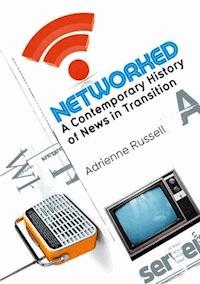
Journalism, what happened? In the last decade, the industry and the profession have been rocked to the core. Newspapers as consumer product are as ripe for comic mocking and satire as are the techniques of the journalism profession. The contemporary death and life of journalism is the story of an historic cultural transition. We have lived through the end of the mass-media era and the beginning of the networked-media era. We took in news one way for a century and we simply don't do it like that anymore. Networked: A Contemporary History of News in Transition examines this moment in journalism, the conditions that brought it about and the characteristics that have shaped it and will shape its future. In crafting this sophisticated yet accessible study, new-media scholar Adrienne Russell draws on personal interviews with journalists and analysts at the center of the shift, examines innovative and revealing digital news projects, and underlines larger cultural changes that reflect the new news reality. Networked also examines emergent journalism practices that suggest the forces at work and the stakes involved in developments we have all experienced but, caught up in the rush of change, have had limited perspective to interpret.
Sie lesen das E-Book in den Legimi-Apps auf:
Seitenzahl: 289
Veröffentlichungsjahr: 2013
Ähnliche



















Networked
For my dad
Networked
A Contemporary History of News in Transition
Adrienne Russell
polity
Copyright © Adrienne Russell 2011
The right of Adrienne Russell to be identified as Author of this Work has been asserted in accordance with the UK Copyright, Designs and Patents Act 1988.
First published in 2011 by Polity Press
Polity Press
65 Bridge Street
Cambridge CB2 1UR, UK
Polity Press
350 Main Street
Malden, MA 02148, USA
All rights reserved. Except for the quotation of short passages for the purpose of criticism and review, no part of this publication may be reproduced, stored in a retrieval system, or transmitted, in any form or by any means, electronic, mechanical, photocopying, recording or otherwise, without the prior permission of the publisher.
ISBN-13: 978-0-7456-3773-0
A catalogue record for this book is available from the British Library.
Typeset in 11 on 13 pt Adobe Sabon
by Servis Filmsetting Ltd, Stockport, Cheshire
Printed and bound in Great Britain by MPG Books Group Limited, Bodmin, Cornwall
The publisher has used its best endeavours to ensure that the URLs for external websites referred to in this book are correct and active at the time of going to press. However, the publisher has no responsibility for the websites and can make no guarantee that a site will remain live or that the content is or will remain appropriate.
Every effort has been made to trace all copyright holders, but if any have been inadvertently overlooked the publisher will be pleased to include any necessary credits in any subsequent reprint or edition.
For further information on Polity, visit our website: www.politybooks.com
Contents
Acknowledgements
1
Introduction: The Rise of Networked Journalism
2
Participatory Journalism: The Wealth of Networks
3
From Personalization to Socialization
4
News Parody, Satire, Remix: When There’s Nothing to Do But Laugh
5
Public Life and the Future of News
Index
Acknowledgements
Thanks to the Annenberg Center for Communication at the University of Southern California for time and funds and for the inspiration I drew from my colleagues there as the ideas of this book were coming together. Thanks to the American University of Paris and to the University of Denver for providing the rich personal and academic environments in which I undertook this project and for the time and money that were essential for me to get things done. And thanks to my colleagues at the University of Denver’s Digital Media Studies Program who have deepened my understanding of technology and culture in ways that have greatly influenced this book.
Thanks also to my editors at Polity, Andrea Drugan and Lauren Mulholland, who are great at what they do, and to the anonymous reviewers of the first, very rough draft of the book.
I am grateful to the many journalists who shared their time and expertise; in particular I want to thank Kevin Anderson, Nick Bilton, Denis Burgierman, Gabor Vajda, and Derek Willis. Special thanks to my great friend Kerry Lauerman, who sat for many interviews with me over the years and whose smart and candid stories of his work as an editor have helped shape this book.
I would also like to thank the many friends and colleagues who offered advice, encouragement, and criticism over the years: Chris Anderson (the one at Indiana University not at Wired), Michela Ardizzoni, Rod Benson, Lynn Schofield Clark, Waddick Doyle, Nabil Echchaibi, Corinna di Gennaro, Ted Glasser, Jayson Harsin, Alfred Hermida, Mimi Ito, Risto Kunelius, Merlyna Lim, Howard Rheingold, Tony Shawcross, Matt Tegelberg, and Barbie Zelizer. Many thanks to Liz Fakazis, a great and careful reader, for passing her eyes over every word and sending vital late-stage feedback.
Thanks to my mom, Jay Duchene, for her encouragement and for taking care of the kids while I traveled and for inviting me repeatedly and always with a smile to hole up in San Francisco to write. Thanks to Sammy and Sofia: World Champion Distractors.
Most of all, thanks to John Tomasic. His insight into his own work as a journalist greatly influenced my own understanding of where the field is and where it is going. More than that, his patient encouragement and practical help – talking through ideas and editing and reediting drafts of the book literally over the course of years – went far beyond the call of duty. It’s not really possible to thank him enough.
1
Introduction
The Rise of Networked Journalism
The Gulf War was the best-covered war in history.
Dick Cheney (Frontline 1996)
Preface
Networked is about a transformative era in the history of media, the twenty-year period from 1990 to 2010, when the web rose and newspapers declined. The book centers on the transition as it has occurred in journalism. In networked journalism, members of various publics make journalism material that intersects, mixes, and is distributed to a new heightened degree. To me, networked journalism is journalism that sees publics acting as creators, investigators, reactors, (re)makers, and (re)distributors of news and where all variety of media, amateurs and professional, corporate and independent products and interests intersect at a new level. What’s more, the variety of forms and perspectives that make up news in this environment and the number of connections linking creators to one another have significant influence on the news and have expanded journalism as a category of information and genre of storytelling.
Others have described networked journalism simply as collaboration between professionals and amateurs (Beckett 2008; Jarvis 2006; Rosen 2009). Jeff Jarvis (2006), journalist and author of the high-profile blog BuzzMachine, writes that in networked journalism, “the public can get involved in a story before it is reported, contributing facts, questions, and suggestions. The journalists can rely on the public to help report the story.” Jarvis describes a trend where professional journalists accept input from the public while maintaining their authority over the news product, but this shift in the relationship between professionals and the public is just one element of the current changes taking place. Networked journalism is about more than journalists using a digitally equipped public as a kind of new hyper-source. It is also about a shift in the balance of power between news providers and news consumers. Digital publishing tools and powerful mobile devices are matched by cultural developments such as increased skepticism toward traditional sources of journalistic authority (Jenkins 2006; Russell et al. 2008). Contemporary journalism products and practices give new relevance to long-standing questions at the heart of what used to be called the journalism profession: How is truth defined and by whom? Which forms and practices of journalism yield the most credible product? How do consumers measure value among, on the one hand, elite media institutions, with their gatekeepers, resources, and professional codes and training, and, on the other, the bloggers and wiki-ists and emailers, with their editorial independence, collaborative structures, and merit-based popularity?
Lesen Sie weiter in der vollständigen Ausgabe!
Lesen Sie weiter in der vollständigen Ausgabe!
Lesen Sie weiter in der vollständigen Ausgabe!
Lesen Sie weiter in der vollständigen Ausgabe!
Lesen Sie weiter in der vollständigen Ausgabe!




