


Erhalten Sie Zugang zu diesem und mehr als 300000 Büchern ab EUR 5,99 monatlich.
- Herausgeber: Arena Sport
- Kategorie: Lebensstil
- Serie: Behind the Jersey Series
- Sprache: Englisch
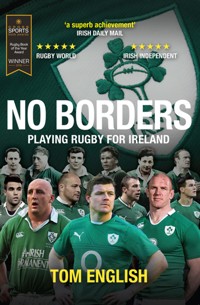
Fully updated to include Ireland's historic victory over the All Blacks and their 2018 Six Nations Grand Slam. From Jack Kyle's immortals to Brian O'Driscoll's golden generation, this is the story of Irish rugby told in the players' words. Celebrated rugby writer Tom English embarks on a pilgrimage through the four provinces to reveal the fascinating and illuminating story of playing test rugby in the emerald green of Ireland - all the glory of victory, all the pain of defeat, and all the craic behind the scenes.But this is more than just a nostalgic look back through the years, it is a searing portrait of the effects of politics and religion on Irish sport, a story of great schisms and volatile divisions, but also as story of the profound unity, passionate friendships and the bonds of a brotherhood. With exclusive new interview material with a host of Ireland rugby greats, No Borders unveils the compelling truth of what it means to play for Ireland at Lansdowne Road, Croke Park and around the world. This is the ultimate history of Irish rugby - told, definitively, by the men who have been there and done it.
Sie lesen das E-Book in den Legimi-Apps auf:
Seitenzahl: 722
Veröffentlichungsjahr: 2018
Das E-Book (TTS) können Sie hören im Abo „Legimi Premium” in Legimi-Apps auf:
Ähnliche














NOBORDERS
PLAYING RUGBY FOR
IRELAND
First published in hardback in 2015
This paperback edition first published in 2018 by
POLARIS PUBLISHING LTDc/o Turcan ConnellPrinces Exchange1 Earl Grey StreetEdinburghEH3 9EE
in association with
ARENA SPORTAn imprint of Birlinn LimitedWest Newington House10 Newington RoadEdinburghEH9 1QS
www.polarispublishing.com
Text copyright © Tom English, 2015, 2016, 2018
The right of Tom English to be identified as the author of this work has been asserted by him in accordance with the Copyright, Designs and Patents Act 1988.
Every effort has been made to trace copyright holders and obtain their permission for the use of copyright material. The publisher apologises for any errors or omissions and would be grateful if notified of any corrections that should be incorporated in future reprints or editions of this book.
All rights reserved. No part of this publication may be reproduced, stored or transmitted in any form without the express written permission of the publisher.
ISBN: 9781909715707EBOOK ISBN: 9780857908445
British Library Cataloguing-in-Publication DataA catalogue record for this book is available from the British Library
Designed and typeset by Polaris Publishing, Edinburgh
Printed and bound by Gutenberg Press Limited, Malta
CONTENTS
ACKNOWLEDGEMENTS
FOREWORD
PROLOGUEEYES IN THE BACK OF HIS HEAD
ONEPHONING THE WIFE, IS IT? AH, BALLS
TWOTHAT WAS THE BUSINESS WITH GOD SAVE THE QUEEN
THREEWE WEREN’T BIG ON AURA IN MONEYGLASS
FOURNO BORDER IN THE IRISH DRESSING ROOM
FIVEWAS CHOLLEY DOING 2OO SCRUMS A NIGHT?
SIXTEN TICKETS! I NEEDED A HUNDRED
SEVENDOYLER WAS OFF THE WALL
EIGHTA BOMB – I THOUGHT HE WAS DEAD
NINEDRY ROT OF THE LOWER ORIFICE, AS THE MAN SAYS
TENLIKE AN ELEPHANT, CLAW WASN’T FORGETTING
ELEVENSOMETHING’S AWRY WHEN PA’S THE GOOD COP
TWELVELENS – I WATCHED IT IN STRANGEWAYS
THIRTEENIN THE CREATION OF O’DRISCOLL, I WAS THE BUTTERFLY
FOURTEENPAULIE – HE JUST HAD THAT DOG IN HIM
FIFTEENCROKE PARK AND THE CLARE JERSEY IN MY BAG
SIXTEENWE PLAYED LIKE A HORSE’S ASS
SEVENTEENDECCIE, WHAT’S GOING ON, MAN?
EIGHTEENA DREAM I DIDN’T WANT TO WAKE UP FROM
NINETEENI JUST WENT WALKING, AIMLESSLY
TWENTYIT’S BEEN A PRIVILEGE
TWENTY-ONETHEY WEREN’T COMING BACK THIS TIME
TWENTY-TWOJOHNNY – THE BIGGEST BALLS ON THE PLANET
SELECTED BIBLIOGRAPHY
BOOKS
Diffley, Sean, The Men In Green. Pelham Books, 1973
English, Alan, Grand Slam. Penguin Ireland, 2009
Fallon, Ivan, The Player: The Life of Tony O’Reilly. Hodder & Stoughton, 1994
Fanning, Brendan, From There To Here. Gill & Macmillan, 2007
Foley, Anthony, Axel: A Memoir. Hachette Books Ireland, 2008
Hayes, John, My Story. Simon & Schuster, 2012
Johnson, Tony and McConnell, Lynn, Behind the Silver Fern, Polaris Publishing, 2016
Keane, Moss, Rucks, Mauls & Gaelic Football. Merlin Publishing, 2005
McBride, Willie John, The Story Of My Life. Portrait, 2004
McKinney, Stewart, Voices From The Back Of The Bus. Mainstream Publishing, 2010
O’Callaghan, Donncha, Joking Apart. Transworld Ireland, 2011
O’Driscoll, Brian, The Test. Penguin Ireland, 2014
O’Gara, Ronan, My Autobiography. Transworld Ireland, 2008
O’Gara, Ronan, Unguarded. Transworld Ireland, 2013
O’Reilly, Peter, The Full Bag Of Chips. The O’Brien Press, 2004
Quinlan, Alan, Red Blooded. Irish Sports Publishing, 2010
Reason, John (Ed.), How to Beat the All Blacks: The 1971 Lions Speak. Aurum Press, 2005
Robbie, John, The Game Of My Life. Pelham Books, 1989
Scally, John, The Giants of Irish Rugby. Mainstream Publishing, 1996
Sexton, Johnny, Becoming A Lion. Penguin Ireland, 2013
Ward, Tony, The Good, The Bad And The Rugby. Blackwater Press, 1993
OTHER SOURCES
‘Friends Reunited’, David Kelly, Irish Independent
‘Remembering 2007 – The One That Got Away’, Gerry Thornley, Irish Times
‘My room, your room: Mike Gibson MBE and Elaina Davis chat about life in Room Q4A, Queens’ College Cambridge’. alumni.cam.ac.uk
‘Unassuming Simon Easterby’, Gerry Thornley, Irish Times
‘Dockland Express’, Peter O’Reilly, Sunday Times
‘The Day Warren Gatland Gambled On The Future Of Irish Rugby’, The42.ie Rugby
‘An All-Time Great Comfortably At Home In Any Era’, David Kelly, Irish Independent
‘All It Takes’, 3.ie with Paul O’Connell
‘All It Takes’, 3.ie with Robbie Henshaw
Rob Kearney Interview, Tatler Man
‘Crotty And The Try That Still Haunts Schmidt’, Ruaidhri O’Connor, Irish Independent
Brian O’Driscoll Interview, Newstalk Off The Ball
‘Brian O’Driscoll: Ireland’s Rugby Ironman’, Huw Richards. New York Times
‘Brian O’Driscoll: He changed Irish rugby’s mindset for good’, Donald McRae. Guardian
‘One Hand On The Dimmer Switch’, Brendan Fanning, Sunday Independent
Joe Schmidt Interview, Newstalk Off The Ball
‘From Perfect Start To Darkest Finale’, Gerry Thornley, Irish Times
‘Ginger McLoughlin: Limerick’s Rugby Legend’, Dave McMahon, Politico
Rugby Interview with Tom Kiernan. Politico
‘Green Behind The Ears, Neil Francis’, Sunday Tribune
‘You Can’t Send Me Off: Des Fitzgerald Interview’, David Walsh, Sunday Times
‘Tamer of the Aussies: Ken Goodall Interview’, Peter O’Reilly, Sunday Times
‘The Past Is Never So Easy To Forget’, Irish Independent.
Matt Cooper Today FM interview with Paul O’Connell, November 2015
PHOTO CREDITS
InphoPhotography:I, 10, 12, 18, 68, 73, 92, 98, 101, 103, 105, 108, 110, 112, 114, 115, 117, 119, 124, 128, 131, 133, 135, 136, 138, 140, 144, 148, 158, 163, 164, 168, 172, 177, 184, 188, 193, 196, 200, 201, 204, 209, 211 (x2), 212, 213, 218, 220, 221, 226, 229, 231, 232, 233, 234, 237, 240, 243, 244, 247, 248, 249, 250, 252, 254, 255, 257, 260, 261, 264, 273, 274, 286, 288, 294, 296, 300, 304, 308, 310, 313, 314, 315, 318, 320, 325, 326, 327, 328, 329, 336, 340, 341, 345, 349, 351, 353
Getty Images:25, 69, 209, 320, 329
Colorsport:59, 99
Fotosport:168, 247, 249, 254, 261, 268, 270, 272, 273, 281, 282, 285, 288, 289, 290, 304, 313, 314, 315, 317, 318, 320, 326, 333, 336, 337, 352
For Jim Beveridge – he belonged to Glasgow
ACKNOWLEDGEMENTS
How do you go about writing a post-war history of the Ireland rugby team, a journey that begins in 1945 with Jack Kyle taking his first steps in the international game and ends, in this new edition, seventy-three years later with Rory Best leading his band of heroes to the Grand Slam at Twickenham?
The only way to tell a story like this was for me to get the hell out of the way and let the players tell it for me. An oral history, if you like.
The starting point was Kyle. I rang him and he was precisely as everybody said he would be – humble, kind and compelling. Next: Jimmy Nelson, another of the storied 1948 Grand Slam team. Jimmy was ninety-two years old when I interviewed him and his joy at winning, and frustration at losing, was the same as it was all those years ago when he was setting the agenda in the middle of the Irish scrum. I spoke to Jim McCarthy the same week. Another Grand Slam winner in 1948, another rugby great, another gentleman.
Sadly, all three have passed away since I interviewed them. In 2016, a year after the original version of No Borders was published, the last surviving member of the Slam of ’48 went to God. Of all the people I spoke to for this book, Bertie O’Hanlon was, unquestionably, one of the warmest and funniest. What a rugby legacy these men left behind.
I’m indebted to so many people, but I’ve got to start with all the players, past and present, who gave so incredibly generously of their time and spoke so honestly about their years in the Ireland jersey. There are 130 original interviews between these covers and I don’t know how many hours of recordings. We spoke about the highs and the lows, the euphoria, the insecurity and the slapstick, but Ireland’s story doesn’t begin and end at the whitewash on the pitch.
It veers into politics and religion and the complexities of a united Ireland team that could have buckled and broken on numerous occasions during The Troubles but didn’t because of the strength of character of some remarkable men. As the Triple Crown-winning Ulster wing, Trevor Ringland, said, ‘I refused to let symbols like flags and songs be hijacked by extremists – on both sides. To me, rugby was trying to build bridges while others were destroying them. We were finding a way of working together in friendship.’
On a seventy-three year journey there were bound to be gaps in the narrative. Eight years as the Irish rugby correspondent for the Sunday Times gave me some material to draw on, but more than that, those years gave me friends that I could pester for help. And pester them I did.
I leaned on the contacts and the journalism of Brendan Fanning of the Sunday Independent and Peter O’Reilly of the Sunday Times, two of my closest colleagues and pals back in the glory days in the Brill Building. I’m thankful to them and to so many other journalists who have covered Irish rugby down through the years in all forms of media. There are too many to name here.
For this new 2018 Grand Slam edition I’d like to thank all those history-making players who spoke to me and who brought the total interview count up towards the 130-mark covering a span of more than seven decades of the team, from the late Jimmy Nelson, the lock in Ireland’s first Slam in 1948, to James Ryan, the lock in Ireland’s third Slam in 2018.
Thanks, also, to David McHugh at Line Up Sports, Niall Woods and Fiona Coghlan at Navy Blue Sports, Ian Humphreys at Esportif, Richard Finlay at Ulster Rugby, Fiona Murphy at Munster Rugby and Marcus O’Buachalla at Leinster Rugby.
Thanks to everyone at the ever-excellent Rugby World, especially Sarah Mockford. Mark Hendry, Craig Fergusson and Mark McDougall helped me transcribe some interviews towards the end and I only wish I discovered them right at the start. I want to thank Mark Stanton who introduced me to Peter Burns at Polaris Publishing. Pete’s love of rugby and his passion for this project has been a massive help along the way. He understood that writers – particularly this one – have a pretty loose grasp of the meaning of the word ‘deadline’ and was a joy to work with it.
My brother, Alan, is a constant source of support and inspiration. Grand Slam, his outstanding book about Ireland’s famous 2009 season, was important to me as was Stand Up And Fight: When Munster Beat the All Blacks. If there’s a finer rugby book than Stand Up and Fight then I haven’t read it. Alan was also the ghost writer on The Test – Brian O’Driscoll’s autobiography and on The Battle – Paul O’Connell’s autobiography. As the brains of our family – and with, as she may have mentioned once, an A in honours English – our sister, Sinead, could write a best-seller if she put her mind to it. She’s a force of positivity – the best Sis in the world.
Our parents, Tom and Anne, have given us love and encouragement and a lifetime of laughter. In February 2018, Dad passed away peacefully and with all his family around him and though there’s a huge sadness in losing him there’s also a great comfort in having had him for so long.
The last word goes to my wife, Lynn, and our children, Eilidh and Tom. In the acknowledgements in the last edition of No Borders I said that it would be many years before they heard the words ‘working on the book’ again. They heard them sooner than planned and their love and support means everything.
Tom English, 2018
Joe Schmidt.
PROLOGUE
EYES IN THE BACK OF HIS HEAD
Joe Schmidt’s reputation as a Midas is hard-earned and well-deserved. From Manawatu on New Zealand’s north island, to Clermont in France, to winning trophy after trophy in his years at Leinster, everything the Kiwi touches seems to turn to gold – or silver. In 2013, Schmidt wasn’t so much appointed as Ireland coach as carried shoulder high into the job by players at the province that achieved greatness on his watch.
Those Leinster guys understood what he was about. The forensic eye for detail, the extraordinary work-ethic, the obsessive demand for perfection. The Brian O’Driscolls, the Johnny Sextons, the Rob Kearneys were aware of what was coming when the New Zealander began a new era in the history of the Ireland team. Others, less so.
Paul O’Connell: I knew very little about Joe. I knew from talking to the Leinster players and reading their interviews in the papers that he was very impressive and that he was on a different level, but it’s hard to imagine it until you actually experience it.
Andrew Trimble: The Leinster lads knew exactly what he was like but the rest of us were playing catch-up. We’d heard a lot about him and we were all reading into everything. In his first autumn, one player was in the team-room and he was kinda slouched back on the sofa and when Joe walked in he sat up straight. Bolt upright. It was like the head teacher had walked into the room. That made me realise how aware his players were of how aware he was, if you know what I mean. It’s a silly one, but it’s a reflection of his impact.
Johnny Sexton: At times, it’s almost like he’s a voice in my head. When I’m analysing my own game and I spot myself doing something wrong I can hear him pointing it out to me. You’d go in on the Monday and there’s a video session and nothing is said and you’d go in on the Tuesday and there’s another video session and nothing is said and you think, ‘Great, I got away with it,’ and then it’s the last clip on a Thursday and this thing comes up. And you think, ‘Ah Jesus, I thought I had him for once.’
Rob Kearney: There’s a touch of the obsessive about him. Rugby seems to be his love and drives him on every day, like a lot of us. There’s a touch of genius as well.
Rory Best: He misses nothing. You know the one about the key card holder?
Paul O’Connell: The room key at the hotel comes in a little sleeve with your name and room number on it and somebody dropped it in the corridor of the Carton House, our training base with Ireland.
Conor Murray: It wasn’t me.
Rory Best: Joe found it and brought into the team meeting. He says, ‘Just to let you know that somebody on their way to their room dropped their key card holder on the floor and that sort of stuff won’t be tolerated. If we’re sloppy off the pitch then we’ll be sloppy on it’. I was sitting there going, ‘Oh my God.’
Paul O’Connell: He said it reflected badly on an Irish international player that he was almost littering in a hotel. And he had a point.
Conor Murray: I actually don’t know who it was, but the story of the key card holder gave everybody a clear view of what Joe was trying to get across and what he wanted from us. He was going to run a tight ship.
Tommy Bowe: I learned pretty early on that Joe has eyes in the back of his head.
In Joe Schmidt’s first season, Ireland won four games out of five and took the Six Nations title in a dramatic denouement in Paris. It was Brian O’Driscoll’s final day in the green jersey, but it was just the start of Schmidt’s remarkable influence.
In the spring of 2015, the Six Nations went to the wire again. On the last day, almost unimaginable in its drama, Ireland won a second successive title. A year later, after 28 failed attempts stretching back 111 years, they created more history by beating the All Blacks at Soldier Field, Chicago.
Sixteen months later they won another Six Nations, but that’s not all they won. With four wins out of four, Ireland went to Twickenham on St Patrick’s Day 2018 in pursuit of a third Grand Slam and what they did there will live forever in the memory. Their power, their élan and their superiority secured the Slam. Officially, Schmidt’s Ireland had become the second-best team in the world with only the All Blacks ahead of them. Then they went to Australia and, for the first time in 39 years, they won a series on Wallaby soil.
This is the best of it. There hasn’t been a better era in the history of the Irish game. It is, as Rob Kearney says, a fairy tale and more. In the telling of the postwar story of how Ireland got to where they are now, via heartache, embarrassment, rancour and isolated passages of glory, there is a natural starting point, a man who is no longer with us but whose class transcends the eras: Kyle.
On the road to the 1948 Grand Slam: the Ireland players are swarmed by the crowd after their victory over England at Twickenham.
ONE
PHONING THE WIFE, IS IT? AH, BALLS
Jack Kyle: Some international rugby matches were played in the late war years, a few here and there, nothing major and there were no caps given out. Ireland played the British Army at Ravenhill and I remember as a schoolboy going and watching some of those games and never imagining for a moment that I would ever play for Ireland. I loved my rugby, but I never dreamt that big.
Bertie O’Hanlon: Jack Kyle. John Wilson Kyle. Nature’s gentleman.
Jack Kyle: The first time I played at Lansdowne Road was for Ulster schools against Leinster schools. My goodness, what a wonderful thrill going all the way to Dublin to play rugby. I was getting out brochures and reading about where I should go and what I should see - The Book of Kells and all these other things in my big journey south.
Bertie O’Hanlon: He had a wonderful pair of hands, you know. They were like glue. He was a brilliant player. And you couldn’t help but like him.
Jim McCarthy: Nobody could touch Jack. He’d play games and he wouldn’t need to have his shorts laundered afterwards.
Jack Kyle: Those of us who ever achieved anything on a rugby field were fortunate in a way to be born with a certain ability. We had the right sort of genes. As far as my own game was concerned it was at least 85% in-born. A lot of it was instinct. I never quite knew why I was doing something, but I did it anyway. The first time I wore the green jersey was mid-December, 1945. It was an Irish XV against the British Army in Belfast. I can still remember lying in bed in the morning and thinking, ‘What happens if I keep dropping passes and play an absolute shambles of a game?’ I was only a young lad then. God, I remember it clearly.
Crito, rugby correspondent writing in the Irish Press: In one glorious swoop the Irish XV wiped out memories of four defeats in a row at the hands of powerful British Army combinations with as devastating and convincing a victory as has ever been scored by an Irish side. Kyle, a nineteen year old youth just out of school, positively sparkled on this, his first appearance on an Irish team.
Jack Kyle: There was absolutely no planning, ever. If you saw the opportunity, you went for it. If there was no opportunity you had to come up with something else. It was totally spontaneous. In 1946, the Five Nations started. Unofficially anyway. If you look at the record books, those games don’t exist. But they were real enough to us. I’m pretty sure I didn’t imagine the French second-rows and back-rows running hard at me in that first game – Jean Prat and Guy Basquet, Robert Soro and Alban Moga, who went by the rather ironic nickname, Bambi. We didn’t know anything about them at the time, but we knew they came from exotic-sounding places – St Vincent-de-Tyross, Brive-la-Gaillarde, Fontenay-sous-Bois. It was all very glamorous – until they hit you.
Jack Kyle.
Crito: It’s thirty-three years since we gave the French rugby team a real licking, but if our strong suits turn out trumps at Lansdowne Road tomorrow when we renew international relations with the French after a break of fifteen years, not only should we beat them but we may go near repeating that glorious 24-nil victory we scored in Cork in 1913.
Jack Kyle: We met on the Friday afternoon, worked out our signals and passed the ball up and down a field a few times with the other three-quarters. Nothing too strenuous. Then we went back to the hotel, which was usually the Shelbourne, and had a team meeting which was run by the captain because there was no coach. The captain was sitting up the front and basically saying ‘Has anybody got any ideas for tomorrow?’
Crito: The French team which we thought so harmless gave Irish rugby a rare shaking at Lansdowne Road on Saturday. No adequate excuses can be offered for our defeat.
Jack Kyle: It was 4-3.
Crito: I don’t want to detract from the merit of the French side, but I do think that our side gave a fairly miserable exhibition.
Jack Kyle: When you were chosen to play, nobody phoned or telegrammed. We’d all listen to Radio Athlone on a Sunday evening to find out if you were on the next team or it often just appeared in the paper and then you’d get a letter from the IRFU on the Tuesday or the Wednesday which said ‘You have been chosen to play for your country’ and that ‘your jersey will be provided at the beginning of the game but must be returned afterwards, otherwise a charge of 30 shillings shall be made.’ So, we lost to France in Dublin and who did we play then? England in Twickenham, wasn’t it?
Crito: Forwards like damp squibs that spluttered and died, a back division crippled by injuries, a place-kicker who couldn’t kick, a full-back and a wing who couldn’t carry the rest of the team on their shoulders. That was the Irish team which was licked and humbled by England.
Jack Kyle: We lost all our games in 1946. It wasn’t acceptable to give interviews, which might have been just as well. The IRFU felt that we should know our place and keep our thoughts to ourselves. We were to be on the stage for eighty minutes and then we were to stay in the background and that was that. The year after, 1947, was when the games were made official again. I’d been playing for two years but it wasn’t until 1947 that I was actually recognised as having won a cap. We lost to France. People didn’t have high expectations.
Bertie O’Hanlon: I came into the team for the second game, against England above in Dublin. We won 22-0 and I scored two tries. ’Twas a mighty day.
The Irish Press: Like chaff hurled far and wide by a furious whirlwind which didn’t know when it had enough done, the might of England’s rugby lies in thraneens in the straw-strewn pitch at Lansdowne Road where on Saturday, an Irish side hardly given a chance, whipped the opposition in a manner which almost made the spectators rub their eyes in amazement and forget that they were nearly frozen stiff from the bitterly cold conditions.
Bertie O’Hanlon: My parents died when I was very young. I was only four when my father went and I was only fourteen when my mother died. They were fifty-five and fifty-two years of age. One went of a stroke and the other was cancer. My dad was a surgeon physician in Mallow. He worked his arse off. And he died when he was fifty-five.
The Irish Press:An attack on the left was blunted and [winger Barney] Mullan, getting possession, attempted a drop at goal. The ball went right across the pitch and O’Hanlon getting to it before [winger David] Swarbrick, showed fine ball control in dribbling over the line for a try.
Bertie O’Hanlon: My eldest brother worked in the bank and ’twas him who paid for my education at Rockwell College; my older brother, Cormac, a real father to me. He was a regional manager inside in the AIB in Ennis and then transferred to Cork. Went right to the top. There was about twenty years between us and he looked after me. Sent me to Rockwell as a boarder for five years. I got a wonderful Catholic education with the Holy Ghost Fathers. Mass every morning at 8 o’clock. Jeepers, you’d no choice.
The Irish Press: Shortly afterwards came the real nail in the English coffin. O’Hanlon fielded a Hall cross-kick near the halfway line, handed off Swarbrick, left [fullback Arthur] Gray standing with a marvellous side-step and swerve and again turned on the speed to make sure.
Bertie O’Hanlon: I was twenty-three at the time. I was Irish sprint champion. I won it in Dundalk. I did, yeah. That’s why I was picked for the wing. I was playing in the centre for Munster but Ireland put me out on the wing because they had other fellas in the centre and Paddy Reid from Garryowen and Dessie McKee from the north of Ireland weren’t long in coming on the scene. So I was a winger.
Before the match, you’d always be psyched-up. Playing the old enemy and all that. You’d be thinking of the Empire and the Brits dominating us for so long and you’d be mad to tear into them. I had a great debut altogether. Two good tries – a handy ol’ thing from the twenty-five and one from the halfway line. Sheer speed. I went into the corner, you know.
Jack Kyle: Lansdowne Road was packed. In those days they used to put seats along the touchline and at the throw-in you were practically looking into the eyes of the people. They were more or less talking to you.
Bertie O’Hanlon: Oh God, you always loved to hammer England. It was one of the greatest hidings Ireland ever gave them. I floated off the pitch. You’d never forget that. The history of it. England? You wanted to kick the shit out of them. Us downtrodden Irish doing it for our great grandfathers. The Irish history, we all read it. If you were doing history and geography you knew what they did to us. The whole Colonial crowd, the bloody Empire, the full bit.
Jack Kyle: The IRFU gave us our train fare but there was always a little note which told us, ‘You shall dine off the set menu but not a la carte. Any other orders to the room such as telephone calls or other pieces of food or drink shall be at your own expense.’
Bertie O’Hanlon: Billy Jeffares was the secretary of the union and he was a shit. Tough as nails and mean as shit. He was. In every way. He wanted receipts and all that. You couldn’t cod him. He was great for the union. Everyone was trying to shove in things trying to make a few quid on the expenses, but you got away with nothing. You’d try a few tricks but he knew ’em all. No free phone calls. Not at all. A phone call me arse. You might have sent it in but you weren’t paid for it. What phone call would you need to be making? Phoning the wife, is it? Ah, balls.
Jimmy Nelson: I was a work-horse in the second-row. I never pretended to be anything else. The boys had just missed out on a Triple Crown in 1947 by losing 6-0 in Wales and in the next match, against Australia, I came in at lock and we lost heavily and then I got dropped immediately. I always maintained that I was unlucky. Wherever we were staying the night before, the heat was desperate in my bedroom and I never got to sleep. I was exhausted going on to the field. I wasn’t surprised they got rid of me. I was determined to come back, though.
I’ll tell you a story. I was 6ft 1in tall, which was quite small for a lineout player. Somebody asked me how I leaped so high when I wasn’t the biggest. I said that my old grandfather was chairman of the Opera House in Belfast and I used to get free tickets, and I was there one night and there was a ballet company on and I was watching them, not because I had any interest in ballet but because I was amazed at the height they could jump. Now, I’ve embellished this story a bit over the years so I’ve half-forgotten what was real and what wasn’t. But this bit is true. I was looking at these ballet dancers and wondering how in the hell they jumped up so high. They used to have a party backstage and I went along that night. I collared the chief male dancer and I asked him how he got the height that he did when he was dancing. He took me out on the stage and showed me how to stretch your body to get the maximum jump. I was on the stage for ten minutes with this fella – and I’m sure it put about three inches on my leap at the lineout.
Karl Mullen: A lot of us were doing stuff. I was never the best player on the side but, as a hooker, I recognised that speed in the strike would be essential so I used to train, swinging between the banisters and a chair. I would swing each leg back and forwards fifty times so that I could get to the ball first in the scrum. Did it help? I don’t know, but I did it anyway.
Ireland finished the 1947 Five Nations Championship in the middle of the pack, below Wales and England and above Scotland and France. Paris was the first port of call the following season – and it was an odyssey. Three days before New Year, the players went from Dublin to Holyhead by boat and Holyhead to London by train. Staying the night in London, they trained it to Dover the next morning, got the ferry to Calais and then dragged themselves on to a train to Paris. They left on Wednesday afternoon and arrived in the City of Love on Thursday evening feeling like they had left one world and entered another.
Paddy Reid: Travelling to Paris for us at the time was like going to the edge of the planet. We were as green as grass.
Jim McCarthy: Paris was such a naughty place. We saw real prostitutes in the streets. I thought I’d have to get absolution. And the Folie Bergere? That’d be three extra Hail Marys.
Jack Kyle: The excitement was unreal. The Folies Bergere was an eye-opener. A few of the guys got onto the stage. I think Bill McKay, our blindside flanker, was one of them.
Jimmy Nelson: Bill McKay was a hard man, but he and I didn’t really see eye to eye about anything. He had a very different sense of humour.
Jack Kyle: McKay was a Coleraine chap. A fantastic rugby player. An immensely strong man. He had quite a war record out in Burma, fighting in the jungle. He told me once that he got malaria out there and they thought he was going to die. A priest gave him the last rites. He was a boxer and was the fittest man on our team. He was a very good miler. Word had it that he ran Roger Bannister a very close second in a race once. The journalist, Sean Diffley, once described our back-row of McKay, McCarthy and Des O’Brien as ‘wisecracking bandits roaming the foothills preying on unwary travellers’. And he was right.
Des O’Brien: I hadn’t been capped at that stage. I was a reserve. The game in Paris was played on New Year’s Day, 1948, and I was sitting near the touchline at Stade Colombes with the rain falling on me and the team flying around in front of my eyes. We were 10-0 ahead at half-time and eventually won 13-6. Paddy Reid, Jim McCarthy and Barney Mullan scored tries and at one stage I reached into a bag and pulled out a spare jersey and held it over my head as shelter. I said, ‘The way this team is going, this will be the closest I ever get to wearing one of these.’
Jack Kyle: Ernie Strathdee was our scrum-half and we had a great understanding. We played alongside each other at Queen’s and we just gelled really well. He was an excellent scrum-half and he was captain in Paris. And then he was gone. Didn’t matter that we won. Dropped. Hugh de Lacy came in and Karl Mullen took over as captain. It was pretty ruthless.
Karl Mullen: My father was a great friend of James Connolly and they used to walk in the hills every Sunday in the years before the Easter Rising and talk and argue. The library in our house was packed with books on Communism and free thinking and I was called Karl after Karl Marx. Dad always came to the matches, but he was very shy and physically small – about four foot ten – and would stay in the terraces.
Des O’Brien: I won my first cap against England in the second game of the ’48 season. Karl asked me if I would be leader of the pack. I told him I didn’t feel up to it because I didn’t know any of the forwards. He said, ‘We can soon fix that,’ and then he took me on the bus and introduced me to them one by one.
Jimmy Nelson: Des was the greatest player I played with. He was very accomplished. He worked for Guinness in Dublin and I said to him one day, ‘Des, what do you do in that job of yours?’ And he says, ‘I call to eight or ten publicans a day.’ I said, ‘What do you do when you get there?’ He said, ‘I have a glass of stout.’ I said, ‘Where can I get a job like that?’
Des was a very good tactician. He, more than Karl, directed the team. He laid out the plans. Karl was a very good player and a fine motivator. We had a good set of forwards, good handlers and we were quick. There were one or two workhorses like me, but you need workhorses. JC Daly was another one. John Christopher Daly. A prop. Oh, he was a rough diamond.
Bertie O’Hanlon: JC Daly fought in the war against Rommel and all these fellas. Some called him Jack and some called him Chris. Ah, you could call him anything you wanted. I’d call him JC. He was an iron man. He fought in the famous 8th army in the war, I think. He fought all over the bloody place, against the Japs and the rest of them.
Des O’Brien: He was an extraordinary character and one of rugby’s great romantics. Before the Second World War he was playing with the thirds for London Irish. As he departed for combat he said, ‘When I come back, I’ll be picked for Ireland’. He was stationed in Italy and had to carry heavy wireless equipment on his back. As a result, his upper-body strength was incredible. Before internationals he did somersaults to confirm his fitness.
Jack Kyle: It’s important to remember the good times but also you can’t forget the times you almost made a shambles of things. In our second game in 1948 we went to Twickenham. The previous year we’d beaten them 22-0 and there we were in a nice comfortable lead again. I’d scored a try and we were looking good. I’d taken a pass from Hugh de Lacy and there was a gap and I thought, ‘Maybe I’ll get through it,’ and I scored out on the right-hand side. As we used to say, ‘We don’t like the Welsh beating us, we don’t like the Scots beating us, but whatever we do, we can’t let the English beat us. We can stand lots of things but that’s more than we can stand.’
Then, later on, I ran across the field thinking there was an opportunity for another try. I threw a pass which was intercepted by Dickie Guest, who ended up scoring under our posts. It was now 11-10 and we were hanging on for dear life.
Des O’Brien: It was a terrifying last fifteen minutes.
Jim McCarthy: It was piss-in-your-trousers stuff.
Des O’Brien: They had a scrum near our line and Karl issued the instruction: ‘Drop it.’ They had another scrum: ‘Drop it again, boys.’ It wasn’t illegal and we were prepared to do anything to survive. The noise was incredible. It rose up as if coming from a well and hit such a crescendo that we could barely hear ourselves think. But we made it.
Jimmy Nelson: The forwards took charge of it. That’s what we did.
Jack Kyle: The final whistle was the sweetest sound I ever heard on a rugby field. We’d won. My mistake hadn’t cost us. It was relief more than anything.
Bertie O’Hanlon: We beat Scotland next and that was us three wins from three games. Not bad. So it was all down to us and Wales – March 13, 1948, above in Belfast for the Triple Crown and the Grand Slam, although no one talked about Grand Slams in those days. It was the Triple Crown we were after. It was strange going up there, the old border crossing and that. The northern boys were strictly educated in the Protestant faith and we were Catholics but there was no bigotry, none of that. We were wearing the green jersey and we were one team and that was it.
Jack Kyle: Hugh de Lacy played very well against England and Scotland and I enjoyed playing with him. He had a lovely pass. He was excellent, but when it came to the final match at Ravenhill, the selectors thought he was too light to be going up against the heavy Welsh lads. Ernie Strathdee was deemed to be more solid and so there was another change. I was really sorry for Hugh. It was nice to have Ernie back, but I felt for Hugh because to play well on two winning sides and to be dropped for the big game is very tough.
Jim McCarthy: Back then, a selector was God and a player kissed every ass he had to. It didn’t even occur to you to question why they travelled first class and you were in third. You didn’t question anything.
Bertie O’Hanlon: I was the youngest of nine kids and with my parents dead, my brothers and sisters went to all the matches to watch me. I used to get the tickets. I had to pay for them, of course. The rugby union wasn’t a charitable institution. Free tickets? Are you joking me? No way. We got feck all.
Crito: Can Ireland beat Wales for the Triple Crown at Belfast tomorrow? For almost fifty years we have been scoring near-misses at the coveted trophy. Psychologists, star-gazers, seers, critics and even old man Euclid say we can’t go on missing for ever, but Wales have proved to be our Becher’s so often that it is with a certain amount of trepidation that we face this last stumbling block to our cherished ambition.
Jack Kyle: I changed next to Jack Daly before that game. He thumped one fist into another and shouted, ‘I’m mad to get at ’em.’ We all thought Jack was a bit mad.
Paddy Reid: The night before, we had a meeting. One of the people who had given us advice was Dave O’Loughlin who had been a star Irish forward before the Second World War. To all of us on the ’48 team he was an idol. He had played against the great Welsh scrum-half, Haydn Tanner, who was still calling the shots on the Welsh team. Dave told us that Tanner was the man to watch and assured us that he would make two breaks during the game. At the meeting I suggested that Des O’Brien should be appointed as Tanner’s shadow. I went so far as to suggest that if he didn’t do his job properly he should be dropped. Des wasn’t too happy with this part of the plan. Sure enough, as Dave had promised, Haydn broke twice. Both times, Des tackled him superbly. In fact, so frustrated was Tanner on the second occasion that he slammed the ball to the ground in frustration. These things turn a match. I’m convinced it was the difference between victory and defeat.
Jack Kyle clears the ball against Wales in Belfast in 1948.
Jim McCarthy: It sounds a bit simplistic but we just knew we were going to win. It’s nothing to do with arrogance, it was just a mood.
Jimmy Nelson: The scrums were rough. The Welsh would throw punches trying to unsettle Karl. The second-row was throwing digs when we were down in the scrum. I could see the punches coming. The referee did nothing. Jack Daly said to me, ‘The next time he throws a punch you belt him one.’ Did I do it? Ah, I can’t remember.
Karl Mullen: I got a few cuffs on occasions all right.
Bertie O’Hanlon: They’d kick the shit out of you. The Welsh were tough as nails. Miners! What do you expect? Imagine coming out of the mines on a Saturday morning and hitting for Cardiff Arms Park. Three quarters of the team were coal miners and all belonging to them came from the mines. Rugby was the religion. None of this soccer act. Cardiff, Swansea, Newport, Pontypridd, Pontypool. You got nothing easy from those fellas.
Karl Mullen: By the end of the match I couldn’t see. Both my eyes were closed from the punches. Even the referee couldn’t find out who was doing it, but what was happening was that Don Hayward in the Welsh second-row would tip the guy ahead of him, who would move slightly to his right, and then he would come through with his fist into my face. He came clean on the Lions tour a few years later. He says, ‘I was the one that did you.’
Karl Mullen’s 1948 immortals.
Jimmy Nelson: There was one scrum midway through the second half and we went down and when we locked horns I could hear a few groans from the other side and I thought we have them now. As soon as I heard that I said to myself, ‘They’ll not recover.’
Jack Kyle: Jack Daly scored the famous try at Ravenhill. You know the story about him running back to the halfway line and saying that if Wales don’t score again ‘they’ll canonise me.’ I wasn’t sure about it, but apparently it’s true.
Jimmy Nelson: It’s definitely true because I landed on top of him as he touched the ball down and I ran back with him to the halfway line.
Bertie O’Hanlon: The wings threw the ball into the lineout and it was coming down to the end of time and I mentioned to the referee, ‘How long more, ref?’ I had my eye on grabbing the ball, you see. He said, ‘If you ask me that question again I’ll put you off’. That shut me up. A minute or two later he blew the final whistle and I so happened to have the ball in my hands at the time. And did I scamper!
Jimmy Nelson: I’ll tell you another one, Daly lost his shirt after the match. The crowd came on and his shirt was gone.
Jim McCarthy: The crowd rushed on to the pitch and literally ripped the shirt off his back
Jimmy Nelson: Years afterwards I met a fella and he said to me, ‘You know what happened to Daly’s shirt?’ I said, ‘No.’ He said, ‘I got it.’ I said, ‘How?’ He said, ‘I was still in school at the time and a crowd of us ran on to the pitch and got it and took it away and cut it into squares and sold it for sixpence each.’ And then he said when the jersey was finished he went and bought a new one and cut that one up too.
Jim McCarthy: Some of the lads went off after the dinner and got drunk and unfortunately one of them ended up in a police cell because for some reason there was a parade going on at that hour and he kicked an Orangeman’s drum.
Des O’Brien: I can still see the boys with the big Lambegs, taking the drums off their shoulders and coming in around us. I was sure we were about to get done. There were blows struck. We must have been close to a police station because we were hauled out, arms twisted behind our backs, run along a pavement, through swing doors and into a police station. There was one sergeant there who chucked us into a cell. We weren’t very upset as I recall. Half an hour later we were marched out into the guard room, where there were about twenty RUC men standing in two rows with their hands behind their backs. We were lectured by the sergeant, who said something along the lines of ‘Try that again and there will be no more Triple Crowns for you boys.’ Then they let us go. It must have been 3.30am before we got to our beds. Not a word to anyone, of course.
Jim McCarthy: I got a letter of admonishment from Billy Jeffares after the Welsh match. I’d claimed four pounds and ten shillings in expenses for the trip to Belfast but he docked me a shilling for departing from the table d’hote. I’d had a couple of raw eggs out of the hotel kitchen and made a phone call to my parents to tell them that we’d made history by beating Wales. They charged me for it.
Bertie O’Hanlon: Mean, you see. All that sort of crack.
Jack Kyle: In 1949 the team changed but we were formidable again. George Norton came in at full-back. Noel Henderson came on the scene in the centre. Jack Daly went to England to play rugby league and Tom Clifford came in instead of him. Tom was one of the greatest characters you could ever hope to meet. A great Limerickman. He was one of these men that people instantly warmed to without him ever having to open his mouth.
Jimmy Nelson: Clifford was the biggest character. He was an extraordinary person. He was received everywhere he went as if he was the King. Everybody liked him. Even when we went on the Lions tour in New Zealand in 1950 the first person the prime minister wanted to see was Tom Clifford.
Bertie O’Hanlon: Tom was a magic man. People just wanted to be around him. The pride of Young Munster – the great Tom Clifford.
Jack Kyle: In 1949 we started off by losing to France but then we beat England 14-5. None of the dramas of the previous year, thanks be to God.
Crito: Against England on Saturday, Kyle just dominated the whole proceedings. His devastating punting, remarkable defensive covering and, above all, those superbly rhythmic and seemingly effortless bursts through the centre drew the eyes of all upon him.
Karl Mullen: We went to Scotland next and beat them 13-3. Jim McCarthy scored two tries.
Crito: Opinion will vary as to who was our star but without hesitation I plump for George Norton, who gave an inspired display. His kicking, fielding and general play went a long way towards breaking the back of the opposition, but his quite astonishing place kicking was the factor which took a lot of the steam out of the Scots. The cumulative effect of his three successful kicks at goal was tremendous and the general query after the game was – ‘Who is this Norton and why wasn’t he on the Irish team last year?’
Jim McCarthy: So that was us playing against Wales in the big one for a second year in a row. This time we were in St Helen’s.
Des O’Brien: There was a big worry over Bill McKay, who was arriving late after doing an exam in Belfast and got caught up in traffic. Terry Davis of Trinity was put into his jersey, but McKay arrived ten minutes before kick-off and poor Terry never got a cap.
Jim McCarthy: I got the winning try. There was a lineout on the left-hand side in front of the stand and Ernie Strathdee passed it to Jack. Something told me ‘He’s going to have to cross-kick this,’ so I took off towards the posts. I arrived on Frank Trott’s chest just as the ball was coming down and it stuck in my mitts.
Crito: McCarthy crossed the line with a panther-like leap.
Jim McCarthy: And no, I wasn’t offside. People said I lived offside. I was never offside in my life.
Crito: Scenes bordering on hysterical occurred in Swansea on Saturday following our second successive Triple Crown victory. Welsh followers, stunned at the defeat of their own side, stood rooted to the ground as the Irish followers, bursting all barriers and police cordons, swept on to the field waving tri-colours and chaired the victorious Irishmen off the ground to the accompaniment of boisterous back-slapping, which inflicted more damage to some than did the tough Welsh forwards. Sods of grass and even some of the iron railings round the ground were snatched away as souvenirs and it took the concerted efforts of a squad of policeman to rescue from the hands of over-enthusiastic well-wishers, Jim McCarthy, star of the game and the man who scored the try which carried us through.
Bertie O’Hanlon: I only played once more after that, against France in 1950. I tore all my ligaments in my ankle in a club match against Cork Con or Garryowen or some other crowd and that was the end of me. But, sure, didn’t I have the best of it. Twelve caps. One Grand Slam and one Triple Crown. I think I have one jersey left. I’d say the moths have nearly eaten it now. It’s in a drawer somewhere. I should have put the bloody thing in a plastic bag to keep it safe.
Karl Mullen laces his boots before playing Wales in Cardiff in March, 1951. Notice the holes in the Ireland captain’s socks.
TWO
THAT WAS THE BUSINESS WITH GOD SAVE THE QUEEN
Norman Hodgson was a film-maker with a difference. Much of what he shot, he shot in colour. Originally from Lenzie, a village near Glasgow, but exiled in Skerries in north county Dublin, he was fanatical about his home-movies.
On February 10, 1951, Hodgson went to Lansdowne Road to see what footage he could get on the day Ireland played England in the second match of the Five Nations. Karl Mullen’s men had already won their first game of the Championship, against France by a solitary point, thanks to tries from Jimmy Nelson and Tom Clifford. And now the Irish players posed for Hodgson’s camera, the green of their shirts, the whiteness of their shorts visible in technicolour for what may be the first and only time.
The camera scans along the back-row. There’s McCarthy, pensive as you like, and Nelson and O’Brien. At the end of the line is Harry Millar, the wing making his debut and looking like he’s heading for the gallows. There’s Kyle crouched on the floor at the feet of John Smith, the loosehead prop, and John O’Meara, sitting in front of Clifford, who’s looking down the row and laughing. There’s no audio, just moving pictures. But there doesn’t need to be. Everything they say about Clifford’s charisma comes across in these few seconds of film; the playfulness, the devilment. Of the fifteen players, he’s the one your eye is drawn to.
Jack Kyle: We won that match 3-0. Des McKibbin, our second-row, stood up and poked over a penalty and that got us the victory. We were a very good side that year. We beat France, England and Scotland and, of course, it was Wales yet again standing in our way in the last game of the Championship.
T.D.F, writing in the Irish Press: They tell me here in Cardiff that never before has the search for tickets for a rugby match been so frantic. Local word is that black market tickets will be available in abundant numbers this morning.
Jack Kyle: George Norton was injured and how we missed his goal-kicking. I don’t know how many penalties we had and failed to put over. It must have been five or six. I scored a try and Wales scored a penalty and it ended 3-3. The ifs and whatevers stayed with me for a while. If we had George we would have won that game quite easily.
T.D.F: Oh, for a place-kicker
Jimmy Nelson: We left it behind us.
Jack Kyle: It was a long time ago.
Jimmy Nelson: It was, but I still remember it like it was last week. There was one incident which I’ll never forget. A regret, if you like. We were attacking the Welsh posts and we got right underneath them and I was in a bit of space and I said to myself, ‘Stand back and drop a goal,’ and the thought went in and out of my head in about half a second – ‘Don’t be daft you’ve never dropped a goal in your life’ – and I passed it out to Des O’Brien and Des was knocked into touch. I remember that well. And I regretted that I never took the chance. I don’t know if I’d have kicked it but I regretted not trying. Why didn’t I give it a go? I couldn’t tell you. I said it to Jack Kyle later and he said, ‘If you’d put that over you’d have been a saint.’
Jim McCarthy: We didn’t win the Triple Crown or the Grand Slam, but we won the Championship. We were top dogs again for the third time in four years. That was a golden era, I suppose.
Fullback George Norton makes a break during the 3-0 win over England at Lansdowne Road, 1951.
Ronnie Kavanagh: I came on the scene in 1952, from the Leinster back-row into the Ireland back-row. My strength was my fitness. I trained hard by the standards of the day. I spent a lot of time practicing my tackling, two or three times a week. I was pretty physical. In the summer of ’52 I was invited to go on the tour of Argentina. I still have the letter from the IRFU. It finished with, ‘If you want to accept this invitation then please forward a postal order for fourteen and sixpence for the cost of your visa.’ Can you imagine that? Heading over there for a five-week trip and we had to pay for our own visa.
A few days after we arrived, Eva Peron died. The place was going mental. The beloved First Lady had passed away. The Spiritual Leader of the Nation, as they called her. People were crushed to death in their attempts to pay their respects. The grief was something else. The chat was that the tour was going to be cancelled, but what happened was we went to Chile for a game until the craziness eased in Buenos Aires. We beat Chile 30-0 in Santiago and then a few days after her funeral we drifted back to Argentina and got things going. I was twenty-one at the time. It was like dying and going to heaven.
Maurice Mortell: I was a winger and I made my Ireland debut against France in Belfast in January, 1953. I’ll give you a laugh. I used to go to Lansdowne Road as a schoolboy and the man I’d be looking at most was Kevin Quinn, the centre from Old Belvedere. He was lethal. A fabulous player. I could never understand how the selectors could ignore him so often. Anybody playing football in those days would have put him down as the second best back in the country, behind Kyle. But he never got a look-in. There was this ol’ fetish about his defence. ‘Ah, his defence isn’t strong.’ I’d say he missed a tackle once in some war-time international against the British Army and they held it against him.
He was a kind of a hero in my mind. On the day of my debut in Belfast we were up in the pavilion in Ravenhill getting ready and Kevin’s in the team and he’s sitting beside me. It was his first time in the Ireland side in five years.
He leaned over and said, ‘Maurice, will you keep talking to me during the match?’ I said, ‘I will, of course, Kevin. Why, like?’ He said. ‘I get very nervous when I’m playing.’ Jesus, this fella was a God to me. Nervous! I was the one who was nervous. I was marking a fellow called Alain Porthault and somebody told me he had sprinted for France in the Olympic Games in Helsinki in 1952. He ran 10.7sec in the 100m. This fella was a flying machine. I was very uptight at the thought of having to deal with a guy who had that kind of speed.
Jim McCarthy: It was Jack’s first time captaining the side. And Jack being Jack, he turned it on. He scored, I scored, Paddy Lawlor scored and Maurice Mortell scored. We beat them handy. Then we had a draw against England and Jack was brilliant again.
The Sunday Chronicle: The one player who stood out head and shoulders above everyone else for ideas, imagination and innate rugby skills was Jack Kyle, a consummate artist and easily the best outside [half] now playing.
The Observer: The Irish forwards were terrific. And behind them Kyle at stand-off played one of the greatest games ever of his great career, brilliant in the cut-through, cool and commanding in defence.
Ronnie Kavanagh: Jack was one of the hardest guys to handle. He was so quick. Over a short little area of twenty to thirty yards he was devastatingly fast. I played against him a lot in the Interpros and you couldn’t allow yourself to get too close to him too quickly because he’d go around you. You had to try and herd him across the field rather than tear in and knock him flying because you had no chance if you tried that. He’d make a fool of you.
Cecil Pedlow:




