


Erhalten Sie Zugang zu diesem und mehr als 300000 Büchern ab EUR 5,99 monatlich.
- Herausgeber: epubli
- Kategorie: Lebensstil
- Sprache: Englisch
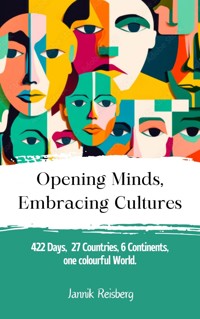
Jannik Reisberg is 26 years old when he embarks on the journey of a lifetime. With his degree in aeronautical engineering just in his pocket, he sets off into the wide world just a few days later. He doesn't know exactly what awaits him. What happens to you when you travel for so long? What happens when you are confronted with the dramatic contrasts of this world in a very short space of time? Questions that ultimately take him on the journey of his life. A rucksack, BVB jersey, sturdy shoes and the will to make it. Sometimes it takes no more and no less. What follows is a highly emotional ups and downs, an unimaginable journey that not only pushes his emotions to unimagined heights.
Sie lesen das E-Book in den Legimi-Apps auf:
Seitenzahl: 712
Veröffentlichungsjahr: 2024
Das E-Book (TTS) können Sie hören im Abo „Legimi Premium” in Legimi-Apps auf:
Ähnliche


















#widenyourmind
Expand your horizon
1st edition July 2024
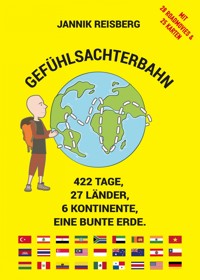
Original German book title: Gefühlsachterbahn
© Copyright by Jannik Reisberg
Contact: [email protected]
Publisher: epubli
Editing: Sara Grasso
Cover design: Simone Buchmann
Maps: Tobias Jan Pienta
Mock-up: Tobias Jan Pienta
Without you three, this book would never have been published.
Thank you very much for your commitment.
The smartest decision of my life was my studies of aeronautical engineering.
The best decision of my life was to go on this journey.
"Travel is fatal to prejudice, bigotry, and narrow-mindedness, and many of our people need it sorely on these accounts. Broad,wholesome, charitable views of men and thingscannot be acquired by vegetating in one little corner of the earth all one’s lifetime."
Mark Twain
"You go away for a long time and return a different person – you never come all the way back."
Paul Theroux
With 15,000 Euro around the world:
422 days (6 October 2017 - 1 December 2018)
26 countries on 6 continents
100,000 kilometres travelled of which 75.000 km by air, 25.000 km by land
40 flights
5 days and 20 hours spent in planes swam in 3 oceans
8 world wonders visited
39 % spent in the Southern & 61 % Northern hemisphere
2 pairs of shoes expired
& countless times I have reached my limits
The statements made in this book are purely subjective. They are the result of my dailyexperiences, impressions and experiences madeduring the journey in the respective countries. They are neither complete nor necessarily correct. They are simply personal.
The notes in this book were made during the journey. No changes were made to the content at a later date. Therefore, it cannot be excluded that the situation in the respective country described by me has changed extensively in the meantime.
The country facts mentioned in this book were intensively researched at the time of the worldjourney. However, they are not exhaustive and reference should be made to relevant literature for more in-depth interest.
Preface
In 2010, it all started. At that time I was just one year away from my final school certificate before heading to university. I had recently become a member of the German Young Liberals and in my younger years I was interested not only in the local politics of my birthplace Ennepetal, but above all in international politics. Attending individual events of the German Free Democratic Party (FDP) I met many new people. Well-known personalities such as Guido Westerwelle or Hans-Dietrich Genscher, but also other people of my age who were also liberal-minded. Due to my political commitment I was known as now for not mincing my words and always speaking my mind openly.
In August 2010, however, I was to learn that when it came to international politics there was always a need for sensitivity and that my aggressiveness was often simply counterproductive. Through a party friend, I was made aware of an international youth forum in Seoul, South Korea. After a very spontaneous booking of flights and the issuing of a passport on the spur of the moment (I didn’t have one at the time), I was drawn out into the wide world for the first time at the age of 18 - far away from home and everything I had ever known. There, I quickly came into contact with young people of the same age from all over the world. A dream that became reality. I can still remember the differences I directly felt between Germany and South Korea. Be it only the lack of a small everyday object that we take so much for granted, such as a product divider at the supermarket checkout.
I finally began to understand how small my previous universe of my home town Ennepetal in Germany and how big the world was. I realised how differently people all over the world live their lives, how differently views and life paths can form and develop. At the same time, I learned a lot about myself in this short time. I learned to listen. I changed from the cheeky and hastily judging boy to an open, curious person who reflects the words and opinions of others. A Chinese, US American or an Egyptian sees the world differently than a German - and that is a wonderful opportunity. With all the differences and the resulting conflicts that arise between countries and cultures, open dialogue is essential. We must listen and let listen in a constant exchange.
I am sure that this short but intense time in South Korea has shaped me over the years into the person I am today: a cosmopolitan. A person without prejudices towards others and their cultures. A person who loves the world and who has made it his life’s work to make it a better place for everyone. I want to fight and stand up for a world that perceives its differences as richness. We must not destroy these differences, we must preserve them and protect them with everything we have.
May 9, 2022 completely changed my life. During my world journey a few years ago, I was in many very dangerous situations. But on this day - my second birthday - I was riding my bicycle at my around 20,000th bicycle kilometer. I had a chilled afternoon with my girlfriend by the Alster in Hamburg, Germany. A wonderful place. A wonderful, safe place. But accidents always happen when you can't think of having them. Due to a serious bicycle accident with a days-long stay in the intensive care unit of a hospital because of brain bleeding, I now know how lucky I am to have done this world trip before. I am now in my second life and can still do all what I did before. I can travel. However, there was a period of several weeks after the accident when I knew nothing about at all. I didn't know where I was, what had even happened, or who I was. And I didn't know why I was different now, with no sense of smell or taste. Life always goes on, but now I know even better what I always told myself during my journey around the world: Enjoy your life, every second.
Cape Town, July 2024
Contents
Part I: Departure
Part II: Europe
1. Istanbul (Turkey)
Part III: Asia I
2. Lebanon
Part IV: Africa
3. Egypt
4. Ethiopia
5. South Africa
Part V: Asia II
6. United Arab Emirates
7. Sri Lanka
8. India
9. Vietnam
10. Cambodia
11. Thailand
12. Singapore
13. Malaysia
14. Indonesia
Part VI: Photo memories of my journey
Part VII: Oceania
15. Australia
16. New Zealand
17. French Polynesia
18. Easter Island (Chile)
Part VIII: South America
18. Chile
19. Bolivia
20. Peru
21. Ecuador
22. Columbia
Part IX: North America
23. Mexico
24. Panama
25. Costa Rica
26. New York City (United States of America)
27. Return
Part X: Home
Summit victory
Descent
Part I: Departure
One great advantage of being a student for me was certainly being my own boss. No longer being guided by the hand of a teacher or my parents. So after a short preliminary technical internship, I moved to Aachen in August 2011 to my first flat of my own. With that, I had arrived at a new stage in my life. No one asked me anymore when I would be home again or who I was bringing home with me. I had the freedom to just be me and that was good.
After my experiences in South Korea, and especially thanks to social media, I was able to keep in touch with my newfound friends from all over the world and the desire grew in me to escape my everyday life again as soon as possible. Escape to another world that was still foreign to me. So just under a year later, with the first major hurdles of my studies already behind me, I travelled to my friend Naoufal in Morocco over New Year’s Eve 2012/2013. Naoufal and I met in South Korea and I immediately liked his fresh and open manner. It was something that was unknown to me at the time. During our meeting in Korea I offered him a packet of biscuits late at night to help him break his fast. That was the beginning of our friendship. During my visit, he then introduced me to his friends as the "man with the biscuits". What was just a gesture of politeness and nothing really big for me, meant much more to him. He was surprised by the helpfulness of a stranger, his understanding of a religion to which he did not belong. The fact that Naoufal, as a strict believer, met the world with so much openness fascinated me: he never missed a football match in the midday heat and went into every sprint full of energy, but refused any food or drink during the day because of the fasting during Ramadan.
Morocco was an extremely interesting and experiential time for me. For the first time, I was able to mingle with those praying in a mosque, to be present at a prayer and to experience all the facets of this wonderful country. I could still tell a lot about this trip alone, but that is not the subject of this book. Morocco was the next step on my way to a new life ideal: travelling.
Morocco was followed by a semester abroad in 2014, which I spent in Istanbul, Turkey’s largest city. Despite official compulsory attendance, I was able to travel around a lot within the country during my stay thanks to my professors. Even at that time, the situation in Turkey was very tense, but I met many new people and even made new friends. I hitchhiked with lorry drivers towards the Turkish-Iranian border, listening attentively on the way when they told me about their worries and problems. Everything was a big new adventure for me. If I couldn’t find a ride, I had to camp lonely by the side of the road in the middle of the Eastern Turkish wasteland until the first cars woke me up the next morning and the search for a ride began again.
People often ask me why I decided to go to Turkey. For me it was simple. Within the framework of the EU’s Erasmus programme, Turkey was the only country from which I could expect a sufficiently large cultural difference to Germany. Additionaly I wanted to get a picture of the country from which so many of my fellow citizens in Germany are descended. Having arrived back in Aachen in autumn 2014, it was clear to me that I had to continue travelling. Of course, I also wanted to finish my studies, but travelling ignited a desire in me that I absolutely had to satisfy. So after South Korea, Morocco, Kenya, Turkey and Israel, I went to Uruguay and Argentina, the Philippines, Singapore and Hong Kong after I graduated with my bachelor’s degree and Romania later that year. Without exception, during my travels - whether alone or as a couple - I eschewed tourist comforts and instead tried to slip into the shoes of a local, to live their life, if only for a short time. I wanted to see life through their eyes. I wanted to know what it felt like to live in a slum in Mombasa, Kenya. That has not changed to this day. I want to feel the countries, their people with their history and cultures, and not just look at them through the windows of expensive westernized hotel. All these countries have inspired me, their wonderful and at the same time terrifying experiences are the reason for writing this book.
Besides the simple pleasure of travelling with a backpack, I am also interested in much more. To do that, I have to backtrack a little and tell you about my past. I have always achieved everything in my life without any major detours. My A-levels were immediately followed by my aeronautical engineering studies in Aachen. First I got a Bachelor and then an Master in it. That sounds like an excellent curriculum vitae. Nevertheless, at the moment I still have great problems imagining sitting in some office in some provincial town in Germany for the rest of my life soon after finishing my studies. That’s not exactly the future aspiration of a 25-year-old young man who loves the world so much. So before the professional routine, I want to escape once more and go on my great journey. I don’t know what it will do to me. Perhaps I will miss my family too much and eventually be drawn back to Germany, and thus to a conventional life, to a desk in some office in some provincial town. Or maybe I will find the place for me and my future in some other faraway country. Who can say? I don’t know how long I will travel or even have the opportunity to do so. I trust that everything will fall into place, because no matter what and how it may come, I am sure of one thing: I am very much looking forward to this time!
December
I’m getting closer and closer to my goal, in a roundabout way, but it’s coming along. From April, I will leave the place of my studies after five and a half years and move to another German city to finish my studies and write my Master’s thesis. Of course, like the majority of my fellow students, I could also write the thesis at the university itself and remain in Aachen until the end of September. But I have felt a certain boredom in the last weeks. It’s time for me. I need to take a new next step in my life, in a new place, in a new area. A new beginning. Aachen is a great city that I have come to know. But maybe sometimes you have to be open to a new love. Of course, I am still in Germany. Nevertheless, I am looking forward to a new and hopefully exciting time in another university city in Germany. Things are moving forward. A damn good feeling.
March
All the required vaccinations are done. I used the move to Göttingen to get rid of any ballast that I won’t need now for a while: TV, Playstation, camera lenses, furniture. Everything has found a buyer, the travel fund is ringing.
August
Time is running and a lot has changed in the last few months. The flights for the first three months of my world trip are booked and I am two wisdom teeth lighter. The flight booking makes the world journey real, the departure date is 6th October. And after taking out my travel health insurance and deregistering with my German health insurance company, it is now clear: the uncertainty is over, the deal is fixed! The writing of my Master’s thesis has gone pretty well so far, but unfortunately this has also meant that the preparations for the world trip have come far too short. The fact that I already started planning a good year ago saves me a lot of stress and the fear of forgetting something important. Planning like a real German sometimes pays off after all! Nevertheless, I’m very excited about what’s in store for me from 6th October. I will start in Istanbul, where I spent my semester abroad in 2014. The rest of my journey will take me via Lebanon to Egypt and then on to Ethiopia and South Africa. I want to scuba dive and am particularly looking forward to my time on the Red Sea. Maybe I will meet the great white shark? At the end of December, I will leave Cape Town for Dubai to celebrate New Year’s Eve with my girlfriend Rebecca and, of course, to admire the impressive fireworks. Afterwards, we want to travel through the United Arab Emirates together, before I will finally head to Sri Lanka alone. I will probably be a little tired of travelling after the first three months of continuous travel. That’s why I plan to take my first little break there. Everything else after that will be up to me. I already have a rough itinerary in mind, but what will happen in the end will be decided spontaneously. Now I have the remaining six weeks in Germany. Of course, I will use this time as intensively as possible with my family and friends.
September
Today is 27th September. There are only nine days left. In a little more than a week, I’ll already be on my way to my first destination: Istanbul. I have already finished and handed in my master’s thesis. After six years, my studies came to an end last Thursday and I can finally call myself an aeronautical engineer with a master degree. Looking back, I can only say that I had a very nice time studying. I am all the happier now that I am finally able to start a new phase of my life. My mother’s birthday is still coming up on the 1st October. I will use this day to say goodbye to most of my relatives. It’s a strange, but nevertheless insanely nice feeling at the same time. After almost a year of planning, my dream is actually becoming reality, everything is within reach. I am very glad that I planned my world trip well in advance. Hopefully, I haven’t forgotten anything important and have successfully overcome the hurdles of German bureaucracy.
Part II: Europe
The time had come. After more than a year of planning, I was standing at my gate at Düsseldorf airport waiting for my already delayed flight. It was hard to say goodbye to my family and my girlfriend Rebecca. But like the long and meticulous planning, the anticipation and the excitement of stepping into the vast unknown, goodbyes are just part of it. Goodbye to old habits. Goodbye to everyday life. Goodbye to friends and the all the more difficult goodbye to family. This year will be the first time ever that I will not spend Christmas with them. Instead, I will probably be in Cape Town, 9,500 kilometres away from my birthplace Ennepetal and my family.
Rebecca had given me another surprise to take with me on my trip, which I looked at while waiting at Düsseldorf airport. She had created an email address to which my acquaintances, friends and family members had sent me their wishes for the start of my world trip. It was a very moving moment for me and so beautiful to read each of the warm words. Even today my voice gets shaky and I start to tremble when I think back to that moment at the boarding gate. It was a goodbye that I had chosen for myself, that I had wanted so much for myself and that I just had to accept as the beginning of a new chapter in my life.
I had become a rather cool person in recent years, not showing my feelings in public and crying extremely rarely even behind closed doors. Yes, I was even warned that I would forget how to cry and show my feelings and would no longer be able to do so at all. It was nothing I was proud of, but I could not and would not change anything about myself. But at the moment of saying goodbye, and especially as I sat alone at the gate reading all the news, I suddenly felt unexpectedly left alone. This moment was to be the first of many on this trip in which tears ran down my cheeks without thinking about it. I just started to cry.
So whether I wanted it or not, off I went: the plane was finally ready for boarding, I said goodbye to the friendly airport employee checking my boarding card, entered the plane, took my seat and waved one last time to my home. My first home.
1. Istanbul (Turkey)
The first destination of my trip was on shaky ground until the very end. The original idea of starting the world trip with Istanbul had faltered due to the then increasingly deteriorating diplomatic relations between Turkey and Germany, particularly as a result of the arrests of Deniz Yücel and Peter Steudtner. Nevertheless, it remained my wish to begin this great journey in a city that I already knew very well. So there were no major alternatives for me and it was clear to me that I would either travel to Istanbul or, after a delay, to what was actually the first new country, Lebanon. During my last visit in 2014, I gave a presentation at a public event that was politically agitated about the general behaviour of the police at demonstrations in Germany compared to my observations in Turkey at the time. However, an arrest could be largely ruled out as long as I would appear as a regular, non-politically motivated backpacker during my time in Istanbul. That had become my firm motivation by now anyway. I was left with a queasy feeling when I boarded the plane to Istanbul in Düsseldorf, but it was clear to me that I owed it to the dear people there to visit them again and see with my own eyes how their life had changed.
I finally landed in Istanbul almost two hours later at around 10 pm. Shortly afterwards, I stood nervously in front of the Turkish immigration control. Fortunately, the queues were remarkably short at this point. The airport was very empty overall. This meant that I could not doubt my intention for long, because it was already too late now anyway. I pretended to be bored, tried to look as indifferent as possible and greeted a Turkish police officer with a quiet but audible "Merhaba abi” ("Hello, big brother"). I handed him my passport, he eyed me with the typical bored look of a Turkish man. Before I could say anything else, there was the moment I had been dreading. The moment of silence. It didn’t last long, maybe only 10 or 15 seconds. It seemed like an eternity to me. So while I waited tensely for his reaction, I watched the people behind the control. They were young men in civilian clothes, obviously from the Turkish police or the Turkish secret service - as I already knew them from 2014 from the anti-Erdogan protests from Taksim. Back then, they had mingled with the demonstrators, acting rather inconspicuously and observing what was happening. Until they were able to locate the alleged leaders of the demonstration, who then abruptly struck: With a loud "Polis!" ("Police!") they made themselves known, arrested the respective persons, dragged them out of the demonstrating group of people and took them into custody in a car behind the hundreds of police. From this point on, it was no longer possible for me and the international reporters, whom I accompanied during the demonstrations out of pure political interest, to follow what was happening to them. As soon as the police bus was full enough, it drove off protected by a police squad and disappeared into the confusion of the metropole. I took this risk at that time because I wanted to understand what drove young people my age to the streets. I, as part of a generation of young Germans who had never been to a large demonstration in their home country and always saw the German police as friends and helpers, was curious. Curious to know how I would have fared if I had been born in Istanbul. Because I had already been politically active as a liberal in Germany since 2010 and had always been primarily interested in issues of international policy, my thirst to experience for myself and to see the extent to which citizens in Turkey were actually increasingly deprived of their human rights and their freedom to express their opinions and shape their lives was naturally all the greater.
At that time, together with other exchange students, I had met with the German Consul General of Istanbul, who gave us advice on how to behave appropriately. After this meeting, it was clear to me that I had to be with the international reporters at all times so as not to run the risk of looking like a demonstrator. At the same time, it was - at least at that time - quite safe to be in a group of international photographers at a demonstration, as they were almost always protected by the police. They were left to go about their work in peace. Of course, there were situations where demonstrations escalated within seconds, where you had to hide together with other photographers in a nearby McDonald’s restaurant and the one or other irritant gas grenade was detonated. And of course I reached my limits there. But people helped each other, the photographers handed out wet cloths or gas masks among themselves, for example. I remember one situation where the owner of the McDonald’s restaurant on Taksim even provided us with free burgers and gave us shelter until the situation calmed down. One can accuse me of recklessness without any doubt.
Back to the situation at the entry point at the airport: So I stood there and waited for a reaction from the police officer. For a few seconds, nothing happened, he just looked at the picture on my ID card and at me in turn. What followed was a movement that instantly brought me back to reality. He flipped to a blank page in my passport, lifted the entry stamp and pressed it firmly. Already it had happened. So simple. So quickly. And so liberating. No one was waiting for me behind him to arrest me or subject me to a more detailed check. Everything was exactly as it had been when I first entered the country. Had I perhaps been influenced too much by the German press? Was I too afraid of something that would never happen in the end? I don’t know, but five exciting days lay ahead of me in my old acquaintance Istanbul and soon I would be able to answer all the burning questions: What has changed and what hasn’t? How do people behave, what are the reactions of the younger generation? Of course, I also had to do everything I could to get out of the country in good health. For me, that meant first and foremost no posts in the social media, if at all, they had to be absolutely apolitical and show Istanbul and Turkey as a country exclusively in a positive light. My anticipation was as enormous as my excitement. After arriving at Taksim late in the evening, I first went in search of something to eat. On the way back to the hostel, I got a little lost because I had somewhat carelessly not taken my mobile phone with me and finally fell tired into bed. The tensions of the day had kicked in. Well, what is my conclusion from the first two days in Istanbul? After initial difficulties, I have arrived in the city quite well. I feel the usual tiredness in the evening that this city gives you every day anew, thanks to its size and volume and its muezzins calling to prayer. I learned to love this city in 2014, and I quickly realise that this love remains today. I love the smell of hot brewed Çay (tea) and fresh fish pouring out of the restaurants as you walk across the Galata Bridge. I love the simit vendors standing everywhere, all selling the typical ring-shaped pastry at the same price. I love the dedication of people selling water bottles and handkerchiefs on the street to supplement their income or pension. I love sitting in a café writing these words while an Arab couple sits next to me and the woman is practisedly pushing fries through her niqab, or at the next table two Western-looking middle-aged men are holding hands. Istanbul is a city for all people. It lives precisely through its contrasts. Its diversity and openness to other cultures and lifestyles cannot even be found in a modern German city like Cologne or Berlin. Istanbul is not Turkey, it is often said. That is probably true. If you go off the beaten track and visit districts like Üsküdar or Fatih, you quickly realise that even the small liberal world of Istanbul has its limits. It is precisely this diversity, the immersion in new worlds when you change neighbourhoods or continents, that makes Istanbul so authentic and shapes the corners and edges of this city. Nevertheless, I sense how much many Turks long for normality, for a return to the situation before the attempted military coup. Already three years ago, the Turks reacted to my confession of being German with great solidarity. This has not changed to this day, despite verbal misconduct on the part of the Turkish government. Germany was and still is the great role model for many Turks. The German-Turkish relationship, which is currently in an extremely difficult situation, is very important to them. Today, when I tell people that I am German, they react even more positively and nicely than they did then. It seems to me that Turkish society thereby wants to repair what its government has destroyed in recent months through deeds and, above all, words.
By bus and metro, I headed north from Taksim towards the Black Sea. Past the third Bosphorus Bridge, which was proudly opened in 2016 with a staging by the "big man" that is customary by Turkish standards. The bridge was busy this time, at least on the west to east side. I don’t want to make a statement about the extent to which the construction of the bridge was actually worthwhile and whether it was really necessary. What is clear, however, is that, like the Marmaray tunel or the new Istanbul airport this is primarily a status symbol for the current government. At the same time, it is meant to appease the Turkish citizen in economically bad times: The impression is to be created that Turkey has grown into a modern and autonomous power that is not dependent on foreign aid. This is Turkish national pride as one knows it and often wishes - at least in a watered-down version - for Germany as well. When I arrived in Kilyos, I sat down in an open café on the shore of the Black Sea and enjoyed one thing above all: the peace and quiet. The peace from the noisy city, from the crowds, from the honking cars. I can understand why many Istanbul residents those who can afford it - have a holiday home there. It’s only about an hour and a half from the city centre and easy to get to. But you still feel like you’re in another world. The Turkish Çay has normal prices again. The people are quiet, everything seems almost sleepy. You could think that the people there are much better off than in Istanbul. A higher standard of living, everyone knows each other and nepotism has its advantages. Back in this place, I couldn’t help but think of all the travelling I had done during my student days. I travelled around the country almost more than I did at the university in Istanbul. The fascination of Turkey was too great for me, the joy of the diversity of this country, whether on the Black Sea coast, in the touristy south, on the Aegean coast, in the interior or in the deep east of Turkey. This country is my great love and I am incredibly happy that I was able to get to know it with a backpack and at a time when it was possible to travel to the Kurdish regions without any problems. I was particularly enchanted by the deep east of Turkey, right on the border with Iran, Iraq and Syria. At the same time, I still vividly remember the queasy feeling I got in a small town right on the Syrian border. Mardin is a beautiful city situated on a mountain, but its beauty cannot hide the brutality of its immediate neighbour Syria. From my hostel in Mardin at the time, I had a wonderful view of the border region and could see far beyond the country’s border into Syria. You could already feel the suffering of the Syrians caused by the war when you got off the bus. Many Syrian children were selling water or simply begging for a few coins. In me, they only saw a very rich young man from the West. The queasy feeling arose when I enjoyed the local cuisine in a small restaurant in the evening. It happened suddenly when, as if from nowhere, something lit up on the horizon. I, as a spoiled German, thought of fireworks. I heard the banging and thought: Beautiful, a wedding comes to its crowning glory. I, as a boy of a generation lucky enough never to have had to experience wars myself, did not know that it was not fireworks. It was war. It was anti-aircraft fire. Then it happened: a big explosion. The sound had just taken a few seconds to reach us. It filled the air. It was like the loud thunder of a thunderstorm, something I had always loved as a small child. Sheltered and protected, cosy in my warm bed, while outside the window the world seemed to end for a brief moment. But not because of a war, but because of a ridiculous thunderstorm. It is these moments, these experiences, that will shape me for the rest of my life, pulling me out of my sheltered reality and reminding me to be careful with my life. I will never again forget who I am and appreciate what I have and that I will probably never have to endure such suffering in my home country.
After the Çay, we head down to the beach promenade of Kilyos. At least what is left of it. It is typical Turkish: a few years ago, concrete buildings were erected here, probably to serve as changing rooms, toilets and cafés, following the example of the Turkish Mediterranean coast around Antalya. But the tourists apparently stayed away, or not long enough. Compared to my last visit three years ago, the picture has not changed at all. The buildings lie derelict and all you see on this sleepy but beautiful beach is a tourist couple standing in the water, braving the waves of the Black Sea. I still love the usual Turkish game between reality and reality, or rather between hope and reality. It is a sunny autumn day; not too hot and not too cold. Simply wonderful. I enjoy the sea air, the sound of the sea and kick my feet around in the water. At this moment I ask myself how many more seas I will feel on my skin during this journey. I decide to take a picture of each one. The Black Sea is the first to be ticked off as of today. Next is the Marmara Sea in Moda, Kadıköy, where I want to go tomorrow. I head back to the many fish restaurants on the shore of Kilyos. On the way, I meet an old man selling beach balls. He has a way about him that immediately leaves me in awe. Another part of Turkey that I love. He is looking for some extra income to supplement his meagre pension. Next to him on the beach are three horses on which he leads interested tourists along the shore. Tourists, in Kilyos that means maybe a few dozen people a day, if that. I have been in this place for four hours and have seen exactly six tourists in the cafés and restaurants on the beach, of which I was the only non-Turkish one. The old man makes me think of my grandfather. After my grandmother died, he continued to go every day to the small garden they had been looking after together for a long time. It used to serve my grandparents mainly for recreation. I can still remember the large quantities of fresh fruit and vegetables we got from them every year. My grandmother’s home-grown carrots were always my favourite vegetable. My grandfather continued this, perhaps as a kind of occupational therapy. Much like the old Turkish man here in Kilyos, he just wanted something to do. It’s a bit of a routine, something he can stick to. He was never a person who could sit still and quiet in one place for long. He was always on the move, whether on foot or in his car. Nevertheless, he preferred the known environment to the unknown. He loved the places where he knew his way around and which he therefore visited again and again, just like his garden or the German coast, where he went with his wife for many years. He is a person I have so many fond memories of and have always looked up to. It’s a shame that I haven’t spent enough time with him over the years. You only realise something like that when it’s too late. Family is the most important thing, I know that today. As much as I am sorry that he is no longer here today, I know that somewhere up there he is looking out for me and still accompanies me on my journeys, my grandmother firmly in his arms.
Over delicious bread with freshly caught fish from the Black Sea, I watched the fishermen and how they brang their catch ashore and directly to the restaurants. Afterwards, with a few stops in between, we head back to the centre of Istanbul. I will never forget this place. It was already something very special to me on my first visit and will remain so for all time.
Istanbul, I am once again overwhelmed by your quality of life. Yes, you challenge me every day, and when I finally get to sleep late in the evening, I am dead tired. You don’t let me go so quickly, your streets never sleep. The noise of the people, the traffic and the street vendors always gets through to me, no matter where I am. Even at three o’clock in the night in the bed of my hostel room, I feel your pulse. For this reason, I currently have a daily routine adapted for Istanbul or for Turkey. I don’t get up until late, my day doesn’t start until around 11am. The first thing I do is go to a café and have a Çay, then look for something to eat. The relatively late start to the day means that the evening in Istanbul is all the longer. Whereas in Germany, especially during the week, there is hardly anything going on in the streets after 10 pm and you are already more or less on your way to bed, in Turkey the day is just beginning. People are on the streets until late at night, meeting up with their friends, drinking, sharing a shisha and enjoying the conviviality. Up again at 6 am the next morning to go to work? No problem for the Turks, then you just take a little nap in the afternoon. At around 1 am I walked towards the hostel and passed Taksim Square, probably the most famous place in Istanbul. My hostel was only a few metres away, and in my mind I was already in bed. But from one moment to the next, my mood changed. Maybe the beer I had drunk just before had made me a little more emotional, I don’t know. I followed Istiklal Caddesi and˙ saw a blind man standing at the edge of the shopping street. Nothing rare in Istanbul, actually. He was standing there selling handkerchiefs and lighters to the people passing by, which is just as typical for Istanbul. I immediately thought of the old beach ball seller in Kilyos. The sight of him made me sad. There was a needy person standing there and all around him were party-going drunks who paid him no attention. I have seen this kind of thing many times, especially in the tourist areas of Istanbul. There, rich meets poor. Syrian refugee children play the harmonica to beg for money for the family, while right next to them, the child of the same age from Western Europe gets a delicious ice cream pressed into his hand by his father. It is so absurd. It still hits me every time. But these contrasts are present everywhere in the world, different in their characteristics, but always the same in the end. So it just happened that I couldn’t just walk past it. I could not close my eyes myself. I took a packet of handkerchiefs from his hand and put three Turkish liras in the other. While I was thinking about how happy I had been in my life, I squeezed his hand. I was born in Germany, I grew up in a loving family, without money worries, sheltered and completely healthy. I could see, walk, laugh and travel. I squeezed his hand and kissed it, wished him well and thanked him before disappearing again into the hustle and bustle of drunken people. It hit me like a blow. I was privileged, had been all my life. Within a year as a student, I was able to save up so much money through part-time jobs that I could go on a world trip for more than a year. I had never really been in need of money in my life and very likely never would. Just the fact that I was healthy and could travel was something that basically didn’t have to be the case. I was lucky. Even as a healthy, wealthy person, travelling is nowhere near as easy as it is for a German. As Germans, we have the opportunity to travel to most countries in the world with our passports, without first having to go through lengthy bureaucratic processes to obtain inflexible visas. Why do you think a young Egyptian or Thai has not yet been to Europe? I do not want to doubt the raison d’être of the Schengen visa requirements, nor do I want to criticise them in any way. Especially in the current refugee situation, strict rules for visas are important. Far too often they are misused to get asylum faster and easier. I have learned through this meeting with the blind man to appreciate my privileges much more. What I am and what I was allowed to become, I basically owe to chance. Yes, I was lucky to have been born at the right time in the right country and to have been offered a place at the best technical university in Germany. So far, I have been able to fully enjoy and live out my freedoms because restrictions of any kind are completely foreign to me. However, I have not only learned about my privileges, but also about my resulting responsibilities. On my journey, I will still visit regions where people do not know such a simple life as mine. Their lives are more about survival, their worries for the day consist of finding something to eat, not finding the best location with a bar and rooftop terrace for the perfect selfie. Life is so varied; it can be beautiful, but just as often absurd, unfair and cruel. And I don’t mean the cruel weather or motorway construction sites.
That evening, I was the only guest in my shared dormitory with six beds. But the hostel owner told me that he was currently waiting for a guest and that he would keep me company in my room for one night. He was already three hours late and hadn’t checked in yet, so I went to sleep and put on my sleep mask, just in case. A sleep mask, by the way, is a bit of a saviour, especially in shared rooms, especially if you are very sensitive to sudden differences in brightness. Sometime deep in the night I suddenly woke up, my new flatmate had arrived. He showed me this by ripping the door wide open, loudly crashing his two suitcases on the floor, turning on the light and starting to unpack. He couldn’t be serious. I groaned angrily to make it clear to him that he hadn’t booked a single room and should be considerate. But it was in vain, it took quite a while until he finally lay down and started to snore. Finished with my nerves, I too eventually found my sleep. The next morning, we both woke up around 11am and greeted each other briefly in English. Afterwards, I asked the hostel owner for a good restaurant for menemen, a typical Turkish dish for breakfast. My already hated roommate got wind of this and so, as a friendly German, I naturally had no choice but to ask him if he wanted to accompany me. A little later, we sat together at a table and fortified ourselves for the day ahead. The conclusion from breakfast with him: Widen your Mind, expand your horizons! He quickly turned out to be an extremely likeable Belgian with Moroccan roots who lived in Brussels. Although he was also a trained engineer, he owned a shisha bar there and also earned his money by importing oil and saffron from Morocco. What an exciting person, who was almost the same age as me and was still expecting his first child with his wife at the time. What a slap in the face. Man Jannik, we humans are different and have a different idea of what the words quiet and considerate mean. I hate prejudices. I hate them even more when I realise that they are my own. There will never be a world without prejudices, but I will now make an even more conscious effort to go through the world with an open mind. I want to reduce my prejudices and at the same time at least question everyone else’s. Politely, but with conviction. Likewise, the conversation with him also showed that in future I will try to represent my opinion less offensively and no longer talk others into the ground with my eternal monologues until they give up. Tomorrow my journey will really begin. After all, I already know Istanbul and Turkey very well. Today, the main thing is to gather strength and enjoy the calm before the storm. The city - as beautiful as it may be - makes you one thing: tired. In retrospect, I am happy that I stuck to my plan of starting my trip with Istanbul. Güle Güle, Türkiye.
You can find the road movie about my time in Istanbul (Turkey)here:
https://www.qr1.at/1turkey
Part III: Asia I
2. Lebanon
The first completely unknown country lies before me: Lebanon. My journey into the unknown is just beginning. I had to smile when I had to explain to my French friend in Istanbul exactly where Lebanon is (who, in his defence, has Chinese roots). After all, Lebanon was originally part of the French colonies and even until the middle of the 20th century. Well, what motivates me to travel to this small country between Israel and Syria? On the one hand, of course, it is curiosity about every country that has been foreign to me until now. On the other hand, in this specific case, it is precisely the geographical location that makes the country so exciting for me. Lebanon is located in a politically highly interesting region, albeit one that has been worn down by many wars. At the same time, it is considered the Switzerland of the Middle East. After two or three nights in Beirut, I will leave the capital for the north-west. Thanks to a helpful tip from a couchsurfer, I was able to arrange a three-night stay in a monastery in Istanbul. It is located in the Qadisha Valley, which is also very well known outside Lebanon due to its landscape and remoteness. It’s been a few years since I left church, but when I heard about the possibility and the recommendations of the couchsurfer from Beirut, it was clear to me that I had to take this unique opportunity. Maybe I will join the church again after my stay? Even though I don’t believe in it at the moment, I am open to the experiences I will have there. I am incredibly excited.
The Uber driver from the airport to Beirut city was a father whom I estimated to be 30 years old. During the ride, I quickly recognised the same temperament as in Turkey: he drove us through the area with 80 km/h and proudly showed us the latest baby photos of his family while typing on his mobile phone. He was so endearing that I blocked out the typical German fear and enjoyed the car ride. At least on the outside. The world is often much crazier than Germany. It got interesting when we drove into the city centre and he showed us the places we had just passed. We immediately experienced the cynical humour of a country that was still in civil war until 2006: Instead of saying something about the place itself, we were only told when a bomb last went off there or why a crater was still visible there. Lebanon is still at enmity with Israel and no citizens of the other country are tolerated in their own. In addition, as recently as November 2015, there was an Islamic State attack on Beirut that killed over 40 people and injured more than 200. Lebanon may be more stable at the moment than it has been for a long time, but it still has an extremely brutal history, marked by wars and clashes.
An the next days I walked in the city. Of course, I also wanted to swim in the Mediterranean. So without thinking twice, I took off my shoes and was soon standing with both feet in the warm water. It was pleasant, warmer than the Black Sea. On the other hand, the footbath was accompanied by large amounts of plastic waste washed up on the shore. It reminded me a little of the Kenyan coast, where you could see more plastic waste in the water than corals, rocks or fish. After this little refreshment, I went on to the real highlight of Raouché, the so-called Pigeon Rocks: two high, martial rocks standing in the sea, just off the coast of Beirut. What a sight! Exhausted from the long walk under a persistent sun, I looked for a nearby café to enjoy the view of the rocks and the sea. I experienced the city as very quiet, at least as far as tourists were concerned. Most of the hotels were empty, which was probably due to the fact that I had visited Lebanon rather in the low season, namely in late autumn. The 30 degrees Celsius did not seem at all like a classic autumn.
When someone next to you is holding out a towel for midday prayer in the direction of the Medina and at the same time behind you an apparently gay couple is stretching their feet into the water holding hands, that’s when you know you’re in Lebanon. Here, people live side by side, whether Muslim, Christian or follower of another religion. Here, people respect each other without discriminating.
Starting tomorrow, I will probably experience one of my personal highlights: the three nights in the Qannubin - monastery in the vastness of the Lebanese hinterland are coming up. I am incredibly excited, but at the same time I have respect for the arduous journey there, because I have to change trains twice and will probably have a long walk ahead of me. Before that, I will meet Gloria tonight, a 23-year-old anthropology student from China who is studying here at the American University of Beirut and lives in a women’s dormitory. Unfortunately, she couldn’t take me in, but she will show me a new facet of this fascinating city.
I met Gloria at the blue mosque. This place represents what Lebanon is all about: its diversity of religions. Right next to the mosque is a Christian church of similar size. For me, as a cosmopolitan who appreciates every religion, Lebanon really is a dream. Of course, in my short time I will see little of the strife between the different religious communities within Lebanon. However, as an outsider who can only be in this country for a short time, I am immediately struck by how harmonious coexistence seems to be. It is more or less like life in culturally complex Germany. One could now claim - especially as a German reader - that this is not really something special. I can only agree with that, but one must not forget in the whole thing that Lebanon lies in the melting pot between Israel and Syria. I don’t want to delve deeply into the history of this country, although it is extremely interesting, but there is enough suitable literature for that. What fascinates me, however, are the rules agreed upon in the framework of the Agreement of Taif between the representatives of the major confessions present in Lebanon. The four highest state offices are reserved for members of certain religious groups, more precisely:
In a way, this agreement can be seen as a positive result of the Lebanese civil wars. In the past decades, there had been repeated clashes because individual denominations, which are deeply rooted in Lebanon, felt disadvantaged. The most diverse religious spheres have always clashed in Lebanon. On the one hand, Lebanon is under the influence of Shiite Iran in the form of Hezbollah; on the other, Sunni Saudi Arabia, an ally of the USA, holds the upper hand. Added to this is the influence of the Christians, which continues to this day. After all, Lebanon has only ceased to be a French colony in 1943. It is precisely these religious differences that have led to wars and thousands of deaths in the past. To this day, the country is deeply divided in a northsouth direction into two areas - a part friendly to the USA and a part friendly to Iran. Gloria herself came from China. She completed her bachelor’s degree there and had already been in Beirut for two months to do her master’s in anthropology thanks to a scholarship at the university. The exciting thing about such encounters is always that through something as simple as, in her case, creating a Couchsurfing profile, you inevitably get a certain impression of a person before you have even met them in person. Something like that happens all by itself. It is all the more interesting when you actually meet and then wander the streets of Beirut for almost two hours, chatting about a wide variety of topics in pleasant temperatures.
The following day, I set off at 10am from my accommodation in downtown Beirut towards Qadisha Valley. The way to the monastery took me out of civilisation and was very arduous. After I had managed to cover part of the distance by bus, I still had about five very demanding kilometres of walking ahead of me, with 15 kilograms of luggage on my back. I felt like the pilgrims of that time who went from monastery to monastery with their belongings. I was glad of every minute I had spent doing sport in my life. Nevertheless, a certain disappointment in myself for not having joined the armed forces at that time came into my mind. I wondered how easy this path would have been for me if I had learned to march there. So I could only rely on myself and on a small piece of paper with the name of the monastery in Latin and Arabic letters - thanks to the hostel operator. So I walked along the narrow paths with only one goal in mind. I tried to orientate myself by the mountains and if someone came towards me from time to time, I stopped them and asked them if I was still on the right path. I had no other alternative, the road would have been impassable for any taxi. So around 2 pm I decided to walk my way from Bischarri. The information given by the locals varied from six to eight hours of walking. I was starting to get a queasy feeling, after all, according to my calculations, it would already be dark in about four hours. I thought of the small torch in my backpack that Rebecca had given me back then for my birthday for the holiday in Kenya. It had a crank and didn’t need batteries. It was probably my only friend when night fell and I was still alone, without direct orientation and without knowing exactly the way through the dark valley. In the end, I had no choice but to be confident. Despite all the doubts and dark thoughts of perhaps having exaggerated and put my foot in my mouth. Why couldn’t I travel safely and comfortably like all other tourists, pay my money and arrive sheltered at my desired destination without much hassle? Of course I knew the answer. It always failed because of my stubbornness and unyielding doggedness. I guess I tend to always seek the extreme and push myself to my limits. Rebecca can tell many stories about that. I’m thinking of our little day trip to the Philippines from 2015, where we set out on a walk in hot and humid 35 degrees, with ridiculous daypacks, not comparable to the load I had to carry on my own on the way to the monastery. I won’t lie, even then the walk was not an easy one, especially the way back. But we had each other and could encourage each other when we ran out of strength or desire. Like so many things in life, the loneliness I felt at that moment had its advantages and disadvantages. But there, wandering alone through the wasteland, it made me despair. Who could have really helped me? I didn’t know a single word in Arabic except for the obligatory hello and thank you. Nor did I know any French and the locals in the region - I had noticed this very early on - did not speak a word of English. Something I already knew from my previous travels and was to experience many more times. Despite my many travels and my passion for everything new and the world, I was never much of a foreign language learner. Of course, I could speak a little Turkish after my time in Turkey, but my knowledge was quickly lost once I lost the routine and no longer needed to rely on the language. You forget so quickly. Nevertheless, I noticed that I often answered people in Lebanon in Turkish out of desperation. Sometimes it even worked, because the Turkish and Arabic languages are quite similar.




