


35,99 €
Mehr erfahren.
- Herausgeber: John Wiley & Sons
- Kategorie: Fachliteratur
- Sprache: Englisch
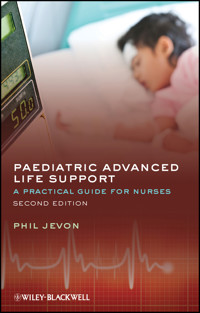
In the event of a paediatric cardiac arrest, it is essential to be able to respond rapidly, providing safe and effective care. The second edition of this successful text provides nurses with a practical and systematic guide to the rapid assessment and delivery of appropriate resuscitation to infants and children.
- Conforms to current European Resuscitation Council Guidelines
- Based on up-to-date research and evidence-based practice protocols
- Synoptic approach enables rapid delivery of effective treatment
- Written by experts in the field of both resuscitation and paediatrics
Paediatric Advanced Life Support is a succinct yet comprehensive guide and is an essential purchase for any health professional likely to encounter an emergency situation.
Sie lesen das E-Book in den Legimi-Apps auf:
Seitenzahl: 320
Veröffentlichungsjahr: 2012
Ähnliche














Table of Contents
Cover
Title page
Copyright page
Foreword
Contributors
Chapter 1 An Overview of Paediatric Advanced Life Support
Introduction
Learning objectives
Causes of death in childhood
Survival rates following paediatric resuscitation
Pathophysiology of cardiac arrest
Importance of treating children differently from adults
Cardiopulmonary resuscitation: standards for clinical practice and training
Summary
Chapter 2 Resuscitation Equipment for Paediatric Resuscitation
Introduction
Learning objectives
Resuscitation equipment required for paediatric resuscitation
Aids to estimating paediatric drug doses and equipment sizes
Routine checking of resuscitation equipment
Checking resuscitation equipment following use
Summary
Chapter 3 Recognition of the Seriously Ill Child
Introduction
Learning objectives
Aetiology of cardiorespiratory arrests in children
ABCDE approach
Summary
Chapter 4 Paediatric Basic Life Support
Introduction
Learning objectives
Sequence of actions in basic life support
Principles of basic airway management
Principles of mouth to mouth ventilation
Principles of performing chest compressions
The recovery position
Management of foreign body airway obstruction
Principles of safer handling during CPR
Summary
Chapter 5 Airway Management and Ventilation
Introduction
Learning objectives
Relevant anatomy and physiology
Causes of airway obstruction
Recognition of airway obstruction
Simple techniques to open and clear the airway
Principles of cricoid pressure
Oropharyngeal and nasopharyngeal airways
Role of the laryngeal mask airway
Principles of tracheal intubation
Principles of oxygen delivery and ventilation
Principles of oxygenation administration
Summary
Chapter 6 ECG Recognition and Management of Cardiac Arrhythmias
Introduction
Learning objectives
The conduction system of the heart
The ECG and its relation to cardiac contraction
Problems encountered with ECG monitoring
Management of cardiac arrhythmias
Treatment of sinus bradycardia and sinus tachycardia
Recognition and treatment of supraventricular tachycardia and ventricular tachycardia
Summary
Chapter 7 Defibrillation and Electrical Cardioversion
Introduction
Learning objectives
Ventricular fibrillation
Mechanics of defibrillation
Safety issues and defibrillation
Procedure for manual defibrillation
Procedure for automated external defibrillation
Procedure for synchronised electrical cardioversion
Summary
Chapter 8 Paediatric Advanced Life Support
Introduction
Learning objectives
Resuscitation Council (UK) PALS algorithm
Intraosseous infusion
Resuscitation medications
Potential reversible causes of cardiac arrest
Summary
Chapter 9 Management of Anaphylaxis
Introduction
Learning objectives
Definition
Incidence and mortality statistics
Pathophysiology
Causes
Clinical features and diagnosis
Treatment of anaphylaxis
Summary
Chapter 10 Resuscitation in Special Situations
Introduction
Learning objectives
Epiglottitis
Hypothermia
Drowning
Acute severe asthma
Electrocution
Poisoning
Trauma
Life-threatening electrolyte abnormalities
Summary
Chapter 11 Post-resuscitation Care
Introduction
Learning objectives
Goals of post-resuscitation care
Initial assessment and treatment priorities following the ABCDE approach
Measures to minimise secondary cerebral damage
Guidelines for referral to a paediatric intensive care unit
Basic principles of safe transport
Summary
Chapter 12 Bereavement
Introduction
Learning objectives
Ideal layout for the family room
Principles of breaking bad news
Telephone notification of family members
Practical arrangements following a death
Importance of written guidelines and policies
Family members witnessing resuscitation
Summary
Chapter 13 Records, Record-keeping and Audit
Introduction
Learning objectives
Importance of accurate record-keeping
Principles of effective record-keeping
What post-resuscitation records should include
Records as a legal document
National Cardiac Arrest Audit
Summary
Chapter 14 Legal and Ethical Issues
Introduction
Learning objectives
The scope of a nurse’s accountability
Issues related to Do Not Attempt Resuscitation orders
Factors influencing the decision to stop CPR
Risk management strategy for CPR
Summary
Chapter 15 Resuscitation Training
Introduction
Learning objectives
Why resuscitation training is important
Recommendations concerning resuscitation training
Principles of adult learning
Methods of resuscitation training
Nationally recognized courses in paediatric resuscitation
Key learning objectives of paediatric resuscitation training
Paediatric training manikins and models
Summary
Index
This edition first published 2012 © 2012 by Phil Jevon
Wiley-Blackwell is an imprint of John Wiley & Sons, formed by the merger of Wiley’s global Scientific, Technical and Medical business with Blackwell Publishing.
Registered office: John Wiley & Sons, Ltd, The Atrium, Southern Gate, Chichester, West Sussex, PO19 8SQ, UK
Editorial offices: 9600 Garsington Road, Oxford, OX4 2DQ, UK
The Atrium, Southern Gate, Chichester, West Sussex, PO19 8SQ, UK
2121 State Avenue, Ames, Iowa 50014-8300, USA
For details of our global editorial offices, for customer services and for information about how to apply for permission to reuse the copyright material in this book please see our website at www.wiley.com/wiley-blackwell.
The right of the author to be identified as the author of this work has been asserted in accordance with the UK Copyright, Designs and Patents Act 1988.
All rights reserved. No part of this publication may be reproduced, stored in a retrieval system, or transmitted, in any form or by any means, electronic, mechanical, photocopying, recording or otherwise, except as permitted by the UK Copyright, Designs and Patents Act 1988, without the prior permission of the publisher.
Designations used by companies to distinguish their products are often claimed as trademarks. All brand names and product names used in this book are trade names, service marks, trademarks or registered trademarks of their respective owners. The publisher is not associated with any product or vendor mentioned in this book. This publication is designed to provide accurate and authoritative information in regard to the subject matter covered. It is sold on the understanding that the publisher is not engaged in rendering professional services. If professional advice or other expert assistance is required, the services of a competent professional should be sought.
Library of Congress Cataloging-in-Publication Data
Data available
ISBN 978-14051-9776-2
ISBN 978-11182-7462-0 (epdf)
ISBN 978-11182-7463-7 (epub)
ISBN 978-11182-7461-3 (mobi)
A catalogue record for this book is available from the British Library.
Wiley also publishes its books in a variety of electronic formats. Some content that appears in print may not be available in electronic books.
Foreword
The death of any child is a tragedy, but is more so if that death could have been prevented.
In England and Wales, the mortality rate for infants and children has fallen by more than 50% in the last three decades and is now at its’ lowest ever level.
This fall is due in part to an increasing understanding of the causes of death in infants and children and the recognition that many of these deaths are preventable and are preceded by a recognisable period of deterioration in respiratory and circulatory function secondary to an underlying condition which is often potentially treatable. Failure to intervene early in such infants and children can lead to cardiac arrest which has a dismal outcome. This is seen most markedly by contrasting the survival rates of patients in asystole (survival rates of less than 5% being reported), with those of children in respiratory arrest who have received prompt resuscitation (survival rates of over 50% being reported).
Paediatric Advanced Life Support (PALS) is a succinct yet comprehensive guide to the knowledge, skills, drugs and equipment necessary to identify and effectively treat infants and children who have potential life threatening conditions, and thus prevent a cardiac arrest. It provides an evidence-based approach to paediatric advanced life support based on the latest Resuscitation Council UK 2010 guidelines. The text is complimented by the inclusion of the latest Resuscitation Council algorithms. The book emphasises the logical and systematic team approach required to recognise and manage the seriously ill child and provides a concise source of essential information.
This second edition is pocket sized and presents the most recent information in an accessible format and serves as an excellent reference source for all involved or potentially involved in the treatment and management of the sick child particularly nurses, junior doctors and allied health professionals. I can highly recommend it.
Derek Burke
Consultant in Paediatric Emergency Medicine
Sheffield Children’s NHS Foundation Trust
UK
Contributors
Consulting Editors
Kathleen Berry, Consultant Paediatrician A & E, Birmingham Children’s Hospital, Birmingham, UK
Gale Pearson, Consultant Paediatrician PICU, Birmingham Children’s Hospital, Birmingham, UK
Contributors
Jayne Breakwell, Senior Sister Paediatrics, Walsall Healthcare NHS Trust, Manor Hospital, Walsall, UK
Kirsti Soanes, Matron Paediatrics, Birmingham Children’s Hospital, Birmingham, UK
Richard Griffin, Lecturer in Law, Swansea University, Wales
Chapter 1
An Overview of Paediatric Advanced Life Support
Introduction
Paediatric advanced life support (PALS) includes the knowledge and skills necessary to identify and effectively treat infants and children who have potential respiratory or circulatory failure, and to provide the appropriate early treatment for a paediatric cardiac arrest.
The aim of this chapter is to provide an overview of PALS.
Learning Objectives
At the end of this chapter, the reader will be able to:
Discuss the causes of death in childhoodDiscuss survival rates following paediatric resuscitationOutline the pathophysiology of paediatric cardiac arrestDiscuss the importance of treating children differently from adultsOutline the provision of a resuscitation service in hospitalCauses of Death in Childhood
The most common causes of death in children under 6 years of age worldwide are detailed in Table 1.1.
Table 1.1 Most common causes of death worldwide in children under 6 years of age
Reproduced from Stevenson & Tedrow (2010).
According to the Office for National Statistics (2009), the highest death rates in childhood occur during the first year of life, particularly the first month (Table 1.2). Causes of death in childhood vary according to age. The most common causes are:
Newborn period – congenital abnormalities and factors associated with prematurity1 month to 1 year – cot death, infection and congenital abnormalityFrom 1 year – traumaTable 1.2 Causes of death by age in England and Wales, 2008
Reproduced from Office for National Statistics (2010).
In England and Wales, infant mortality rates (number of deaths of children under 1 year of age in one calendar year per 1000 live births in the same calendar year) have fallen by more than 50% in the last 28 years, from 12 in 1980 down to 4.5 in 2008, the lowest on record (Advanced Life Support Group, 2011).
Lesen Sie weiter in der vollständigen Ausgabe!
Lesen Sie weiter in der vollständigen Ausgabe!
Lesen Sie weiter in der vollständigen Ausgabe!
Lesen Sie weiter in der vollständigen Ausgabe!
Lesen Sie weiter in der vollständigen Ausgabe!
Lesen Sie weiter in der vollständigen Ausgabe!
Lesen Sie weiter in der vollständigen Ausgabe!
Lesen Sie weiter in der vollständigen Ausgabe!
Lesen Sie weiter in der vollständigen Ausgabe!
Lesen Sie weiter in der vollständigen Ausgabe!
Lesen Sie weiter in der vollständigen Ausgabe!
Lesen Sie weiter in der vollständigen Ausgabe!
Lesen Sie weiter in der vollständigen Ausgabe!
Lesen Sie weiter in der vollständigen Ausgabe!
Lesen Sie weiter in der vollständigen Ausgabe!




