


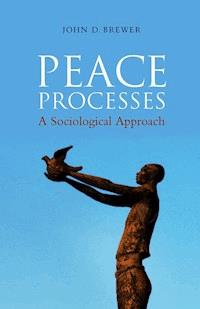
19,99 €
Mehr erfahren.
- Herausgeber: John Wiley & Sons
- Kategorie: Geisteswissenschaft
- Sprache: Englisch
Peace processes are mostly very fragile. This engagingly written book takes a bold new approach to the topic by beginning from the premise that sociology can identify those factors that help to stabilize them.
The book draws a distinction between the political and social dimensions of peace processes, arguing that each is dependent on the other. Consideration of the social peace process, neglected in conventional treatments of the subject, is made central to this volume. While complementing current approaches that emphasize institutional reform in politics, law and economics, it pays due attention to sociological factors such as gender, civil society, religion, the deconstruction of violent masculinities, restorative justice, emotions, hope, forgiveness, truth recovery, social memory and public victimhood. These important themes are fully illustrated with examples and in-depth case studies from across the globe.
The book locates itself within the growing debate about the positive impact of global civil society on peace and identifies the new forms of peace work engendered by globalization. It will be essential reading for students and scholars of peace studies in politics, international relations and sociology departments.
Sie lesen das E-Book in den Legimi-Apps auf:
Seitenzahl: 528
Veröffentlichungsjahr: 2013
Ähnliche



















Peace Processes
Peace Processes
A Sociological Approach
John D. Brewer
polity
Copyright © John D. Brewer 2010
The right of John D. Brewer to be identified as Author of this Work has been asserted in accordance with the UK Copyright, Designs and Patents Act 1988.
First published in 2010 by Polity Press
Polity Press65 Bridge StreetCambridge CB2 1UR, UK
Polity Press350 Main StreetMalden, MA 02148, USA
All rights reserved. Except for the quotation of short passages for the purpose of criticism and review, no part of this publication may be reproduced, stored in a retrieval system, or transmitted, in any form or by any means, electronic, mechanical, photocopying, recording or otherwise, without the prior permission of the publisher.
ISBN-13: 978-0-7456-5923-7
A catalogue record for this book is available from the British Library.
Typeset in 10 on 11.5pt Utopia by Servis Filmsetting Ltd, Stockport, Cheshire Printed and bound in Great Britain by MPG Books Group, UK
The publisher has used its best endeavours to ensure that the URLs for external websites referred to in this book are correct and active at the time of going to press. However, the publisher has no responsibility for the websites and can make no guarantee that a site will remain live or that the content is or will remain appropriate.
Every effort has been made to trace all copyright holders, but if any have been inadvertently overlooked the publisher will be pleased to include any necessary credits in any subsequent reprint or edition.
For further information on Polity, visit our website: www.politybooks.com
For my father, Charles Benjamin Brewer, who died in a mining accident when I was too young to know him, and for my adult children, Bronwen and Gwyn, in thanks for the memories we have.
Contents
Acknowledgements
Introduction: war, peace and communal violence
1 Types of post-violence society
2 The problem of peace processes
3 Civil society
4 Gender
5 Emotions
6 Memory, ‘truth’ and victimhood
Conclusion: a sociological approach to peace processes
References
Index
Acknowledgements
Three different sorts of colleague ignited my interest in the sociology of peace processes. First, were Tom Bamat and Mary Ann Cejka, from Maryknoll Missionary Research Center New York, when, on the basis of my writings on religion as a site of conflict, they asked me in 1998 to participate in research on religion as a site of reconciliation. Regular visits to Maryknoll enabled me to meet and become friends with the second significant group of colleagues. Shirley Wijesinghe, Deepthi Silva and, later, Jude Fernando, from Sri Lanka, introduced me over two visits to the beauty of the island and the pains of its conflict. Third was Jack Spence, formerly of the Royal Institute of International Studies, and now retired to the wilds of wonderful Shropshire, when, for a conference in Dublin in 1998, he asked me to reflect as a sociologist on the occurrence of the peace processes in Northern Ireland and South Africa. From there it has been a series of easy – and inevitable – steps to look at peace processes in general.
But the stimulus has not been solely intellectual, for there is a biographical referent to this book that connects my life and work. I lived for twenty-three years in Northern Ireland amidst on-going conflict and some of the worst years of ‘the Troubles’; my son Gwyn was born in Belfast at the height of the Hunger Strikes, and my daughter Bronwen in South Africa four years earlier, in the troubled aftermath of Steve Biko’s death. Family and personal life demanded more than passing interest in peace and stability. Through my relationship with the Revd Ken Newell, and via him with members of the Faith in a Brighter Future Group of ecumenical churchmen and women in Northern Ireland, Francis Teeney and I became activists in Northern Ireland’s peace processes, small-scale though our involvement was. Gareth Higgins inspired me to this as well; and that Francis and Gareth are former Ph.D. students of mine illustrates how much I have learned from them.
I have many other debts. I am grateful to colleagues at the University of Aberdeen who have helped to make academic life congenial, especially Bernie Hayes. Cohorts of students in my fourth-year sociology option course, on the sociology of peace processes, warrant special respect for listening to my draft ideas. Some of the research for this book was undertaken while a Visiting Fellow in the Research School of Social Sciences at the Australian National University and I am particularly grateful to my sponsors on that occasion: Ian McAllister, John Braithwaite and Clifford Shearing. An extra-special debt is owed to the following colleagues for reading the manuscript in its entirety: John Brown Childs, Gerard Delanty, John A. Hall and Clifford Shearing. John Brown Childs is another Maryknoll friend and I am grateful for all I have learned from him. The following people kindly read parts of the manuscript: Jude Lal Fernando, Gareth Higgins, Myra Hird, Shadd Maruna, Tim Strangleman, Francis Teeney and Iain Wilkinson. All are excused responsibility for its continuing faults. I am also grateful to Patricia Lundy for sight of her unpublished research report to the British Academy on the operation of the Historical Enquiries Team of the Police Service of Northern Ireland, and to Gerard Delanty for pre-publication access to the Summer 2008 special issue of the European Journal of Social Theory on emotions in post-trauma societies. I am especially grateful to the Leverhulme Trust for awarding me a Research Fellowship for 2007–8, which enabled me to complete the writing of this book.
Last – but by no means least – I owe very much to Caitríona and Fiachra for keeping me sane over many years; they deserve far more than this inadequate acknowledgement can convey, but, being a creature of habit, I end this acknowledgement, as every other before, in expressing my love for Bronwen and Gwyn, no less now than that for Caitríona and Fiachra.
John D. Brewer
Belfast, 16 April 2009
IntroductionWar, peace and communal violence
Introduction
I have two purposes in writing this book: to highlight sociology’s contribution to our understanding of peace processes and the factors that help stabilize them; and to introduce specialists in peace processes to sociology and some of its special debates and concerns. I hope to inform sociologists about peace processes and enlighten experts in peace processes from other disciplines about sociology. The field indicates they know little of each other, suggesting this book may prove useful to both. I offer a sustained intellectual justification for the contribution of sociology not only for the analysis of peace processes but also for the stability and quality of peace processes themselves, making the book an unremitting defence of public sociology.
I have been interested in ‘the sociological imagination’ as a life’s work and have applied it in the past in ways that bring sociology’s insights to areas relatively neglected by the discipline, as a way of drawing attention to its role in analysing public issues. None can be more topical than the concern with war and peace. As Cortright (2008) explains in his history of peace movements, peace is an old idea and modern forms of violence attest to its enduring relevance (the idea of ‘perpetual peace’ was used by Kant in 1795; for another history of the durability of peace see Adolf, 2009). If new kinds of war help to define global society, as so many social scientists claim (see in particular Kaldor, 1999), late modernity is also marked by new kinds of peacemaking. It is ironic, therefore, that most of the attention in social science has been on the changing character of organized violence rather than the impact of globalization on peace. This book addresses peace processes from a sociological perspective and seeks to correct the weaknesses in the current literature in the belief that sociology can disclose some of the better ways to manage the after-effects of communal violence. There can be no single definitive ‘sociology of peace processes’ but I hope to illustrate how useful the sociological imagination can be.
Vignette: Sociology and ‘the moral imagination’ for peace
I seek here to illustrate sociology’s potential to unlock hidden features of peace processes by using the example of the ‘moral imagination’, a term associated with John Paul Lederach (2005), Professor of International Peacebuilding at the Joan B. Kroc Institute of International Peace Studies at the University of Notre Dame, and a leading peace studies teacher, trainer, practitioner and researcher. Lederach is a Mennonite Christian and sociologist whose religious convictions infuse his many writings on peace (notably Lederach, 1997). The idea of the ‘moral imagination’ became popular in peace studies very quickly. Etymology suggests that Christianity gives meaning to what is ‘moral’ in this idea, and cognitive and artistic ability supplies the ‘imagination’. Peace builders are therefore urged to conceive of their work as akin to an artistic process. Unfettering their imagination enables them to recognize turning points, venture down unknown paths, transcend orthodox conflict resolution strategies by new forms of thinking and act anew to create the peace process, thereby ‘linking unlike-minded people’, as Lederach puts it (2005: 13). However, peace processes require soul as well as art, and the steps that peacemakers are enjoined to take can only really be understood in terms of the moral values that encourage and motivate activists, for peacemakers have to imagine themselves in a web of relationships that include even their enemies, embrace complexity and diversity without further schism, and accept the risks involved (Lederach, 2005: 5). Without this moral framework, giving free rein to peacemakers’ curiosity, creativity and risk-taking could harm rather than transform social relationships. Thus, without acknowledging it, Lederach is forced to draw on his Christianity to describe the moral precepts peace builders use as a resource when ‘moving parties toward a relationship of love rather than fear’ and developing ‘relationships of love characterized by openness, mutual respect, and dignity’ (2005: 57).
In truth, the moral imagination is another in a series of ideas within peace studies that deploy quasi-religious discourse. Peace unavoidably encourages the re-enchantment of our vocabulary by references to healing, reconciliation, forgiveness, redemption, hope, ‘truth’, restoration, love and the like, all of which have a Judeo-Christian resonance. Peace processes do require eschatology, the sense of a better, longed-for future society without violence, but this ought to be secular. Many conflict are about religion, or involve religious protagonists, making Christian eschatology divisive, and some have involved the Christian Church taking the side of the dominant group and state. Secularization is another reason why religious eschatology is problematic. Peace processes are, as Lederach rightly contends, too focused on reaching a political agreement rather than healing damaged relationships. Peaceful transformation involves on-going changes to social relationships and constructive engagements between people who have been historically divided, but placing social change within Christian eschatology seriously limits the purpose.
The other major weakness of the term is its restriction to professional peacemakers. It describes the moral precepts and behavioural and cognitive challenges of activists engaged in mediation, negotiations and conflict resolution. Their work might well benefit from being rethought as both art and morality, but peace processes require that lay people are addressed as well. Part of the fragility of peace processes is that reconciliation is professionalized – sometimes to outside third parties – and not taken ownership of by society at large. Bystanders, victims and ex-combatants also need to rethink and reformulate, to risk-take and develop a new set of moral precepts for living together with their former enemies. The moral imagination seems a quality necessary for everyone. Indeed, this is its greatest contribution.
Sociology helps us significantly at this point by supplying a secular eschatology within which the moral landscape of post-violence societies as a whole can be discussed without recourse to religion. Reconstructing the moral landscape becomes possible in a peace process once space has been opened up by the negotiated accord; and a specialism within sociology gives an account of what this morality might look like. The sociology of citizenship is an area of sociology quite comfortable with normative vocabulary and with advocating a particular set of moral values. Its depiction of cosmopolitan virtues – trust, tolerance, respect, civic responsibility, duty, altruism, empathy and the like – makes this a suitable moral code to underpin peace processes.
Citizenship is an inter-disciplinary field but what distinguishes sociology’s focus is the connection it makes between citizenship and societal solidarity, as Turner (1990: 189) put it, making citizenship a moral as well as legal category. Sociology speaks less about the formal legal rights and entitlements that define citizenship, addressing instead how citizenship is conferred by social membership rather than law. In rendering citizenship as a moral category, it becomes a normative term bound up with society’s values, and invokes moral (as well as legal) responsibilities. The difficult questions for the sociology of citizenship, however, are two-fold: what are the specific moral injunctions in a situation of changing or diverse moral codes, competing sets of values and different normative systems?; and how does moral diversity affect conceptions of the obligations of citizens?
The literature on this is interesting and we can have a brief taster. Couching the discussion of citizenship in terms of obligations rather than rights has led some to argue that we have, for example, an obligation to work (Becker, 1980; Mead, 1986), a public responsibility akin to paying taxes and obeying the law. Neo-conservative approaches such as this tend to prioritize citizens’ economic obligations. In assessing such a view, Goodin (2002) encouraged its advocates to consider ‘mutual obligations’, ‘fair play’, ‘reciprocity’, and to broaden out from focusing on the economy, although, as Scholz and Pinney (1995) argued, ordinary people nonetheless comply with tax and financial laws through a sense of duty rather than fear. Duty is commented on also by Conover, Leonard and Searing (1993: 161–2), whose focus group interviews picked up people for whom the notion was ‘a four-letter word’ but also others who experienced it as an obligation. It was noticeable, however, that the latter grounded their responsibilities more in terms of social roles than as citizens, feeling duties toward children, parents, grandparents, friends and the local community and neighbourhood. This tends to reinforce the ideas of the communitarians and civil society theorists, who see citizenship obligations in terms of the moral injunction to promote public-spiritedness, civic responsibilities and a just and ethical society (see Dagger, 1997: 6), based on both the filial and intimate connections associated with social roles and wider notions of ‘civic citizenship’ (on which, see also Janoski, 1998).
One of the most interesting dimensions of the debate about the moral underpinning to citizenship obligations is the emphasis on virtue. This is expressed overtly in the outline of what is called ‘cosmopolitan virtue’ (thus giving us ‘cosmopolitan citizenship’; H. Smith, 2007), but is also evident in the emphasis placed on specific cosmopolitan virtues, notably tolerance and trust. The return of virtue is remarkable, since it was only in 1981 that a leading moral philosopher entitled his review of modern thought After Virtue (MacIntyre, 1981). Its re-emergence, however, has paralleled the rediscovery of citizenship. Its rediscovery by academic writers on citizenship is echoed in the voluntary sector by the ‘Virtues Project’ (see www.virtuesproject.com/). This was set up in 1991 and addresses ‘spiritual and moral virtues’ through leadership training and programmes of activities for secular and religious youth groups. The project emphasizes that it is about virtues not values: about character rather than beliefs. This is not the sense in which it is used in the academic literature. In the latter, virtue does not mean virtuousness, the moral excellence of a person’s behaviour, as it tends to do in the several world faiths that identify specific virtues as part of their scriptures, but the classic civic humanist sense of the social traits, habits and values that promote the public good, such as tolerance, respect, sociability, duty, loyalty, trust and the like. This was such a motif of eighteenth-century thought that Hont and Ignatieff entitled their account of it Wealth and Virtue (1983), and Pocock Virtue, Commerce and History (1985). This is the sense in which it is used, for example, in Dagger’s (1997) reference to the ‘civic virtues’ of citizenship, such as public-spiritedness and active engagement in community affairs, and by Bryan Turner (2002), when he outlines ‘cosmopolitan virtues’ as the specifically cultural obligations that accrue from cultural citizenship (see also Turner, 2000). In Turner’s accounts, cosmopolitan virtue involves respect for other cultures and an ‘ironic’ attitude toward one’s own. Dobson (2003) has referred to our obligations to protect the environment as part of cosmopolitan virtue, in what he calls ‘ecological citizenship’.
The use of cosmopolitanism to flesh out the morality that is required under conditions of culturally plural citizenship after conflict, where groups bear rights to cultural citizenship, is not without its critics in sociology (see Nash, 2008) and needs some justification given cosmopolitanism’s association with individualism. Atack (2005: 40–1) emphasizes that cosmopolitanism normally refers to the view that all individuals are part of one universal moral community, so that rights are grounded in egalitarianism, universalism and individualism. The respect is for persons not cultures, individuals not groups. Therefore, the deployment of cosmopolitanism to understand the virtues necessary for cultural citizenship requires revision to the grounds on which these values are invoked and of the moral entities to which they accord recognition. It can be argued that community membership, not individualism, is the dynamic. Citizens apply these moral notions as members of a particular community in order to give recognition to members of other groups, in realization that it is the best way to live harmoniously in societies where there is deep diversity. The values are grounded in community membership and accorded to all communities for the purpose of managing multiculturalism. While cosmopolitan virtues are still universal, their application in particular settings recognizes that in some locations people happen to live their lives in groups, that group membership in these settings frames their notions of morality, and that moral codes are needed there to structure the relationship between groups. The discourse of rights in these societies is about groups not individuals (on group rights, see Baubock, 1999).
Dobson (2006) refers to this as ‘thick cosmopolitanism’, which he contrasts with the thin veneer of group protection in individualism. There is something of this in Appiah’s (2007) contention that cosmopolitanism provides an ethic for living amidst strangers, an idea directly opposed to Bauman’s (1998) sociology of modernity, where we are supposedly cast adrift morally and project our ontological fears onto the strange ‘other’. There are also parallels in Kaldor’s (1999: 68) idea of ‘cosmopolitanism from below’, a respect for universal values that is grounded in the concerns of particular civil society groups, and in what Erskine (2000: 582) calls ‘embedded cosmopolitanism’, which portrays people as being morally obligated to each other as a result of the community networks to which they belong (see also Atack, 2005: 52–5). Hampson’s (2002: 58) notion of ‘civil society cosmopolitanism’ captures this in the clearest terms. This is the version of cosmopolitanism that gives meaning to the moral code best suited for citizenship in post-violence societies.
In these writings sociology does not shrink from discussions of morality and it does not automatically endorse moral relativism (Lukes, 2009). Nussbaum (1996), for example, has argued that compassion is the basic social emotion and is a leading advocate of the use of citizenship education to encourage cosmopolitan virtues in our global age (Nussbaum, 2002). Waghid (2004) argued from a South African perspective that encouraging people to take seriously the suffering of others ought to be the outcome of that country’s citizenship education curriculum, as well as peace and democracy. And Ure (2008: 290–1) and Frost (2008) have argued that post-conflict societies ought to be rebuilt on the basis of compassion and empathy, emotions cultivated through collective senses of tragedy. This argument represents an example of the general idea that emotions can be constructed through the ‘education of emotion’ (a term I owe to Iain Wilkinson). There is potential for particular types of emotion to be actively cultivated and the principal cultural means by which this can be achieved is through schools, civil society associations and grassroots groups, International Non-Governmental Organizations (INGOs), governments and the like, using school curricula, adult education workshops, voluntary-sector courses, training programmes, forms of popular culture and the media to encourage the positive emotions that are needed to undergird a peace process, such as compassion for others’ suffering, empathy with victims, forgiveness for perpetrators, toleration of difference and tolerance towards others’ identity and culture, hope in the future, and courage to take the ‘leap of trust’ (Mollering, 2001) in relationships with erstwhile enemies. Thus sociology enables us to use Delanty’s (2006) notion of the ‘cosmopolitan imagination’ as an alternative to Lederach’s ‘moral imagination’ when referring to the moral landscape necessary for successful peace processes.
Johan Galtung, the principal founder of the discipline of peace studies, is a Norwegian sociologist but the new subject is primarily located within political science; Evangelista’s (2005) multi-volume collection of classic readings in peace studies is sub-titled Critical Concepts in Political Science. Galtung’s (1996: 3ff.) pioneering distinction between negative and positive peace – the former being the absence of violence, the latter the achievement of fairness, justice and social redistribution – finds empathy with Wolterstorff’s (1983) suggestion that peace incorporates feelings of well-being and a sense of flourishing and Sen’s idea that socio-economic development is freedom (1999). As Wolterstorff notes, peace is often perceived in negative terms as the absence of something (violence) rather than as an affirmation (of justice, fairness and the like). No author, however, locates positive peace sociologically. Wolterstorff draws on Augustinian philosophy and Galtung stresses its political, military, economic and cultural dimensions. The distinction between negative and positive peace, however, has lasting relevance to a sociological approach to peace, as will become clear throughout these pages (for a modern discussion of the distinction, see Barash and Webel, 2009: 3–12).
There is, however, a small literature within sociology on aspects of peace processes that suggests there is value in a broader treatment. Jon Elster (2004) analysed ‘transitional justice’, by which demands for retribution and reparation are handled; some sociological literature focuses on the principles and practices surrounding reconciliation as a normative value, addressing the interpersonal and even spiritual grounds (for example Lederach, 1997) on which co-existence is feasible (for example Kriesberg, 2003; Weiner, 1998). There is also research by sociologists on conflict resolution and mediation techniques, such as John Brown Child’s notion of ‘transcommunality’ (2003a), which is based on indigenous North American mediation procedures. Sociologists, amongst others, have contributed substantially to our understanding of the ‘truth’ recovery procedures. Other sociological analyses have taken a case study approach, looking at specific peace processes (J.D. Brewer, 2003a; Knox and Quirk, 2000; Oberschall, 2007).
In what follows I offer an analysis of the different types of post-violence society and the various ways in which peace can be achieved. There are all sorts of ways in which communal conflict and wars come to an end, such as partition (and repartition), cultural absorption or annihilation, third-party intervention, United Nations’ peacekeeping, and negotiated peace settlements in which parties give up their preferred options for a second-best compromise. It is the latter that forms the focus here. I explore the array of social issues that negotiated peace accords throw up: questions like globalization, civil society, religion, women’s victim experiences, the problem of violent masculinities amongst ex-combatants, emotions, the management of shame–guilt, the garnering of hope and forgiveness, restorative justice, memory, ‘truth’ recovery and victimhood. As a piece of sociology itself, this volume tends to concentrate on the general analytical features of negotiated peace processes but it draws eclectically on empirical examples to illustrate the arguments and I include in-depth case studies and shorter vignettes.
At first sight these issues do not appear to be exclusively sociological ones, but they represent what the art historian Griselda Pollock once called ‘travelling concepts’ – ideas which pass through various disciplines, taking on different dimensions and nuances as they journey. While they are not the sole provenance of sociology, this study suggests they coalesce to make an important sociological dynamic in peace processes, the resolution of which is vital to the success of post-violence adjustments. Societies like Northern Ireland, South Africa, Rwanda, the Sudan, the Philippines, Sierra Leone, Liberia, Sri Lanka and various South American countries will be used for illustration, giving us an expansive geographic range. Some obvious cases are missing from this list because the conflict was resolved by partition or repartition (the Balkans, Cyprus), cultural annihilation (Australian treatment of aboriginal peoples and indigenous Americans in North America) or continued third-party ring-keeping (Afghanistan, Iraq). Some have simply not yet stopped the killing and have no peace process (Somalia, Democratic Republic of Congo, Israel–Palestine). Negotiated compromise peace deals based on consensus form the cases tackled here since they involve societies having to find ways of internally managing the social cleavages that once provoked conflict in non-violent ways, whilst maintaining their territorial integrity.
Sociology, war and peace
Sociology’s contribution to understanding the globalization of war (for example Martin Shaw, 2003, 2007) has been immense. However, the sociological study of war necessitates a corresponding approach to peace. War and peace are implied by each other, for no war is irresolvable and no peace secure from renewed conflict. They implicate each other in another sense for the nature of the conflict often shapes the potential for peacemaking. They are two sides of the same Janus face, above all because the globalization of war has impacted on the globalization of peace, producing new forms of peacemaking. If war is no longer a matter just for the protagonists, neither is peace; peace-making is as much a global process as war. Peacemakers have learned from warmakers how to mobilize global networks and in the process mediate the very global structures that constitute the new forms of peacemaking in the modern world. If globalization has resulted in new forms of war, as many contend, it has also transformed peacemaking.
So implicated are war and peace in each other that it is first necessary to provide context to our discussion of peace processes by briefly exploring the globalization of organized violence. In a penetrating account of the impact of globalization on ‘new wars’, Kaldor (1999) argues that it has eroded the autonomy of the state, even facilitated the disintegration of the state, lost the state its monopoly of organized violence, encouraged a more dangerous kind of ‘identity politics’ that is easily mobilized by modern means of electronic media and slips readily into organized killings that do not protect the immunity of non-combatants, and has disseminated the means of mass killing to groups less easily regulated and controlled by international norms (1999: 4–7).
We can begin to understand these processes by making the common distinction between ‘global militarization’ and ‘military globalization’ (see Held et al., 1999: 88ff.). The former refers to the global military build-up under the arms race, to the point where very localized wars can involve the use of very sophisticated weaponry; the latter to the military connectedness between the world’s major regions as localized wars impact on the geo-political order and reinforce the necessity for the geo-governance of war. War, communal violence and rapidly expanding military technologies have been amongst the most important processes that are reconstituting the world into a single strategic geo-space. This time–space compression in turn has increased the potential for war, as well as its destructive consequences and its capability to disrupt relations well beyond the site of conflict. These are not the only reasons why globalization is said to have resulted in new kinds of war. The reassertion of regional and local interstate rivalry has intensified with the ending of the Cold War and the fragmentation that has accompanied globalization has witnessed the resurgence of nationalist, religious, ethnic and communal conflict. The intensity with which ‘local traditions’ (Giddens, 1996: 15) are upheld in moments of transition or as a reaction to globalization often results in old identities assuming significance, thus perpetuating old divisions and sometimes turning them violent. Bauman (1998) argues that the human consequences of globalization encourage us to feel secure only in collective identities and to project risk onto the stranger in our midst. Democracy itself is increasingly perceived to have a ‘darker side’ (Mann, 2004) by permitting people to mobilize openly around cleavages that can become divisive and encouraging people to feel that that their particular religious, ethnic or communal values must be represented politically, sometimes at the cost of other people’s. Whilst this increases the potential for conflict in global society, ironically, changing technologies of warfare permit the prosecution of war without the total mobilization of societies. This tends to make war several steps removed from many people’s direct experience, at least in the global First World (which causes British generals, for example, to complain that the public does not understand what the army is going through in Iraq and Afghanistan), which can assist in public acquiescence in war. These separate processes make for both more war and changed forms of war.
But it is also the case that lying within the globalization of war are increased opportunities for peacemaking and new forms of peace work. The development of regional security blocs contributes both to fragmentation and to centripetal processes at the same time, for these networks can encourage co-operation over defence and security arrangements as much as rivalry. Their interconnectedness makes us all vulnerable to conflict in distant parts of the globe and can heighten our mutual interest in peaceful intervention. The rising density of economic connections between states and regional security blocs means that nations no longer see threats to national security just in military terms, but also as economic threats, so that intervention is more readily contemplated. The development of extensive diaspora networks gives nations a cultural connectedness with distant others that may also motivate peacekeeping as diaspora and other filial connections increase the pressure on governments to do something. New technologies and effective use of the Internet can mobilize for peace (and bring to world attention various atrocities), as evidenced in the Burmese case in 2007 and Tibet in 2008.
The growth of humanitarian cosmopolitanism also affects peace-making. Military globalization inevitably involves new forms of geo-governance that monitor the means and conduct of organized violence. The development of cosmopolitan humanitarian law to regulate conflict (see Atack, 2005; Hirsh, 2003; Woodiwiss, 2002), to limit use of instruments of war and to hold people to account for war crimes constitutes a moral justification for peacekeeping and legal support for the interventions of the United Nations (UN). The UN Charter provides for the body to intervene to restore peace, and it has increasingly done so after its security function became real with the ending of the Cold War. The human rights discourse that affects so much of geo-politics is in essence a language of peace by constituting a powerful deterrent to the violation of human rights. It has furnished a monitoring regime of numerous INGOs that operate transnationally, bypassing governments to establish a global network of peace activists. This network allows INGOs to play an international role as peace campaigners, which gives peace a global voice. There are many weaknesses in the enforcement of human rights and in the geo-governance regulation of warfare, but peace has become a universal principle that is mediated by global networks – noted at present for its breaching as much as its practice, but an international principle nonetheless.
The impact of this global network is enhanced by the co-operation between human rights INGOs and a plethora of global networks mobilizing around gender, violence against women, the environment, anti-capitalism, opposition to landmines and other instruments of war, charitable giving, AIDS and other health issues and the like. There are flows of information between these networks and co-campaigning, to the point where we are observing the emergence of what Kaldor (2003) calls global civil society with shared values and aims (see also Anheier, Glasius and Kaldor, 2005; Kaldor et al., 2003b; cf. Keane, 2003). The effects of NGOs can be exaggerated, or at least their negative side neglected (on ‘bad’ civil society, see Chambers and Kopstein, 2001), as we shall see in chapter 3, but the progressive elements of civil society resonate with peace in two ways. These specific issues are often aligned with peace inasmuch as organized violence is seen to provoke them or make them worse; and these global networks can easily be mobilized around peace as a vocation. Paradoxically, organized killings have intensified with globalization to the point where the success of peace processes assumes immense topical importance, justifying sociological engagement with peace. Before making such an engagement, however, we need to spend a little more time thinking about violence.
Collective or communal violence?
Sociology has long been interested in particular kinds of violence – ‘domestic’ violence, riots, crowd behaviour, wars, criminal damage, murder, terrorism and so on – and major figures from the sociological pantheon have discussed violence, such as Weber, Elias, Giddens and Foucault. The strong sense of sociological determinism that developed in nineteenth-century European sociology was rooted in part in studies of group violence, for crowds seemed to exemplify the power of the collectivity over individuals. Group violence forms an essential part of sociological theories that seek to deconstruct two Enlightenment meta-narratives, that of social progress – examined in studies of genocide and the Holocaust as examples of social regression in advanced modernity (see Bauman, 1989) – and that of rationality – focusing on how we objectify the ‘truth’ about mass killings and atrocities (see Cohen, 2001). It also features in sociology’s concern with globalization, where communal violence is often linked to local forms of resistance, in which the survival of what Giddens (1996: 15) calls ‘little traditions’ as a resistance to cultural hegemony can reinforce violent conflict over such cleavages as ‘race’, ethnicity and religious fundamentalism.
Violence can simultaneously be against the person and against the group. Group violence comes in many types, such as collective violence, genocide and structural violence. ‘Collective violence’ is the term in widest currency. The distinction between it and communal violence is thus worth reiterating. Communal violence involves groups, with the violence directed either towards another group as a whole or towards individual members of the group because of their group membership. Where there is intent to destroy the whole group, communal violence merges into genocide. Of course, communal violence is against the person in that an individual Catholic or Tutsi is the victim, but it is their identity as a member of the group that explains their victimhood. It is the group that is being punished or attacked, and the individual only as a proxy for it. Some forms of interpersonal or collective violence may also involve groups, such as gang rape or some forms of riot, but the victim is not selected as a representative of the group, nor punished or attacked as a proxy for others. Or at least, if they are, collective violence veers into communal violence.
It is not the number of participants that makes violence a collective activity. The late Charles Tilly (2003) argued that collective violence only requires three people: two colluding together with the intent to attack the third. What makes violence collective for Tilly is thus the collusion amongst perpetrators and the design between them to attack another. This makes gang rape a form of collective violence, as are brawls on rugby pitches and fights after the pubs and bars close. Tilly’s term is thus ambiguous. At one end, collective violence borders interpersonal violence – ‘domestic’ abuse against children often involves collusion amongst attackers (the parents) against a single victim (the child) or collection of victims (all the siblings). This confusion between collective and interpersonal violence is unhelpful; it is contrary to common sense to think of ‘domestic’ abuse as a form of collective violence. At the other end, it also borders on communal violence, since people may be involved as participants or victims precisely because of their group membership. ‘Collective violence’ is thus an unhelpful term concealing different sorts of things.
I want to concentrate on the specific kind of collective violence that I call ‘communal violence’. It has three qualities: it involves the mobilization of group identities; its perpetrators and victims act as proxies for group interests; and it is embedded in the social structure in which it takes place. ‘Communal violence’ is my preferred term because it makes clear that the perpetrators and victims are not random individuals who, through chance circumstance end up in incidents of violence. Accidental circumstance may explain how and why the communal violence broke out there and then, but how and why these perpetrators and victims were involved is not accidental but linked to their identity as group members. This makes the term analytically quite different from ‘interpersonal violence’ in a way that Tilly’s definition of ‘collective violence’ is not. I prefer this term to ‘genocide’ because there may be no intent to destroy the whole group and occasionally mass killings are ideological rather than ethnic, such as Khmer Rouge violence in Cambodia. Most acts of communal violence fall below the threshold of the legal definition of genocide operated by the United Nations.
Embedding communal violence in the social structure in which it takes place enables us to focus on the influence of particular kinds of social structure to explain the violence, rather than on the effect of different kinds of political regime or other political explanations. It draws attention to the effect of social processes like ‘race’, structural inequality, colonialism, ethnicity and religion, and to the impact of globalization in reinforcing violent conflict over social cleavages. It thus incorporates Galtung’s notion of ‘structural violence’ (1969; for a modern usage see Ho, 2007), where violence is understood as systemic inequality arising deliberately or unintentionally from social structural arrangements (such as apartheid or institutional racism) rather than as direct acts of aggression. The notion of communal violence also touches on the lively debate about whether globalization has created new conflict or simply transformed long-established ones. Mary Kaldor (1999) and Martin Shaw (2003) are strongly associated with the idea that globalization has created new kinds of war, while Barrington Moore (2000) argues that it has simply allowed older conflict to appropriate new forms. By tying communal violence to social structural cleavages, we see that some conflict are ancient in reproducing old divisions.
I am not saying that communal violence only takes place in the country with which it is associated and that it has no international dimension. Structural violence is inevitably restricted to a particular society’s set of institutional arrangements, while communal violence stretches social structural conflict across several societies. Groups are often transnational, describing ‘imagined communities’ that reflect patterns of extensive migration and diaspora, impacting on social structures stretched across significant spatial distances and territorial boundaries. The point, however, is that these places are seen as extensions of the original group conflict and are proxies for the group identities involved in it. India gets involved in Sri Lanka’s communal conflict precisely because of the resonances it has with its own Tamil community in Southern India. India and Pakistan go to war as nation states over Kashmir because both claim communal ties to it. Links exist across social structures to ensure that a nation state’s communal conflict is not always confined to one territory: Rwanda’s ethnic conflict has infected – and destabilized – Burundi and the Democratic Republic of Congo.
Plan of the book
Having established the sociological roots to communal violence, I want now to sketch the sociological features of peace processes and explain the format of the book. Whether or not conflict is thought of as new kinds of war wrought by globalization or as older ones appropriating new forms, in the contemporary world there are many societies racked by communal violence. If violence is a mark of late modernity, as Giddens contends (1996: 60–4), or of the clash of advanced civilizations, as Huntington argues (1996), it appears also as a feature of societies at different stages of development, wrenching apart post-colonial societies, former Communist countries, advanced industrial societies and rapidly modernizing countries. There are, however, a number of societies that have progressed from violent communal conflict to a measure of peace, with much-reduced levels of communal violence. These cases form the substance of this book. I develop a sociological category in chapter 1, which I call ‘post-violence society’, which is applied to those social formations that have undergone transition from communal violence to relative non-violence. A typology is developed of different kinds of post-violence society as they cohere around three axes. Conceptual clarification of the category forms only part of the argument, however. The taxonomy is used to focus on one type of post-violence society, in which peace accords based on consensus have been negotiated as a strategy for managing the fissures that previously provoked communal violence. I focus on this type in order to try to understand better the range of policy issues that need to be faced in negotiated peace agreements.
If sociology can assist in understanding the fragility of peace processes and explain why peace processes are invariably problematic, it fulfils its obligations to discharge a public role. Chapter 2 examines some of the reasons why peace processes are insecure. Part of the explanation is that negotiated peace deals tend to focus on the democratization of politics, the introduction of market economics and human rights reform. There is a wealth of literature within political science, diplomatic and security studies, International Relations and legal studies that champions this approach (for example Arnson, 1999; Atack, 2005; Cejka and Bamat, 2003; Darby and MacGinty, 2000; Hampson, 1996; Maley, 2002; Maley, Sampford and Thakur, 2003; Oberschall, 2007; Stedman, Rothchild and Cousens, 2002). I call it the ‘good governance’ approach. International Relations theorists know it better as ‘liberal internationalism’ (Paris, 1997), ‘Wilsonianism’ (Paris, 2004), ‘political realism’ or ‘Westphalianism’ (Atack, 2005). Whether new institutional arrangements are externally imposed by third party intervention – so-called ‘market democratization’ – or internally devised prior to liberalization from the outside (as recommended by Paris, 2004), new institutional structures and forms of representation and law either solve the violent conflict or institutionalize it in ways that do not threaten the compromise deal. Governance is not unfamiliar to sociology but the discipline’s focus has been on the regulation and social control dimensions of governance, particularly in areas like policing, penology and crime. Sociologists have not critiqued governance as it applies to post-violence transitions, yet there are limits to an exclusive focus on good governance.
I contrast this approach with my own in several places in the text, arguing that, as important as good governance is, it does not adequately capture the range of policy issues that negotiated peace settlements need to address if they are to succeed. Stable peace accords require more than good governance, liberal market economies and human rights law – or, at least, good governance in this type of post-violence society has to be understood broadly to cover a range of sociological issues that shape the success of the transition. Chapters 3–6 elaborate on some of these issues, focusing respectively on civil society, gender, emotions, and memory, ‘truth’ recovery and victimhood. The Conclusion summarizes what a sociological approach adds to our knowledge of peace processes and to the factors that make them stable. The Conclusion takes up again the impact of globalization on new forms of peacemaking and ends with an important distinction between political and social peace processes. I suggest that the relationship between political and social peace processes is recursive and that they facilitate each other: a political deal opens up the room for the social peace process to develop apace, while the social peace process helps to consolidate good governance reforms.
1
Types of post-violence society
Introduction
If war and peace implicate one another, peace processes are obviously affected by the kind of violence that has taken place; and to understand peace, we therefore need first to know more about violence. Violence can be distinguished by its scale, such as interpersonal or collective violence; by the social space in which it occurs, such as violence in the home or in the public sphere; by its motivating force, such as ‘domestic’, political, racial, terrorist violence and the like; and by its intentionality, which contrasts direct violence with indirect structural violence. A lot of these terms overlap.
Lesen Sie weiter in der vollständigen Ausgabe!
Lesen Sie weiter in der vollständigen Ausgabe!
Lesen Sie weiter in der vollständigen Ausgabe!
Lesen Sie weiter in der vollständigen Ausgabe!
Lesen Sie weiter in der vollständigen Ausgabe!
Lesen Sie weiter in der vollständigen Ausgabe!
Lesen Sie weiter in der vollständigen Ausgabe!
Lesen Sie weiter in der vollständigen Ausgabe!




