


14,39 €
Mehr erfahren.
- Herausgeber: Fernhurst Books Limited
- Kategorie: Fachliteratur
- Sprache: Englisch
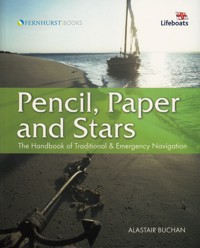
Today's sailors rely on GPS for position finding and passage making. But what happens if your electronic navigation systems fail?_x000D_ This book provides you with simple, practical, get-you-home navigation techniques that could save you in an emergency. These easy techniques require no complicated mathematics. Learn the principles of navigation and you will have confidence in your decision-making when you need it most. You will also learn how to make simple instruments using materials and equipment likely to be found on every boat, and how to use them at sea. With colourful and clear diagrams to aid learning, you will be confident in continuing your passage in a safe and seamanlike manner if the electronics let you down.
Das E-Book können Sie in Legimi-Apps oder einer beliebigen App lesen, die das folgende Format unterstützen:
Veröffentlichungsjahr: 2008
Ähnliche

















Pencil, Paper and Stars
Pencil, Paper and Stars
The Handbook of Traditional and Emergency Navigation
ALASTAIR BUCHAN
Copyright © 2008
Published by
Alastair Buchan
John Wiley & Sons Ltd, The Atrium, Southern Gate, Chichester,
West Sussex PO19 8SQ, England
Telephone (+44) 1243 779777
Email (for orders and customer service enquiries): [email protected]
Visit our Home Page on www.wiley.com
All Rights Reserved. No part of this publication may be reproduced, stored in a retrieval system or transmitted in any form or by any means, electronic, mechanical, photocopying, recording, scanning or otherwise, except under the terms of the Copyright, Designs and Patents Act 1988 or under the terms of a licence issued by the Copyright Licensing Agency Ltd, 90 Tottenham Court Road, London W1T 4LP, UK, without the permission in writing of the Publisher. Requests to the Publisher should be addressed to the Permissions Department, John Wiley & Sons Ltd, The Atrium, Southern Gate, Chichester, West Sussex PO19 8SQ, England, or emailed to [email protected], or faxed to (+44) 1243 770620.
Designations used by companies to distinguish their products are often claimed as trademarks. All brand names and product names used in this book are trade names, service marks, trademarks or registered trademarks of their respective owners. The Publisher is not associated with any product or vendor mentioned in this book.
This publication is designed to provide accurate and authoritative information in regard to the subject matter covered. It is sold on the understanding that the Publisher is not engaged in rendering professional services. If professional advice or other expert assistance is required, the services of a competent professional should be sought.
Other Wiley Editorial Offices
John Wiley & Sons Inc., 111 River Street, Hoboken, NJ 07030, USA
Jossey-Bass, 989 Market Street, San Francisco, CA 94103-1741, USA
Wiley-VCH Verlag GmbH, Boschstr. 12, D-69469 Weinheim, Germany
John Wiley & Sons Australia Ltd, 42 McDougall Street, Milton, Queensland 4064, Australia
John Wiley & Sons (Asia) Pte Ltd, 2 Clementi Loop #02-01, Jin Xing Distripark, Singapore 129809
John Wiley & Sons Canada Ltd, 22 Worcester Road, Etobicoke, Ontario, Canada, M9W 1LI
Wiley also publishes its books in a variety of electronic formats. Some content that appears in print may not be available in electronic books.
Library of Congress Cataloging-in-Publication Data
Buchan, Alastair.
Pencil, paper and stars: the handbook of traditional and emergency navigation / Alastair Buchan.
p. cm.
Includes index.
ISBN 978-0-470-51652-2 (pbk.: alk. paper)
1. Yachting. 2. Navigation. I. Title.
GV813.B785 2008
623.89–dc22
2007035528
British Library Cataloguing in Publication Data
A catalogue record for this book is available from the British Library
ISBN 978-0-470-51652-2 (PB)
Typeset in 10/15pt Futura by Aptara Inc., New Delhi, IndiaPrinted and bound in Singapore by Markono
Contents
1An excellent art
2Another kind of sailing
Positive Waves
Picture This
Keep It Simple
Proper Preparations
3The first navigators
4All in the mind
Route Navigation
Map Navigators
5Passage planning
Choice of Landfall
One Step at a Time
Sailing Directions
Log Keeping
6A home-made magnetic compass
The Compass Rose
Making a Magnetic Compass
7Direction from the sun
Amplitudes
North by Your Watch
A Sun Compass
8Direction from the stars
The Celestial Sphere
Finding Polaris
Meridian Stars
Planets
9Direction from the moon
10Telling the time
GMT
Zone Time
Time and the Navigator
Time from the Sun
Making a Sundial
Time from the Stars
Time from the Moon
11Dead reckoning and estimated positions
A Dead Reckoning Position
The Log Ship
Estimated Positions
The Traverse Board
12Coastal navigation
Distance to the Horizon
Geographic and Nominal Range of Lights
Distance Off by Similar Triangles
Distance Off by Vertical Angle
Distance Off by Horizontal Angle
Distance Off by Winking
Distance Off by Horizon Angle
Distance Off by Bearings
Distance Off by Echo Ranging
13Home-made sextants
The Astrolabe
The Sun Shadow Board
The Latitude Hook
The Kamál
The Quadrant
The Cross Staff
The Back Staff
14Sextant corrections
DIP
Refraction
Horizon Sights
Parallax
Semi-Diameter
15Meridian sights
16Latitude from Polaris
Latitude from Polaris
Latitude from Circumpolar Stars
17Longitude
Lunar Eclipses
Lunar Distances
Longitude by Time
18Plane sailing
Plane Sailing and Passage Planning
Traverse Tables Courses
19Chartmaking
Home-made Charts
Charts for Coastal Passages
20Signs of Landfall
Waves
21Accuracy
Course Errors
Plotting Positions
Index
Chapter 1
An excellent art
Navigation is that excellent Art, which demonstrateth by infallible conclusions, how a sufficient Ship may be conducted the shortest good way from place to place, by Table and Travers.
John Davis, The Seaman’s Secrets, 1594
Electronics took its time killing traditional navigation. The first hint of its intentions was in 1906 when the Italians Bellini and Tosi found how to determine the direction from which radio signals were transmitted. By the end of the 1940s radio navigation had grown to include Consol, Decca, Loran-C (the Russians had their version called Chayka), and Omega, the son of a 1940s development called Radux and the first worldwide positioning system. It even had its own differential system for improved accuracy and was switched off only in 1997. It is hard to believe that only 30 years ago hi-tech, electronic navigation for most yachtsmen was donning a set of headphones and waving a glorified transistor radio vaguely towards a radio beacon in the hope of obtaining a bearing on a magnetic compass that could be plotted on a paper chart.
The introduction of inertia navigation was ignored by the leisure sailor and the arrival of satellite navigation gave no hint of its future dominance. With only one, often doubtful, fix every half hour or so and a cumbersome, parsimonious display, the Transit system hardly seemed worth the expense and certainly no reason to throw away your sextant.
Navigational calculators were expensive and rarely found on yachts. A few enthusiasts wrote simple navigation programmes for the handful of calculators that could be persuaded to remember a few keystrokes. Primitive by today’s standards and less than user friendly, these were the ancestors of those managing today’s GPS sets. There were no digital charts. Positions were plotted on paper, just as they had been since the Egyptians invented papyrus.
Navigation stubbornly remained more art than science, heavy with traditions. Innovation, when finally accepted, came in small, genteel steps building carefully on what had gone before. The sextant’s lineage goes back over 2,000 years to the astrolabe. Robert Hooke showed the prototype of the modern sextant to the Royal Society in 1666. Isaac Newton described his notion for a double reflecting sextant to a Royal Society meeting in1699. Both ideas sank without trace. It was 1731 before Thomas Godfrey in America, and John Hadley, a London instrument maker, simultaneously and independently re-invented the double reflecting quadrant. In the summer of 1837, over a century later, Captain Thomas H Sumner accidentally developed the celestial position line but it was 1875 before Captain, later Admiral, Marc St Hilaire cracked the maths behind the altitude-difference method of establishing a position line, and the middle of the 20th century was approaching before short method tables were published.
The rotator log replaced the medieval log ship towards the end of the 19th century. Around the 1930s the micrometer drum superseded the vernier scale on sextants. In the late 1950s, the echo-sounder finally took over from the lead line. Hardly revolutionary progress. Well into the 1980s, navigators like Cook or Bligh would have had no difficulty in coming up to speed on the latest techniques and then showing us how it should be done.
In an overnight coup, the microchip deposed centuries of tradition and changed everything. Watches, so accurate that in the past they would have been cherished as top end chronometers, became so cheap that they were disposable. LCD screens provided detailed information in easily understood language that superseded the analogue display. Plotters, digital charts, digital compasses, radios, autohelms, radars, and, soon after it went fully operational in 1995, GPS, all quickly became commonplace on the smallest yacht.
The computer in every instrument began networking with every other, and displaying more information than any reasonable navigator was able to use. Modern navigation requires no prior knowledge or skill. If you can send a text message then you can navigate. The distinction between coastal and ocean navigation, novice and expert, amateur and professional, vanished. Knowing why or understanding how it is done is unimportant – irrelevant. Since May 1998, the United States Naval Academy has stopped running courses on celestial navigation. The sextant is dead. Long live the microchip!
There is a downside. Electronic navigation makes the divine right of kings look like democracy in action. Instruments talk, but only to their equals and then announce decisions set in tablets of stone. Their proclamations are assumed accurate to several decimal places and their absolute reliability is unquestioned. Cross checking by traditional methods reveals only gross errors and since computers never err, why bother? So we no longer cross check, and age-old knowledge is forgotten.
But what happens when your electronic wizardry abdicates and leaves you alone with silent, blank screens upon an empty sea? After checking its connections and giving an encouraging thump you can do little more. Modern instruments are impervious to user repair. Why they fail is irrelevant. The fact is you are in the middle of nowhere and want to go home. The question is, how?
The kneejerk, textbook solution of digging out a paper chart and sharpening a pencil works brilliantly in the clubhouse, but unless you remember long-forgotten skills, have a clockwork log and magnetic compass you are going nowhere. Bar room knowledge may take you clear of the yacht club but before long you won’t know where you are, how you got there, or how to return in time to buy your round. You need ‘Crash Bag’ (emergency) Navigation. The chances are it will get you to the bar on time and with a good tale to tell.
This book explains the principles involved in finding your way without instruments, and how to make simple instruments from materials you have on board. But you will find no answers, simple or otherwise. No formulaic solution can cover every situation. It is up to you to use the principles and techniques described in this book in a way that meets your circumstances. We modern navigators may not be as accurate, skilful or confident as those who learned these techniques through a long apprenticeship and used them every day, but we would have to be really slow not to learn enough to dig ourselves out of a hole and reach port.
Chapter 2
Another kind of sailing
Positive Waves
Picture This
Keep It Simple
Proper Preparations
… three kindes of Sayling, Horizontal, Paradoxal, and Sayling upon a Great Circle
John Davis, The Seaman’s Secrets, 1594
The techniques that once made piloting, dead reckoning and celestial navigation separate skills, are history. Nowadays navigation depends on accessing detailed and accurate data provided by an array of electronic devices that do not care if you are inshore, offshore, or in the middle of nowhere. But take these clever instruments away and the flow of data dries up, and we are lost unless we find some other way of acquiring the information that will allow us to continue on our way.
It can be done and has been done for thousands of years. Sailing without electronic instruments demands more of the navigator. He or she is no longer a button pusher but a combination of a mathematician, astronomer, biologist, meteorologist, cartographer, and geographer. It is daunting, but the biggest challenge is in acquiring or re-acquiring a mindset for another kind of sailing.
Positive Waves
Always think positive. A lack of instrumentation and charts is not a disaster. You are not inventing the wheel. Sailors have been navigating without instruments far longer than they have with them. They have even sailed round the world without them. Take comfort in the fact that you are not the first.
Accept Uncertainty
Be happy living with uncertainty. GPS has accustomed us to pinpoint our positions accurately all of the time, anywhere and everywhere. At one time, knowing your position to within a handful of metres was only possible if you had correctly identified and taken bearings or transits on several charted features. Unless you were anchored, the position had a half-life measured in minutes. The further you travelled the less certain your position. You were not lost, but where you were became an educated guess rather than a certainty taken to several decimal places.
Make Mistakes
Uncertainty means your position contains unknown errors. The only certainty is that you are not where you think. Sometimes a known error is better. You still do not know your precise position but at least you are making mistakes of your choosing.
Picture This
Digital navigators have been known to carefully log their vessel’s GPS coordinates and minutes later run aground. They have failed to relate this information to the real world. Always doubtful of his position, a Crash Bag Navigator must remain spatially aware and keep a plot running in his head. In other words, he must have a mental picture of where the boat is in relation to the world about it.
You do this all the time. When travelling between home and work, at any point on the journey you can point towards your home, destination, or places in between, without any hesitation. You know where you are without looking at a map.
Similarly, the Crash Bag Navigator knows what course he’s steering and what speed he’s making. He always has in mind a fair approximation of the boat’s position and its relationship to landmarks and hazards. He uses as many independent ways as possible to check his direction, position, and speed. Each check gives a slightly different answer but they should all lead to more or less the same position.
Keep It Simple
At one time, nautical ambitions more or less kept pace with navigational skills. You dared not sail across the bay and lose sight of land without being sure you could find terra firma again. Ocean passages waited until you had mastered astro-navigation. With GPS, you can buy a boat on Monday and start out across the Atlantic on Tuesday. The occasion when you lose your instruments may be your first time at sea without their comfort blanket around you.
It is a steep learning curve. Keep it simple. Always chose the easy option. Prioritise the tasks facing you. Do them one at a time, deliberately, slowly, and check progress before moving onto the next task.
Proper Preparations
It is a fundamental truth that performance in any field is directly proportional to the preparations and training made beforehand. Lay the foundations for Crash Bag Navigation before you need it. You should not be trying it for the first time five minutes after your instruments die. Every passage plan should be prepared and made bearing in mind the possibility that Crash Bag Navigation might be needed.
Although there should be no difference between theory and practice, it would be prudent to take every opportunity to practise the ideas described in this book. You not only gain proficiency and a good understanding of the degree of accuracy you can expect, but learn to allow for inaccuracies.
If you live by the plotter then it is important to have an up-to-date written record of your position in a paper log, or as a plot on a paper chart. Without this you will have to guess where you are when you begin Crash Bag Navigation. It also helps to have written down (or printed out) the coordinates of the waypoints you intended to use.
Greater than the Whole
Although this book deals with topics separately, the trick is in putting them together. The sum of the parts is greater than the whole. Sometimes an insignificant, almost overlooked and apparently irrelevant detail in the distant outfield completes the picture. The Crash Bag Navigator is a ravenous and omnivorous collector of data.
Chapter 3
The first navigators
Once cavemen developed a navigational methodology it was not long before this methodology became formalised with certificates of competence, and a range of gadgets all promising to make it easy. It would be wrong to think of the early navigators as uncivilised, uneducated, unsophisticated, unqualified and fearful of losing sight of land.
The distribution of finds of Irish Bronze Age gold ornaments showed that there was a healthy trade between Ireland, mainland Europe, Scotland and Denmark. Any way in which you retrace those routes involves some wild water sailing and serious navigation.
In the fourth century BCE, Herodotus wrote that when you were in 11 fathoms (this is a misprint for 100 fathoms) and found yellow mud on the lead then you were one day’s sail from Alexandria. Mud from the Nile extends about 60 miles offshore, and soundings of 100 fathoms puts you some 50 nautical miles offshore. Coincidentally, the Minoans had a harbour at Knossus on the south coast of Crete whose only purpose was to trade with Africa, a good two days’ sail across open sea.
Around 500 BCE Hanno, a Carthaginian, took 60 ships down the west coast of Africa, colonising as he went. He reached the region that is modern Sierra Leone. Even earlier, in 605 BCE Pharaoh Necho II, upset by failure in his war against Nebuchadnezzar and keen to secure his place in history, commissioned a Phoenician fleet to sail round Africa. They sailed down the east coast, round the Cape of Good Hope, up the west coast and back along the Mediterranean to Egypt.
This is a voyage of about 16 000 nautical miles and it took three years. Considering they stopped ashore for a few months each year to grow crops, they were either putting up eye-watering performances, or they had the capability to make long offshore passages, navigationally unequalled for many centuries.
Around 340 BCE another Phoenician, Pytheas of Massalia (present-day Marseilles) explored the Arctic Ocean and reached Utima Thule. Wherever that was, getting there involved offshore passages in some of the world’s most inhospitable seas. Pytheas also invented an accurate method of calculating latitude using a calibrated sundial, theorised over the relationship between tides and the phases of the moon, and attempted to determine the position of true north.
On his return he documented his voyage in Peritou Okeanou (On the Ocean), which was lost. Fortunately, other writers drew upon it and we know Pytheas estimated the coastline of Britain to be 45,000 stades. Using the best guess we have about the length of a stade Pytheas made Britain’s coastline 4,800 miles as against our figure of 4,710 miles.
In 146 BCE, Eudoxus of Cyzicus on his second voyage from Egypt to India was blown ashore below Cape Guardafui (then called the Cape of Spices) in Somalia off the Horn of Africa. There he found a wooden prow, carved with a horse’s head, floating in the water. On his return to Carthage, he discovered that this was identical to those found on ships from Cadiz and Morocco. Did some navigator make it into the Indian Ocean a thousand years before Vasco Da Gama?
In about 100 BCE, the Roman geographer Statius Sebosus claimed that sailing for 40 days from the Gorgades brought you to the Hesperides, the legendary islands beyond the Atlantic Ocean. Some claim that the Gorgades are the Cape Verde Isles. If so, the next stop west is the Caribbean. On his third journey to the New World it took Columbus 33 days to sail between the Cape Verde Islands and the Caribbean. Was someone making transatlantic round trips 1600 years before Columbus? If so, who? Sadly Sebosus does not say.
Pliny the Elder in about 50 CE related the tides to the phases of the moon. Sometime around 700 CE, the Venerable Bede, sitting in his monastic cell by the River Wear in North-east England, described the tides round the British coast. Bede’s work was used by seamen into the 17th century.
About 4000 years ago, on the far side of the world, the Polynesians began sailing the Pacific. Polynesian sea lanes have been correlated to the flight paths of migrating birds. Some believe that Polynesian explorers were great bird watchers, and that when they set out to explore it was to discover land that they were almost sure was there to be found. As they had no iron, they did not have magnetic compasses, but instead evolved a navigation system that needed neither instruments, nor charts as the west understood them. Their system survived more or less intact into the 19th century, and on a diminishing scale, into the early 20th century.
It is possible that some of their voyages were accidental, forced on them by heavy weather, but most were not. When they discovered an island accidentally, those who did so were not lost, for they found their way home with sufficient information for others to retrace their steps.
Closer to home and prior to 1492 the Caribs, Mayans and other tribes in the Caribbean sailed amongst the islands, and to and from the mainlands of North, Central and South America.
The expertise that made these early voyages possible is not completely lost. When John C Voss was sailing across the Pacific in his 30-foot Tilikum in September 1901 the boat was pooped 1200 miles from Sydney. He lost his companion and only compass overboard. Unfazed, he steered by the sun, moon, stars and swell to reach Sydney 22 days later. His confidence in his Crash Bag Navigation was so great that 15 minutes after noting that he should see ‘Sidney light before long’, he did.
In the 1960s, using Polynesian techniques, David Lewis sailed from Tahiti to New Zealand and made landfall within 30 miles of his destination. Between 1982 and 1984 Martin Creamer in Gold Star made one of the greatest circumnavigations ever by sailing round the world without using any instruments, not even a watch. Starting and ending at Cape May Harbor USA he called at Cape Town, Hobart, Sydney Whangora, and Port Stanley in the Falkland Islands.
It is unlikely the achievements of early navigators were lucky accidents. We know of Phoenician voyages, although not how they navigated, but to argue they did not develop a sophisticated navigational methodology is to believe they learnt nothing from centuries of voyaging. Look how far our own navigational skills have come in the last 500 years.
More to the point, early navigators probably had instruments. We think otherwise because we do not know about them or would not recognise them if we saw them. Sea power has always represented political power and wealth. Its skills and tools were jealously guarded secrets. Evidence of their existence was not left around for passers-by to pick up. This is still true today. Ask any military organisation for details of its latest navigational gizmos and you receive a bland and probably misleading answer.
Around 150 BCE the Greeks had a mechanical computer capable of predicting the movement of the sun, the moon, and some planets, as well as being able to add, subtract, multiply, and divide. Its remains were found in 1901 aboard a shipwreck. It took over a century to work out what it was. The Greeks also knew about the astrolabe and had star catalogues. The Pharaohs used sundials and knew the earth was spherical. They even measured its diameter pretty accurately. Devices for measuring the altitude of celestial bodies have been around for thousands of years. It is presumptuous to assume this knowledge was not used at sea.
Lead line apart, the first instrument to come into widespread maritime use was the compass. It possibly appeared in several places at about the same time as the characteristics of lodestone were widely known. The first mention of the compass in the west was by an Englishman Alexander Neckham. In his 1187 book De Utensilibus (On Instruments) he described a needle that swung on a point and showed the direction of north. This is a dry, pivoting compass needle so it is possible that the simpler, floating compass needle was in existence earlier than that.
Almost from the beginning, it was noted that compasses did not point to true north. Variation was empirically calculated in the 15th century. Around 1600 William Gilbert, physician to Queen Elizabeth I of England, suggested the difference was because the earth was behaving like a magnet, with its magnetic poles some distance away from its geographic ones.
In 1405, the Chinese began a series of voyages to establish trading routes throughout Micronesia, India, and the east coast of Africa. According to Gavin Menzies, the voyages peaked between 1421 and 1423 when four Chinese fleets circumnavigated the world, charting it as they went, using this information to produce an accurate world map in 1428.
Charts, pilots, tide tables, traverse tables, and almanacs have been used for centuries. Techniques for measuring time and angles, calculating position, speed, and direction have been around even longer. The solutions the early navigators found reflected the technology of their times. We may regard their instruments as crude, but their very simplicity means that workable versions producing acceptable results can be put together from the odds and ends found on most yachts.
Different early cultures, separated by time and geography, all mastered the science of navigation. They did not rely on celestial benevolence, a sixth sense, charms, incantations, or sacrifices, human or otherwise, but skills and knowledge based on the close observation of natural phenomena, the meticulous construction of mental maps, simple instruments, and detailed sailing directions.




