


13,99 €
Mehr erfahren.
- Herausgeber: John Wiley & Sons
- Kategorie: Fachliteratur
- Sprache: Englisch
Learn how to influence others and get your own way more often
Wouldn't it be great if you could get the pay rise you've asked for, win the business you've pitched for or get that job you so desperately want?
Well, with this book you can learn how to get inside the head of the person making the decision and find out exactly what is it that's going to get them to say yes! Persuade explains the seven psychological drivers that motivate us all. By understanding these drivers and the impact they have on our own lives, we can gain valuable insights into how we can motivate ourselves, improve our relationships, negotiate more effectively, get people to like us and ultimately get our own way more often. Persuade:
- Is written in Philip's trademark humorous, yet well-researched style
- Draws from scientific and psychological sources
- Is delivered in short, accessible, bite-sized chapters
Sie lesen das E-Book in den Legimi-Apps auf:
Seitenzahl: 182
Veröffentlichungsjahr: 2015
Ähnliche

















‘If you want to become more persuasive … read this book. It does exactly what it says on the cover.’
Ged Shields, Vice President – Marketing, Ronseal
‘Insightful. Funny. Brilliant. Mr Hesketh uses loads of stories, research and real-life experiences to show us what drives us; what drives the people we talk to; and how to use this knowledge to adapt our approach so we all win. An excellent book.’
Andy Bounds, Communications Expert and Bestselling Author of The Jelly Effect, The Snowball Effect and Top Dog
‘Essential reading for anyone who wants to better understand what makes people tick and why we do the things we do. In addition, it's hilarious.’
Graham Hill, Managing Director, International Investment Bank
‘In this book, Phil gives us the keys to be more persuasive and influential. In a unique style, he shows us how to engage with people's minds. I highly recommend you read this book!’
Lina Marcela Torres, Marketing Manager for Latin America, LinkedIn
‘Lao Tzu said that knowing others is wisdom, knowing yourself is enlightenment. Reading Phil's book will help you achieve both!’
David Maher, Managing Director, Celebrity Speakers Bureau, Australia
‘Phil's storytelling ability is second to none and his highly-informed perspective on behaviour and psychology make this book something very special indeed.’
Steve McDermott, Author of How to be a Complete and Utter Failure in Life, Work and Everything
‘The combination of stories and humour backed with scientific rigour make this a compelling, engaging and essential read.’
Paul McGee, Author of the International Bestsellers SUMO (Shut Up, Move On) and Self-Confidence
‘Ultimately, with any book that pertains to educate you, the litmus test is: what do I learn? This book has literally 100's of fascinating facts, thoughts and ideas that you can apply to your own life, straight away.’
Scott Stevens, Head of Marketing, BNY Mellon Investment Management EMEA
‘A wonderful and unique contribution to the field of human study that really helps you understand why people do what they do.’
Michael Wainwright, Managing Director, Boodles
‘Anybody who reads this book and puts it into action will become more persuasive and influential. Guaranteed.’
Martin Wild, Sales Director, UK, Ireland and Northern Europe, Callaway
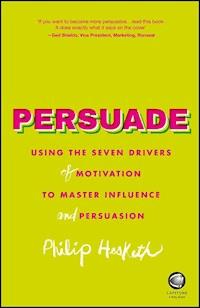
Persuade
Using the seven drivers of motivation to master influence and persuasion
Philip Hesketh
This edition first published 2016 © 2016 Philip Hesketh
Registered officeJohn Wiley and Sons Ltd, The Atrium, Southern Gate, Chichester, West Sussex, PO19 8SQ, United Kingdom
For details of our global editorial offices, for customer services and for information about how to apply for permission to reuse the copyright material in this book please see our website at www.wiley.com.
The right of the author to be identified as the author of this work has been asserted in accordance with the Copyright, Designs and Patents Act 1988.
All rights reserved. No part of this publication may be reproduced, stored in a retrieval system, or transmitted, in any form or by any means, electronic, mechanical, photocopying, recording or otherwise, except as permitted by the UK Copyright, Designs and Patents Act 1988, without the prior permission of the publisher.
Wiley publishes in a variety of print and electronic formats and by print-on-demand. Some material included with standard print versions of this book may not be included in e-books or in print-on-demand. If this book refers to media such as a CD or DVD that is not included in the version you purchased, you may download this material at http://booksupport.wiley.com. For more information about Wiley products, visit www.wiley.com.
Designations used by companies to distinguish their products are often claimed as trademarks. All brand names and product names used in this book and on its cover are trade names, service marks, trademarks or registered trademarks of their respective owners. The publisher and the book are not associated with any product or vendor mentioned in this book. None of the companies referenced within the book have endorsed the book.
Limit of Liability/Disclaimer of Warranty: While the publisher and author have used their best efforts in preparing this book, they make no representations or warranties with respect to the accuracy or completeness of the contents of this book and specifically disclaim any implied warranties of merchantability or fitness for a particular purpose. It is sold on the understanding that the publisher is not engaged in rendering professional services and neither the publisher nor the author shall be liable for damages arising herefrom. If professional advice or other expert assistance is required, the services of a competent professional should be sought.
Library of Congress Cataloging-in-Publication Data
Hesketh, Philip. Persuade : using the seven drivers of motivation to master influence and persuasion / Philip Hesketh. pages cm Includes index. ISBN 978-0-85708-636-5 (paperback) 1. Persuasion (Psychology) 2. Influence (Psychology) 3. Interpersonal communication. I. Title. HM1196.H47 2015 303.3′42–dc23
2015028023
A catalogue record for this book is available from the British Library.
ISBN 978-0-857-08636-5 (pbk)
ISBN 978-0-857-08637-2 (ebk) ISBN 978-0-857-08638-9 (ebk)
Cover Design: Kathy Davis/Wiley Hand drawn type: © Kathy Davis/Wiley
CONTENTS
Introduction: Our seven psychological ‘drivers’
1 Curiosity and the importance of having something to look forward to
2 Why keeping an open mind will help you to understand others
3 Using the ‘Bubble Reputation’ to improve how others see you
4 How fleeting attraction and perceived similarity can change ‘no’ to ‘yes’
5 The single most persuasive expression you can ever use
6 How to worm your way into a group's affections and influence them
7 The ‘chameleon effect’ and how to use body language to your advantage
8 How your behaviours dictate either successful long-term partnerships – Or relationships heading for disaster
9 Why persistence pays when asking for a favour
10 The power of belief and the ‘illusory correlation’
11 The anchor effect, the drive we have for ‘more’ and how to improve your negotiating skills
12 The seven things you need to know to improve your communication
13 The truth about money and motivation
Conclusion: Our seven psychological ‘drivers’ and the pursuit of happiness
Drivers 1, 2 and 3: The need to be loved, to be important and to belong
Drivers 4 and 5: The need to believe and the need for a balance of certainty and uncertainty
Driver 6: The need for ‘a place’
Driver 7: The need for growth and improvement
The top 50 questions for you to master influence and persuasion
About the author
Index
Advert
EULA
Guide
Cover
Table of Contents
Chapter
Pages
vii
viii
ix
x
xi
xii
xiii
xiv
xv
xvi
xvii
xviii
1
3
4
5
6
7
8
9
11
13
14
15
16
17
18
19
20
21
23
25
26
27
28
29
30
31
32
33
35
37
38
39
40
41
42
43
44
45
47
49
50
51
52
53
54
55
56
57
58
59
61
63
64
65
66
67
68
69
70
71
73
75
76
77
78
79
80
81
83
85
86
87
88
89
90
91
92
93
94
95
97
99
100
101
102
103
104
105
106
107
109
111
112
113
114
115
116
117
118
119
120
121
122
123
124
125
127
129
130
131
132
133
134
135
136
137
139
140
141
142
143
144
145
146
147
148
149
150
151
153
154
155
156
157
158
159
160
161
163
164
165
166
167
168
169
170
171
172
173
174
175
176
177
178
179
181
182
183
184
185
186
187
188
189
190
Introduction: Our seven psychological ‘drivers’
It's no secret that being part of a social group provides an all-important sense of belonging. For years, American Express has spent millions telling us that ‘membership’ has its privileges. But there is more to it. People believe a sense of belonging to a social group also gives their life more meaning.
But what's with this in-built desire to join social groups? In the animal kingdom the reason is easy to understand since it's mostly about survival. That's why wolves hunt in packs, birds fly together for safety and ants achieve more by working in unison.
Like Ant and Dec, for instance.
However, for humans, belonging to a group helps us form a view of our social identity which, in turn, contributes to our sense of who we are.
Back in the 70s, a famous study by Henry Tajfel demonstrated how complete strangers stuck together even when they had only the smallest thing in common. In his experiment, a group of boys were gathered together and then told they were to be split into two teams. Despite not knowing each other at all, most favoured being in a team with those immediately around them rather than those furthest away. Better the devil you know, I guess.
Tajfel was also able to demonstrate that merely putting people into groups – effectively categorizing them – is sufficient for people to discriminate in favour of their own group and against members of the other group.
It's a bit like meeting your countrymen abroad when on holiday. Walking along the promenade of a UK resort you would happily pass by without saying a word. But in a foreign country you're likely to at least exchange pleasantries when you recognize that they're from these shores. Wearing Union Jack shorts helps in this respect.
What's more, a funny thing happens when we join a group. We start to behave just like everyone else and follow the group ‘norm’.
Even when there's nobody in the group called Norm.
One of the most famous experiments showing how easily we conform to unwritten group rules was conducted by Solomon Asch of Rutgers University in New Jersey. He asked participants to sit amongst a group of strangers and judge the length of queues that were being formed in front of them. What he didn't tell them was that all the other people had been instructed to lie when asked which was the longest queue. Sure enough, 75% of participants denied all the evidence from their own senses and instead conformed to the group view.
A similar experiment run by psychology professor Philip Zimbardo of Stanford University wasn't quite so successful. His idea was to place young men in a simulated prison environment with some assuming the role of prisoners whilst others played the part of guards complete with riot gear. Despite being a psychologist, he clearly hadn't thought through the consequences of the experiment and the likely long-term effects on the mental health of the participants.
To summarize, he recruited clean-cut young men as volunteers, none of whom had any kind of criminal record and who all rated ‘normal’ on psychological tests; and he randomly assigned half of them to play the role of prisoners and the other half to play guards. His plan was that he would step back for two weeks and observe how these model citizens interacted with each other in their new roles.
What happened next has become the stuff of legend.
Social conditions in the mock prison deteriorated with stunning rapidity. On the first night the prisoners staged a revolt and the guards, feeling threatened by the insubordination of the prisoners, cracked down hard. They began devising creative ways to discipline the prisoners, using methods such as random strip-searches, curtailed bathroom privileges, verbal abuse, sleep deprivation and the withholding of food.
Not surprisingly, many of the prisoners began to crack. It was clear that for everyone involved the new roles had quickly become more than just a game. Even Zimbardo himself felt seduced by the corrosive psychology of the situation. He began entertaining paranoid fears that his prisoners were planning a break-out, and he tried to contact the real police for help. Luckily, at this point Zimbardo realized things had gone too far.
After less than a week the experiment had to be scrapped when some of the ‘prisoners’ were becoming too submissive and some of the guards a little too zealous when meting out discipline. The prisoners were relieved; but tellingly, the guards were upset. They had been quite enjoying their new-found power and had no desire to give it up. Needless to say, the emotional fallout from the experiment outweighed any positive conclusions. In fact, I think some ‘prisoners’ are still on the roof protesting.
Only joking.
So if you want to join a group and become its leader, the first thing to do is conform. Then, when you feel trust has been gained, it's safe to start to show the way. And if you decide to start a group outside of work, don't forget to invite me. Because just like everyone else, I hate to be left out.
Today, people connect on LinkedIn and socialize on Twitter and Facebook partly to satisfy this need to be part of a group. The popularity of social media websites serves to underline this basic need in us all. Not just to share embarrassing pictures with the rest of the world, but rather to ‘belong’. Outside of cyberspace, fans flock to football grounds to support their team in a show of unity. Even Brian, from Monty Python's ‘Life of Brian’, had his devoted followers whose overwhelming need to belong saw them follow him everywhere. Even though it turned out he wasn't the Messiah after all, just a very naughty boy.
There are seven psychological ‘drivers’ for us all. They are what make us ‘tick’. Throughout the book we will explore these drivers and how, by understanding them, we can improve our relationships with the people around us, communicate better and get our own way more often. I have asked people all around the world ‘What is most important thing in your life?’ The answer is almost always ‘My family’. And that is why the first three – and most important drivers – are to be loved, to be important and to have a sense of belonging.
But these are what drive all successful relationships – whether at work or with your friends. The word ‘love’ can mean so many things but often what it means in this context is that we want to feel that someone truly cares about us. It's why you need to show you are truly interested in the other person. And the word ‘important’ does not mean that you want to be the top dog. Rather, it means that people want to feel like what they are doing matters. That their contribution is valued.
In Greek mythology the greedy and deceptive Sisyphus was condemned to an eternity of hard labour. His task was to roll a great boulder to the top of a hill, but every time Sisyphus – after the greatest of exertion – reached the summit, the boulder rolled back down again and he had to repeat the task. It was the futility of it that took its toll. The exact opposite of the job having importance and mattering to someone was what really made Sisyphus suffer for his many crimes.
And Zimbardo's experiment in a simulated prison environment shows how quickly both the ‘prisoners’ and the ‘guards’ became part of a group. They started to behave as they did because their uniform told them they were part of a group. And they behaved like they thought other members of the group would behave.
We'll look more at these seven psychological ‘drivers’ throughout the book and show how, by understanding what makes us ‘tick’, we can not only be more persuasive and influential, but happier too.
So here are the top three drivers:
We all want to be loved.
We all want to feel important.
We all have a deep-seated need to ‘belong’.
Nat Lambert of Brigham Young University in Utah explored the implications of ‘belonging’ in an experiment where he asked participants to close their eyes and think of two groups to which they really belonged. Then they were asked about how much meaning they felt life had. The results were compared with those of two other groups where the participants were asked to think about something else. In one, they were asked to think about the value of other people, and in the other, the help that others had provided them.
The results showed that the participants who had been thinking about the groups they belonged to felt the highest levels of meaning in life. Proof that belonging to a group provides meaning over and above the value of others or the help they can provide.
But why is this? Well, it's more than just bonding. It seems that people who really feel like they fit in with others report the highest levels of ‘meaningfulness’ in their lives. I guess this is why the followers of some religious sects often seem like they have been brainwashed. A deep-seated and unshakeable belief in something often manifests itself in the strangest behaviour.
Think Tom Cruise jumping up and down on a chat show sofa.
Now stop.
Here's the really interesting bit:
People who feel that life is meaningful are more likely to be in good physical and psychological health. And – you guessed it – people who feel that life is not so meaningful are more likely to suffer depression and illness.
So it seems that there's a lot to be said for adopting a positive mental attitude, finding a real meaning in it all and socializing more.
And if you believe that, then you are much more likely to find true meaning in life because the need to believe is the fourth of the seven psychological drivers.
Indeed, success is most often achieved by those who just don't believe in failure.
Those words of wisdom came from none other than the stylishly elegant and fabulously chic Coco.
Not Coco the clown, of course, but the French fashion designer, Miss Coco Chanel. Her affirmation that anything is possible if you believe in it is a view shared by many a successful business entrepreneur.
But just how powerful is the act of believing and what part does it really play in determining success or failure? The answer may lie in a study by Irving Kirsch of Harvard Medical School, who conducted a series of trials featuring placebos. As I'm sure you know placebos are nothing more than sugar pills with no active ingredient that researchers use to test the efficacy of real drugs.
How and why placebos work is still something of a mystery. Some patients taking them report an improvement in their condition, some even claim to be suffering from the drug's side effects.
In a study of Parkinson's sufferers, it was discovered that placebo patients who reported an improvement had changes in their brain identical to those caused by the actual medication, Levodopa.
So why did these sufferers get better? Quite simply it was a case of mind over matter. They believed that what they were taking would help and so it did. Sportsmen and women use the same psychology to help them run faster, jump further and last longer. Some football teams believe they will score a goal in the last few minutes of a game and they often do. Aided by their opponent's belief in the very same outcome.
In his study, Kirsch reviewed the results from 35 clinical trials of modern antidepressant medication, such as Prozac, and concluded that placebos duplicated more than 80% of the improvement observed in the drug groups. In other words, 80% of people's improvement after taking a sugar pill they thought was Prozac was exactly the same as if they had actually taken Prozac. He also concluded that the effect of placebo on pain is about 50% of the response to pain medication.
So how does this phenomenon translate into the business world? Well, it seems to me that the vital ingredient is the expectation of benefit. In my work as a motivational speaker, I talk about these seven psychological drivers that we all possess – and, as I say, the fourth one is the need to believe. We all want to believe, we all need to believe. And it seems that if you believe enough, you'll go a long way to achieving your goals.
So here are the next four of the seven psychological drivers:
The need to believe.
The need for some certainty and some uncertainty in our lives.
The need for ‘a place’.
The need for growth and improvement.
This need we have for some certainty and some uncertainty in our lives is all about having things to look forward to. If we know exactly how our life will be mapped out it takes away the fun and interest. But if we dread the future we have too much uncertainty in our life and are equally unhappy.




