


127,99 €
Mehr erfahren.
- Herausgeber: John Wiley & Sons
- Kategorie: Fachliteratur
- Serie: A Wiley-Science Wise Co-Publication
- Sprache: Englisch
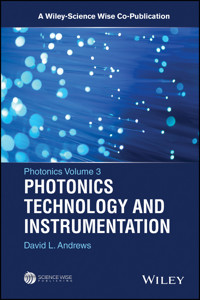
Discusses the basic physical principles underlying the technology instrumentation of photonics
This volume discusses photonics technology and instrumentation. The topics discussed in this volume are: Communication Networks; Data Buffers; Defense and Security Applications; Detectors; Fiber Optics and Amplifiers; Green Photonics; Instrumentation and Metrology; Interferometers; Light-Harvesting Materials; Logic Devices; Optical Communications; Remote Sensing; Solar Energy; Solid-State Lighting; Wavelength Conversion- Comprehensive and accessible coverage of the whole of modern photonics
- Emphasizes processes and applications that specifically exploit photon attributes of light
- Deals with the rapidly advancing area of modern optics
- Chapters are written by top scientists in their field
Written for the graduate level student in physical sciences; Industrial and academic researchers in photonics, graduate students in the area; College lecturers, educators, policymakers, consultants, Scientific and technical libraries, government laboratories, NIH.
Sie lesen das E-Book in den Legimi-Apps auf:
Seitenzahl: 1021
Veröffentlichungsjahr: 2015
Ähnliche
















PHOTONICS
Scientific Foundations, Technology and Applications
Photonics Technology and Instrumentation
Volume III
Edited by
DAVID L. ANDREWS
School of Chemical SciencesUniversity of East AngliaNorwich, UK
Copyright © 2015 by John Wiley & Sons, Inc. All rights reserved.
Published by John Wiley & Sons, Inc., Hoboken, New Jersey.Published simultaneously in Canada.
No part of this publication may be reproduced, stored in a retrieval system, or transmitted in any form or by any means, electronic, mechanical, photocopying, recording, scanning, or otherwise, except as permitted under Section 107 or 108 of the 1976 United States Copyright Act, without either the prior written permission of the Publisher, or authorization through payment of the appropriate per-copy fee to the Copyright Clearance Center, Inc., 222 Rosewood Drive, Danvers, MA 01923, (978) 750-8400, fax (978) 750-4470, or on the web at www.copyright.com. Requests to the Publisher for permission should be addressed to the Permissions Department, John Wiley & Sons, Inc., 111 River Street, Hoboken, NJ 07030, (201) 748-6011, fax (201) 748-6008, or online at http://www.wiley.com/go/permissions.
Limit of Liability/Disclaimer of Warranty: While the publisher and author have used their best efforts in preparing this book, they make no representations or warranties with respect to the accuracy or completeness of the contents of this book and specifically disclaim any implied warranties of merchantability or fitness for a particular purpose. No warranty may be created or extended by sales representatives or written sales materials. The advice and strategies contained herein may not be suitable for your situation. You should consult with a professional where appropriate. Neither the publisher nor author shall be liable for any loss of profit or any other commercial damages, including but not limited to special, incidental, consequential, or other damages.
For general information on our other products and services or for technical support, please contact our Customer Care Department within the United States at (800) 762-2974, outside the United States at (317) 572-3993 or fax (317) 572-4002.
Wiley also publishes its books in a variety of electronic formats. Some content that appears in print may not be available in electronic formats. For more information about Wiley products, visit our web site at www.wiley.com.
Library of Congress Cataloging-in-Publication Data:
Photonics technology and instrumentation / edited by David L. Andrews. pages cm. – (Photonics ; volume III) Includes bibliographical references and index. ISBN 978-1-118-22554-7 (hardback) 1. Optoelectronic devices. 2. Photonics–Equipment and supplies. I. Andrews, David L. TK8304.P567 2015 621.36′5–dc 3
2014041605
CONTENTS
LIST OF CONTRIBUTORS
PREFACE
1 SOLID-STATE LIGHTING: TOWARD SMART AND ULTRAEFFICIENT MATERIALS, DEVICES, LAMPS, AND SYSTEMS
1.1 A BRIEF HISTORY OF SSL [1]
1.2 BEYOND THE STATE-OF-THE-ART: SMART
AND
ULTRAEFFICIENT SSL
1.3 ULTRAEFFICIENT SSL LIGHTING: TOWARD MULTICOLOR SEMICONDUCTOR ELECTROLUMINESCENCE
1.4 SMART SOLID-STATE LIGHTING: TOWARD CONTROL OF FLUX AND SPECTRA IN TIME AND SPACE
1.5 SUMMARY AND CONCLUSIONS
ACKNOWLEDGMENTS
NOTES
REFERENCES
2 INTEGRATED OPTICS USING HIGH CONTRAST GRATINGS
2.1 INTRODUCTION
2.2 PHYSICS OF NEAR-WAVELENGTH GRATING
2.3 APPLICATIONS OF HCGs
2.4 SUMMARY
ACKNOWLEDGMENTS
REFERENCES
3 PLASMONIC CRYSTALS: CONTROLLING LIGHT WITH PERIODICALLY STRUCTURED METAL FILMS
3.1 INTRODUCTION
3.2 SURFACE PLASMON POLARITONS
3.3 BASICS OF SURFACE PLASMON POLARITONIC CRYSTALS
3.4 POLARIZATION AND WAVELENGTH MANAGEMENT WITH PLASMONIC CRYSTALS
3.5 CHIRPED PLASMONIC CRYSTALS: BROADBAND AND BROADANGLE SPP ANTENNAS BASED ON PLASMONIC CRYSTALS
3.6 ACTIVE CONTROL OF LIGHT WITH PLASMONIC CRYSTALS
3.7 CONCLUSION
ACKNOWLEDGMENTS
NOTES
REFERENCES
4 OPTICAL HOLOGRAPHY
4.1 INTRODUCTION
4.2 BASIC CONCEPTS IN HOLOGRAPHY
4.3 HOLOGRAM ANALYSIS
4.4 HOLOGRAM GEOMETRIES
4.5 HOLOGRAPHIC RECORDING MATERIALS
4.6 DIGITAL HOLOGRAPHY
4.7 COMPUTER GENERATED HOLOGRAPHY
4.8 HOLOGRAPHIC APPLICATIONS
REFERENCES
5 CLOAKING AND TRANSFORMATION OPTICS
5.1 INTRODUCTION
5.2 THEORETICAL UNDERPINNING
5.3 THE CARPET CLOAK
5.4 CONFORMAL CLOAKING
5.5 SPACETIME CLOAKING
5.6 CONCLUSION AND OUTLOOK: BEYOND OPTICS
APPENDIX 5.A: TECHNICALITIES
APPENDIX 5.B: VECTORS AND TENSORS IN FLAT SPACETIME
APPENDIX 5.C: MAXWELL’S EQUATIONS AND CONSTITUTIVE RELATIONS IN COVARIANT FORM
NOTES
REFERENCES
6 PHOTONIC DATA BUFFERS
6.1 INTRODUCTION
6.2 APPLICATIONS OF PHOTONIC BUFFERS
6.3 LIMITATIONS OF ELECTRONICS
6.4 PHOTONIC BUFFER TECHNOLOGIES
6.5 INTEGRATION EFFORTS
6.6 SUMMARY
REFERENCES
7 OPTICAL FORCES, TRAPPING AND MANIPULATION
7.1 INTRODUCTION
7.2 THEORY OF OPTICAL FORCES
7.3 THEORY OF OPTICAL TORQUES
7.4 MEASUREMENT OF FORCES AND TORQUES
7.5 CALCULATION OF FORCES AND TORQUES
7.6 CONCLUSION
REFERENCES
8 OPTOFLUIDICS
8.1 INTRODUCTION
8.2 PHOTONICS WITH FLUID MANIPULATION
8.3 FLUIDIC SENSING
8.4 FLUIDIC ENABLED IMAGING
8.5 FLUID ASSISTED NANOPATTERNING
8.6 CONCLUSIONS AND OUTLOOK
ACKNOWLEDGMENTS
REFERENCES
9 NANOPLASMONIC SENSING FOR NANOMATERIALS SCIENCE
9.1 INTRODUCTION
9.2 NANOPLASMONIC SENSING AND READOUT
9.3 INHERENT LIMITATIONS OF NANOPLASMONIC SENSORS
9.4 DIRECT NANOPLASMONIC SENSING
9.5 INDIRECT NANOPLASMONIC SENSING
9.6 OVERVIEW ON DIFFERENT EXAMPLES
9.7 DISCUSSION AND OUTLOOK
REFERENCES
10 LASER FABRICATION AND NANOSTRUCTURING
10.1 INTRODUCTION
10.2 LASER SYSTEMS FOR NANOSTRUCTURING
10.3 SURFACE STRUCTURING BY LASER ABLATION
10.4 GENERATION OF THIN FILMS BY LASER ABLATION IN VACUUM
10.5 GENERATION OF NANOPARTICLES BY LASER ABLATION IN LIQUIDS
10.6 LASER INDUCED VOLUME STRUCTURES
10.7 DIRECT WRITING OF POLYMER COMPONENTS VIA TWO-PHOTON POLYMERIZATION
10.8 CONCLUSION
REFERENCES
11 FREE ELECTRON LASERS FOR PHOTONICS TECHNOLOGY BY WILEY
11.1 INTRODUCTION
11.2 PHYSICAL PRINCIPLES
11.3 WORLDWIDE FEL STATUS
11.4 APPLICATIONS
11.5 SUMMARY AND CONCLUSION
NOTES
REFERENCES
INDEX
EULA
List of Tables
Chapter 2
Table 2.1
Table 2.2
Chapter 6
Table 6.1
Lesen Sie weiter in der vollständigen Ausgabe!
Lesen Sie weiter in der vollständigen Ausgabe!
Lesen Sie weiter in der vollständigen Ausgabe!
Lesen Sie weiter in der vollständigen Ausgabe!
Lesen Sie weiter in der vollständigen Ausgabe!
Lesen Sie weiter in der vollständigen Ausgabe!
Lesen Sie weiter in der vollständigen Ausgabe!
Lesen Sie weiter in der vollständigen Ausgabe!
Lesen Sie weiter in der vollständigen Ausgabe!
Lesen Sie weiter in der vollständigen Ausgabe!
Lesen Sie weiter in der vollständigen Ausgabe!
Lesen Sie weiter in der vollständigen Ausgabe!
Lesen Sie weiter in der vollständigen Ausgabe!
Lesen Sie weiter in der vollständigen Ausgabe!
Lesen Sie weiter in der vollständigen Ausgabe!




