


127,99 €
Mehr erfahren.
- Herausgeber: John Wiley & Sons
- Kategorie: Fachliteratur
- Serie: A Wiley-Science Wise Co-Publication
- Sprache: Englisch
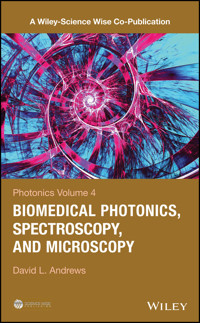
Discusses the basic physical principles underlying Biomedical Photonics, spectroscopy and microscopy
This volume discusses biomedical photonics, spectroscopy and microscopy, the basic physical principles underlying the technology and its applications. The topics discussed in this volume are: Biophotonics; Fluorescence and Phosphorescence; Medical Photonics; Microscopy; Nonlinear Optics; Ophthalmic Technology; Optical Tomography; Optofluidics; Photodynamic Therapy; Image Processing; Imaging Systems; Sensors; Single Molecule Detection; Futurology in Photonics.
- Comprehensive and accessible coverage of the whole of modern photonics
- Emphasizes processes and applications that specifically exploit photon attributes of light
- Deals with the rapidly advancing area of modern optics
- Chapters are written by top scientists in their field
Written for the graduate level student in physical sciences; Industrial and academic researchers in photonics, graduate students in the area; College lecturers, educators, policymakers, consultants, Scientific and technical libraries, government laboratories, NIH.
Sie lesen das E-Book in den Legimi-Apps auf:
Seitenzahl: 1202
Veröffentlichungsjahr: 2015
Ähnliche
















PHOTONICS
Scientific Foundations, Technology and Applications
Biomedical Photonics, Spectroscopy, and Microscopy Volume IV
Edited by
David L. Andrews
School of Chemical Sciences University of East Anglia Norwich, UK
Copyright © 2015 by John Wiley & Sons, Inc. All rights reserved.
Published by John Wiley & Sons, Inc., Hoboken, New Jersey. Published simultaneously in Canada.
No part of this publication may be reproduced, stored in a retrieval system, or transmitted in any form or by any means, electronic, mechanical, photocopying, recording, scanning, or otherwise, except as permitted under Section 107 or 108 of the 1976 United States Copyright Act, without either the prior written permission of the Publisher, or authorization through payment of the appropriate per-copy fee to the Copyright Clearance Center, Inc., 222 Rosewood Drive, Danvers, MA 01923, (978) 750-8400, fax (978) 750-4470, or on the web at www.copyright.com. Requests to the Publisher for permission should be addressed to the Permissions Department, John Wiley & Sons, Inc., 111 River Street, Hoboken, NJ 07030, (201) 748-6011, fax (201) 748-6008, or online at http://www.wiley.com/go/permissions.
Limit of Liability/Disclaimer of Warranty: While the publisher and author have used their best efforts in preparing this book, they make no representations or warranties with respect to the accuracy or completeness of the contents of this book and specifically disclaim any implied warranties of merchantability or fitness for a particular purpose. No warranty may be created or extended by sales representatives or written sales materials. The advice and strategies contained herein may not be suitable for your situation. You should consult with a professional where appropriate. Neither the publisher nor author shall be liable for any loss of profit or any other commercial damages, including but not limited to special, incidental, consequential, or other damages.
For general information on our other products and services or for technical support, please contact our Customer Care Department within the United States at (800) 762-2974, outside the United States at (317) 572-3993 or fax (317) 572-4002.
Wiley also publishes its books in a variety of electronic formats. Some content that appears in print may not be available in electronic formats. For more information about Wiley products, visit our web site at www.wiley.com.
Library of Congress Cataloging-in-Publication Data applied for.
CONTENTS
List of Contributors
Preface
Chapter 1: Fluorescence
1.1 Introduction
1.2 Spectra
1.3 Quantum Yield
1.4 Lifetime
1.5 Quenching
1.6 Anisotropy
1.7 Microscopy
1.8 Conclusions
Acknowledgments
Notes
References
Chapter 2: Single-Molecule Detection and Spectroscopy
2.1 Introduction
2.2 Experimental Setups
2.3 Fluorescence Spectroscopy
2.4 Fluorescence Correlation Spectroscopy
2.5 Fluorescence Excitation Spectroscopy
2.6 Other Detection Methods
2.7 Conclusion
Acknowledgments
References
Chapter 3: Resonance Energy Transfer
3.1 Introduction
3.2 History of RET
3.3 The Photophysics of RET
3.4 Investigative Applications of RET in Molecular Biology
3.5 The Role of RET in Light-Harvesting Complexes
Acknowledgments
References
Chapter 4: Biophotonics of Photosynthesis
4.1 Introduction
4.2 Structure of Pigment–Protein Complexes and Structure–Function Relationships
4.3 Key Concepts in Physics of Pigment–Protein Complexes
4.4 Experimental Techniques
4.5 Examples
4.6 Conclusions
Acknowledgments
References
Chapter 5: Optical Sectioning Microscopy and Biological Imaging
5.1 Introduction and Background
5.2 Confocal Imaging
5.3 Nonlinear Microscopy
5.4 Practical Implementation of Nonlinear Microscopy
5.5 Recent Advances in Nonlinear Microscopy
5.6 Widefield Optical Sectioning by Specialized Illumination Methods
5.7 Summary
References
Chapter 6: Cell Handling, Sorting, and Viability
6.1 Handling Cells with Light
6.2 Optical Sorting
6.3 Cell Viability
References
Notes
Chapter 7: Tissue Polarimetry
7.1 Introduction
7.2 Polarized Light Fundamentals
7.3 Instrumentation
7.4 Forward Modeling and Testing in Phantoms
7.5 Applications
7.6 Conclusions and Outlook
References
Chapter 8: Optical Waveguide Biosensors
8.1 Introduction
8.2 Fundamentals of Label-Free Optical Waveguide Biosensing
8.3 Surface Biofunctionalization
8.4 Evaluation of Optical Biosensors
8.5 Integrated Optical Waveguide-Based Biosensors
8.6 Optical Fiber-Based Biosensors
8.7 Lab-On-A-Chip Integration
8.8 Summary
References
Chapter 9: Light Propagation in Highly Scattering Turbid Media: Concepts, Techniques, and Biomedical Applications
9.1 Introduction
9.2 Physics Behind Optical Imaging Through a Highly Scattering Turbid Medium
9.3 Study of Ballistic and Diffuse Light Components
9.4 Photon-Sorting Gates
9.5 Transition From Ballistic to Diffuse Imaging in Turbid Media
9.6 Conclusion
Acknowledgments
References
Chapter 10: Photodynamic Therapy
10.1 Historical Overview of PDT
10.2 Introduction to PDT
10.3 Photosensitizer Structure and Photophysical Properties
10.4 Light Dosimetry and Photodynamic Therapy Light Sources
10.5 Light-Based Strategies to Enhance PDT
10.6 PDT Targeting and Nanotechnology
10.7 PDT for Dermatology
10.8 PDT for Oncology
10.9 PDT for Infectious Disease
10.10 PDT in Ophthalmology
10.11 PDT and The Immune System
10.12 Conclusion
Acknowledgment
References
Chapter 11: Imaging and Probing Cells Beyond the Optical Diffraction Limit
11.1 The Quest for Achieving Optical Resolution Beyond ABBE'S Limit
11.2 Stimulated Emission Depletion Microscopy
11.3 Photoactivated Localization Microscopy and Stochastic Optical Reconstruction Microscopy
11.4 Structured Illumination Microscopy
11.5 Super-Resolution Optical Fluctuation Imaging and Other Approaches
11.6 Outlook
Acknowledgments
References
Chapter 12: Technology
12.1 Basic Ocular Anatomy and Physiology
12.2 Measurement Techniques
12.3 Anterior Segment Diagnostics, Refractive Measurements, and Treatment
12.4 Diagnostic Applications and Treatment of Posterior Segment
References
Index
EULA
List of Tables
Chapter 1
Table 1.1
Table 1.2
Table 1.3
Table 1.4
Chapter 6
Table 6.1
Table 6.2
Chapter 7
Table 7.1
Table 7.2
Table 7.3
Chapter 8
Table 8.1
Chapter 9
Table 9.1
Table 9.2
Table 9.3
Chapter 10
Table 10.1
Lesen Sie weiter in der vollständigen Ausgabe!
Lesen Sie weiter in der vollständigen Ausgabe!
Lesen Sie weiter in der vollständigen Ausgabe!
Lesen Sie weiter in der vollständigen Ausgabe!
Lesen Sie weiter in der vollständigen Ausgabe!
Lesen Sie weiter in der vollständigen Ausgabe!
Lesen Sie weiter in der vollständigen Ausgabe!
Lesen Sie weiter in der vollständigen Ausgabe!
Lesen Sie weiter in der vollständigen Ausgabe!
Lesen Sie weiter in der vollständigen Ausgabe!
Lesen Sie weiter in der vollständigen Ausgabe!
Lesen Sie weiter in der vollständigen Ausgabe!
Lesen Sie weiter in der vollständigen Ausgabe!
Lesen Sie weiter in der vollständigen Ausgabe!
Lesen Sie weiter in der vollständigen Ausgabe!
Lesen Sie weiter in der vollständigen Ausgabe!




