


64,99 €
Mehr erfahren.
- Herausgeber: John Wiley & Sons
- Kategorie: Fachliteratur
- Serie: Research Methods for the Social Sciences
- Sprache: Englisch
Teacher inquiry helps improve educational outcomes
Practitioner Teacher Inquiry and Research explores the concept and importance of the teacher practitioner, and prepares students in teacher education courses and programs to conduct research in the classroom. Author Carolyn Babione has extensive experience in undergraduate- and graduate-level teacher training and teacher inquiry coursework. In the book, Babione guides students through the background, theory, and strategy required to successfully conduct classroom research. The first part of the book tackles the "how-to" and "why" of teacher inquiry, while the second part provides students with real-life practitioner inquiry research projects across a range of school settings, content areas, and teaching strategies. The book's discussion includes topics such as:
- Underlying cultural and historical perspectives surrounding the teaching profession
- Hidden stereotypes that limit teacher beliefs about power and voice
- Current curriculum innovation and reflections on modern developments
Practitioner Teacher Inquiry and Research successfully guides and encourages budding teachers to fully understand the importance of their involvement in studying and researching their classroom settings, giving a better understanding of how their beliefs and teaching practices impact classroom learning.
Sie lesen das E-Book in den Legimi-Apps auf:
Seitenzahl: 595
Veröffentlichungsjahr: 2014
Ähnliche



















CONTENTS
Cover
Title Page
Copyright
List of Tables, Figures, and Exhibits
Dedication
Preface
Acknowledgments
The Author
The Contributors
Part 1: Perspectives, Strategies, and Methodologies
Chapter 1: Developing A Concept of Practitioner Teacher Inquiry
How to Define Research
Complexities for Developing Inquiry Identity
Summary
Discussion Questions
Chapter 2: School Change and Teacher Inquiry Identity
Postmodern Schooling
Crafting Inquiry Possibilities for Improving Schools
Summary
Discussion Questions
Chapter 3: Inquiry Communities for Learning and Change
Educators as Inquirers
Collaborative Youth Inquiry
Inquiry Action Studies
Summary
Discussion Questions
Chapter 4: Where We Begin Practitioner Teacher Inquiry
Finding a Focus
Seeking Expertise from Others
Summary
Discussion Questions
Chapter 5: Guidelines For Collecting Data
Ethical Issues, Choices, and Challenges
Data Collection
Summary
Discussion Questions
Chapter 6: Analyzing, Interpreting, and Managing Inquiry Study
Data Analysis and Interpretation
Managing the Study
Summary
Discussion Questions
Chapter 7: Sharing And Changing School Culture
Communicating New Knowledge and Understandings
Collective Thinking and Decision Making
Summary
Discussion Questions
Part 2: Teacher Inquiry into Practice
Chapter 8: Blogging In The LA Classroom
Context
School and Community Description
Problem Statement
Literature Review
Design
Data Analysis
Conclusion
Discussion Questions
Chapter 9: Struggles and Successes of Problem-Based Learning
Problem Statement
Theoretical Framework
Study Overview
Effective Strategies for Project-Based Learning Experiences
Conclusion
Discussion Questions
Chapter 10: Teaching Social Skills with Picture Books
Context
Problem Statement
Literature Review
Design
Data Analysis
Conclusion
Discussion Questions
Chapter 11: Increasing Readership of Online Student Publications
Context
Description of Study
Assessment and Analysis
Conclusion
Discussion Questions
Chapter 12: One-to-One iPad Initiative Review
Problem Statement
Literature Review
Research Design
Data Analysis
Conclusion
Discussion Questions
Chapter 13: The Vegas Effect
Obstacle Set 1
Obstacle Set 2
Research Aspirations
Obstacle Set 3
Conclusion
Discussion Questions
Chapter 14: Transferring Oral Phonemic Skills to Written Form
Problem Statement
Literature Review
Research Design
Data Analysis
Conclusion
Discussion Questions
Chapter 15: Connecting Socially Through a Morning Meeting Approach
Context
Conducting the Study
Findings and Results
Conclusion
Discussion Questions
Glossary
Index
Credits
End User License Agreement
List of Tables
Table 2.1
Table 4.1
Table 4.2
Table 6.1
Table 7.1
Table 7.2
Table 10.1
Table 10.2
Table 15.1
List of Illustrations
Figure 12.1
Figure 12.2
Figure 12.3
Figure 12.4
Figure 12.5
Figure 12.6
Figure 12.7
Figure 12.8
Figure 14.1
Guide
Cover
Table of Contents
Begin Reading
Part 1
Chapter 1
Pages
i
ii
vii
ix
x
xi
xii
xiii
xiv
xv
xvi
xvii
xviii
xix
xx
xxi
xxii
1
2
3
4
5
6
7
8
9
10
11
12
13
14
15
16
17
18
19
20
21
22
23
24
25
26
27
28
29
30
31
32
33
34
35
36
37
38
39
40
41
42
43
44
45
46
47
48
49
50
51
52
53
54
55
56
57
58
59
60
61
62
63
64
65
66
67
68
69
70
71
72
73
74
75
76
77
78
79
80
81
82
83
84
85
86
87
88
89
90
91
92
93
94
95
96
97
98
99
100
101
102
103
104
105
106
107
108
109
110
111
112
113
114
115
116
117
118
119
120
121
122
123
124
125
126
127
128
129
130
131
132
133
134
135
136
137
138
139
140
141
142
143
144
145
146
147
148
149
150
151
152
153
154
155
156
157
158
159
160
161
162
163
164
165
166
167
168
169
170
171
172
173
174
175
176
177
178
179
180
181
182
183
184
185
186
187
188
189
190
191
192
193
194
195
196
197
198
199
200
201
202
203
204
205
206
207
208
209
210
211
212
213
214
215
216
217
218
219
220
221
222
223
224
225
226
227
228
229
230
231
232
233
234
235
236
237
238
239
240
241
242
243
244
245
246
247
248
249
250
251
252
253
254
255
256
257
258
259
260
261
262
263
264
265
266
267
268
269
270
271
272
273
274
275
276
277
278
279
280
281
282
283
284
285
286
287
288
289
290
291
292
293
294
295
296
297
298
299
300
301
302
303
304
305
306
307
308
309
310
311
312
313
314
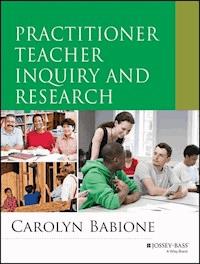
Practitioner Teacher Inquiry and Research
Carolyn Babione
ContributorsKathy Anderkin
Angela Durbin Page
Brandon La Mar
James E. Lang
Mark Lorence
Melissa Rhinehart
Resjohna Tomblin
Kayce Ware
Cover design by Wiley
Cover Images: Top Inset Image: © Thinkstock.com/Monkey Business; Lower Inset
Image: © Thinkstock.com/Brand X Pictures; Main Image: © Thinkstock.com/Roy Mehta
Copyright © 2015 by John Wiley & Sons, Inc. All rights reserved.
Published by Jossey-Bass
A Wiley Brand
One Montgomery Street, Suite 1200, San Francisco, CA 94104-4594—www.josseybass.com.
No part of this publication may be reproduced, stored in a retrieval system, or transmitted in any form or by any means, electronic, mechanical, photocopying, recording, scanning, or otherwise, except as permitted under Section 107 or 108 of the 1976 United States Copyright Act, without either the prior written permission of the publisher, or authorization through payment of the appropriate per-copy fee to the Copyright Clearance Center, Inc., 222 Rosewood Drive, Danvers, MA 01923, 978-750-8400, fax 978-646-8600, or on the Web at www.copyright.com. Requests to the publisher for permission should be addressed to the Permissions Department, John Wiley & Sons, Inc., 111 River Street, Hoboken, NJ 07030, 201-748-6011, fax 201-748-6008, or online at www.wiley.com/go/permissions.
Limit of Liability/Disclaimer of Warranty: While the publisher and author have used their best efforts in preparing this book, they make no representations or warranties with respect to the accuracy or completeness of the contents of this book and specifically disclaim any implied warranties of merchantability or fitness for a particular purpose. No warranty may be created or extended by sales representatives or written sales materials. The advice and strategies contained herein may not be suitable for your situation. You should consult with a professional where appropriate. Neither the publisher nor author shall be liable for any loss of profit or any other commercial damages, including but not limited to special, incidental, consequential, or other damages. Readers should be aware that Internet Web sites offered as citations and/or sources for further information may have changed or disappeared between the time this was written and when it is read.
Jossey-Bass books and products are available through most bookstores. To contact Jossey-Bass directly call our Customer Care Department within the U.S. at 800-956-7739, outside the U.S. at 317-572-3986, or fax 317-572-4002.
Wiley publishes in a variety of print and electronic formats and by print-on-demand. Some material included with standard print versions of this book may not be included in e-books or in print-on-demand. If this book refers to media such as a CD or DVD that is not included in the version you purchased, you may download this material at http://booksupport.wiley.com. For more information about Wiley products, visit www.wiley.com.
Library of Congress Cataloging-in-Publication Data is on file and available from the Library of Congress
Babione, Carolyn.
Practitioner teacher inquiry and research / Carolyn Babione; contributors, Kathy Anderkin, Angela Durbin Page, Brandon La Mar, James E. Lang, Mark Lorence, Melissa Rhinehart, Resjohna Tomblin, Kayce Ware - First edition.
pages cm. - (Research methods for the social sciences)
Includes bibliographical references and index.
ISBN 978-1-118-58873-4 (paperback) - ISBN 978-1-118-60379-6 (pdf) -
ISBN 978-1-118-60353-6 (epub)
1. Teachers–Training of. 2. Inquiry-based learning. 3. Education research. 4. Research–Methodology–Study and teaching. I. Title.
LB1707.B334 2015
370.71′ 1–dc23
2014026474
List of Tables, Figures, and Exhibits
Tables
2.1 Teaching Strategies and Expected Student Response
4.1 Journaling Payoffs
4.2 Philosophical Orientations
6.1 Researcher Positioning Biases
7.1 Working Conditions for Academics and Teachers as Inquirers
7.2 Writing Grant Applications
10.1 Book Categories
10.2 Results Table
15.1 Schedule
Figures
12.1 Use of iPad for Academics
12.2 Effect of iPad Use on Mathematics Progress
12.3 Effect of iPad Use on Mathematics Understanding: Parent View
12.4 Effect of iPad Use on Motivation to Learn Mathematics
12.5 Effect of iPad Use on Participation in Mathematics Class
12.6 Effect of iPad Use on Mathematics Understanding: Student View
12.7 Effect of iPad Use on Mathematics Grades
12.8 Effect of iPad Use on Overall Academic Performance
14.1 Hearing and Recording Sounds
Exhibits
10.1 Pretest/Posttest
15.1 Preassessment Survey
15.2 Postassessment Survey
Dedication
We dedicate this text to past, current, and future classroom teachers, for their continuous devotion to achieve the highest quality of education for youth in today's changing world.
Preface
Some of the most important issues around classroom teaching have to do with fundamental disagreements about what should be taught, how students should be educated, and how learning should be evaluated. The knowledge base for teaching has been heavily influenced by academic outsiders to the school setting, whose findings are often generalized beyond the context of the research site. Classroom teachers are usually limited to the role of research subject rather than accepted as partners or designers of these studies. Consequently, the voices of teachers are absent from educational literature, and critical thinking and inquiry have not been valued as dispositions in teacher identity. This invisibility of teacher-generated knowledge persists today as the expertise of practicing teachers continues to be bypassed.
Although classroom teachers understand that effective instruction means continuous seeking deeper understandings about learning to inform classroom practice, subtle messages negate the validity of teachers as inquirers and thinkers in their classroom settings. To understand teacher identity and inquiry, viewed within a patriarchy analysis and understood historically as a system of social structures and domination, one must first understand how the gendered history of classroom teachers as caregivers continues today to silence their analytical and critical voices.
The context of contemporary schools is rapidly changing in our postmodern society. School settings today are messy, multifaceted, and unpredictable real-world environments. The complexity of teaching includes social and cultural factors, both inside and outside the school setting. Teachers are unique “insiders” positioned to redefine themselves as professionals to bring a new understanding to this rapidly changing social milieu.
Effective teachers must be reflective, engaged in the school context, and active in school initiatives. Active experimentation develops new curriculum and strategies to meet these changing needs. The need for teachers to have a clearer understanding of how beliefs and teaching practices impact classroom learning has never been greater.
Proponents of practitioner teacher inquiry support postmodern theories that teachers must be adaptable and flexible, able to accommodate uncertainty and change. As teachers strive to meet the ever-changing needs of youth, empirical research with its treatment and control groups and statistical analysis offers less credibility and legitimacy to specific contexts in which teachers work.
Practitioner teacher inquiry is grounded in the realities of educational practice as teachers investigate their own questions and facilitate classroom change based on the knowledge discovered. Teachers as researchers develop into knowledge-generators and, as such, gain access to more control over the knowledge base surrounding the teaching profession. This shift has the potential to change the nature of critical analysis in areas relating to teaching such as self, academic curriculums, impact on student learning, and the larger society.
Schooling is regarded as a major mechanism to socialize youth for citizenship and must therefore be thought of as a political activity. Creating an ethical stance produces complexities and role ambiguity for classroom teachers. Effective teachers develop habits of inquiry, either individually or collaboratively, seeking to understand themselves and others. Inquiry research that includes student participation and action studies challenges top-down policy and can be used as a powerful mechanism for transforming school culture and empowering teachers and pupils. Visions for better schools inform teacher decisions and shape the issues they explore.
Designed to be more qualitative, open-ended, and reflective, practitioner teacher inquiry is also collaborative, engaging with youth, other teachers, and community. Practitioner teacher inquiry encourages teachers to disconnect from norms of professional isolation and reconnect and capture accounts and rich descriptive perspectives of others. Teachers study and develop empathetic understanding of others, such as students and parents, to engage community in new curriculum designed for a postmodern world. Community-based research offers the potential to actively examine broader social change and improvement, where values, meanings, and practice can be studied and transformed. Practitioner teacher inquiry offers a new paradigm in which schools grow into cultures of teachers, students, and communities, learning collectively about themselves in an ever-changing society.
Practitioner teacher inquiry begins with imaginings and envisioning the possibility of “otherwise.” Teachers as inquirers adapt and modify designs and methodologies to effectively study not as outsiders but as insiders in schools. Teacher inquiry is not an easy endeavor. These insider studies require a willingness to act with personal integrity, openness, and honesty within a subjective and practical wisdom stance.
Classroom teachers recognize issues as complex, uncertain, unique, and conflicting as they empower themselves to frame and name their stories and experiences. Teachers must collaborate and collectively think critically about how to design, conduct, and analyze insider studies in school settings. Many classroom teachers will require training in group problem solving, teamwork, and leadership. As more practitioner teacher inquiry studies are conducted and shared with larger audiences, new information about how teachers go about these studies will be available to others in the field.
The final question that must be addressed is whether teaching is to become a full profession or merely a technocratic career where the knowledge base is developed by those outside the school setting. Should teachers be prepared as intellectuals and inquiring professionals, capable of exploring issues impacting educational settings, or is the concept of practitioner teacher inquiry merely a passing fad that has no authentic value or possibilities for sustainability? Until formal inquiry becomes a disposition in which all teachers experiment, explore, and design studies inside schools, we will not know the true value or benefit inquiry study can have on classroom teachers and our youth in contemporary society.
Organization of the Book
Practitioner Teacher Inquiry and Research addresses three concepts: an analysis of historical and gendered discourse that has impacted teachers as inquirers and researchers, guidelines and strategies for conducting practitioner inquiry studies as insiders, and examples of previously unpublished teacher inquiry stories. The text provides a constructivist application to insiders' conducting studies in schools, supported by theories from fields such as anthropology, sociology, and organizational psychology.
The text consists of two sections. Part 1 combines theoretical and practical understandings regarding practitioner teacher inquiry and prepares the reader with background knowledge about the traditional role of classroom teaching that has emphasized caring dispositions at the expense of critical thinking and inquiry dispositions. Part 1 describes traditional empirical research and provides guidelines and strategies for conducting practitioner teacher research, adapted primarily from qualitative designs.
The chapters in Part 2 are written by eight contemporary classroom teachers who reflect on inquiry projects conducted among various developmental levels, content areas, and school contexts. These teachers have approached this writing from the context of their school settings. Through the chapter readings of Part 2, readers apply concepts and themes from Part 1 for critical thinking and discussion.
The text is intended for teachers or teacher candidates preparing to explore and analyze some aspect of schooling, as insiders, and is applicable to both initial and advanced teacher preparation as well as professional development initiatives in school settings. State and national educational standards increasingly focus on teacher training models that examine effectiveness of teaching on student learning. The concept of practitioner teacher inquiry research aligns philosophically to university field and clinical practice involving reflection and self-analysis of effectiveness and is increasingly used in teacher preparation programs at both the initial and advanced levels. Conducted in school settings, teacher inquiry uses methodologies to explore and think critically, reflect on one's practice, and strengthen teaching and learning. Practitioner Teacher Inquiry and Research is designed for use with face-to-face instruction as well as with hybrid and online teaching formats and includes higher order questions at the end of each chapter as well as websites with additional information.
Part 1—Perspectives, Strategies, and Methodologies
A major challenge when facilitating inquiry studies involves changing the mindset of teachers about conducting formal inquiry studies in classroom settings, mindsets that are often the result of stereotypes and long-standing beliefs. Practitioner Teacher Inquiry and Research addresses two themes related to this challenge in Part 1.
The first theme of Part 1 is the exploration of underlying sociocultural and historical perspectives surrounding teaching that have contributed to lingering stereotypes and beliefs that negate inquiry and critical thinking as part of teacher identity, undermining and silencing teacher power and voice. Part 1 emphasizes how historical silencing has allowed teaching to stall into a semiprofession, with educational reforms and research originating from the work of professionals outside the classroom. The reader is asked to reflect on everyday tensions between control and agency, and ambivalence and contradictions.
The second theme of Part 1 is the concept of practitioner teacher inquiry. These chapters address how retooling teacher identity is necessary for school change and suggest strategies for crafting partnerships through inquiry, guidelines for designs and methodologies, procedures to consider for data analysis and management, and emphasize the importance of sharing and reusing knowledge.
Practitioner Teacher Inquiry and Research emphasizes both lower and higher level thinking skills. Outcomes that stimulate lower level thinking are an important part of understanding the practitioner teacher inquiry process, yet these skills are useless unless they build toward the development of higher order thinking. Through following the outcomes and thinking about discussion questions at the end of each chapter, readers are given opportunities to organize and select facts and ideas, interpret, compare, order, see problems and challenges from different viewpoints, predict, and make choices based on new information learned.
Chapter 1, Developing a Concept of Practitioner Teacher Inquiry, argues that the changing nature of schooling necessitates a change in teacher identity to include the concept of formal inquiry. The chapter urges readers to look closely at how practitioner teacher inquiry is influenced by teacher identity and by long-standing beliefs, including stereotypes. Teachers are asked to analyze the history of teaching as a female occupation, which has stalled the movement of professionalism, silencing the voices of many practitioner teachers. As teachers analyze personal beliefs and values, including stereotypes of teacher identity that they themselves have accepted, teacher identity moves closer to dispositions involving professional inquiry needed to educate youth in our rapidly changing world.
Critical Thinking and Engagement
Examining the beliefs and stereotypes surrounding the feminization of teaching
Analyzing how teacher identity as caring has impacted the inquiry stance
Evaluating how teacher identity must change as society changes
Distinguishing the differences between interpretive science and positivism
Chapter 2, School Change and Teacher Inquiry Identity, features the changing nature of schooling today along with its complexities involving social and economic changes on a global scale. Schooling today involves social and political complexity that requires teachers to anticipate new roles, including adapting teaching strategies to increase access of knowledge to an increasing number of diverse learners. The identity of teachers as researchers in the classroom is intertwined with concepts of emotional caring, moral endeavors, and empowerment over one's work. Practitioner teacher inquiry has the potential to identify educational problems in complex, uncertain, distinctive, and conflicting situations. Teachers who engage in sociocultural inquiry studies of contemporary society, curriculum, and self do so in efforts to provide more effective understandings of the role of schooling for today's youth, as young people grapple with their own identities within these changing environments. These understandings also strengthen understandings of teachers regarding their moral roles in sustaining democratic societies through educational opportunities for all groups.
Critical Thinking and Engagement
Understanding new insights into social, political, and moral complexities of school change
Describing critical tensions between individual freedom and collective citizenship
Recognizing how inquiry can be used for teachers as makers of knowledge
Evaluating marketization as it impacts contemporary schooling
Chapter 3, Inquiry Communities for Learning and Change, focuses on constructing one's professional identity by crafting inquiry study partnerships and collaborative initiatives. Collaboration with youth, parents, and community can be used to examine broader social change related to school and community improvement. Constructivist in design, teacher inquiry with others brings schools and communities together to tackle contemporary educational issues.
Critical Thinking and Engagement
Explaining postmodern rationale for teacher inquiry that engages youth and community in study
Demonstrating the importance of inquiry in changing school cultures involving isolation
Distinguishing between various types of inquiry study to engage others
Identifying teacher skills needed to engage youth and community
Chapter 4, Where We Begin Practitioner Teacher Inquiry, underscores how teachers begin their inquiry journey with a focus and with questions to study. A broad focus is narrowed to a more specific question, along with understandings from others regarding the topic. Although various strategies are proposed when one begins to build a study, much of the teacher inquiry process remains open-ended and evolving as practitioners identify issues in the classroom and confront each in a unique and holistic manner. The teacher prepares a plan to begin an inquiry study and seeks out the work of others for support and understanding.
Critical Thinking and Engagement
Comparing and contrasting educational philosophies that impact teaching and learning
Distinguishing between types of reflection
Understanding how theories are developed and used
Analyzing good habits for beginning practitioner teacher inquiry
Chapter 5, Guidelines for Collecting Data, discusses a variety of issues regarding the collection of data. Ethical principles, initially designed for traditional academic researchers, create complexities and ambiguity that challenge insider studies. Data collection and analysis, drawing heavily from qualitative methodologies, are described, including multiple and flexible data collections and technology applications. As a flexible tool for both the novice and experienced teacher, practitioner teacher inquiry can assist teachers in examining and studying school settings in organized, unique, and holistic ways.
Critical Thinking and Engagement
Explaining the ethical principles that researchers consider when conducting studies
Examining role conflict relating to due diligence issues that teachers experience when conducting practitioner teacher inquiry studies
Describing multiple data sources that can be used when studying as insiders in schools
Creating mixed methods of data collection
Chapter 6, Analyzing, Interpreting, and Managing Inquiry Study, highlights the task of making sense of practitioner teacher inquiry data analyses, requiring creative problem solving and critical thinking. Analyzing and interpreting involve decisions and judgments for managing the quantity and quality of data collected. Content analysis, coding, emic accounts, and triangulation are discussed.
Critical Thinking and Engagement
Describing higher level thinking skills required for analyzing and interpreting data
Explaining the purposes of content analysis and coding
Labeling types of triangulations used in inquiry study
Understanding how emic accounts are managed
Analyzing management of documents
Chapter 7, Sharing and Changing School Culture, underscores mechanisms for teachers to share and reuse knowledge both locally and with wider audiences. Contemporary teachers are urged to add their voices to the knowledge base of P–12 teaching and instruction through practitioner inquiry to regain understandings of changes needed in teaching and instruction. The chapter compares and contrasts academic research with inquiry study in establishing rigor and emphasizes how thinking skills and emotions impact accuracy and dependability of findings.
Critical Thinking and Engagement
Evaluating venues for sharing and reusing knowledge
Understanding how thinking skills and emotions impact accuracy and dependability of findings
Identifying challenges of teacher collaborative groups
Comparing and contrasting rigor in traditional academic research and practitioner teacher inquiry
Part 2—Teacher Inquiry into Practice
Academic studies are often too removed from the classroom to be helpful to practitioner teachers when they conduct insider studies themselves. The designs, methodologies, and accounts are often written by outsiders, and the insider voices of teachers are often negated or silenced.
Part 2 consists of eight chapters contributed by P–12 teachers who share their inquiry studies. Firsthand teacher accounts offer readers new insights into insider studies conducted in contemporary classrooms. Each teacher has approached the inquiry project in a way that fits within the context of a specific school culture. These projects examine a broad range of inquiry study, including various educational technologies, traditional teaching strategies, long-term and short-term designs, and various data collection methodologies, analyses, and documentations.
Teacher narratives in Part 2 begin with imaginings and envisioning the possibility of the “otherwise.” They describe issues such as caring and emotional labor, power and isolation, collaboration and teacher leadership. The writing styles and formats of their stories vary as do the data collection methodologies and analyses. Each classroom teacher offers insight into the inquiry process of practitioner inquiry.
Through the chapters in Part 2, readers apply and examine concepts and themes from Part 1 readings. Questions at the end of each contributing chapter can be used as jumping-off points for discussion and critical analysis regarding how these classroom teachers each uniquely approach formal inquiry study.
Kathy Anderkin (Chapter 8) delivers a highly reflective narrative account of a blogging project with her advanced middle school language arts class. She engages in reflection-in-action as well as reflection after action.
Angela Durbin Page (Chapter 9) uses a narrative account to describe a long-term service learning project. She shares her teaching philosophy for youth and community involvement and offers suggestions to other teachers interested in community-study, based on her problem-based learning projects with high school youth.
Brandon La Mar (Chapter 10) recounts an inquiry study involving the teaching of social skills to middle school students using picture books. He uses a mixed method of data collection and reporting of findings, and demonstrates the importance of the inquiry stance in changing school cultures of isolation.
James E. Lang (Chapter 11) describes a project directed at increasing readership of an online student newspaper. He uses technologies to collect and analyze data to enhance student involvement in a journalism program.
Mark Lorence (Chapter 12) studies a Christian high school mathematics department's use of iPads. Mark uses discussions and surveys to analyze perceptions of students, teachers, and parents regarding effectiveness of using technology for mathematics instruction.
Melissa Rhinehart (Chapter 13) analyzes how teacher beliefs about formal inquiry can be put to the test through both professional and personal obstacles. She constructs a personal account that narrates such challenges she has personally experienced.
Resjohna Tomblin (Chapter 14) examines urban literacy in her kindergarten classroom. She defines her work within bureaucratic requirements and describes critical-friend involvement.
Kayce Ware (Chapter 15) shares her inquiry as an experienced elementary teacher of high-ability upper elementary students. Kayce discusses insights and challenges she confronted with data collection and analysis when conducting an inquiry study in a new teaching assignment.
As a recently retired professor of graduate and undergraduate teacher education, I have extensive experience facilitating teacher inquiry learning and classroom applications with teacher candidates from both public and private P–12 school settings. It is difficult to persuade teachers that they should study their own classrooms when the textbooks we use do not include examples from insider studies to guide teachers through the inquiry process. Teachers who formally study their schools and classrooms need to hear the voices of classroom teachers as they endeavor to frame important questions about their own work, as they organize and conduct studies within context-specific bureaucratic and administrative constraints. There are many subtle and not so subtle challenges and ambiguities classroom teachers encounter along this journey as they study as insiders in school settings. Part 2 adds to the current knowledge and practice about teacher inquiry through authentic practitioner voices that can be studied by other classroom teachers who are beginning the inquiry process.
An instructor's supplement is available at www.wiley.com/go/babione. Comments about this book are invited and can be sent to [email protected].
Acknowledgments
The writing of this book has been a privilege. With deep gratitude I wish to thank Andy Pasternack for grasping my early ideas and visions for this book and to Seth Schwartz for his patience and expertise through the writing and editing process for Jossey-Bass. Justin Frahm and Mary Calvez were crucial to the copyediting and they must also be thanked.
I must also thank my husband, Bernie Babione, for his tireless support of my educational endeavors, including the writing of this text. None of my accomplishments would be possible without the validation for the importance of my work from my family and friends.
I would also like to thank the many dedicated and committed classroom teachers I have worked with over the years who have inspired and illuminated my critical and creative thinking. I am especially grateful to Earl Dean, my high school history and government teacher, and Susan Ash, my cooperating teacher for student teaching, as they were both early influences in my cognitive and emotional development to be the kind of classroom teacher I aspired to become. I would also like to acknowledge other classroom teachers who have influenced and helped to form my thinking about the concepts in this book: Ron Atkins, Millie Harrison, Sam Chattin, Kathy Anderkin, Susan Stewart, Kate Fleace, Darla Mallein, Teresa Barrett, and Sue Shellhammer.
I would like to thank proposal reviewers Rui Kang, Colette Rabin, Peter Taylor, Pamela Jewett, Heather Lattimer, Linda H. Pickett, and Stacia Stribling, who provided valuable feedback on the original book proposal. J. Randy McGinnis and Colette Rabin provided thoughtful and constructive comments on the complete draft manuscript.
Finally, I must thank the gracious teachers who contributed chapters to Part 2 of this text. Although these classroom teachers have various levels of experience with the teacher inquiry process, they were each willing to make these experiences public for the purposes of assisting other classroom teachers with the inquiry process.
The Author
Carolyn Babione is a professor emerita of education at Indiana University Southeast, a regional campus of Indiana University. She holds a PhD from the University of New Mexico in educational thought and sociocultural studies with advanced coursework in areas of socioeconomic status, gender, reading literacy, and gifted education. Prior to completing her doctorate, Carolyn was a classroom teacher in Ohio. She taught preschool Head Start, parochial middle school, and K–12 gifted education and second grade in public school settings.
While coordinating the Graduate Studies Program at Indiana University Southeast, she piloted teacher inquiry designs with area teachers and initiated the capstone teacher inquiry program requirement for graduate teacher education. As an instructor for the capstone inquiry studies course, Dr. Babione developed discussion and teaching strategies around the concept of feminization and resegregation of teaching and its relationship to the lack of published inquiry studies by teachers. Dr. Babione has reviewed several hundred teacher inquiry projects for the MS in Education program, conducted teaching grants using teacher inquiry concepts, and published in this area. Prior to her retirement, she also integrated teacher inquiry projects into undergraduate teacher education coursework.
Lesen Sie weiter in der vollständigen Ausgabe!
Lesen Sie weiter in der vollständigen Ausgabe!
Lesen Sie weiter in der vollständigen Ausgabe!
Lesen Sie weiter in der vollständigen Ausgabe!
Lesen Sie weiter in der vollständigen Ausgabe!
Lesen Sie weiter in der vollständigen Ausgabe!
Lesen Sie weiter in der vollständigen Ausgabe!
Lesen Sie weiter in der vollständigen Ausgabe!
Lesen Sie weiter in der vollständigen Ausgabe!
Lesen Sie weiter in der vollständigen Ausgabe!
Lesen Sie weiter in der vollständigen Ausgabe!
Lesen Sie weiter in der vollständigen Ausgabe!
Lesen Sie weiter in der vollständigen Ausgabe!
Lesen Sie weiter in der vollständigen Ausgabe!
Lesen Sie weiter in der vollständigen Ausgabe!
Lesen Sie weiter in der vollständigen Ausgabe!
Lesen Sie weiter in der vollständigen Ausgabe!
Lesen Sie weiter in der vollständigen Ausgabe!
Lesen Sie weiter in der vollständigen Ausgabe!
Lesen Sie weiter in der vollständigen Ausgabe!
Lesen Sie weiter in der vollständigen Ausgabe!
Lesen Sie weiter in der vollständigen Ausgabe!




