


18,99 €
Mehr erfahren.
- Herausgeber: John Wiley & Sons
- Kategorie: Geisteswissenschaft
- Sprache: Englisch
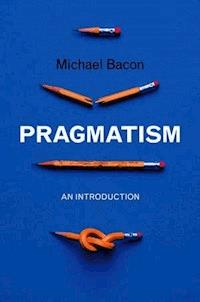
Pragmatism: An Introduction provides an account of the arguments of the central figures of the most important philosophical tradition in the American history of ideas, pragmatism. This wide-ranging and accessible study explores the work of the classical pragmatists Charles Sanders Peirce, William James and John Dewey, as well as more recent philosophers including Richard Rorty, Richard J. Bernstein, Cheryl Misak, and Robert B. Brandom.
Michael Bacon examines how pragmatists argue for the importance of connecting philosophy to practice. In so doing, they set themselves in opposition to many of the presumptions that have dominated philosophy since Descartes. The book demonstrates how pragmatists reject the Cartesian spectator theory of knowledge, in which the mind is viewed as seeking accurately to represent items in the world, and replace it with an understanding of truth and knowledge in terms of the roles they play within our social practices.
The book explores the diverse range of positions that have engendered marked and sometimes acrimonious disputes amongst pragmatists. Bacon identifies the themes underlying these differences, revealing a greater commonality than many commentators have recognized. The result is an illuminating narrative of a rich philosophical movement that will be of interest to students in philosophy, political theory, and the history of ideas.
Sie lesen das E-Book in den Legimi-Apps auf:
Seitenzahl: 451
Veröffentlichungsjahr: 2014
Ähnliche




















Table of Contents
Cover
Title page
Copyright page
Preface
Introduction
1 The Birth of Pragmatism: Charles Sanders Peirce and William James
Charles Sanders Peirce
William James
2 John Dewey on Philosophy and Democracy
3 Pragmatism and Analytic Philosophy: W. V. O. Quine, Wilfrid Sellars and Donald Davidson
Willard Van Orman Quine
Wilfrid Sellars
Donald Davidson
4 Neo-Pragmatism: Richard Rorty and Hilary Putnam
Richard Rorty
Hilary Putnam
5 Between Europe and America: Jürgen Habermas and Richard J. Bernstein
Jürgen Habermas
Richard J. Bernstein
6 The Return of Peirce: Susan Haack and Cheryl Misak
Susan Haack
Cheryl Misak
7 Rationalist Pragmatism and Pragmatic Naturalism: Robert B. Brandom and Huw Price
Robert B. Brandom
Huw Price
Conclusion
Works Cited
Index
Copyright © Michael Bacon 2012
The right of Michael Bacon to be identified as Author of this Work has been asserted in accordance with the UK Copyright, Designs and Patents Act 1988.
First published in 2012 by Polity Press
Polity Press
65 Bridge Street
Cambridge CB2 1UR, UK
Polity Press
350 Main Street
Malden, MA 02148, USA
All rights reserved. Except for the quotation of short passages for the purpose of criticism and review, no part of this publication may be reproduced, stored in a retrieval system, or transmitted, in any form or by any means, electronic, mechanical, photocopying, recording or otherwise, without the prior permission of the publisher.
ISBN-13: 978-0-7456-4664-0
ISBN-13: 978-0-7456-4665-7(pb)
ISBN-13: 978-0-7456-5649-6(Single-user ebook)
A catalogue record for this book is available from the British Library.
The publisher has used its best endeavours to ensure that the URLs for external websites referred to in this book are correct and active at the time of going to press. However, the publisher has no responsibility for the websites and can make no guarantee that a site will remain live or that the content is or will remain appropriate.
Every effort has been made to trace all copyright holders, but if any have been inadvertently overlooked the publisher will be pleased to include any necessary credits in any subsequent reprint or edition.
For further information on Polity, visit our website: www.politybooks.com
Preface
Pragmatism is North America’s most significant contribution to Western philosophy. This book aims to introduce readers to the ideas and arguments of some of its principal figures. These extend from its founder, Charles Sanders Peirce, writing towards the end of the nineteenth century, through to important contemporary pragmatists.
In this book, the centre of pragmatism’s contribution to philosophy is shown to lie in the resources it finds in and develops from our social practices. Pragmatism challenges the often implicit assumption that our practices are necessarily inadequate and require backup from some standard or principle which lies beyond them. It does so while avoiding the kind of relativism or conservatism which holds that those practices are beyond reform and improvement. For pragmatists, suggestions for improvements are themselves worked up from elements contained within those practices. In other words, pragmatism takes our lives, in all their richness as well as their deficiencies, seriously, and theorizes from that basis.
Pragmatism is, however, a deeply contested tradition. In a famous comment, Ralph Barton Perry wrote that pragmatism originated with William James’ misreading of Peirce (Perry, 1935: 410). This formulation simplifies matters somewhat; James recognized that his work extends Peirce’s ‘pragmatic maxim’ in ways of which Peirce himself would (and did) not approve. From its beginnings through to the present day, there is no programme around which all pragmatists unite. At the same time, pragmatism constitutes a recognizable tradition of thought, one in which specific themes recur. In her introduction to a recent collection of essays entitled New Pragmatists (2007a), Cheryl Misak identifies three commitments that pragmatists tend to share: (i) that standards of objectivity are historically situated but their contingency does nothing to detract from their objectivity; (ii) that knowledge has and requires no foundation; and (iii) the importance of connecting philosophical concepts to the practices of everyday life. Misak’s is a helpful summary of the commitments of many pragmatists. Yet, as we shall see, the ways in which they are interpreted and connected together differ significantly between pragmatists.
The approach taken here is to offer an account of the work of some of the philosophers who have either identified with pragmatism, or recognizably developed ideas found within the pragmatist tradition.1 This second point is important. In this book, the issue of whether a philosopher actually identifies him- or herself as a pragmatist is largely set aside.2 The reason for this connects to an interpretive issue. The dominant interpretation of pragmatism and its history has been aptly labelled by Robert Talisse as ‘the eclipse narrative’ (Talisse, 2007, ch. 7). According to this narrative, pragmatism receded from view sometime after the Second World War, only to be revived with the publication of Richard Rorty’s Philosophy and the Mirror of Nature in 1979. It will be seen that the eclipse narrative misinterprets the enduring nature of pragmatism. Pragmatist themes were in fact central to philosophy throughout the twentieth century, and remain so today.
This book examines the roots of pragmatism in the work of the classical pragmatists, considering how their ideas have been taken forward, in different ways, by more recent philosophers. In so doing, it will show that pragmatism is a living tradition, one which can properly lay claim to the attention of philosophy more generally. Owing to the nature of the large and ongoing pragmatist tradition, some major figures are not discussed. The aim is not to be exhaustive but rather to consider the writings of some of the thinkers who can be seen to have contributed to the pragmatist tradition in the hope of providing an introduction and orientation for further investigation.
I would like to express my gratitude to the Leverhulme Trust for an award which supported the project. In addition, my thanks go to Emma Hutchinson, my helpful and supportive editor at Polity. Thanks also to Leigh Mueller for carefully copy-editing the typescript. Two anonymous readers provided helpful comments for which I am very grateful. I am equally grateful to the following friends and colleagues who commented on drafts of chapters: Zara Bain, Andrew Bowie, Paul Dawson, Neil Gascoigne, Sara Wallace Goodman, Jim Hall, Eva-Marie Nag, Jonathan Seglow, Ramida Vijitphan, Mei-Chuan Wei and Nathan Widder. Additional thanks go to Jonathan Seglow and Nathan Widder and other colleagues who help to ensure that working at Royal Holloway is an especially happy and rewarding experience.
Notes
1 That is to say, the approach focuses upon thinkers rather than themes. For an excellent thematic introduction to pragmatism, see Talisse and Aikin (2008).
2 In this I follow Misak. In her introduction to New Pragmatists, Misak remarks of the inclusion of philosophers who have not themselves identified with pragmatism: ‘It is not of much concern in this volume whether these philosophers have in fact been influenced by the classical pragmatists or whether they see themselves as part of the pragmatist tradition. What matters is that the best of Peirce, James, and Dewey has resurfaced in deep, interesting, and fruitful ways’ (Misak, 2007a: 1–2).
Introduction
In the everyday sense of the term, ‘pragmatism’ is associated with a matter-of-fact approach to problem-solving. The related word ‘pragmatist’ is sometimes used as a compliment, describing the person who ‘gets results’. It is also employed pejoratively; in the case especially of politicians, the pragmatist does not stand on principle but will do whatever it takes to succeed. These connotations carry over, though often in misleading ways, into pragmatist philosophy.
The idea of pragmatism as a philosophy immediately raises a question. For if pragmatism is tied to practical success, how does it relate to philosophy, characterized as it is by the attempt to rise above everyday concerns? Pragmatists address philosophical questions, such as the nature of truth, how knowledge is possible, and the demands of moral and political life. But they do so by arguing that these questions should be addressed by drawing upon the resources offered by our practices, and with reference to the consequences they have for our lives.
The term ‘pragmatism’ was introduced into philosophy in a lecture given in August 1898 by William James. In his lecture, given at the University of California in Berkeley, James says that he ‘will seek to define with you merely what seems to be the most likely direction in which to start upon the trail of truth’ (James, 1977: 347). That direction is pragmatism, the invention of which he does not claim for himself but credits to his friend Charles Sanders Peirce. In his essay ‘How to Make Our Ideas Clear’ (1878), Peirce proposes that philosophy would profit by examining thought and ideas in terms of the difference they make to human behaviour. He writes there that ‘we come down to what is tangible and practical, as the root of every real distinction of thought, no matter how subtile it may be; and there is no distinction of meaning so fine as to consist in anything but a possible difference of practice’ (Peirce, 1992: 131).
In his lecture at Berkeley, James points out that pragmatism did not simply spring into existence in North America in the latter half of the nineteenth century; pragmatist ideas are to be found in the work of philosophers as diverse as Socrates, Aristotle, Locke and Hume. The term ‘pragmatism’ is, rather – in the subtitle of James’ book Pragmatism (1907) – ‘A New Name for Old Ways of Thinking’. The reason he thinks the invention of pragmatism should be attributed to Peirce is that he was the first to focus wholeheartedly on what pragmatism means and entails: ‘these forerunners of pragmatism used it in fragments: they were preluders only’ (James, 1977: 379). James claims that it is only with Peirce that pragmatist ideas came to be placed at the heart of philosophy.
The focus on the importance of taking seriously ‘what is tangible and practical’ unites pragmatists. However, what doing so means differs from pragmatist to pragmatist. Mindful of these differences, John Dewey, the third of those who have come to be referred to as the classical pragmatists, wrote in 1908 that ‘the pragmatic movement is still so loose and variable that I judge one has a right to fix his own meaning, provided he serves notice and adheres to it’ (Dewey, 1969–90, Middle Works – hereafter in text references, MW – 4: 128n1). In our own time, Richard Bernstein has suggested that ‘the history of pragmatism has always – from its “origins” right up to the present – been a conflict of narratives. Despite family resemblances among those who are labeled pragmatists, there have always been sharp – sometimes irreconcilable – differences within this tradition. There are (as a pragmatist might expect) a of conflicting narratives’ (Bernstein, 1995: 55 – unless otherwise stated, emphasis in quotations is as in the original). For this reason, pragmatism is best viewed not as a set of doctrines but rather as a tradition of thought. As we will see in this book, various themes reappear throughout its history, but do so in different ways and with different degrees of emphasis.
Lesen Sie weiter in der vollständigen Ausgabe!
Lesen Sie weiter in der vollständigen Ausgabe!
Lesen Sie weiter in der vollständigen Ausgabe!
Lesen Sie weiter in der vollständigen Ausgabe!
Lesen Sie weiter in der vollständigen Ausgabe!
Lesen Sie weiter in der vollständigen Ausgabe!
Lesen Sie weiter in der vollständigen Ausgabe!
Lesen Sie weiter in der vollständigen Ausgabe!
Lesen Sie weiter in der vollständigen Ausgabe!
Lesen Sie weiter in der vollständigen Ausgabe!




