


4,00 €
Mehr erfahren.
- Herausgeber: Stefano Orlando Puracchio
- Kategorie: Lebensstil
- Sprache: Englisch
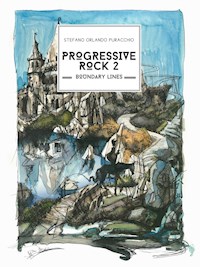
Progressive Rock 2. Boundary Lines: a work that from its title approaches prog-rock’s lesser-known and unclassifiable territories. The aim of this book, after the classics of the first volume, is to explore names, surroundings and subgenres less familiar to us.
Das E-Book können Sie in Legimi-Apps oder einer beliebigen App lesen, die das folgende Format unterstützen:
Veröffentlichungsjahr: 2015
Ähnliche

















Progressive Rock 2
Boundary lines
di Stefano Orlando Puracchio
Aprile 2015
ISBN 9788890927133
The cover image has been created by Bihon Győző specifically for this book.
Autopubblicato con Narcissus.me
www.narcissus.me
_________________________________________________
Versione digitale realizzata da Simplicissimus Book Farm srl
__________________________________________________
[…] The real objective is to wipe those sneers off the faces of many of our contemporaries, whose sceptical and cynical little smiles say: everything is worth nothing. (Lorenzo“Jovanotti”Cherubini)
1. Preface
Hooray!
It has been more than forty years and we are still here to talk about "Prog." "Prog", of all things! I personally had never heard of Progressive Rock at the beginning of the 70s, when my fellow adventurers and I, caught by an irresistible desire to play and express ourselves, sought out new musical languages and formed a band that we liked to call Metamorfosi.
"Prog", short for Progressive Rock, is a label that we were given many years later in an attempt to bring together into a single stream all the musical groups that were seeking new forms of expression at that time. In reality, the styles that derived from research and the miscellaneous formed by the most varied genres and that characterised the musicality of each band were very different from each other. In my opinion, this was so that they could not be grouped into a single current. The only point they had in common was research.
It is nice to talk about it now and observe that later generations have given so much attention to that period. This second book by Stefano Orlando Puracchio bears witness to this fact.
The layout is mainly based on interviews with musicians, leaving them the task of describing that historical period through their experiences, their work and their musical paths. This leaves the novice entering the world of 'Prog' wide freedom of interpretation without having to undergo a list of names, dates, judgements and prejudices typical of authors we find in this field of publication. The expert, however, will draw enjoyment and enrich his knowledge with the opinions of the protagonists in the following interviews containing the author's well-structured and stimulating questions.
I also find very pleasing the almost "fictionalised" style of the description of the meetings with the musicians, filled with details and the atmosphere of the places where these occurred, full of sensations and considerations that make for nice, smooth reading.
This new endeavour by Puracchio stands out for its simplicity, relaxedness and the comprehensiveness with which the topics are addressed, as well as the complete and detailed analysis of the history and of the episodes involving the characters and events of our beloved world of "Prog."
Enrico Olivieri
2. Introduction (and the required premises)
This book is a continuation of my first book: "Progressive Rock - a handbook", published last year in e-book format. This text will address issues and topics that I have not seen fit to include in the first book, so as to prevent the guide from becoming too difficult for the reader.
Why have I decided to broaden the discussion on Progressive Rock? So that it can be more complete. Although my first book stands well on its own, with these additions you can, in my opinion, reach a greater understanding. Not a 360-degree view but you will certainly have a better understanding.
My first book has received very good reviews since its publication over a year ago. Among the many impressions gathered, I want to point out a part of what Riccardo Storti wrote for Counterpoints - Notebook of the Research Centre for Italian Progressive (Contrappunti - Quaderno del Centro Studi per il Progressive Italiano) - in the winter issue of 2014/15:
Beyond any personal level that one may advance about some of the details, this new book on Prog has an undeniable merit in terms of setting. The humility of the author. He does not climb onto a podium and preach, he just wants to disclose and does so with common sense.
These words have been the source of greatest satisfaction to me. Storti has understood the deepth of motivation that led me to begin my personal adventure to spread Progressive Rock in the way I thought most fitting.
The spirit, in this second book, has remained unchanged: I wish to continue spreading information. Obviously, since I firmly believe that one should always try to improve (and to improve oneself), compared to the first volume, Boundary lines represents a step forward. I will not go back to some of the concepts that I will assume to have been assimilated. Instead, I will be more thorough on other matters that deserve to be examined in more detail, First among these is the definition of Progressive Rock.
Without wanting to bother semiologists and linguists, what is called, in technical jargon, process of significance is something that is in constant and continuous movement. What does significance mean? We can understand through this example.
We all know what a dog is. We could say, very quickly, that it is a four-legged animal that barks. When we see a dog, whether it be a Great Dane or a poodle, we distinguish it from a cat and a bird. The cat has four legs but meows while the bird has two legs, two wings and chirps. So, we are able to distinguish dogs, cats and birds and we are even able to establish that an animal like the Great Dane is part of the same category of a small dog like a Poodle. However, when we see a dog of a breed unknown to us, our brain takes a little time 'to catalogue the animal. Although we "think" we know what a dog is, every time we see a different dog - which does not fully fit into our cataloguing standards - we need to fix (even slightly) our concept of a dog. Here, even if in a "simple" context like that of dogs we need some time to distinguish certain dogs from other dogs and then, dogs from cats and dogs from birds, think how long it could take - and how exhausting it could be at times - to do this with more complicated things, such as machinery, philosophical themes or even music, which includes, incidentally, our Progressive Rock.
The process of "significance" of Progressive Rock, like many other things, it is not fast and has not been without discussion or strong criticism. This is why I believe it is right, after trying to give the reader a possible reading key for Prog, to provide some boundary lines in the same way. Points on the horizon to help the reader to better manage in this fantastic and imaginative world. Obviously, I ought to specify that this process should be seen as a game. A game of discovery to pass the time, time spent enriching one's own culture.
How is this book structured? The first two chapters are very conversational and pick up the theme of Hungarian Prog that I had mentioned in the appendices of the first book. In the next chapter, I will talk with an expert about the new Pink Floyd album entitled “The Endless River”. In the chapter with the same name as the subtitle of this book, I will address the analysis of a few groups that are very representative of the balance between being or not being Progressive. In the seventh chapter, I will provide a quick look on the experience of Neo (or New) British Progressive. A remarkable time leap will follow, arriving to two contemporary bands: Periferia del Mondo and Unreal City. We will then arrive at the final part with a review of the last disc of Metamorphosi: “Purgatorio”, which concludes a trilogy begun more than 40 years ago. Finally, an interview with Toni Fidanza (conductor of the Orchestra Contemporanea) on his collaboration with some members of Gentle Giant. Do not forget the appendix: a quick look at North American Prog (with an exclusive interview with Rich Williams of Kansas).
Many topics, many situations, many stories. In wishing you a good read, I would remind you that I will keep with the same style of the previous book: I will not be a painter, rather a bricklayer who attempts at painting. So if the picture will be pleasant - although not exceptional – I will have achieved a considerable result.
SOP
PS: Compared to the first book, I have lingered a lot on the interviews in this text. I believe that the protagonists of the Story are the ones who should always have priority, especially on historians, writers, journalists, warm, scribes... call us what you will. Between an explanation made by the same musician and mine, I always favoured the musician's.
PPS: It is highly recommended to listen to the songs and albums mentioned in the book and to read simultaneously.
3. Mini! Mini!
"Omega and Solaris," murmured Bihon Győző, a Hungarian painter, when I told him that, in my first book on Progressive Rock, I had spoken of two Hungarian bands. The artist looked at me exclaiming: "Mini! Mini! If you want to talk again of Hungarian Progressive Rock, this time, you cannot exclude Mini."
May 2014. I am in the town of Szentendre, Hungary, on the banks of the Danube. I'm chatting amiably with Bihon Győző about the possibility of having one of his illustrations for the cover of my new text on Progressive Rock. Bihon, an esteemed artist, is in the main square of Szentendre during the summer to sell his work. I had already had the opportunity of appreciating his work months ago, when I was trying to find a cover for the first book. I had seen one of his works exhibited which was very evocative: a Don Quixote represented in a dreamlike and highly imaginative atmosphere. At the time I thought, "I can't afford this now, I'll come back another time." Well, that piece was eventually sold. I went back again to Szentendre to talk to Bihon to commission him, this time, for an original piece.
I could not have chosen a better place to find an artist. Szentendre, a town about twenty kilometres from the Hungarian capital Budapest, is known for being a very prosperous and important art centre. The town is also known for being a favourite tourist attraction. At a stone's throw from Budapest, you can immerse yourself in a peaceful and quiet town, surrounded by old buildings and loads of history. Along the beautiful Danube (in reality more green than blue) you can eat typical dishes and sip good drinks, but there's obviously much more. Listen to the words of Eszenyi Judit, a tour guide:
When the name of Szentendre is mentioned, personal experiences and overwhelming emotions come to mind, combined with the surprise and fascination expressed by the thousands of tourists visiting the town, so it is difficult for me to provide an impartial description.
The romantic atmosphere of Szentendre is not only captured by the chirping crickets in summer and by people who walk hand in hand, but also by the narrow streets, stone-framed windows, the heavy wooden or wrought iron gates, small shops and the melodies of street musicians.
Rich in history, since the twentieth century the town has become a haven for young artists who wanted to make Szentendre famous. Real art colonies were created. Among the many artists: JenőBarcsay, Béla Czóbel (friend of Picasso) and Károly Ferenczy. The artists' works are shown in different museums, dedicated to each of them. The most important function of art galleries is to give support to the city's traditions.
Set in this context, the words of Bihon made me think. Mini ... obviously I already knew the band's work and not just what was written in PROG 40, a very comprehensive guide (I have added some small adjustments):
The first album of Mini [Vissza a városba], published in 1978, surprised the public for their approach to a particularly elaborate progressive jazz, with good initiatives on keyboards and especially the ingenious inclusion of the flute in all of the most delicate melodies. With their next album“Úton a Föld felé" there were no substantial novelties, while the live "Mini koncert”of 1980 allowed the band to show off all their potential in concert, which was full of improvisations and homages to gender fusion, all played with incredible energy. The same energy flows in "25év Rock" a live anthology published in 1993, confirming their great capacity to perform in public.
The passion that shone from Bihon's suggestion eventually convinced me: Alright, let's get a hold of Mini, which meant I had to contact the band leader, vocalist and flutist Török Ádám.
The quest was not particularly difficult at the beginning. I went onto Török's website and looked for the first concert date of this live musician. Here it is: the festival of the families of Göd. The festival of the fami ... what? Göd? Oh my God!
We will arrive in Göd in just a minute. Firstly, though, I would like to mention something I noticed while looking at Török's live dates. The leader of Mini has an intense concert schedule and when I say intense, I mean that he never seems to stop. Solos, duos, trios, with the old and with the new Mini... in short, in any place and in any way, Török Ádám performs throughout Hungary.
Göd is a town of about 20 thousand inhabitants located on the Danube. More or less it is almost at the same altitude as Szentendre, only it is located on the opposite bank, on the Pest side. In addition, from Göd you cannot see Szentendre (and vice-versa).This is because, on the Danube between Szentendre and Göd there is an island called Szentendrei-sziget, or the island of St. Andrew. Eszenyi Judit again, this time on Göd:
As opposed to the attractions of Szentendre, which are available to tourists in all seasons, Göd is a place linked to summer and bathing .
The town evolved in the proximity of the ruins of the military camp built during the rule of Constantine II, but today there are few historical sights to see. Today Göd is more popular for sport holidays, aquatic sport in particular.
Getting to Gödis not difficult. From the west station of Budapest (Nyugati pályaudvar) a train takes you directly into the town. After printing a map to figure out where I had to go, once I arrived at the station of Göd, I realised one small thing: three kilometres from the station to the venue. I thought, optimistically "what's the problem? I'll take a bus. " No buses on Sundays. “Ok a taxi?” No taxis at the station. My only means of locomotion: my two feet. Ok, let's start the six kilometres return trip!
I arrived on site, sweaty and tired, and after a pit stop to the bathroom, I found a nice place at a table under a big tree. I rested and waited for the concert to start. I was even able to get a well-deserved beer and lángos, which is a sort of fried dough topped with cheese and, if one so desires, garlic. Definitely not a healthy dish but as we know, all that is not healthy is, on the other hand, very good.
Barely the time to bite into the lángos and it starts pouring rain. As people found shelter under the big umbrellas that drink (or food) companies "give" to the bars, I stood there with my lángos in hand and I thought only one word: "Perfect!". Here I have trekked three kilometres to get caught in a downpour, here I was going to enjoy a nice beer and a meal that it starts to rain. I will probably miss the concert as well, and so forth. Fortunately, after a (long) while, the situation seemed to return - almost - to normal. The concert, well actually, the concerts can begin.
Yes, I said concerts. Before the "old" Mini, in fact, I saw the performance of Syrius, another very important group on the Hungarian rock scene. What I saw was not the historical formation of Syrius, but one could easily spot the presence of the great keyboardist Pataki László.
For those wishing to go deeper into the discussion about Syrius, I recommend listening to the album: "Az ördög álarcosbálja" also known as "Devil's masquerade." Published in 1972, it was later re-mastered onto CD in 1993. The sound is very Zappa-like (from his period of Hot Rats - The Grand Wazoo) with more or less obvious references to ELP (Emerson, Lake & Palmer).
Also, if you are still interested, I suggest you also watch a video found on YouTube that I consider a small masterpiece. It is called: "Magyar vakáció", by Szomjas György. The video's intent is to show Hungary in the 1970s between tradition and modernity. The nice thing is that tradition is accompanied by musicians like Halmos Béla and Sebő Ferenc (among the greatest exponents of the rediscovery of ancient Magyar melodies in the 20th century) while modernity is represented by Syrius. New and old that come together in a commendable way.
I had already had a chance to listen to Syrius live. They had opened for the Grandmothers of Invention - the group formed by the old components of Frank Zappa's Mothers of Invention - when they played in the A38 club in Budapest. Syrius, at the time, are bringing a repertoire indeed taken from Zappa's music. Being luxury musicians, the songs are presented to the public so that they would not regret the original versions in any way.
Feeling cold (but glad for the show), I listened to the performance of Syrius while waiting for Mini. And then came the group with Török Ádám. The first thing that caught the eye was the absence of a guitar player. The old Mini that were playing in Göd were made up of a keyboardist, a drummer, a bass player and Török, who sings and plays the flute. An interesting lineup. We know that Progressive has an (almost) fundamental characteristic: the predominance of keyboards which, often and deliberately stand out at the expense of the electric guitar. However, in this case, the guitar is actually absent. A point to look into, I thought.
The concert lasted about an hour, a period in which I could appreciate the technical preparation of all the musicians but, most of all, the theatrical abilities of Török. Physically-built like Bud Spencer, with a well-trained voice (melodic or hoarse, as needed), he is a virtuoso flute player and great puller between one song and another. A lion, a king having become leader not by blood but by decades of life "on the road". Stylistically speaking, Török definitely owes a debt to Ian Anderson but, unlike so many other flute players, the Hungarian musician took (and learnt) the style of Anderson and then reworked it; creating an entirely personal suit. In a sense, Török is exactly half way between Ian Anderson and Thijs van Leer of Focus.
"Délelőtt" e "Gőzhajó" are the songs that stood out the most from what was played. They were very engaging. In most cases, Török's songs have a very simple structure: they don't roam far from the standard in the key of Jazz. Playing in an AABA structure, Török disrupts and inserts several improvised parts (his or belonging to other members of the band). The base is Rock but, more often than not, you hear other influences: Jazz, in the case of his solos and the disruption of the set scheme and blues in the singing. Then there is a marked difference between the original versions of the studio songs (much more Prog, especially in the first record) and live versions. The latter, in some way, are "lighter", not having a lot of planning (or writing), so they tend to be more slender, engaging and valuable to the concert audience. Török later also confirmed his predilection not only for live performances in general but also for his albums recorded at concerts.
Apart from the good music, I was drawn to what was happening around me. First of all, I saw many young people and this made me happy. Then I saw young musicians and that made me very happy. Especially, when a young guitarist, at the end of the concert, went to convey his deepest respects to the musicians. Another thing that struck me was that I noticed two gentlemen, two friends, who had gone to see the concert. While the band was performing some songs these friends - peers of Török - exchanged glances, pointed at the stage and said things like, "do you remember this? Nice song". They were happy, happy to be listening to "their" music and to remember their youth. The highlight was when I saw a couple of twenty-somethings. I began to think, quite frankly, that the rain in my beer had a hallucinogenic effect. Then I remembered that, in some parts of the world and in some particular contexts, music still manages to be a healthy thing and not totally dedicated to the idea of sales.
After the concert I approached Török Ádám and introduced myself. Török turned out to be very kind. Thanks to the support of another musician, I managed to make myself understood and we exchanged contact information. We then set an appointment at a place Budapest for the interview. Here it is:
What is Progressive Rock for TörökÁdám?
As a young man I started with Blues. I didn't study music, I became a musician by chance. I found myself, in some way, entangled in music. Before becoming a musician, I was interested only in one part of Rock. The goal was to be like Ian Anderson, Chris Wood, Ráduly Mihály... let's say that it's because of them that I started to play the flute. I felt that I had to find an instrument, in addition to singing. So I chose the flute. At that time there was no talk yet of Progressive Rock. There were groups like Traffic, then Syrius. From these groups I formed and forged my world. In 1971, when the organist Papp Gyula joined the group, that was a turning point. With him, from then until now, we relive the atmosphere of those times. Those were great times: the songs came one after the other. I took my cues from Progressive Rock, then wrote in my own style. I always had Progressive in front of me: interesting texts, fables, the abstract. I was looking for some way to "tame" Progressive Rock and the effects of Jazz Rock, creating my own language. For me it was important that TörökÁdám's style be recognisable already after five notes, to understand that it was TörökÁdám who was playing. That personal magic must always be there.
We are used to seeing an electric guitar in rock bands. It is true that in Prog the keyboard is more important but why wasn't there a guitar player in Göd? Why was the guitar absent?
In music, I always look for an archaic and ethereal component. This is why I believe that the keyboard is essential. The guitar? I can replace it myself with the flute. You can hear the guitar in the recordings. However, it's important to say that I have always thought that a band should be very small. Three or four member at most. Do you know why? Because a tremendously important part is the personal contact, the synergy within the group. If that's missing, we're not talking about a band. Keeping that in mind, I could always keep everyone together. We played every day, we rehearsed every day and played many concerts. Every morning we got up, we were tired but we knew we had to leave for the next concert. Every member of the band was needed, it was very important to be united to find solutions together. That's how we formed our own style. Young people really like the soft sound of the flute and the frantic mishmash of my shouting. We could count on a huge number of fans.
Did any members of the band have a classical background?
Yes. Papp Gyula. He is a fantastic pianist. He left school and began to hang around with us. Everyone wanted him. They wanted to take him away from us, for moremoney than I could promise him.
It is fair to remember that the keyboards in Mini are not managed solely by Papp Gyula. Németh Károly has also been a faithful companion to Török in many concerts and records. He is a notable musician and in some parts, his style is comparable to that of Ray Manzarek, keyboardist of the Doors. For example, listen to the way that Németh tackles the solo in Gőzhajó. But back to the interview.
Let's talk about the music scene in those years. Did you hang around with other artists?Were you friends?
At the time there were two bands that really mattered: Syrius and Mini. We always went to the same places together, to the restaurant of the Royal Hotel, for example. We drank and we were with girls. Then we moved to the Erzsébet restaurant. We were almost friends. Even though of the original Syrius group today only two are still living, this relationship has endured.
It's amazing the message and the effect that music can have. I even saw two young people in their twenties at the Göd concert, a smiling couple, who were listening to the concert while locked in an embrace...
This is a wonderful thing. The effect of Prog and Jazz. A waiter, long ago, asked me insistently for a CD. Not for himself or even his father, but for his grandfather. He then listened to the CD and he too was enraptured by the music. Three generations who listen to our music together. It's a great thing. Many people in their twenties come to our shows.
Is this, perhaps, because the public is looking for a more sophisticated music? Are they more demanding? Today's selection may not be of a sufficiently high quality compared to what you play?
This is only part of the issue. Nowadays, there are youth groups that play Progressive Rock. They are talented, but they just don't have space. Perhaps Jazz is more socially“accredited”.There are many jazz musicians, while proggers are much less. So they come to hear us: the old, bald, progressive musicians.
Ah, Jazz and Prog. In the music of Mini, how much is written and how much is improvised?
Progressive is good if the lyrics and compositions are wonderfully created and if it can be improvised. This the progressiveness: to be open to everything, to always be able to receive everything that is new.
You've probably been asked this a lot but why the flute?
Because I was expelled from school as a result of football and disciplinary problems. I didn [...]




